


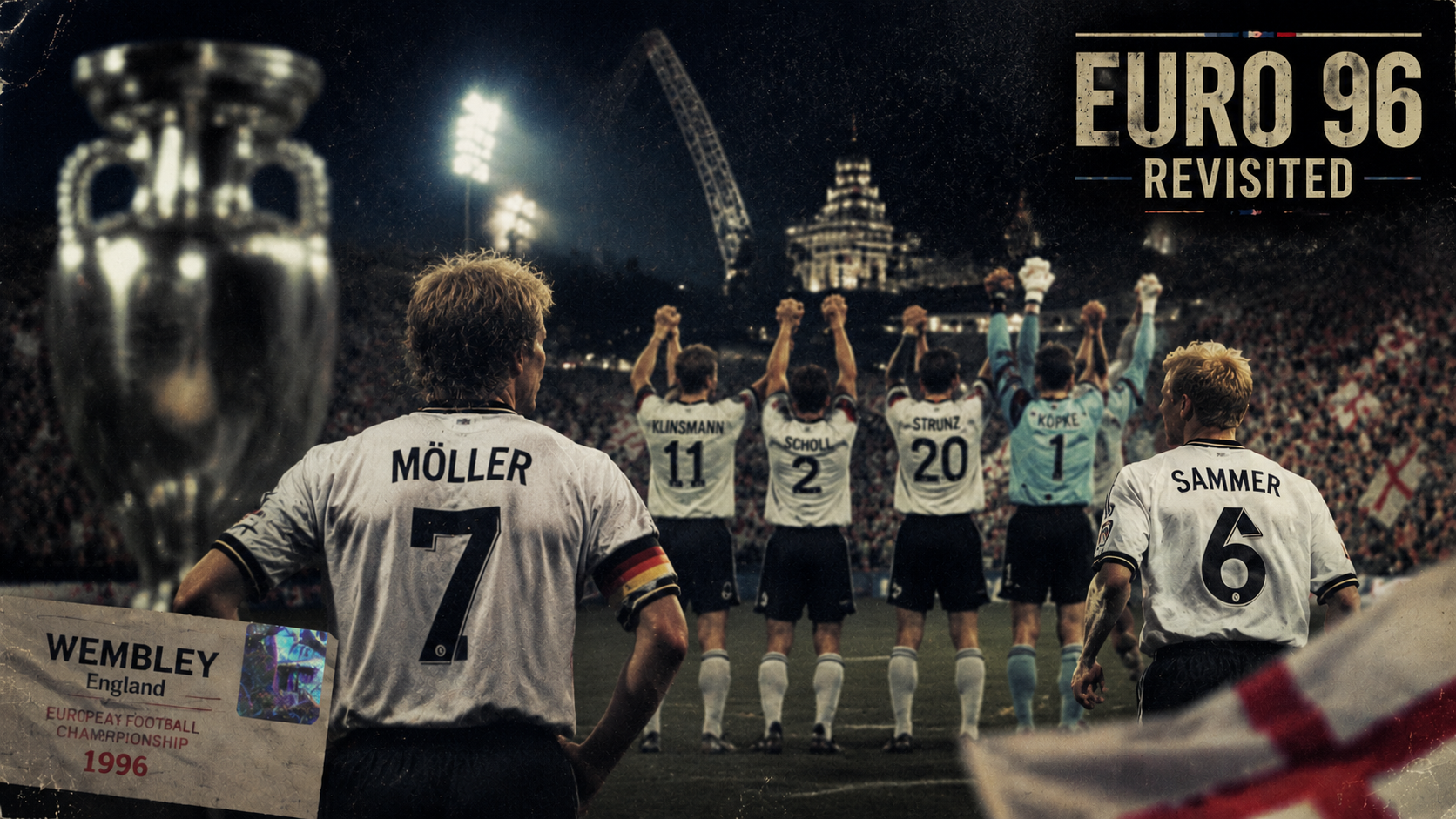
Germany lifted the trophy at Wembley, but England took possession of the memory. Nearly thirty years later, Euro 96 remains one of football’s strangest acts of narrative theft.
The Tournament Everybody Remembers Wrong
Ask somebody about Euro 96 and the answers usually arrive quickly.
Paul Gascoigne lifting the ball over Colin Hendry before volleying beyond Andy Goram. The dentist’s chair celebration. Alan Shearer scoring relentlessly. Terry Venables smiling beneath the Wembley sun. Three Lions drifting out of pubs, cars and bedroom radios. Gareth Southgate standing alone on the Wembley turf after Andreas Köpke had pushed away his penalty.
Even people who were not old enough to remember the tournament often feel as though they know it. Euro 96 has become one of those sporting summers passed down through images, songs and fragments. It survives less as a sequence of matches than as a national mood.
That has been the central thread running through our Euro 96 Revisited series: the tournament as memory, not merely as sport. It was there in the story of Euro 96 as the last analogue tournament, in the way England tried to rebrand itself as a host nation, and in the cultural force of Britpop, football and mid-1990s optimism.
Now ask a different question.
Who won it?
Most people know the answer eventually. Germany. Of course it was Germany. But the answer rarely arrives with the same emotional force. It does not carry the same heat as Gazza’s volley or the same ache as Southgate’s miss. It feels factual rather than felt.
That is odd.
Germany were not accidental champions. They topped their group, eliminated Croatia, survived England at Wembley and came from behind to beat the Czech Republic in the final. Matthias Sammer was named player of the tournament and later won the Ballon d’Or. Oliver Bierhoff scored the first golden goal in a major international final. Berti Vogts became the first manager to lead a unified Germany to a major trophy.
On paper, this should be one of the great chapters in German football history.
Instead, it sits awkwardly. Too important to ignore, too strangely unloved to dominate memory.
Euro 96 belongs to Germany in the record books. In popular culture, it belongs somewhere else. It belongs to England’s hope, England’s heartbreak and England’s ability to turn defeat into folklore.
That is the surface story.
The deeper story is more interesting. Germany’s victory has faded not because it lacked merit, but because it arrived at the wrong emotional moment. It was a triumph between myths. It was not the rebirth of 1954, not the maturity of 1974, not the reunification symbolism of 1990 and not the modern reinvention of 2014. It was a title won by a country still working out what it had become, by a squad that looked more patched up than glorious, and by a team whose greatest qualities were the ones memory finds hardest to romanticise.
Germany won Euro 96.
England inherited Euro 96.
That distinction explains almost everything.
The Champion Nobody Wanted To Love
Football pretends that victory settles the argument. It does not.
Results decide trophies, but they do not decide memory. The teams that endure most powerfully are not always the teams that win. Hungary in 1954, the Netherlands in 1974 and Brazil in 1982 all left tournaments without the trophy, yet each became more romantic with every passing decade. Their defeats left space for imagination. Their stories remained open.
Germany gave Euro 96 a different kind of story.
They solved problems. They endured setbacks. They adapted. They survived. They won.
Those are admirable qualities. They are not always magnetic ones.
England, by contrast, gave the tournament a tragedy. The hosts came close enough to make the alternative history visible. Darren Anderton hit the post in extra time. Gascoigne slid inches short of turning Shearer’s cross into the most famous England goal since 1966. Southgate’s penalty was saved. Every detail remained available for replay, regret and reinvention.
A heavy defeat closes an argument. A narrow defeat invites a lifetime of revision.
Germany suffered from the opposite problem. Their tournament ended with completion. No national wound stayed open. No possibility remained suspended in the air. The job was done.
That is part of the reason champions are often harder to love than dreamers. Dreamers give supporters somewhere to place themselves. Winners remove the uncertainty. They finish the story.
Germany in 1996 were also the wrong kind of winners for a tournament that has become wrapped in warmth. They were respected rather than adored. They were admired rather than embraced. Even their most dramatic moments felt strangely practical. Bierhoff’s equaliser was a header from a free-kick. His winner was a turn, a deflection and an abrupt ending. It mattered enormously, but it did not have the clean, mythic beauty of Gascoigne’s volley or Karel Poborský’s lob, the moment that made the Czech Republic’s Euro 96 run feel almost dreamlike.
That is not a criticism of Germany. It is an explanation of how football remembers.
Memory tends to favour the artists over the engineers. Euro 96 had many artists. Germany were the engineers who took the trophy home.
What Was Germany In 1996?
To understand why Germany’s victory has never settled comfortably into football mythology, it is necessary to go back six years.
In July 1990, West Germany defeated Argentina in Rome to win the World Cup. The Berlin Wall had fallen months earlier. Europe was changing. German reunification was no longer an idea but an approaching reality. As Lothar Matthäus lifted the trophy, football seemed to be moving with history.
Franz Beckenbauer, who had coached that West German side, captured the mood with a line that would follow German football for years. He said he was sorry for the rest of the world because a united Germany would be unbeatable for years to come.
It sounded plausible.
West Germany already had one of the strongest football structures in the world. The talent of the former East Germany would now be added to it. The new national side would have a larger player pool, deeper roots and a symbolic force few countries could match.
But reunification was far more complicated than that.
The political border disappeared quickly. The emotional border did not. East and West had spent decades developing separate institutions, habits, cultures and ideas of belonging. Football reflected those divisions. Clubs from the former East were not absorbed into a shared future as equals. They were often swallowed by the stronger western structure. Careers were interrupted. Traditions weakened. Many eastern supporters felt that their footballing identity had been treated as something to be managed rather than honoured.
The national team carried that tension, even when it did not state it openly.
Germany were no longer West Germany, but they had not yet found a new footballing identity. They were expected to dominate, but the years after 1990 did not feel like dominance. They reached the final of Euro 92 and lost to Denmark. They went to the 1994 World Cup as champions and were knocked out by Bulgaria. By 1996, respect remained, but certainty had thinned.
That is why Euro 96 was more complicated for Germany than it appeared from outside.
England arrived at the tournament wondering whether football might finally come home. Germany arrived carrying the burden of a promise made in 1990. England could be lifted by possibility. Germany were weighed down by expectation.
There is a world of difference between hoping to win and being expected to win.
Hope gives a team air. Expectation removes it.
Germany won Euro 96 before Germany had emotionally finished becoming Germany. That is the first reason the victory feels strangely under-remembered. It was a national triumph, but not a settled national myth.
Berti Vogts And The Burden Of Being Right
No figure better expressed that burden than Berti Vogts.
Vogts was not Beckenbauer. He did not have the Kaiser’s grace, ease or public affection. As a player, he had been ferocious, disciplined and awkward to face. As a manager, he carried some of the same qualities. He was serious, stubborn and often criticised.
He knew exactly how he was seen.
“If I was walking on water,” Vogts once said, “all my critics would say: ‘He can’t even swim.’”
It is a funny line, but it also reveals something important about Germany’s Euro 96. This was not a team basking in admiration. It was a team built by a manager who felt permanently judged, even when he was winning.
Vogts’ Germany did not always inspire affection. They were organised, resilient and tactically disciplined. They were also, to many observers, functional. In a tournament remembered for English emotion, Czech imagination, Croatian emergence and Portuguese promise, Germany could seem like the adult in the room. Useful. Necessary. Hard to romanticise.
That does not mean they were dull. It means their intelligence was often expressed through control rather than spectacle.
They could play. Thomas Häßler remained a clever technician. Andreas Möller was capable of decisive attacking moments. Jürgen Klinsmann gave the side leadership and movement. Dieter Eilts offered balance and defensive judgement. Christian Ziege provided energy and width. Sammer gave the whole structure its brain.
But the emotional grammar of the side was not freedom. It was duty.
Germany’s first match against the Czech Republic at Old Trafford set the tone. Klinsmann was suspended, but Germany still won 2-0. They lost Jürgen Kohler to a tournament-ending injury after only 14 minutes, yet the structure held. They beat Russia 3-0 in their second game, then drew 0-0 with Italy in a tense match in which Köpke saved Gianfranco Zola’s penalty.
The group stage was not romantic, but it was revealing.
Germany could absorb disruption. Germany could lose key pieces and remain coherent. Germany could move through difficulty without inviting panic.
Those are champion qualities.
They are also qualities that often vanish in memory because they do not produce clean images. They happen in positioning, covering, decision-making, second balls and restraint. They are the details that win tournaments without necessarily becoming the moments that sell anniversary documentaries.
The Tournament Of Survival
The lazy memory of Germany at Euro 96 is of an efficient machine.
The reality was very different.
Germany were not a machine. By the final, they were closer to a squad being held together by tape, nerve and habit.
Kohler’s injury in the opening match was only the beginning. Mario Basler was lost. Steffen Freund suffered a serious knee injury. Fredi Bobic became unavailable. Klinsmann was carrying a calf problem. Thomas Helmer and others were not fully fit. Suspensions then made the situation worse. Andreas Möller and Stefan Reuter were unavailable for the final.
In a UEFA interview looking back on the final, Oliver Bierhoff recalled that Germany were “on our last legs” before facing the Czech Republic at Wembley. That phrase should matter more than it usually does. It cuts through the stereotype. This was not a swaggering champion cruising through a tournament. This was a side being stripped of options round by round.
The most revealing detail came before the final. Germany were so short of outfield cover that reserve goalkeepers Oliver Kahn and Oliver Reck had outfield shirts prepared in case they were needed. It sounds like dressing-room folklore, but the story has endured because it captures the absurdity of the situation perfectly.
Imagine that now.
A European Championship final. Wembley. Germany. A bench so depleted that Oliver Kahn might have been required to run around in midfield.
That image does more for the article than another abstract line about resilience ever could. It shows the state Germany had reached. The champions of Europe were one more injury away from emergency theatre.
Vogts’ team had to become narrower, harder and more pragmatic as the tournament wore on. They were not free to indulge in style. They had to survive the day in front of them.
Against Croatia in the quarter-final, that meant resisting a gifted new nation with Davor Šuker, Zvonimir Boban and Robert Prosinečki. Croatia had imagination and technical class, as explored in our piece on Croatia’s arrival as a football nation at Euro 96, but Germany had the colder tournament instincts. Klinsmann scored from the penalty spot. Šuker equalised. Then Germany found another answer, with Sammer arriving from deep to score the winner after Igor Štimac had been sent off.
It was a classic Germany result, but not in the cartoonish sense. It was not automatic. It was earned through adjustment, patience and refusal.
The same was true against England.
Germany conceded after three minutes. In that stadium, in that atmosphere, at that cultural moment, a lesser team might have been swept away. Wembley was not merely loud. It was convinced. England had beaten Scotland, dismantled the Netherlands and begun to believe that the old story might finally change.
Germany did not accept the role assigned to them.
Stefan Kuntz equalised. Köpke made the saves he needed to make. Germany bent but did not break. In extra time, they survived Anderton’s shot against the post and Gascoigne’s desperate slide across the face of goal. Then, in the shoot-out, they delivered six perfect penalties.
England remember what almost happened.
Germany remember what they refused to allow.
Those are different memories of the same match, and the English version has travelled further because it hurts more.
England As Mirror, Not Main Character
This article cannot avoid England, because England are the reason Germany’s victory is remembered strangely. But England should not be mistaken for the centre of the story.
England were the mirror.
They showed what Germany were not.
England had cultural momentum. Germany had obligation. England had Three Lions. Germany had Vogts. England had the redemptive charge of a country trying to fall back in love with football after the darker associations of the previous decade. Germany had the quieter pressure of a country expected to turn reunification into dominance.
The contrast was stark.
England’s best moments were vivid and easily packaged. Gascoigne’s volley against Scotland was a perfect piece of football theatre: individual genius, old rivalry, Wembley noise, instant celebration, scandal transformed into joy. It was the kind of moment that explains why our pieces on England, Scotland and British identity and the summer England loved Paul Gascoigne back matter to the wider series.
The 4-1 victory over the Netherlands was the tournament’s great English performance, a night when Shearer and Sheringham made Venables’ side look not merely inspired but genuinely superior.
Germany’s best qualities were harder to isolate. Their greatness lay in the fact that they were still there. Still organised. Still dangerous. Still able to remove opponents from the tournament even when their own squad was falling apart.
This is why the semi-final became such a powerful act of English memory.
England did not lose because they were outclassed. They lost because football reduced everything to inches, nerve and one saved penalty. That kind of defeat does not fade. It becomes a national possession.
Southgate would later say that the penalty miss would live with him forever. It did not live only with him. It lived with a generation of supporters, and then with another generation who learned the tournament through archive footage and inherited emotion.
Germany advanced to the final, but England owned the images.
The defeated team became the emotional centre of a tournament they did not win.
That is not fair. Football memory rarely is.
Bierhoff And The Strange Ending
If Germany’s tournament had a fitting hero, it was Oliver Bierhoff.
Not because he was the best player in the squad. He was not.
Not because he represented glamour. He did not.
Bierhoff mattered because he embodied the practicality of Germany’s triumph. He had rebuilt his career in Italy, away from the central stage of German football. He was a striker of timing, strength and penalty-box conviction. He was not the tournament’s poster boy. He was the solution kept on the bench until Germany had almost run out of time.
The final against the Czech Republic looked, for more than an hour, as if it might complete one of Euro 96’s great underdog stories.
The Czechs had already beaten Italy in the group, Portugal in the quarter-final and France on penalties in the semi-final. They had Poborský, Pavel Nedvěd, Patrik Berger and a sense of possibility around them. They played with the freedom of a side that had already exceeded expectation.
Germany, by contrast, looked tired. They controlled phases of the match, but not its emotional direction. When Berger scored from the penalty spot shortly before the hour, the final tilted sharply.
Vogts needed something direct. Something uncomplicated. Something effective.
He sent for Bierhoff.
Within minutes, Germany were level. Christian Ziege delivered the free-kick. Bierhoff attacked it. The header was not decorative, but it was decisive. Germany had spent the entire tournament refusing to disappear. Now they had done it again.
Then came extra time and the rule that made the ending so strange.
The golden goal was intended to encourage attacking football. In practice, it often created anxiety. One mistake could end everything. One shot could remove the final whistle from the referee’s watch and place it inside a single movement.
In the 95th minute, Klinsmann found Bierhoff with his back to goal. Bierhoff turned and shot. The ball took a deflection off Michal Horňák and slipped through Petr Kouba’s hands. UEFA’s account of the final still frames it as the moment Bierhoff climbed from the bench to inspire an injury-hit Germany to the trophy.
The final ended immediately.
That abruptness matters.
Great football victories usually build towards release. The clock runs down. The crowd senses the finish. Players begin to understand that the trophy is close. The final whistle becomes the emotional explosion.
Germany’s Euro 96 victory did not quite work like that. One second the match was alive. The next it was over.
The golden goal gave football a historic first, but it also stole something from the champions. There was no long closing passage to remember, no slow accumulation of certainty, no grand final whistle image that could grow over time. There was Bierhoff’s shot, a goalkeeper’s mistake, brief confusion and sudden celebration.
It was unforgettable as a fact.
It was oddly difficult to mythologise as a feeling.
The Triumph Between German Myths
Germany’s problem was not only that England owned the emotional memory of Euro 96. It was also that Germany themselves had other football memories that carried greater symbolic force.
1954 was the Miracle of Bern. West Germany’s victory over Hungary became tied to national recovery and post-war self-belief.
1974 was Beckenbauer, Cruyff and the assertion of West German confidence on home soil.
1990 was the World Cup won as the Wall had fallen and reunification approached.
2014 was the fulfilment of the modern German project: the academy reforms, the technical reinvention, the 7-1 against Brazil and Mario Götze’s winner in Rio.
Where does 1996 sit among those?
That is the difficulty.
It was not a birth. It was not a coronation. It was not a culmination. It was not the arrival of a new model. It was a title won in between.
Euro 96 was the last great triumph of one version of German football before the crisis became unavoidable.
The warning signs followed quickly. Germany were beaten 3-0 by Croatia in the quarter-finals of the 1998 World Cup. At Euro 2000, the collapse was complete. Germany finished bottom of their group without winning a match. Only then did the country fully confront the weaknesses that the 1996 title had helped disguise.
The reforms that followed changed everything. Youth development was rebuilt. Academies became central. Technical skill, tactical flexibility and creative decision-making were given far greater emphasis. The Germany that emerged in the 2000s and early 2010s looked very different from Vogts’ champions.
That later Germany was easier for the modern world to admire.
It was quick, technical, multicultural and proactive. It gave the country a new football identity, one that felt unburdened by the old clichés of German efficiency. By the time Joachim Löw’s team won the 2014 World Cup, the story of German football had been rewritten around transformation.
In that story, Euro 96 became awkward.
It was too successful to be part of the crisis narrative, but too old-fashioned to be part of the reinvention narrative. It proved Germany could still win, but it did not prove German football was healthy. In some ways, it delayed the reckoning.
That is one reason the tournament does not occupy the same shelf as Germany’s other great victories.
It was a trophy, but not a myth.
The Small Role Sammer Must Play Here
Sammer cannot be removed from this story. He was too important.
But he should not overwhelm it.
At Euro 96, Sammer was the tournament’s outstanding footballer because he gave Germany something no other side possessed. As a libero, he defended, organised and advanced the play. He could step out from behind the back line and change the geometry of a match. He could read danger early, then appear in attacking areas late. His winning goal against Croatia captured that duality perfectly.
He also carried a deeper symbolism. Born in Dresden, formed in East German football and later central to a unified Germany’s first major trophy, Sammer seemed to offer the neat story reunification wanted.
His excellence was recognised at the time. According to the RSSSF record of the 1996 Ballon d’Or voting, Sammer finished one point ahead of Ronaldo, 144 to 143, in one of the closest votes in the award’s history.
But football rarely stays neat.
His position was already nearing extinction. The game was moving towards higher defensive lines, collective pressing and different forms of ball progression. The traditional libero’s space was disappearing. Sammer may have been the last truly great player of that type.
Then injury cut him down. After Borussia Dortmund’s Champions League win in 1997, complications from knee surgery effectively ended his career far too early.
That matters here because Sammer’s fading from broader memory mirrors Germany’s fading from Euro 96 memory. Both were brilliant. Both were recognised at the time. Both became harder to place once football moved on.
But this is not only Sammer’s story.
It is the story of a whole team whose qualities were real, but whose meaning became harder to explain with each passing year.
Why The Trophy Never Found Its Proper Shelf
Germany’s Euro 96 victory is often forgotten because it belongs to no single simple story.
It was the first major title of unified Germany, but it did not create the emotional unity Beckenbauer had imagined.
It was a triumph of resilience, but resilience is harder to romanticise than brilliance.
It produced the tournament’s best player, but that player represented a position about to disappear.
It ended with a historic golden goal, but the suddenness of the ending made the final feel oddly unresolved.
It confirmed Germany as European champions, but it also masked the structural weaknesses that would soon force German football to rebuild itself.
Above all, it happened in England during a summer England has never stopped remembering.
That is the emotional imbalance at the heart of Euro 96.
Germany had the better tournament. England had the better story.
Germany had the title. England had the song.
Germany had Bierhoff’s winner. England had Gascoigne’s missed connection at the far post.
Germany had resolution. England had longing.
Longing lasts.
That is why the memory of Euro 96 still returns so often to the losing semi-finalist rather than the champions. Every England tournament since has found its way back to that summer. Southgate’s later career as England manager only deepened the connection. Three Lions reappears whenever England begin to believe again. Wembley, penalties, Germany and what might have been have all remained part of the national football vocabulary.
Germany do not need Euro 96 in the same way.
Their football history has larger monuments. Their modern identity was shaped more by failure in 2000 and victory in 2014 than by the title won in 1996. Their memory of that tournament is respectful, even affectionate, but it does not carry the same unresolved emotional charge.
That may be the final irony.
Germany won Euro 96 because they were better at dealing with reality.
England remember Euro 96 because they were left with imagination.
Closing Reflection
Germany left Wembley with the trophy.
England left with the story.
Nearly thirty years later, the trophy remains in Germany’s record. The story still lives in songs, documentaries, pub conversations, anniversary features and the ache of a ball that rolled just beyond Gascoigne’s studs.
That does not make the memory accurate.
It makes it human.
Football history is written through results, but football mythology is written through feeling. Germany’s Euro 96 win deserves to be remembered more clearly than it is, not because it was beautiful, but because it reveals something sharper than beauty. It shows how a team can achieve everything required of it and still lose possession of the summer it conquered.
Germany won Euro 96 at exactly the wrong moment for posterity.
Too late to become a founding myth.
Too early to become part of modern Germany.
Too efficient to become romantic.
Too successful to become tragic.
The trophy survived.
The feeling moved elsewhere.
