


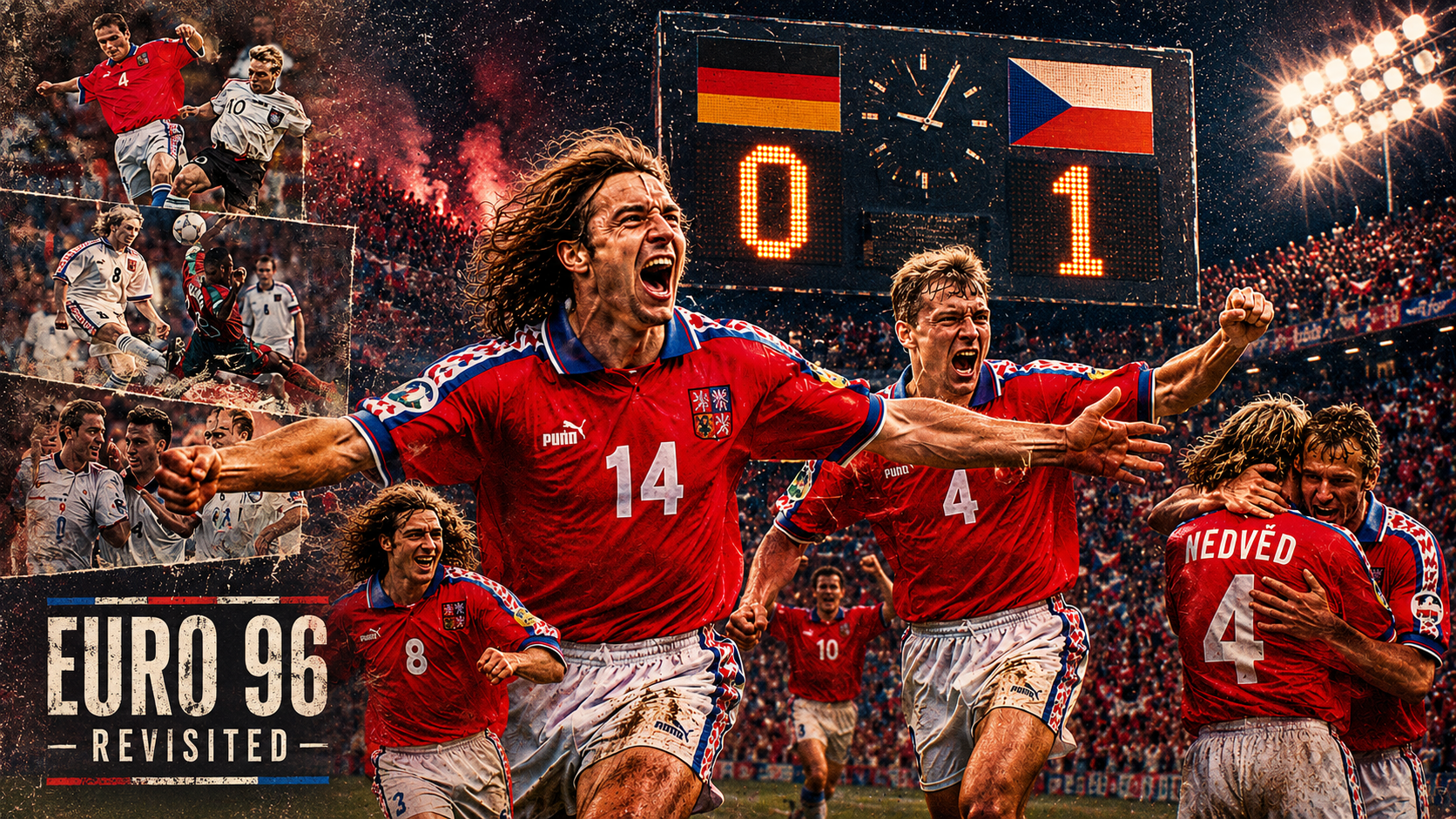
The clock inside Wembley Stadium showed 59 minutes.
Patrik Berger placed the ball on the penalty spot and stepped backwards without looking up.
Around him, seventy-three thousand people seemed to pause at once. Germany had arrived in England as favourites. They had won this tournament before. They had won the World Cup before. They carried history with them wherever they went.
The Czech Republic carried almost none.
Three years earlier, the country itself had not existed.
Now, on the biggest stage European football could offer, a generation of players raised amid the final years of Czechoslovakia stood one kick away from leading a European Championship final.
Berger began his run.
Andreas Köpke guessed correctly.
It did not matter.
The shot flew beneath the goalkeeper and into the net.
For a second there was silence from one end of Wembley and disbelief from the other. Then the red shirts began to sprint. Karel Poborský was first. Pavel Nedvěd followed. Players spilled from the bench. Somewhere behind them, Dušan Uhrin clenched both fists.
The scoreboard read: Germany 0, Czech Republic 1.
The lead would last only fourteen minutes. The trophy would never reach Prague. Oliver Bierhoff would change everything.
Yet that is not why Euro 96 remains one of the most remarkable stories in European Championship history.
The enduring fascination lies in how a nation barely three years old came within touching distance of becoming champions of Europe. Not through luck. Not through sentiment. Not because football needed a fairy tale.
But because, for three extraordinary weeks in the summer of 1996, the Czech Republic proved they were good enough.
This Was Never Supposed to Happen
The simplest version of the Czech Republic’s Euro 96 story is also the least interesting.
A newly independent country arrives in England with little expectation, catches a few breaks, rides a wave of momentum and somehow reaches the final. It fits neatly into football’s long tradition of romantic underdogs.
It also ignores almost everything that made the team remarkable.
The Czech Republic that arrived at Euro 96 was not an established football power. The country itself was still trying to understand what it was.
Only three and a half years earlier, Czechoslovakia had ceased to exist. The Velvet Divorce of January 1993 created two independent states, the Czech Republic and Slovakia, ending a political union that had lasted more than seven decades. Unlike the violent break-ups taking place elsewhere in Eastern Europe, the separation was peaceful. It was also abrupt.
Football found itself caught in the middle of the transition.
The national team that had represented Czechoslovakia did not disappear overnight. Instead, it completed its World Cup qualifying campaign under the awkward title of the Representation of Czechs and Slovaks, a team representing a country that no longer existed.
When qualification for the 1994 World Cup slipped away in Brussels against Belgium, that chapter ended.
A new one began.
The Czech Republic inherited some of the footballing traditions of old Czechoslovakia, but inheritance is not identity. Identity has to be built.
By the summer of 1996, few outside Central Europe knew what Czech football would look like as an independent force. There were talented players, certainly. Nedvěd was beginning to attract attention. Poborský had impressed domestically. Berger possessed one of the most dangerous left feet in Europe.
But there was no widespread belief that this collection of players was capable of challenging the continent’s elite.
Germany arrived in England as Germany. Italy arrived as Italy. The Dutch carried the legacy of Total Football. France possessed one of the most gifted generations in their history.
The Czech Republic arrived carrying questions.
Even inside the story, the expectations were low. Poborský later told The Guardian: “Nobody expected anything from us.”
Their preparations hardly resembled those of future finalists. Before the tournament, Uhrin’s squad travelled to Lancashire and played a warm-up match against semi-professional Bamber Bridge. The setting could scarcely have been further removed from Wembley. Local volunteers organised the event. A brass band performed. The Czech delegation erected a temporary beer tent beside the ground.
Within a month, several of the players involved would become household names across Europe.
At the time, they were largely unknown outside their own country.
That anonymity became one of their greatest advantages. Nobody feared them. Nobody built a tournament strategy around stopping them. Nobody expected them to survive.
Yet beneath the lack of reputation sat something far more dangerous.
This was not a team built on individual stardom. It was a team built on clarity.
Uhrin understood exactly what his players could do and, just as importantly, what they could not. He did not try to imitate Germany. He did not try to out-pass Italy. He did not try to match France technically.
Instead, he built a side that understood itself completely.
That understanding would carry the Czech Republic far further than anyone imagined.
The Night Europe Started Paying Attention
The opening match appeared to confirm every pre-tournament assumption.
Germany beat them 2-0 at Old Trafford. The result was not embarrassing, but it felt familiar. Established power defeats ambitious outsider. Order restored.
Most observers moved on.
The Czech Republic did not.
Five days later they arrived at Anfield to face Italy.
If Germany represented power, Italy represented prestige. Arrigo Sacchi’s side contained some of the most admired footballers in the world. Paolo Maldini was already regarded as one of the game’s great defenders. Angelo Peruzzi stood behind him. Roberto Donadoni, Dino Baggio and Enrico Chiesa provided experience and quality throughout the side.
Few expected the evening to become one of the defining matches of the tournament.
Yet from the opening minutes there was something different about the Czech Republic.
They did not play like a team grateful to be there. They played like a team that had identified a weakness.
Only four minutes had passed when Poborský isolated Maldini near the touchline and delivered a cross into the penalty area. Nedvěd, still largely unknown beyond Central Europe, controlled the ball and struck a fierce finish beyond Peruzzi.
Anfield fell silent.
Italy were stunned.
Nedvěd later became known across Europe for his relentless energy, thunderous shooting and refusal to accept defeat. In many ways, that goal was the first glimpse of the player he would become. It was not elegant. It was not delicate. It was direct, aggressive and utterly fearless.
Italy recovered quickly through Chiesa, but the rhythm of the match never settled into the pattern many had expected.
The Czech Republic refused to disappear.
When Luigi Apolloni was sent off before the half-hour mark, they sensed vulnerability. Seven minutes later Pavel Kuka launched a cross into the Italian penalty area. Maldini missed his clearance. Radek Bejbl met the dropping ball and drove home the winner.
The entire second half became an examination of their character.
Italy pushed. The Czech Republic absorbed. Every clearance seemed to matter. Every tackle felt significant. Every minute survived increased the sense that something unusual might be developing.
When the final whistle arrived, the result reverberated across the tournament.
Germany had beaten them. Italy had not.
Suddenly the Czech Republic were no longer viewed as participants.
They were contenders.
What impressed opponents was not merely the result. It was the manner of it. This was not the chaotic football of an underdog hoping for a miracle. There was structure to everything they did. Defensively they remained compact and disciplined. In possession they attacked with conviction and speed. They understood exactly where danger existed and how to exploit it.
Years later, Vladimír Šmicer would look back on the Italy match as the turning point. It changed the tournament for them because it changed what the players believed was possible.
The opening defeat against Germany had created doubt.
The victory over Italy created belief.
And belief, once established in tournament football, can become a dangerous thing.
The First Escape
Tournament runs are rarely built on perfect performances.
More often they are built on survival.
The Czech Republic discovered that at Anfield on 19 June.
The mathematics were simple enough. Avoid defeat against Russia and there was a realistic chance of reaching the quarter-finals. Lose, and the victory over Italy would probably become a footnote rather than a turning point.
For an hour, everything appeared under control.
Jan Suchopárek gave the Czechs the lead. Kuka doubled it. The team that had shocked Italy was now 2-0 ahead and seemingly cruising towards the knockout stages.
What followed was chaos.
Russia, already eliminated, began playing with a freedom that can make dangerous teams even more dangerous. Aleksandr Mostovoi and Vladimir Beschastnykh injected energy and unpredictability. Suddenly the spaces the Czech Republic had controlled so carefully throughout the tournament began to open.
One goal arrived.
Then another.
Then a third.
By the closing minutes, Russia led 3-2.
Everything the Czech Republic had spent ten days constructing appeared to be collapsing in front of them.
The transformation was psychological as much as tactical. Against Italy they had played with confidence. Against Russia they suddenly looked vulnerable. The defensive certainty disappeared. Passes became rushed. Decisions became reactive. Players who had spent most of the tournament making intelligent choices started chasing moments instead.
It would have been an understandable ending.
New nation. Promising team. One famous victory. An honourable exit.
That is usually how these stories finish.
Instead, the Czech Republic produced the first indication that this campaign might become something more.
With the clock running down, they refused to accept elimination.
There was no tactical masterpiece in the final minutes. No carefully designed sequence. Just urgency, belief and the growing sense that the players trusted each other completely.
In the 88th minute, Šmicer struck.
The finish itself was excellent, low and precise, but what mattered more was its timing. The goal transformed disaster into survival. Almost instantly the emotional direction of the tournament changed.
Had the Czech Republic lost, their Euro 96 story would likely be remembered as an interesting group-stage surprise.
Instead they advanced.
The margins were impossibly small. One goal. One moment. One shot.
Yet that is often how international tournaments work. The great teams are not necessarily those who avoid danger. They are the teams that learn from it.
For Uhrin’s side, the 3-3 draw with Russia revealed two truths.
The first was that they were good enough to compete with anyone.
The second was that they were still vulnerable enough to lose to anyone.
That combination would become one of the defining characteristics of their campaign. They were organised without being robotic. Talented without being dominant. Confident without becoming arrogant.
And because they remained imperfect, they remained dangerous.
The Goal That Outlived the Tournament
By the time the quarter-finals arrived, Portugal had become one of the most admired teams in England.
They played the sort of football people wanted to watch. Rui Costa drifted through matches with effortless elegance. Luís Figo seemed capable of accelerating past defenders whenever he chose. Paulo Sousa controlled possession with calm authority. The Portuguese press spoke confidently about a golden generation that was finally ready to fulfil its promise.
Portugal looked modern. They looked creative. They looked destined for bigger things.
The Czech Republic looked like an obstacle standing in the way.
For an hour at Villa Park, that appeared to be exactly what they were.
Portugal dominated possession. They moved the ball beautifully. Their midfield controlled territory. The match was largely played on Czech terms only in the sense that the Czech Republic had willingly surrendered the ball and invited pressure.
To many watching, it seemed a familiar pattern.
Portugal attacking. The Czech Republic resisting. Sooner or later, the breakthrough would come.
Yet Uhrin understood something many opponents had not.
His side did not need long periods of possession. They needed moments.
One transition. One mistake. One opening. One player brave enough to recognise it.
The player was Karel Poborský.
Even before the goal, he had been one of the most influential figures in the tournament. He was not the fastest player on the pitch. Nor was he the most physically imposing. What made him dangerous was his willingness to attack space that others ignored.
While opponents focused on controlling possession, Poborský focused on opportunity.
The two are not always the same thing.
In the 53rd minute, opportunity appeared.
Receiving possession near the halfway line, Poborský drove directly at the Portuguese defence. What happened next has been replayed so many times that it risks becoming detached from reality.
The goal is often remembered as a moment of spontaneous brilliance.
It was that.
But it was also something more.
It was an expression of complete conviction.
As Vítor Baía advanced from his goal, most players would have chosen power. Some would have searched for a pass. Others would simply have taken the safer option and retained possession.
Poborský chose imagination.
The ball rose into the Birmingham sky.
For a moment it seemed suspended there.
Then it dropped.
Over Baía.
Into the net.
Villa Park erupted.
The image immediately entered football folklore.
Poborský, though, always resisted the idea that it was a fluke. Speaking later to UEFA, he explained that Baía was too far from his goal line and that the finish came naturally to him: “I chose a technical finish as I was used to doing that my whole life; I had scored two or three similar goals before.”
That matters.
The goal was not a lucky ricochet rewarded by an accident of technique. It was a difficult skill performed under extreme pressure by a player who recognised the only finish available.
Nearly three decades later, it remains one of the defining goals in European Championship history. But the goal alone does not explain why the match mattered.
What followed explained far more.
The Czech Republic still had almost forty minutes to survive.
Portugal still had Figo. Still had Rui Costa. Still had enough talent to overwhelm almost anyone in Europe.
The pressure became relentless. Wave after wave of Portuguese attacks crashed into the Czech defence. Every clearance felt temporary. Every recovery challenge felt decisive. The match became an examination of concentration, discipline and nerve.
Late in the game, Radoslav Látal was sent off.
The final minutes felt endless.
Portugal pushed forward desperately.
The Czech Republic refused to bend.
When the final whistle arrived, something important had changed. Before Villa Park, the Czechs had been one of the stories of Euro 96. After Villa Park, they became one of its defining images.
The goal made the highlights.
The victory made the statement.
This was no longer a team surviving on momentum. This was a team eliminating some of the strongest nations in Europe.
Germany. Italy. Portugal.
The list was growing.
And so was belief.
The Siege of Manchester
By the time the Czech Republic arrived at Old Trafford for the semi-final, they looked less like a finalist in waiting and more like a team being slowly dismantled by the tournament itself.
The victory over Portugal had come at a cost.
Látal was suspended. Suchopárek was suspended. Bejbl was suspended. Kuka was suspended.
Four starters gone.
Four pillars of Uhrin’s system removed.
And waiting for them was France.
If Portugal had represented beauty, France represented depth. Aimé Jacquet could call upon Zinedine Zidane, Youri Djorkaeff, Didier Deschamps, Marcel Desailly and Laurent Blanc. They possessed technical quality in every area of the pitch. More importantly, they possessed options. If one solution failed, another usually existed.
The Czech Republic had no such luxury.
Their margin for error had disappeared.
For perhaps the first time in the tournament, even those who admired them privately wondered whether they had finally reached the limit of what organisation and belief could achieve.
The circumstances seemed impossible.
What followed remains one of the most overlooked performances in European Championship history.
The match itself was not beautiful.
That was precisely the point.
The Czech Republic refused to allow it to become beautiful.
France wanted rhythm. The Czechs denied it.
France wanted space. The Czechs removed it.
France wanted moments where individual quality could take over. The Czechs turned the match into an argument instead.
Every pass was contested. Every metre was defended. Every attack encountered another red shirt.
The brilliance of Uhrin’s side was not that they stopped France playing entirely. No team could do that. The brilliance was that they prevented France from playing comfortably.
Zidane saw plenty of the ball but rarely in positions where he could dictate the game. Djorkaeff searched constantly for openings. Deschamps circulated possession. Yet the longer the match continued, the more frustration replaced confidence.
France controlled territory.
The Czech Republic controlled emotion.
That distinction matters.
Tournament football is often decided not by who plays best but by who remains calm longest. The Czech Republic understood that.
Their players never appeared interested in winning a beauty contest. They were trying to survive.
As the minutes accumulated, something unusual began happening inside Old Trafford. The pressure shifted. France had started as overwhelming favourites. Now they looked burdened by expectation.
The Czech Republic looked liberated by it.
When extra time arrived, the psychological balance had changed completely. France had more possession. France had more opportunities. Yet it was France carrying the weight of failure. The Czechs had already exceeded every expectation placed upon them.
That freedom gave them strength.
The match drifted inevitably towards penalties.
For some teams, a shootout feels like surrender.
For this Czech side, it felt like another challenge to be endured.
The first ten penalties were converted. One after another. No hesitation. No panic. No drama. Just execution.
Then came Reynald Pedros.
His penalty lacked conviction. Petr Kouba saved it with his legs.
Suddenly everything rested on Miroslav Kadlec.
It was fitting.
Throughout the tournament, Kadlec had embodied the team better than anyone. He was not the most celebrated player. He would never become the face of the generation. Yet he represented everything that had carried the Czech Republic this far: discipline, composure and responsibility.
As he walked forward, Old Trafford seemed to shrink around him.
One kick.
One moment.
One nation.
Kadlec struck the ball high into the net.
The Czech Republic were through.
The celebrations that followed felt almost disbelieving. Not because the players lacked confidence, but because even they had not imagined this.
One story from those days captures the mood perfectly.
Šmicer had been so convinced the tournament would be over by late June that he had arranged his wedding for 28 June, two days before the European Championship final.
Now he found himself asking permission to leave the national team camp temporarily so he could get married before returning to prepare for Wembley.
The image feels almost absurd. A player leaving a major tournament to attend his own wedding before flying back to play in a European Championship final.
Yet it also captured something essential about the Czech Republic’s journey.
Nothing about this run had been planned. Nothing about it followed the expected script.
A country that barely existed at the start of the decade had reached the biggest match in European football.
Only Germany remained.
Fourteen Minutes From History
The danger with looking back at Euro 96 is that the ending can make everything feel inevitable.
Germany won. Germany usually won. The strongest team prevailed. History followed its expected course.
That is not how it felt at Wembley.
Not even close.
The Czech Republic walked onto the pitch on 30 June carrying the accumulated confidence of three extraordinary weeks. They had survived Italy. Escaped Russia. Eliminated Portugal. Outlasted France.
The opening defeat against Germany at Old Trafford felt like it belonged to a different tournament.
These were not the same players.
This was not the same team.
Nor was it the same country.
As kick-off approached, Wembley carried an unusual atmosphere. England had gone. The hosts’ dream had ended in the semi-finals against Germany. Many inside the stadium wanted Germany to lose. Some admired the Czechs. Others simply wanted a different winner.
The Czech Republic had not become everyone’s second team. That claim is impossible to prove.
What is beyond dispute is that they had become one of the stories of the tournament.
People were paying attention.
People cared.
And for long periods of the final, they gave Germany a genuine problem.
Uhrin’s approach was familiar by now. Remain compact. Protect central areas. Accept long periods without possession. Wait for moments.
The remarkable thing was how calmly his players executed the plan.
Germany controlled territory but rarely looked comfortable. Jürgen Klinsmann worked tirelessly. Matthias Sammer pushed forward whenever opportunities appeared. Andreas Möller searched for gaps between the lines.
Yet the Czech Republic never looked overwhelmed.
If anything, they appeared increasingly confident.
Every successful challenge strengthened them. Every clearance reinforced belief. Every minute brought the possibility of something extraordinary a little closer.
Then came the moment.
Just before the hour mark, Poborský surged into the German penalty area. He had spent the entire tournament doing this, finding space where none seemed to exist and running directly at defenders who preferred the game to remain organised.
Sammer lunged.
Poborský went down.
Penalty.
The decision was immediate. No prolonged arguments. No uncertainty. Just a referee pointing towards the spot and an entire nation holding its breath.
Berger picked up the ball.
The same Berger whose career was about to take him to Liverpool.
The same Berger whose left foot had already become one of the signatures of the tournament.
He placed the ball carefully. Stepped back. Waited.
Then struck.
The shot flew beneath Köpke and into the net.
Germany 0.
Czech Republic 1.
Pandemonium.
For a few glorious seconds, everything became possible.
The celebrations were not those of a team that had won. They were those of a team suddenly allowing itself to imagine.
That distinction matters.
The players knew how much football remained. They knew Germany would respond. But they also knew where they were.
Wembley. A European Championship final. Leading.
The scoreboard became impossible to ignore.
The minutes ticked away.
Sixty. Sixty-five. Seventy.
And still the Czech Republic led.
Around Europe, supporters who had barely considered the team a month earlier found themselves wondering whether they were about to witness one of the greatest shocks in tournament history.
Then Berti Vogts made his move.
Oliver Bierhoff entered the match.
At the time, the substitution barely registered beyond normal tactical adjustment.
History would remember it differently.
Within minutes, Bierhoff met Christian Ziege’s free-kick with a powerful header.
1-1.
The noise inside Wembley changed instantly.
Relief from one side. Disbelief from the other.
The Czech Republic had spent three weeks defying expectations. Now they faced something they had largely avoided throughout the tournament.
Doubt.
Extra time arrived.
And with it came the newly introduced Golden Goal rule.
One goal. One touch. One mistake. One champion.
Five minutes into extra time, Bierhoff received possession near the edge of the penalty area. His shot was hardly the sort of effort destined for immortality. There was a touch from Michal Horňák. The ball changed direction. Kouba reacted late. The ball slipped beneath him and rolled across the line.
Everything ended.
No comeback. No final attack. No opportunity to respond.
The Golden Goal rule allowed no second chances.
One moment the Czech Republic were still alive.
The next they were runners-up.
It remains one of the cruellest endings any major tournament has produced.
Yet reducing the story to heartbreak misses the point entirely.
The defining image of Euro 96 is not Bierhoff celebrating. It is not the trophy presentation. It is not Germany lifting the cup.
The defining image is the scoreboard after Berger’s penalty.
Germany 0.
Czech Republic 1.
Because for fourteen minutes, a country that had existed for barely three years stood on the brink of becoming champions of Europe.
What Euro 96 Changed
For many nations, a tournament run becomes a beautiful memory.
For the Czech Republic, Euro 96 became a foundation.
The immediate impact was obvious.
Europe’s biggest clubs had spent three weeks studying a team few of them fully understood when the tournament began. By the time the players left England, anonymity had vanished.
Poborský joined Manchester United. Berger signed for Liverpool. Nedvěd moved to Lazio. Šmicer headed to Lens before later becoming a European Cup winner with Liverpool.
The rest of Europe had finally noticed what Czech football had been producing.
Yet the significance of Euro 96 ran deeper than transfers.
Before England, Czech football still existed in the shadow of Czechoslovakia. The country’s greatest footballing memories belonged to another state. The runners-up finish at the 1962 World Cup. The triumph of Antonín Panenka and the European champions of 1976. The generations led by Josef Masopust and later Panenka belonged to a football history that both the Czech Republic and Slovakia inherited.
Euro 96 changed that.
For the first time, the Czech Republic possessed a football story that was entirely its own.
The achievement belonged to a new flag. A new anthem. A new national team. A new country.
That matters more than league tables or transfer fees.
International football has always been about identity as much as competition. Nations use sport to tell stories about themselves. Sometimes those stories are triumphant. Sometimes they are painful. Often they reveal far more than the results alone.
The Czech Republic’s story in 1996 was one of confidence.
Not arrogance. Not superiority.
Confidence.
A country that had spent the first years of its existence defining itself politically had suddenly found a sporting expression of that identity.
Disciplined. Resilient. Technically gifted. Unafraid.
The influence could be seen in the years that followed. The Czech Republic did not disappear after Euro 96 in the way many surprise finalists do. They qualified for major tournaments consistently and reached the semi-finals of Euro 2004 with one of the most admired sides in the competition’s modern history.
At the centre of that later generation stood many of the players who had announced themselves in England.
Nedvěd became the most successful of all. His rise from promising midfielder to Ballon d’Or winner was extraordinary, but those who watched Euro 96 closely had already seen the qualities that would define his career: the running, the aggression, the clean striking and the refusal to accept limits imposed by reputation.
Poborský became one of the faces of Czech football, though he often appeared uncomfortable with the fame that followed him. The romance of 1996 was easier for supporters to carry than for the men who had lived it. Speaking years later, he admitted that after the Portugal goal he wanted to hide, wanted to be left alone, wanted peace with his family and friends.
That reaction tells us something important.
The players themselves rarely viewed Euro 96 through the lens of mythology. Supporters did. Journalists did. Historians certainly did. The squad often seemed more practical.
They remembered the training sessions. The suspensions. The injuries. The pressure. The opportunities missed. The final lost.
That difference between memory and experience exists in every great sporting story.
For spectators, tournaments become legends.
For participants, they remain real.
Yet even the most grounded members of the Czech squad understood what had happened.
Uhrin, looking back years later, told The Guardian: “It was an amazing achievement and maybe it hasn’t even been fully appreciated until now.”
He was right.
Because the Czech Republic did not merely reach a final.
They altered perceptions.
Not only of themselves.
Not only of Czech football.
Of what was possible.
In the decades since Euro 96, football has become increasingly concentrated around wealth, infrastructure and institutional power. Success is often presented as something predictable, something that can be forecast by budgets, academies and squad values.
The Czech Republic’s run remains a reminder that football is rarely that simple.
Organisation still matters. Belief still matters. Identity still matters.
And sometimes a team can arrive at a tournament carrying little more than those things and leave having changed how an entire country sees itself.
Closing Reflection
The trophy never reached Prague.
That is the fact most record books preserve.
Germany were champions. Bierhoff scored the Golden Goal. The Czech Republic finished second.
History, at first glance, appears straightforward.
Yet football has never been remembered solely through winners.
Thirty years later, Euro 96 still belongs partly to the Czech Republic because their story was larger than the final result.
They arrived in England representing a nation that was still discovering itself. Their players were talented but largely unfamiliar beyond Central Europe. Their ambitions were modest. Their expectations even more so.
Then, over the course of three remarkable weeks, they defeated Italy, eliminated Portugal, outlasted France and stood fourteen minutes away from becoming champions of Europe.
Šmicer later captured the ache of it when he reflected that they had been minutes away from becoming champions.
That is the line between history and memory.
The result says they lost.
The memory says they arrived.
The image that survives is not really Bierhoff’s winner. It is not even Poborský’s famous lob.
It is the sight of those red shirts celebrating Berger’s penalty at Wembley, allowing themselves, however briefly, to believe that the impossible might actually happen.
For fourteen minutes, a country barely three years old stood on the summit of European football.
The lead disappeared.
The trophy slipped away.
The memory never did.
