


The Ball Above Schmeichel
Peter Schmeichel was still running back towards his goal when Davor Šuker decided.
The Danish goalkeeper had spent most of the evening doing what great goalkeepers do. Commanding his area. Barking instructions. Refusing to allow panic into the European champions.
Now, deep into stoppage time at Hillsborough, he was stranded somewhere between desperation and hope.
Denmark had sent him forward for a corner. Croatia had cleared it. The ball travelled out to the left, where Aljoša Asanović, one of the great underrated passers of that Croatian generation, shaped his body and sent a crossfield ball towards Šuker.
The striker was still almost 30 metres from goal.
One touch.
A glance.
Then the finish.
Not power. Not violence. Not urgency.
Just certainty.
Šuker lifted the ball delicately over Schmeichel, who could only turn and watch it drop towards the net. For a moment the stadium seemed suspended between disbelief and admiration. Then the ball landed.
Croatia 3. Denmark 0.
The reigning European champions had been dismantled.
Years later, speaking to UEFA about the goal, Šuker explained that it came from instinct rather than calculation. “For me, it’s that first idea that comes into my mind and I want to pursue it,” he said, “even if it is more difficult or technically more demanding.”
That sentence explains the goal. It also explains something larger about Croatia at Euro 96.
This was a team willing to attempt the difficult thing. A new nation, carrying fresh wounds and old football knowledge, refusing to behave like a grateful debutant. Croatia had arrived in England still fighting for recognition in the European imagination. By the time Šuker’s chip dropped beyond Schmeichel, the argument had changed.
The players gathering around him were not simply celebrating qualification for the quarter-finals. They were representing a country that, only a few years earlier, had been fighting for survival.
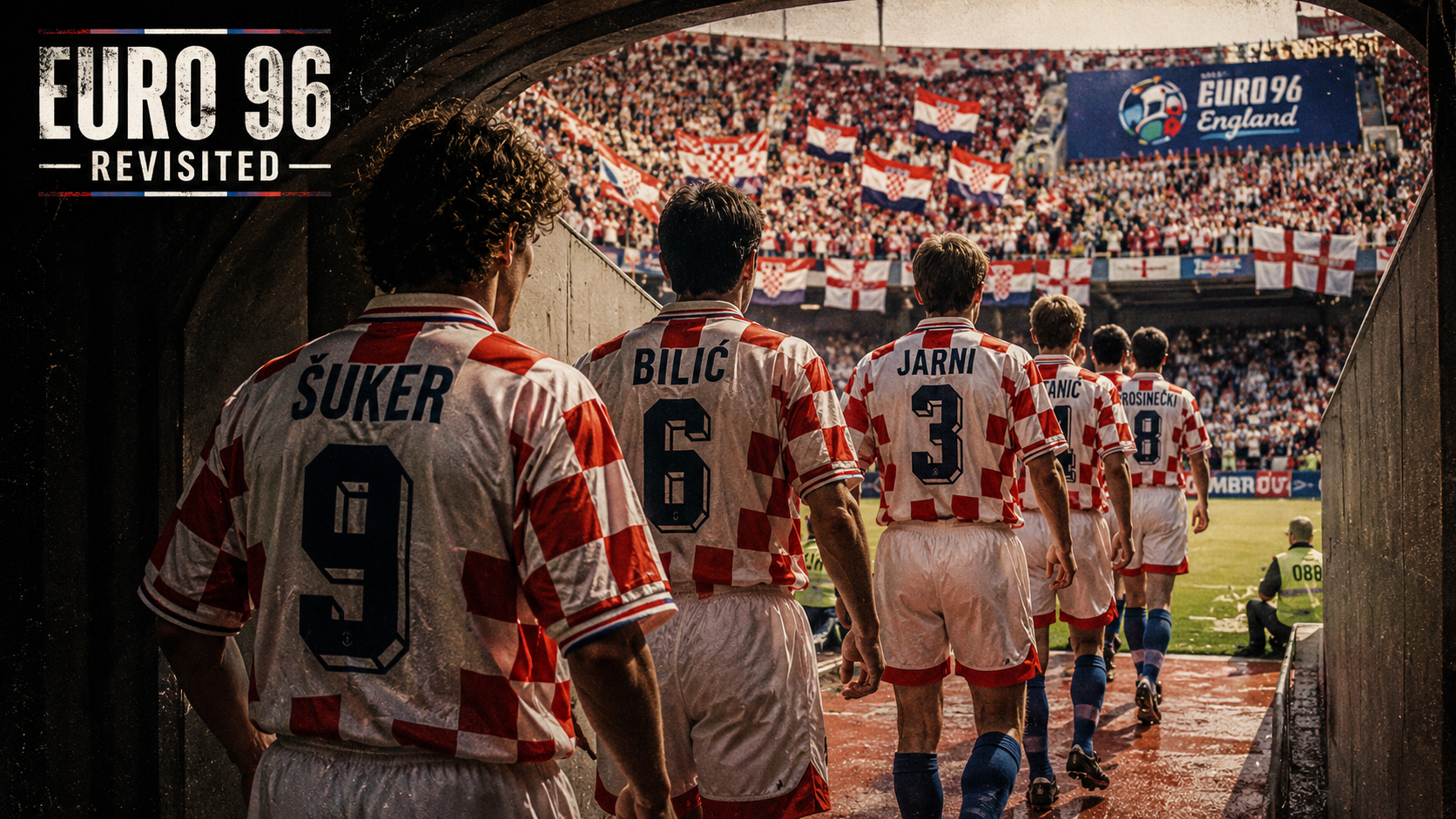
The red-and-white chequered shirts racing across the grass belonged to a nation many viewers were still learning to place on a map.
For Croatia, Euro 96 was never simply a football competition.
It was an introduction.
An announcement.
A declaration that the Republic of Croatia had arrived on the European football stage and intended to stay.
The Tournament Everyone Remembers Too Simply
When Euro 96 is discussed now, Croatia are usually placed among the tournament’s pleasant surprises.
The narrative is familiar enough. A talented new nation arrives unexpectedly, plays attractive football, beats the defending champions, reaches the quarter-finals and leaves behind one of the great goals of the decade.
It is neat. It is also incomplete.
Croatia did not arrive in England as footballing outsiders. The players who walked onto pitches in Nottingham, Sheffield and Manchester were not innocents discovering major tournament football for the first time. Many had already spent years among the best company in Europe.
Zvonimir Boban was established at AC Milan. Davor Šuker was moving through the peak years of his career in Spain. Robert Jarni had become one of the most forceful left-sided players on the continent. Robert Prosinečki, injuries and all, retained the kind of technical gift that made opponents feel the match was happening at his speed. Aljoša Asanović could see and deliver passes that appeared to exist only after he had played them.
This was not a Cinderella story.
It was a golden generation finally appearing under its own name.
The more revealing question is not why Croatia were so good. It is why a team with such players felt new at all.
The answer lies in the ruins of Yugoslavia. Several of Croatia’s leading players had already represented the old state. Boban, Šuker, Prosinečki, Jarni and Igor Štimac had been part of the Yugoslavia Under-20 side that won the 1987 FIFA World Youth Championship in Chile. In another version of history, that group might have formed the spine of a senior Yugoslavia team capable of challenging for trophies throughout the 1990s.
Instead, history intervened.
By the time Croatia reached Euro 96, independence had been declared, recognised and defended through a war that left deep physical and emotional scars across the country. The football team existed inside that memory. It could not do otherwise.
Štimac once explained the emotional difference with unusual bluntness in The Guardian.
“When I used to play for Yugoslavia it meant nothing. It was only sport, nothing else. Now the feeling is incomparable. We were expected to sing the Yugoslavian national anthem but we didn’t want to. Now we can think we are Croatian and we can say we are Croatian. We couldn’t do that before.”
That was the emotional charge Croatia carried into England.
England arrived hoping to end thirty years of hurt. Germany arrived seeking another trophy. Italy arrived with expectation. Croatia arrived carrying representation.
Every anthem mattered. Every victory mattered. Every television image mattered.
For President Franjo Tuđman and Croatia’s political leadership, football offered something conventional diplomacy could not. A match gave direct access to millions of viewers. It allowed a young state to project competence, confidence and distinction in the universal language of sport. Croatia could be seen not only as a country recently associated with conflict, but as a European football nation of skill, discipline and imagination.
The danger was obvious. Emotion can liberate a team, but it can also suffocate one.
The achievement of Croatia’s Euro 96 was that they somehow played with freedom while carrying a burden that would have overwhelmed lesser sides.
Before the Nation Came the Symbols
Every country needs a flag. Some need an anthem. Croatia needed a football team.
Long before UEFA recognised the new republic, football had become one of the most visible battlegrounds on which Croatian identity was being contested.
The story is often simplified into one image.
Zvonimir Boban suspended in mid-air at Maksimir Stadium.
A flying kick.
A police officer falling backwards.
A country supposedly announcing rebellion.
The reality was more complicated.
On 13 May 1990, Dinamo Zagreb were due to face Red Star Belgrade in one of Yugoslav football’s most politically charged fixtures. Tensions between republics were already escalating. Nationalist rhetoric was becoming increasingly visible. Croatia’s first multi-party elections had recently transformed the political landscape. The federation itself was beginning to fracture.
When violence erupted inside Maksimir, football did not start the war. It provided the stage on which deeper tensions became impossible to miss.
Boban later framed his intervention in terms that ensured the moment would never be remembered only as a riot. “Here I was, a public face prepared to risk his life, career, and everything that fame could have brought,” he said, “all because of one ideal, one cause; the Croatian cause.”
The image endured because it offered something political speeches rarely can. It gave people a single, unforgettable picture onto which they could project fear, anger, pride and defiance.
Yet Maksimir was only one part of a wider process.
Across Croatia, football grounds were becoming places where national identity could be expressed more openly than elsewhere in public life. In September 1990, Hajduk Split supporters invaded the pitch during a match against Partizan Belgrade, burned the Yugoslav flag and raised the Croatian tricolour. Old songs returned. Old symbols reappeared. Stadiums became theatres of political emotion.
Then came the most important symbol of all.
The shirt.
When Croatia prepared to field its emerging national team, artist Miroslav Šutej, who also worked on the modern Croatian flag, coat of arms and banknotes, produced one of the most distinctive visual identities in international football. He could have chosen something conventional. Instead, he placed the historic šahovnica, the red-and-white chequerboard, across the front of the national shirt.
The decision was brilliant because it did several things at once.
It looked ancient and modern. It invoked Croatian history while feeling completely fresh on a football pitch. It separated Croatia instantly from the other former Yugoslav republics. Most importantly, it worked on television.
That mattered in 1996.
Euro 96 was a tournament of images. Gazza’s dentist chair. Karel Poborský’s lob. Bierhoff’s golden goal. The Three Lions shirts in the Wembley sun. Croatia’s chequerboard belonged in that visual archive because no one else looked like them.
Some national shirts are identifiable through colour alone. Brazil’s yellow. Argentina’s stripes. The Netherlands’ orange. Croatia achieved the same rare status almost immediately.
One glance was enough.
There was no need to read the badge. No need to identify the players. No need to understand the language.
The shirt announced the country before the team had even kicked a ball.
It debuted in a friendly against the United States in October 1990, before Croatia’s independence referendum, before full international recognition, before FIFA membership and before UEFA membership. The symbolism could hardly have been clearer.
The football team arrived before the state was fully accepted.
By the time Croatia reached Euro 96, the chequered shirt had become far more than sportswear. It was a flag in motion. A wearable declaration of existence.
Inside those shirts stood a generation uniquely equipped for the task, because their footballing education had begun under a different flag entirely.
The Chileans
Nine years before Croatia arrived in England, a group of young footballers travelled to South America and announced themselves to the world.
Not as Croatians.
Not as the future spine of a new national team.
They travelled as Yugoslavia.
The 1987 FIFA World Youth Championship in Chile remains one of the great youth tournaments. Yugoslavia scored freely, played with technical confidence and defeated West Germany in the final after a penalty shootout.
Among those lifting the trophy were Boban, Prosinečki, Šuker, Jarni and Štimac.
In Chile they stood beneath one flag.
Nine years later they would stand beneath another.
Everything in between changed.
The Chile side represented the final flowering of Yugoslav football’s extraordinary talent production system. The region had long produced players of rare technique and imagination. Coaches across Europe admired the way its best footballers seemed to combine street invention with tactical schooling. Chile gave that tradition its most persuasive youth-level proof.
Prosinečki was named player of the tournament. Boban scored in the final and converted the decisive penalty. Šuker emerged as a forward of unusual subtlety, a striker who did not overpower defenders so much as arrive at conclusions before they did.
By 1996, those qualities had matured.
Prosinečki did not merely retain possession. He changed the temperature of a game. Under pressure, he could make frantic matches feel suddenly slow, drawing opponents towards him before releasing the ball at the moment they lost shape.
Boban was less decorative but more controlling. He understood rhythm. He knew when to carry the ball, when to circulate it and when to impose a pause that allowed Croatia to breathe.
Jarni gave the team its running power. From the left, he could turn defence into attack within two strides, stretching opponents who wanted to crowd the central creators.
Asanović was the team’s risk-taker, left-footed, angular, forever hunting for the pass others considered too ambitious.
And Šuker gave everything a finish. He was not a sprinter in the modern sense and not a target man. His gift lay in timing, disguise and calm. He often seemed to shoot before goalkeepers had fully set themselves.
Miroslav Blažević’s task was not finding talent. It was arranging it. More than that, it was releasing it.
Blažević understood that international football teams are not simply collections of players. They are collections of emotions. Croatia arrived carrying pride, grief, expectation and responsibility. Left unmanaged, those emotions could have made the team heavy.
Instead, Blažević made them feel chosen.
Part tactician, part psychologist, part showman, he cultivated belief with relentless force. His public optimism sometimes sounded absurd, but it mattered. Croatia had never played at a major tournament. Many of his players had already beaten the world at youth level, played in Serie A or La Liga, and competed in the most hostile club environments in Europe. They did not need to be told they could play.
They needed permission to believe Croatia belonged.
Blažević gave them that.
Before they could introduce themselves in England, however, they first had to qualify. That campaign produced the first unmistakable evidence that Croatia were not coming to Euro 96 merely to take part.
On a November evening in Palermo, one of European football’s traditional powers discovered exactly how dangerous they had become.
Palermo and the End of Any Doubt
The easiest way to misunderstand Croatia’s appearance at Euro 96 is to imagine they arrived unexpectedly.
They did not.
England was where Europe noticed them. Qualification was where they announced themselves.
Drawn alongside Italy in Group 4, Croatia entered a section containing the runners-up from the 1994 World Cup and one of the most established football nations on the planet. For most emerging countries, such a draw would have represented an obstacle. For Croatia, it became an opportunity.
The campaign soon revealed something that could not be dismissed as emotion or symbolism.
This was a genuinely excellent football side.
Šuker led the scoring, finishing with 12 goals in qualification. Yet Croatia’s threat extended well beyond their centre-forward. Boban controlled the tempo, Prosinečki controlled possession, Jarni stretched the pitch, Asanović supplied invention, and the back line carried the hard edge required to survive away from home.
The clearest statement came on 16 November 1994 in Palermo.
Italy entered the match expecting to impose hierarchy. Even after Croatia’s promising early results, the old order of European football still felt secure. Italy were Italy. Croatia were new.
Then Šuker scored twice.
Croatia won 2-1 at the Stadio La Favorita, and the result echoed well beyond the group table. It was not merely an away victory. It was validation. The players already believed they belonged among Europe’s elite. Palermo gave them proof.
By the end of the campaign, Croatia had finished above Italy and qualified directly for England.
There was no lucky late surge. No favourable quirk of the table. No underdog romance.
Croatia topped the group because they were the best team in it.
Looking back, qualification feels less like a road to Euro 96 and more like a warning. The warning simply went unnoticed in some quarters.
European football in the mid-1990s still tended to think in old categories. Germany, Italy, the Netherlands, England and Spain occupied the highest tier. Others fought for attention. Croatia challenged that assumption before the tournament even began.
Their first match in England would show whether they could do it under tournament pressure.
The setting was Nottingham. The opponent was Turkey. The occasion was the first major tournament match in Croatia’s history.
The introduction was anything but comfortable.
Nottingham: Surviving the Introduction
For all the confidence created by qualification, Croatia arrived at Euro 96 carrying a problem every new national team faces.
Nobody truly knew how they would react when the moment came.
Qualification unfolds across months. Major tournaments compress everything into days. The pressure is different. The scrutiny is different. The consequences feel immediate.
On 11 June 1996, Croatia walked onto the pitch at the City Ground for the first major tournament match in the country’s history.
Turkey had travelled in huge numbers. Their support turned one end of the stadium into a wall of red, with drums, whistles and chants accompanying almost every passage of play. Every Croatian touch seemed to draw noise. Every Turkish attack seemed to lift the stands.
It was exactly the kind of environment capable of unsettling a debutant.
For long periods, the match was more about nerve than beauty. Turkey were organised, physical and competitive. Croatia struggled to find rhythm. The flowing football expected from Blažević’s side appeared only in fragments.
UEFA’s own retrospective of the match called Croatia “disappointing” for long spells, noting that several of their stellar names failed to match their billing. That judgement is fair. It also misses what made the victory important.
This was not the night Croatia proved they could be beautiful.
It was the night they proved they could survive.
Prosinečki, later named man of the match by UEFA, became crucial precisely because the game refused to settle. When tension rose, he kept the ball. When Turkey pressed, he bought time. When Croatia needed composure, he gave them something firm to stand on.
Then, four minutes from time, the match opened.
Asanović took possession and shaped a reverse pass through the Turkish defensive line. Vlaović, who had come on as a substitute, read it instantly. He sprinted away, escaped Alpay Özalan, rounded Rüştü Reçber and rolled the ball into the net.
Croatia had scored their first goal at a major tournament.
Vlaović’s celebration carried more than personal joy. Months earlier he had undergone surgery to remove a blood clot from his brain. Now he had scored the goal that gave Croatia their first finals victory.
“My goal is a present for Croatia and its people,” he said afterwards.
The line could have been sentimental. In that moment, it was exact.
Croatia’s country, shirt and symbols mattered. But football still had to supply the evidence. Vlaović supplied it.
The final whistle brought relief rather than euphoria. The performance had not yet flowed. The creativity had been intermittent. The side still looked like one learning tournament football in real time.
But the burden of introduction had been lifted.
Croatia were no longer just a new nation with a striking shirt and a powerful story.
They were a team with three points.
Five days later, against the reigning European champions, they would become something more.
Sheffield: The Night Europe Started Paying Attention
Every breakthrough team has a moment when curiosity becomes conviction.
For Croatia, it arrived at Hillsborough.
The opponent could hardly have been more symbolic. Four years earlier, Denmark had not even qualified for the European Championship. Called into the tournament at the last minute following Yugoslavia’s exclusion, they had gone on to win it. Their triumph in 1992 remains one of football’s great tournament stories.
Now they stood in Croatia’s path.
The defending champions.
Experienced, respected, proven.
Everything Croatia wanted Europe to believe they could become.
The contrast with Nottingham was immediate. Against Turkey, Croatia had looked tense. Against Denmark, they looked released.
The passing was sharper. The distances between midfielders were better. Jarni pushed higher on the left. Boban found spaces from which to receive and turn. Prosinečki drew Danish pressure and slipped away from it. Asanović gave the side a left-footed unpredictability Denmark never fully solved.
And still, the first half remained scoreless.
Denmark were European champions for a reason. Schmeichel commanded the penalty area. The defensive line held. Croatia had control, but not yet separation.
Shortly after half-time, Mario Stanić burst into the penalty area and was brought down by Schmeichel.
Šuker stepped forward.
There was nothing theatrical about his preparation. No delay designed to unsettle the goalkeeper. No exaggerated ritual.
Just a controlled run-up and a finish.
Croatia led.
From there, they produced arguably their finest sustained football of the tournament. With the pressure released, they began to play with the elegant authority that qualification had suggested. Denmark chased. Croatia moved the ball. The game tilted.
The second goal arrived nine minutes from time. Šuker crossed, Boban slid in, and the captain scored.
The image mattered.
Six years earlier, Boban had become the face of Croatian defiance at Maksimir. Now he was captaining his country at its first major tournament and scoring against the defending European champions. His personal journey mirrored the national one, but this time the image was not violent. It was football.
Then came the moment that outlived everything else.
Deep into stoppage time, Denmark won a corner. Schmeichel went forward. Croatia cleared. Asanović found Šuker with the crossfield pass. Šuker cut inside and lifted the ball over the retreating goalkeeper.
It was a goal of rare beauty, but its meaning came from more than technique.
Europe already understood great goals. What Europe was beginning to understand was Croatia.
The goal contained the whole tournament in miniature. Confidence without apology. Skill without deference. A new state presenting itself not through speeches or diplomatic communiqués, but through a striker making one of the best goalkeepers in the world look helpless.
By the time the ball landed, Denmark’s reign as European champions was effectively finished.
Croatia’s introduction was complete.
Before Hillsborough, they had been a talented newcomer.
After Hillsborough, they were a contender.
Old Trafford and the Limits of the First Dream
Major tournaments rarely allow a story to remain clean for long.
Having secured qualification, Blažević rotated heavily against Portugal in the final group match. The decision was understandable. Croatia had reached the quarter-finals. Fresh legs mattered. Yet the changes broke rhythm. Portugal won 3-0, and Croatia lost the chance to top the group.
The punishment was severe.
Germany.
Old Trafford.
A quarter-final against one of Europe’s defining football powers.
For Croatia, the match carried the feel of an examination. Germany were not just a strong opponent. They represented the established order Croatia were trying to join.
The game was fierce, emotional and controversial.
Jürgen Klinsmann gave Germany the lead from the penalty spot after Nikola Jerkan handled in the area. Croatia did not collapse. They pushed back. Early in the second half, Šuker equalised with the kind of finish that had made him the tournament’s most compelling striker.
He moved into the inside-right channel, shaped to shoot with his left, rolled the ball onto his right and finished past Andreas Köpke.
At 1-1, the match felt alive.
Croatia believed.
This is the detail that matters. They were not clinging on. They were not hoping merely to survive Germany. They could feel the semi-final within reach.
Then Igor Štimac was dismissed for a second yellow card.
UEFA’s account of the match is stark. Štimac’s red card “halted any such momentum” and Matthias Sammer scored three minutes later.
That is exactly how the match felt. One moment Croatia were rising. The next, the air had gone.
Sammer, who would later win the Ballon d’Or, drove forward and finished calmly. Germany led 2-1. Croatia, down to ten men, chased the game but could not recover.
Šuker had a chance to equalise again. It did not fall. Germany advanced.
For Croatia, the pain came from proximity. Losing heavily would have been easier to process. Being outclassed would have kept the tournament in perspective. This was different. They had felt the old hierarchy wobble. They had seen Germany vulnerable. Then the chance was gone.
In the dressing room afterwards, Tuđman reportedly framed the players as “Knights of Croatia”. The phrase was revealing. Knights do not always win. They endure. They represent. They fight for something larger than themselves.
That framing suited the political moment, but it also risked obscuring the footballing truth.
Croatia had not gone out as romantic warriors.
They had gone out as a serious team beaten narrowly by the eventual champions.
That distinction matters.
Euro 96 was not powerful because Croatia nearly turned football into mythology. It was powerful because they proved the mythology had elite football behind it.
Why Euro 96 Was Never Really About Euro 96
It is tempting to view Croatia’s first major tournament through what happened next.
Two years later, at France 98, Croatia reached the World Cup semi-finals, defeated Germany 3-0, finished third and produced the tournament’s Golden Boot winner in Šuker. For many younger supporters, that is the defining achievement of the first Croatian golden generation.
Yet fame and legitimacy are not the same thing.
France 98 made Croatia famous.
Euro 96 made Croatia believable.
Before England, Croatia were still often viewed through the prism of politics. A new state. A post-Yugoslav republic. A country associated with war, recognition and uncertainty. The football team existed within that same frame.
Euro 96 changed the frame.
Not through speeches. Not through diplomacy. Through football.
The tournament showed that Croatia’s statehood might have been new, but its football culture was not. The federation was young. The players were not. The passport was young. The game knowledge was old.
That is the contradiction at the heart of the story.
Croatia appeared to arrive suddenly, but the football had been forming for decades.
The clubs of Zagreb, Split, Osijek and elsewhere had carried traditions of technique, rivalry and identity long before independence. The Yugoslav system had developed players of rare imagination. The violence of the 1990s altered the political map, but it did not invent Croatian football quality from nothing.
Euro 96 revealed what had been there.
That is why the chequered shirt mattered so much. It gave a visible form to something deeper. It made Croatia instantly recognisable to viewers who had no context, then the football gave that image substance.
The anthem carried another subtle truth. Lijepa naša domovino, Croatia’s national anthem, has its own layered cultural history. The words were written by Antun Mihanović, while the melody has been associated with Josip Runjanin, a Croatian Serb. That detail complicates any crude reading of the team as a simple nationalist symbol. Croatian identity, like the region itself, has always contained intertwined histories.
The football team carried that complexity too.
Players shaped in Yugoslavia.
Players representing Croatia.
Players formed by one vanished state and asked to introduce another.
That is why the tournament still resonates. Croatia were not just playing matches. They were translating statehood into something the world could understand.
The Tournament That Made Croatia Visible
The enduring image of Croatia’s first major tournament will always be tempting to reduce to a single frame.
Šuker’s chip. Boban’s celebration. Vlaović rounding Rüştü. The chequered shirts. The anthem. The supporters.
Each captures part of the truth.
None captures all of it.
What made Euro 96 significant was credibility.
When the tournament began, Croatia were introducing themselves. When it ended, introductions were no longer necessary.
The country had demonstrated that it belonged among Europe’s football elite.
Not eventually.
Immediately.
The years that followed strengthened the argument. France 98 delivered global recognition. Later generations carried the line forward, from Luka Modrić and Ivan Rakitić to Mario Mandžukić, Ivan Perišić and Mateo Kovačić. Croatia reached a World Cup final in 2018 and another semi-final in 2022.
Observers often describe this as remarkable. It is. But there is also a danger in treating Croatian football success as a perpetual miracle.
Miracles happen once.
Traditions endure.
Euro 96 did not create Croatian football. It revealed it.
That is why the tournament still matters.
Not because Croatia surprised Europe.
Because Croatia corrected Europe.
The country arriving in Nottingham, Sheffield and Manchester was not a footballing newcomer. It was a football nation finally appearing under its own name.
For years, Croatia had been introduced to the world through images of destruction.
At Euro 96, another image took their place.
A football rising over Peter Schmeichel.
A sea of red-and-white squares behind the goal.
A group of players who had once represented a vanished country now representing one of the newest states in Europe.
The goal did not win a trophy.
It did something more important.
It made Croatia visible.
By the time the ball landed in the net, the introduction was complete.
