


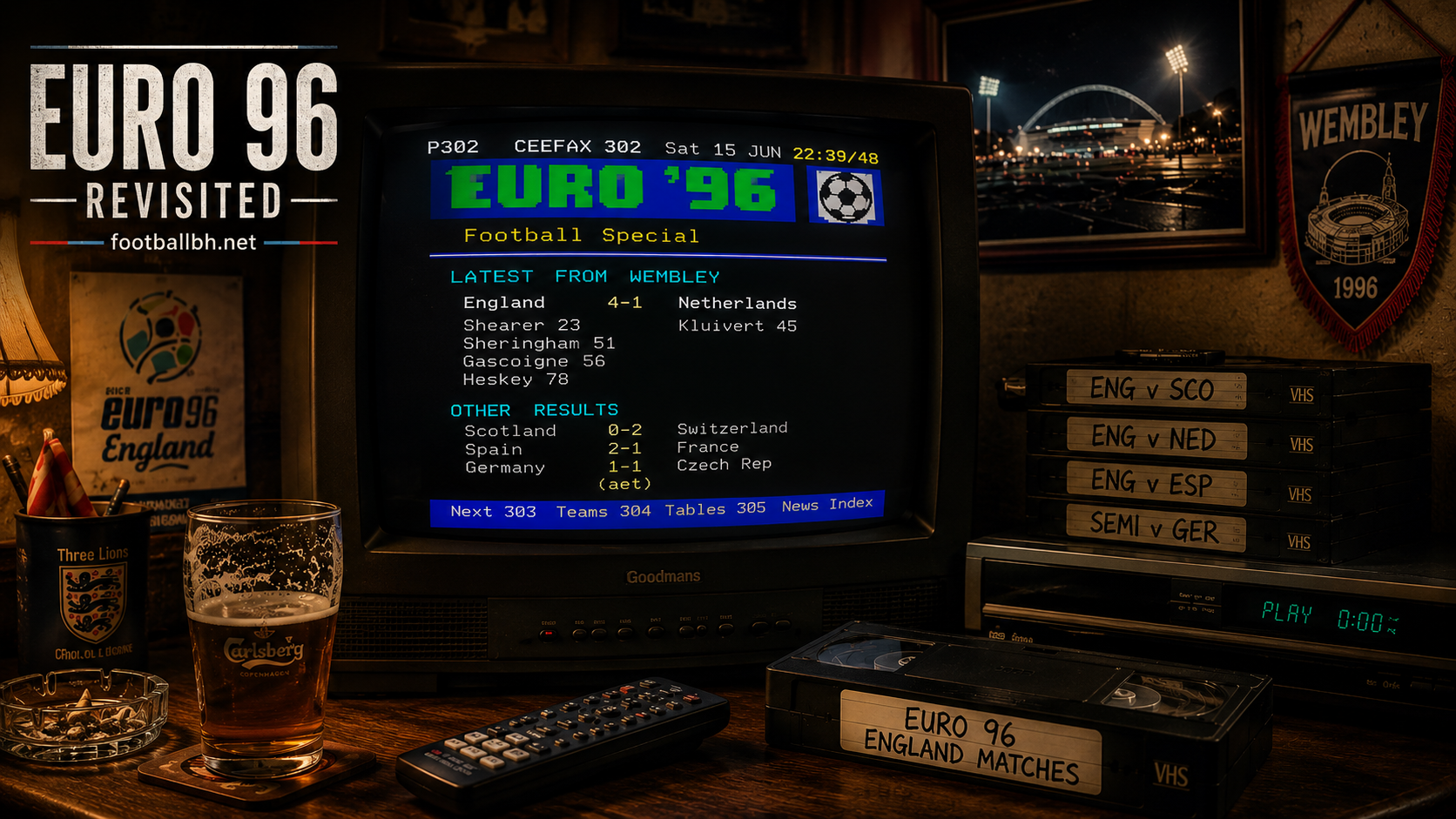
Euro 96 was not the greatest tournament ever played. It was something stranger and more lasting: the final great football summer before digital life changed how the game was watched, remembered and felt.
Key Takeaways
- Euro 96 endures because it arrived at the final edge of analogue football culture.
- Ceefax, VHS tapes, terrestrial television and packed pubs helped create unusually strong collective memories.
- The tournament captured Britain during Cool Britannia, but it also reflected a Europe still reshaping itself after the Cold War.
- Its power lies not in perfect football, but in the way millions experienced the same moments together.
The Last Analogue Tournament
The screen flickers.
Not smoothly. Not cleanly. Not with the frictionless precision of a modern livestream loading instantly onto a six-inch OLED display. The image arrives heavily, glowing through the curved glass of a Cathode Ray Tube television that hums faintly in the corner of a living room thick with cigarette smoke and summer heat.
A thumb hovers over the plastic buttons of a remote control.
3.
0.
2.
Ceefax.
The page loads slowly, block by block, line by line, as if the information itself must physically travel before reaching the screen. Somewhere in Britain, a pub falls briefly silent waiting for the football pages to refresh. Somewhere else, a teenager sits cross-legged on the carpet staring at cyan text against a black background. Somewhere else, a father leans forward in his chair while the television emits that familiar electronic hiss unique to 1990s broadcasting.
This was football before immediacy.
Before smartphones.
Before second screens.
Before football became permanent background noise.
Thirty years later, Euro 96 still exists in memory with startling clarity. Not merely as a tournament, but as a feeling. The tournament survives differently from modern football competitions. The colours seem sharper in recollection. The atmosphere feels heavier. Individual moments remain lodged in public consciousness with unusual emotional precision.
Objectively, this should not really be the case.
The football itself was often cautious. The newly introduced Golden Goal rule created knockout matches paralysed by fear. Several stadiums were half-empty for games involving smaller nations. Even Wayne Rooney would later admit confusion at how mythologised England’s semi-finalists had become, remarking that people spoke about the team as if they had won the tournament.
Yet Euro 96 persists.
Not simply because of nostalgia.
And not simply because England came close.
The tournament endures because it arrived at the precise historical point before football, media and public life changed completely.
Euro 96 was the final major football tournament of the analogue age.
A tournament experienced through scarcity rather than abundance.
A tournament consumed collectively rather than individually.
A tournament that belonged to a Europe still emerging from the long psychological shadow of the Cold War, while Britain itself drifted into the strange, euphoric optimism of Cool Britannia.
To revisit Euro 96 now is to revisit an entire way of experiencing sport that no longer exists.
In 1996, information still moved slowly. Football supporters waited for scores. They waited for highlights. They waited for newspaper analysis the following morning. Matches were not instantly clipped into social media fragments and delivered back to audiences before the final whistle had even blown.
The waiting mattered.
Scarcity intensified attention.
A goal felt larger because not everyone had seen it instantly from seventeen different camera angles. A major match felt culturally dominant because millions experienced it simultaneously through the same television broadcast rather than through fragmented digital feeds tailored by algorithms.
Football still commanded complete focus.
There were no group chats vibrating in pockets during penalties. No live tactical threads dissecting shape and spacing before half-time. No endless statistical overlays reducing emotion into percentages and probability models.
There was only the match.
Only the room.
Only the noise.
And perhaps that is why Euro 96 survives so vividly now. Not because it was perfect, but because it was one of the final great sporting events experienced before modern technology permanently fragmented collective memory itself.
The summer of 1996 now feels close enough to touch and impossibly distant at the same time.
A world of VHS tapes stacked beside televisions.
Of pubs packed shoulder-to-shoulder beneath hanging cigarette smoke.
Of Umbro kits glowing beneath floodlights.
Of Britpop blasting from car radios.
Of Gazza sliding inches away from history.
Of an entire country singing “Football’s Coming Home” before it fully understood how long the wait would actually become.
Euro 96 mattered because it sat on the edge of two worlds.
One was disappearing.
The other had not fully arrived yet.
Enjoying Euro 96 Revisited?
This article forms part of a month-long FootballBH project revisiting the football world of summer 1996.
👉 Explore the archive here
👉 Receive future archive entries by email
Broadcast Scarcity and the Ritual of Waiting
To properly understand why Euro 96 feels so emotionally vivid, it is necessary to reconstruct something modern football supporters rarely experience anymore: waiting.
Not waiting as a mild inconvenience.
Waiting as a central part of fandom itself.
In 1996, football information still travelled with resistance. Scores did not arrive instantly in pockets through vibrating notifications. Goals were not uploaded to social media before the stadium announcer had even finished speaking. Highlights were not endlessly available on demand.
Football existed inside time differently.
The modern supporter lives inside a world of total digital abundance. Every match is available instantly, often simultaneously across multiple devices. Tactical clips, expected-goals models, heat maps and statistical breakdowns arrive before emotional reactions have even settled. Football has become permanent background noise, endlessly accessible and endlessly refreshed.
Euro 96 belonged to the final era before that transformation.
Back then, information still had weight because it was harder to access.
The Ceefax and Teletext pages that now look prehistoric were once sacred territory for football obsessives. Page 302 was football news. Scores, tables and other updates sat nearby in the wider football pages, part of a ritual that became one of the defining emotional rhythms of 1990s football culture.
A supporter would type three numbers into a remote control and wait for the screen to refresh slowly, cycling methodically through subpages while blocky text assembled itself line by line.
The slowness mattered.
Because the update did not arrive immediately, anticipation intensified. Entire emotional states were built around waiting for confirmation. Had somebody scored? Had the final whistle gone? Had England held on?
The process forced concentration.
Modern football audiences consume matches while simultaneously scrolling through reactions, messages, clips and arguments. Attention is permanently fractured. During Euro 96, the television remained the singular source of truth. The match commanded absolute focus because there was nowhere else for attention to drift.
That complete concentration shaped memory formation.
When Paul Gascoigne flicked the ball over Colin Hendry and volleyed past Andy Goram against Scotland, millions saw the moment together at exactly the same time. There was no second-screen distraction. No immediate online debate over historical ranking. No instant flood of alternative camera angles diluting the emotional shock of the goal itself.
The moment simply landed.
Collectively.
The same applied to England’s 4-1 victory over the Netherlands at Wembley. When the fourth goal went in and the stadium dissolved into noise, the country experienced the release through the same broadcast feed. The emotional response was national rather than algorithmic.
Modern football rarely feels like that because modern media consumption rarely allows it.
Even the pacing of television itself reinforced the sense of anticipation. Highlights programmes arrived at specific times. Newspaper analysis appeared the following morning. Supporters argued in pubs, offices and school playgrounds because the game still unfolded in shared stages rather than through a constant flood of instant reaction.
Football conversation had breathing space.
Memory had breathing space too.
This scarcity also changed the perceived value of images themselves. A major football moment felt culturally dominant because there were fewer competing images surrounding it. When Stuart Pearce roared toward the Wembley crowd after scoring his penalty against Spain, the image became iconic partly because audiences could not immediately drown it beneath hundreds of newer clips and distractions.
The image stayed.
The feeling stayed.
And perhaps that is why Euro 96 continues to feel strangely close while many modern tournaments blur together almost immediately after they end.
Not because football was necessarily better.
But because the experience of consuming football demanded deeper emotional investment from the people watching it.
The Texture of Analogue Football
Modern football is visually immaculate.
Every blade of grass is visible in ultra-high-definition. Camera rigs glide above stadiums with cinematic precision. Slow-motion replays dissect movement so clearly that the game can sometimes feel strangely clinical, as though football itself has been converted into data before emotion has time to register.
Euro 96 looked different.
It survives in memory through grain, softness and imperfection.
The tournament belonged to the final generation of major football broadcasts experienced primarily through Cathode Ray Tube televisions. These heavy, curved screens shaped football aesthetically in ways modern audiences rarely consider. Unlike contemporary displays built around fixed digital pixels, CRT televisions painted images using electron beams and phosphor glow. Colours bled slightly into one another. Floodlights shimmered. The edges of moving figures softened naturally.
The result was not technical clarity.
It was atmosphere.
Football under analogue broadcasting felt textured. Slightly rough around the edges. More physical somehow. Stadiums appeared heavier beneath the lights. Shadows lingered longer on the pitch. Rain seemed colder. Night matches carried a particular visual weight that modern digital sharpness often strips away.
Even the kits looked different.
The oversized Umbro patterns worn by England. Germany’s deep green away shirt. The geometric chaos of 1990s goalkeeper jerseys. Bold colours and aggressive shapes were amplified by analogue television’s softened image quality, giving the era a visual identity that remains instantly recognisable decades later.
Modern football kits are often designed to look sharp on pristine digital broadcasts and social media graphics.
Euro 96 kits looked alive beneath CRT glow.
That visual texture became inseparable from memory itself.
The same applies to the way the tournament was archived domestically. Euro 96 was arguably the last major international tournament primarily preserved through VHS tapes stacked beside televisions in living rooms across Europe.
Recording football in 1996 required effort.
Supporters bought blank tapes. They checked recording times nervously before extra time began. They argued over whether somebody had accidentally taped over a previous match. Handwritten labels accumulated beside televisions and VCR units:
“England v Holland.”
“Euro 96 Semi.”
“Gazza Goal.”
Football memory existed physically.
And physical memory behaves differently from digital storage.
Magnetic tape degrades over time. Tracking lines creep across recordings. Audio warps slightly at the edges. The image flickers and bends. Yet those flaws often deepen emotional attachment rather than weakening it. Rewatching Euro 96 footage on VHS does not simply revisit the tournament itself. It revisits the entire sensory experience of the period.
The hiss of the television.
The click of the cassette entering the machine.
The faint blur around floodlights.
The distortion during crowd noise.
Memory becomes tied not only to football, but to the technology through which football was experienced.
That is partly why Euro 96 feels difficult to separate from the wider emotional texture of the 1990s. The tournament was not consumed through invisible cloud storage and frictionless streaming platforms. It existed through objects that occupied physical space in people’s homes.
Programmes.
Ticket stubs.
Newspaper pullouts.
VHS tapes.
Magazine covers.
Even now, decades later, the discovery of a pristine set of 31 unused Euro 96 tickets inside a suitcase in Stoke-on-Trent feels strangely moving. Not because the tickets themselves are valuable, but because they belong to a football culture where memory still existed materially.
Modern football increasingly lives everywhere and nowhere at once, scattered across devices, feeds and disappearing clips.
Euro 96 still feels tangible.
You can almost hold it.
And perhaps that tangibility explains why the tournament remains emotionally accessible in ways many modern competitions do not. The imperfections of analogue media created friction between the supporter and the game, and that friction made memories feel earned.
Football was not yet frictionless.
Which meant it still felt precious.
The Pub as Football’s Cathedral
If analogue television provided the texture of Euro 96, the pub provided its emotional architecture.
Before broadband internet, before streaming platforms and before football dissolved into personalised digital timelines, major tournaments were experienced physically. Supporters gathered together because there were limited alternatives. Football still pulled people toward shared spaces rather than isolated screens.
And no space mattered more in the summer of 1996 than the pub.
The British public house had long functioned as more than somewhere to drink. For centuries, pubs operated as communal meeting points where stories were exchanged, arguments unfolded and local identity took shape. By the mid-1990s, they remained one of the few places where social classes, generations and personalities still mixed naturally beneath the same roof.
During Euro 96, those spaces became emotional theatres.
When England played, pubs transformed completely. Chairs disappeared as people crowded closer to the screen. Beer gardens emptied before kick-off. Cigarette smoke hung beneath the lights. The room itself seemed to tighten with tension every time the ball entered the penalty area.
The physical closeness mattered.
Modern football fandom is often experienced individually while pretending to be communal. Millions now watch matches while simultaneously scrolling through reactions on social media, contributing to an endless digital conversation without ever physically sharing the moment with anyone else.
Euro 96 belonged to a different emotional structure.
The reactions were immediate, collective and completely unfiltered.
When David Seaman saved Gary McAllister’s penalty against Scotland, entire pubs erupted at once. Pints launched into the air. Tables shook. Strangers grabbed each other instinctively. For a few chaotic seconds, the room ceased functioning as a collection of individuals and became one emotional organism.
Then came the goal.
Paul Gascoigne flicked the ball over Colin Hendry and volleyed past Andy Goram. Inside pubs across England, the reaction bordered on delirium.
Not performative excitement.
Not content creation.
Pure release.
That distinction matters.
Modern football culture often exists with an additional layer of self-awareness. Moments are immediately converted into memes, posts, clips and online performances. During Euro 96, emotion still unfolded privately within public spaces. The memory belonged primarily to the people inside the room rather than to the wider internet.
Even silence felt different then.
When England entered penalty shootouts, pubs became almost unnervingly quiet. The scrape of a chair or the clink of a glass suddenly sounded amplified beneath the tension. Entire rooms inhaled collectively before penalties were struck.
Then came the roar.
Or the devastation.
Nothing diluted the emotional impact because there was nowhere else for attention to go.
Football still commanded the room completely.
The pub also reinforced the feeling that Euro 96 belonged to the whole country. People who rarely followed football suddenly became emotionally invested because major tournaments still functioned as national events rather than niche digital ecosystems. Offices organised sweepstakes. Families gathered together. Car horns sounded through streets after victories.
The tournament escaped football culture and entered wider public life.
This was particularly important within the atmosphere of mid-1990s Britain. The country was emerging from years of recession, political fatigue and cultural pessimism. Euro 96 arrived during a brief moment where optimism felt possible again, and the pub became one of the places where that optimism was collectively performed.
England’s run through the tournament created the sensation of a country briefly rediscovering itself through football.
And because the experience remained rooted in physical spaces, the memories became anchored physically too.
People still remember where they watched the Scotland game. Who they hugged after the Netherlands performance. Which pub fell silent after Gareth Southgate’s missed penalty. How the room felt when “Three Lions” echoed through the crowd afterwards.
That is partly why Euro 96 survives with such unusual emotional force.
It was not simply watched.
It was inhabited together.
Cool Britannia and Football’s Rebirth
The emotional power of Euro 96 cannot be separated from the atmosphere of Britain in the mid-1990s.
The tournament arrived during a strange and fleeting moment when the country seemed briefly convinced that its future might be brighter than its past.
After years of recession, political exhaustion and cultural cynicism, Britain suddenly felt younger. Louder. More confident. London presented itself as the cultural centre of Europe once again. British music dominated globally. Fashion became exportable. Television felt irreverent and energetic. The phrase “Cool Britannia” emerged to describe a nation rediscovering swagger after decades of decline.
Euro 96 landed directly inside that mood.
The soundtrack of the summer came from Britpop. Oasis and Blur fought public chart battles while Pulp, The Lightning Seeds and the Spice Girls turned Britishness itself into a marketable cultural aesthetic.
For perhaps the final time before the internet fragmented mass culture permanently, huge sections of the country consumed the same music, television and sporting moments simultaneously.
Football had changed too.
During the 1970s and 1980s, English football often carried the image of national embarrassment. Hooliganism, stadium disasters and decaying infrastructure created the sense of a sport trapped inside social decline. Following tragedies like Heysel and Hillsborough, football in England underwent forced reinvention.
The launch of the Premier League in 1992 accelerated that transformation. Stadiums modernised. Television money flooded into the game. Football repositioned itself from tribal working-class obsession into mainstream entertainment.
Euro 96 became the public unveiling of that rebirth.
England hosting a major tournament for the first time since the 1966 World Cup carried symbolic importance far beyond football itself. The slogan “Football Comes Home” worked because it captured multiple national desires at once.
A footballing return.
A cultural return.
A psychological return.
Then came the song.
“Three Lions” remains one of the most important pieces of football culture ever produced because it understood England emotionally in a way previous football anthems never had. Rather than presenting triumphalist certainty, the song embraced disappointment, insecurity and self-awareness.
“Thirty years of hurt.”
The line mattered because it acknowledged failure openly instead of pretending England still dominated world football.
Supporters recognised themselves inside it immediately.
The song became unavoidable.
It poured from pubs before kick-off. Car stereos blasted it through city centres after victories. Entire stadiums sang it with growing conviction as England advanced through the tournament.
By the time England dismantled the Netherlands 4-1 at Wembley, the atmosphere around the country bordered on euphoric. For a few extraordinary days, it genuinely felt possible that football might come home.
Even politics began borrowing the language of the tournament. Tony Blair referenced the mood around football while positioning New Labour as the youthful future of Britain itself.
That convergence between football, music, politics and national identity is one of the reasons Euro 96 remains culturally unique. As The Guardian later argued, the tournament’s cultural resonance far exceeded England’s actual achievement on the pitch.
The tournament did not simply exist alongside British culture.
For one brief summer, it became British culture.
And yet, looking back now, there is something fragile about the optimism of Euro 96. The laddish confidence, the Union Jack imagery and the celebration of youthful British identity all feel suspended between sincerity and performance. Britain believed in itself again, but only temporarily.
That fragility gives the tournament part of its emotional power in retrospect.
Euro 96 now feels like the final moment before cynicism returned.
Before football became hyper-commercialised.
Before celebrity culture became fully managed.
Before the internet flattened national experiences into endless digital noise.
The summer of 1996 still glows in memory because Britain itself briefly glowed too.
A Continent in Transition
In England, memories of Euro 96 are usually framed through the lens of near-miss heartbreak.
Gascoigne’s volley against Scotland.
The destruction of the Netherlands.
The penalty shootout against Germany.
“Football’s Coming Home.”
But the tournament mattered far beyond England.
Euro 96 arrived during one of the most unstable and transformative periods in modern European history. The continent itself still felt unfinished. Borders had shifted. Nations had dissolved. Political identities remained fragile after the collapse of the Soviet Union and the violent fragmentation of Yugoslavia earlier in the decade.
The tournament reflected that new Europe.
UEFA expanded the European Championship from eight teams to sixteen partly because the map of the continent had changed so dramatically. Nations that barely existed as independent footballing identities a few years earlier suddenly arrived on one of the sport’s biggest stages carrying entirely new political and cultural significance.
Croatia reached the quarter-finals only a short time after war and independence.
The Czech Republic emerged as the romantics of the tournament, playing with freedom and intelligence on their way to the final.
Russia appeared under a new identity following the collapse of the Soviet Union.
Even the atmosphere surrounding the tournament carried the strange energy of a continent reorganising itself in real time.
And then there was Germany.
The eventual winners arrived at Wembley carrying pressures far larger than football. Formal reunification between East and West Germany had taken place in 1990, but psychological reunification remained incomplete. Economically, socially and culturally, the country was still attempting to understand what a unified Germany actually meant.
Football became part of that process.
Matthias Sammer embodied the symbolism of the tournament more than any other player. Born in Dresden in the former East Germany, Sammer operated as both defensive organiser and attacking initiator, reading games with eerie calm while the rest of Europe moved increasingly toward modern flat-back systems.
Germany themselves looked imperfect.
Their squad carried injuries. Critics questioned whether the old aura surrounding German football had disappeared after defeat to Denmark in the Euro 92 final and the chaotic World Cup exit against Bulgaria in 1994.
Yet they survived.
That became the defining quality of the team.
Resilience replaced glamour.
Control replaced spectacle.
Their semi-final against England at Wembley remains one of the most emotionally charged matches in modern European football history. The English tabloids framed the fixture using militaristic language that now feels deeply uncomfortable in retrospect. Front pages invoked war imagery. The atmosphere inside Wembley became saturated with nationalism and historical baggage.
When Alan Shearer scored after three minutes, Wembley erupted with the sound of a country sensing destiny.
Germany responded through Stefan Kuntz.
Then came the defining image.
Gascoigne sliding inches away from Shearer’s cross.
The ball rolling on.
The silence.
Viewed now, the moment feels larger than football because it captures the emotional fragility of the entire tournament. England believed history might finally bend in their favour. Germany, meanwhile, continued doing what German tournament teams had done for decades: enduring pressure without emotional collapse.
When Gareth Southgate’s penalty was saved and Andreas Möller converted the winner, Wembley fell into stunned silence.
Days later, Germany defeated the Czech Republic in the final through Oliver Bierhoff’s Golden Goal.
Even that victory carried symbolic resonance.
Sammer, the player of the tournament, represented the East.
Bierhoff, the goalscoring hero, represented the West.
Germany’s triumph became one of the first great collective successes of the reunified country.
That broader European context matters because it elevates Euro 96 beyond simple football nostalgia. The tournament now feels like a historical bridge between eras. One Europe was disappearing while another attempted to define itself.
The Cold War generation was fading.
The digital generation had not fully arrived yet.
And for one summer, football became the stage upon which those transitions played out in front of millions.
The Last Analogue Echo
So why does Euro 96 still feel so emotionally close?
Why does the tournament remain unusually vivid when so many more recent competitions already feel blurred together?
Part of the answer is simple nostalgia. Human beings naturally soften the edges of the past. Memory filters away inconvenience and preserves emotion. The empty seats, the cautious football and the moments of ugliness surrounding the tournament slowly fade while the atmosphere, music and dramatic images remain.
But nostalgia alone does not fully explain Euro 96.
Something deeper survives inside the memory of that summer.
Modern life increasingly feels fragmented. Attention is permanently divided between screens, platforms, feeds and notifications. Football itself now exists inside an endless digital cycle where every moment is instantly clipped, analysed, debated and replaced by the next one.
Nothing settles.
Nothing lingers.
Euro 96 belonged to the final period before that acceleration fully arrived.
It was the last major football tournament experienced primarily through analogue culture, where technology still imposed friction between supporters and information. That friction created patience. Patience created concentration. And concentration strengthened memory.
People did not consume Euro 96 casually.
They organised their lives around it.
They rushed home for kick-off.
They crowded into pubs.
They bought newspapers the following morning to relive moments properly.
They waited for highlights.
They recorded matches onto VHS tapes because missing something meant genuinely losing access to it.
Football still felt scarce enough to matter differently.
That scarcity gave emotional weight to even small details.
The sound of the BBC intro music before kick-off.
The glow of floodlights against summer skies.
The clatter of the Vidiprinter.
The sight of fans spilling onto streets after England beat the Netherlands.
The silence inside pubs after Germany won the semi-final.
The tournament became woven into ordinary life because ordinary life itself still moved slowly enough for shared experiences to dominate national attention.
That is difficult to replicate now.
Modern football exists everywhere simultaneously, yet often feels strangely intangible because it is consumed in fragments. Matches are half-watched while scrolling through phones. Goals become content within seconds. Entire tournaments disappear beneath the speed of the next news cycle.
Euro 96 escaped that fate because it arrived at the exact moment before sport became permanently accelerated.
And perhaps that is why certain images from the tournament feel almost mythological now.
Paul Gascoigne lying on the turf at Wembley after missing by inches.
Stuart Pearce screaming toward the crowd after scoring against Spain.
Alan Shearer celebrating beneath floodlights.
Matthias Sammer calmly controlling games while Europe reshaped itself around him.
The images endure because millions experienced them together without distraction.
No algorithms softened the silence after defeat.
No second screen diluted the tension before penalties.
The emotions arrived completely and collectively.
That world no longer really exists.
And perhaps that is the true reason Euro 96 still glows so brightly in memory. Not because it was the greatest tournament ever played, but because it was one of the final moments before modern technology permanently changed the texture of human experience itself.
The summer of 1996 now feels like a fading transmission from another emotional age.
A world of VHS tapes and CRT televisions.
Of cigarette smoke hanging above packed pubs.
Of Ceefax pages slowly refreshing.
Of football that still demanded patience.
A world close enough to remember clearly, yet distant enough to feel almost impossible now.
Euro 96 survives because it was not simply watched.
It was lived together.
Closing Reflection
Somewhere in Britain, there is probably still a VHS tape labelled “Euro 96” sitting forgotten in a loft.
The handwriting across the sticker has likely faded slightly with time. Dust gathers along the edges of the plastic casing. The magnetic tape inside has already begun its slow process of deterioration, quietly warping frame by frame in the darkness.
Yet if the cassette still works, the images would immediately feel familiar.
The glow of Wembley beneath the floodlights.
The geometric shapes of 1990s kits.
The strange softness of analogue television.
The noise.
Always the noise.
You would see Paul Gascoigne flick the ball over Colin Hendry once more. You would watch Stuart Pearce roar into the night against Spain. You would hear the crowd sing “Three Lions” with growing certainty that perhaps this time England’s story might finally change.
And then, inevitably, you would arrive back at Wembley against Germany.
The cross.
The slide.
The miss.
The silence.
Thirty years later, those moments still feel emotionally alive because they belong to one of the last great collective sporting memories formed before digital life fragmented public attention into thousands of separate realities.
Euro 96 was not perfect.
The football could be tense and cautious. Some stadiums sat half-empty. Hooliganism had not fully disappeared from English football culture. The tournament still carried traces of an older Europe struggling to redefine itself after political upheaval and social change.
But perhaps that imperfection is part of why the memory survives.
Nothing about the tournament felt frictionless.
Supporters waited for information.
Waited for highlights.
Waited for newspapers.
Waited for Ceefax pages to refresh.
Football still required patience, and because it required patience, it demanded emotional investment in return.
Modern football often feels infinite, endlessly available and instantly consumed.
Euro 96 felt finite.
Temporary.
Fragile.
And maybe that fragility is what people are really remembering when they talk about the tournament now. Not simply the goals or the songs or the penalties, but the sensation of belonging briefly to the same emotional world as everyone around them.
For one summer, millions of people looked at the same screens, heard the same songs and carried the same hope simultaneously.
Then the world changed.
The internet accelerated everything. Football became globalised, digitised and permanent. Attention fragmented. Shared national experiences became harder to sustain. Even memory itself began to feel different.
Euro 96 now exists at the edge of that divide.
The final great football tournament of the analogue age.
A competition suspended forever between two worlds: one disappearing, the other not yet fully arrived.
