


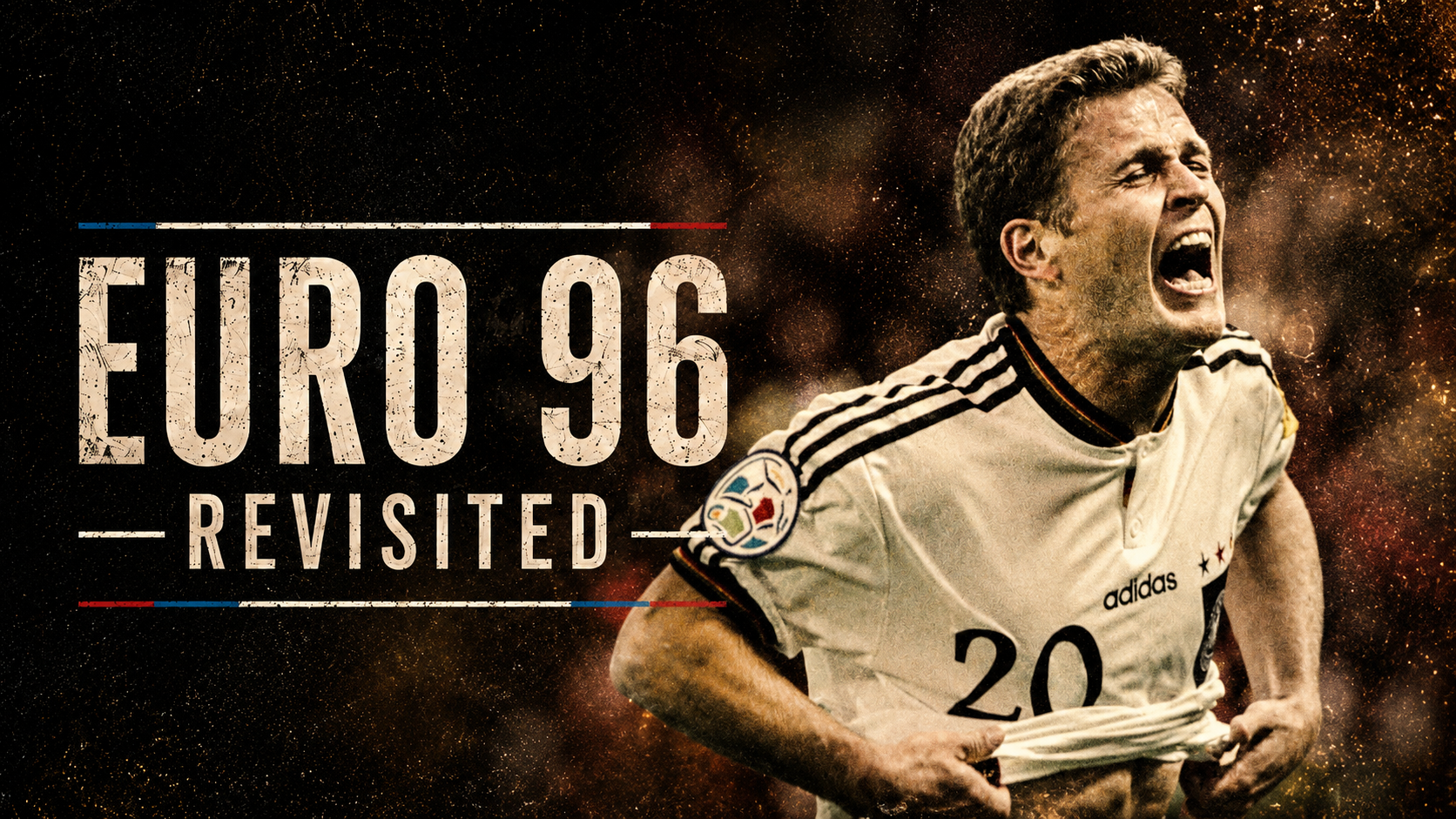
Oliver Bierhoff’s winner at Wembley was supposed to announce football’s future. Instead, the first Golden Goal in a major international final exposed the limits of trying to legislate courage.
Key Takeaways
- Euro 96 was the first 16-team European Championship and the first major tournament final decided by a Golden Goal.
- The rule was designed to encourage attacking football, but often made teams more cautious.
- Bierhoff’s winner remains iconic, but the system that produced it was widely questioned by players, managers and commentators.
- The Golden Goal revealed the tension between football as competition and football as television spectacle.
The Ball That Ended Everything
The ball rolled towards the corner of the net almost in slow motion.
For a moment, nobody seemed entirely sure what had happened.
Oliver Bierhoff wheeled away, arms beginning to rise. Behind him, Petr Kouba lay on the Wembley turf, staring towards the goalmouth. The Czech defenders looked first at the referee, then towards the assistant. One of them raised an arm. Another simply stopped moving.
The ball had crossed the line in the 95th minute of the Euro 96 final. Under normal football logic, there should still have been a match to play. Twenty-five minutes remained. There was time for another attack, another mistake, another twist.
Instead, there was nothing.
Germany were champions of Europe.
The final was over.
No restart. No chase for an equaliser. No final siege of the German penalty area. The tournament that had captivated Europe for three weeks ended not with a final whistle, but with an interruption.
The confusion was visible everywhere. Czech players surrounded the officials. Their manager, Dušan Uhrin, protested furiously from the touchline. Around Wembley, thousands of supporters were still processing what the new rule actually meant. Football had always allowed a response. It had always allowed hope. Suddenly it did not.
Euro 96 had just delivered the first Golden Goal in the history of a major international tournament.
Today, the moment survives mostly as a piece of football trivia. A question in a pub quiz. An answer people half remember. Oliver Bierhoff. Germany. Wembley. Golden Goal.
Yet the significance of that night stretches far beyond the identity of the scorer.
Because Bierhoff’s strike was not simply the goal that won a European Championship.
It was the moment football’s administrators believed they had found a shortcut to drama.
For years, the game’s governing bodies had worried that football was becoming too cautious, too slow, too vulnerable to stalemate. Extra time had become a landscape of exhaustion and calculation. Players no longer chased victory. They managed risk. They waited for penalties.
The Golden Goal was supposed to change all that.
The theory seemed irresistible. Make the reward immediate. One goal wins everything. Surely teams would attack. Surely they would take chances. Surely they would gamble.
Instead, the opposite happened.
What unfolded over the next decade became one of the most revealing experiments in football history. An experiment that exposed the difference between excitement and entertainment. Between sporting drama and television drama. Between what administrators imagined players would do and what human beings actually do when the cost of failure becomes absolute.
The Golden Goal was designed to make football braver.
It ended up teaching football something about fear.
The Real Story Was Not The Goal
The common explanation for the Golden Goal is straightforward.
Football wanted more excitement.
Football got it.
Oliver Bierhoff scored.
Germany won the European Championship.
Experiment complete.
The reality was considerably more complicated.
The Golden Goal was born from a period of anxiety inside the sport. By the early 1990s, football’s administrators had become increasingly concerned that knockout football was drifting towards caution and calculation. The problem was not simply that matches were ending in penalties. It was that the thirty minutes before those penalties often felt devoid of ambition.
The shadow hanging over every discussion was Italia 90.
Despite producing some of the most memorable images in World Cup history, the tournament was widely criticised by officials, journalists and broadcasters. Teams scored only 2.21 goals per game, still the lowest average in World Cup history. Defensive systems dominated. Players exhausted themselves protecting territory rather than creating chances. Too often, extra time felt like an agreement not to lose.
The game’s lawmakers had already demonstrated they could alter behaviour through regulation. The back-pass rule introduced in 1992 transformed football almost immediately. Goalkeepers could no longer pick up deliberate passes from team-mates. Matches became quicker. Pressing became more valuable. Goalkeepers were forced to play football rather than simply manage it.
The lesson seemed obvious.
If one rule change could encourage positive football, perhaps another could do the same.
The Golden Goal emerged from that optimism.
Under the new system, the first goal scored in extra time would end the match instantly. No comeback. No response. No second chance.
The language surrounding the proposal was revealing. Officials spoke repeatedly about positive football. They believed players would see the possibility of immediate victory and attack with greater conviction. Risk would be rewarded. Stalemates would disappear. Penalty shootouts would become less common.
On paper, it made perfect sense.
Yet football is not played on paper.
The flaw sat at the heart of the idea itself.
The people designing the rule viewed football through the lens of incentives. Offer a bigger reward and players will take greater risks. What they failed to appreciate was that footballers, managers and teams often respond more strongly to danger than opportunity.
A goal scored under the traditional extra-time format hurts.
A goal conceded under the Golden Goal format destroys everything.
That distinction changed the psychology entirely.
Years later, Czech goalkeeper Petr Kouba would describe the rule as unjust and cruel. His explanation was remarkably simple. Under normal circumstances, a team that concedes still has time. There is still hope. There is still another attack to build.
Under the Golden Goal, Kouba said, “you daren’t take any risks”.
In one sentence, he exposed the central contradiction of the entire experiment.
Football’s authorities wanted bravery.
What they created was fear.
And nowhere was that contradiction more visible than during the summer of 1996, when a tournament now remembered for colour, optimism and possibility became the testing ground for one of the strangest ideas the sport has ever embraced.
Before The Experiment
The Golden Goal did not emerge from nowhere.
It arrived during one of the most transformative periods football had ever experienced.
The sport that entered the 1990s was still recognisably the old game. Television mattered, but it did not yet dominate every decision. Domestic leagues remained powerful local institutions. The European Cup had only recently become the Champions League. The Premier League did not exist until 1992.
By the middle of the decade, the landscape was changing rapidly.
Satellite television money was flooding into the game. Broadcasting contracts were becoming larger and more influential. Football was no longer merely a sporting contest. It was increasingly becoming a global entertainment product.
That shift created new pressures.
For generations, football’s unpredictability had been one of its greatest strengths. Matches could drift. Tension could build slowly. Finals could become wars of attrition. Supporters accepted that uncertainty because football belonged primarily to them.
Television executives viewed things differently.
A sport that might produce drama after ten minutes or after one hundred and twenty minutes presented obvious challenges. Broadcasters wanted moments. Governing bodies wanted spectacle. Sponsors wanted memorable images that could be replayed endlessly around the world.
The search for solutions accelerated after Italia 90.
The tournament itself remains a curious contradiction. It delivered some iconic stories. The emergence of Cameroon. The tears of Paul Gascoigne. West Germany’s march to the title. Yet the football often felt suffocated by caution. Teams feared making mistakes. Managers prioritised control. The average number of goals fell to a historic low.
Many within the game concluded that football had a problem.
Whether football itself agreed was another matter.
The introduction of the back-pass rule in 1992 appeared to offer proof that administrators could successfully intervene. The change was almost universally regarded as a success. Goalkeepers became more active participants. Teams pressed higher. Matches flowed more naturally.
For administrators, it was intoxicating evidence.
Perhaps football’s shortcomings could be fixed through intelligent regulation.
Perhaps excitement could be engineered.
Perhaps drama could be encouraged.
The Golden Goal emerged directly from that mindset.
FIFA first introduced the concept at youth level before gradually expanding its use. The idea was marketed as progressive and modern. It promised decisive conclusions and attacking football. Nobody wanted extra time to become thirty minutes of players protecting themselves from failure.
The irony was that football’s greatest moments had rarely emerged from certainty.
They emerged from possibility.
The possibility of one more attack.
One more mistake.
One more escape.
Think of the famous football images that endure. Geoff Hurst racing through in 1966. Manchester United’s stoppage-time goals in Barcelona. Sergio Agüero in 2012. Liverpool in Istanbul. They survive because there was still time for something impossible to happen.
The Golden Goal sought to eliminate waiting.
It promised an ending the instant a decisive moment arrived.
That sounded attractive in a boardroom.
It sounded attractive in a television production meeting.
What nobody fully appreciated was that the suspense football creates often lives inside the minutes that follow the goal rather than the goal itself.
Euro 96 would become the first major tournament to test that theory under the brightest possible lights.
The timing could hardly have been more symbolic.
Because Euro 96 was itself a tournament caught between two eras.
One foot remained in football’s past.
The other was already stepping into its future.
The Summer Of 1996
What makes the Golden Goal story so fascinating is that it unfolded inside a tournament that now feels almost defiantly human.
Euro 96 is remembered through emotions rather than regulations.
People remember Three Lions echoing from car radios. They remember Gazza’s celebration at Wembley. They remember the Czech Republic becoming the tournament’s adopted underdogs. They remember Croatia announcing themselves to the world. They remember football shirts, newspaper pull-outs, sticker albums and long summer evenings.
Nobody remembers spending June 1996 discussing tie-break procedures.
Yet beneath the nostalgia sat a tournament that was quietly introducing football’s future.
The competition itself represented a crossroads.
This was the first European Championship featuring sixteen teams. Satellite television coverage had expanded dramatically. Sponsorship was growing. UEFA was becoming increasingly conscious of the tournament as a global product rather than simply a European sporting event. The game remained rooted in local identities and national rivalries, but commercial football was beginning to flex its muscles.
That tension ran through the entire tournament.
England embraced a wave of optimism that felt both modern and deeply traditional. Terry Venables assembled a side built on tactical flexibility and intelligent movement, yet the atmosphere surrounding the team was driven by emotion, memory and national expectation. Germany arrived carrying the weight of reunification and history. Croatia appeared as an independent football nation for the first time. The Czech Republic reached beyond expectations and captured imaginations across the continent.
The stories that endured were all profoundly human.
Which is precisely why the Golden Goal feels so strange when viewed from a distance.
It belonged to a different logic.
The tournament itself repeatedly demonstrated that football’s drama could not be scripted.
England’s campaign was transformed by a goal from Paul Gascoigne that nobody could have predicted. Scotland’s tournament effectively ended because Gary McAllister missed a penalty and moments later Gascoigne produced a piece of genius. Karel Poborský’s lob against Portugal became one of the defining images of the championship because it seemed to arrive from nowhere.
None of these moments emerged from planning.
They emerged from uncertainty.
The Golden Goal, by contrast, was football’s attempt to organise uncertainty.
To package it.
To create a mechanism through which drama could be guaranteed.
Yet as the knockout rounds unfolded, the contradiction became increasingly obvious.
Rather than liberating teams, the rule appeared to tighten them.
Managers talked about bravery before matches. During extra time they reverted to caution. Defensive lines dropped a few yards deeper. Midfielders took fewer chances. Players became acutely aware that a single lapse would not merely concede a goal but instantly end their tournament.
The semi-finals gave the warning without needing to become the story.
In Manchester, France and the Czech Republic fought through 120 tense minutes without a goal before penalties finally separated them. At Wembley, England and Germany produced one of the tournament’s defining emotional ordeals. The match contained near-misses that seemed made for the new rule, but it still travelled all the way to penalties.
That was enough.
The experiment had already begun to reveal its flaw.
Five days later, in front of more than 70,000 spectators at Wembley, the flaw would become impossible to ignore.
The Turning Point At Wembley
The final began exactly as the Czech Republic wanted.
Perhaps that should have been the first warning.
Germany arrived at Wembley as favourites, but they were favourites carrying scars. Berti Vogts’ squad had been stretched throughout the tournament. Key players were missing. Injuries had accumulated. Suspensions had disrupted continuity. By the time the final arrived, Germany looked less like an unstoppable machine and more like a team surviving through discipline and resilience.
The Czech Republic, meanwhile, had become the story nobody had anticipated.
Three years earlier, the country itself had not existed as an independent state. Yet here they were, ninety minutes from becoming champions of Europe.
Much of their success had come from understanding exactly who they were.
Dušan Uhrin’s side defended compactly, broke quickly and trusted the imagination of players such as Karel Poborský, Pavel Nedvěd and Patrik Berger to create moments of inspiration. They were organised without being mechanical. Disciplined without being cautious.
More importantly, they carried freedom.
Germany were expected to win.
The Czechs had already exceeded every expectation.
For nearly an hour, the match unfolded as a contest between those competing emotional realities.
Germany controlled possession.
The Czech Republic absorbed pressure.
Then, just before the hour mark, the tournament took an unexpected turn.
Poborský burst into the penalty area and was brought down by Matthias Sammer. The decision was immediate. Penalty.
Patrik Berger stepped forward.
Wembley held its breath.
The shot was emphatic.
And suddenly Germany were behind.
For a few moments, the possibility of a Czech triumph felt entirely real.
The underdogs who had eliminated Italy, defeated Portugal and survived France now stood thirty minutes from the greatest achievement in their history.
Vogts reacted decisively.
With twenty minutes remaining, he introduced Oliver Bierhoff.
At the time, Bierhoff was an unusual elite striker. He lacked the glamour of Klinsmann and the technical elegance associated with many continental forwards. His reputation rested on different qualities. Physical presence. Timing. Relentless movement inside the penalty area.
He specialised in making matches ugly for defenders.
Within four minutes, he had changed the final.
Christian Ziege swung a free-kick into the Czech penalty area. Bierhoff attacked the delivery and powered a header beyond Kouba.
One substitute.
One chance.
One goal.
The match was level.
Everything changed.
Not simply because the score was 1-1.
Because everyone inside Wembley now understood what came next.
The Golden Goal.
Extra time no longer represented a final half-hour of football.
It represented a waiting room.
One mistake.
One loose pass.
One defensive lapse.
One shot.
The tension inside the stadium became different from anything supporters had previously experienced.
Traditional extra time contains layers. Teams calculate. They recover. They push. They retreat. The clock becomes part of the contest.
Golden Goal football compresses all of that into a single question.
Who will blink first?
That question hung over Wembley as extra time began.
The players looked exhausted.
The managers looked anxious.
The crowd seemed uncertain whether to urge their teams forward or simply hope catastrophe could be avoided.
Five minutes passed.
Then came the moment.
Klinsmann received possession and helped direct the ball towards Bierhoff on the edge of the penalty area. It was not a defence-splitting masterpiece. It was not the sort of move destined for coaching manuals.
It was a hopeful ball into a dangerous area.
Bierhoff controlled it with his back to goal.
He turned.
He shot.
The effort took a slight deflection.
Kouba reacted.
The goalkeeper got both hands to the ball.
And then football entered one of the strangest moments in its history.
Because what happened next unfolded in two entirely different realities.
In one reality, the one football had always known, Kouba had made an unfortunate mistake. Germany had scored. The Czech Republic still had twenty-five minutes to respond.
In the other reality, the new reality created by the Golden Goal, there was no response.
The ball crossed the line.
The tournament ended.
Instantly.
What followed was almost as memorable as the goal itself.
The Germans knew instantly.
The Czechs did not.
Several Czech players turned towards the officials rather than towards the centre circle. Uhrin emerged from the technical area protesting furiously. Much of his anger centred on the assistant referee, whose flag had briefly been raised before being lowered again. For a few chaotic seconds, players, coaches and supporters seemed to be processing two separate questions at once.
Had the goal counted?
And if it had, was the tournament really over?
Football had conditioned everyone present to expect a response. A team concedes. A match restarts. The clock continues. Hope survives.
The Golden Goal removed that instinctive sequence.
The final of the European Championship ended not with a whistle but with a realisation.
Only gradually did the Czech players understand there would be no final attack and no opportunity to recover. Their tournament had not been lost over the remaining twenty-five minutes of extra time.
It had disappeared in a single touch.
For FIFA and UEFA, this was supposed to be the perfect advertisement for their new idea.
A European Championship final.
A dramatic winner.
A decisive ending.
Everything worked exactly as intended.
Yet the reaction that followed suggested something else entirely.
People remembered the goal.
They were far less certain about the rule.
Why It Worked. And Why It Didn’t
The great irony of the Golden Goal is that it delivered exactly the image its creators wanted.
Bierhoff scoring.
Players sprinting away in celebration.
A major tournament decided in an instant.
A climax fit for television.
If UEFA had commissioned a promotional video for the concept, it would have looked remarkably similar.
Yet almost everything beneath the surface pointed in the opposite direction.
The rule’s architects believed they had created an incentive for attacking football. Their logic was understandable. Offer a reward so valuable that teams will become more adventurous in pursuit of it.
The problem was that football matches are not played by economists.
They are played by human beings.
Human beings rarely assess risk and reward in perfectly rational ways. Under pressure, people tend to fear losses more intensely than they value equivalent gains. Psychologists call it loss aversion. Footballers simply call it common sense.
The Golden Goal transformed every attacking decision into a calculation.
A full-back considering whether to overlap had to think not only about the possibility of creating a chance but also about the space left behind. A midfielder contemplating a risky forward pass had to weigh the prospect of unlocking a defence against the danger of surrendering possession. A centre-back stepping out of position risked ending his country’s tournament with a single mistake.
The reward remained victory.
The cost became extinction.
Those are not equal emotional forces.
This helps explain why so many Golden Goal matches developed a distinctive atmosphere. They were tense, but not necessarily adventurous. Nervous, but not always creative. The closer a match moved towards a decisive moment, the more valuable caution became.
Euro 96 provided the first evidence.
The knockout rounds still leaned heavily towards shootouts. Four of the seven knockout matches went to penalties. Across those seven matches, only nine goals were scored. If the Golden Goal had been designed to liberate teams, the early returns were poor.
The final followed the same pattern.
Once Bierhoff had equalised, the emotional temperature changed immediately. Germany wanted to win. The Czech Republic wanted to win. Yet both teams also understood that one lapse could erase everything they had achieved over the previous three weeks.
Football often rewards courage.
Golden Goal football punished recklessness.
There is a difference.
That distinction became increasingly obvious as the experiment continued beyond Wembley.
The rule was supposed to eliminate penalty shootouts.
It largely failed.
The rule was supposed to encourage attacking football.
Evidence increasingly suggested the opposite.
The rule was supposed to create unforgettable drama.
It certainly created memorable endings, but many of those endings left participants feeling dissatisfied rather than exhilarated.
Even some of those who benefited from it struggled to embrace it wholeheartedly.
That discomfort was remarkably widespread.
Alex Ferguson questioned whether such a significant match should be decided by the sudden impact of a single moment. Brian Moore, one of British television’s most respected commentators, felt the ending created a strange anti-climax despite its obvious drama.
More revealing still were the views of those who actually lifted trophies under the system.
Berti Vogts, whose Germany side benefited from the first major Golden Goal final, later argued that football should always allow the trailing team an opportunity to respond. Gérard Houllier, whose Liverpool team won the 2001 UEFA Cup through a Golden Goal, eventually concluded that the rule was a bad idea from the perspective of football and fair play.
That consensus is striking.
The critics were not merely the victims.
They included winners.
The people who gained most from the rule often seemed among the least convinced by it.
Football’s emotional rhythm had been interrupted.
That may sound like a subtle distinction.
In reality, it strikes at the heart of what makes the sport compelling.
Football is not merely a sequence of decisive moments.
It is the tension between those moments.
The attack after the setback.
The response after the concession.
The possibility that the story has not finished yet.
The Golden Goal offered certainty.
Football, as it turned out, preferred possibility.
The Tournament That Did Not Need Fixing
The Golden Goal failed as a football rule.
That much is clear.
What makes it interesting nearly three decades later is what it revealed about the sport itself.
Because the rule arrived at precisely the moment football was beginning to ask a fundamental question.
What exactly was it becoming?
For much of the twentieth century, football’s relationship with its audience had been remarkably straightforward. Supporters attended matches, listened on the radio, watched highlights programmes and argued about the game in pubs, workplaces and living rooms. The sport’s drama emerged naturally from competition itself.
By the mid-1990s, another force was becoming increasingly influential.
Television.
Not simply as a broadcaster of football.
As a stakeholder in football.
The distinction matters.
Television does not experience football in the same way supporters do. A supporter can spend ninety minutes immersed in a tense, goalless match because the tension itself has value. Every misplaced pass matters. Every attack carries possibility. Every minute contributes to the story.
Television tends to seek moments.
The goal.
The save.
The celebration.
The image that can be replayed endlessly.
The Golden Goal emerged from a world increasingly convinced that those moments could be engineered.
Football’s administrators looked at extra time and saw inefficiency. They saw exhausted players, cautious managers and uncertain endings. They saw thirty minutes that might not deliver a defining image.
The solution was to create one.
Instant victory.
Instant heartbreak.
Instant resolution.
Yet football’s greatest power has never really been instant resolution.
It has always been uncertainty.
There is another irony sitting at the heart of the Golden Goal story.
Euro 96 was already producing exactly the kind of drama football’s administrators claimed they wanted.
Nobody had engineered Paul Gascoigne’s goal against Scotland.
Nobody had designed Karel Poborský’s lob against Portugal.
Nobody had predicted Croatia’s arrival on the international stage or the Czech Republic’s extraordinary run to the final.
Those moments emerged naturally from the tournament itself.
They were unexpected.
Messy.
Human.
They felt real because nobody had planned them.
Yet while those stories were unfolding, football’s governing bodies were quietly promoting an innovation built on the opposite assumption. The Golden Goal reflected a belief that drama could be accelerated, that tension could be concentrated, that emotion could be made more efficient.
Euro 96 ultimately delivered a different lesson.
Its most enduring memories were not the product of administrative design.
They were accidents.
A moment of inspiration.
A mistake.
A deflection.
A player attempting something nobody else saw.
The tournament became beloved because it felt alive.
The Golden Goal struggled because it felt constructed.
One trusted football.
The other tried to improve upon it.
The rule also revealed something about the era that produced it.
The 1990s were filled with confidence in systems, incentives and technological solutions. Across politics, business and sport, there was a growing belief that human behaviour could be shaped through clever design. Identify the problem. Adjust the mechanism. Improve the outcome.
Football was hardly immune.
The back-pass rule had worked brilliantly. The sport became faster and more entertaining almost overnight. Administrators understandably wondered what other improvements might be possible.
The Golden Goal exposed the limits of that thinking.
You can stop goalkeepers wasting time.
You can change offside interpretations.
You can alter substitution rules.
What you cannot do is legislate courage.
The closer football moves towards absolute consequences, the more cautious people become.
Petr Kouba understood this better than anyone.
Years after Wembley, he reflected that the Golden Goal prevented players from taking risks. One mistake carried too much weight. One error became final.
His observation reaches beyond football.
Human beings rarely become bolder when the punishment for failure becomes absolute.
They become careful.
Protective.
Conservative.
The Golden Goal was built on a misunderstanding of human nature.
And perhaps that is why it still fascinates.
Because it represents something larger than a failed sporting experiment.
It represents a moment when football believed it could improve upon itself.
A moment when the game tried to manufacture the emotions that had always arrived naturally.
A moment when football briefly confused drama with speed.
And in doing so, discovered they are not the same thing.
Bierhoff’s Goal Revisited
The strangest part of Oliver Bierhoff’s winning goal is what happened after it crossed the line.
Or rather, what did not happen.
There was no frantic restart.
No desperate Czech attack.
No goalkeeper charging forward for a late corner.
No final siege.
No final whistle.
The story simply stopped.
That abruptness explains why the moment still feels unusual even today.
Watch the footage now and the celebrations seem almost disconnected from the flow of the match. Germany celebrate a European Championship victory, but around them players and officials are still processing the fact that the contest has ended. The assistant referee’s brief flag movement creates further confusion. Czech players instinctively look for explanations because football has conditioned them to expect another phase of play.
Instead, there is only finality.
When we revisit the moment with the benefit of hindsight, the goal itself appears almost secondary.
Bierhoff’s finish was good.
The move was functional rather than spectacular.
The shot took a slight deflection.
Kouba got hands to it.
Bierhoff himself later offered a useful corrective to the idea that the goal was simply a dreadful goalkeeping error. In a UEFA interview, he noted that the shot looked easier to save on television than it had been in reality, with spin on the ball and a possible deflection altering its flight.
That detail matters.
The point is not that Kouba made an unforgivable mistake.
The point is that football suddenly made one imperfect moment carry unbearable weight.
Had the ball been pushed around the post by a few inches, nobody would remember the sequence as one of football’s defining moments.
What transformed it was the rule.
The goal became famous because it carried an authority no previous goal had ever possessed.
It did not merely change the score.
It erased the future.
That distinction becomes clearer with time.
When supporters remember Geoff Hurst’s third goal in 1966, they remember the uncertainty that followed. Was it over? Had England finally won? Kenneth Wolstenholme’s commentary endures because people were still waiting for confirmation.
When Manchester United scored twice in injury time in Barcelona, the drama came from the collapse of certainty. Bayern Munich believed they had won. Then they had not.
Football’s greatest moments often derive their power from the survival of possibility.
The Golden Goal eliminated possibility altogether.
That is why the reaction of the Czech players remains so revealing.
They did not simply lose a football match.
They lost the opportunity to respond.
Years later, Kouba would describe the rule as cruel. Watching the footage now, it is difficult not to understand why.
Goalkeepers make mistakes. Defenders lose challenges. Strikers miss chances.
Football usually allows a chance for redemption.
The Golden Goal offered none.
One moment you were competing in a European Championship final.
The next, it no longer existed.
Perhaps that is why Bierhoff’s goal occupies such an unusual place in football memory.
It is simultaneously iconic and isolated.
People remember it vividly.
Few remember feeling any affection for the system that produced it.
The goal survived.
The idea did not.
The Legacy Of A Failed Future
Football gave the Golden Goal a decade.
That was more than enough.
In the years that followed Wembley, governing bodies persisted with the experiment despite mounting evidence that it was failing to achieve its stated aims. The rule appeared at World Cups, European Championships and major club competitions. Administrators continued to hope that players would eventually embrace the spirit of the idea.
Instead, the same pattern repeated itself.
Teams became cautious.
Managers became conservative.
Extra time remained tense but rarely adventurous.
The promised attacking revolution never arrived.
There were memorable moments. Laurent Blanc’s winner against Paraguay at the 1998 World Cup carried genuine drama. Senegal’s victory over Sweden in 2002 remains one of the great stories of that tournament. South Korea’s Golden Goal against Italy became one of the most controversial moments in World Cup history.
Yet even as individual goals entered football folklore, enthusiasm for the rule steadily declined.
The contradiction became impossible to ignore.
Supporters remembered the goals.
Few defended the format.
Perhaps sensing the problem, UEFA attempted a compromise. The result was the even stranger Silver Goal, introduced in the early years of the new century.
Under the revised system, a match would continue until the end of the current fifteen-minute period of extra time. If one team led at that point, the game would end.
It was an idea that somehow managed to be both more complicated and less satisfying.
The defining moment arrived at Euro 2004.
The Czech Republic, the same nation whose supporters had suffered through the first major Golden Goal final eight years earlier, reached the semi-finals with arguably the most exciting team in the tournament. Pavel Nedvěd, Milan Baroš, Tomáš Rosický and company appeared capable of beating anyone.
Against Greece, they became victims of the Silver Goal.
Traianos Dellas scored from a corner in the final seconds of the first period of extra time. Moments later, the referee blew for half-time.
The match was over.
The Czech players technically received the opportunity to respond that Silver Goal was supposed to preserve.
In reality, they were granted only a handful of seconds.
The absurdity was difficult to defend.
Football had spent years trying to improve extra time and had somehow succeeded only in making it more complicated.
By then, the decision had effectively already been made.
Earlier in 2004, the International Football Association Board had voted to abolish both Golden Goal and Silver Goal. Football would return to the traditional format: thirty minutes of extra time followed by penalties if necessary.
The experiment was finished.
Looking back, it is striking how little remains of the idea itself.
The offside rule has evolved repeatedly.
The back-pass rule permanently transformed the game.
Substitution laws continue to change.
VAR, for better or worse, has fundamentally altered modern football.
The Golden Goal left almost nothing behind.
No tactical revolution.
No lasting strategic innovation.
No significant change in behaviour.
Instead, its legacy survives largely as a cautionary tale.
A reminder that football’s most enduring qualities often resist engineering.
The sport’s administrators were not foolish. Their diagnosis contained elements of truth. Extra time could be dull. Teams could be cautious. Penalty shootouts remained divisive.
Their mistake was believing that the solution lay in manufacturing a more dramatic ending.
Football eventually rediscovered something it had known all along.
Drama is not created by removing possibilities.
It is created by preserving them.
That is why the traditional format survived.
And why the Golden Goal, despite all the hopes invested in it, quietly disappeared.
Closing Reflection
On that wet evening at Wembley, football thought it had found a better ending.
The image seemed perfect.
A substitute striker turning in the penalty area. A shot through a crowded defence. A European Championship decided in an instant. Jubilant German players racing away beneath the floodlights.
For a moment, it looked exactly like the future.
Yet the future never arrived.
Instead, the game quietly retreated from the idea.
Not because the Golden Goal failed to produce memorable moments. It produced several. Not because it failed to create drama. At times, it did that too.
It failed because it misunderstood where football’s drama comes from.
The sport has always lived in the space between certainty and possibility.
A team trailing by one goal still believes.
A crowd still hopes.
A player still imagines that one more chance might come.
Those remaining minutes matter. They are not an inconvenience standing between the audience and the ending. They are often the most important part of the story.
The Golden Goal removed those minutes.
It removed the possibility of rescue.
It removed the opportunity to answer.
In doing so, it discovered something football had known for more than a century.
The game does not need help creating tension.
It does not need administrators to manufacture emotion.
Its power lies precisely in the fact that nobody knows what happens next.
Perhaps that is why the image that endures is not really Bierhoff celebrating.
It is the Czech players looking for the restart.
Instinctively searching for the next phase of the story.
Football had taught them there should be one.
For a decade, the game experimented with taking that possibility away.
Eventually it realised the possibility was the point.
The ball crossed the line.
The match ended.
The experiment began.
And almost immediately, football started looking for a way back.
