


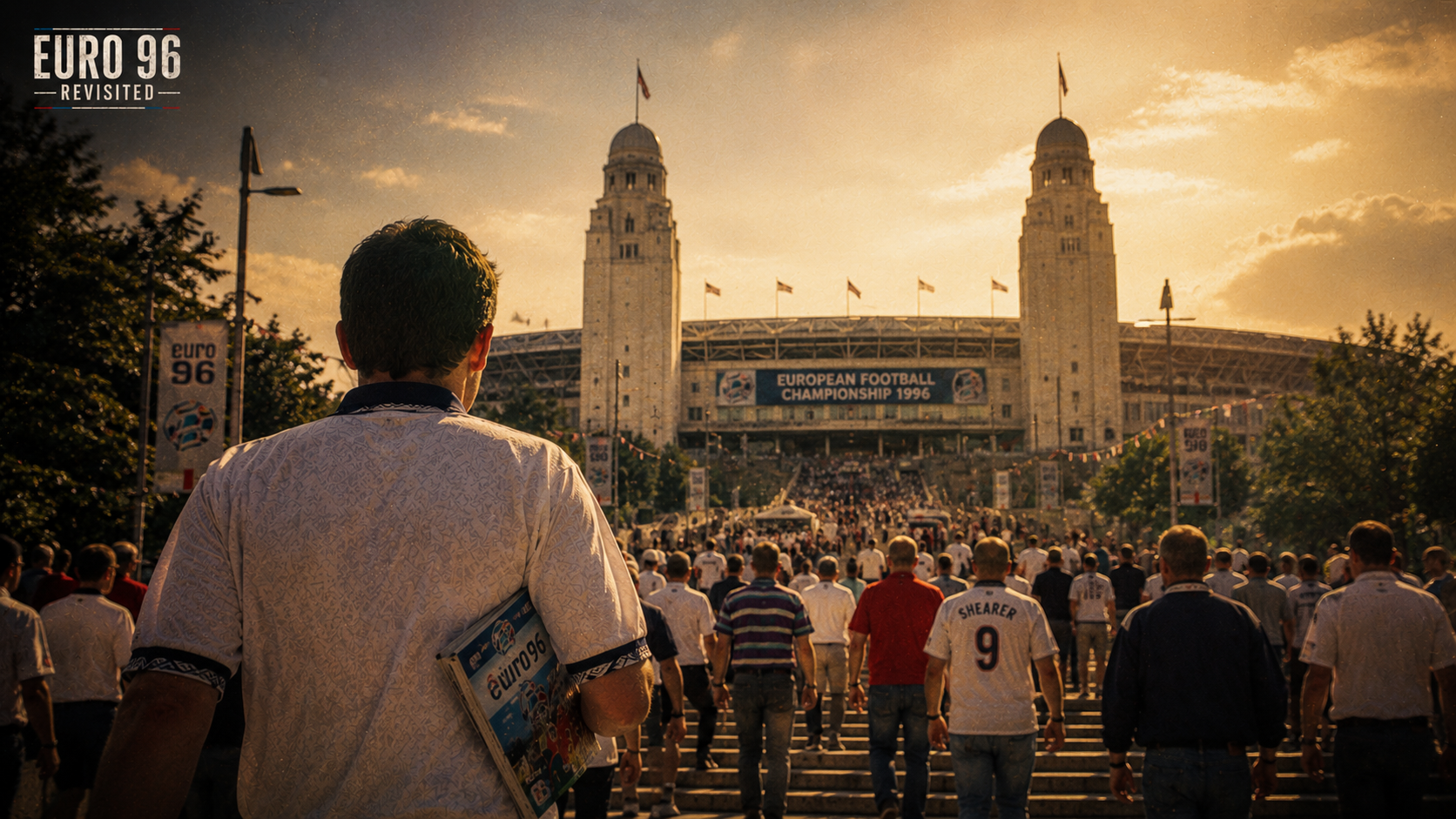
Euro 96 is remembered as the summer football came home. But beneath the songs, shirts and Wembley noise, an older football world was already fading. This was not just the beginning of modern football. It was also one of old football’s final summers.
Key Takeaways
- Euro 96 sat between two football ages: the old local game and the emerging global entertainment industry.
- The tournament still carried the habits, humour and imperfections of old football, even as modernisation was already reshaping the sport.
- Glenn Hoddle’s signing of Ruud Gullit at Chelsea showed how continental influence was already entering English football before Arsène Wenger arrived.
- The gains were real: safer stadiums, better players, higher standards and broader appeal. But football also lost proximity, spontaneity and some of its local texture.
The Dentist’s Chair
The ball seemed to hang forever.
For a moment, Wembley held its breath.
Paul Gascoigne had already taken the first touch. Colin Hendry had already slid past him. The angle was narrowing. Scotland’s defenders were turning. Thousands of people were rising from their seats before they even understood what they were seeing.
Then came the second touch.
A flick.
A piece of instinct.
A movement that looked less like football than imagination.
The ball floated over Hendry’s outstretched leg and dropped perfectly into Gascoigne’s path. Before it touched the ground again, he struck it. Andy Goram could only watch.
The net rippled.
Wembley erupted.
Thirty years later, most people remember the goal. They remember the commentary. They remember the roar. They remember Gascoigne running towards the touchline with his arms spread wide.
What they remember slightly less clearly is what happened next.
Gascoigne fell backwards onto the turf. Team-mates gathered around him. Alan Shearer arrived first. Steve McManaman followed. Water bottles appeared. One after another, they squeezed water into Gascoigne’s mouth as he lay grinning on the grass.
The Dentist’s Chair.
A week earlier, England’s players had been photographed in a Hong Kong nightclub during a boozy night out that became front-page news. Critics questioned their professionalism. Tabloids demanded explanations. The squad responded not with embarrassment but with defiance. Gascoigne turned the scandal into a celebration.
The crowd loved it.
Of course they did.
There was something recognisable about these players. They were elite athletes, but they still seemed connected to the world around them. They looked like men who might still be found in the pub after closing time. They carried imperfections publicly. They made mistakes publicly. They laughed publicly.
England beat Scotland 2-0 that afternoon. Gascoigne scored one of the most famous goals in the nation’s football history. Yet what lingers now is not simply the finish itself. It is the feeling surrounding it.
The looseness.
The humanity.
The sense that football still belonged to ordinary people.
Euro 96 is often remembered as a beginning. It was the tournament that made football fashionable. The tournament that helped reshape England’s image. The tournament that accelerated the Premier League’s rise and convinced much of the country that football could sit comfortably at the centre of national life.
All of that is true.
But standing in Wembley that afternoon, nobody realised they were also witnessing an ending.
The old terraces had already begun disappearing. Ticket prices were climbing. Foreign stars were arriving. Television money was transforming clubs. Sports science was creeping into dressing rooms. Football was becoming richer, cleaner, safer and more sophisticated.
It was also becoming something different.
Gascoigne and his team-mates could not have known it as they laughed on the Wembley turf. Neither could the supporters singing in the stands above them.
Yet when we look back at that image now, it feels strangely fragile.
Not because England failed to win the tournament.
Not because Gascoigne’s career would later unravel.
Because almost everything visible in that moment belonged to a football world that was quietly fading away.
Euro 96 is remembered as the summer football came home.
It might also have been the last summer before football left.
The Last Moment Before the Change Became Obvious
Memory has a habit of simplifying things.
Over time, the rough edges disappear. Contradictions fade. Complex moments are compressed into neat stories that are easier to carry.
Euro 96 has suffered from that process as much as any tournament.
The accepted version is familiar enough. England hosted a successful championship. Football came home. Three Lions became a national anthem. Wembley rediscovered its voice. A country briefly fell in love with its national team.
Viewed from a distance, Euro 96 feels like a beginning.
The beginning of modern English football.
The beginning of the Premier League’s cultural dominance.
The beginning of football’s transformation from a Saturday afternoon pastime into the central language of British popular culture.
There is truth in all of that.
Yet it is only half the story.
What makes Euro 96 so fascinating is not that it announced the future. It is that it briefly allowed the past and future to occupy the same space.
The tournament sat on a fault line.
Behind it lay one version of football. Ahead of it lay another.
The older game was still visible everywhere if you knew where to look. It existed in supporter habits formed on terraces that no longer existed. It lived in dressing-room cultures that would soon be swept away. It survived in the accents, mannerisms and imperfections of players who still seemed part of the communities they represented.
At the same time, the future was already arriving.
The stadiums looked different. Television looked different. Sponsorship looked different. Clubs were becoming businesses in ways that would have been almost unimaginable a decade earlier. The Premier League was only four years old. Sky Sports was changing how football was consumed. Wealth was beginning to concentrate at the top of the game.
Even the football itself was changing shape.
Tactical ideas were crossing borders more quickly than ever before. Foreign players were arriving in increasing numbers. The influence of continental Europe was becoming impossible to ignore.
In the summer before Euro 96, Glenn Hoddle had persuaded Ruud Gullit to join Chelsea.
That transfer now feels routine. At the time it felt extraordinary.
Gullit was not an ageing foreign professional looking for a final payday. He was one of the most recognisable footballers on the planet. A former Ballon d’Or winner. A European champion. A player whose reputation had been built in Milan rather than Manchester.
His arrival carried a message.
English football no longer believed it had all the answers.
For generations, England had largely exported its football culture to the rest of the world. Now it was beginning to import ideas in return.
The shift would accelerate dramatically over the next few years. Arsène Wenger would arrive at Arsenal three months after Euro 96 ended. Gianfranco Zola would follow Gullit to Chelsea. Gianluca Vialli would help give the club a new identity. Tactical influences from Italy, France, Holland and beyond would steadily reshape English football’s assumptions about how the game should be played.
But during Euro 96 itself, the transformation remained incomplete.
That is why the tournament feels so distinctive in retrospect.
The old football world had not vanished.
The new football world had not fully arrived.
For a few weeks that summer, they coexisted.
Supporters still carried memories of terraces while sitting in newly rebuilt all-seater stadiums.
Players still embraced a drinking culture even as sports science prepared to revolutionise the profession.
Football remained local enough to feel personal, yet large enough to become a national obsession.
Nobody watching realised they were standing in the middle of a transition.
That is rarely how historical change works.
People recognise beginnings because beginnings announce themselves.
Endings are quieter.
They happen while everyone is looking somewhere else.
Which is why the image of Gascoigne lying on the Wembley turf now feels so revealing.
At the time, it looked like a celebration.
Today, it looks like a farewell.
The Football England Had Grown Up With
Before football became content, it was somewhere people went.
That sounds obvious. Yet it describes a world that increasingly feels distant.
For much of the twentieth century, football was rooted in place. Not simply geographically, but socially. Clubs belonged to neighbourhoods. Supporters inherited teams rather than choosing them. Matchdays followed rhythms that barely changed across generations.
People met in the same pubs. Walked the same streets. Stood in the same sections of the ground.
Football existed less as a product than as a habit.
The game England carried into Euro 96 had emerged from that culture.
Its stadiums were rarely comfortable. Its administration was often chaotic. Its reputation, particularly during the 1970s and 1980s, had become deeply damaged by hooliganism, crumbling facilities and a succession of national tragedies.
Yet the game retained an intimacy that modern football often struggles to replicate.
Supporters did not merely consume football. They inhabited it.
Fanzines appeared on street corners outside grounds every Saturday. Programmes were bought from sellers standing in the rain. Results were checked through transistor radios and Teletext pages. News travelled slowly. Rumours travelled even slower.
Football supporters spent entire weeks discussing a single match because there was little alternative.
There were no podcasts waiting to fill every silence.
No tactical clips appearing on phones before people had even left the stadium.
No endless stream of content demanding attention.
Football occupied a larger emotional space partly because it occupied a smaller informational one.
Waiting was part of being a supporter.
So was uncertainty.
Even the players felt closer.
The modern footballer exists behind layers of management, branding, media training and security. By comparison, many players in the early and mid-1990s still appeared accessible. Not because they actually were, but because they seemed to belong to the same world as the people watching them.
Tony Adams battled alcoholism publicly.
Paul Gascoigne carried his vulnerabilities in plain sight.
Matt Le Tissier could spend an entire career at Southampton.
Supporters recognised themselves in players because footballers still looked like products of ordinary lives rather than elite performance systems.
There was also a roughness to the game that modern football has largely eliminated.
Some of that roughness deserved to disappear.
The terraces could be intimidating. Stadium safety standards were often inadequate. Racism remained a serious problem. Violence lingered around parts of the game. Many grounds were uncomfortable, ageing and neglected.
It is important not to romanticise those realities.
Old football was not a lost utopia.
Yet it possessed qualities that were becoming increasingly rare by 1996.
Football clubs remained overwhelmingly local institutions.
The Premier League existed, but it had not yet become the dominant global entertainment machine it would later become.
The richest clubs were wealthier than the rest, but the financial gulf remained relatively narrow compared with what would follow.
Foreign players were arriving, but English football still felt unmistakably British in its culture, language and assumptions.
That culture shaped everything from dressing rooms to television coverage.
The footballer of the early 1990s was still expected to be hard more than sophisticated. Coaches valued organisation and commitment. Technical excellence was admired, but often viewed through a lens of practicality. The game’s centre of gravity remained rooted in traditions established decades earlier.
Which is why the arrival of figures such as Ruud Gullit felt so significant.
When Gullit joined Chelsea in 1995, English football was not merely acquiring a great player.
It was encountering a different football culture.
One that viewed preparation differently.
One that thought differently about technique.
One that treated football as a craft rather than simply a contest.
Hoddle understood this instinctively. English football was beginning to realise that the wider game had evolved while it was looking inward.
The old certainties were starting to loosen.
Yet during Euro 96, they had not disappeared.
That is what makes the tournament feel so unique.
The football England had grown up with was still visible.
You could hear it in the accents.
See it in the players.
Feel it in the crowds.
But beneath the surface, the foundations were already shifting.
The world that had created English football’s traditions was beginning to give way to something larger, richer and more international.
Most people simply had not noticed yet.
Everything Felt Possible
The summer itself helped.
Euro 96 arrived during one of those rare moments when a country seems comfortable in its own skin.
Britain was changing. The arguments and anxieties that had defined much of the previous two decades had not disappeared, but they no longer dominated every conversation. A younger generation was emerging into public life. Popular culture felt confident. Music, television, fashion and sport all appeared to be pulling in the same direction.
For football, the timing could hardly have been better.
Only a few years earlier, much of the British establishment still regarded the game with suspicion. Football was associated with crumbling stadiums, hooliganism and social decline. Politicians rarely embraced it. Broadcasters often treated it as something separate from mainstream culture.
By the summer of 1996, that had changed dramatically.
Football no longer felt apologetic.
It no longer felt as though it needed to justify its place within national life.
The Premier League had given the game fresh visibility. Sky Sports had wrapped football in modern presentation and ambition. New stadiums projected an image of safety and professionalism. Clubs were beginning to understand marketing. Sponsors increasingly wanted to be associated with the sport rather than distance themselves from it.
For the first time in generations, football looked respectable.
Yet what made Euro 96 special was that respectability had not yet become corporate.
The game was still close enough to its roots to feel authentic.
This balance can be difficult to explain to younger supporters.
Modern football often feels polished from the moment it reaches the public. Every image is managed. Every interview is curated. Every narrative is shaped before supporters encounter it.
Euro 96 felt different.
It felt spontaneous.
The tournament possessed flaws, quirks and imperfections that made it seem alive.
England embodied that contradiction.
Terry Venables had built a tactically intelligent side, perhaps more sophisticated than many people realised at the time. Yet the players themselves still felt approachable. Shearer, Sheringham, Adams, Southgate, McManaman and Gascoigne did not appear like distant global celebrities.
They appeared like footballers.
That distinction mattered.
The same applied across the tournament.
Croatia arrived carrying the emotional weight of a newly independent nation, a story explored in our piece on Croatia’s first Euro 96 tournament.
The Czech Republic became adopted by neutrals because their run felt improbable and romantic, as discussed in our article on the Czech Republic’s impossible summer.
Portugal’s emerging generation hinted at the future while still carrying traces of the old European game, which we covered in Portugal’s Euro 96 new dawn.
Germany won through organisation, intelligence and resilience, yet even they looked more human than the machine-like international teams that would emerge in later decades.
Everywhere you looked, football still seemed shaped by people rather than systems.
That atmosphere extended beyond the pitch.
Supporters travelled without smartphones.
People arranged meetings through payphones, train stations and pubs.
Matchdays unfolded through conversation rather than notifications.
When a remarkable moment happened, it belonged entirely to those experiencing it.
There was no immediate debate about legacy.
No instant statistical analysis.
No social media verdict.
Just reaction.
Emotion arrived first.
Interpretation came later.
That made tournaments feel larger.
A goal could dominate discussion for days because there were fewer distractions competing for attention. A match could become part of a national conversation because millions of people had watched the same thing at the same time.
The shared experience carried unusual power.
Looking back, it is tempting to see Euro 96 as the culmination of everything Britain thought it was becoming.
The music was optimistic.
The politics were shifting.
The economy was improving.
Football was finally popular, fashionable and respected.
For a few weeks, the country seemed convinced that the future would be brighter than the past.
That optimism forms part of the tournament’s enduring appeal.
Yet optimism can be misleading.
Because while supporters celebrated what football was becoming, very few stopped to consider what football was ceasing to be.
The crowds filling England’s modernised stadiums believed they were witnessing the dawn of a new age.
They were.
What they could not see was that another age was already slipping away behind them.
The Tournament That Lived Between Two Worlds
The easiest mistake is to imagine that old football ended neatly and modern football began neatly.
History is rarely that tidy.
The reality is that Euro 96 occupied an uncomfortable middle ground. It belonged fully to neither era.
That is why it still feels so distinctive.
The tournament looked modern.
The culture surrounding it often did not.
Consider the stadiums.
By 1996, England’s great football grounds had already been transformed. The Taylor Report had reshaped the physical landscape of the game. Standing terraces were disappearing. New seats stretched across arenas that had looked very different only a few years earlier.
The visual language of football had changed.
Yet many of the people sitting in those seats remained terrace supporters in everything but geography.
They still carried the habits, songs, attitudes and memories of the old game.
You could remove the concrete terraces.
You could not remove terrace culture overnight.
Supporters still arrived through familiar routines. They still met in the same pubs. They still occupied the same social worlds. The physical environment had changed faster than the people inside it.
The same contradiction existed in the dressing rooms.
The England squad that thrilled the country during Euro 96 already belonged to an older football culture.
The dentist’s chair was not an isolated incident.
It was a glimpse into a world where footballers remained relatively unfiltered. Players socialised together. Drinking remained embedded in dressing-room culture. Team bonding often occurred away from training grounds rather than inside carefully controlled performance environments.
Within a decade, much of that culture would be gone.
Not because footballers became less social.
Because they became professional athletes first and footballers second.
Recovery sessions replaced pub sessions.
Nutrition plans replaced intuition.
Performance became a science.
In the summer of 1996, however, both worlds still coexisted.
Footballers were already becoming elite athletes.
They had not yet stopped behaving like footballers.
The contradiction extended onto the pitch.
Euro 96 contained tactical ideas that pointed directly towards the future. Terry Venables was among the most progressive coaches England had produced. His team shifted shapes fluidly. Players exchanged positions. England looked more sophisticated than the rigid stereotypes often attached to English football.
At the same time, the tournament still contained players who operated with freedoms that would soon become rare.
Matthias Sammer spent much of the competition appearing to ignore the rules that would later govern elite football.
Officially, he was a defender.
In reality, he was whatever the game required him to be.
Sometimes he swept behind Germany’s back line.
Sometimes he carried possession through midfield.
Sometimes he appeared in attacking positions that modern tactical structures would struggle to accommodate.
Sammer was not simply a great player.
He was evidence of a disappearing football ecosystem.
The libero could only exist because football still contained enough space, ambiguity and tactical looseness to allow it.
Modern football would eventually remove that space.
Not because coaches became less intelligent.
Because they became more intelligent.
Every zone became mapped.
Every responsibility became defined.
Every movement became connected to a wider collective structure.
The freedom that allowed players like Sammer to flourish gradually disappeared beneath layers of organisation.
Even the relationship between supporters and players occupied a middle ground.
Footballers were becoming celebrities.
They had not yet become brands.
The distinction matters.
Supporters knew Shearer, Gascoigne or Sheringham through television appearances, newspaper coverage and occasional interviews. Their access was limited, but the distance remained manageable.
Modern footballers often feel omnipresent and inaccessible simultaneously.
They appear constantly.
Yet reveal almost nothing.
Euro 96 belonged to an era before that contradiction emerged.
The players still seemed knowable.
Not because supporters genuinely knew them.
Because football had not yet built the protective machinery that now surrounds elite athletes.
Looking back, this may be the tournament’s defining characteristic.
Everything was changing.
Nothing had finished changing.
The old crowd remained.
The old footballer remained.
The old tactical freedoms remained.
The old relationship between club, player and supporter remained.
But only just.
Like a photograph taken seconds before a storm arrives, Euro 96 captured a football world suspended between what it had been and what it was becoming.
That suspension is part of the reason the tournament still feels so alive.
We are not simply remembering a competition.
We are remembering a moment when two versions of football briefly shared the same stage.
The Man Arriving From the Future
One year before Euro 96, Ruud Gullit walked into English football looking as though he had arrived from another football civilisation.
There had been foreign players in England before, of course. Some had succeeded. Some had struggled. Some had been treated as novelties. But Gullit was different.
He arrived with a level of continental authority that English football could not ignore.
This was not merely a good overseas player. This was Gullit.
The dreadlocked Dutchman. The former Ballon d’Or winner. The European champion. The Milan icon. A footballer formed by Dutch intelligence, Italian seriousness and a cosmopolitan confidence that made much of English football look suddenly provincial.
Simon Kuper later described Gullit as the “epitome of continental sophistication”. That phrase captures why his Chelsea move mattered.
Gullit did not simply bring talent.
He brought a different idea of what a footballer could be.
English football had long prided itself on courage, directness, endurance and physical honesty. Gullit belonged to a world where football intelligence carried its own glamour. He could play in midfield, in defence or off the front. He could slow the game, accelerate it, command it, decorate it.
Glenn Hoddle recognised that immediately.
Hoddle himself had always seemed slightly miscast in English football. As a player, he had been admired and mistrusted in equal measure, partly because his gifts did not fit easily into the native vocabulary of industry and commitment. As Chelsea manager, he became one of the first English football figures to look seriously towards Europe not as an exotic alternative but as an instruction manual.
His praise for Gullit was revealing. After watching him at Chelsea, Hoddle said: “He makes decisions for other players when the ball is at his feet.” He added: “That is what a world class player is all about.”
That was the future in one sentence.
Football was moving towards players who could interpret the game for others.
Not simply runners.
Not simply tacklers.
Not simply finishers.
Interpreters.
Hoddle and Gullit became part of a small but important pre-Wenger revolution. Chelsea were not yet the global super-club they would become. They were not winning league titles. They were not a central power in European football. Yet through Gullit, and later Gianfranco Zola and Gianluca Vialli, they began to represent something new inside the English game.
The Premier League was becoming less insular.
Less British in its habits.
More continental in its imagination.
That shift matters to Euro 96 because the tournament is often treated as though it took place before modern football arrived.
It did not.
Modern football was already standing in London.
It was wearing Chelsea blue.
It spoke several languages.
It had played at San Siro.
It ordered English football to raise its eyes.
By the time Euro 96 began, England was not merely hosting Europe. It was beginning to learn from it.
Football Before the Spreadsheet
It would be easy to look back at Euro 96 and imagine a simpler game.
In some respects it was.
In others, it was becoming remarkably sophisticated.
The tournament’s fascination lies in the fact that football’s tactical future was already visible, even if it had not yet fully arrived.
This was not the football of the 1970s or 1980s.
The sport had accelerated.
One rule change, introduced four years earlier, had altered everything.
When FIFA banned goalkeepers from handling deliberate back-passes in 1992, the decision initially appeared administrative. In reality, it reshaped football’s geometry.
For decades, defenders under pressure had possessed an escape route. A pass back to the goalkeeper could slow the game, relieve tension and allow teams to reset their shape.
Suddenly that option disappeared.
Pressure became valuable.
Space became contested.
Defenders needed to think more quickly.
Goalkeepers needed to play football.
The modern game began there.
By Euro 96, the consequences were becoming obvious.
Matches moved faster.
Teams pressed higher.
Possession carried greater importance.
The old rhythms of football were changing.
England’s success under Terry Venables reflected that shift.
Venables is often remembered as a superb man-manager, which he was. Yet reducing him to that does him a disservice. Tactically, he was among the most forward-thinking English coaches of his generation.
Gary Neville, reflecting after Venables’ death, wrote that the England players trusted him and had great faith in him. That mattered because Venables’ football depended on trust. Players had to understand structure without being imprisoned by it.
His England side rarely resembled the rigid 4-4-2 caricature that foreign observers often attached to English football.
The team’s shape evolved constantly.
Steve McManaman drifted inside.
Teddy Sheringham dropped into deeper spaces.
Darren Anderton moved between roles.
Gascoigne floated wherever opportunity appeared.
England’s famous destruction of the Netherlands looked less like traditional English football than a glimpse of what football would soon become.
Players exchanged positions.
Overloads appeared across the pitch.
Movement mattered as much as structure.
Venables understood that systems should serve players rather than imprison them.
That idea now feels commonplace.
At the time, it was far less common within English football culture.
Elsewhere in the tournament, similar changes were visible.
Portugal’s technical midfielders hinted at the possession-heavy future that would later define much of European football.
France looked more tactically mature than many observers appreciated at the time.
The Czech Republic demonstrated how organisation and intelligence could compensate for disadvantages in reputation or resources.
And Germany possessed Matthias Sammer.
If this article has a ghost, it may be Sammer.
Because no player better represents the strange position Euro 96 occupies in football history.
Officially, Sammer was a defender.
Watch the tournament again and the description feels inadequate.
He defended.
He created.
He attacked.
He organised.
He appeared to occupy multiple positions simultaneously.
Berti Vogts built Germany around the assumption that Sammer would solve problems wherever they emerged.
Modern football rarely permits such freedom.
Not because players are less gifted.
Because tactical systems have become more complete.
Contemporary football divides responsibility with extraordinary precision. Every movement influences the structure around it. Space is controlled collectively.
Sammer belonged to a football world that still tolerated ambiguity.
He could see an opportunity and simply go.
The same was true of many creative players during the tournament.
Gascoigne.
Rui Costa.
Zinedine Zidane.
Karel Poborský.
Even when operating within organised systems, they retained a degree of personal autonomy that feels increasingly unusual today.
This is where modern nostalgia sometimes becomes confused.
People often claim that footballers were more skilful in the 1990s.
That is almost certainly untrue.
Today’s players are technically extraordinary.
What has changed is freedom.
The modern game asks players to interpret space within structures.
The older game often allowed them to improvise within it.
Euro 96 sat directly between those philosophies.
The tournament contained tactical sophistication without tactical totality.
Organisation without complete control.
Structure without full systemisation.
Football had become smarter.
It had not yet become managerial.
And that distinction matters.
Because much of what people remember fondly about Euro 96 is connected to uncertainty.
Matches felt less predictable.
Players felt less constrained.
Coaches exerted immense influence, but they had not yet become the dominant authors of every moment.
The sport still contained pockets of chaos.
That chaos produced mistakes.
It also produced magic.
The game was evolving rapidly.
The spreadsheet was coming.
The data was coming.
The analysts were coming.
The positional maps, heat maps and optimisation models were all waiting somewhere beyond the horizon.
But in the summer of 1996, football remained just loose enough to surprise itself.
When Football Became an Industry
The transformation did not arrive wearing a villain’s costume.
That is important.
Too many conversations about modern football collapse into nostalgia. The past becomes romantic. The present becomes corrupted. Reality disappears somewhere between the two.
The truth is more complicated.
Much of what happened to football during the 1990s was necessary.
The old game had genuine problems.
Stadiums needed rebuilding.
Supporters deserved greater safety.
Clubs required modernisation.
The sport needed to repair a reputation that had been damaged across Europe.
Nobody sensible would wish to return entirely to the football of the 1980s.
Yet progress always carries consequences.
By the summer of 1996, football was no longer simply changing. It was becoming an industry.
The shift had begun several years earlier with the formation of the Premier League.
The breakaway itself was presented as a commercial opportunity. Clubs could negotiate television contracts independently. Revenue would increase. Facilities would improve. The best players could be retained.
All of those things happened.
What few people fully understood at the time was how fundamentally football’s centre of gravity was shifting.
The game increasingly revolved around audiences rather than attendees.
Television viewers became as important as supporters inside the stadium.
Perhaps more important.
Sky Sports understood this before almost anyone else.
Football was no longer presented merely as a sporting event. It became a television event.
The music was bigger.
The graphics were sharper.
The build-up became more theatrical.
Matches acquired an entertainment value beyond the football itself.
For supporters watching at home, the experience improved dramatically.
For clubs, the financial rewards were transformative.
Yet every gain created a secondary effect.
As television money flooded into the game, ticket prices rose.
The reconstruction of stadiums required investment.
Clubs discovered that football’s growing popularity created opportunities to charge more.
Gradually, almost imperceptibly, the economics of attending football changed.
A History & Policy study found that between 1989 and 1999, Premier League ticket prices rose by 312 per cent, compared with a retail price index increase of 54.8 per cent.
That statistic tells the story more cleanly than any sermon about lost soul.
For generations, football had been among the most accessible forms of mass entertainment in Britain. A supporter could decide on a Saturday morning to attend a match and simply pay at the turnstile.
That world was beginning to disappear.
Season tickets became increasingly important.
Membership schemes expanded.
Corporate hospitality multiplied.
The supporter was slowly becoming a customer.
This process did not happen overnight.
Nor did it happen evenly.
But the direction of travel was unmistakable.
The Football Supporters’ Association has long argued that the Taylor Report’s stadium safety recommendations were implemented, while its wider ideas about affordability and supporter involvement were neglected. That is the balanced point. Football became safer. It also became less answerable to the people who had sustained it.
What disappeared was not support.
What disappeared was influence.
David Conn captured the commercial logic of this new era in his essay The New Commercialism. He noted that clubs had begun treating supporter loyalty as economically dependable. Demand for tickets was seen as “inelastic”; supporters were considered “brand loyal”.
That language matters.
It belongs to business, not belonging.
The same shift was occurring culturally.
Football shirts offer an unexpectedly revealing example.
For most of the twentieth century, replica kits existed largely within football culture.
By the mid-1990s they had escaped into mainstream fashion, a subject explored in our piece on Umbro, Euro 96 and the rise of football shirts as fashion.
This was partly a triumph.
Football no longer felt embarrassed about itself.
Young people wore shirts away from stadiums.
Musicians wore them.
Actors wore them.
Football became cool.
Yet becoming cool also meant becoming marketable.
Every cultural victory created a commercial opportunity.
Every commercial opportunity attracted investment.
Every investment nudged football further towards entertainment and further away from community ownership.
Again, there was nothing inherently wrong with this.
The results would often be magnificent.
The standard of football improved.
Facilities improved.
Coaching improved.
The world’s best players increasingly arrived in England.
But every transformation involves exchange.
Football gained scale.
It lost intimacy.
Football gained wealth.
It lost some accessibility.
Football gained global audiences.
It became slightly less local.
The supporters celebrating during Euro 96 could not fully see those trade-offs because many had not yet become visible.
The future still looked overwhelmingly positive.
And in many ways, it was.
Yet beneath the optimism, football was quietly changing its identity.
The game that had emerged from factories, dockyards, mining towns and local communities was learning how to behave like an international entertainment business.
By the end of the decade, that process would be impossible to ignore.
During Euro 96, however, it remained just subtle enough to feel exciting rather than unsettling.
The revolution had begun.
Most people still thought they were attending a celebration.
Looking Again at the Dentist’s Chair
The image feels different now.
Not because the goal has changed.
Not because the celebration has changed.
Because football has changed.
The older you become, the more photographs begin to reveal things that nobody noticed when they were taken.
A family picture becomes a record of a house that no longer exists.
A school photograph becomes evidence of a world that disappeared without warning.
Euro 96 works in much the same way.
When Gascoigne lay on the Wembley turf that afternoon, nobody thought they were witnessing a symbolic moment in football history.
They thought they were watching a footballer taking the mickey out of a tabloid scandal.
The joke was immediate.
The meaning came later.
What we see now is not simply Gascoigne.
We see an entire football culture gathered around him.
The dressing-room humour.
The player autonomy.
The imperfections.
The sense that footballers still belonged to the same social world as the people watching them.
The celebration feels impossible to imagine today.
Not because modern players lack personality.
Not because footballers no longer enjoy themselves.
Because the environment surrounding them has changed completely.
The contemporary elite footballer exists inside a permanent surveillance system.
Every action can be filmed.
Every comment can be shared globally within seconds.
Every mistake carries commercial consequences.
Clubs invest hundreds of millions in players and protect those investments accordingly.
Spontaneity survives.
But it survives within boundaries.
Euro 96 belonged to a moment before those boundaries hardened.
Gascoigne’s celebration captured that freedom.
It also captured something else.
An older understanding of professionalism.
Modern football increasingly treats professionalism as a science.
Training loads are monitored.
Sleep is monitored.
Recovery is monitored.
Nutrition is monitored.
Performance is measured through an endless flow of information.
The objective is optimisation.
In 1996, professionalism still retained elements of personality.
Footballers prepared seriously.
They also remained human in ways that feel increasingly unusual.
The dentist’s chair scandal horrified sections of the media because it appeared reckless.
Today it appears almost innocent.
Not because the behaviour itself was wise.
Because it belonged to a world where footballers had not yet become full-time performance projects.
Three months after Euro 96 ended, Arsène Wenger arrived at Arsenal.
No single individual better symbolises what came next.
Wenger did not invent sports science. He did not invent nutrition. He did not invent professionalism.
What he did was normalise them.
The old culture that had sustained English football for decades suddenly looked outdated.
Ian Wright later recalled being “devastated” by Wenger’s dietary restrictions. The anecdote is funny, but its meaning is serious. Wenger was not simply changing menus. He was changing what English football thought a professional footballer should be.
Tony Adams gives the other side of that story its weight.
Adams was not a comic symbol of old football’s drinking culture. He was one of the people most damaged by it. In a later interview with The Guardian, he recalled that after England’s semi-final defeat, “the booze was in my hand again”. He described a 44-day bender that ended with him seeking help and beginning recovery.
That detail matters because it prevents cheap nostalgia.
The old football world produced warmth, humour and proximity.
It also produced damage.
The culture that made the dentist’s chair possible was not harmless just because it was memorable.
Wenger’s arrival did not kill joy.
It helped save careers.
It helped extend careers.
It helped push English football towards standards that elite sport had already begun demanding elsewhere.
Yet there is another reason the image still resonates.
It captures football before it became entirely self-conscious.
Modern football understands its own importance.
Players know they are creating content.
Clubs know they are building brands.
Supporters know they are participating in narratives that will immediately be analysed, debated and monetised.
Euro 96 still feels innocent by comparison.
Not innocent in a moral sense.
Innocent in the sense that it had not yet started watching itself.
The tournament existed in the moment.
Only later did it become mythology.
Which is why the dentist’s chair remains such a powerful image.
It was never supposed to carry historical significance.
Nobody designed it.
Nobody marketed it.
Nobody focus-grouped it.
It simply happened.
And perhaps that is the deepest thing people miss when they talk about old football.
Not the tackling.
Not the terraces.
Not even the ticket prices.
The unpredictability.
The sense that football still occasionally stumbled into its most memorable moments by accident.
When Gascoigne closed his eyes and opened his mouth on the Wembley grass, he thought he was making a joke.
Thirty years later, the photograph looks like a goodbye.
What Actually Died?
The temptation is to answer that question emotionally.
To say football lost its soul.
To say money ruined everything.
To say the game was better before.
None of those arguments survive serious examination.
Old football contained plenty that deserved to disappear.
The terraces created extraordinary atmospheres.
They could also be dangerous.
Players felt accessible.
They were often badly protected.
The game felt local.
It could also be exclusionary.
Football in the 1970s and 1980s left many supporters feeling unwelcome, particularly women, ethnic minorities and families.
The safer, cleaner and more professional game that emerged after Euro 96 improved countless aspects of football life.
That matters.
Any honest assessment has to begin there.
The modern game is not a mistake.
It is, in many respects, a success story.
Yet acknowledging the gains does not require pretending there were no losses.
Something did disappear.
The difficulty lies in defining it.
Perhaps the best word is proximity.
Supporters once felt closer to football.
Closer to players.
Closer to clubs.
Closer to one another.
Football occupied a smaller world.
The game’s horizons were narrower.
Its ambitions were smaller.
Its audiences were smaller.
Its revenues were smaller.
But because everything was smaller, everything felt nearer.
The relationship between club and community was less abstract.
The relationship between supporter and player was less mediated.
The relationship between football and everyday life felt more direct.
Modern football has expanded beyond anything imaginable in 1996.
The Premier League became the most successful domestic competition in the world.
English clubs attracted global audiences measured in hundreds of millions.
Players became international celebrities.
The quality of football reached astonishing levels.
Yet expansion creates distance.
A Manchester United supporter in Jakarta is no less authentic than a supporter in Salford.
But the existence of a global audience inevitably changes the nature of the institution being supported.
The club becomes larger than its locality.
The game becomes larger than its culture of origin.
Football gains universality.
It loses some specificity.
That is the trade-off.
And trade-offs sit at the heart of this story.
The old football world was not defeated.
It was exchanged.
Safety for danger.
Comfort for discomfort.
Professionalism for spontaneity.
Global reach for local intimacy.
The gains were real.
The losses were real too.
Euro 96 matters because it captured the exchange while it was still happening.
The tournament allows us to see both sides of the bargain simultaneously.
That is why it feels so emotionally rich.
We are not simply looking at a football championship.
We are watching one version of football hand the game to another.
The handover was largely successful.
But it was still a farewell.
The Last Summer Before Football Grew Up
Perhaps that is why Euro 96 remains so vivid.
Not because it was the greatest tournament.
Not because England reached the semi-finals.
Not because of Three Lions, Wembley, Gascoigne or penalties.
Those things matter.
But they are not the whole explanation.
Other tournaments have produced better football.
Other tournaments have produced greater drama.
Few occupy such a distinctive place in time.
Euro 96 arrived at the precise moment football stood between two identities.
The old game was still visible.
The new game was already emerging.
For one summer, they shared the same stage.
Supporters carried terrace memories into modern stadiums.
Players still belonged partly to an older football culture.
The Premier League was becoming global without yet feeling global.
The future was arriving, but it had not fully arrived.
That balance could never last.
By the early years of the new century, the transformation was unmistakable.
Wenger’s methods had spread.
Foreign influence had accelerated.
Television money had exploded.
Football had become bigger than anyone in 1996 could reasonably have imagined.
Much of that change was beneficial.
Some of it was inevitable.
None of it could be reversed.
Yet when people return to Euro 96, they are often responding to something deeper than nostalgia.
They are responding to a feeling.
A sense that football still existed at a human scale.
A sense that the game remained connected to ordinary life.
A sense that its heroes were brilliant without appearing untouchable.
The tournament survives because it captured possibility.
The possibility of England.
The possibility of football.
The possibility of a future that had not yet revealed all of its consequences.
That is why the image of Gascoigne on the Wembley turf endures.
Not as a symbol of victory.
Not as a symbol of failure.
As a symbol of transition.
A football world was laughing.
A football world was changing.
A football world was saying goodbye without realising it.
And perhaps that is why Euro 96 still feels so alive.
Nobody standing inside that summer knew they were standing in a doorway.
Behind them was the football that had shaped generations.
Ahead of them was the football that would shape the world.
For a few extraordinary weeks, both existed at once.
