


For a few brief weeks in 1996, England built itself around a footballer who refused to hide who he was.
The Ball Hanging Above Colin Hendry
For a split second, the entire stadium stopped moving.
The old Wembley noise had already risen once that afternoon, first in panic, then in relief. Gary McAllister’s penalty had been saved by David Seaman’s outstretched arm, preserving England’s fragile lead against Scotland with barely twelve minutes remaining. Around the ground, people were still exhaling. Tony Adams slapped the turf. Terry Venables turned away from the pitch and shouted instructions toward his bench. Scottish supporters behind the goal held their heads in disbelief.
And then suddenly England were running the other way.
Seaman launched the ball long toward Teddy Sheringham, who cushioned it calmly under pressure before feeding Darren Anderton on the left. Gascoigne had started the move deep inside his own half. By the time Anderton looked up, the blond blur was charging through the middle of the pitch with that strange combination of looseness and violence that defined him at his best.
The pass arrived slightly behind him. Colin Hendry stepped out aggressively, expecting contact, collision, something physical and predictable.
Instead, Gascoigne slowed.
Not fully. Just enough.
The ball bounced once on the warm Wembley grass. Gascoigne lifted his left foot and clipped it over Hendry’s outstretched leg in one impossibly delicate movement. Hendry twisted helplessly beneath it while the ball continued to hang in the June air above him.
Then came the volley.
Right foot. No hesitation. Across Andy Goram and into the far corner.
Wembley detonated.
The sound was not joy at first. It was release. Weeks of anxiety, ridicule and pressure leaving the stadium all at once. England had spent the build-up to Euro 96 waiting for humiliation. The tabloids had spent the previous fortnight circling the squad after the infamous “dentist’s chair” photographs emerged from Hong Kong. Gascoigne, more than anyone, had become the face of the supposed disgrace.
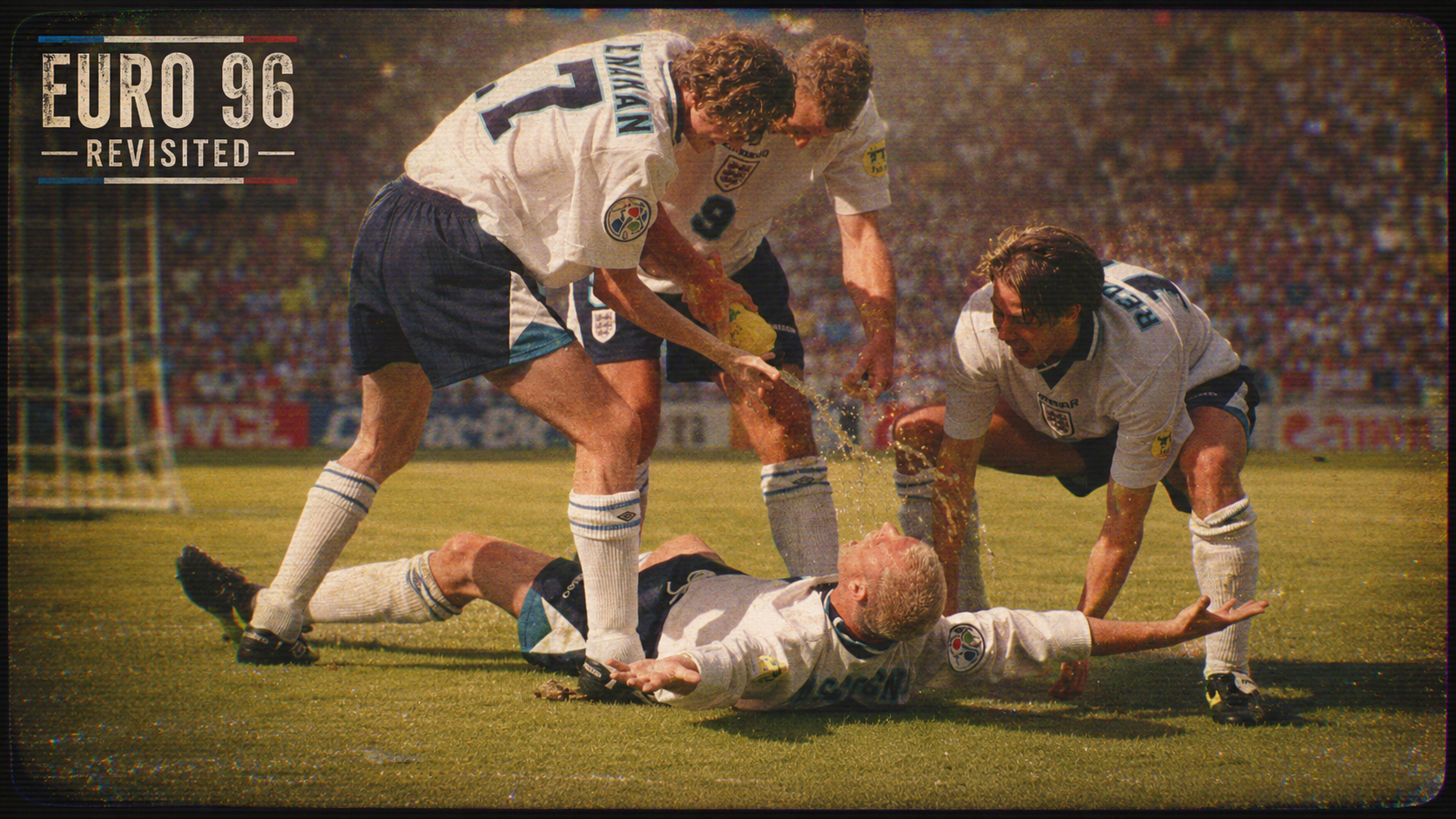
Now he sprinted behind the goal and collapsed onto the turf.
Arms spread wide. Mouth open.
One by one, his teammates arrived carrying water bottles. Teddy Sheringham knelt first. Then Jamie Redknapp. Then Steve McManaman. Liquid sprayed into Gascoigne’s mouth as Wembley roared in delirium around them.
The celebration was not spontaneous. That was what made it extraordinary.
Gascoigne and his teammates had deliberately recreated the drinking game that had nearly destroyed the tournament before it had begun. In front of millions watching live across the country, they turned scandal into theatre and humiliation into defiance.
Even the commentary sounded overwhelmed by the scale of it all.
“Oh brilliant,” shouted John Motson from the BBC gantry. “Oh yes. Oh yes.”
The goal instantly became one of the defining images in English football history. But the deeper reason it endured had less to do with technique than recognition.
Because in that moment, Paul Gascoigne still felt reachable.
Not polished. Not managed. Not protected by layers of media training and corporate choreography. He looked chaotic, emotional, impulsive and entirely alive. The country did not merely admire him that summer. For a few brief weeks, it recognised itself in him.
England had spent years demanding that Paul Gascoigne grow up.
Instead, on a blazing afternoon at Wembley, he dragged the entire country back into adolescence with him.
The Problem With Remembering Gazza
The difficulty with writing about Paul Gascoigne is that everybody already thinks they know him.
Even people who never saw him play carry some inherited version of “Gazza” in their heads. The tears in Turin. The dentist’s chair. The peroxide blond hair. The tabloid front pages. The public collapse. English football has replayed the same handful of images for so long that the real footballer underneath them has gradually blurred into myth.
In modern Britain, Gascoigne exists less as a former midfielder than as a national emotional memory.
That memory is strangely selective.
People remember the vulnerability before they remember the passing range. They remember the chaos before they remember the tactical intelligence. They remember the self-destruction before they remember that, at his peak, he could dominate elite international midfields in a way almost no English player of his generation could.
The caricature eventually swallowed the footballer whole.
Part of that is because Gascoigne arrived at exactly the moment English football was changing beyond recognition.
By the mid-1990s, the Premier League had already begun transforming players into commercial assets as much as athletes. Football was becoming richer, cleaner and more globally marketable. Media training intensified. Sponsorship obligations grew. Clubs wanted controlled personalities. Television wanted reliable stars.
Gascoigne simply did not fit the direction the sport was moving in.
He was too emotional. Too impulsive. Too visible in his flaws.
Even physically, he felt different from the modern footballer who would emerge after him. He was broad through the shoulders, thick through the legs and aggressive in contact. He played with the body language of somebody improvising his way through danger rather than calculating angles in advance.
José Mourinho once described him as “very physical” while also possessing “fantastic characteristics that you need to be a top footballer”. That combination mattered. Gascoigne was not merely a street footballer who entertained crowds. He was a complete midfielder operating inside a football culture that often struggled to understand what it was looking at.
Which is why Euro 96 became so powerful.
The tournament did not simply revive Gascoigne’s reputation. It briefly restored a version of English football that still had room for contradiction. A footballer could be vulnerable and brilliant. Disorganised and decisive. Loved and ridiculed within the same week.
Modern footballers are scrutinised more heavily than ever, yet they often feel less knowable. Elite academies monitor nutrition, psychology, sleep cycles and media behaviour before players even reach the first team. Vulnerability itself is now often managed carefully and revealed strategically, through documentaries, sponsor-approved interviews and curated social media posts.
Gascoigne belonged to the final generation before elite athletes learned how to edit access to themselves.
There was no real separation between the performance and the person. England saw the whole thing unfolding in public. The talent. The insecurity. The recklessness. The need for affection. The inability to hide.
That openness became the source of both his magnetism and his destruction.
Football Was the Only Quiet Place
Long before the tears, the goals and the headlines, there was simply a frightened kid from Gateshead trying to find somewhere his mind would stop racing.
Gascoigne’s childhood was unstable even by the standards of working-class Britain in the 1970s. The family lived for periods in cramped conditions while money drifted constantly in and out of crisis. His father, John, suffered from severe epilepsy. Violence and unpredictability were ordinary parts of daily life.
Then came the moment that seemed to fracture something permanently.
When Gascoigne was ten years old, he witnessed the aftermath of a fatal road accident involving the younger brother of a close friend. The trauma stayed with him for years afterwards. He later spoke openly about obsessive fears around death, compulsive behaviours and uncontrollable tics.
Football was the exception.
“I didn’t have twitches or worry about death when I was playing football,” Gascoigne once admitted.
That line explains more about his career than almost any tactical analysis ever could.
For many elite players, football gradually becomes profession, discipline and ambition. For Gascoigne, it first became escape.
Football did not make Gascoigne feel famous.
It made him feel briefly safe.
England Had Never Seen One Like Him
By the end of the 1980s, English football still distrusted flair.
Technical players existed, but the centre of the English game remained physical and functional. Midfielders were expected to compete first and create second.
Gascoigne arrived like somebody from another football culture entirely.
At Newcastle United, supporters quickly recognised that the rhythm of matches changed when he touched the ball. He received possession on awkward angles, rolled defenders with sudden body feints and dragged games into unexpected spaces.
He wanted risk.
What made him unusual was that he combined that creativity with genuine aggression. Gascoigne tackled hard, demanded the ball constantly and played through contact rather than away from it.
Gary Lineker later described him as “the most naturally gifted English player” of his generation. Teammates often spoke about the same quality in simpler terms: training sessions became unpredictable whenever Gascoigne became involved.
His rise accelerated rapidly. Tottenham Hotspur signed him in 1988 for a British record fee despite strong interest from Manchester United and Alex Ferguson.
Then came Italia 90.
Against Egypt, Belgium and Cameroon, Gascoigne became the emotional and technical centre of Bobby Robson’s side. England’s football loosened around him.
The semi-final against West Germany changed everything.
Gascoigne lunged into a challenge on Thomas Berthold, received a yellow card and instantly realised he would miss the World Cup final if England progressed. The tears arrived before he could suppress them.
In a sporting culture built on emotional restraint, Gascoigne looked startlingly exposed.
Salman Rushdie later captured the reaction perfectly.
“Before Paul Gascoigne, did anyone ever become a national hero and a dead-cert millionaire by crying?”
Italia 90 created “Gazza” as a national figure, but it also planted the foundations for everything that followed afterwards.
England did not fall in love with Gascoigne despite his vulnerability.
It fell in love with him because of it.
Not a Luxury Player
One of the strangest things about Paul Gascoigne’s legacy is how often his football gets softened by memory.
Younger supporters who know him mainly through archive clips often inherit a distorted version of Gascoigne as an entertainer first and footballer second.
The reality was far more intimidating.
At his peak, Gascoigne was one of the most complete midfielders in Europe.
He could dribble through pressure, but he could also dominate physically. He tackled aggressively, accelerated transitions and carried the ball huge distances through midfield. He could manipulate slower games patiently or intensify chaotic ones.
He was not a classic Number 10 drifting delicately between the lines. Nor was he a disciplined controller capable of maintaining perfect structure for ninety minutes.
Gascoigne played emotionally.
The best managers understood this immediately.
Terry Venables did not try to suppress Gascoigne’s unpredictability during Euro 96. He built tactical flexibility around it.
England trained in multiple systems throughout the tournament, shifting between a 4-3-2-1, a 3-5-2 and a variation of 4-3-3 depending on the opposition. Venables encouraged Gascoigne to take the “short route into the box”, arriving late and aggressively into dangerous areas rather than orchestrating safely from deep.
The Scotland goal captured that perfectly. People remember the flick over Colin Hendry because it looked playful. What often gets forgotten is the run itself. Gascoigne covered almost the entire transition at full speed before executing one of the most delicate moments of the tournament.
The violence and subtlety existed together.
But the real footballing peak of his tournament arrived against the Netherlands.
That night at Wembley remains one of the finest England performances of the modern era. More importantly, England were not simply emotional that evening. They were technically superior.
Venables shifted England into a shape that gave Gascoigne greater freedom in the right half-space alongside Paul Ince and Darren Anderton. Suddenly the Dutch midfield faced impossible decisions. Step toward Gascoigne too aggressively and England played through them. Sit deeper and he carried the ball directly into retreating defenders.
Everything England did increased his influence.
Steve McManaman drifted intelligently inside. Teddy Sheringham linked the lines brilliantly. Alan Shearer occupied defenders physically. Behind them all sat Ince, stabilising transitions whenever England lost possession.
For long stretches, Gascoigne looked impossible to contain.
The third goal demonstrated the complete version of him. Receiving possession under pressure, Gascoigne exchanged a rapid one-two with McManaman before brushing aside Aron Winter as he surged into the area. When the cutback eventually reached Shearer through Sheringham’s dummy, Wembley erupted because the move already felt unstoppable.
For the final twenty minutes, England toyed with the Netherlands while Wembley chanted “olé”. Gascoigne, now playing in borrowed boots after forgetting his own pair at the hotel, drifted through midfield controlling possession with outrageous calm.
England briefly looked like the future.
Building a Team Around One Uncontainable Footballer
The defining achievement of Terry Venables at Euro 96 was not motivational.
It was architectural.
England had spent decades trying to force gifted footballers into rigid systems built around caution and physical reliability. Venables reversed the logic entirely. He built England around movement, flexibility and emotional momentum.
At the centre of everything sat Gascoigne.
Venables understood that unpredictability was not a problem to solve but a force to direct.
David Seaman later recalled Venables occasionally asking him to take Gascoigne fishing before matches because he was “winding him up”. Compared to the hyper-controlled environment of modern elite football, the story now sounds almost absurd. Yet it revealed something essential about Venables’ management. He treated psychology as carefully as tactics.
The Scotland match demonstrated his adaptability under pressure.
England’s first-half structure looked congested and awkward. Gareth Southgate, initially pushed into midfield to support Paul Ince, struggled to connect England’s transitions cleanly.
At half-time, Venables changed everything.
Southgate dropped back into defence. Jamie Redknapp entered midfield. England immediately looked calmer in possession and more fluid between the lines. Most importantly, Gascoigne no longer needed to build attacks from deep areas.
He could arrive where he was most dangerous: around the edges of chaos.
The Netherlands match became the clearest example of Venables’ philosophy functioning at elite level.
By 1996, Dutch football still represented sophistication in the English imagination. Ajax had won the Champions League only a year earlier. Yet for one extraordinary evening at Wembley, England looked tactically superior.
Venables created room for Gascoigne rather than trapping him inside structure.
That was the real achievement of Euro 96.
For one brief tournament, England stopped fearing imagination.
England Wanted Him Pure. The Papers Wanted Him Broken.
By the summer of 1996, Paul Gascoigne had become something dangerously valuable inside British culture.
Not merely famous.
Consumable.
The tabloids understood before anybody else that Gascoigne generated huge public emotion. Every version of him sold newspapers. The joyful version. The reckless version. The overweight version. The vulnerable version.
The relationship between Gascoigne and the British press was never really journalism.
It was extraction.
The dentist’s chair incident in Hong Kong exposed the dynamic completely.
England’s pre-tournament trip had initially been designed as a controlled release before the pressure of a home European Championship tightened around the squad.
Then came the nightclub photographs.
Gascoigne and several teammates were pictured participating in a drinking game while reclining backwards in chairs. The images exploded across the tabloids. Suddenly the tournament seemed in danger of collapsing before England had kicked a ball.
The reaction was hysterical.
Newspapers questioned the squad’s professionalism, discipline and patriotism simultaneously. One headline labelled them “DISGRACEFOOLS”. Polls demanded expulsions from the squad.
The hypocrisy underneath it all was astonishing.
The same newspapers that spent years celebrating Gascoigne precisely because he behaved differently now attacked him for failing to resemble a corporate role model.
Inside the England camp, the siege mentality intensified.
Paul Ince later recalled photographers climbing over hedges with ladders simply to capture images of players having a quiet drink away from the training camp.
Venables reacted furiously.
Rather than publicly disciplining the squad, he accused sections of the British press of behaving like “traitors”, actively trying to turn the country against its own national team.
Gascoigne never forgot it.
Years later, after Venables’ death, he broke down while describing him.
“Terry was a f***ing diamond,” he said. “He had to be, to put up with me.”
Venables understood something fundamental that much of the country did not: Gascoigne’s volatility was inseparable from the qualities that made him extraordinary.
Modern football has become highly efficient at eliminating that kind of unpredictability before players ever reach elite level.
Gascoigne arrived just before all of that machinery fully took hold.
Which meant the public saw everything.
The insecurity.
The weight fluctuations.
The need for affection.
The humour.
The damage.
Nothing felt hidden.
The Missed Inch
The semi-final against Germany is usually remembered through the penalty shootout.
Which is understandable, but incomplete.
Because long before Gareth Southgate’s penalty rolled toward Andreas Köpke, England had already lived through the defining moment of the match.
Extra time had dragged both teams into exhaustion. Germany controlled space calmly as they always seemed to do in major tournaments, slowing the mood of the game whenever England threatened to accelerate it.
Then suddenly England almost won it.
Alan Shearer hooked a low cross through the German six-yard box. Gascoigne was arriving at the back post completely unmarked.
For one instant, time seemed to fracture.
Gascoigne lunged forward, right leg extended desperately toward the ball as it skipped across the turf in front of him.
Had he made contact, England would have reached the final under the golden-goal rule.
Instead, he missed it by inches.
Years later, the moment became surrounded by strange football folklore. Gascoigne had reportedly forgotten his boots at the team hotel and borrowed a pair from Teddy Sheringham before the match.
The mythology survives because it feels emotionally true.
The great improvisational football genius arriving at the defining moment of his career in borrowed boots.
The semi-final itself became increasingly physical as extra time wore on. Gascoigne looked exhausted. So did everybody else.
Paul Ince later admitted the emotional energy expended against the Netherlands had probably taken something irreplaceable out of the squad.
When Southgate’s penalty was saved, the emotional collapse felt immediate and total.
But the missed chance from Gascoigne lingered differently.
Because it felt like the edge of an era disappearing.
Euro 96 had briefly allowed England to imagine itself differently. More expressive. More tactically modern. Less burdened by its own insecurities.
And then suddenly Gascoigne could not quite reach the ball.
The Dentist’s Chair
The goal against Scotland survives in English football memory because it seemed to contain every version of Paul Gascoigne simultaneously.
The footballer.
The entertainer.
The rebel.
The damaged boy.
The national hero.
The warning sign.
The dentist’s chair celebration looked joyous in the moment because England needed it to look joyous.
But the celebration was not simply spontaneous relief.
It was public retaliation.
Gascoigne understood exactly what he was doing when he lay down on the Wembley turf and invited his teammates to recreate the Hong Kong photographs. The gesture mocked the entire moral panic surrounding the squad.
Within hours, newspapers that had spent days denouncing him transformed themselves into willing participants in the redemption narrative.
One paper apologised directly to him on its front page. Others suddenly rediscovered his “genius”.
Gascoigne seemed to understand the contradiction instinctively.
Years later, Jamie Redknapp recalled asking him whether he ever teased Colin Hendry or Ally McCoist about the Scotland goal afterwards.
“I never said a word,” Gascoigne smiled. “Because I knew I’d already damaged them.”
That line captured the psychological edge underneath his humour.
Viewed through modern eyes, the celebration now carries a different weight.
The joy and the self-destruction exist side by side in the same frame.
Gascoigne lying flat on his back while liquid poured into his mouth became, retrospectively, an almost painfully loaded image.
Yet the deeper tension underneath the celebration was always about ownership.
England loved Gascoigne most intensely when he seemed emotionally open and publicly available.
But that same openness left him permanently exposed.
Modern athletes survive partly through distance. Public relations teams create barriers. Interviews become rehearsed performances. Vulnerability is carefully managed because the scrutiny surrounding elite sport has become relentless.
Gascoigne existed before those walls fully arrived.
The country saw everything.
And because it saw everything, it eventually felt entitled to everything too.
Why England Still Searches for Another Gazza
English football has produced greater careers than Paul Gascoigne’s.
Wayne Rooney broke records. David Beckham became a global phenomenon. Steven Gerrard and Frank Lampard dominated the Premier League for years. Jude Bellingham may eventually become the most complete English midfielder of them all.
And yet none of them have occupied quite the same emotional space in the national imagination.
That is not criticism of those players. It is recognition that the relationship between footballers and the public fundamentally changed after Euro 96.
Modern footballers are shaped from adolescence inside highly controlled systems. Nutritionists regulate diets. Sports psychologists regulate emotional responses. Media teams regulate language. Every public appearance carries commercial implications.
Players now reveal personality strategically. Vulnerability often arrives packaged carefully through documentaries, sponsor-approved interviews or tightly managed social media accounts.
Gascoigne never learned how to do that.
Which was why supporters connected with him so intensely.
He looked vulnerable in public. Not strategically vulnerable. Actually vulnerable.
There was no visible barrier separating the footballer from the person underneath.
For one generation especially, Gascoigne came to represent the fantasy that elite footballers still belonged emotionally to ordinary people.
And football itself amplified the feeling.
Gascoigne played with visible risk. He attempted passes other players would avoid. He accelerated into pressure rather than away from it. Even his body language felt different from the optimised movements of the modern game.
That kind of footballer has become increasingly rare.
Not because creativity disappeared, but because modern elite structures reward repeatability above all else.
Venables understood this tension instinctively. His greatest achievement at Euro 96 was not merely tactical flexibility. It was his willingness to build around personality rather than suppress it.
Modern football rarely allows that level of emotional messiness anymore.
Which is partly why England has spent the past three decades searching for another player who makes the national team feel the way Gascoigne once did.
Not simply exciting.
Reachable.
The irony, of course, is that the qualities which made the country love him were the same qualities that later left him exposed to exploitation, addiction and collapse.
England never really knew how to protect what it loved most about him.
Perhaps that is why the memory of him remains so powerful all these years later.
Not because he represented perfection.
Because he never once looked like he was pretending to be perfect.
Suspended in the Summer Light
In the years since Euro 96, English football has tried repeatedly to recreate the feeling of that summer.
Sometimes through nostalgia.
Sometimes through marketing.
Sometimes through the desperate belief that one more tournament run might reconnect the country to itself again.
But the emotional atmosphere of Euro 96 was never only about results.
It was about recognition.
For a few weeks, England watched a football team that felt emotionally exposed in public. The players were talented, flawed, excitable and occasionally chaotic. They looked close enough to touch.
And at the centre of all of it stood Paul Gascoigne.
Not as a symbol of perfection.
Not even as a symbol of victory.
As something far rarer.
A genuinely human superstar.
The Premier League eventually expanded into a global machine. Footballers became brands. Clubs became corporations. Emotional exposure became dangerous.
Gascoigne never really built those walls.
Which is why he still feels strangely close all these years later, even after everything that followed.
And perhaps that is the final reason the Scotland goal continues to endure so vividly in English football memory.
Not simply because of the technique.
Because for one perfect moment, suspended in the heavy Wembley summer light, Paul Gascoigne looked entirely free.
The ball dropping out of the sky.
Colin Hendry twisting helplessly beneath it.
The volley flashing past Andy Goram.
Then Gascoigne lying flat on the turf with his arms spread wide while the stadium lost its mind around him.
England has spent thirty years searching for footballers who make it feel like that again.
Nobody quite has since.
