


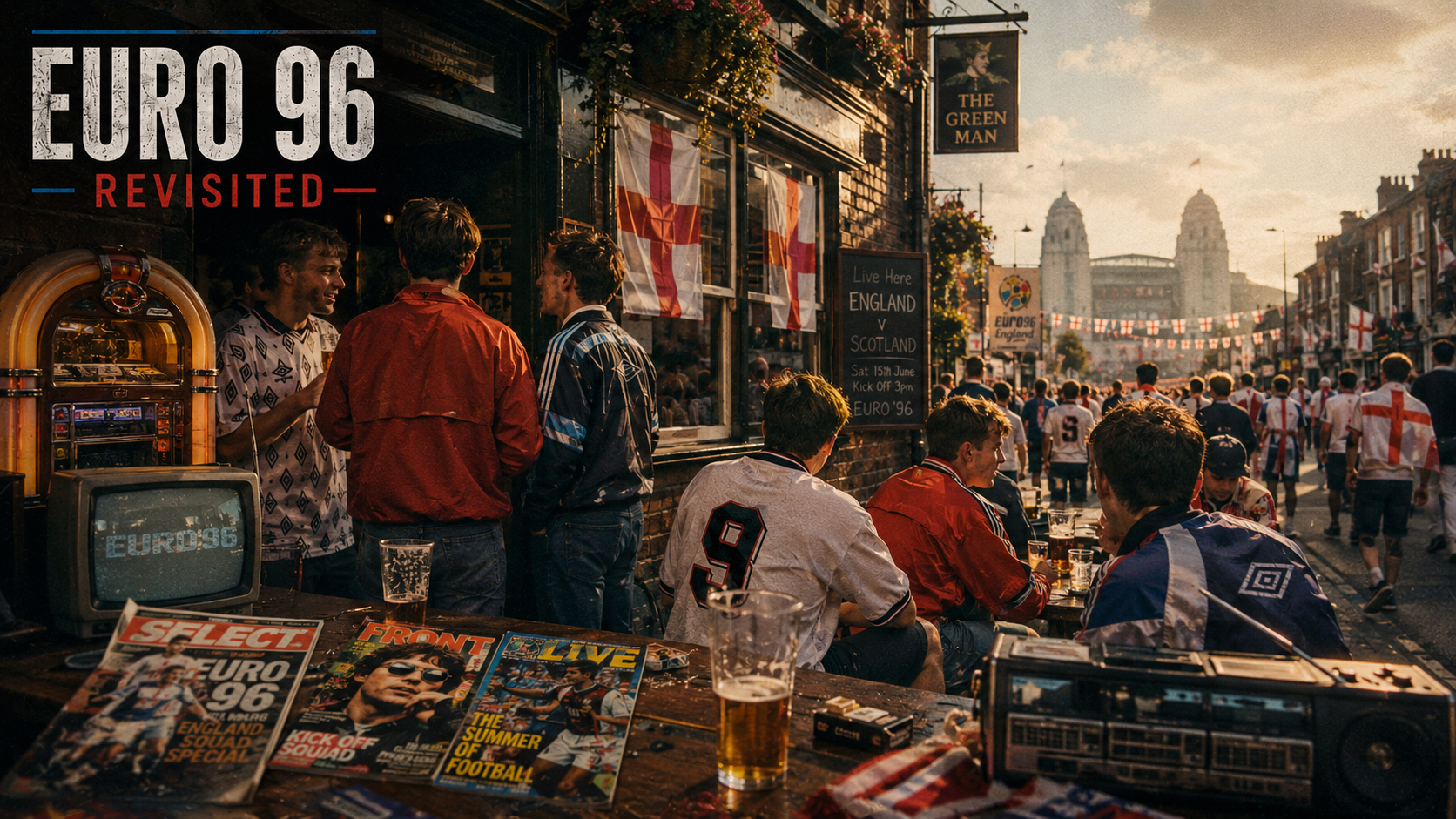
Euro 96 did not simply happen during Britpop. It became the football stage for the same cultural shift: a country trying to sell itself as young, stylish, confident and emotionally renewed.
Key Takeaways
- Euro 96 arrived at the exact moment football moved from social problem to mainstream lifestyle culture.
- Britpop and football shared the same emotional language: regional pride, class tension, nostalgia, swagger and insecurity.
- Three Lions worked because it made English doubt sound communal rather than embarrassing.
- The tournament helped turn football into a fashionable, marketable cultural product without yet losing its human scale.
Football Walks Into Pop Culture
By the summer of 1996, football no longer felt sealed inside football grounds.
It had spilled out into the rest of British life.
You could see it before a ball had even been kicked at Euro 96. England shirts appeared in places they traditionally did not belong, worn not only by hardened supporters heading toward stadiums but by teenagers wandering through shopping centres, students drinking outside pubs, musicians on magazine covers, office workers finishing early on warm afternoons, and families preparing for barbecues with radios balanced on windowsills. Football clothing had escaped the matchday ritual and entered the wider cultural bloodstream.
The details mattered.
Umbro drill tops. Adidas Gazelles. Parkas despite the heat. Fred Perry polos. Cheap lager sweating on sticky pub tables. Liam Gallagher haircuts. St George’s Cross flags hanging from upstairs windows in streets that would not normally display any public form of English identity at all. Every pub seemed to have suddenly acquired extra television screens. Every radio station sounded as though it was alternating between Oasis, Blur, Pulp and discussions about England’s chances.
Football was no longer merely being watched.
It was being lived as culture.
That transformation had taken years to build, but Euro 96 became the moment when all the separate strands finally locked together. Music, fashion, television, advertising, politics and football briefly moved in rhythm with one another. Looking back now, what feels striking is not simply the optimism of the period, but the unusual sense of cultural alignment. Britain rarely sustains unified moods for very long. The country is normally too suspicious of itself, too regionally fragmented, too class-conscious to move with any shared emotional momentum. Yet for a few weeks in the summer of 1996, the nation appeared to discover a common aesthetic language.
Football sat directly at the centre of it.
Only a decade earlier, that would have sounded absurd. English football in the 1980s carried the image of social decline. Stadium disasters, hooliganism, crumbling infrastructure and international embarrassment had turned the domestic game into something much of respectable Britain preferred to keep at arm’s length. Football was often framed politically and culturally as a problem to manage rather than an identity to celebrate. Supporters were treated with suspicion. Grounds looked tired and hostile. Television coverage felt functional rather than glamorous.
But the 1990s altered the texture of the sport.
The formation of the Premier League in 1992 accelerated the process dramatically. Sky Sports repackaged football as premium entertainment, using cinematic advertising, hyper-saturated visuals and emotional storytelling to reposition the game for a new audience. Stadiums became cleaner, safer and more commercially polished following the Taylor Report reforms. Clubs modernised their branding. Replica shirts evolved into fashion products. Players stopped looking like anonymous sportsmen and started resembling celebrities.
Yet infrastructure and television alone were not enough to change football’s emotional status within British culture.
Football needed youth culture to adopt it.
That is what happened in the mid-1990s.
Britpop arrived at exactly the right moment. The movement was not simply a musical trend but a broader performance of British identity. It rejected the gloomy introspection of American grunge and instead embraced regional accents, terrace humour, kitchen-sink storytelling and a deliberately exaggerated sense of Britishness. Oasis, Blur and Pulp each approached that identity differently, but all of them drew energy from ideas football supporters immediately recognised: tribal rivalry, local pride, masculine performance, class anxiety and collective release.
The connection between football and Britpop therefore felt natural rather than manufactured.
Oasis embodied the swagger of the terraces. Liam Gallagher looked less like a conventional rock star than someone who had wandered onto the stage directly from the Kippax. Blur approached English identity with irony and self-awareness, turning suburban awkwardness and national habits into performance art. Pulp understood the social discomfort and class performance sitting underneath modern British life better than almost anyone. Even the structure of Britpop itself resembled football culture. Bands represented cities and regions. Fans argued over authenticity. Rivalries became tribal and emotionally loaded. Music journalism covered Blur versus Oasis with the same intensity and territorial language usually reserved for title races or derby matches.
By 1996, the boundaries separating football from wider youth culture had almost entirely collapsed.
Magazine covers captured the shift perfectly. Musicians appeared in football shirts. Footballers appeared in fashion spreads. The language of the terraces migrated into advertising campaigns and television comedy. Fantasy Football League transformed football discussion into mainstream entertainment built around irony and self-deprecation. Loaded magazine fused drinking culture, laddish humour and football obsession into a new version of masculinity that dominated the decade. Football had become fashionable precisely because it no longer belonged solely to football supporters.
That distinction matters.
The transformation of football during Euro 96 was not simply about popularity. Football had always been popular. The change was cultural legitimacy. By the mid-1990s, football no longer represented social embarrassment or industrial decline. It represented energy, humour, style, youth and commercial possibility. Politicians wanted to associate themselves with it. Advertisers built campaigns around it. Musicians wrapped themselves in its symbolism. Fashion borrowed from its terraces. Television reinvented itself through its rhythms and emotions.
For the first time in modern British history, football felt culturally central rather than culturally separate.
Euro 96 became the perfect stage for that shift because the tournament itself seemed to embody the emotional contradictions of the country. Britain in 1996 projected confidence, but underneath the swagger sat insecurity and longing. The economy was recovering. Tony Blair’s New Labour was rising. “Cool Britannia” suggested a country rediscovering its cultural confidence after years of post-industrial pessimism. Yet much of the national mood still depended on nostalgia, irony and references to past glories.
That emotional mixture defined football too.
The genius of Three Lions was not that it sounded triumphant. It sounded wounded. The song acknowledged failure while still insisting on hope. That combination of melancholy and belief became the emotional key to the entire summer. It allowed English football culture to feel expressive without becoming aggressively nationalistic. The old triumphalist language of sporting patriotism was replaced by something more vulnerable, self-aware and emotionally open.
That vulnerability helped make football feel modern.
But the transformation came with contradictions that were already visible beneath the surface. As football became more fashionable, it also became more commercial. As the game embraced working-class aesthetics, many traditional supporters found themselves increasingly priced out of the new all-seater era. Lad culture celebrated ordinary masculinity while simultaneously hiding misogyny behind irony and “banter.” Football was becoming more inclusive in some ways and more corporatised in others.
Euro 96 sat directly in the middle of that tension.
That is partly why the tournament still feels so vivid nearly three decades later. It captured a fleeting moment before football became fully globalised, algorithmic and hyper-commercialised. The sport was modern enough to feel exciting, glossy and culturally dominant, but still local enough to feel rooted in real places, accents and communities.
For one summer, football seemed capable of carrying the entire emotional mood of the country.
And for one summer, the country allowed it to.
Britpop Did Not Soundtrack Euro 96. It Explained It.
One of the easiest mistakes to make when revisiting Euro 96 is to treat Britpop as decorative background noise.
The temptation is understandable. The songs remain everywhere in the memory of the tournament. Oasis blasted from pub jukeboxes. Blur songs leaked from passing car windows. Pulp lyrics seemed to capture the awkward social aspirations of the decade. Three Lions became inseparable from the image of England supporters bouncing through summer streets beneath St George’s Cross flags.
But Britpop did not merely accompany Euro 96.
It provided the emotional grammar for the entire tournament.
That distinction matters because it explains why the summer still feels culturally coherent in hindsight. Euro 96 was not simply football taking place at the same time as a successful music movement. Both belonged to the same wider attempt to reinvent British identity during the mid-1990s. Music, football and politics were all wrestling with identical questions: how could Britain appear modern without abandoning nostalgia? How could the country project confidence while still carrying the emotional baggage of decline? And how could national pride be expressed without collapsing into the uglier forms of nationalism associated with the previous decades?
Britpop answered those questions before football fully realised it was asking them.
At its core, the movement was an attempt to reclaim Britishness from embarrassment. The dominant mood of early-1990s British culture had been shaped partly by American influence. Grunge arrived from Seattle carrying introspection, alienation and emotional heaviness. Britpop reacted against that atmosphere almost aggressively. It replaced rain-soaked self-destruction with melody, swagger, humour and local identity. Suddenly, regional accents were not obstacles to success but central parts of the performance. British references were no longer hidden or softened for international audiences. The music embraced buses, betting shops, tower blocks, football terraces, cheap pubs, kebab shops and awkward suburban life.
Football recognised itself immediately inside that world.
The emotional architecture of Britpop mirrored football culture almost perfectly. Both revolved around tribal loyalty, regional rivalry, memory, longing and public performance. Oasis and Blur were framed less like ordinary bands and more like competing football clubs representing different visions of England. Oasis carried the force of working-class northern swagger, fuelled by Manchester identity and terrace aggression. Blur approached Englishness through irony and observation, packaging southern middle-class awkwardness into art-school cool. Pulp sat somewhere outside the rivalry entirely, documenting class aspiration and social discomfort with the eye of detached sociologists.
The music press understood instinctively how football language could intensify these rivalries. The so-called Battle of Britpop between Oasis and Blur during the summer of 1995 was covered like a title race. Chart positions became league tables. Fans picked sides with almost territorial loyalty. Authenticity mattered. Regional identity mattered. Even clothing choices mattered. The entire structure resembled football culture translated into pop music.
That crossover accelerated once football itself became commercially attractive.
The rise of the Premier League transformed the visual language of the sport. Sky Sports coverage moved away from muddy realism and toward cinematic spectacle. Football broadcasts suddenly looked brighter, louder and more emotionally choreographed. Advertising campaigns borrowed from music-video aesthetics, using fast cuts, dramatic lighting and anthemic soundtracks. Football shirts evolved into desirable fashion objects. Stadiums became cleaner and more camera-friendly. Players became recognisable celebrities rather than distant athletes.
Britpop entered this newly polished football landscape almost seamlessly because the movement already traded in many of the same ideas: youth, confidence, locality, masculine performance and carefully managed authenticity.
That word mattered enormously in the 1990s.
Authenticity became the decade’s cultural obsession precisely because so much of Britain was changing underneath it. The economy was modernising. The old industrial working class was shrinking. Consumer culture was accelerating. Politics was becoming increasingly media-driven. Against that backdrop, football and Britpop both offered a version of British identity that still felt grounded in recognisable places and people. Oasis looked like they belonged in ordinary pubs. Football shirts still represented towns and cities rather than global marketing departments. Terrace fashion carried a sense of inherited local knowledge. Even the rough edges of lad culture were marketed as proof that this was all somehow real.
In truth, much of it was already performance.
That was the deeper contradiction sitting underneath Cool Britannia. Britain was selling authenticity at the exact moment it was becoming increasingly commercialised. Football supporters were encouraged to celebrate working-class aesthetics while the modernised game itself became steadily more expensive and corporatised. Britpop fetishised ordinary life while rapidly turning musicians into global celebrities. Laddishness performed rebellion while being packaged through glossy magazines and advertising campaigns.
Euro 96 sat directly in the centre of that contradiction.
The tournament felt spontaneous and communal, yet almost every aspect of it had been carefully polished into marketable national imagery. The St George’s Cross transformed from a symbol associated with far-right fringe politics into something fashionable and celebratory. Football songs became chart hits. Pub culture became part of the national brand. England supporters were no longer framed solely as dangerous or embarrassing but as colourful contributors to a huge summer festival.
Britpop helped make that transformation emotionally acceptable.
Its greatest achievement was turning nostalgia into energy rather than sadness. The movement constantly referenced older versions of Britain: the Beatles, mods, terrace culture, 1966, working men’s clubs, old sitcoms, seaside holidays and post-war optimism. Yet it repackaged those references as youthful and contemporary rather than mournful. Euro 96 did the same thing. The entire slogan of “Football’s Coming Home” depended on nostalgia, but nostalgia presented as possibility instead of grief.
That emotional trick was incredibly powerful.
For a few weeks, Britain convinced itself that the future and the past could comfortably coexist. The country could modernise without losing itself. Football could become fashionable without losing authenticity. Patriotism could become celebratory rather than aggressive. Pop music could become commercially dominant without surrendering regional identity.
Looking back now, some of those beliefs seem naive. Others were outright illusions. But during the summer of 1996, the alignment felt completely real.
That is why Britpop matters to the story of Euro 96.
Not because the songs happened to be popular at the same time.
But because the music explained the emotional logic of the entire country.
When Football Became a Lifestyle
Before the 1990s, English football largely existed in its own social compartment.
People either followed it obsessively or kept a certain distance from it. There was very little middle ground.
Football supporters were overwhelmingly associated with working-class masculinity, tribal aggression and physical matchday culture. The game carried an atmosphere that many institutions regarded with suspicion. Politicians spoke about football crowds as public-order risks. Broadcasters treated the sport carefully. Mainstream advertisers approached it cautiously. Fashion ignored it almost entirely unless borrowing ironically from terrace culture. Even successful footballers often existed outside the wider celebrity ecosystem. They were famous athletes rather than cultural figures.
By Euro 96, that separation had collapsed.
Football no longer functioned simply as sport. It had become lifestyle.
That transformation happened gradually, then suddenly.
The creation of the Premier League in 1992 was the structural turning point. The deal with Sky Sports fundamentally altered how football presented itself visually and emotionally. English football stopped marketing scarcity and started marketing spectacle. Camera angles improved. Graphics became more dramatic. Music became more cinematic. Television coverage increasingly borrowed techniques from entertainment programming and advertising rather than traditional sports broadcasting.
Sky understood something vital before most football institutions did.
The sport itself was not the only product.
The atmosphere, aesthetics, personalities and emotional identity surrounding football could all be monetised too.
The famous “A Whole New Ball Game” campaign captured that shift perfectly. Football was no longer framed as muddy Saturday endurance watched by hardened loyalists. It became premium drama. Bright floodlights. Slow-motion tackles. Sweeping crowd shots. Pulsing music. Heroic close-ups. The modern football supporter was not simply attending matches anymore. He was consuming identity.
That consumption spread rapidly into wider culture.
The new all-seater stadiums accelerated the process. Following the Taylor Report reforms after Hillsborough, grounds became safer, cleaner and more commercially attractive. Hospitality expanded. Families returned. Middle-class audiences who might previously have avoided football grounds now entered the sport more comfortably. Corporate investment increased. Replica shirts became fashion items rather than purely supporter uniforms.
Paradoxically, the more football modernised, the more aggressively it marketed authenticity.
That contradiction sat at the heart of the decade.
The game increasingly sold itself through working-class aesthetics even as many traditional working-class supporters found themselves financially squeezed out of the new Premier League environment. Terrace culture became aspirational branding. Regional accents became commercially useful. Ordinary-bloke masculinity became a media product.
Football’s crossover with Britpop accelerated this dramatically.
The Gallagher brothers were central to that process because they blurred the distinction between pop star and football supporter almost entirely. Liam Gallagher wearing Umbro drill tops and parkas did not feel like celebrity styling in the modern sense. It felt like terrace culture invading mainstream entertainment. When Oasis performed at Maine Road in 1996, the imagery carried enormous symbolic power. A rock band was no longer borrowing football aesthetics ironically or occasionally. Football itself had become one of the primary visual languages of British youth culture.
Other musicians followed similar patterns.
Damon Albarn embraced football references with a more self-aware theatricality. Jarvis Cocker documented class anxieties and social awkwardness that football supporters immediately recognised from ordinary British life. The lines separating music audiences and football crowds increasingly disappeared because they were often composed of the same people wearing the same clothes and consuming the same media.
Fashion brands recognised the opportunity instantly.
The rise of terrace casual culture during the 1980s had already established football supporters as influential trendsetters, but Euro 96 pushed those aesthetics fully into the mainstream. Parkas, track tops, polo shirts and trainers stopped functioning as purely subcultural signals and became national uniform. Umbro, Adidas, Kappa and Fred Perry were no longer simply sportswear manufacturers. They became architects of mid-1990s British identity.
Football shirts themselves underwent a psychological transformation.
Before the Premier League era, replica kits were often worn primarily by children or committed matchgoing supporters. By 1996, adults wore football shirts casually in pubs, clubs, concerts and public spaces. Shirts represented belonging. They projected humour, locality and emotional allegiance. Wearing football clothing no longer marked someone as outside respectable culture. It increasingly marked them as culturally fluent.
Advertising campaigns accelerated the shift even further.
Nike’s famous “Good vs Evil” commercial during Euro 96 represented a completely different philosophy of football marketing. Eric Cantona and a multinational collection of stars battled demonic opponents inside a gothic stadium illuminated like a fantasy film. The commercial barely resembled traditional sports advertising. It looked closer to cinema or music television. Footballers were reimagined not simply as athletes but as mythological figures occupying a shared entertainment universe.
Coca-Cola approached the same audience differently but with equal sophistication. Their Euro 96 campaigns emphasised humour, terrace passion and grassroots fandom, using music and self-deprecation to make football feel emotionally accessible rather than intimidating. The message underneath both campaigns was similar: football was no longer separate from mainstream culture. It was mainstream culture.
Even television comedy reflected the change.
Fantasy Football League captured something essential about the mid-1990s because it allowed football obsession to become socially acceptable entertainment rather than niche male fixation. The programme replaced tactical seriousness with irony, nostalgia and sofa-based banter. Watching football became conversational rather than confrontational. The emotional tone shifted from aggression toward humour and collective recognition.
That tonal change mattered enormously.
English football had spent much of the 1980s associated internationally with fear, disorder and violence. Euro 96 presented an entirely different image: colourful, ironic, emotional, communal and commercially polished. Football still carried tribal energy, but now it was packaged as entertainment rather than threat.
The transformation of the supporter was central to that process.
The idealised supporter of Euro 96 was no longer the dangerous hooligan of 1980s headlines. He became the “new lad”: emotionally expressive but protected by irony, patriotic but supposedly non-threatening, beer-drinking but media-savvy, nostalgic but commercially useful. Lad culture magazines such as Loaded amplified this identity relentlessly, packaging football, drinking, music and casual masculinity into a single lifestyle product.
Of course, much of that culture contained obvious problems. Misogyny frequently hid beneath the humour. Irony became a shield protecting behaviour from criticism. National identity occasionally drifted toward uglier territory beneath the self-awareness. But commercially, the formula worked perfectly.
Football became aspirational without fully abandoning its roughness.
That balance explains why Euro 96 still feels culturally unique.
The tournament arrived during a narrow historical window when football was modern enough to dominate mainstream culture but still rough-edged enough to feel emotionally authentic. The game had not yet become fully globalised content optimised for digital audiences. Clubs still felt deeply local. Supporters still experienced football physically rather than primarily online. Pop culture still revolved around shared national moments rather than fragmented algorithms.
For one brief period, football became the organising principle for an entire national mood.
And Britain willingly built its identity around it.
The Song That Made Doubt Sound Like Belief
No piece of music explains England better than Three Lions.
Not because it is the most musically sophisticated song of the Britpop era. It is not. Nor because it is the loudest, cleverest or most culturally ambitious. The song endures because it captured something English football had never previously articulated properly: the emotional contradiction of believing while fully expecting disappointment.
That tension sat at the heart of Euro 96.
For decades, football songs had usually relied on certainty. They tended to present national teams as invincible forces marching inevitably toward glory. Triumph was assumed. National pride was performed loudly and aggressively. The emotional language was military, triumphant and occasionally ridiculous.
Three Lions rejected almost all of that.
Released in May 1996 by David Baddiel, Frank Skinner and Ian Broudie of the Lightning Seeds, the song immediately sounded different from the usual machinery of tournament patriotism. Its opening moments were not triumphant at all. Instead, they carried exhaustion and memory. Crowd noise faded underneath references to years of failure, near misses and inherited disappointment. The famous refrain, “Thirty years of hurt,” acknowledged something England supporters recognised instinctively: supporting the national team often felt emotionally irrational.
That honesty changed everything.
The genius of the song lay in its refusal to present hope as certainty. England were not framed as favourites destined to reclaim their throne. The team were framed as emotionally damaged dreamers trapped inside recurring cycles of optimism and collapse. The chorus did not announce victory. It announced longing.
“Football’s coming home” functioned less as a statement of confidence than an act of magical thinking.
That distinction explains why the song connected so powerfully across the country. It reflected the psychological condition of English football support more accurately than any previous anthem had managed. The lyrics understood that England fans were shaped by memory almost as much as live experience. 1966 hovered permanently in the background of every tournament, not simply as triumph but as emotional burden. Each new competition carried decades of accumulated anxiety.
Britain in the mid-1990s understood that emotional mixture deeply because the country itself was wrestling with similar contradictions.
The era projected confidence externally while carrying huge internal insecurities. “Cool Britannia” suggested renewal and modernity, yet much of the decade’s cultural output remained obsessed with nostalgia, memory and national decline. Britpop celebrated Britain while constantly referencing older versions of it. Politicians spoke about renewal while invoking lost greatness. Fashion recycled terrace culture and mod imagery from earlier generations. Even football’s commercial rebirth depended heavily on emotional references to tradition and authenticity.
Three Lions distilled all of those tensions into three and a half minutes.
That is why the song felt larger than football almost immediately.
It became communal language.
During Euro 96, entire streets, pubs and stadiums began singing the chorus not as performance but as emotional release. The song travelled because it balanced irony and sincerity perfectly. English culture traditionally struggles with open emotional expression, particularly masculine emotional expression. Irony often functions as protective armour against embarrassment. Three Lions solved that problem elegantly. The humour and self-awareness made public vulnerability socially acceptable.
People could sing about failure while still believing.
That emotional permission mattered enormously during Euro 96 because the tournament itself increasingly resembled the structure of the song. England stumbled uncertainly through the opening match against Switzerland. They then exploded emotionally against Scotland and the Netherlands. The country oscillated wildly between scepticism and euphoria, exactly as the lyrics anticipated. Every victory felt fragile. Every hopeful moment carried awareness of what might eventually go wrong.
The song therefore became less soundtrack than prophecy.
Its emotional climax arrived not during the final but during the semi-final defeat against Germany. When Gareth Southgate’s penalty was saved and Wembley fell silent, Three Lions suddenly sounded devastatingly accurate rather than optimistic. The dream collapsed exactly as the song itself had quietly warned it probably would.
That heartbreak strengthened the anthem permanently.
If England had won Euro 96, the song might eventually have become trapped inside uncomplicated nostalgia. Instead, defeat preserved its emotional tension forever. The lyrics remained unresolved. Hope survived, but only barely. That uncertainty allowed future generations to project themselves into the song repeatedly during every subsequent tournament.
Few sporting anthems possess that adaptability.
Most are tied rigidly to specific victories or eras. Three Lions remained alive because it described a recurring national condition rather than a single football moment. It articulated the exhausting cycle of expectation, memory, embarrassment and stubborn hope that continued defining England supporters long after Euro 96 ended.
The song also played a crucial cultural role during the wider Cool Britannia period.
Importantly, it softened English nationalism at a moment when overt patriotism still carried uncomfortable associations. The St George’s Cross had spent much of the 1970s and 1980s linked publicly with hooliganism and far-right politics. Euro 96 helped reclaim the flag as something more communal and celebratory, but Three Lions made that transition emotionally possible because the song’s patriotism never felt aggressive.
It sounded wounded rather than dominant.
That vulnerability mattered enormously. England supporters could wave flags, sing loudly and embrace national identity without sounding militaristic or triumphalist. The emotional tone became self-deprecating, melancholic and oddly humble. In many ways, Three Lions turned patriotism into shared therapy.
No previous football anthem had achieved that.
The timing amplified everything further.
Britpop was already dominating British cultural life by 1996, but Three Lions crossed boundaries even Britpop rarely reached. It was sung by children, office workers, taxi drivers, students and grandparents. It escaped subculture entirely. Unlike many songs associated with Cool Britannia, it did not belong to one scene or demographic. It became social glue.
And unlike many other cultural products from the era, it never fully disappeared. The Official Charts Company records its repeated returns to No.1, including its original 1996 success and later revivals.
That endurance reveals something profound about both Euro 96 and modern England. The country continues returning to the song because the emotional conditions that created it never completely vanished. England supporters still carry historical memory like inherited trauma. Every tournament still reopens old psychological wounds. Hope still arrives wrapped in embarrassment and caution.
That is why Three Lions still feels alive while so many other Britpop artefacts now feel trapped inside museum nostalgia.
The song did not simply soundtrack Euro 96.
It explained the emotional architecture of modern England.
The New Lad and the Problem Beneath the Joke
The dominant male figure of Euro 96 was not the football hooligan.
Nor was it the polished metrosexual footballer who would arrive in the 2000s.
It was the new lad.
To understand the emotional atmosphere of Euro 96 properly, it is necessary to understand how masculinity was being reconstructed during the mid-1990s. Much of the decade’s cultural identity rested on a carefully managed balancing act between vulnerability and bravado, sincerity and irony, emotional openness and emotional avoidance. Football sat directly inside that negotiation.
The new lad emerged partly as a backlash.
During the late 1980s, British media had flirted with the idea of the “new man”: emotionally articulate, domesticated, politically aware and comfortable with feminism. By the mid-1990s, parts of male culture reacted against that image aggressively. Publications like Loaded magazine championed a return to drinking, football obsession, laddish humour and prolonged adolescence. The tone was deliberately irreverent. Responsibility became unfashionable. Seriousness became suspect.
Yet the movement was more complicated than simple regression.
The defining feature of lad culture was irony.
That irony functioned as protective camouflage. Men could perform exaggerated masculinity while pretending not to fully mean it. Heavy drinking became banter. Emotional immaturity became comedy. Sexual objectification became framed as self-aware humour rather than outright misogyny. Football tribalism became entertainment rather than genuine aggression. The joke protected the performer from criticism because sincerity itself became culturally dangerous.
Euro 96 unfolded perfectly inside that atmosphere.
The tournament’s emotional power depended heavily on the strange combination of emotional openness and ironic distance that defined the era. England supporters cried openly, sang collectively and embraced strangers in pubs and streets. Yet almost every moment of vulnerability was buffered through humour, self-awareness or performative exaggeration. People could care deeply precisely because the culture gave them ways to pretend they did not care too deeply.
Fantasy Football League captured this tonal shift brilliantly.
The programme transformed football discussion from combative expertise into ironic communal entertainment. David Baddiel and Frank Skinner approached football not as tactical analysts or authoritative broadcasters but as emotionally damaged supporters trying to process the absurdity of fandom itself. The show normalised football obsession for wider audiences because it refused to take itself entirely seriously.
That tone fed directly into Three Lions.
The song’s emotional intelligence depended on understanding how English masculinity processed disappointment. The lyrics admitted vulnerability, but always with enough humour to prevent embarrassment. The supporters singing it in pubs and stadiums could therefore express longing, sadness and hope without feeling culturally exposed.
Football became emotionally accessible because irony softened the risk of sincerity.
This mattered politically too.
England in the 1990s was attempting to reinvent itself after years of social division, economic upheaval and reputational decline. The country wanted to appear more modern, optimistic and culturally confident, but traditional forms of English nationalism still felt uncomfortable after the violence and ugliness associated with parts of football culture during the 1980s.
Lad culture provided an awkward solution.
It allowed men to perform patriotism in a deliberately unserious register. Flags could be waved. Songs could be sung. Entire pubs could erupt emotionally. Yet the humour surrounding the culture created plausible deniability. The atmosphere felt rowdy and emotional rather than overtly ideological.
That balance helped transform football support into something commercially usable.
The supporter of Euro 96 was increasingly marketed not as a dangerous extremist but as a lovable, slightly chaotic everyman. Beer commercials, magazine covers and television programmes all reinforced this image relentlessly. The idealised supporter drank too much, shouted at televisions, wore football shirts casually and behaved irresponsibly, but fundamentally remained harmless.
Reality, of course, was more complicated.
The violence and uglier nationalism of earlier decades had not vanished completely. Xenophobia still surfaced repeatedly during the tournament, particularly in sections of the tabloid press. Misogyny remained embedded throughout much of lad culture. Women were often treated as decorative accessories inside media aimed at men. Irony frequently acted less as genuine self-awareness than as permission to avoid accountability.
Yet despite those problems, Euro 96 undeniably softened the emotional image of English masculinity.
The figure at the centre of that transformation was Paul Gascoigne.
Gascoigne mattered culturally because he embodied the contradictions of the era perfectly. He was emotionally expressive, chaotic, vulnerable, funny, self-destructive and deeply gifted. His tears at Italia 90 had already altered the emotional relationship between English supporters and the national team. By Euro 96, he represented something broader: a masculinity capable of public emotion without losing cultural legitimacy.
That was new.
Traditional English football masculinity had usually valued stoicism, emotional suppression and physical toughness. Gascoigne retained the toughness but abandoned much of the emotional restraint. He cried publicly. He behaved recklessly. He laughed constantly. He seemed incapable of fully managing himself. Yet supporters adored him because he felt emotionally authentic in a decade increasingly suspicious of polished professionalism.
The Dentist’s Chair celebration after his goal against Scotland revealed the complexity of the era perfectly.
On one level, it was laddish rebellion: drinking culture, mock irresponsibility, anti-authoritarian humour. On another, it was sophisticated media manipulation. Gascoigne and the England team reclaimed a scandal and turned it into communal performance art. The country laughed with them rather than condemning them.
That transformation could only have happened inside the cultural logic of the mid-1990s.
Today, such behaviour would likely trigger relentless social-media outrage cycles, corporate distancing and weeks of manufactured controversy. In 1996, the performance of flawed masculinity still carried a kind of warmth. Footballers were expected to appear human rather than relentlessly sanitised.
That humanity helped make Euro 96 feel emotionally alive.
The supporters, players, musicians and television personalities of the era all appeared imperfect in visible ways. Modern sports culture often feels professionally managed to the point of sterility. Media-trained athletes deliver rehearsed interviews. Branding strategies flatten personality into safe commercial neutrality. Euro 96 belonged to a transitional moment before that complete sanitisation occurred.
The imperfections remained visible.
People drank too much. Said stupid things. Behaved emotionally. Lost control occasionally. The culture often confused authenticity with recklessness, but it also allowed football to feel connected to ordinary life in ways modern elite sport sometimes struggles to replicate.
That is partly why the masculinity of Euro 96 still feels strangely intimate decades later.
It was flawed, contradictory and frequently immature.
But it was recognisably human.
Euro 96 as National Theatre
By the time England faced the Netherlands on 18 June 1996, Euro 96 no longer felt like a football tournament.
It felt like the entire country had wandered into the same emotional performance.
That transformation had happened remarkably quickly. The opening draw against Switzerland produced anxiety and frustration rather than euphoria. England looked heavy, nervous and constrained by expectation. Newspapers questioned the team almost immediately. The old fear returned that the nation might embarrass itself on home soil. But football tournaments often shift emotionally through single moments rather than gradual developments.
Gascoigne’s goal against Scotland changed the temperature of the country.
Not simply because it was brilliant, although it was. The flick over Colin Hendry and the volley beyond Andy Goram instantly entered football mythology because it carried aesthetic arrogance at exactly the moment England needed emotional release. Yet the celebration mattered just as much. The Dentist’s Chair routine transformed tabloid scandal into national comedy. Suddenly the England team no longer felt burdened solely by pressure. They looked playful, rebellious and emotionally connected to the public.
The country relaxed with them.
That release exploded fully against the Netherlands.
England’s 4-1 victory remains one of the defining performances in the modern history of the national team, but its cultural significance extended beyond the football itself. The match represented the exact moment when Euro 96 became larger than sport. Pubs erupted. Streets filled. Television audiences reached extraordinary levels. For a few hours, England seemed to discover a version of itself that felt confident without appearing arrogant.
The emotional atmosphere of the tournament shifted fundamentally after that night.
What made Euro 96 unique was not simply patriotism. England had experienced patriotic football moments before. What felt different in 1996 was the sense that national identity itself had become performative and participatory. The country did not merely support the team. It staged itself through the tournament.
Everywhere, symbols multiplied.
St George’s Cross flags appeared across suburban streets, city centres, pubs, cars and balconies. Importantly, the flag no longer carried quite the same political charge it had during the 1970s and 1980s, when it often felt tied to far-right nationalism and football violence. Euro 96 softened the symbolism. The flag became festive rather than threatening, communal rather than confrontational.
That change was culturally enormous.
For perhaps the first time in modern English history, large-scale public displays of English identity briefly felt inclusive and emotionally open rather than defensive or aggressive. Families displayed flags. Children painted faces. Pubs decorated entire exteriors. The atmosphere resembled celebration more than confrontation.
That transformation did not happen accidentally.
The tournament itself had been carefully designed as a global showcase for a modernised Britain. After decades in which English football had become internationally associated with hooliganism, stadium disasters and xenophobic behaviour, Euro 96 represented an opportunity for reputational reconstruction. The country wanted to appear hospitable, modern and culturally confident.
In many ways, it succeeded.
Foreign supporters frequently described the atmosphere positively. The stadiums looked modern and vibrant. Television broadcasts projected warmth and colour. The combination of football, music and summer weather created an atmosphere closer to festival culture than traditional tournament hostility.
Yet underneath the optimism sat enormous political tension.
The summer of Euro 96 coincided directly with the BSE crisis, commonly known as mad cow disease, which triggered a severe diplomatic dispute between Britain and the European Union. John Major’s government was engaged in increasingly bitter negotiations with European partners over the ban on British beef exports. Euroscepticism intensified. Relations with parts of continental Europe became openly hostile in political terms.
Paradoxically, England was hosting a celebration of European football while simultaneously fighting with Europe politically.
Euro 96 therefore functioned partly as national theatre: a carefully managed performance of friendliness, openness and modernity masking deeper anxieties underneath. Football provided emotional cohesion at a moment when British politics remained fractured and uncertain.
The timing amplified everything further.
New Labour’s rise under Tony Blair created a parallel narrative of national renewal. Blair positioned Britain as youthful, creative and optimistic. Cool Britannia became shorthand for a country supposedly rediscovering cultural confidence after years of economic decline and political exhaustion. Euro 96 slotted naturally into that mood. Football became evidence that Britain still mattered culturally.
For a few weeks, the country appeared united around that idea.
That unity, however, depended heavily on television.
Modern audiences often underestimate how concentrated national attention remained during the mid-1990s. There were fewer channels, fewer distractions and no smartphones fragmenting collective focus. When England played, vast sections of the population watched the same broadcast simultaneously. Shared national experiences still genuinely existed.
Euro 96 may have been the final great British television event before the internet permanently fragmented cultural attention.
The pub became central to this experience.
Without social media or second screens, supporters experienced the tournament physically together. Pubs transformed into emotional pressure chambers filled with smoke, beer fumes, chants and nervous anticipation. Every goal produced immediate communal explosion. Every missed chance generated collective despair. Emotional reactions spread physically through rooms rather than digitally through feeds.
That physicality made the tournament feel socially immersive.
People did not merely consume Euro 96 privately.
They inhabited it together.
Even the tournament’s aesthetics contributed to the theatrical feeling. The brightly coloured kits, the bold television graphics, the music, the advertising campaigns and the summer light combined to create imagery that still feels strangely vivid decades later. Euro 96 looked emotionally saturated. The tournament carried visual warmth before the hyper-clean sterility of modern ultra-high-definition broadcasting flattened much of football’s atmosphere into corporate polish.
And then there was Wembley.
The old stadium mattered psychologically because it already existed as national mythology before Euro 96 even began. The twin towers carried decades of emotional residue: 1966, cup finals, concerts, national ceremonies and inherited football memory. England matches at Wembley therefore felt less like ordinary sporting fixtures and more like episodes in a continuing national narrative.
That emotional layering intensified every moment.
By the time England faced Germany in the semi-final, the country had effectively written itself into a national drama about redemption, identity and historical trauma. The football almost became secondary to the emotional symbolism attached to it. Germany represented not merely opponents but recurring psychological torment. England were no longer just players but characters carrying the weight of collective memory.
That is why the defeat hurt so profoundly.
Not because England lost a football match.
But because the national performance collapsed just as the audience had started believing in the script.
When Brands Discovered Football’s Attitude
The most revealing thing about Euro 96 is how quickly corporations understood what the tournament really was.
It was not simply football.
It was emotional inventory.
By the mid-1990s, global brands had begun recognising that football could sell far more effectively than sport itself. The game offered access to masculinity, loyalty, rebellion, nostalgia, class identity, regional belonging and collective emotion all at once. Euro 96 therefore became one of the first major tournaments where advertising did not merely sit around football culture. It actively shaped the way the tournament was experienced.
Nike understood this earlier than almost anyone.
Its famous “Good vs Evil” commercial from 1996 remains one of the defining football advertisements ever made because it abandoned realism entirely. Eric Cantona, Paolo Maldini, Ronaldo, Luís Figo and other stars faced demonic opponents inside a gothic football arena lit like a horror film. The advert felt cinematic, theatrical and mythological. Cantona’s final “Au revoir” line turned the footballer into something closer to a rebellious movie character than a conventional athlete.
That shift mattered enormously.
Footballers stopped being marketed primarily as sportsmen and started being sold as cultural archetypes. Coolness became more commercially valuable than sporting achievement alone. Nike recognised that supporters increasingly wanted identity, attitude and emotional projection as much as they wanted results.
The company’s visual language borrowed heavily from music television and club culture. Fast edits. Heavy contrast. Stylised darkness. Anti-authoritarian swagger. Football was no longer presented as organised sport. It became youth mythology.
Adidas approached the same cultural moment differently.
The Questra Europa ball, used during Euro 96, symbolised football’s visual modernisation. It was brighter, bolder and more graphic than previous tournament footballs, fitting perfectly inside the increasingly stylised aesthetics of the decade. Television broadcasts became more colourful. Kits became louder. Scoreboards adopted more aggressive typography and motion graphics. Football presentation itself became part of the entertainment product.
That visual escalation mirrored wider Britpop culture perfectly.
The mid-1990s increasingly treated style as emotional communication. Clothing, logos, trainers, magazine covers and television graphics all functioned as identity markers. Football therefore became attractive to advertisers precisely because supporters already understood tribal visual language instinctively. Shirts, scarves and colours already carried deep emotional meaning. Brands simply learned to insert themselves into those emotional systems.
Umbro achieved this especially effectively.
Few brands became more culturally linked to Euro 96 than Umbro because the company managed to bridge authenticity and fashion simultaneously. Liam Gallagher wearing Umbro drill tops transformed ordinary training wear into iconic Britpop imagery. The clothing looked recognisably football-related but also emotionally connected to wider youth culture.
That crossover changed football fashion permanently.
Before the 1990s, football clothing generally remained confined to stadiums, training grounds or childhood fandom. Euro 96 accelerated the moment when football apparel became acceptable casualwear for adults in mainstream public life. Replica shirts entered clubs, pubs and music festivals. Track tops and terrace casual fashion became aspirational rather than niche. Football style no longer represented social exclusion. It represented cultural fluency.
Importantly, this transformation was deeply tied to class identity.
Much of the era’s fashion fetishised working-class aesthetics at the exact moment Britain itself was moving further into post-industrial consumer capitalism. Britpop musicians wore parkas, trainers and football tops partly because those items projected authenticity and ordinary masculinity. Fashionable Britain increasingly borrowed from football crowds because football still appeared emotionally real in ways mainstream politics and media often did not.
Terrace culture therefore became commercially valuable.
Stone Island, Fred Perry, Adidas, Lacoste and CP Company all benefited from the migration of football aesthetics into wider culture. What had once functioned as coded supporter clothing evolved into national fashion language. The terraces effectively became style laboratories for mainstream Britain.
Yet the process carried obvious contradictions.
As football became fashionable, it also became increasingly expensive and corporatised. The all-seater revolution modernised stadiums but also accelerated gentrification inside the game. Traditional supporter culture became commodified and repackaged back to consumers through advertising and fashion branding. Working-class identity became something marketed aesthetically even as many working-class supporters found themselves gradually marginalised economically.
Euro 96 sat directly inside that contradiction.
The tournament felt emotionally communal and culturally democratic, but underneath sat sophisticated commercial machinery. Coca-Cola’s “Eat Football, Sleep Football, Drink Coca-Cola” campaign deliberately targeted grassroots supporter emotion. Advertisements focused on ordinary fans, terrace humour and communal rituals rather than elite glamour alone. The strategy worked because corporations understood that football’s power came from emotional belonging.
Supporters did not merely buy products.
They bought participation.
That logic shaped television presentation too.
The BBC and ITV increasingly treated football broadcasts as cultural events rather than straightforward sports coverage. Graphics became stylised. Opening titles borrowed from music-video editing. Soundtracks carried emotional narrative weight. Presenters like Des Lynam projected warmth and familiarity rather than stiff authority. Football television became entertainment television.
This mattered because Euro 96 may have been the first major tournament fully consumed through modern branding logic while still retaining analogue emotional intimacy.
The audience remained collectively concentrated. Millions still watched the same broadcasts simultaneously. Yet the commercial framing around those broadcasts already resembled contemporary entertainment culture. Football was no longer resisting commercialisation. It was actively becoming one of Britain’s most valuable cultural exports.
The irony is that many people remember Euro 96 precisely because it still felt uncommercialised emotionally.
That memory persists because the branding of the era was unusually successful at disguising itself as authenticity. Advertisements looked rebellious rather than corporate. Football fashion felt organic rather than strategically marketed. Pop culture and sport appeared to merge naturally even when huge commercial forces were carefully orchestrating much of the crossover.
The corporations won partly because the products genuinely connected with existing emotional realities.
People did feel attached to football aesthetically in new ways. Football genuinely did become fashionable. The emotional atmosphere was real even when heavily monetised.
That balance proved historically important.
Modern football often feels over-designed, over-managed and commercially overwhelming because the machinery behind it is impossible to ignore. Euro 96 existed at an earlier point in the process, when commercialisation still carried novelty and energy rather than exhaustion. Brands had not yet flattened football entirely into algorithmic global content.
The game still retained enough unpredictability, locality and roughness to feel alive.
Which meant the advertising around it could feel exciting rather than oppressive.
For one brief summer, football and commerce appeared to move together naturally.
Britain would spend the next three decades trying unsuccessfully to recreate that balance.
The Semi-Final and the End of the Illusion
Every cultural era eventually encounters the moment when reality returns.
For Cool Britannia, that moment arrived on 26 June 1996.
England versus Germany at Wembley quickly became larger than football because the entire emotional architecture of the decade had already attached itself to the match. The optimism of Britpop, the reinvention of football culture, the reclaiming of English identity, the softening of nationalism, the rise of New Labour, the fantasy of national renewal, the belief that Britain could somehow modernise without losing emotional authenticity. All of it drifted toward ninety minutes beneath the old Wembley floodlights.
By kick-off, the tournament no longer resembled ordinary sport.
It felt mythological.
The emotional tension surrounding England versus Germany carried decades of historical baggage. The rivalry had become psychologically loaded through repeated sporting trauma and endless tabloid mythology. Italia 90 still lingered heavily in the national memory. Penalty shootouts already felt like inherited national curses. The media amplified the atmosphere relentlessly, often irresponsibly. Tabloid front pages leaned into militaristic imagery and Second World War references with startling aggression, reviving precisely the forms of nationalism Euro 96 had supposedly softened.
Yet inside Wembley and across the country, the emotional mood remained more fragile than triumphant.
That fragility explains why the match still feels emotionally raw decades later.
When Alan Shearer scored after only three minutes, the release was almost overwhelming. Wembley exploded not simply with joy but with relief. The country briefly convinced itself that history might finally bend differently. But Germany equalised through Stefan Kuntz, and the game gradually transformed into something far more psychologically exhausting.
The semi-final exposed the emotional limits of Cool Britannia.
For all the optimism surrounding the tournament, England still carried enormous cultural insecurity underneath the confidence. The country desperately wanted validation. Euro 96 had become a national referendum on whether modern England could finally escape the shadow of decline and embarrassment. Football therefore absorbed emotional pressures that extended far beyond sport itself.
And then came the moment.
Sheringham’s pass. Shearer’s volleyed cross. Gascoigne arriving at the far post by the width of a heartbeat too late.
Few moments in English sporting history feel as culturally overdetermined as Gascoigne missing that chance.
Partly because the miss itself perfectly embodied the emotional logic of Three Lions. Hope arrived. Hope became tangible. Then hope dissolved almost immediately into familiar pain. But the moment also mattered because Gascoigne himself symbolised the entire emotional mood of Euro 96. He represented vulnerability, flawed brilliance, humour, chaos and emotional openness. His failure therefore felt collective rather than individual.
When he slid past the ball, the illusion cracked.
The country did not simply fear defeat. It recognised something emotionally familiar and deeply uncomfortable: the suspicion that England’s greatest cultural moments often ended in collapse just before fulfilment.
The subsequent penalty shootout intensified that feeling further because it transformed football into psychological theatre. England supporters already anticipated disaster long before Gareth Southgate stepped forward. The emotional script felt prewritten. Andreas Köpke’s save therefore landed not as surprise but as dreadful confirmation.
Germany winning the tournament afterwards only sharpened the symbolism.
The Germans appeared disciplined, emotionally controlled and tactically efficient. England appeared passionate, expressive and wounded. The contrast reinforced old national stereotypes that British culture had spent years trying simultaneously to reject and romanticise.
Yet the deeper significance of the semi-final lay in what happened immediately afterwards.
The atmosphere surrounding Euro 96 shifted almost overnight.
The optimism of the earlier weeks suddenly looked fragile and temporary. Trafalgar Square disturbances after the defeat hinted at the more aggressive forms of nationalism still sitting underneath the supposedly softened image of English football culture. The careful balancing act between patriotism and irony became harder to maintain once the euphoria disappeared. Cool Britannia suddenly looked less like permanent transformation and more like temporary emotional suspension.
Even the music changed emotionally after the tournament.
Britpop itself soon entered decline. The raw swagger and communal energy of the mid-1990s gradually gave way to something more polished, melancholic and commercially sanitised. Oasis became bloated and internally fractured. Blur moved toward introspection and experimentation. Pulp increasingly sounded like chroniclers of disappointment rather than celebration. By the early 2000s, Coldplay and post-Britpop emotional restraint had largely replaced the noisy confidence of 1996.
Football changed too.
The Premier League accelerated toward hyper-commercialisation. Global money flooded into the sport. Clubs became international brands. Players became carefully managed corporate assets. The emotional roughness that made Euro 96 feel intimate gradually disappeared beneath public-relations management and global marketing logic.
In hindsight, the semi-final now feels less like the end of a tournament and more like the final scene of a particular version of Britain.
The analogue intimacy of the era would soon vanish beneath digital fragmentation. Shared national television experiences became increasingly rare. Irony hardened into cynicism. Lad culture curdled into embarrassment. Cool Britannia collapsed beneath the weight of Iraq, celebrity overexposure and political disappointment. Football itself drifted further from the communities and emotional textures that had once made it feel culturally organic.
Euro 96 therefore survives partly because it ended before reality could fully expose its contradictions.
The defeat preserved the tournament emotionally.
Had England won the competition, the summer might eventually have hardened into triumphalist nostalgia. Instead, failure froze Euro 96 permanently inside longing and unfinished possibility. The country remembers the tournament not as completed fulfilment but as interrupted emotion.
That interruption is crucial.
Because the emotional power of Euro 96 has always depended on what it almost became rather than what it actually was.
Why 1996 Still Echoes
The reason people still talk about Euro 96 is not because it was the best tournament.
It was not.
Large sections of the football were cautious and tense. Several stadiums were half-empty for neutral matches. The knockout rounds often became paralysed by fear because of the Golden Goal rule. Tactically, the competition sat awkwardly between eras. In purely footballing terms, other tournaments have offered greater technical quality, stronger champions and more dramatic finals.
Yet almost none occupy British cultural memory with the same intensity.
That is because Euro 96 attached itself to something larger than football. It became one of the last moments when Britain still appeared capable of producing a coherent national story about itself.
Modern Britain rarely feels culturally unified.
The country now exists inside constant fragmentation: political fragmentation, media fragmentation, regional fragmentation and digital fragmentation. Shared experiences have become increasingly difficult to sustain. Social media atomises attention. Streaming platforms divide audiences. Political consensus barely exists. Even football itself is consumed differently, sliced into clips, memes, tactical graphics and algorithmic debates rather than lived collectively in real time.
Euro 96 belonged to a different psychological environment.
People watched together. Waited together. Celebrated together. Suffered together.
That collective attention created emotional density.
The tournament also arrived at a precise historical intersection before several major cultural shifts fully transformed Britain. The internet existed but had not yet rewired daily life. Globalisation accelerated but had not yet flattened local identities completely. Football commercialised rapidly but still retained visible traces of its older working-class textures. Politics still operated partly through national television moments rather than continuous outrage cycles.
Euro 96 therefore became one of the final major British events experienced almost entirely through analogue emotional rhythms.
That analogue texture matters more than many people realise.
The tournament lived through physical spaces: pubs, living rooms, terraces, city centres and streets. Memories became attached to places and bodies rather than screens alone. The smell of cigarette smoke inside crowded pubs. Warm beer cups sticking to tables. Flags hanging from upstairs windows. VHS recordings stacked beside televisions. The flicker of CRT screens. Ceefax pages loading slowly. Newspapers spread across breakfast tables the following morning.
All of those textures embedded themselves into memory alongside the football itself.
Modern tournaments struggle to generate equivalent emotional permanence because digital life fragments experience too aggressively. Today, football arrives accompanied by notifications, tactical threads, instant replays, reaction videos and second-screen distraction. Attention constantly splinters. Euro 96 still belonged to an era when football could monopolise emotional focus completely.
That concentration intensified the mythology.
The tournament also persists because it represented the final optimistic version of pre-millennial Britain before cynicism hardened again. The mid-1990s briefly convinced themselves that the country might be entering a more relaxed, culturally confident era. Britpop celebrated British identity without appearing fully reactionary. New Labour promised renewal without ideological heaviness. Football reinvented itself from embarrassment into entertainment. Even the St George’s Cross temporarily transformed from a politically loaded symbol into something playful and communal.
Looking back now, much of that optimism appears fragile or commercially manipulated.
But emotionally, it felt real while it lasted.
That sincerity is important.
Contemporary British culture often struggles with open belief. Irony eventually became exhaustion. Social media accelerated cynicism. Political distrust deepened. Football itself became so commercially overwhelming that emotional authenticity frequently feels harder to locate. Euro 96 survives partly because it still belonged to a period when people allowed themselves moments of uncomplicated collective emotion before immediately analysing or monetising them.
The tournament therefore functions now almost like emotional archaeology.
People revisit it not simply because they miss the football, but because they miss the feeling of collective possibility attached to it. The memory of Euro 96 has become intertwined with broader nostalgia for a slower, more physically grounded Britain that may never have fully existed as cleanly as memory suggests.
That nostalgia is selective, of course.
The 1990s carried deep social problems beneath the optimism. Lad culture often disguised misogyny beneath irony. Football commercialisation accelerated inequality inside the sport. National identity remained politically unstable. Xenophobia and tabloid nationalism still surfaced repeatedly during Euro 96 itself. The Cool Britannia project ultimately collapsed beneath political disappointment and cultural overexposure.
Yet nostalgia rarely preserves complete historical truth.
It preserves emotional atmosphere.
And the atmosphere of Euro 96 remains unusually powerful because the tournament captured Britain at the precise moment before digital life permanently altered how collective memory itself operates. The summer still feels vivid because it was experienced physically, communally and slowly enough for memories to settle properly into the national imagination.
That is why younger generations remain fascinated by the era despite never experiencing it directly.
The aesthetics still resonate because they appear emotionally tangible compared to contemporary digital culture. The fashion looks textured. The television broadcasts feel warm and imperfect. The music carries communal energy rather than algorithmic optimisation. Even the football itself appears less systematised and less robotic.
Euro 96 increasingly resembles the final chapter of a disappearing emotional world.
Not because everything about the era was better.
But because the tournament captured one of the last moments when Britain still experienced culture primarily through shared physical attention rather than fragmented digital consumption.
That is the real reason the summer remains alive.
Euro 96 was not merely remembered.
It was collectively inhabited.
The Last Summer Before Everything Changed
If Euro 96 now feels impossibly vivid, it is partly because the tournament sits directly on the edge of historical transition.
So much of what followed would move in the opposite direction.
The internet accelerated. Football globalised. Politics hardened. Celebrity culture became professionally managed. Social media fragmented collective attention. The Premier League transformed into an almost incomprehensibly wealthy entertainment machine. Music scenes splintered into digital microcultures rather than national movements. Television lost its monopoly over shared experience. Irony stopped feeling playful and started feeling defensive.
Euro 96 arrived just before all of that fully took hold.
That timing gives the tournament its haunting quality.
Looking back now, the summer feels suspended between worlds. Britain still possessed analogue rhythms but could already sense digital modernity approaching. Football still looked local while becoming global. National identity still appeared emotionally negotiable before politics turned more polarised and brittle. Pop culture still operated through mass participation rather than personalised algorithms.
For a brief moment, all the major forces shaping modern Britain appeared to align.
Music. Football. Fashion. Television. Politics. Advertising. National identity. Masculinity. Consumer culture. Nostalgia. Optimism.
They all pointed in roughly the same direction.
That alignment was always fragile.
The semi-final defeat to Germany exposed the emotional instability underneath the confidence. The optimism of Cool Britannia would eventually collapse beneath cynicism, commercial exhaustion and political disappointment. The new lad would age badly. Britpop would implode under its own mythology. Football would drift further into hyper-commercial spectacle. Shared national experiences would become increasingly rare.
But Euro 96 survives precisely because it ended before the illusion fully dissolved.
The tournament remains preserved inside emotional possibility.
That preservation explains why the imagery still feels strangely alive decades later. Gascoigne sliding past the ball by inches. Shearer celebrating beneath floodlights. Wembley’s twin towers looming above summer crowds. Liam Gallagher in Umbro. Flags hanging from pub windows. Des Lynam introducing coverage beneath synth-heavy BBC graphics. The opening chords of Three Lions. The yellow glow of CRT televisions inside smoky living rooms.
None of it feels fully historical.
Instead, it feels emotionally unfinished.
That unfinished quality is crucial because Euro 96 never hardened into complete nostalgia or complete triumph. England did not win. Cool Britannia did not entirely collapse yet either. The country existed temporarily inside uncertainty, suspended between memory and possibility. The emotional narrative remained unresolved.
In many ways, modern Britain still lives inside that unresolved feeling.
The country continues searching for versions of collective identity that feel emotionally authentic without becoming exclusionary or nostalgic in destructive ways. Football still functions as one of the few remaining spaces where national emotion can be expressed collectively. Music still searches for moments of shared cultural centrality. Politics still tries repeatedly to recreate the optimism and confidence associated retrospectively with the 1990s.
Nothing has quite managed it.
Because Euro 96 depended on conditions that no longer fully exist.
The analogue world slowed emotional experience down enough for moments to settle deeply into memory. Broadcast scarcity concentrated national attention. Football still retained visible traces of locality and imperfection. Pop culture still moved through collective rhythms rather than personalised feeds. Commercialisation existed but had not yet overwhelmed authenticity entirely.
The tournament therefore occupies a unique historical space.
It was modern enough to feel colourful, expressive and media-savvy.
But old enough to remain human-sized.
That human scale explains why the summer continues echoing emotionally while many later tournaments blur together despite superior football and vastly greater production quality. Euro 96 felt inhabited by ordinary people rather than content ecosystems. Supporters were participants rather than consumers. Footballers still looked flawed and emotionally exposed. The country itself still seemed capable of surprise.
And perhaps that is the deepest reason the tournament endures.
Euro 96 captured the final moment when England believed football might genuinely change how the nation felt about itself.
Not permanently.
Not rationally.
But emotionally.
For a few warm weeks in the summer of 1996, the country stopped looking backwards with embarrassment and started looking forwards with hope. Music, football and popular culture combined to create the sensation of national renewal, even if only temporarily. The dream was fragile. Commercial forces shaped much of it. Contradictions sat everywhere beneath the surface.
But the feeling itself was real.
That is why Euro 96 still exists so clearly in memory.
Not because England won.
Not because the football was perfect.
But because the tournament represented the last great analogue moment before Britain entered the fractured emotional landscape of the digital age.
The summer survives because it was experienced collectively, physically and imperfectly.
And because somewhere beneath all the nostalgia, people still miss the possibility it briefly allowed them to imagine.
