


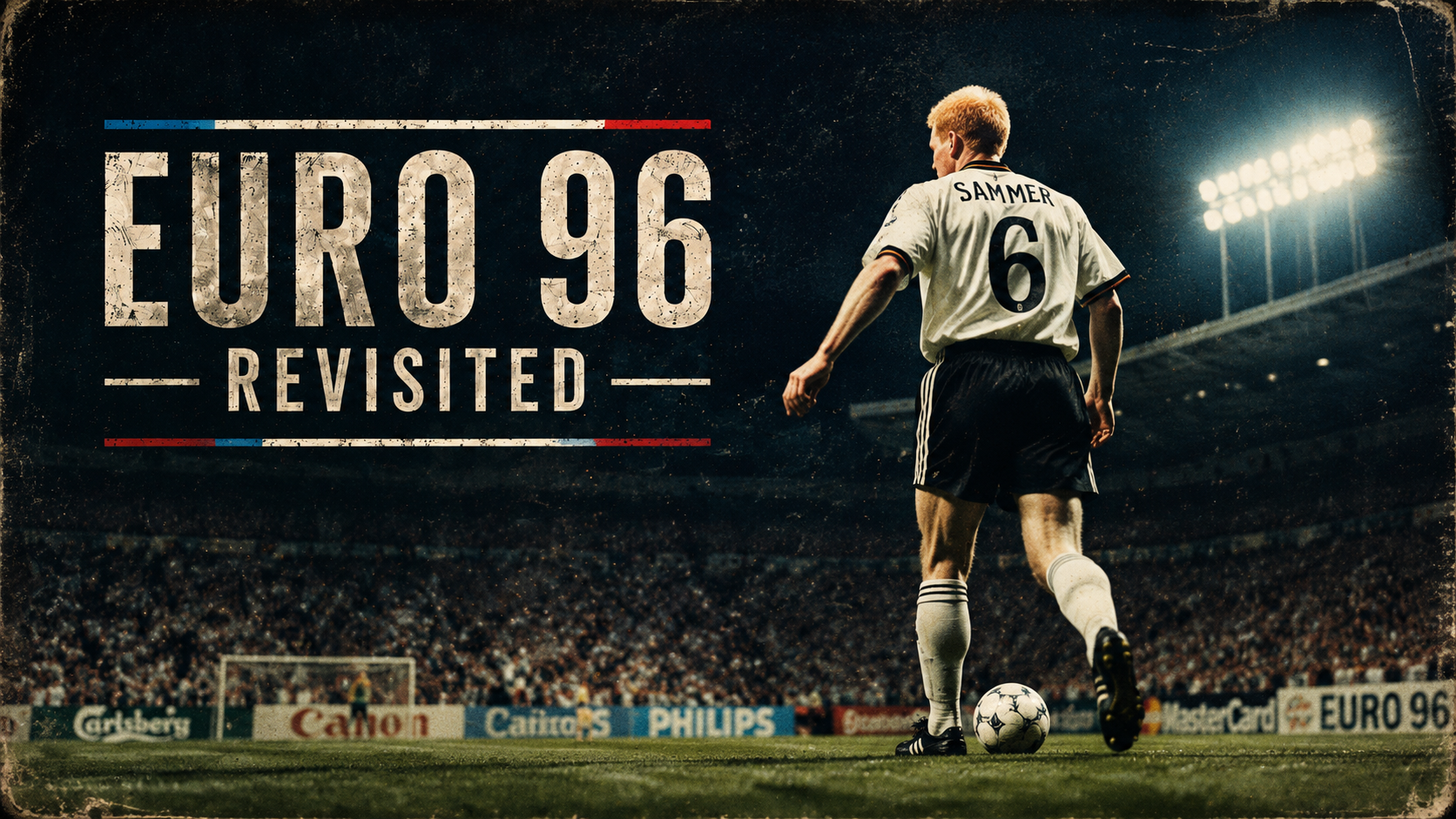
Matthias Sammer won the Ballon d’Or in 1996.
He finished one point ahead of Ronaldo.
Not Cristiano Ronaldo. Ronaldo. The original phenomenon. Twenty years old, explosively quick, already beginning to look like football’s future.
Thirty years later, almost every football supporter knows exactly who Ronaldo was. Many would struggle to explain what position Matthias Sammer played.
That disconnect is one of the strangest acts of collective forgetting in modern football. For a brief period in the mid-1990s, there was a serious argument that Sammer was the best footballer in Europe. Not one of the best. The best.
Yet Sammer’s story is about more than a forgotten Ballon d’Or winner. It is about a footballer who reached the summit at precisely the moment football decided it no longer wanted players like him.
He was the last great libero.
The last free man.
The defender who should not have been there
The ball dropped inside the Croatian penalty area at Old Trafford, and Matthias Sammer was exactly where no defender should reasonably have been.
Germany and Croatia had spent more than an hour tearing at one another in a Euro 96 quarter-final that felt less like a clean technical contest than a collision between two hard, proud football cultures. Croatia had arrived in England as a new nation with an old football intelligence. Davor Šuker, Zvonimir Boban, Robert Prosinečki and Aljoša Asanović gave them imagination, cruelty and craft. They were not tourists. They were dangerous.
Germany had led through Jürgen Klinsmann’s penalty. Šuker had equalised with the cold assurance that would soon make him one of the defining forwards of the tournament. Igor Štimac had been sent off, but the match still felt alive. Croatia were down to ten men, not beaten. Germany were experienced, not comfortable.
Then Markus Babbel crossed from the right.
Sammer, copper-haired and restless, appeared in the box. He had spent the afternoon reading danger, covering behind the defensive line and organising Germany’s resistance. Now he had abandoned all normal defensive geography. The ball came loose, and Sammer forced it past Dražen Ladić.
The goal decided the quarter-final.
What made the moment remarkable was not simply that Sammer scored. Defenders score goals. Even important ones. The question was how he arrived there in the first place.
What kind of defender spends a European Championship quarter-final sweeping up danger near his own box before appearing inside the opposition penalty area to win the match?
What kind of defender is both safety net and spearhead?
What kind of defender can be the tournament’s best player from a position that now feels almost extinct?
The answer belongs to a different football world.
The best player nobody talks about
Mention Euro 96 and the conversation usually follows familiar routes.
Paul Gascoigne flicking the ball over Colin Hendry. Alan Shearer celebrating in front of Wembley. Gareth Southgate standing alone after his penalty was saved. Three Lions escaping the charts and becoming part of England’s emotional weather.
The tournament survives in popular culture largely as an English memory. It is remembered through pubs, shirts, songs, summers and what nearly happened. That memory is powerful. It is also incomplete.
The outstanding footballer at Euro 96 was not English.
It was not Gascoigne, despite producing the tournament’s most famous goal, already explored in this series’ piece on the afternoon England loved him back. It was not Shearer, despite finishing as top scorer. It was not Karel Poborský, whose lob against Portugal has become one of the championship’s great visual memories and sits at the heart of the Czech Republic’s Euro 96 story.
The best player in the tournament was Matthias Sammer.
UEFA recognised it. Coaches recognised it. Opponents recognised it. Months later, journalists across Europe recognised it too when they made him the 1996 Ballon d’Or winner.
Somehow, between then and now, Sammer has drifted towards the margins of football memory.
That is not because he lacked achievement. In 1995 and 1996, he was named German Footballer of the Year. He won back-to-back Bundesliga titles with Borussia Dortmund. He inspired Germany to the European Championship. Then, in 1997, he captained Dortmund to the Champions League, beating a Juventus side containing Zinedine Zidane, Alessandro Del Piero, Didier Deschamps and Christian Vieri.
For two years, he sat at the centre of European football.
Yet talk about the great players of the 1990s and the conversation tends to move elsewhere. Ronaldo. Zidane. Roberto Baggio. Dennis Bergkamp. Luís Figo. George Weah. Paolo Maldini.
Sammer is harder to place.
Everyone understands what Ronaldo was. A striker. Everyone understands what Zidane was. A playmaker. Everyone understands what Maldini was. A defender.
Sammer slips through those categories.
Defender. Sweeper. Libero. Midfielder. Playmaker. Leader. Goalscorer. All of them are true. None of them are enough.
Football struggles to preserve players it can no longer describe. That is Sammer’s problem. He was not underrated in his own time. He was recognised, celebrated and rewarded. What happened later was more subtle. Football lost the language required to explain him.
A footballer from a country that vanished
Matthias Sammer was born in Dresden in September 1967.
Had he been born a few hundred miles further west, his story would have unfolded very differently. Instead, he grew up inside the German Democratic Republic, a country that no longer exists.
East Germany produced outstanding athletes through a highly organised sporting system. It also produced footballers inside a culture where collective discipline mattered more than individual expression. Football was not detached from the state. It was shaped by it, funded by it and watched by it.
Sammer emerged through Dynamo Dresden, one of the flagship clubs of East German football. His father, Klaus, had played for and later coached the club. Matthias was not raised as a romantic street footballer. He was trained inside a system.
Yet he never quite seemed built for obedience.
One story from his youth survives because it reveals something essential about him. When players at Dynamo were issued new football boots, Sammer received a pair several sizes too large. Whether it was punishment, pettiness or a deliberate attempt to humble a talented young footballer is less important than how he understood it.
He saw it as an attempt to suppress individuality.
He remembered it.
That response would echo through his career. Sammer was not a rebel in the theatrical football sense. He was not George Best, Eric Cantona or Paul Gascoigne. His resistance was colder, more internal and more stubborn. He refused to become what other people wanted him to be.
At Dynamo, even his position refused to settle. He began as a striker, moved wide, then became a central midfielder. Coaches shifted him because he kept being useful everywhere. He scored, ran, created, covered and competed. The more he developed, the harder he became to categorise.
By the late 1980s he was one of the finest players in East Germany. Then history moved faster than football.
The Berlin Wall fell in November 1989.
Almost overnight, the world Sammer knew began to disappear.
Living through disappearance
Most footballers spend their careers representing one country.
Sammer represented two.
Very few athletes have ever experienced their nation disappearing while they were still wearing its shirt. Fewer still have then become the defining footballer of the country that replaced it.
The political story of reunification is often told through images of crowds, borders, speeches and celebration. The football story was messier. East German clubs lost structures that had sustained them. Old institutions were absorbed into a richer, stronger and more commercially powerful western football economy. Some players crossed over successfully. Many did not. Entire clubs that had once mattered became footnotes.
East German football was not so much integrated as overtaken.
That matters in Sammer’s story because he did not simply move from one league to another. He moved from one world into another. He had to prove that his excellence was not provincial, not a product of a smaller system, not something that would dissolve when placed under the harder light of the Bundesliga.
He did more than survive.
He conquered.
On 12 September 1990, East Germany played its final international match. Their opponents were Belgium in Brussels. The country itself was only weeks away from formal reunification.
Sammer captained East Germany that night.
He scored both goals in a 2-0 win.
The final goals in East German football history belonged to him.
There is a quiet grandeur in that fact. Sammer was not merely present at the end of a footballing nation. He signed it off. The last act of East German international football was not defeat, not collapse, not disappearance, but a copper-haired midfielder scoring twice away from home.
Six years later, he would become the outstanding player in the first major international triumph of a reunified Germany.
The symbolism is almost too neat, but that does not make it false.
The country vanished. The footballer remained.
Jürgen Klinsmann would later reflect that football helped build a bridge between East and West during reunification. Sammer embodied that bridge better than anyone. He was the great Eastern player who did not need to be patronised, explained or excused. He did not ask to be included in unified Germany’s football identity. He forced his way into its centre.
That is why his Euro 96 triumph carried meaning beyond tactics. Germany did not simply win a tournament in England. It won with an East German as its defining player.
For a country still learning how to speak about itself, that mattered.
The reinvention
When Sammer joined VfB Stuttgart in 1990, he arrived as a highly gifted midfielder with a fierce reputation and an uncertain tactical future. He was strong, intelligent, direct and productive. He could score from midfield, break lines with his running and impose himself physically.
He quickly proved himself in the Bundesliga, helping Stuttgart win the 1991-92 title under Christoph Daum.
Then came Inter Milan.
On paper, it made sense. Serie A was the strongest league in the world. Inter were one of Europe’s grand clubs. The move offered prestige, money and difficulty.
It also made Sammer miserable.
He was not a disaster in Italy. He scored goals and performed respectably when selected. But the fit was wrong. The tactical environment felt restrictive. The distance from Germany weighed on him. He later spoke openly about homesickness.
Within months, he wanted to return.
At the time it looked like a failed move. In retrospect, it may have been the most important failure of his career.
Because in January 1993, Borussia Dortmund brought him back to Germany.
Waiting there was Ottmar Hitzfeld.
Great coaches are often remembered for systems. The best ones are remembered for seeing something in a player that others have missed. Hitzfeld looked at Sammer and saw not a midfielder who needed a settled position, but a footballer too intelligent to be confined to one zone.
He moved him back.
Not to reduce his influence.
To expand it.
As a midfielder, Sammer could affect a match. As a libero, he could interpret the whole thing. He could see the play ahead of him, step into midfield when required, cover behind defenders when danger developed and attack space when the moment appeared.
Hitzfeld did not give him a position so much as a licence.
That licence changed Borussia Dortmund.
Sammer became the tactical heartbeat of a side that won back-to-back Bundesliga titles in 1995 and 1996. He was not decorative. He was not a luxury. He was the organising intelligence of the team.
His authority did not come from warmth. Sammer was not a soft leader. Teammates spoke of his intensity, his standards and his near-obsessive seriousness. Ottmar Hitzfeld once remarked that Sammer thought like a coach. The line matters because it explains the player better than any positional label.
He did not merely play football.
He diagnosed it.
He saw problems before they became visible to others. He moved into spaces before they officially existed. He anticipated danger not as a defender reacting to crisis, but as a reader of the whole match.
Players trusted him because he was usually right.
What the libero was
The word libero means free man.
That freedom was the point.
In its classic form, the libero operated behind the defensive line, covering for markers, reading danger and stepping forward when play allowed. Franz Beckenbauer elevated the role into art. He showed that a defender could not only stop attacks, but begin them. The sweeper became a playmaker. The spare man became the most important man.
Sammer was not Beckenbauer reborn. He was too aggressive for that comparison to be exact. Beckenbauer had glide and aristocratic calm. Sammer had force, heat and urgency. If Beckenbauer looked like he was conducting the game, Sammer often looked as if he was dragging it by the collar.
That difference mattered.
By the mid-1990s, football was quicker, more compressed and more physically demanding than it had been in Beckenbauer’s prime. Space closed faster. Midfields pressed harder. Transitions were more violent. A libero in that world could not simply stroll elegantly through the thirds.
Sammer modernised the role for its final great act.
He defended like a centre-back, passed like a midfielder and attacked space like a late-arriving number ten. He did all three not as separate tasks, but as one continuous interpretation of the game.
That is why opponents found him so awkward.
If they let him have the ball, he advanced. If they pressed him, he released others. If they ignored his forward runs, he appeared in dangerous areas. If they tracked him, Germany or Dortmund gained space elsewhere.
He was not just difficult to stop.
He was difficult to define.
That distinction is crucial. Football can prepare for quality. It struggles more with uncertainty.
The summer the free man ruled Europe
Germany arrived at Euro 96 carrying damage.
They had lost the Euro 92 final to Denmark, one of the great surprises in modern tournament history. They had been knocked out of the 1994 World Cup by Bulgaria in a result that felt like a crack in the old certainty. Berti Vogts was under pressure. The squad had experience, but also age, injuries and doubt.
Germany were not short of famous names. They were short of assurance.
Vogts found it in Sammer.
Building a national team around a libero in 1996 was not a conservative act, even if the position carried old German associations. It was a gamble against the direction of the sport. Much of elite football was moving towards flatter lines, tighter collective organisation and reduced individual freedom. Vogts trusted interpretation instead.
Germany opened against the Czech Republic at Old Trafford and won 2-0. It was controlled rather than spectacular, but Sammer immediately gave the team its balance. He moved between defence and midfield with a command that made a patched-up side feel more coherent than it really was.
Then came Russia.
The scoreline says Germany won 3-0. The match was not so open for more than half an hour. Russia frustrated them. Germany needed someone to force the game into a different shape.
Sammer did.
Eleven minutes after half-time, he appeared in the box and scored the opening goal. It was a typical Sammer tournament moment because it looked both strange and inevitable. The defender had become the attacking solution. Germany relaxed, Klinsmann scored twice, and the result became emphatic.
The quarter-final against Croatia was different. It was harder, nastier and more revealing.
Croatia were not overawed by Germany. They had a midfield capable of hurting anyone and a striker in Šuker whose finishing contained almost no emotion. When he equalised, the match seemed to tilt.
That was when Sammer’s value became clearest. Very good players continue performing their role in moments like that. Great players change the role to meet the moment.
Sammer did not wait for the game to come to him.
He went and took it.
His winning goal was the image of his whole career in miniature. The libero, supposedly the spare defender, arriving in the opposition area to finish a European Championship quarter-final.
That is why the moment still matters.
It was not a defender scoring.
It was freedom scoring.
England’s dream, Sammer’s control
The semi-final against England was a different kind of examination.
Wembley belonged to England that night. The noise, the expectation, the beer-soaked hope, the sense of history folding back on itself. After the Scotland match, after the Netherlands performance, after the cultural rush already explored across this series’ opening essay on Euro 96 as the last analogue tournament, England were no longer merely playing a semi-final.
They were living inside a national story.
Alan Shearer scored after three minutes. Wembley erupted. Germany were suddenly trapped inside somebody else’s dream.
Sammer’s job was to make sure it remained a dream.
His performance that night is easy to underrate because it does not belong to highlight culture. There is no famous goal. No obvious assist. No single clip that explains the whole thing. His work was positional, corrective and coldly intelligent.
England attacked with emotion. Sammer defended with thought.
He adjusted Germany’s shape when England pressed. He dropped when space appeared behind. He stepped forward when Germany needed a passing angle. He slowed moments that Wembley wanted to accelerate.
The great defensive performances are not always remembered because they often involve preventing the thing that would have been remembered.
That was Sammer against England.
He did not win the shootout. He did not miss the penalty. He did not become the face of the night. But he helped keep Germany alive long enough for English hope to become English trauma.
For a series about Euro 96 and memory, that is worth stating clearly. England’s tournament is often remembered as something England lost. Germany’s tournament was something Germany managed.
Sammer was the manager on the pitch.
The mistake in the final
The final against the Czech Republic gave Sammer something he had rarely shown all tournament.
Vulnerability.
Germany were depleted by injuries and suspensions. Their route to the final had taken a physical toll. The Czechs, written off earlier in the competition and already discussed in this series as Euro 96’s adopted team, had grown into the tournament with every round.
For much of the final, Germany looked short of rhythm. Then, shortly before the hour, Karel Poborský drew Sammer into a challenge and went down. Pierluigi Pairetto pointed to the spot. Patrik Berger scored.
For perhaps the first time all summer, Germany’s most important player had made the costly mistake.
The irony was almost cruel. The footballer who seemed able to see danger before everyone else had misjudged the decisive moment.
That mistake matters because it prevents the article from becoming hagiography. Sammer was not flawless. He was not some mythic figure floating above the tournament. He was a fierce, brilliant, vulnerable footballer operating inside enormous pressure.
His response told you more than the error.
He did not hide. He did not retreat into caution. He kept playing as himself.
Then Berti Vogts sent on Oliver Bierhoff.
Within minutes, Bierhoff headed in Christian Ziege’s free-kick. In extra time, he received the ball with his back to goal, turned, struck and watched the shot squirm past Petr Kouba. It was senior international football’s first golden goal in a major final.
Germany were European champions.
The headlines belonged to Bierhoff.
The tournament belonged to Sammer.
Europe chose Sammer over Ronaldo
On Christmas Eve 1996, European football made a decision that looks more startling with every passing year.
It chose Matthias Sammer over Ronaldo.
The margin was one point. Sammer received 144. Ronaldo received 143. Alan Shearer finished third. That detail alone makes the vote one of the most fascinating in Ballon d’Or history.
But the deeper significance is not mathematical.
It is cultural.
Europe did not merely vote for one player over another. It chose between two visions of football.
Ronaldo was the future. A forward of impossible acceleration, balance and violence. He made defenders look biologically outdated. He seemed to belong to the football that was coming: faster, more individual, more global, more spectacular, more easily clipped into moments.
Sammer represented something older and harder to market.
Tactical intelligence. Collective responsibility. Defensive authority. The idea that a footballer could dominate matches without living near the opposition goal.
One was instinct.
The other was interpretation.
One terrified defenders.
The other organised entire games.
Modern memory makes the vote seem almost perverse because we know what Ronaldo became. We know the goals, the injuries, the World Cup, the mythology. We know the future he carried.
But the journalists voting in 1996 were not judging mythology. They were judging that year.
And that year, Sammer had been complete.
He had been Germany’s best player at the European Championship. He had won the tournament. He had won the Bundesliga. He had played a position that required him to defend, create, lead and score.
For one final year, football valued the whole game enough to give its greatest individual prize to a defender who was not really only a defender.
That is why the vote feels so poignant now.
It was not the start of a Sammer era.
It was the last great public coronation of the libero.
Why the free man disappeared
Sammer’s triumph came at the exact moment football was turning away from his kind of freedom.
The change had been building for years. Arrigo Sacchi’s AC Milan had shown how devastating collective defensive movement could be. Rather than relying on one spare man to solve danger, Sacchi’s teams controlled space together. The back line moved as a unit. The midfield compressed the pitch. The team defended through synchronisation.
That mattered because the libero depended on permission.
Permission to sit deeper.
Permission to step forward.
Permission to interpret the match independently.
Modern systems increasingly distrusted that freedom. A high defensive line needed coordination. Pressing needed compact distances. Zonal defending needed shared reference points. One player operating outside the structure could solve problems, but he could also create them.
The 1992 back-pass law accelerated the change. Goalkeepers could no longer pick up deliberate passes from teammates, which made defensive build-up riskier and pressing more valuable. The old escape route disappeared. Defenders had to play differently. Goalkeepers had to become more comfortable with their feet. The modern sweeper-keeper began to inherit some of the libero’s old territory.
At the same time, formations changed. As more teams used single-striker systems, the logic of playing two markers and a spare man weakened. Midfield became the central battleground. Carrying an extra central defender could mean losing a body elsewhere.
The libero did not vanish because it failed.
It vanished because football found more repeatable ways to manage the same problems.
That distinction matters. Sammer was not made obsolete by poor performance. He was made obsolete by the sport’s appetite for control.
The pieces survived
Modern football still contains fragments of Matthias Sammer.
You see them when a centre-back carries the ball through the first line of pressure. You see them when a defender steps into midfield to create an overload. You see them when a goalkeeper sweeps behind a high line. You see them when a deep midfielder drops between centre-backs to begin attacks.
The game did not forget what the libero did.
It redistributed the job.
Ball-playing centre-backs inherited some of the passing. Defensive midfielders inherited some of the control. Sweeper-keepers inherited some of the cover. Full-backs and inverted defenders inherited some of the positional fluidity.
The pieces survived.
The whole disappeared.
That is why there is no modern Sammer. Not because today’s players lack the talent. Many are technically superior in specific ways. They pass better under pressure, receive more cleanly and operate inside more complex collective structures.
But they do not have Sammer’s sovereignty.
They are pieces in systems, even when they are brilliant pieces. Their movements are prepared, rehearsed, analysed and constrained. Their freedom exists inside a plan.
Sammer’s freedom was the plan.
The cruel timing of greatness
Football rarely gives perfect endings.
Sammer’s career came close, which makes its suddenness feel even harsher.
Between 1995 and 1997, he won almost everything available to him. Two Bundesliga titles. Two German Footballer of the Year awards. A European Championship. A Ballon d’Or. A Champions League.
Then it stopped.
In May 1997, Dortmund beat Juventus in the Champions League final in Munich. Sammer captained the side. It should have been the start of another chapter. Instead, it became the final great act.
A serious knee problem followed. Surgery brought complications. A post-operative infection made the situation more serious than a normal football injury. German reporting from the time described repeated operations and the collapse of any realistic hope that he would be fit for the 1998 World Cup.
By 1998, aged only thirty-one, Sammer was finished as a player.
Most great footballers decline in public. Supporters watch them lose speed, adapt, compromise, reinvent themselves and slowly become something else.
Sammer did not get that phase.
One moment he was the best player in Europe. The next he was gone.
That abruptness has shaped his memory. He did not have a long late career to reintroduce himself to younger audiences. He did not become a veteran organiser, a fading icon or a Champions League elder statesman. He disappeared just as football was changing around him.
The timing was almost impossibly cruel.
The last great libero left the pitch just as the position itself was leaving football.
The last free man
There is a temptation to describe Matthias Sammer as underrated.
It is not quite right.
Underrated players are usually ignored in their own time. Sammer was not ignored. He was honoured. UEFA named him Player of the Tournament at Euro 96. France Football gave him the Ballon d’Or. Dortmund built around him. Germany trusted him. Europe recognised him.
The misunderstanding came later.
Sammer was not underrated.
He became untranslated.
The football that understood him disappeared. The role vanished. The category dissolved. Modern football kept his fragments but not his freedom. Without a contemporary equivalent, his greatness became harder to picture.
That is why the Old Trafford goal remains the perfect image.
Not the Ballon d’Or. Not the trophy lift. Not even Wembley.
Old Trafford.
Germany against Croatia. A quarter-final balanced on a knife edge. Sammer deep inside his own half one moment, inside the opposition penalty area the next, deciding the game from a position he was not supposed to occupy.
Most footballers spend their careers learning where they are meant to be.
Sammer spent his proving why he did not need to stay there.
In September 1990, he scored the final goals in East Germany’s history. Six years later, he became the outstanding footballer in the first major triumph of unified Germany. Months after that, Europe named him the continent’s best player.
It should have felt like a beginning.
It was an ending.
Football did not abandon the libero because the libero failed. It abandoned the libero because structure proved easier to control than freedom. Coaches preferred systems that reduced uncertainty. Clubs preferred repeatable solutions. The sport became faster, richer and more efficient.
In many ways, it became better.
But something disappeared too.
Matthias Sammer reached the summit at precisely the moment football decided it no longer trusted players to interpret the game for themselves.
He was not the last great libero because nobody else was talented enough.
He was the last great libero because football stopped believing in free men.
That is why his story still matters.
Not because the position vanished.
Because the freedom vanished with it.
