


Euro 96 was not just a football tournament. It was England’s attempt to show Europe that the country, its game and its supporters had changed.
Key Takeaways
- Euro 96 allowed England to present a softer, safer and more modern football identity after the damage of the 1980s.
- The tournament followed a decade of reputational crisis, stadium reform, legislation and commercial transformation.
- The St George’s Cross became central to a new, more civic expression of English identity.
- England’s rebranding was powerful but incomplete, with tabloid nationalism and old insecurities still visible beneath the optimism.
The Flags Were Everywhere
The flags are everywhere.
They hang from pub windows in Birmingham and Newcastle. They flap from white Ford Transit vans crawling through suburban traffic. They are tied to scaffolding outside corner shops, draped from tower-block balconies, taped carefully inside bedroom windows beside Oasis posters and handwritten fixture charts torn from newspapers. Red on white. St George’s Crosses. Hundreds of thousands of them.
A decade earlier, many English people would have felt deeply uncomfortable displaying that flag in public.
Now, in the summer of 1996, it suddenly feels different.
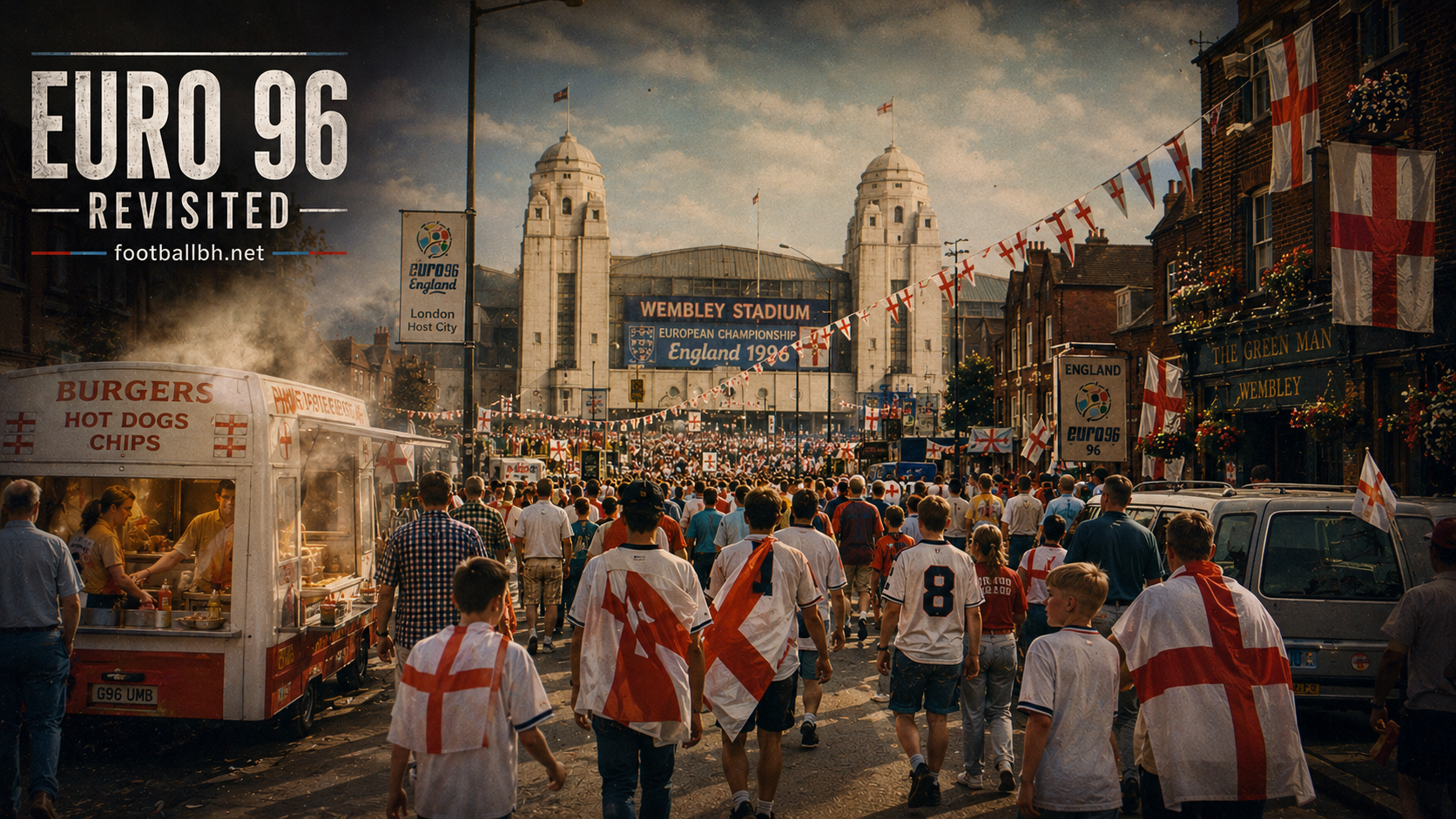
Outside Wembley Stadium before England face Scotland, the streets are thick with noise and heat. Police horses edge slowly through the crowds. Portable burger vans hiss with grease and steam. Somewhere in the distance, somebody is singing Three Lions already, hours before kick-off. The sound drifts between concrete walkways and railway arches before being swallowed by the larger roar building around the stadium.
But what is striking is not the aggression. It is the absence of it.
Families walk beside groups of young men in replica shirts. Children sit on their fathers’ shoulders waving miniature flags bought from market stalls. Beer flows openly outside pubs and temporary bars, yet the atmosphere feels unusually light. Foreign journalists, many of whom arrived in England expecting hostility, vandalism and tribal menace, instead find a country trying very hard to appear welcoming.
Cheerful, even.
UEFA officials watch carefully. So do government ministers.
Because Euro 96 is not simply a football tournament.
It is a test.
For years, English football had represented something toxic in the European imagination. The imagery of the 1980s still lingered stubbornly across the continent: riot police, fenced terraces, smashed seats, burning city centres, skinheads charging through railway stations, mounted officers confronting crowds outside decrepit stadiums. English supporters had become associated with a particular kind of exported disorder. Margaret Thatcher herself had treated football hooliganism not as a sporting problem, but as a matter of national embarrassment and state control.
Now England has been handed the European Championship.
And beneath the music, the optimism, the carnival colours and the laddish humour sits a quieter national anxiety:
Can England finally be trusted again?
The country staging Euro 96 is not the confident imperial Britain of old political mythology. Nor is it yet the sleek, globally marketable Britain that Tony Blair’s New Labour would soon attempt to package and export. Instead, it exists in an awkward, transitional space between decline and reinvention.
The economy is recovering from recession. Britpop pulses through radios and pubs. The Premier League is beginning to turn football into a polished entertainment product rather than a crumbling civic problem. All-seater stadiums have changed the visual texture of the game itself. Satellite television money has started to transform clubs into commercial brands. London increasingly presents itself as youthful, creative and culturally magnetic.
But scars remain visible beneath the surface.
Only eleven years have passed since Heysel. Seven since Hillsborough. English clubs have only recently returned from European exile. The memory of violence still hangs heavily over the game. Across Europe, many supporters and journalists remain suspicious of England’s attempts at rehabilitation.
And so Euro 96 becomes something larger than sport.
It becomes a month-long exercise in national image reconstruction.
The symbolism is impossible to miss. Throughout the tournament, volunteers and organisers help turn the St George’s Cross into part of the visual language of the summer. The flag itself is undergoing a strange cultural rebirth. For years, it had been associated uncomfortably with fringe nationalism and far-right movements. Yet during Euro 96, it is reclaimed and softened into something more civic, more inclusive, more celebratory. The old Union Jack-heavy imagery of English football begins to fade. A new Englishness emerges in its place.
Not British.
Specifically English.
And importantly, emotionally vulnerable.
That vulnerability is everywhere during the tournament. It exists in the self-deprecating humour of Three Lions. It exists in the collective national obsession with thirty years of failure. It exists in the way supporters speak not with entitlement, but with almost apologetic hope. England are not expected to conquer Europe. They are simply desperate to belong to it again.
Even the aesthetics of the tournament reflect this transitional identity. The stadiums are cleaner and safer, yet still imperfectly analogue. The BBC and ITV presentation packages attempt modernity through synth-heavy graphics and early digital styling, while remaining unmistakably rooted in the visual language of mid-1990s television. The pubs remain crowded social cathedrals of communal viewing. Ceefax pages flicker across CRT screens. Programmes, tickets and newspapers still possess physical weight. Football has not yet disappeared into the frictionless digital stream.
Everything still feels tangible.
That tangibility matters because Euro 96 becomes one of the final moments when an entire nation experiences football collectively, physically and in real time. Before smartphones. Before social media fragmentation. Before algorithmic culture shattered shared attention into infinite smaller worlds.
For one month, England watches itself carefully.
And, remarkably, much of Europe likes what it sees.
England Was Asking Europe to Look Again
The popular memory of Euro 96 is overwhelmingly nostalgic.
People remember the soundtrack. The sunshine. The flags hanging from pub windows. They remember Three Lions echoing across packed terraces and city centres. They remember Paul Gascoigne flicking the ball over Colin Hendry. They remember the emotional delirium of England dismantling the Netherlands at Wembley and the devastation of the semi-final against Germany.
But nostalgia alone obscures what Euro 96 actually represented.
The tournament was not simply a football championship hosted in England.
It was a carefully managed exercise in national rehabilitation.
To understand Euro 96 properly, it must be viewed through the lens of reconstruction rather than celebration. England in 1996 was attempting to repair a damaged reputation that had taken more than a decade to unravel. Football became the vehicle through which the country tried to present itself as modern, safe, tolerant and emotionally mature after years in which English football culture had been associated internationally with violence, xenophobia and social disorder.
This was not accidental.
Nor was it purely organic.
The transformation had been shaped deliberately through legislation, policing, infrastructure reform, media management and political rhetoric. By the time the tournament arrived in June 1996, England had spent years trying to redesign not only its stadiums and supporter culture, but its public personality.
That distinction matters enormously.
Because Euro 96 was not merely England hosting Europe.
It was England asking Europe to look again.
The scale of the reputational collapse during the 1980s is difficult to overstate now. Following the Heysel Stadium disaster in Brussels, English football became internationally toxic. The deaths of 39 supporters, most of them Italian, during crowd disorder involving Liverpool fans transformed the perception of the English game across the continent. UEFA’s subsequent ban on English clubs from European competition isolated the country footballingly for half a decade, but the damage extended far beyond sport itself.
England became synonymous with hooliganism.
The phrase “the English disease” entered the European football vocabulary as shorthand for tribal violence, drunken aggression and civic disorder attached specifically to English supporters. Domestically, football was increasingly treated by political elites as a social problem rather than a cultural asset. Stadiums decayed physically while attendances collapsed. The game itself appeared trapped inside a wider narrative of national decline.
By the early 1990s, however, the country had begun trying to reimagine football differently.
The Taylor Report accelerated the transition toward all-seater stadiums and fundamentally changed the architecture of English football grounds. The removal of terraces altered not only safety standards, but the emotional presentation of the sport itself. Football increasingly moved away from the image of uncontrolled mass confrontation and toward something more commercially palatable and socially acceptable.
This transformation coincided with the birth of the Premier League in 1992, which repackaged English football as entertainment rather than urban menace. Television money flooded into the game. Stadiums modernised. Corporate branding replaced decay. Families began returning in larger numbers.
Crucially, the state itself supported this transition.
Under John Major, football was no longer viewed solely as a policing issue. Major understood sport politically as a form of social glue capable of projecting optimism and unity during a difficult national period marked by recession, internal Conservative Party conflict and broader uncertainty about Britain’s future place in Europe.
Euro 96 therefore became politically useful.
Hosting the tournament allowed England to project an image of itself that differed radically from the one Europe had internalised during the previous decade. The country wanted to appear youthful, welcoming and culturally alive. The timing aligned with the emergence of Cool Britannia, Britpop and the early commercial boom of Premier League football.
Yet there was also insecurity underneath the optimism.
That insecurity is what makes the tournament historically fascinating.
Because England’s rebranding project remained incomplete.
The country still carried the psychological residue of the 1980s. Violence had not vanished entirely. Xenophobic instincts still surfaced within sections of the tabloid press. The tension between civic hospitality and aggressive nationalism never fully disappeared during the tournament itself.
In many ways, Euro 96 becomes more interesting because of those contradictions.
England was not yet fully transformed.
It was rehearsing transformation publicly.
And perhaps that is why the tournament still feels emotionally distinctive now. The optimism of Euro 96 was genuine, but it was also fragile. The country was trying to become a softer, more emotionally open version of itself while remaining haunted by older instincts it could not completely suppress.
Football simply became the stage upon which that struggle played out most visibly.
The Ruins England Was Emerging From
To understand why the atmosphere of Euro 96 felt so emotionally significant, it is necessary to remember just how damaged English football had become during the previous decade.
By the mid-1980s, the game in England was not viewed as a cultural success story.
It was viewed as a national embarrassment.
The stadiums themselves reflected that decline. Concrete terraces crumbled beneath rusting crush barriers. Floodlights illuminated chipped paint, exposed wiring and fencing designed less for spectator comfort than for crowd containment. Visiting a football ground in 1985 often meant entering an environment shaped by suspicion and hostility rather than celebration. Supporters were herded, searched, segregated and monitored as though the expectation of disorder had already been accepted before kick-off.
In many ways, it had.
The rise of organised hooliganism during the 1970s and 1980s profoundly altered how English football was perceived both domestically and internationally. Violence became intertwined with the image of the English supporter. Firms attached themselves to clubs. Railway stations, city centres and terraces became battlegrounds where tribal identity frequently spilled into orchestrated confrontation.
The game itself suffered accordingly.
Attendances collapsed dramatically throughout the 1980s. By the 1985-86 season, total attendance figures in English football had fallen to their lowest post-war level. Large sections of the middle class abandoned the sport entirely, while many political elites viewed football culture with outright contempt.
Then came Heysel.
On 29 May 1985, before the European Cup Final between Liverpool and Juventus at the Heysel Stadium in Brussels, crowd disorder triggered a catastrophe that killed 39 supporters, most of them Italian. Hundreds more were injured. The images travelled across Europe: collapsing walls, terrified supporters, chaos unfolding inside a major continental final.
The disaster became a defining moment in the international collapse of English football’s reputation.
UEFA responded by banning all English clubs from European competition indefinitely, with Liverpool receiving an additional year on top of the general suspension. The punishment carried symbolic as well as sporting weight. English football was effectively exiled from Europe because the rest of the continent no longer trusted it to behave responsibly.
The phrase “the English disease” hardened into accepted shorthand across European media and political discourse.
And crucially, many inside England agreed.
Margaret Thatcher treated hooliganism not as a marginal issue but as evidence of wider social disorder requiring state intervention. Football increasingly became framed as a policing problem and a threat to public order rather than a source of communal identity or national pride.
The relationship between the state and the game grew colder and more confrontational.
Yet the true horror of the era had not ended.
Four years after Heysel came the Hillsborough disaster.
Ninety-seven Liverpool supporters would eventually lose their lives following the crush at Hillsborough during the FA Cup semi-final against Nottingham Forest. The disaster exposed catastrophic failures in crowd control, stadium safety and institutional accountability throughout English football.
But it also revealed something psychologically important about England at the time.
Large sections of the press and political establishment initially responded not with empathy, but with suspicion toward supporters themselves. Decades of associating football crowds with violence had conditioned many people to assume fan behaviour must somehow be responsible. That reflex illustrated how deeply the image of the dangerous English football supporter had embedded itself within national consciousness.
By the beginning of the 1990s, English football felt culturally exhausted.
The contrast with the mood surrounding Euro 96 only six years later therefore appears almost startling in retrospect.
Because England did not simply modernise football infrastructure during that period.
It attempted to morally reconstruct football culture itself.
The Taylor Report became central to that effort. The move toward all-seater stadiums fundamentally changed the physical experience of attending matches. Fences disappeared. Terraces vanished. Grounds increasingly prioritised visibility, safety and comfort. Commercial redevelopment accelerated. Clubs sought new audiences.
This transition carried enormous sociological consequences.
Older supporters often viewed the transformation with suspicion, seeing the loss of terraces as the erosion of working-class football culture. Yet the reforms also altered how England presented itself publicly. Stadiums no longer resembled fortified conflict zones. Families returned in greater numbers. Corporate sponsors became more comfortable attaching themselves to the game. Television coverage increasingly framed football as entertainment rather than menace.
The sport became visually softer.
That softness mattered politically.
Because by the time Euro 96 arrived, England desperately needed Europe to believe the country itself had softened too.
And perhaps that explains one of the defining emotional tensions running beneath the tournament. Euro 96 constantly projected warmth, hospitality and optimism, yet those qualities felt meaningful precisely because the memory of ugliness still remained so close beneath the surface.
England was not celebrating from a position of confidence.
It was emerging from reputational ruin.
Italia 90: The First Softening
Before Euro 96 could present England as modern, welcoming and emotionally self-aware, another tournament first had to humanise the country to itself.
That tournament was the 1990 World Cup.
Italia 90 now exists in English football memory as something close to mythology. The soundtrack of Nessun Dorma. The Mediterranean heat. The white Umbro shirts beneath floodlights. The strange cinematic melancholy of the tournament itself. But beyond aesthetics, Italia 90 performed an essential psychological function within English culture.
It softened England.
That softening mattered because the national image attached to English football during the 1980s had become emotionally hard, aggressive and defensive. The dominant archetype of the English supporter was still rooted in confrontation: hooligan firms, tribal hostility and performative masculinity. Football culture often projected toughness as identity.
Italia 90 disrupted that image.
For perhaps the first time in decades, England’s national team appeared emotionally vulnerable rather than emotionally threatening.
The central figure in that transformation was Paul Gascoigne.
Gascoigne’s football during the tournament felt joyous and instinctive, but it was his tears during the semi-final against West Germany that altered the emotional relationship between England and its football team. After receiving a yellow card that would have ruled him out of a potential final, Gascoigne’s face crumpled visibly on camera. His bottom lip trembled. Tears rolled down his cheeks beneath the floodlights in Turin.
Millions watched the moment live.
And something changed.
English footballers had traditionally been expected to embody emotional restraint. Masculinity within football culture often revolved around hardness, stoicism and aggression. Gascoigne shattered that image publicly. He looked devastated, frightened and vulnerable in front of the entire country.
Instead of weakening him, the moment transformed him into a national obsession.
“Gazzamania” exploded across England after the tournament. Gascoigne became simultaneously a footballer, celebrity and emotional symbol. More importantly, his tears helped recast the England team itself. The squad no longer appeared as distant representatives wrapped in patriotic obligation. They became emotionally accessible.
Human.
That distinction is crucial when understanding the road toward Euro 96.
Italia 90 did not yet complete England’s football rehabilitation. Hooliganism still existed. Stadium infrastructure remained problematic. The game itself had not yet fully commercialised into the polished Premier League era that would emerge during the early 1990s.
But the tournament began changing the emotional vocabulary surrounding English football.
The soundtrack helped enormously.
Nessun Dorma became inseparable from the atmosphere of Italia 90 through the BBC’s coverage, giving the tournament an operatic melancholy that contrasted sharply with the uglier football culture of the preceding decade. Even the presentation of the competition itself felt cinematic rather than tribal.
England’s run to the semi-finals intensified that transformation further. For the first time in years, football appeared capable of uniting the country positively rather than dividing it anxiously. Supporters gathered in pubs and living rooms not merely expecting violence or embarrassment, but hope.
And yet, the transformation remained incomplete.
The symbolism of Italia 90 still belonged largely to an older idea of Britishness. Union Jacks dominated crowds more visibly than St George’s Crosses. The terraces themselves had not yet disappeared entirely from domestic football. The emotional openness surrounding Gascoigne coexisted uneasily beside the harder edges of late-1980s supporter culture.
In many ways, Italia 90 represented transition rather than arrival.
The tournament softened England emotionally, but it did not yet modernise England structurally.
That work would happen during the years between Turin and Wembley.
The Taylor Report would reshape stadiums. The Premier League would reshape football commercially. Satellite television would reshape presentation. John Major’s government would increasingly view sport as an instrument of national cohesion rather than national embarrassment.
And by the summer of 1996, the emotional vulnerability first glimpsed through Gascoigne’s tears had evolved into something broader: a country attempting to present itself not as powerful, but as likable.
That distinction defined Euro 96 completely.
Because England in 1996 was not asking Europe to fear it.
It was asking Europe to embrace it.
The State Rebuilds the Game
The transformation that culminated in Euro 96 did not happen naturally.
It was engineered.
Not entirely, of course. Cultural change is rarely so neat. But the England that hosted Europe in the summer of 1996 had been deliberately reshaped through legislation, policing, commercial reinvention and political calculation. The modernisation of English football during the early 1990s was not simply aesthetic. It was structural.
The state wanted football to stop embarrassing the country.
And increasingly, it began to believe the game might actually help repair the national image instead.
That shift in thinking marked a major departure from the tone of the Thatcher era. During the 1980s, football had often been treated politically as a problem population requiring containment. Stadiums were monitored spaces. Supporters were viewed suspiciously. Public discussion surrounding the game revolved around violence, decay and control.
By the early 1990s, however, football was becoming commercially valuable again.
The publication of the Taylor Report accelerated the physical redesign of English football grounds. All-seater stadiums became mandatory in the top divisions. Fencing disappeared. Safety standards improved dramatically. Clubs increasingly rebuilt ageing grounds into cleaner, more marketable environments capable of attracting broader demographics.
The significance of this transition extended far beyond architecture.
Terraces had functioned not merely as spectator spaces, but as emotional ecosystems. They fostered intimacy, tribalism and confrontation. The shift toward all-seater stadiums fundamentally altered how football looked, sounded and behaved. Crowds became easier to monitor. Violence became more difficult to organise at scale. Middle-class supporters and families returned in larger numbers.
The visual language of English football changed almost overnight.
That visual transformation proved essential to Euro 96.
Because hosting a major international tournament required England to appear safe and modern to foreign audiences still haunted by memories of Heysel and hooliganism. Clean stadiums mattered politically. Organised fan zones mattered politically. Hospitality mattered politically.
Football became part of a wider national rebranding project.
The creation of the Premier League in 1992 accelerated the process further. Backed by lucrative television deals, the Premier League repackaged English football as premium entertainment rather than civic dysfunction. Broadcast presentation improved dramatically. Marketing became more sophisticated. Clubs increasingly resembled modern commercial brands.
England was learning how to sell football aesthetically.
That mattered because image itself had become central to the rehabilitation process.
The Premier League era introduced a cleaner visual identity for English football just as the country prepared to host Europe. Stadium shots looked brighter. Camera angles improved. Television graphics became more polished. Matchdays increasingly resembled orchestrated entertainment experiences rather than volatile public gatherings.
At the centre of this shift politically stood John Major.
Unlike Margaret Thatcher, Major genuinely loved sport. He understood football emotionally as well as politically. More importantly, he recognised its potential utility during a period of recession, social uncertainty and deep Conservative Party divisions over Europe.
Football offered something rare: shared emotional focus.
Major’s 1995 sports policy document, Raising the Game, framed sport as a national priority tied directly to social cohesion and international reputation. The government increasingly saw major sporting events not simply as competitions, but as opportunities to present Britain as dynamic, modern and culturally confident.
The introduction of the National Lottery in 1994 became another critical component of this transformation. Lottery funding would become a major source of support for sport, from community facilities to elite programmes, at a moment when British sport had long suffered from underinvestment.
The symbolism mattered as much as the economics.
Because by the mid-1990s, football no longer represented industrial decline or urban disorder politically. It increasingly symbolised modern Britain itself.
That symbolism intensified as Euro 96 approached.
The government recognised immediately what the tournament could offer. At a time when Britain remained economically fragile and politically uncertain, hosting Europe’s biggest football event provided a rare chance to project competence, warmth and cultural relevance simultaneously.
And yet there was a strange irony underneath the optimism.
Because while England prepared to welcome Europe through football, Britain’s actual political relationship with Europe was deteriorating rapidly.
The summer of Euro 96 coincided directly with the height of the BSE crisis, commonly known as “mad cow disease.” Following the European Union’s ban on British beef exports earlier that year, relations between Britain and continental Europe became deeply strained. Major’s government entered open diplomatic conflict with EU partners over the ban.
This contradiction sat quietly beneath the tournament.
Publicly, England projected hospitality and togetherness through football.
Privately, the government was engaged in an increasingly bitter struggle with Europe politically.
In many ways, Euro 96 became a kind of emotional shield against wider national anxieties. The tournament allowed England to perform openness and confidence at precisely the moment the country felt uncertain about its relationship with Europe and its place within the modern world.
That performance mattered enormously.
Because for one month, football made England feel modern before politics managed to do the same.
The Reinvention of Englishness
Perhaps the most revealing image of Euro 96 is not a goal, a celebration or a trophy lift.
It is a flag.
Not the United Kingdom’s Union Jack that had historically dominated English football crowds throughout the twentieth century, but the red-and-white St George’s Cross.
During Euro 96, it seemed to appear everywhere simultaneously.
Wrapped around shoulders. Hanging from pub windows. Painted across cheeks. Draped over motorway bridges and suburban fences. It became the defining visual motif of the tournament and, in many ways, the defining symbol of a changing national identity.
That transformation was culturally significant because, for much of the post-war period, public expressions of English nationalism had often carried uncomfortable political baggage.
Britishness had traditionally functioned as the safer umbrella identity. The Union Jack represented empire, monarchy and wartime solidarity. Englishness itself felt less stable and often more politically volatile. By the 1970s and 1980s, the St George’s Cross had increasingly become associated with far-right movements such as the National Front and the British National Party, who used the flag aggressively within anti-immigration and xenophobic rhetoric.
For many people, displaying the English flag publicly therefore felt awkward, even faintly threatening.
Euro 96 changed that.
The tournament became the first major moment in modern English football culture when the St George’s Cross was reclaimed on a mass civic level. Families displayed it. Children waved it. Pubs decorated themselves with it. Crucially, the atmosphere surrounding the flag shifted from confrontational nationalism toward something softer, warmer and more emotionally open.
As later reflections on English identity noted, the St George’s Cross gained new respectability after Euro 96, even if the struggle over its meaning never fully disappeared.
That emotional shift mattered enormously.
Because England in 1996 was searching for a modern form of national identity capable of existing after empire, after industrial decline and after the social fragmentation of the Thatcher years. Football unexpectedly became the space where that reinvention occurred most visibly.
The emergence of a specifically English identity also reflected wider constitutional tensions inside Britain itself. During the 1990s, devolution debates in Scotland and Wales increasingly challenged older assumptions about unified Britishness. As Scottish and Welsh national identities became more politically assertive, England itself began searching for symbols that felt distinct rather than merely dominant by default.
Euro 96 accelerated that process dramatically.
And importantly, the tournament’s version of Englishness was not built primarily around superiority.
It was built around vulnerability.
That distinction separates Euro 96 from many older expressions of English football nationalism. The emotional tone of the summer felt reflective rather than triumphalist. England’s unofficial anthem, Three Lions, captured this perfectly. Instead of celebrating dominance or demanding victory, the song focused on failure, heartbreak and stubborn hope.
“Thirty years of hurt.”
The lyric became a national emotional shorthand precisely because it acknowledged weakness openly. England supporters during Euro 96 did not present themselves as inevitable winners. They presented themselves as wounded romantics still desperate to believe.
That self-awareness softened the image of English fandom significantly.
For decades, the stereotype of the English supporter abroad had revolved around aggression, entitlement and nationalism. Euro 96 introduced something else: self-deprecating humour.
The tone mattered. Supporters sang ironically. Television coverage leaned into melancholy as much as optimism. The national mood often felt emotionally fragile beneath the carnival atmosphere.
Even the aesthetics of the tournament reflected this softer Englishness. The imagery of Euro 96 became tied to pubs, beer gardens, music, families and communal gatherings rather than confrontation. The famous “Football Comes Home” slogan worked because it carried emotional yearning rather than patriotic certainty.
England did not expect glory.
It hoped for redemption.
The inclusivity of this new Englishness mattered too.
By the mid-1990s, the England national team itself increasingly reflected a more multicultural society. Players such as Paul Ince, who became England’s first Black captain in 1993, symbolised an important social shift. During previous decades, Black footballers in England had often faced horrific racist abuse from terraces and sections of the media. By Euro 96, the national conversation surrounding identity had started moving toward a broader understanding of who could represent England publicly.
The transformation remained incomplete, of course.
Racism had not vanished from football culture. Xenophobia still lingered within parts of the press and supporter base. Yet Euro 96 represented a visible attempt to create a version of English identity that felt civic rather than ethnic. The St George’s Cross increasingly belonged not to extremist groups, but to ordinary supporters participating in a shared national event.
This was one of the tournament’s most important long-term legacies.
Because modern English sporting identity still largely operates within the emotional framework established during Euro 96. The widespread public use of the St George’s Cross at tournaments now feels normal largely because the summer of 1996 rehabilitated the symbol culturally.
For one brief period, England managed to separate national pride from overt hostility.
And perhaps that explains why the atmosphere of Euro 96 still feels emotionally unusual in retrospect. The country appeared genuinely hopeful that it could reinvent itself into something more relaxed, more welcoming and more emotionally comfortable in its own skin.
Football simply became the language through which that reinvention was expressed most clearly.
The Old England Never Fully Went Away
Yet for all the warmth, optimism and reinvention surrounding Euro 96, the tournament never fully escaped the darker instincts England was trying to leave behind.
That contradiction is essential to understanding the summer properly.
Because Euro 96 was not a clean national rebirth.
It was a negotiation between two competing versions of English identity.
One version sought openness, humour and civic confidence. The other still carried traces of defensiveness, xenophobia and imperial nostalgia inherited from the previous decades. Both existed simultaneously throughout the tournament.
The tension became most visible in the coverage surrounding the semi-final against Germany.
No opponent triggered English anxieties more powerfully. Germany represented footballing trauma, historical memory and unresolved insecurity all at once. England’s defeats to West Germany at the 1970 World Cup, Euro 72 and the 1990 World Cup had already embedded a psychological inferiority complex within English football culture. Layered on top of that sat the lingering shadows of the Second World War, which sections of the British tabloid press continued exploiting decades later through militaristic language and crude nationalism.
The most infamous example arrived via the Daily Mirror’s front page before the semi-final.
“Achtung! Surrender!”
The headline appeared alongside images of England players in wartime-style helmets. Other newspapers leaned into similar rhetoric, recycling war iconography and nationalist caricatures that sat uneasily beside the tournament’s supposedly modern and inclusive atmosphere.
The imagery revealed how fragile England’s attempted reinvention still was.
Because beneath the language of hospitality and civic nationalism lingered an older emotional reflex: the need to define Englishness against an external enemy.
This tension did not go unnoticed politically.
During the tournament, members of the House of Lords openly debated nationalistic press reports around Euro 96, criticising what they regarded as irresponsible coverage capable of damaging England’s international reputation. Some peers expressed genuine concern that tabloid nationalism threatened to undermine the very image of tolerance and maturity the country was trying to project.
The debate itself revealed something fascinating about England in the mid-1990s.
The country had become deeply self-conscious about how it appeared internationally.
That self-consciousness barely existed during the height of hooligan culture in the 1980s, when aggression itself often functioned as performance. By Euro 96, however, England wanted approval. It wanted Europe to like it. The tabloid rhetoric therefore felt embarrassing even to many English observers because it clashed directly with the softer national image emerging elsewhere during the tournament.
And yet the contradiction extended beyond newspaper headlines.
The atmosphere surrounding the semi-final itself carried a strange emotional volatility. Wembley became deafeningly patriotic. Chants referencing wartime history circulated among sections of supporters. National emotion intensified into something more primal and defensive as the possibility of finally defeating Germany on home soil came into view.
The old instincts resurfaced under pressure.
That emotional instability perhaps explains why the eventual defeat felt so psychologically devastating. When Gareth Southgate’s penalty was saved by Andreas Köpke and Andreas Möller converted the winning kick, the mood shifted instantly from euphoric possibility toward familiar fatalism.
England had not conquered its past after all.
The emotional fragility underlying the tournament suddenly became visible again.
This is why the famous image of Paul Gascoigne lying face-down on the Wembley turf after missing Alan Shearer’s cross resonates so powerfully within English memory. The moment captures not merely sporting disappointment, but the collapse of a wider national fantasy.
Because Euro 96 had briefly allowed England to imagine itself differently.
More mature.
More modern.
More emotionally open.
More culturally confident.
The semi-final defeat shattered that illusion slightly.
And yet, paradoxically, the heartbreak also deepened the tournament’s emotional legacy.
Because England’s failure reinforced the reflective tone that had made the summer feel distinct in the first place. Victory might have transformed Euro 96 into triumphalist mythology. Defeat preserved its vulnerability.
That vulnerability became central to the national memory of the tournament.
Even the most optimistic moments of Euro 96 therefore carried a shadow beside them. The country was changing, but unevenly. The old England had not vanished completely. It remained present in parts of the press, parts of supporter culture and parts of the national psyche itself.
Perhaps that is why the tournament still feels historically honest despite its nostalgia.
Euro 96 never fully pretended England had solved itself.
It simply offered a glimpse of what the country hoped it might become.
Why the Rebrand Worked Anyway
And yet, despite the contradictions, despite the tabloid rhetoric, despite the political tensions simmering beneath the surface, Euro 96 worked.
Not just operationally.
Emotionally.
That distinction explains why the tournament still occupies such a unique place in English cultural memory nearly three decades later.
Because for one summer, England managed to feel comfortable with itself.
That feeling had become surprisingly rare by the mid-1990s. The country was emerging from recession, wrestling with questions about Europe, carrying the long shadow of deindustrialisation and still negotiating the social aftershocks of Thatcherism. British identity itself felt unstable and fragmented. Politics had become bitter and exhausted. Public trust in institutions remained shaky.
But Euro 96 briefly created something close to collective emotional alignment.
Football became the mechanism through which millions of people experienced a shared national mood simultaneously.
And crucially, that mood felt optimistic without becoming triumphalist.
The communal architecture of the tournament mattered enormously here. Euro 96 arrived just before the digital revolution permanently fragmented public attention. People still consumed football collectively and physically. The pub remained the emotional centre of the experience. Offices paused for matches. City centres filled before kick-off. Television audiences gathered around the same broadcast feeds at the same moment.
The nation watched together.
That togetherness is difficult to replicate now.
Modern tournaments unfold inside algorithmic fragmentation. Supporters simultaneously watch matches while scrolling social media, checking statistics, arguing online and consuming endless secondary content. Attention splinters constantly. Euro 96 belonged to the final era of concentrated national focus.
When Gascoigne scored against Scotland, entire pubs erupted together physically. When Stuart Pearce roared after scoring his penalty against Spain, strangers embraced instinctively. The emotional rhythm of the tournament spread through shared public spaces rather than isolated digital feeds.
That collective intensity gave the summer unusual emotional density.
The soundtrack amplified it further.
Three Lions became more than a football song because it perfectly captured the emotional register of the country at that moment. The lyrics balanced hope with fatalism, humour with vulnerability. Unlike older football anthems built around swagger or patriotic certainty, Three Lions acknowledged failure openly.
That honesty made it feel human.
And humanity became central to England’s rebranding.
The atmosphere surrounding the tournament often felt emotionally available in a way modern football rarely does. Supporters cried openly. Players looked nervous. Television coverage lingered on crowds singing together in pubs and city squares. The emotional tone of Euro 96 was not detached or ironic. It was sincere.
Even the aesthetics of the summer contributed to that feeling.
The weather seemed unusually perfect in retrospect, whether accurately remembered or not. Beer gardens overflowed. Britpop drifted from radios and open windows. The visual identity of the tournament, from Umbro kits to BBC title sequences, carried the distinctive warmth of analogue-era broadcasting. Everything looked textured and tangible rather than clinically polished.
England itself suddenly appeared culturally vibrant.
That mattered internationally too.
Foreign supporters arriving for the tournament encountered a country very different from the hostile image many had inherited from the 1980s. Host cities felt celebratory rather than militarised. Fan interaction was largely peaceful. The atmosphere often resembled a nationwide street festival more than a security operation.
For perhaps the first time in decades, England seemed capable of hosting Europe without fear.
And beneath all of this sat a deeper emotional truth:
Euro 96 succeeded because the optimism never felt fully secure.
There was fragility inside the joy.
The country did not celebrate from a position of dominance or certainty. England remained emotionally scarred by decades of football failure and broader national decline. That vulnerability made the atmosphere feel authentic rather than manufactured.
People wanted to believe.
That desire connected everything: the flags, the music, the tears, the pub singalongs, the sudden warmth toward the national team, the emotional investment in every kick.
For one month, football allowed England to imagine itself not as an anxious former power clinging to past status, but as a modern country capable of openness, humour and collective hope.
And perhaps that is why Euro 96 still feels strangely alive in memory now.
Not because England won.
But because, briefly, the country felt emotionally united enough that victory almost seemed possible.
England Rehearsed a New Identity
The summer ends, as English football summers so often do, in silence.
Not literal silence, of course. Wembley still hums after Germany eliminate England on penalties. The pubs still spill bodies onto pavements long after midnight. Radios continue replaying Three Lions. Newspapers continue printing front pages filled with grief, disbelief and exhausted hope.
But emotionally, something shifts.
The dream recedes.
And what remains afterwards is stranger, softer and far more important than victory itself.
Because Euro 96 was never truly about winning the tournament.
It was about England attempting to reintroduce itself to the world.
For one month in 1996, football became the stage upon which a country rehearsed a different version of its identity. Not the brittle imperial confidence of the past. Not the violent tribalism of the 1980s. Not even the aggressively commercial modernity that would dominate football during the decades ahead.
Something more emotionally tentative than that.
More human.
The transformation was incomplete, certainly. The contradictions remained visible throughout the tournament. Xenophobic instincts still surfaced within sections of the press. Old insecurities still shaped national behaviour beneath moments of optimism. England had not fully escaped the psychological shadows of decline, hooliganism or post-imperial uncertainty.
But Euro 96 mattered because people briefly believed change might be possible anyway.
The country looked different.
Sounded different.
Felt different.
The stadiums no longer resembled cages. The St George’s Cross no longer belonged solely to extremists. Football crowds no longer appeared automatically threatening to outsiders. The national team became emotionally accessible rather than distant. Supporters sang about failure instead of superiority. Even patriotism itself softened into something less defensive and more reflective.
For perhaps the first time in modern football history, England projected vulnerability instead of aggression.
That vulnerability became the emotional core of the tournament.
And maybe that is why the memory persists so vividly now.
Because Euro 96 arrived at the precise historical moment before everything accelerated permanently. Before smartphones. Before social media. Before football transformed fully into hyper-commercial global content. Before politics hardened again into permanent culture war. Before public life fragmented into endless digital noise.
The tournament still feels tangible because it belonged to a slower emotional world.
A world of CRT televisions glowing inside crowded pubs.
Of newspapers spread across breakfast tables.
Of Ceefax pages flickering late at night.
Of physical tickets tucked inside drawers.
Of supporters gathering together because there was nowhere else to experience football collectively.
England did not fully reinvent itself during Euro 96.
But it did glimpse a version of itself that felt modern without becoming cynical. Open without becoming naive. Patriotic without collapsing entirely into hostility.
That glimpse proved powerful enough to linger.
And so the tournament survives now not simply as football nostalgia, but as a memory of a country caught briefly between identities, trying desperately to become something softer than its past.
For one summer, remarkably, it almost succeeded.
And perhaps that is why England still remembers Euro 96 not as victory, but as possibility.
