


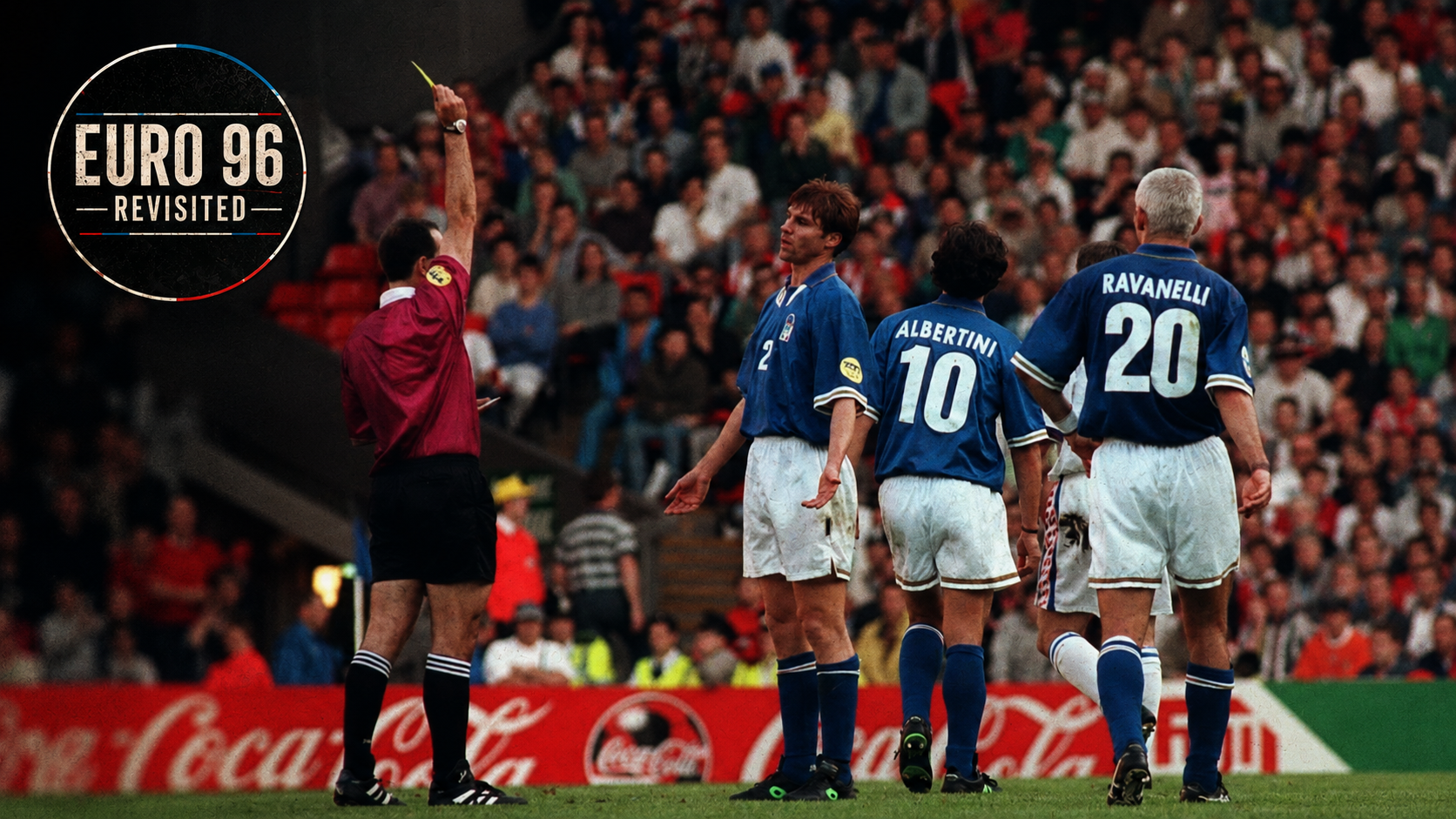
The ball travelled slowly enough for everyone inside Old Trafford to watch its fate unfold.
For a moment, it seemed an improbable gift. Italy had spent most of the previous week making life difficult for themselves. They had rotated unnecessarily against the Czech Republic, lost a match they had expected to win, and arrived in Manchester knowing that only victory over Germany would guarantee a place in the quarter-finals. Then, after nine minutes, opportunity appeared. Pierluigi Casiraghi intercepted a loose pass, surged into the penalty area and was brought down by Andreas Köpke. Penalty to Italy.
The responsibility belonged to Gianfranco Zola.
He was twenty-nine years old. He had won a UEFA Cup with Parma, become one of the most gifted attacking players in Europe and would soon leave for London, where he would enchant English football in ways few foreign imports had managed before him. He was also carrying a quieter burden. At Euro 96, Zola had inherited a role that no Italian footballer truly wanted to inherit. He had become the man expected to fill the creative void left by Roberto Baggio.
Zola stepped forward.
Köpke guessed correctly.
The shot lacked conviction and height. Germany’s goalkeeper saved comfortably. Italy continued to push, even after Germany were reduced to ten men, but something had changed. The urgency remained. The movement remained. The tactical organisation remained. Yet there was a growing sense that Italy had exhausted whatever reserve of spontaneity they possessed. They could circulate possession. They could maintain shape. They could follow instructions. They could not find a way through.
The match ended goalless.
At almost the same moment, news filtered through from Anfield that the Czech Republic had rescued a late draw against Russia. Italy were out.
Years later, Zola described the penalty miss in terms that felt less sporting than personal. “I suffered so very much,” he told Football Italia. “It was like a light went off inside me and I just could not react to that moment.”
Italy remembers Euro 96 through moments like this. Zola’s penalty. Casiraghi’s miss against the Czech Republic. Arrigo Sacchi pacing the technical area with the agitation of a man convinced the world had misunderstood him. It is tempting to reduce the tournament to a catalogue of isolated mistakes and unfortunate incidents.
That interpretation is comforting because it suggests Italy simply experienced the kind of bad fortune that short tournaments occasionally produce.
It is also incomplete.
Italy’s elimination at Euro 96 had begun long before Zola walked towards the penalty spot at Old Trafford. In truth, it had begun five years earlier, when Sacchi attempted something no Italy manager had seriously attempted before. He was not trying to win matches in the conventional Italian sense. He was trying to redesign what Italian football looked like, how Italian football behaved and, perhaps most provocatively of all, what Italian football believed itself to be.
For generations, Italy had accepted contradiction as part of its footballing identity. Defensive organisation and individual inspiration coexisted comfortably. Tactical discipline was expected, but there was always room for the gifted improviser, the fantasista capable of seeing spaces and possibilities invisible to everyone else. Even when systems became rigid, genius was permitted to exist beyond them.
Sacchi rejected that compromise.
He believed football could be controlled. Distances could be measured. Movements could be rehearsed. Space could be compressed. Collective understanding could supersede instinct. Individual brilliance was welcome, but only if it served the structure rather than existing independently of it.
By the summer of 1996, Italy had spent half a decade trying to live inside Sacchi’s vision.
Euro 96 was not the moment that vision failed.
It was the moment Italy discovered it no longer wanted to inhabit it.
The Revolution Nobody Asked For
Few coaches have transformed club football as profoundly as Arrigo Sacchi. Few have divided their own country quite so completely.
By the time Italy arrived in England in June 1996, Sacchi had already spent nearly a decade dismantling assumptions about how football should be played. At AC Milan, he had built one of the greatest club sides the sport has known. The achievements themselves were extraordinary enough: a league title wrestled away from the established powers of Italian football, back-to-back European Cups, victories over some of the continent’s finest opponents. Yet what fascinated admirers and irritated detractors was not simply that Milan won. It was how they won.
Sacchi had never played professional football. He sold shoes. He coached amateur sides. He reached the summit of the game carrying none of the credentials Italian football traditionally respected. When critics questioned his lack of playing experience, he delivered a response that has outlived almost everything else he said.
“I never realised that to become a jockey you needed to be a horse first.”
It was provocative, arrogant and deeply revealing. Sacchi genuinely believed football had been understood incorrectly. For decades, Italy had elevated instinct, hierarchy and accumulated wisdom. Sacchi believed knowledge could be acquired elsewhere. The game could be studied. Patterns could be rehearsed. Behaviour could be engineered.
At Milanello, his methods became legendary.
Training sessions were obsessive in their detail. Entire afternoons could be spent without a football. Players moved according to invisible cues. Defensive lines shuffled in unison against imaginary opponents. Midfielders learned precisely when to step forward and when to retreat. The objective was not merely fitness. It was synchronisation.
Sacchi often spoke about distances between players. The space separating defence from attack should rarely exceed twenty-five metres. Compressing the field meant compressing possibilities. Opponents would have less time to think, less room to pass and fewer opportunities to exploit defensive weaknesses. Pressing was not simply aggression. It was geometry.
The irony was that many of these ideas now sound entirely familiar. Coaches across Europe discuss compactness, triggers, spacing and rest defence with almost religious conviction. Entire departments are employed to analyse pressing schemes. Elite academies teach principles that would have been immediately recognisable to Sacchi thirty years ago.
In 1996, however, these concepts remained unsettling to many Italians.
Italian football possessed its own identity, one shaped as much by culture as by tactics. The country’s greatest sides had often been pragmatic, but pragmatism was not synonymous with rigidity. The most successful Italian teams generally found ways to balance organisation with individual licence. The sweeper offered security behind aggressive markers, a theme that also runs through Euro 96’s wider story of sweepers and traditional defenders. The midfield provided structure. Somewhere further forward existed a player who operated beyond conventional instruction.
The fantasista was not simply a position.
He was a cultural figure.
Italian football had produced generations of players who seemed to belong partly to the collective and partly to themselves. Their value lay precisely in their unpredictability. They could disobey patterns because they possessed an understanding of situations that others lacked. They represented imagination within order.
Sacchi was suspicious of such romanticism.
He admired intelligence, but he distrusted improvisation. He wanted creativity to emerge from movement rather than impulse. His teams attacked spaces, not moments. They manipulated opponents through coordinated behaviour rather than waiting for inspiration.
It was an approach that made perfect sense at Milan, where players trained together daily for months at a time and where the core of the side remained remarkably stable. Applying the same philosophy to a national team proved considerably more difficult.
International football offers little patience. Coaches inherit players shaped by vastly different club environments. Preparation periods are short. Habits are deeply ingrained. Emotional expectations are amplified.
Sacchi nevertheless attempted to impose his vision entirely.
The Italian national side would not merely borrow aspects of Milan’s success.
It would become Milan.
Players accepted demanding physical workloads. Tactical sessions grew increasingly repetitive. Movements were memorised. Roles became highly prescribed. Successes along the way, particularly the run to the 1994 World Cup Final, provided evidence that the project remained viable. Defeat on penalties to Brazil seemed cruel rather than cautionary.
Yet beneath the surface, resistance had begun to emerge.
There was fatigue.
There was frustration.
There was a growing suspicion among some players that Sacchi was asking international footballers to function as club football automatons. The rhythms of the system required extraordinary physical commitment and complete ideological buy-in. Neither could be guaranteed.
Years later, Paolo Maldini reflected on the demands imposed by Sacchi. In Il Calcio, he described the methods as exhausting, admitting that players eventually struggled to sustain the intensity required by the coach’s approach. The issue was not whether Sacchi understood football.
Almost everyone agreed that he did.
The issue was whether Italian football wanted to understand football in quite the same way.
That question lingered over the Azzurri as they prepared for Euro 96.
Sacchi saw England as an opportunity to validate years of work.
Many Italians saw England as a test.
Not simply of a team.
But of an idea.
And ideas, unlike football matches, are rarely defeated by a single mistake. They collapse when enough people stop believing in them.
The Man Who Won the Argument Lost Euro 96
History has been unexpectedly kind to Arrigo Sacchi.
That sentence would have sounded absurd in the summer of 1996.
At the time, Sacchi appeared to many Italians as an ideologue whose greatest achievements belonged to the past and whose insistence on imposing them upon the national team had finally exhausted both players and public alike. Newspapers questioned his judgement. Supporters questioned his sanity. Players, usually guarded in public, increasingly hinted at frustrations they had largely concealed during the journey to the World Cup Final two years earlier.
Yet viewed from the perspective of today, Sacchi’s most controversial beliefs no longer appear revolutionary. They look almost mundane.
Modern football is, in many respects, profoundly Sacchian.
The vocabulary of elite coaching has become populated by concepts Sacchi spent decades discussing. Compactness. Vertical distances. Pressing triggers. Positional occupation. Coordinated movements. Rest defence. Synchronised pressing. Collective responsibility. The reduction of space. The importance of recovering possession high up the pitch. Entire coaching staffs now analyse principles that Sacchi was trying to teach through megaphones and shadow play exercises in the late 1980s.
Managers as stylistically distinct as Jürgen Klopp, Pep Guardiola, Thomas Tuchel and Julian Nagelsmann have all operated within a tactical universe that Sacchi helped create. Guardiola has spoken admiringly about Sacchi’s Milan, describing them as one of the most influential teams in football history. Coaches throughout Europe regularly revisit footage of those Milan sides not out of nostalgia, but because many of the solutions they offered remain relevant.
Sacchi eventually won football’s intellectual argument.
He simply lost Euro 96.
That distinction matters because it rescues the discussion from becoming an overly simplistic morality tale about arrogance and stubbornness. Sacchi undoubtedly possessed both qualities. He could be inflexible. He could alienate players. He often appeared incapable of recognising that his own certainty might become a weakness. But dismissing him as merely dogmatic risks overlooking a more interesting truth.
Visionaries rarely fail because they are entirely wrong.
They often fail because they ask people to inhabit a future that still feels uncomfortable.
Italy in 1996 was not prepared to think about football in the way Sacchi thought about football.
Italian football remained the most prestigious domestic competition in Europe. Serie A was home to many of the world’s greatest players. Tactical sophistication was not lacking. Yet sophistication and ideological transformation are not the same thing.
Italian football had historically been pragmatic rather than doctrinaire. Systems existed to support talent. They did not exist to subordinate it.
Sacchi inverted that relationship.
The collective became sacred.
Individualism became suspect.
Improvisation became a problem to solve.
Even his successes contained an element of contradiction. His great Milan side was not populated by anonymous workers. It included extraordinary footballers. Paolo Maldini possessed intelligence that transcended systems. Franco Baresi’s reading of the game was almost supernatural. Marco van Basten, Ruud Gullit and Frank Rijkaard were among the most gifted players of their generation. Sacchi’s structure was enhanced by genius even as his philosophy occasionally appeared to distrust it.
The national team presented an even greater challenge. International football asks coaches to work with fragmented preparation periods and players conditioned by different club environments. It rewards adaptability as much as conviction. Tournament football, in particular, tends to punish purity. It rewards managers willing to compromise, to simplify and to recognise that knockout football is often won by moments of inspiration that resist planning.
Sacchi was not built for compromise.
He had spent years proving that old assumptions could be overturned. He had demonstrated that zonal marking could outperform man-marking. He had shown that pressing could overwhelm technically gifted opponents. He had persuaded football that space mattered more than possession and that organisation could become a form of aggression.
The danger for innovators is that they sometimes become prisoners of their own insights.
Sacchi arrived in England convinced that his understanding of football remained fundamentally superior to many of the assumptions still governing Italian thought. He was probably correct.
The problem was that being historically correct and being tournament-proof are not necessarily the same thing.
Italy wanted a team capable of winning Euro 96.
Sacchi wanted Italy to become the football team of the twenty-first century.
Those objectives were not entirely compatible.
And by June 1996, after years of tactical drilling, ideological battles and growing fatigue, it was becoming increasingly clear that Sacchi’s greatest opponents were no longer Germany, the Czech Republic or Russia.
They were the instincts of his own country.
For five years, Italy had tolerated being taught how to think differently.
England would reveal whether they genuinely believed it.
The Artists Left at Home
If Sacchi represented the future of football, his squad selection for Euro 96 suggested he was willing to sacrifice almost anything to reach it.
Italy entered the tournament as vice-world champions and as representatives of what was still widely considered the strongest domestic league on earth. Serie A in the mid-1990s was not merely wealthy. It was the centre of gravity in European football. The UEFA Champions League finalists in 1996 were Italian. The previous three UEFA Cup finals had all contained Italian clubs. The world’s finest defenders, midfielders and forwards largely worked on Italian soil.
Sacchi therefore possessed a luxury few national team coaches enjoy.
He could leave elite footballers at home.
The question that lingered over the weeks before Euro 96 was why he seemed determined to leave so many of the wrong ones behind.
The omission that consumed the most column inches was inevitably Roberto Baggio.
Two years earlier, Baggio had almost carried Italy to a World Cup triumph through sheer force of will. His performances in the United States remain among the great examples of an individual dragging a national side beyond its apparent limits. Injured, exhausted and often isolated, he scored five goals in three knockout matches against Nigeria, Spain and Bulgaria. Without him, Italy would almost certainly have been eliminated before reaching Pasadena.
Sacchi never seemed entirely comfortable with what Baggio represented.
There had always been tension between them. Baggio’s game was instinctive, improvisational and resistant to excessive instruction. Sacchi’s game sought predictability within movement and discipline within creativity. Their relationship deteriorated during the qualifying campaign and reached a low point after defeat against Croatia in Palermo, when criticism of Sacchi’s methods became increasingly public.
Officially, Sacchi pointed towards fitness concerns.
Unofficially, few were convinced. The Independent reported Baggio’s omission from Italy’s Euro 96 squad as one of the most significant selection decisions before the tournament.
Baggio himself would later speak with characteristic restraint.
“Sacchi made other choices for the tournament, and I wasn’t taken into consideration.”
The phrasing was gentle.
The implication was not.
Italy’s greatest footballing artist of the previous decade was being discarded not because he lacked ability, but because he belonged to a different conception of football.
If Baggio’s omission felt painful, Giuseppe Signori’s exclusion felt almost wilfully provocative.
Signori had just finished the 1995-96 Serie A season as joint top scorer with twenty-four goals. He had won the Capocannoniere three times. He was one of the most natural finishers in Europe and arguably the most instinctive goalscorer Italy possessed. Yet Sacchi’s relationship with him had long been strained. During the 1994 World Cup, Signori had been repeatedly deployed wide on the left, sacrificing his strengths to preserve the structure of the team.
Signori objected.
Sacchi remembered.
Euro 96 offered no reconciliation.
Then there was Gianluca Vialli.
Fresh from captaining Juventus to European Cup glory, Vialli should have been one of the most obvious selections in the squad. He provided leadership, experience and an understanding of high-pressure environments. Instead, he remained at home, reportedly the victim of a deteriorated personal relationship with Sacchi that stretched back several years.
In total, Sacchi left behind forty-two Serie A goals from the most recent domestic season.
Viewed individually, each omission could perhaps be defended.
Viewed collectively, they looked less like football decisions and more like an ideological manifesto.
Sacchi was selecting believers.
He wanted players willing to subordinate themselves to a collective idea. Reputation mattered less than obedience. Genius mattered less than compatibility.
No player illustrated that contradiction more clearly than Alessandro Del Piero.
In retrospect, Del Piero’s presence in England feels almost symbolic. Italian football had spent years searching for the heir to Baggio, the next player capable of combining technical brilliance with imagination and elegance. Del Piero appeared to be exactly that player. At twenty-one, he had already won a Champions League with Juventus. He possessed extraordinary close control, unusual composure and an ability to create moments that seemed detached from the rhythm of ordinary matches.
Italy had finally found its crown prince.
Sacchi immediately asked him to become a wing runner.
Rather than operating as a second striker, drifting between defensive and midfield lines and receiving possession in dangerous central areas, Del Piero found himself stationed on the left side of a flat midfield four. Defensive responsibilities increased. Tracking runners became essential. Opportunities to influence the game diminished.
Against Russia at Anfield, he looked uncomfortable from the opening whistle.
The problem was not effort.
Del Piero worked.
He pressed.
He recovered possession.
He followed instructions.
What he rarely did was resemble Alessandro Del Piero.
At half-time, Sacchi substituted him for Roberto Donadoni. The Gentleman Ultra’s retrospective on Sacchi’s Italy captures how Del Piero’s marginalisation became one of the defining symbols of the campaign.
He never played another minute at Euro 96.
It is difficult to imagine a more powerful metaphor for Italy’s tournament.
The country had not merely excluded artists.
It had selected one.
Then immediately attempted to train him not to behave like one.
Sacchi would almost certainly have rejected such criticism. He genuinely believed freedom emerged from structure. Players performed best when liberated from uncertainty. Collective understanding allowed individuals to flourish rather than restricting them.
Yet Euro 96 increasingly suggested that Italian football remained unconvinced.
Baggio watched from home.
Signori watched from home.
Vialli watched from home.
Del Piero watched much of the tournament from the bench.
And as Italy prepared to face the Czech Republic in their second group match, it was becoming harder to avoid a deeply uncomfortable question.
Sacchi may have been building the football of tomorrow.
But had he already stripped Italy of too much of what had made it recognisably Italian?
The Fatal Assumption
Italy’s opening victory over Russia should probably have been treated as a warning.
Instead, it became an affirmation.
On paper, the 2-1 win at Anfield appeared reassuring. Pierluigi Casiraghi had scored twice. Gianfranco Zola had provided an assist. Three points were secured. The defending World Cup runners-up had begun the tournament exactly as favourites are supposed to begin tournaments.
Yet the performance itself was considerably less convincing.
Russia repeatedly found opportunities to attack the space behind Italy’s defensive line. Sacchi’s preferred compactness occasionally looked less like control and more like vulnerability. The distances between players remained disciplined, but there was an unfamiliar heaviness about the side. Their movements were coordinated, though rarely fluid. They functioned more effectively than they inspired.
For most managers, an imperfect victory at a major tournament is something to embrace. Tournament football rarely rewards aesthetic obsession. Momentum often matters more than elegance.
Sacchi saw something different.
He saw confirmation.
If his system could secure victory despite not operating at full capacity, then surely it was resilient enough to withstand adjustment. If collective understanding truly superseded individual talent, personnel changes need not be particularly disruptive.
The assumption was understandable.
It was also disastrous.
Ahead of Italy’s second match against the Czech Republic at Anfield, Sacchi made five changes to his starting eleven. Roberto Di Matteo was omitted. Angelo Di Livio disappeared from the side. Casiraghi dropped out. Zola was rested. Alessandro Del Piero, already marginalised tactically against Russia, lost his place entirely.
Into the side came Roberto Donadoni, Dino Baggio, Diego Fuser, Enrico Chiesa and Fabrizio Ravanelli.
Sacchi explained his reasoning with characteristic certainty.
“You can’t play in the European Championships with only 11, 12 or 13 players. I have faith in all my 22.”
At one level, he was entirely correct.
Major tournaments demand squad depth.
Rotation is often necessary.
Fatigue accumulates quickly.
Players require protection.
Yet Euro 96 was not being played in the era of extensive sports science departments, minute management strategies and rotation accepted as orthodoxy. More importantly, Sacchi’s changes were not simply physical calculations. They reflected an underlying belief that his football had become sufficiently advanced to transcend individual relationships and established combinations.
The machine would continue functioning regardless of which components had been temporarily removed.
Unfortunately for Italy, the Czech Republic arrived in Liverpool carrying their own ideas about the future.
Readers of this series already know what happened next.
The Czech Republic were among the revelations of Euro 96, a side later examined in this series as one of the tournament’s defining disruptors in the story of their run to the final. At this stage, though, they remained widely underestimated. Their squad contained talented players operating within strong European leagues, yet they did not possess Italy’s reputation, Italy’s pedigree or Italy’s sense of entitlement. They were expected to compete.
Italy expected to progress.
That distinction mattered.
Within five minutes, Pavel Nedvěd had given the Czechs the lead. Retro Football Analysis’s match report on Czech Republic 2-1 Italy details the key moments of a defeat that changed the whole shape of Group C.
The goal itself was not particularly complicated. It was simply energetic, direct and opportunistic. More significantly, it exposed the disjointedness of an Italian side attempting to rediscover chemistry under tournament conditions.
Enrico Chiesa equalised after good work involving Diego Fuser, but Italy never appeared fully comfortable. Their pressing lacked synchronisation. Their midfield movements seemed less instinctive than rehearsed. The substitutions had introduced freshness, but not familiarity.
Then came Luigi Apolloni’s dismissal.
Reduced to ten men, Italy became increasingly vulnerable to a Czech side growing in confidence and ambition. Radek Bejbl restored the lead before half-time, converting from close range after another incisive attack. Suddenly, Italy’s assumptions were colliding with tournament reality.
Sacchi responded by introducing Casiraghi and Zola.
The very players he had decided could afford to rest.
The irony was difficult to ignore.
Eventually, Italy fashioned one final opportunity. Zola delivered a delicate pass into Casiraghi’s path. The striker, usually so reliable in these situations, lifted his effort over an open goal.
The chance has often been remembered as one of the tournament’s cruellest misses.
In truth, it was probably something more revealing.
Casiraghi’s miss was not the cause of Italy’s defeat.
It was merely the final consequence of an earlier decision.
Years later, Zola offered an assessment notable for its honesty and absence of bitterness.
“I think Sacchi didn’t have the right information. He was told they were not an athletic team and not very strong. So he decided to change almost half the squad. Five changes at once were too many. We were surprised by the quality of the Czechs.”
The quote remains striking because it punctures one of the myths that occasionally develops around failed tournaments.
Italy did not lose to the Czech Republic because they were unlucky.
They lost because they misjudged them.
And Sacchi’s misjudgement was not merely tactical.
It was philosophical.
He had spent years proving that football could be organised, measured and controlled. At Milan, surrounded by players training together every day, he had largely succeeded. At international level, in a tournament compressed into three frantic group-stage matches, he discovered that football remains stubbornly resistant to complete management.
Some teams enter major tournaments fearing opponents.
Sacchi entered Euro 96 believing his greatest advantage was certainty.
The Czech Republic exposed certainty’s greatest weakness.
It often leaves little room for humility.
By the time Italy travelled to Old Trafford to meet Germany five days later, the margin for error had disappeared.
And perhaps more significantly, so too had the illusion that Sacchi’s revolution was universally believed in by those expected to carry it out.
The Penalty Was Only the Symptom
By the time Italy arrived at Old Trafford on 19 June, Euro 96 had become an exercise in damage limitation.
The mathematics were uncomfortable. Germany led the group with four points. The Czech Republic also had four. Italy had four. Russia had one. A draw might yet prove sufficient, but only if events elsewhere unfolded favourably. The safer solution was obvious.
Beat Germany.
Sacchi abandoned experimentation.
The strongest available side returned. Zola was restored. Casiraghi returned. Paolo Maldini moved back towards the heart of the defence. Angelo Di Livio resumed his relentless running. Roberto Di Matteo brought composure and balance. For perhaps the only time in England, Italy looked like a team selected not to prove a philosophical point, but simply to win a football match.
And for long periods, they were the better side.
This is one of the strange features of Italy’s Euro 96. Their elimination has become so closely associated with failure that it obscures an awkward truth. Against Germany, the eventual European champions, Italy produced arguably their most complete performance of the tournament. They pressed intelligently, disrupted German build-up play and carried a threat in transition. There was aggression in their play, but also an urgency that had been absent against the Czech Republic.
For a fleeting moment, it looked as though Sacchi’s project might yet be rescued.
Then came the penalty.
Nine minutes had elapsed when Matthias Sammer hesitated in possession. Casiraghi anticipated brilliantly, stealing the ball and bursting into the area. Andreas Köpke came out and clipped him. There was little protest.
Penalty.
The moment felt almost cinematic.
Italy had spent years wrestling with Sacchi’s ideas. They had spent days discussing the self-inflicted damage of Anfield. Now they possessed a chance to erase much of it. Score, settle into the game, place pressure on Germany and perhaps restore confidence to a side carrying considerable psychological baggage.
Zola placed the ball on the spot.
His run-up was measured.
The strike was not.
Köpke saved comfortably. UEFA’s account of Italy’s draw with Germany records how Zola’s saved penalty shaped the match and left Italy dependent on events elsewhere.
The immediate temptation is to explain Italy’s elimination through that moment alone. Missed penalties lend themselves to mythology. They provide clear images, identifiable villains and emotionally satisfying turning points. They are easy to remember because they appear to offer certainty.
Football, however, is rarely so accommodating.
Italy’s problem at Euro 96 was not that Gianfranco Zola missed a penalty.
Their problem was that they increasingly looked like a side incapable of surviving moments that had not been rehearsed.
Germany were reduced to ten men during the second half after Thomas Strunz was dismissed, offering Italy another significant advantage. Sacchi’s side attacked. They circulated possession. They maintained territorial control. They generated pressure.
Yet they struggled to improvise.
The movements remained coordinated.
The distances remained compact.
The structure remained visible.
What seemed absent was spontaneity.
There was no equivalent of Roberto Baggio dragging exhausted teammates towards another round. There was no inspired deviation from the script. No player appeared willing or perhaps able to abandon the choreography and create disorder within German organisation.
Paolo Maldini would later offer perhaps the most persuasive explanation.
Writing in Il Calcio, he reflected upon the physical and mental toll exacted by Sacchi’s methods. The sessions had become increasingly demanding. The tactical work increasingly repetitive. The collective rhythms that had once felt invigorating had, over time, become draining. Players were expected to maintain an intensity that was difficult to sustain after long club seasons and repeated international commitments.
Maldini was not criticising Sacchi’s intelligence.
Few players ever have.
He was questioning sustainability.
Systems, however sophisticated, remain dependent upon human beings. Human beings tire. They lose concentration. They become less decisive. They begin to hesitate in moments where instinct should take over.
Euro 96 increasingly resembles a study in diminishing returns.
Sacchi had spent five years trying to create a national team capable of functioning with the precision of a great club side. In many respects, he succeeded. Italy were tactically coherent. They understood positional responsibilities. They could press effectively. They remained difficult to play against.
But perhaps they had travelled too far in one direction.
The machine still worked.
It simply no longer surprised anyone.
Sacchi later defended his team with characteristic conviction.
“We were in a group of steel; we played well in all three matches and I believe that we didn’t deserve to be eliminated because of the standard of our play.”
There is truth in that assessment.
Italy were not humiliated.
They were not chaotic.
They did not implode in the manner of other talented sides that summer.
In another group, they might easily have progressed.
Yet Sacchi’s defence also contained the blind spot that had increasingly defined his tenure.
He evaluated Italy primarily through the quality of their processes.
International tournaments judge teams by something rather less forgiving.
Their outcomes.
As the final whistle sounded at Old Trafford, portable radios carried unwelcome news from Anfield. The Czech Republic had salvaged a dramatic 3-3 draw against Russia thanks to an 88th-minute equaliser from Vladimír Šmicer. UEFA’s report on Šmicer’s late equaliser against Russia explains how the goal sent the Czech Republic through at Italy’s expense. Italy and the Czechs finished level on four points, but the head-to-head defeat in Liverpool proved decisive.
Italy were eliminated.
Zola later recalled the aftermath with painful honesty.
“I became a football player because I watched Italy win the 1982 World Cup and wanted to follow those footsteps. That’s why when I missed the penalty at EURO ’96, I suffered so very much. It was like a light went off inside me and I just could not react to that moment.”
It remains one of the saddest quotations to emerge from Euro 96.
Yet even Zola’s grief can be misleading.
The penalty was real.
The pain was genuine.
But the miss itself was only the symptom.
The illness had been developing for years. Italy had spent half a decade attempting to become a team that trusted systems more than instinct, preparation more than improvisation and collective geometry more than individual imagination.
At Old Trafford, under pressure, exhausted and facing elimination, they discovered how difficult it can be to remember how to improvise once you have spent years being taught not to.
When Football Escaped Football
By the end of June 1996, Arrigo Sacchi was no longer merely a football manager.
He had become an argument.
That was perhaps inevitable. Italy has always discussed football with unusual intensity, but there are moments when sporting disagreements begin to spill beyond stadiums, newspaper columns and television studios into the broader cultural bloodstream. Euro 96 became one of those moments. The tournament was no longer simply about a missed penalty, a mistimed rotation policy or a disappointing group-stage exit. It had become a referendum on what Italians wanted their football to look like.
Euro 96 Revisited has repeatedly shown that 1996 was not simply a football tournament. It was a tournament in which nations confronted versions of themselves. England debated memory in the win over Scotland and Stuart Pearce’s release against Spain. France debated patience before its 1998 transformation. The Netherlands debated cohesion. Italy debated modernity.
The most extraordinary illustration arrived not in a sports section but in a courtroom in Florence.
Salvatore Riina, the notorious Sicilian Mafia boss known as Totò u Curtu and regarded as the architect of some of Italy’s darkest years, was standing trial. Murder, terrorism, organised crime and decades of violence hung over proceedings. Yet even there, amid one of modern Italy’s most significant judicial reckonings, football intruded.
Turning to his lawyer, Riina reportedly delivered his own assessment of Italy’s manager.
“Sacchi uses suicide tactics and suicide choices.”
It is a remarkable quote.
Partly because of its source.
Mostly because of what it reveals.
When the country’s most feared criminal figure feels sufficiently invested to offer tactical analysis during a murder trial, football has escaped football.
Sacchi had become a proxy for something much larger.
To his supporters, he remained one of the most innovative minds the game had produced, a coach courageous enough to challenge stale assumptions and drag Italian football towards modernity. He had transformed Milan. He had reached a World Cup final. He had encouraged Italy to think beyond the comforting certainties of the sweeper, the marker and the inspired number ten.
To his critics, however, Sacchi increasingly resembled a different kind of figure altogether.
He was the technocrat who believed ordinary people simply failed to understand his brilliance.
He was the intellectual who distrusted instinct.
He was the reformer who seemed willing to discard tradition not because it had ceased functioning, but because he no longer considered it enlightened.
That interpretation was not entirely fair.
But it was politically powerful.
Italy in the mid-1990s was itself a nation navigating profound transitions. The old political order had fractured. Corruption scandals had undermined confidence in institutions. New parties and personalities were attempting to redefine Italian public life. Questions of identity, modernisation and continuity extended far beyond football.
Sacchi arrived at precisely the wrong moment to ask Italians to surrender one of the few identities they still believed belonged entirely to them.
Because what irritated many supporters was not merely losing.
Italy had lost tournaments before.
Italy had lost World Cup finals.
Italy had endured disappointments.
The deeper discomfort lay elsewhere.
For many Italians, Sacchi appeared to be suggesting that the football they had historically loved was somehow obsolete. The game that produced Gianni Rivera, Roberto Baggio and generations of elegant improvisers was no longer sufficient. Inspiration was to be replaced by instruction. Freedom would be granted only within carefully measured parameters. Individual brilliance would be tolerated only if it emerged from collective choreography.
It was, in many respects, an argument about Italian identity disguised as an argument about football.
And by the summer of 1996, Italy seemed increasingly determined to reject Sacchi’s proposition.
Newspapers attacked his stubbornness.
Television discussions questioned his judgement.
Supporters overwhelmingly directed their anger towards the coach rather than towards Gianfranco Zola, whose penalty miss was largely treated with sympathy because his devastation was so visibly human.
Sacchi, characteristically, remained defiant.
He insisted Italy had not deserved elimination. He argued that a single defeat in a difficult group could not reasonably be considered a catastrophe. He spoke of harvests not yet reaped and of performances whose quality had been overlooked.
Perhaps he was right.
Perhaps Italy had indeed played better football than their results suggested.
But by then, results had almost become irrelevant.
The relationship between Arrigo Sacchi and Italian football had moved beyond empirical debate.
It had become emotional.
And once football reaches that point, evidence rarely changes minds.
The revolution had not quite ended.
But by the close of Euro 96, it was becoming increasingly apparent that Italy had already begun looking for a way home.
Sarajevo and Italy Comes Home
Arrigo Sacchi survived Euro 96.
Technically.
Politically.
For a while, at least.
The immediate reaction to Italy’s elimination was severe, but not universally hostile. Gianfranco Zola returned home to sympathy rather than condemnation. The image of the slight Sardinian playmaker walking away from Andreas Köpke’s goal in tears made it difficult for supporters to cast him as the villain. If Italy had failed, many believed responsibility lay elsewhere.
Sacchi, however, refused to concede that his project had been fundamentally flawed.
“We were in a group of steel,” he argued. “I believe that we didn’t deserve to be eliminated because of the standard of our play.”
From a certain perspective, he had a case.
Italy had not been dismantled. They had lost only once. Germany, the eventual champions, had not beaten them. A penalty had been missed. A chance against the Czech Republic had been squandered. Margins in tournament football are notoriously thin.
But by the summer of 1996, Sacchi’s problem was no longer statistical.
It was emotional.
Too many Italians had stopped believing.
Too many players looked exhausted.
Too many supporters felt disconnected from the football being played in their name.
The end, when it arrived, felt strangely appropriate.
On 6 November 1996, Italy travelled to Sarajevo for a friendly against Bosnia and Herzegovina.
The match carried significance that extended far beyond football.
The war in Bosnia had formally ended less than a year earlier. Sarajevo remained scarred by siege, shelling and unimaginable loss. Buildings still bore bullet marks. Infrastructure remained damaged. The Koševo Stadium itself lacked functioning floodlights. Yet forty thousand supporters filled the stands.
They unfurled a banner.
Grazie Azzurri.
It was a profoundly European scene.
A country emerging from catastrophe welcoming one of football’s traditional powers not as conquerors, nor as celebrities, but as guests participating in a small act of normality.
Italy, meanwhile, arrived as a nation wrestling with its own sporting identity.
Bosnia won 2-1.
Hasan Salihamidžić scored.
Elvir Bolić scored.
Enrico Chiesa replied for Italy.
The result itself was almost secondary. The match record for Bosnia and Herzegovina 2-1 Italy preserves the bare facts, but the emotional context was far larger than the scoreline. Bosnia and Herzegovina had barely existed as an organised football nation. Training camps had been improvised. Resources were limited. The emotional significance of merely playing international matches far outweighed tactical preparation.
For Italy, however, the defeat felt symbolic.
Sacchi’s revolution had not merely stalled.
It had reached its natural conclusion.
Within weeks, he resigned. The Independent reported Sacchi’s resignation as he left the national job and returned to Milan.
Five years earlier, he had been appointed to drag Italian football towards a different future.
Five years later, Italian football decided it no longer wished to follow.
And perhaps the clearest indication of that decision lay not in Sacchi’s departure, but in the identity of the man chosen to replace him.
The successor told the whole story.
Italy appointed Cesare Maldini.
It was difficult to imagine a more revealing choice.
Maldini was not anti-modern. He had just guided Italy’s Under-21 side to an extraordinary third consecutive European Championship. He oversaw a generation that included Alessandro Nesta, Fabio Cannavaro, Filippo Inzaghi, Francesco Totti and a young goalkeeper named Gianluigi Buffon. He understood elite football. He understood development. He understood winning.
But stylistically, culturally and philosophically, he represented something entirely different from Sacchi.
He represented reassurance.
He represented familiarity.
He represented Italy.
Italy did not simply replace Sacchi with another coach. It replaced revolution with restoration. Cesare Maldini brought back the language Sacchi had tried to move beyond: defensive security, the sweeper, man-marking habits, caution, pragmatism and structures built to protect players rather than discipline them.
Cesare Maldini belonged to a football tradition that Sacchi had spent years attempting to transcend. The old certainties returned. Defensive security mattered again. The sweeper, while increasingly endangered by broader European trends, still occupied an honoured place in Italian tactical memory. Man-marking was not considered an embarrassment. Pragmatism ceased to be apologised for. Systems existed to support talented players, not necessarily to reshape them.
Most importantly, there was an implicit acceptance that gifted footballers occasionally required freedom.
Sacchi had often appeared to believe that freedom emerged from perfect collective organisation.
Cesare Maldini seemed closer to believing that collective organisation should exist partly to protect players capable of doing the unexpected.
The contrast was striking.
Sacchi believed players should serve the structure.
Maldini believed structures should serve players.
Italy were not simply appointing a new coach.
They were restoring a national personality.
By the time Italy reached the 1998 World Cup, they looked recognisable once more. Roberto Baggio returned. Alessandro Del Piero operated in positions that suited his talents. Defensive solidity reasserted itself. There was still organisation, still tactical intelligence, still discipline. But there was also a renewed willingness to trust inspiration.
Under Cesare Maldini, Roberto Baggio returned. That mattered. It was not merely a squad decision. It was an acknowledgement that Italy still wanted room for improvisation inside its order.
In many respects, Euro 96 had functioned as a referendum.
Italy considered Sacchi’s proposition.
It considered the possibility that football’s future belonged to pressing schemes, rehearsed automatisms, compressed spaces and relentless collective movements.
Then, beneath the scarred walls of Sarajevo and in the appointment of Cesare Maldini, Italy quietly cast its vote.
The answer was not that Sacchi had been wrong.
The answer was that Italy preferred being Italy.
The revolution was over.
And the country, exhausted by five years of argument, was finally ready to go home.
Italy Buried Sacchi. Football Did Not.
There is an uncomfortable irony at the heart of Italy’s Euro 96.
The country spent the summer concluding that Arrigo Sacchi had failed.
History has spent the following thirty years suggesting something rather different.
Sacchi was undoubtedly responsible for many of the mistakes that undermined Italy’s campaign. He alienated gifted players. He underestimated the Czech Republic. He rotated at precisely the wrong moment. He appeared unable, or unwilling, to recognise that tournament football often rewards compromise over conviction. There was an arrogance to his methods that became increasingly difficult to defend once results deteriorated.
Yet reducing Euro 96 to a story about a stubborn coach finally being exposed misses something more significant.
Sacchi was attempting to solve a problem that many others had not yet realised existed.
He understood that football was changing. The old distinctions between attackers and defenders were beginning to blur. Space was becoming more valuable than possession. Pressing was evolving from enthusiasm into organisation. Teams that moved together would increasingly overwhelm teams dependent upon individual interventions. Coaches would become architects. Training grounds would become laboratories. Tactical preparation would grow ever more sophisticated.
Much of modern football eventually travelled in the direction Sacchi had pointed.
Compactness became fashionable.
Pressing became fashionable.
Positional discipline became fashionable.
Shadow play became fashionable.
Distances between lines became a coaching obsession.
Today, elite managers speak about football in language that would have been immediately recognisable to Sacchi in 1996.
Italy, however, was not evaluating an abstract future.
Italy was evaluating its own identity.
The country’s football culture had been built upon a productive contradiction. It valued organisation, but distrusted rigidity. It admired defensive intelligence, but reserved its deepest affection for players who appeared capable of transcending systems altogether. Italian football expected coaches to provide order. It expected gifted footballers to occasionally disobey that order.
Sacchi challenged that settlement.
He believed football could be improved by becoming more collective, more measured and more predictable. He wanted Italy to embrace a version of itself that looked less towards Gianni Rivera and Roberto Baggio and more towards coordinated pressing structures and rehearsed movement patterns.
Italy looked at that proposal.
It considered it for five years.
It reached a World Cup Final.
It endured a European Championship disappointment.
It listened to players complain of exhaustion.
It watched Del Piero become a left midfielder.
It watched Baggio stay at home.
It watched Zola walk away from a penalty feeling as though someone had switched off the light inside him.
Then it appointed Cesare Maldini.
That decision told us almost everything.
Italy did not merely dismiss a coach.
It rejected a particular vision of itself.
And perhaps that is why Euro 96 remains such an important chapter within the story of the tournament. England discovered the burden of memory. Old football discovered its approaching death. The back-pass rule showed how quickly the sport was being reshaped. The Netherlands discovered that talent does not automatically produce harmony. France discovered that transition can precede triumph. Germany demonstrated that old ideas can still survive long enough to win one final title, with Matthias Sammer’s last-libero tournament standing as one of Euro 96’s clearest symbols of football between eras. Even Oliver Bierhoff’s golden goal hinted at a sport experimenting with new endings before it understood what those endings meant.
Italy discovered something different.
Football cultures do not change simply because someone proves they should.
They change when they decide they want to.
In the summer of 1996, Italy decided it did not.
The game would eventually catch up with Arrigo Sacchi.
Italian football chose not to wait.
And that may be the strangest legacy of Euro 96.
Italy buried Sacchi in England.
Football spent the next generation quietly becoming more like him.
