


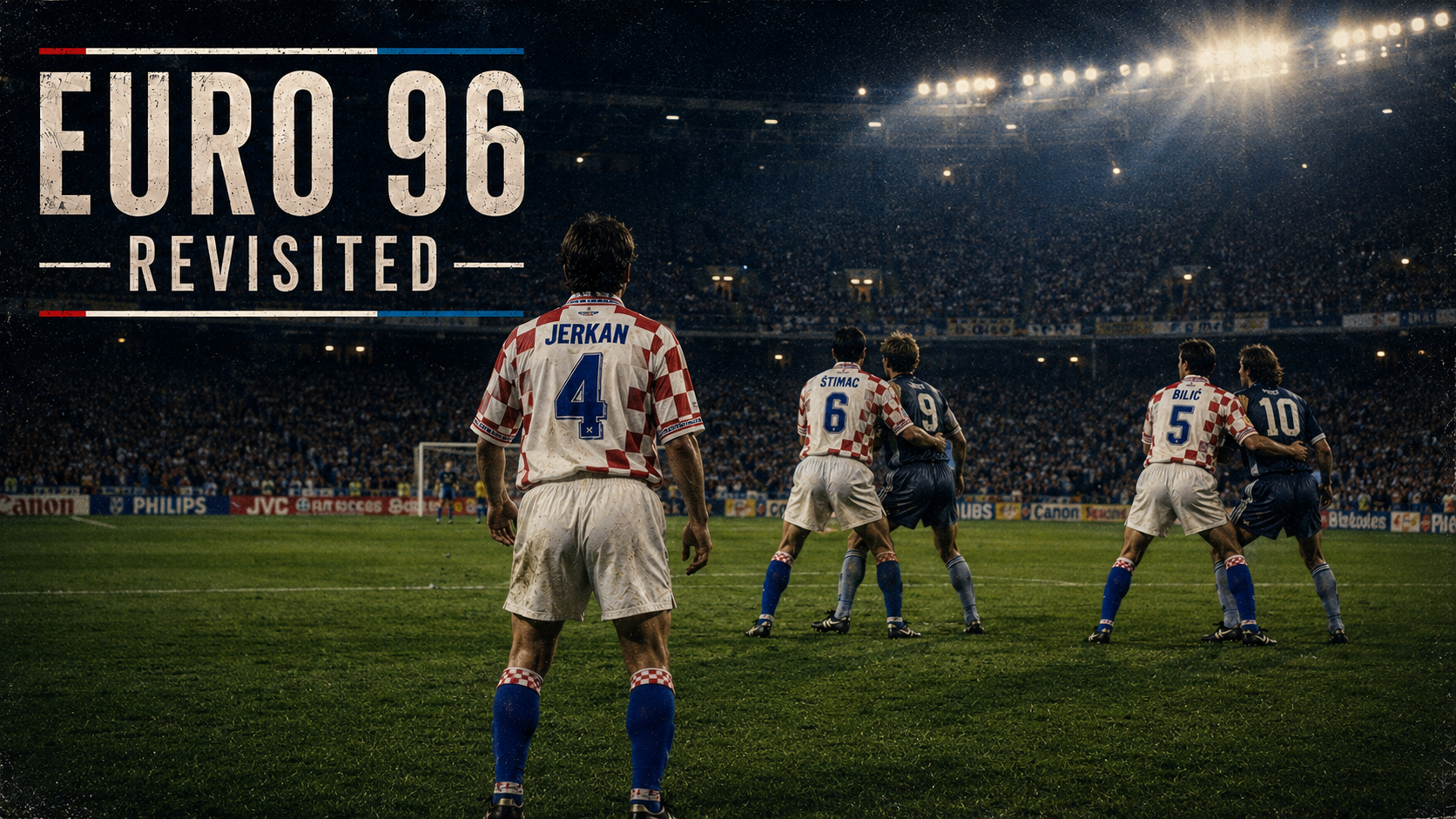
Euro 96 is remembered for Gascoigne, Poborský, Three Lions and Germany’s golden goal. Yet beneath the famous images was another story: the final great international summer for sweepers, stoppers and defenders who read the game before football compressed the spaces they once ruled.
Key Takeaways
- Euro 96 was one of the last major tournaments where sweepers, stoppers and man-marking defenders still shaped elite international football.
- Matthias Sammer’s Player of the Tournament performance represented the peak of the libero, not its future.
- Germany won with an old-world defensive structure, while France hinted at the compact, zonal future that would define the next era.
- The back-pass rule, zonal defending, high lines and coordinated pressing gradually removed the space that traditional defenders needed.
- The libero disappeared, but many of his qualities survived in ball-playing centre-backs, deep midfielders and sweeper-keepers.
Opening Scene
On the evening of 18 June 1996, Wembley staged one of the most celebrated performances in England’s modern football history.
The scoreline would become part of tournament folklore. England 4, Netherlands 1. Alan Shearer at his predatory best. Teddy Sheringham conducting the attack. Wembley roaring to the rhythm of Three Lions and possibility.
Most people remember the goals.
Almost nobody remembers the defenders.
Yet watch the match again and something curious emerges.
Danny Blind spends much of the evening looking over his shoulder. Tony Adams constantly points, shuffles and adjusts the line around him. Gareth Southgate drifts between roles that would barely exist today. Across the tournament, Laurent Blanc glides through games without seeming to run. Matthias Sammer appears in places no defender should ever appear. Igor Štimac and Slaven Bilić engage in personal battles that feel closer to duels than positional assignments.
The football itself looks different.
The spaces are different.
The responsibilities are different.
Even the body language is different.
The defenders of Euro 96 carried themselves like men responsible for individual pieces of territory. They were not components in an elaborate pressing machine. They were specialists. Problem-solvers. Custodians of danger.
At the time, nobody considered this unusual.
This was simply how football looked.
For more than half a century, the game’s greatest defensive systems had been built around figures such as these. Sweepers operating in the shadows behind the action. Stoppers attached to opposing forwards like bodyguards. Centre-backs whose greatest gift was not speed but anticipation. Defenders who survived because they could read the future five seconds before everybody else.
The summer of 1996 was filled with stories about what was arriving.
Germany’s resilience.
The emergence of a new Europe after the Cold War.
What few people recognised was that another story was unfolding quietly in the background.
Something was disappearing.
Not a team. Not a player. An entire way of defending.
The clues were everywhere. Germany still relied on the libero. Croatia trusted a defensive structure that would have been instantly recognisable twenty years earlier. England mixed old principles with new ideas. France were already moving towards something more modern, more compact and more collective.
For a few weeks, all of these football worlds occupied the same tournament.
Then they drifted apart.
When Euro 96 began, the sweeper was still a living, breathing part of elite football. The traditional stopper still had a purpose. The old defensive hierarchies that had shaped European football for decades remained visible.
When the decade ended, most of them were gone.
That is why Euro 96 matters.
Not simply because of the goals that entered football mythology.
Not because England briefly believed.
Not because Germany won.
Euro 96 matters because it was the last major international tournament where the old defenders still ruled the landscape.
The last sanctuary of the free man.
The last summer before football compressed the pitch and changed forever.
The Real Story
The usual explanation for the disappearance of the sweeper is that football evolved.
That is true, but it is also incomplete.
The libero did not vanish because coaches suddenly discovered a better idea. The great stoppers and sweepers were not exposed as tactical frauds. They were not replaced because they lacked intelligence or technical ability.
Quite the opposite.
Many of the finest defenders of the twentieth century possessed football brains so advanced that they would still be valuable in any era.
The real story is more complicated.
Football changed the questions before changing the answers.
For decades, defending was largely an individual craft. A great centre-back’s job was not to execute a collective system but to solve problems. Every match presented a series of personal examinations. Could you read the striker’s movement? Could you anticipate the second ball? Could you recognise danger before it became visible to everyone else?
The best defenders treated the pitch almost like a chessboard.
Franz Beckenbauer once described football as a game that should be played with the eyes. That philosophy sat at the heart of the sweeper tradition. The libero was football’s grandmaster, positioned behind the action, surveying patterns, predicting threats and intervening before disaster arrived.
The role demanded unusual qualities.
Physical courage, certainly.
Technical ability, absolutely.
But above all, imagination.
A great sweeper had to see spaces that did not yet exist.
That is why so many of them began life as midfielders. Beckenbauer. Matthias Sammer. Laurent Blanc, who was not a true libero but carried many of the same instincts. They understood football as creators first and defenders second.
By the mid-1990s, however, the sport was beginning to move in a different direction.
The great tactical innovation of the coming era was not an attacking system. It was compression.
Coaches increasingly sought to reduce the amount of usable space available to opponents. Defensive lines pushed higher. Midfields squeezed closer together. Pressing became more coordinated. The pitch itself did not shrink, but the effective playing area did.
The consequences were enormous.
A traditional sweeper required space.
He needed distance behind the defensive line. He needed room to read danger developing in front of him. He needed a game that unfolded at a pace where anticipation could consistently defeat acceleration.
Modern football gradually removed those conditions.
The spare man became less necessary because zonal systems distributed responsibility across the entire defensive unit. The individual duel gave way to collective organisation. Defending became less about one exceptional reader of the game and more about synchronised movement.
The irony is that Euro 96 was won by the very role that was about to disappear.
Matthias Sammer was named Player of the Tournament.
Germany became European champions.
The libero reached its absolute peak at precisely the moment its future was beginning to evaporate.
That contradiction sits at the heart of the tournament.
Euro 96 was not the triumph of an old idea over a new one.
It was the final moment when both still coexisted.
Germany represented one reality.
France hinted at another.
England sat somewhere in between.
Across England that summer, football’s past and future shared the same pitches, the same dressing rooms and often the same matches.
The participants did not realise they were living through a transition.
Most supporters certainly did not.
Looking back now, however, the signs are impossible to miss.
Euro 96 was not simply the end of one tournament.
It was the end of a defensive civilisation.
Before the Moment
For much of football’s history, defending was built on a simple mathematical problem.
If the opposition played with two forwards, you needed three defenders.
Two would deal with the strikers.
The third would deal with everything else.
That third man became one of the most influential figures the sport has ever produced.
The sweeper.
The libero.
The free man.
The origins of the role stretch back to the 1930s, when Austrian coach Karl Rappan developed his verrou, or bolt, system in Switzerland. The idea was straightforward. Rather than matching attackers man for man, one defender remained spare, positioned behind the others to clean up mistakes and anticipate danger.
The concept survived because it worked.
As football became more sophisticated, the role became more sophisticated with it.
In Italy, Nereo Rocco refined the idea after the Second World War. Then came Helenio Herrera’s great Inter Milan side of the 1960s, where catenaccio elevated the sweeper into football folklore. The system was often caricatured as negative, but its success rested on intelligence rather than caution. The sweeper was not merely destroying attacks. He was organising the entire defensive architecture.
The role reached artistic levels in the hands of Franz Beckenbauer.
Before Beckenbauer, the libero had largely been a defensive insurance policy.
After Beckenbauer, he became something far more ambitious.
The German transformed the position from a cleaner into a creator. Instead of merely collecting loose balls, he stepped into midfield, dictated possession and launched attacks himself. Football had never seen a defender quite like him. He moved through matches with the authority of a conductor directing an orchestra.
His influence was profound.
Across Europe, coaches searched for their own version of the role.
By the 1970s and 1980s, sweepers were everywhere.
Italy had Gaetano Scirea.
Germany had Beckenbauer and later Lothar Matthäus in a modified version of the role.
The Netherlands produced players capable of drifting between defence and midfield.
Even teams that did not formally employ a libero often retained the logic behind it. Defensive structures still relied heavily on man-marking. Individual duels remained the foundation of most systems.
The stopper became as important as the sweeper.
This was a football culture built around specialists.
One defender followed the opposition’s most dangerous striker wherever he went. Another dominated aerial battles. The sweeper interpreted the chaos behind them. Every role had clearly defined responsibilities. Every role required a particular personality.
The language of defending reflected this world.
Markers.
Stoppers.
Sweepers.
Covering defenders.
These terms described distinct jobs rather than variations of the same position.
By the early 1990s, however, cracks had started to appear.
Arrigo Sacchi’s Milan had challenged many of football’s assumptions. His defence moved as a unit rather than as a collection of specialists. Instead of chasing opponents across the pitch, Milan defended space. Instead of relying on a spare man behind the line, they relied on coordination, discipline and compactness.
At first, many regarded Sacchi’s ideas as unusual.
Then they started winning.
A lot.
The impact spread gradually.
Not every team abandoned traditional defending overnight. Football rarely changes that quickly. Most sides adapted in stages, mixing old habits with new concepts.
That is precisely what makes Euro 96 so fascinating.
The tournament arrived at the exact moment when both worlds still existed.
The old order had not disappeared.
The new order had not fully arrived.
Germany still trusted a libero.
Croatia still employed a classical defensive hierarchy.
England moved between systems depending on the opponent.
France were already beginning to resemble something more recognisable to modern eyes.
The tournament became a living snapshot of football’s evolutionary crossroads.
For a few weeks in the summer of 1996, defenders from different eras shared the same stage.
Some just did not know it yet.
The Summer of 1996
The timing mattered.
Had Euro 96 taken place five years earlier, the presence of sweepers and stoppers would barely have attracted comment. Had it taken place five years later, many of them would already have disappeared.
Instead, the tournament landed directly in the middle of football’s great defensive transition.
That tension was visible almost everywhere.
Germany arrived in England carrying the weight of tradition. Berti Vogts had inherited many of the tactical instincts that had defined German football for generations. His squad was ageing. Jürgen Klinsmann was approaching thirty-two. Thomas Helmer was thirty-one. Andreas Köpke was thirty-four. Jürgen Kohler was thirty. Germany were not built to play the kind of aggressive, high-tempo football that would come to dominate the following decade.
So Vogts doubled down on what Germany still possessed.
Organisation.
Experience.
And Matthias Sammer.
The libero was not a nostalgic indulgence. It was the foundation of the entire team.
Germany’s campaign began with urgency rather than comfort. Andreas Köpke later remembered the mood sharply: “We had to be ready from the off. One bad game and it would have been over.” That pressure helps explain why Vogts did not chase novelty. Germany did not win Euro 96 by inventing the future. They won by squeezing every last drop from a system they still trusted.
Elsewhere, Croatia arrived as football’s most exciting new nation, but beneath the romance lay a surprisingly traditional defensive structure. Miroslav Blažević’s side is rightly remembered for the elegance of Robert Prosinečki, the intelligence of Zvonimir Boban and the goals of Davor Šuker. Yet those freedoms were only possible because Croatia still trusted an old-fashioned defensive hierarchy behind them.
Igor Štimac fought strikers.
Slaven Bilić attacked duels.
Nikola Jerkan swept behind them.
The arrangement would have been instantly recognisable to coaches from two decades earlier.
England presented a different picture.
Terry Venables was one of the most tactically flexible managers at the tournament. His England side could switch shapes during matches, alter defensive responsibilities and adjust according to circumstance. Sometimes they resembled a modern team. Sometimes they looked reassuringly traditional.
The Scotland match at Wembley illustrated this perfectly.
England struggled during the first half. Scotland controlled too much of the midfield. Venables responded by reshaping the team. Gareth Southgate dropped deeper, effectively becoming part of a back three. Tony Adams remained the central organiser. The structure became more fluid, more adaptable, more difficult to categorise.
It was neither wholly old nor wholly new.
It was football in transition.
Then there was France.
At the time, France were viewed as a talented side that lacked cutting edge. They reached the semi-finals without scoring freely and exited on penalties against the Czech Republic. Their tournament is often remembered as faintly disappointing.
In hindsight, they may have been the most important team in England that summer.
Aimé Jacquet’s defence looked different.
Laurent Blanc and Marcel Desailly were not operating within the classic libero-stopper relationship. Neither was sweeping behind the other. Neither was attached to a specific opponent. They defended zones, communicated constantly and moved together.
What now feels normal still felt relatively fresh.
Blanc, despite lacking recovery speed, survived through positioning and anticipation.
Desailly supplied the athletic power.
Together they hinted at what elite defending would soon become.
The contrast with Germany was striking.
Germany were the reigning power.
France were the approaching future.
One relied on the last great libero.
The other no longer needed one.
Most supporters never noticed these distinctions. Nor should they have been expected to. Euro 96 was not experienced as a tactical conference. It was experienced as a football tournament wrapped in sunshine, optimism and noise.
England was in the middle of its brief flirtation with Cool Britannia.
Oasis and Blur dominated popular culture.
Three Lions drifted from car radios and pub jukeboxes.
The old Wembley seemed to vibrate beneath every match.
Football felt young.
Modern.
Forward-looking.
Yet one of the tournament’s strangest characteristics was the extent to which so many of its best teams were still carrying the tactical DNA of a disappearing age.
Germany represented football’s past.
France represented its future.
Croatia carried echoes of both.
England sat somewhere in the middle.
For a few weeks, they all coexisted.
That coexistence would not last much longer.
The deeper the tournament progressed, the more clearly the fault lines began to emerge.
The Turning Point
The strange thing about Euro 96 is that the old ways appeared to be winning.
If this had been a simple story about tactical evolution, the tournament would have ended with the most modern team lifting the trophy. The future would have arrived triumphantly and swept aside the past.
Instead, the opposite happened.
The deeper the tournament progressed, the more influential the traditional defenders became.
Germany’s entire campaign increasingly revolved around Matthias Sammer.
Not because Vogts wanted to make a philosophical statement about football’s future.
Because he had little choice.
Germany were ageing, battered and increasingly exhausted. Klinsmann struggled with injury. The squad became progressively thinner as the tournament advanced. What remained was organisation, discipline and the extraordinary intelligence of their libero.
Sammer was everywhere.
Against Russia, he scored.
Against Croatia, he scored again.
Against England, he survived one of the most hostile atmospheres international football could produce.
Against the Czech Republic, he controlled the final despite Germany spending long periods chasing the game.
His performances were so commanding that UEFA later described them as Beckenbauer-like. Later that year he became the first defender since Beckenbauer to win the Ballon d’Or.
On the surface, it looked like a vindication.
The libero had conquered Europe.
But the reality was more complicated.
What made Sammer extraordinary was not that he represented the future.
It was that he represented the absolute peak of the past.
Germany’s system worked because Sammer was uniquely gifted, but it also worked because others protected the structure around him. Dieter Eilts became the hidden mechanism inside the machine, the anchorman whose reading of danger gave Sammer permission to move. UEFA later noted that Eilts’s tactical appreciation enabled Sammer to sweep forward. The libero may have been the visible symbol, but the platform around him mattered just as much.
Behind the romance sat a practical problem.
Very few footballers could actually do what Sammer did.
The traditional libero required an absurd combination of attributes.
He had to defend.
He had to organise.
He had to read danger before everyone else.
He had to pass like a midfielder.
He had to carry the ball through pressure.
Increasingly, he had to contribute goals as well.
Finding one such player was difficult.
Building an entire tactical philosophy around finding another was almost impossible.
The quarter-final against Croatia illustrated both the brilliance and fragility of the model.
Croatia’s defensive structure relied upon clearly defined roles. Štimac and Bilić attacked individual battles. Jerkan covered behind them. For long periods, the system functioned effectively.
Then one moment changed everything.
Štimac was sent off.
Immediately the balance of the structure began to collapse.
One specialist disappeared.
The entire hierarchy became vulnerable.
Three minutes later, Sammer appeared in the Croatian penalty area to score Germany’s winner.
“There was a pass from Markus Babbel, then a header and I put it into the far corner,” Sammer later recalled. “Overall we also showed that we had the necessary calmness; we knew we were physically strong.”
It was a perfect libero goal, if such a thing can exist.
The deepest outfield player had identified the moment, travelled into a zone usually reserved for forwards and decided a knockout match from close range.
It was magnificent.
It was also difficult to repeat.
That was increasingly the problem with football’s traditional defensive systems. They depended on specialists remaining in precisely the right places, at precisely the right moments, while one exceptional free man interpreted everything around them.
Modern football was becoming less willing to offer that luxury.
France provided the counterargument.
They did not possess a libero of Sammer’s quality.
Nobody did.
Instead, they possessed something else.
Interchangeability.
If Blanc stepped forward, Desailly adjusted.
If one defender moved, another compensated.
Responsibility was shared rather than concentrated.
The system mattered as much as the individual.
That idea would become one of the defining tactical principles of the next twenty years.
Yet during Euro 96 it remained unfinished.
Which is why Germany could still prevail.
The old world had not quite surrendered.
The semi-final against England perhaps captured this better than any other match.
England were dynamic, flexible and increasingly modern in their approach. Venables altered systems during games. Players occupied multiple roles. The team felt adaptable.
Germany felt stubbornly German.
Organised.
Disciplined.
Structured.
When the match drifted into extra time and eventually penalties, it became a contest between two football eras as much as two nations.
As they so often did.
But survival was the key word.
There was a sense throughout the tournament that Germany were holding back a tide rather than creating one.
The champions still belonged to the old order.
The momentum belonged elsewhere.
That was the contradiction at the heart of Euro 96.
The tournament’s greatest individual player was a libero.
The tournament’s most influential tactical lesson suggested that football no longer needed one.
The old world won.
The future quietly took notes.
Why It Worked
The simplest explanation for the sweeper’s disappearance is that football discovered a superior solution.
That explanation is tidy.
It is also wrong.
For most of the twentieth century, the libero existed because football genuinely needed him.
The role was not a tactical eccentricity. It was a logical response to the way the game was played.
To understand why, it helps to remember how different attacking football once looked.
Most elite teams operated with two recognised forwards. Some used three. Man-marking remained widespread. Defensive assignments were often brutally straightforward. One defender took one striker. Another defender took the second striker.
The problem emerged when things went wrong.
And things always went wrong.
A striker escaped his marker.
A midfielder failed to track a run.
A flick-on changed direction.
A second ball dropped into space.
The sweeper existed to solve those problems.
He was football’s insurance policy.
His genius lay in arriving where nobody else had thought to look.
That is why the greatest liberos often appeared to be playing a different sport from everyone around them.
Beckenbauer rarely seemed hurried.
Gaetano Scirea appeared to drift through matches untouched.
Sammer often looked as though he had received advance warning of events still waiting to happen.
The common quality was anticipation.
Not speed.
Not strength.
Not even technique.
Vision.
The ability to recognise danger before danger became visible.
Euro 96 offered repeated demonstrations of this skill.
Watch Sammer carefully and something becomes apparent. He is rarely sprinting because he is rarely surprised. His movement begins before the pass is played. He is already adjusting his position while others are still reacting.
The same applied, in different ways, to players such as Laurent Blanc.
Blanc was not quick.
Nobody watching Euro 96 would have mistaken him for an athletic phenomenon.
Yet opponents rarely exposed him.
His gift was positional intelligence.
He seemed permanently aware of where attacks were heading before they arrived there.
That quality had immense value in a game that still contained larger spaces and longer transitions.
Modern football often rewards defenders capable of recovering mistakes through athleticism.
Euro 96 still rewarded defenders capable of preventing mistakes from occurring at all.
There was another reason the old systems survived.
The attackers themselves were different.
Today’s forwards frequently rotate positions, drift into midfield and exchange roles during matches. The boundaries between striker, winger and attacking midfielder have become increasingly blurred.
Euro 96 belonged to a more structured world.
Alan Shearer was a centre-forward.
Davor Šuker was a centre-forward.
Jürgen Klinsmann was a centre-forward.
Many attacking movements remained relatively predictable.
That predictability strengthened the value of specialist defenders.
A man-marker could focus on his assigned opponent.
A stopper could dominate physical duels.
A sweeper could concentrate on covering danger behind them.
The division of labour made sense.
Football’s ecosystem supported it.
Germany represented perhaps the most refined version of this logic.
Sammer’s freedom only existed because others performed more restrictive tasks around him.
Thomas Helmer absorbed physical battles.
Jürgen Kohler embraced confrontation.
Dieter Eilts provided protection in midfield.
Together they created the conditions that allowed Sammer to become something more than a defender.
That detail is important.
The libero was never truly alone.
His freedom depended upon collective sacrifice.
The same was true in Croatia’s defensive structure.
The same was true in countless great teams before them.
The romantic image of the sweeper wandering wherever inspiration took him contains an element of truth, but only an element.
Behind every free man stood teammates doing the less glamorous work.
That balance was what made the role so effective.
And ultimately, it was what made the role so difficult to preserve.
Because once football found ways to distribute those responsibilities across the entire defensive unit, the need for a dedicated sweeper began to disappear.
The libero did not fail.
The problem was that the rest of football learned some of his skills.
Once everyone became responsible for reading space, there was less need for one man whose entire job revolved around it.
That was the future approaching.
Euro 96 simply happened to be the last tournament where the old arrangement still felt natural.
The Great Compression
If Euro 96 was the last great tournament for traditional defenders, the obvious question is why.
What changed so dramatically?
The answer was not a single coach, a single team or a single tactical innovation.
It was space.
Or, more accurately, the gradual disappearance of it.
Football in the 1970s, 1980s and much of the early 1990s was played on a larger tactical canvas. The pitch measured the same dimensions, but the active areas of play were far bigger. Teams stretched further apart. Defensive lines sat deeper. Midfields occupied more territory. Opponents were often separated by ten or fifteen yards rather than two or three.
That environment rewarded anticipation.
A sweeper could read danger because there was time to read it.
A libero could launch attacks because there was room to launch them into.
A defender could afford to wait.
The modern game increasingly removed that luxury.
One of the first shocks came in 1992 with the introduction of the back-pass rule.
At the time, many supporters viewed it as an administrative adjustment designed to make football more entertaining. In reality, it altered the geometry of the sport.
Previously, defenders could relieve pressure simply by rolling the ball back to the goalkeeper. The sequence was repeated endlessly throughout matches. Under pressure, reset. Under pressure again, reset again.
The law now prevented goalkeepers from handling a deliberate kick from a team-mate.
Suddenly defenders had to play.
Goalkeepers had to play.
Pressure became unavoidable.
The consequences took time to fully emerge, but they were profound.
Technical security became more valuable.
Composure under pressure became essential.
The goalkeeper slowly transformed from a specialist shot-stopper into an active participant in possession.
Every tactical development that followed accelerated the process.
Meanwhile, the influence of Sacchi continued to spread across Europe.
Sacchi’s Milan had challenged one of football’s oldest assumptions. Instead of defending opponents, his teams defended space.
The distinction sounds subtle.
It was revolutionary.
Traditional systems were reactive. A striker moved, his marker followed. Another attacker drifted wide, another defender tracked him. The shape constantly changed according to the behaviour of opponents.
Sacchi inverted the relationship.
His players moved according to each other.
The distances between defenders became sacred.
The line remained compact.
The team functioned as a single organism.
As those ideas spread, football began to compress.
Defensive lines pushed higher.
Midfields squeezed tighter.
The spaces between units shrank.
Matches became denser, faster and more crowded.
Modern zonal defending prioritises horizontal and vertical compactness. Distances are kept small. Players defend areas rather than chasing individual opponents across the pitch.
For the libero, this created an existential problem.
The role depended upon separation.
The sweeper needed distance between himself and the defenders in front of him.
He needed room to operate.
He needed a game where danger developed gradually enough to interpret.
Compact football eliminated those conditions.
A defender positioned five yards behind the line no longer looked intelligent.
He looked disruptive.
The offside trap required coordination.
The high line required unity.
One player operating independently could compromise the entire structure.
The free man was becoming an inconvenience.
Perhaps the greatest irony is that many qualities once associated with the sweeper survived.
They simply migrated elsewhere.
The passing ability moved into midfield.
The anticipation remained with centre-backs.
The covering role shifted towards goalkeepers.
The intelligence never disappeared.
The position did.
By the early 2000s, elite football had largely completed the transition.
The sport no longer needed a dedicated sweeper because the responsibilities had been distributed across the entire team.
Everyone defended space.
Everyone pressed.
Everyone compressed.
The specialist gave way to the collective.
Looking back, Euro 96 now feels like a tournament suspended between these realities.
The old game was still visible.
The new game was already arriving.
For a few weeks, both occupied the same fields.
Then the space between them closed forever.
The Deeper Meaning
What vanished after Euro 96 was not simply a tactical role.
It was a particular idea about expertise.
The libero belonged to an era that trusted exceptional individuals to solve complex problems on their own.
That philosophy existed well beyond football.
Across much of twentieth-century life, institutions often revolved around specialists. The master craftsman. The experienced foreman. The veteran detective. The senior journalist. The trusted figure whose judgement carried unusual authority because it had been accumulated over decades.
The sweeper was football’s version of that character.
He occupied a position that could not easily be taught through diagrams or coaching manuals.
Experience mattered.
Instinct mattered.
Memory mattered.
A great libero carried an internal library of football situations. Every mistake, every duel, every match contributed to an ever-expanding understanding of danger. He recognised patterns because he had seen them before.
That is partly why so many famous sweepers seemed older than the rest of the team.
Not literally older.
Wiser.
Football granted them authority because it valued interpretation.
The modern game increasingly values execution.
Neither approach is inherently superior.
They simply prioritise different things.
Today’s elite footballers operate within systems of extraordinary sophistication. Pressing triggers are rehearsed. Distances are measured. Defensive movements are drilled relentlessly. Information flows continuously from analysts, coaches and performance departments.
The individual still matters.
But the collective matters more.
The libero belonged to a world where those priorities were reversed.
His job was to see what others could not.
His freedom existed because the team trusted his judgement.
That trust is much rarer now.
Perhaps that is why old footage of players such as Sammer, Blanc, Scirea or Beckenbauer still feels strangely captivating.
They appear to have more time.
More autonomy.
More room to improvise.
Of course, some of that is nostalgia. Every generation imagines the past as slightly freer than it really was.
Yet there is something genuine in the feeling.
Football before the pressing revolution contained more ambiguity.
The game breathed differently.
Defenders could pause.
They could observe.
They could make decisions without immediate collective consequences.
Euro 96 sits at the edge of that disappearing world.
The tournament arrived during a broader moment of transition across Europe itself.
The Cold War had ended.
The European Union was expanding.
National identities were being renegotiated.
Croatia had emerged as an independent football nation.
Germany were still discovering what reunification meant.
England was attempting to redefine itself through culture, music and optimism.
The continent was changing shape.
So was football.
That parallel is impossible to ignore.
A tournament often remembered for looking forward was also quietly saying goodbye.
Goodbye to certain tactical ideas.
Goodbye to certain footballing personalities.
Goodbye to a style of defending that had shaped generations.
Most endings are obvious.
This one was not.
Nobody at Wembley watched Germany lift the trophy and thought they were witnessing the final victory of the libero.
Nobody watched Laurent Blanc and Marcel Desailly and predicted precisely where football would travel next.
Transitions rarely announce themselves.
Only hindsight gives them clarity.
What makes Euro 96 so fascinating is that it captures both worlds simultaneously.
The old game still existed.
The new game was already emerging.
For a few weeks, they shared the same tournament.
One was saying farewell.
The other was introducing itself.
Almost nobody noticed the handover taking place.
The Moment Revisited
Return to Wembley on that June evening.
England are dismantling the Netherlands.
The crowd is singing.
Sheringham is drifting into pockets of space. Shearer is finishing chances. The atmosphere feels entirely focused on the future.
It is one of the defining images of Euro 96.
Yet now the scene looks different.
Look beyond the ball.
Look at the defenders.
Danny Blind is fighting a battle that would soon become impossible to fight in the same way. Tony Adams is organising a defensive structure rooted in principles that had governed football for decades. Gareth Southgate is operating as a hybrid figure, part traditional defender, part prototype for something newer.
Across the tournament, similar scenes unfold again and again.
Nikola Jerkan sweeps behind Croatia’s stoppers.
Igor Štimac engages in direct personal duels.
Jürgen Kohler follows strikers with almost obsessive commitment.
Matthias Sammer appears wherever the game seems most dangerous.
Laurent Blanc quietly demonstrates a different future.
Marcel Desailly covers spaces that previous generations would never have been asked to defend.
The tournament begins to resemble a meeting place between eras.
That is why Euro 96 remains such a fascinating watch.
Modern viewers often return to it searching for nostalgia. They remember the kits, the floodlights, the music, the atmosphere, the goals.
What they often find instead is evidence.
Evidence of football changing shape.
The defenders tell the story more clearly than anyone else.
Attacking football always receives the attention. Goals become highlights. Strikers become icons. Great attacking moments are replayed endlessly until they harden into memory.
Defending leaves fainter traces.
Its history often disappears beneath the noise.
Yet if you want to understand what Euro 96 really represents, the defenders are where you need to look.
The tournament’s most famous images are often framed around attackers.
Poborský’s lob.
Šuker’s finish against Denmark.
Sheringham and Shearer dismantling the Dutch.
But in the background of every image stands a defensive system trying to solve a problem.
Sometimes the old answers work.
Sometimes they do not.
That uncertainty is what makes the tournament feel so alive.
Nobody had won the argument yet.
The future was not inevitable.
Germany still became champions.
Sammer still became the tournament’s outstanding player.
The libero still occupied centre stage.
For one final summer, the old order remained powerful enough to prevail.
Looking back now, that fact feels almost miraculous.
Not because the defenders were better than the generations that followed.
Because the conditions that allowed them to exist were disappearing even as they played.
The tournament was not merely showcasing great defenders.
It was preserving them.
Like a final photograph taken moments before the landscape changed forever.
Legacy
Germany lifted the trophy.
That is the fact most histories remember.
The more interesting truth is that they lifted it at the precise moment football was moving away from many of the ideas that had helped them get there.
Euro 96 was not the final appearance of the sweeper. Variations of the role would survive for a few more years. Sammer himself would continue to play it for Borussia Dortmund, helping the club win the Champions League in 1997. Other teams occasionally experimented with liberos deep into the following decade.
But after England in 1996, the role ceased to sit at the centre of elite football.
The direction of travel had become obvious.
France reached the semi-finals with a defensive structure that looked far more familiar to modern eyes. Two years later they won the World Cup. Four years after Euro 96 they won the European Championship. Their success accelerated trends already underway across the continent.
The future belonged to compactness.
To zonal defending.
To coordinated movement.
To defensive units rather than defensive specialists.
The libero did not disappear overnight. He simply became harder and harder to justify.
Every tactical question that once required a sweeper gradually found a different answer.
Need somebody to start attacks?
Use a deep-lying midfielder.
Need cover behind the defence?
Use a goalkeeper comfortable outside his penalty area.
Need a defender capable of carrying the ball forward?
Develop centre-backs who can play through pressure themselves.
Football did not abandon the qualities that made great sweepers valuable.
It redistributed them.
That distinction matters.
The disappearance of the libero is often described as a tactical extinction.
In reality, it was closer to an evolution.
The species vanished.
Its DNA survived.
You can see traces of Sammer in the way modern centre-backs step into midfield.
You can see traces of Beckenbauer in ball-playing defenders who dictate possession.
You can see traces of the old sweeper in Manuel Neuer racing thirty yards from goal to clear danger before it develops.
The responsibilities remain.
The position does not.
That is why Euro 96 occupies such a unique place in football history.
Most tournaments are remembered for who won.
Some are remembered for a great team.
A few are remembered because they reveal something larger about the sport itself.
Euro 96 belongs in that final category.
The handover is almost too neat. Sammer was named in UEFA’s Team of the Tournament after what UEFA called Beckenbauer-like performances as sweeper. Blanc and Desailly were there too. One represented the final great expression of the libero. The other two represented the centre-back pairing that would help carry France towards the 1998 World Cup and Euro 2000.
Euro 96 did not choose between past and future.
It placed them in the same photograph.
The tournament captured football in a state of transition. Germany represented the last great triumph of one defensive philosophy. France hinted at the next. England and Croatia occupied fascinating territory somewhere between the two.
Nobody intended it to become a historical marker.
It simply happened that way.
The players themselves rarely spoke in those terms. They were too busy trying to win matches.
Yet viewed from a distance of three decades, the pattern becomes impossible to ignore.
This was the last major international tournament where sweepers, stoppers and traditional defenders still stood at the centre of football’s story.
Afterwards, they moved to the margins.
Then they disappeared.
Not because they failed.
Because football no longer asked the same questions.
Closing Reflection
Perhaps that is why the defenders of Euro 96 still feel so distinctive.
Not because they were better than the generations that followed.
Not because football reached some lost golden age before tactics evolved.
But because they belonged to a version of the game that trusted them differently.
The great sweepers and stoppers of that era were given responsibility that modern football rarely grants to individuals. They were expected to interpret the match for themselves. To read danger. To make judgements. To solve problems that had not yet fully appeared.
There was something deeply human about that.
Watch Matthias Sammer emerge from defence and carry the ball forty yards into midfield. Watch Tony Adams organise those around him with a pointed finger and a glance. Watch Laurent Blanc drift calmly into position before an attack has properly formed. Watch Slaven Bilić and Igor Štimac turn defending into something intensely personal.
They are not simply performing tactical functions.
They are expressing personalities.
The game still allowed room for that.
Euro 96 is remembered for many things. Gascoigne’s goal. England’s summer. Croatia’s arrival. Germany’s victory. Poborský’s lob. The soundtrack of Three Lions drifting through warm June evenings.
All of those memories deserve their place.
Yet hidden beneath them is another story.
A quieter one.
A story about football’s disappearing spaces and the men who once governed them.
The defenders did not know they were saying goodbye. Neither did the supporters. Nobody leaves an era believing it has ended. History only reveals those moments afterwards.
As Germany carried the trophy away from Wembley, few would have thought the tournament’s outstanding player had just given one of football’s disappearing roles its final great international summer.
That is the quiet beauty of Euro 96.
It did not look like an ending.
It sounded like a beginning.
But beneath the songs, the flags and the floodlights, football was saying goodbye to the free man.
The sweeper.
The organiser.
The reader of danger.
The last line of defence and, sometimes, the first spark of attack.
The role survived a little longer.
The idea survived longer still.
But the summer of 1996 was its final great stage.
And for one last glorious tournament, before football compressed the pitch and quickened its pulse, the old defenders still ruled the landscape.
