


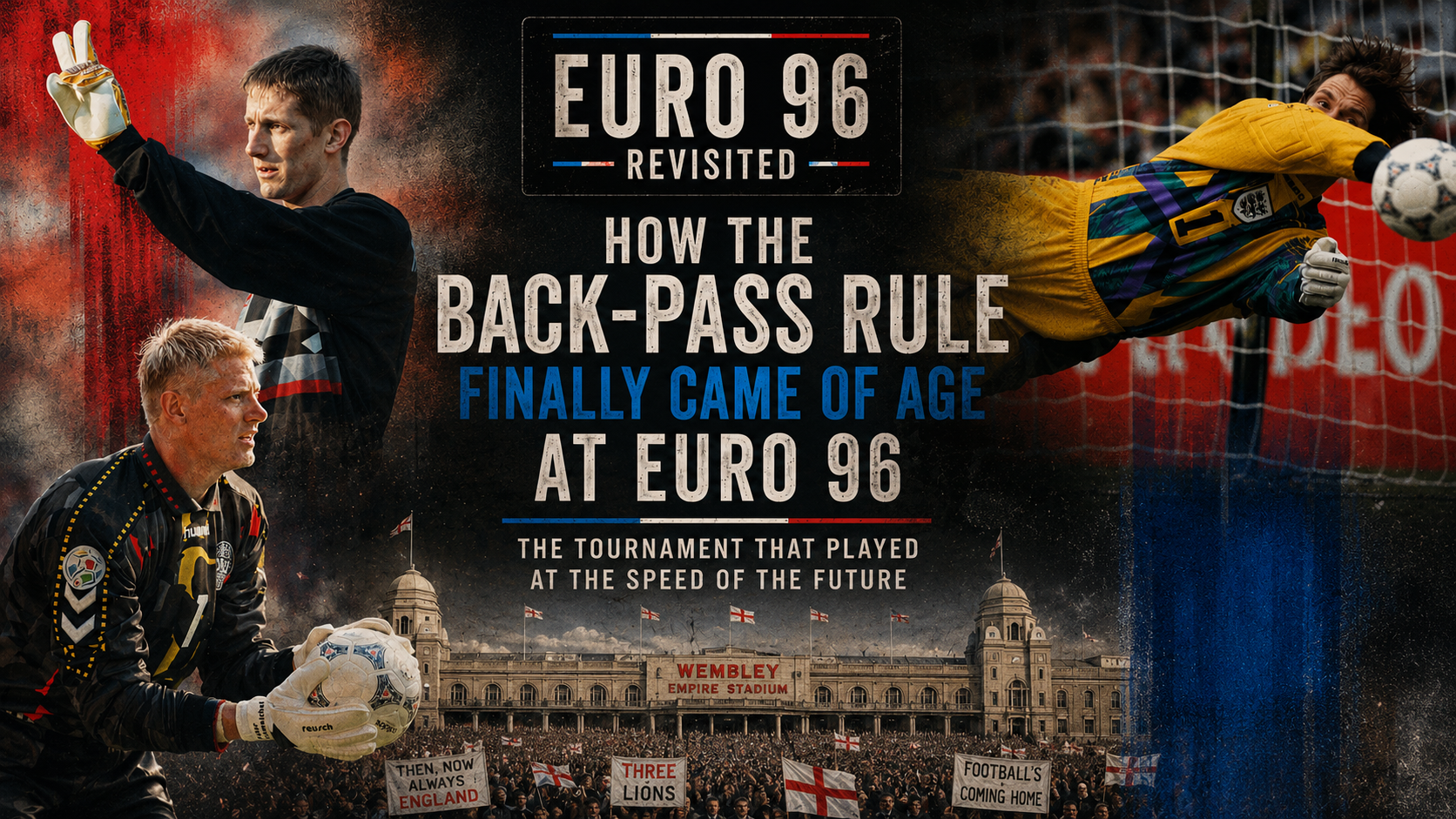
On a warm June evening at Wembley, England dismantled the Netherlands with a speed and fluency that still feels startling three decades later.
The goals are remembered. Alan Shearer scoring again. Teddy Sheringham producing perhaps the finest performance of his England career. The crowd singing long before the final whistle. Yet what stands out when watching the match now is not simply the scoreline. It is the tempo.
England moved the ball quickly. The Dutch pressed and were played through. Possession changed hands and immediately became attack. Defenders stepped forward. Midfielders rotated positions. The game seemed to flow without interruption.
It looked modern.
That observation feels obvious today because modern football has become our reference point. We watch goalkeepers receive passes under pressure every weekend. We expect centre-backs to begin attacks. We take for granted that teams will press high, squeeze space and force opponents into mistakes deep inside their own half.
In the summer of 1996, however, this was still relatively new.
Only six years earlier, the World Cup in Italy had become a symbol of football’s growing conservatism. Matches slowed to a crawl. Goalkeepers picked up endless back-passes. Defenders retreated whenever danger threatened. Teams discovered that the easiest way to protect themselves was not to attack better, but to stop the game moving altogether.
Football had spent much of its history creating ways to slow itself down.
Then, in 1992, the sport made a decision that would change its future.
The new back-pass law appeared deceptively simple. Goalkeepers could no longer pick up deliberate kicks from their own teammates. A minor adjustment, many assumed. A technical amendment buried within the laws of the game.
It was anything but.
The rule removed football’s most reliable escape route. Defenders lost their safety blanket. Goalkeepers lost their sanctuary. Managers lost the ability to kill momentum whenever pressure mounted. The consequences spread far beyond the penalty area.
The game became faster.
Not immediately. Not neatly. The first years were chaotic, often comical. Players struggled to adapt. Goalkeepers looked uncomfortable. Coaches complained. Traditionalists predicted disaster.
But by the time Euro 96 arrived in England, the shock had passed and something else had emerged in its place.
The tournament is remembered for Three Lions, Gazza’s goal against Scotland, Germany’s victory and the agony of penalties. It occupies a cherished place in football’s cultural memory because it felt like the summer when the sport became part of everyday British life again.
Yet beneath the songs, shirts and nostalgia lies another story.
Euro 96 was the first major international tournament played at the speed of the future.
What England, Germany, the Netherlands and the Czech Republic displayed that summer was not simply good football. It was football adapting to a new reality. The game could no longer pause, breathe and reset whenever pressure arrived. It had to think faster. Move faster. Solve problems faster.
The back-pass rule did not create modern football on its own.
But by Euro 96, it had finally finished its work.
Football Before It Learned to Run
To understand why Euro 96 felt different, we need to revisit a version of football that now seems almost unimaginable.
The modern game is built around movement. Pressing, transitions and territorial pressure dominate tactical discussion. Teams are expected to recover possession quickly and use it quickly. Goalkeepers are judged as much on their passing as their shot-stopping. The ball rarely stands still.
Football was not always like this.
For much of the twentieth century, the goalkeeper possessed a unique power. Every outfield player lived under one set of rules. The goalkeeper lived under another. When pressure became uncomfortable, defenders could simply retreat towards their own goal and transfer responsibility to the only player allowed to use his hands.
It was football’s emergency exit.
A centre-back caught in possession could turn and play the ball back. A full-back trapped near the touchline could do the same. A midfielder running out of options could retreat fifty yards and begin again. The goalkeeper would collect the ball, hold it safely in his hands and allow everyone else to recover their positions.
The consequences extended far beyond simple time-wasting.
The manual back-pass shaped the psychology of the game. It encouraged caution. It rewarded risk aversion. It provided a reliable mechanism through which defending teams could remove uncertainty from a match. Whenever chaos threatened, football possessed a built-in pause button.
By the late 1980s, that pause button was being pressed constantly.
What had once been a sensible defensive option gradually evolved into a tactical habit. Defenders used it to escape pressure. Midfielders used it to avoid risk. Teams protecting narrow leads used it to drain matches of rhythm.
The trend reached its bleakest expression during the 1990 World Cup in Italy.
Italia 90 still occupies a complicated place in football memory. It produced unforgettable images. Roger Milla dancing by the corner flag. Toto Schillaci’s unlikely rise. England reaching a semi-final. The tears of Paul Gascoigne.
Yet beneath those memories sat a tournament that many contemporaries found deeply frustrating.
The competition averaged just 2.21 goals per game, still the lowest figure in World Cup history. Teams prioritised caution. Defenders retreated. Goalkeepers held possession endlessly. The fear of losing increasingly outweighed the desire to win.
The game’s administrators understood the danger. If football continued along that path, defensive caution would become even more entrenched.
Then came Denmark.
The Danes’ triumph at Euro 92 remains one of the great tournament stories. Called in after Yugoslavia’s exclusion, they arrived with little expectation and left as European champions.
Yet their victory also provided one final demonstration of how powerful the back-pass had become.
In the final against Germany, Peter Schmeichel repeatedly received deliberate passes from teammates, gathered the ball comfortably in his hands and waited. German forwards could do little but watch. The rhythm of the game belonged entirely to Denmark. Every time pressure mounted, the goalkeeper restored order.
Years later, Schmeichel would admit the absurdity of it: “How can you win football matches like that?”
The answer, of course, was that you could.
Denmark had done exactly that.
But in winning Euro 92, they also helped ensure that football would never be played the same way again.
The sport had reached a crossroads. One path led towards greater control, greater caution and ever more elaborate methods of slowing matches down. The other demanded uncertainty, risk and speed.
For perhaps the first time in its history, football chose acceleration.
The Rule Nobody Was Ready For
The back-pass law entered football quietly.
There was no grand relaunch. No revolutionary manifesto. No promise that the sport would be transformed forever.
At its annual meeting in 1992, the International Football Association Board amended Law 12. The essential instruction was clear: when a player deliberately kicked the ball to his own goalkeeper, the goalkeeper was no longer permitted to touch it with his hands.
The wording occupied only a few lines.
The consequences touched every player on the pitch.
At first, many failed to appreciate the scale of what had happened. The rule seemed aimed at a specific problem: time-wasting. Prevent goalkeepers from picking up back-passes and the game would become more entertaining. Simple.
What followed revealed that the back-pass had been doing far more than wasting time.
For decades, football had organised itself around the assumption that the goalkeeper represented safety. Entire defensive structures were built upon that principle. Defenders retreated because they knew the goalkeeper could rescue them. Midfielders took fewer risks because they always had an escape route behind them. Coaches prioritised shape and caution because pressure could be neutralised with a single pass.
The law removed all of that overnight.
Suddenly, defenders found themselves responsible for situations they had previously delegated to someone else.
The panic was immediate.
Throughout Europe, the opening months of the 1992-93 season resembled a live experiment conducted in public. Goalkeepers hesitated. Defenders misjudged distances. Teams struggled to understand where risk now existed.
Mistakes multiplied.
Players searched desperately for loopholes. Some flicked the ball into the air and headed it back to their goalkeeper. Others attempted elaborate chest passes. FIFA closed those gaps quickly, treating deliberate tricks designed to circumvent the law as offences in themselves.
Footballers had spent generations learning how to use the rule.
Now they were trying to unlearn it.
Many did not like it.
Traditionalists viewed the change with suspicion or outright hostility. Arsenal manager George Graham complained that he did not think the new rule would enhance the game at all. Howard Wilkinson, whose Leeds United side had just won the final First Division title, warned that the law could prove counter-productive and encourage more long-ball football.
Their objections should not be dismissed too easily.
The early evidence was messy. Teams unsure how to build from the back often cleared the ball long rather than risk short passing. Goalkeepers trained for a different sport were suddenly being asked to perform new tasks in the most dangerous area of the pitch.
Former England goalkeeper coach Alan Hodgkinson captured the fear when he complained that keepers had spent years learning to catch the ball. Now instinct itself had become dangerous.
The psychological shift was immense.
Before 1992, the penalty area had been a sanctuary. The goalkeeper operated within a clearly defined world. Pressure arrived in the form of shots, crosses and one-on-one situations. The solution was almost always the same: use your hands.
After 1992, uncertainty entered the equation.
Every back-pass became a small test of nerve.
Every heavy touch carried consequences.
Every pressing forward became a potential source of panic.
David Seaman later admitted that the back-pass rule was “really tough” to get used to. Years of instinct had to be overridden. Reactions that had become automatic suddenly became illegal. Goalkeepers found themselves thinking rather than reacting, often the most dangerous state for any elite athlete.
Yet beneath the confusion, a new version of football was slowly taking shape.
By the middle of the decade, the panic would fade.
In its place would emerge a different kind of player, a different kind of goalkeeper and a different understanding of space itself.
The Goalkeeper Becomes a Footballer
If the back-pass rule transformed football, it transformed goalkeepers more than anyone else.
No position in the sport was forced to reinvent itself so completely.
For most of football’s history, the goalkeeper had existed slightly apart from the game around him. He wore different colours. He trained differently. He possessed privileges unavailable to anyone else on the pitch. The role was defined by separation.
A goalkeeper’s relationship with the ball was fundamentally different from everyone else’s.
Outfield players solved problems with their feet.
Goalkeepers solved them with their hands.
The back-pass law shattered that distinction.
Suddenly, every goalkeeper in Europe was being asked a deeply uncomfortable question. What happened when the ball arrived at their feet?
For some, the answer was panic.
For others, it became opportunity.
The transition exposed an uncomfortable truth. Many elite goalkeepers had reached the highest level without needing to function as footballers in the conventional sense. They were exceptional athletes, shot-stoppers and organisers. Yet few had spent their careers receiving passes under pressure or building attacks from deep positions.
The penalty area had protected them from those demands.
Now the penalty area had become the place where those demands were greatest.
Ray Clemence would later reflect on the transformation with characteristic understatement: “Everything has changed really, apart from that you’ve still got to stop the ball going in the net.”
The observation captured the scale of the shift. The goalkeeper’s primary responsibility remained unchanged, but almost everything around it had evolved.
The position was no longer reactive.
It was becoming proactive.
Schmeichel understood this earlier than most. Although remembered primarily for his physical presence and extraordinary shot-stopping, he was always more comfortable with the ball at his feet than many contemporaries. Looking back years later, he described the back-pass law as the “best rule change ever”.
Partly because it improved the spectacle.
Partly because it forced the position to evolve.
Mark Bosnich, another goalkeeper whose career straddled the change, made the same point more bluntly. The law had “changed the game for the better and sped things up”. He remembered teams scoring, turning from halfway and knocking the ball straight back to their goalkeeper. That world now felt absurdly distant.
By the middle of the decade, the new breed was already emerging.
Its most influential representative arrived from Amsterdam.
At Ajax, Louis van Gaal was constructing one of the most important club sides in modern football history. The team that won the Champions League in 1995 is often remembered for its academy graduates, positional fluidity and technical excellence. Less appreciated was the role played by the man standing behind them.
Edwin van der Sar was not merely protecting Ajax’s goal.
He was helping to build Ajax’s attacks.
When opponents pressed high, Van der Sar remained calm. When defenders were marked, he provided another passing option. When space opened elsewhere on the pitch, he could find it with accuracy that would have been considered exceptional for an outfield player, let alone a goalkeeper.
The position itself was changing shape.
The goalkeeper was no longer the final line of defence.
Increasingly, he was becoming the first line of attack.
That evolution could be seen throughout Euro 96.
Van der Sar’s Netherlands side offered perhaps the clearest glimpse of football’s future. Comfortable receiving possession under pressure, he functioned as part of the Dutch build-up structure rather than existing outside it. His presence allowed the Netherlands to circulate possession more confidently and resist pressure in ways that would have been difficult only a few years earlier.
Seaman represented a different form of adaptation. He had built his career in an era when goalkeepers were encouraged to simplify rather than complicate. Yet by 1996 he had adjusted to the demands of the new landscape, becoming comfortable enough with possession to support England’s more progressive approach under Terry Venables.
Neither man looked revolutionary at the time.
That is precisely the point.
The revolution had already happened.
The Geometry of Pressure
The back-pass rule did more than change the goalkeeper.
It changed the pitch.
Not physically, of course. Wembley remained the same size. Old Trafford remained the same size. Every stadium in Europe retained the same dimensions it had possessed before 1992.
Yet the usable space within those dimensions was fundamentally altered.
For decades, defending teams had enjoyed a hidden territorial advantage. Whenever opponents pressed aggressively, the goalkeeper’s hands created extra room. A defender under pressure could simply retreat towards his own goal, transfer possession to the goalkeeper and watch the entire situation dissolve.
The penalty area functioned as a sanctuary.
The back-pass rule abolished that sanctuary.
For the first time, the area closest to goal became one of the most dangerous places on the pitch.
That single change transformed the calculations of attackers and defenders alike.
Before 1992, pressing high was often an exercise in futility. A striker could sprint twenty yards to close down a centre-back, only to watch the ball rolled harmlessly into the goalkeeper’s hands. The defending team escaped. The attacker wasted energy. The game reset.
After 1992, the same situation looked entirely different.
Now the goalkeeper had to play.
Now the centre-back had to think.
Now the striker’s run carried genuine value.
The possibility of forcing a mistake suddenly existed.
What emerged over the following years was one of the most significant tactical developments in modern football: pressure became a weapon rather than a gesture.
Teams realised they could compress the field.
Instead of retreating and reorganising, they could squeeze opponents higher up the pitch. The distance between attack and defence narrowed. The amount of time available on the ball shrank. Passing decisions that once felt routine became increasingly difficult.
Football did not become faster only because players ran more.
What really accelerated was decision-making.
A defender receiving possession in 1988 could often afford a second touch, a glance over his shoulder and a retreating pass towards the goalkeeper’s hands.
A defender receiving possession in 1996 increasingly faced a different reality. The passing lane backwards still existed, but it no longer guaranteed safety. The goalkeeper was now under pressure too. Every decision carried consequences.
The game demanded quicker solutions.
Watching Euro 96 Now
The easiest way to understand the impact of the back-pass rule is not to read about it.
It is to watch Euro 96.
Not the goals.
Not the highlights.
The matches.
Watch England against the Netherlands today and the first surprise is how familiar it feels.
Seaman receives possession and has to make a decision. Tony Adams and Gareth Southgate do not exist only as stoppers. They step forward when the space opens. Paul Ince sits ahead of them. Gascoigne drifts towards the ball. McManaman carries possession through traffic. Sheringham drops away from the centre-backs and turns attacks into conversations rather than collisions.
The Dutch press.
England play through them.
None of this feels revolutionary now.
That is precisely the point.
In 1996, much of it still was.
UEFA’s match record preserves the bare facts: England 4, Netherlands 1. Shearer twice. Sheringham twice. Patrick Kluivert’s late goal enough to help the Dutch progress. But the scoreline alone does not explain why the match still looks so striking.
It was not simply that England won.
It was that they played at a speed of thought that belonged to football’s next phase.
Paul Ince later explained the pressing plan with revealing simplicity. The Dutch liked to pass square. England were happy to let them have it at the back, but as soon as they entered a particular area, the press arrived. Venables had not merely told England to run harder. He had told them where and when to apply pressure.
That distinction matters.
This was not old English intensity.
It was organised pressure.
Watch Germany and the same pattern emerges in another form. Andreas Köpke is not Van der Sar, but he still belongs to the changed landscape. German defenders no longer possess the old comfort of simply retreating into the goalkeeper’s hands. Matthias Sammer, without becoming the subject of this article, offers a useful symbol of the tournament’s in-between state: a sweeper from the past, carrying the ball with the urgency of the future.
Watch the Netherlands and the direction of travel is clearer still. Their Ajax influence is obvious not simply in passing patterns, but in their attitude towards pressure. The ball is not something to be cleared at the first sign of danger. It is something to be used, moved and trusted.
The football does not resemble the game of the 1970s.
It barely resembles the game of Italia 90.
It resembles football.
That is Euro 96’s hidden achievement.
The tournament sits at the point where the modern game becomes recognisable.
Not complete.
Not finished.
Recognisable.
The First Modern Tournament
The most persuasive argument for the importance of the back-pass rule is not found in a law book or a coaching manual.
It is found on the pitch.
Watch a full match from Italia 90 and then watch a full match from Euro 96.
The difference is striking.
The change is not merely tactical. It is not even primarily tactical. It is experiential.
The game feels different.
Players appear to have less time. Defenders appear less comfortable. Goalkeepers are more involved. Possession circulates more quickly. Pressure arrives sooner. Attacks develop with greater urgency.
Football has become harder.
That was the real consequence of the back-pass rule.
It did not simply make goalkeepers use their feet. It increased the demands placed upon everyone.
The easiest way to see this is through the tournament’s most successful teams.
England approached the challenge through flexibility. Venables understood that modern football increasingly rewarded adaptation. His side shifted shape during matches, altered passing angles and constantly searched for ways to exploit spaces before opponents could close them.
Against the Netherlands, England produced one of the finest performances in their modern history. Yet what made the display so impressive was not merely the scoreline.
It was the speed of thought.
Sheringham drifted into pockets of space before defenders recognised the danger. McManaman drove forward before midfielders could recover. Gascoigne received possession and immediately looked to accelerate play. The Dutch were not simply outplayed.
They were repeatedly forced to react.
Germany found answers through structure.
Berti Vogts’ side retained many qualities associated with traditional German football. Organisation. Discipline. Resilience. Yet they operated within the realities of a faster game. Germany’s defenders were comfortable carrying possession forward. Their midfield worked relentlessly to maintain compactness. Their attacking transitions arrived with a speed that previous generations rarely encountered.
Sammer’s tournament still matters here, but only as part of a wider shift. UEFA would later describe his performances as Beckenbauer-like. That comparison makes sense, but Sammer belonged to a more pressured footballing world. He was not sweeping up behind a slow game. He was driving into a faster one.
The Netherlands offered perhaps the clearest glimpse of where football was heading.
Ajax had won the Champions League only a year earlier with a style built around technical superiority, positional intelligence and collective movement. Many of those ideas travelled to England with the Dutch national team. The goalkeeper became part of possession. The defensive line participated in build-up. Pressure was not feared but manipulated.
What had once seemed revolutionary was beginning to look normal.
Even the Czech Republic, the tournament’s great surprise package, reflected football’s changing landscape. Their run to the final was built on organisation, certainly, but also on mobility, technical competence and an ability to survive prolonged periods without the ball. They could not simply retreat and wait for danger to disappear.
Nobody could.
That was what had changed.
The old game allowed teams to manage pressure through interruption.
The new game demanded that they solve it.
This distinction is easy to overlook because football rarely announces its revolutions. The sport changes gradually. Habits evolve. Expectations shift. What once seemed unusual becomes routine.
By the summer of 1996, most players no longer thought about the back-pass rule.
They no longer discussed it after every match.
They no longer viewed it as controversial.
That was precisely why its influence had become so profound.
The rule had moved beyond legislation and become culture.
A generation of footballers had adapted their behaviour. Coaches had redesigned training sessions. Defenders had developed new technical skills. Goalkeepers had expanded their responsibilities. Tactical systems had evolved around assumptions that barely existed four years earlier.
The panic of 1992 had become the reality of 1996.
Euro 96 therefore occupies a unique place in football history.
It was not the first tournament played under the new law.
It was the first tournament that fully belonged to it.
The Final: No Hiding Place
The strongest evidence for the back-pass rule’s impact arrived on the final day of the tournament.
Not through a tactical diagram.
Not through a coaching theory.
Through a simple question.
What happens when an underdog takes the lead?
For decades, football had offered a straightforward answer.
Protect it.
Slow the game.
Reduce the number of meaningful moments.
Turn football into a contest of patience rather than possibility.
The goalkeeper stood at the centre of that process.
When Denmark shocked Europe in 1992, Schmeichel became more than a goalkeeper. He became a mechanism for controlling time itself. Every back-pass represented an opportunity to disrupt momentum. Every catch slowed the rhythm of the match. Every pause increased Denmark’s chances of survival.
Nobody blamed the Danes.
They were using the rules available to them.
But football’s administrators watched those scenes and recognised a problem.
The game had become too easy to suffocate.
Four years later, Wembley staged a revealing comparison.
When Patrik Berger converted his penalty shortly before the hour mark, the Czech Republic found themselves in precisely the position every underdog dreams about. Germany were trailing. The favourites were under pressure. The clock was becoming an ally.
Under the old laws, the temptation would have been obvious.
Retreat.
Compress space.
Use the goalkeeper whenever possible.
Break the rhythm.
Drain the match of momentum.
Instead, the Czechs found themselves confronting a reality that teams in previous eras rarely faced.
The game would not stop.
Germany kept coming.
The pressure remained constant.
Every clearance returned. Every loose ball mattered. Every defensive action led directly to another. There was no easy mechanism through which the Czech Republic could lower the temperature of the contest.
They still defended bravely.
They still organised themselves intelligently.
But they had to keep playing.
That distinction lies at the heart of modern football.
The back-pass rule did not eliminate defensive football. It did not prevent underdogs from winning. It did not guarantee entertainment.
What it removed was the ability to escape the game itself.
Teams could still defend.
They simply had to defend while football continued moving.
As the final entered its closing stages, Germany’s pressure intensified. Vogts introduced Oliver Bierhoff from the bench. The Czech Republic continued battling, but every minute demanded fresh concentration, fresh decisions and fresh energy.
Eventually the pressure told.
Bierhoff equalised with seventeen minutes remaining.
Then came extra time.
Then came the golden goal.
Yet the significance of the match extends beyond the result.
The final provided a glimpse of football’s new reality.
The Czech Republic did not lose because of the back-pass rule.
That would be absurd.
They lost because Germany were the stronger side.
But the conditions under which the match unfolded had been fundamentally altered by the changes introduced four years earlier.
There was no sanctuary.
No pause button.
No reliable method of stepping outside the contest and slowing it to a manageable pace.
The game kept asking questions.
The players kept having to answer them.
The Legacy of Acceleration
Euro 96 occupies a curious place in football memory.
Ask people what they remember and the answers arrive quickly.
Three Lions.
Gazza.
The dentist’s chair.
Shearer’s goals.
Southgate’s penalty.
Germany’s golden goal.
The tournament survives because it generated moments. Images. Emotions. Memories that still resonate three decades later.
Yet memory can sometimes obscure understanding.
One reason Euro 96 continues to feel so vivid is that it remains recognisable. Watch the tournament today and, despite the changes in tactics, conditioning and technology, much of the football still feels familiar. The speed of possession. The involvement of goalkeepers. The pressure applied high up the pitch. The expectation that defenders should play rather than simply survive.
The game no longer feels trapped in another era.
It feels like the beginning of our own.
That is why the back-pass rule matters.
Not because it solved every problem. Not because it instantly transformed football. Not because it single-handedly created the modern game.
Its significance lies elsewhere.
It changed the direction of travel.
The law removed football’s most reliable method of slowing itself down. In doing so, it forced players, coaches and teams to find new solutions. Goalkeepers became footballers. Defenders became distributors. Pressure became a weapon. Possession became responsibility rather than refuge.
The sport learned to operate at a higher speed.
Not merely physically.
Mentally.
Tactically.
Emotionally.
The changes were sometimes awkward. Sometimes unpopular. Sometimes chaotic. Yet by the summer of 1996, they had become impossible to ignore.
Euro 96 was not the first tournament played under the new laws.
It was the first tournament shaped by them.
That distinction matters.
The competition arrived at a moment when football was standing between worlds. Enough of the old game remained to be visible. Enough of the new game had emerged to be unmistakable. Traditional roles were still present, but they were evolving. Familiar ideas survived, but they were being asked to operate under unfamiliar conditions.
The tournament became a snapshot of transition.
A photograph taken at precisely the moment football began to move differently.
Perhaps that is why the matches still feel alive when viewed today.
Not because they resemble the game of 2026 in every detail.
They do not.
But because they belong to the same story.
Football’s revolutions rarely arrive fully announced. More often, they come disguised as adjustments, experiments and minor amendments that seem unremarkable at the time.
The back-pass law was one of those amendments.
A few lines in a law book.
A technical change.
A solution to a practical problem.
Yet from that small alteration emerged one of the most important transformations in the sport’s history.
Euro 96 is remembered as the summer football came home.
It was also the summer football arrived somewhere new.
The songs, the shirts and the penalties remain part of its legacy.
But beneath them sits something even more significant.
Four years earlier, Schmeichel could bring a match to a halt simply by catching the ball.
By the summer of 1996, the game had lost that ability.
It had learned how to keep moving.
And once it did, there was no going back.
