


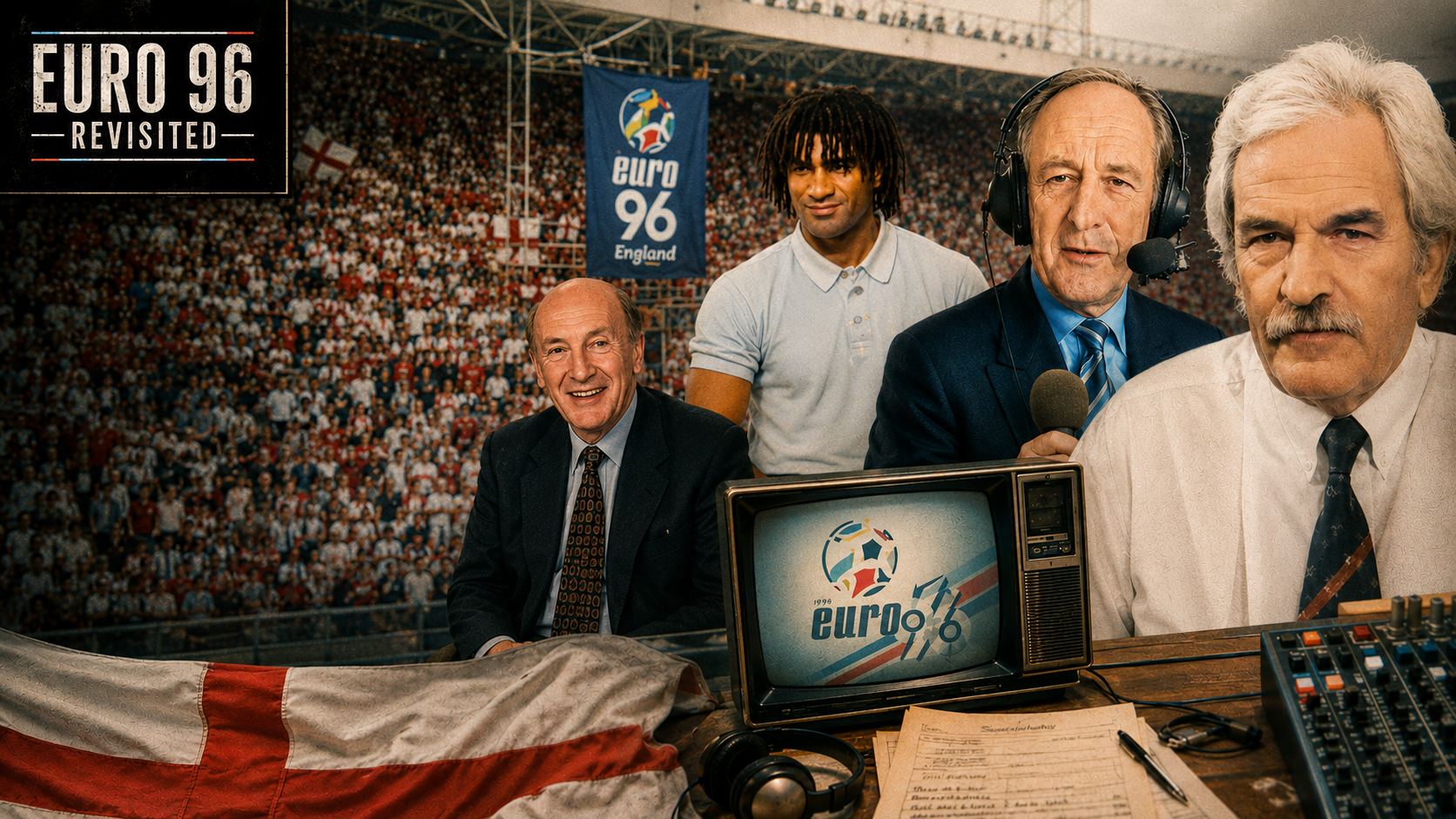
Euro 96 was not only watched. It was presented, framed and paced by broadcasters who understood football as ceremony before it became content.
Before Des Lynam said a word, most of the country already understood the choreography.
The kettle had gone on sometime after seven. Tea was poured before the teams emerged because nobody wanted to leave the room once the music started. June evenings were still bright enough for curtains to remain open. Children who had been allowed to stay up late were reminded to sit down properly. Fathers who had spent the previous week insisting England would inevitably lose had become noticeably quieter. Ashtrays were moved closer to armchairs. The dog had been walked early.
Then the opening titles arrived.
For BBC viewers, Beethoven’s Ode to Joy swelled beneath images of football grounds rendered in the slightly awkward digital language of the mid-1990s. On ITV, Jerusalem accompanied a more openly English visual language of landmarks, skylines and host-nation pride. Different broadcasters offered different interpretations of the same tournament, but both understood something that feels increasingly unusual nearly three decades later. Football was not simply another programme beginning at 7.30pm. It was an occasion.
By the evening of 26 June 1996, England’s semi-final against Germany had become more than a football match. More than 26 million viewers watched at peak, making it one of the largest shared television experiences in modern British sporting history. In pubs, social clubs, student halls, front rooms and holiday camps, people arranged their evenings around the broadcast. The tournament did not fit itself around individual schedules. Individual schedules bent around the tournament.
Then the camera faded into the studio.
Des Lynam leaned slightly towards the lens, smiled and delivered the line that has become inseparable from that summer.
“Glad you’ve tuned in. You’ve obviously heard there’s a football match on tonight.”
It remains one of the great introductions in British sports broadcasting, not because it was witty, although it was, nor because it lowered the tension, because it did not. If anything, it gently acknowledged how absurdly high the stakes already felt. What it demonstrated was an understanding of role. Lynam was not attempting to generate excitement. The excitement already existed. He was not selling a product. Nobody needed persuading to watch. He was not performing fandom. He was performing stewardship.
That distinction matters because Euro 96 Revisited has repeatedly returned to one central idea: this tournament stood between eras. It was the summer of analogue memory, shared national conversation and a football culture not yet fractured by the internet. But this story is not simply about technology. The more revealing observation is that Euro 96 may also have been the last European Championship presented primarily as a ceremony.
Ceremonies require guides.
They require people entrusted to establish tone, regulate anxiety and occasionally reassure participants that what they are feeling is entirely normal. The role occupied by broadcasters during the mid-1990s was remarkably similar. Football presenters were not expected to be celebrities. They were not expected to cultivate online followings, manufacture viral moments or dominate discussions. They were expected to know when to speak, when to understate and, perhaps most importantly, when to step aside.
Lynam represented the ideal version of that authority.
By 1996, viewers already knew him as one of British television’s safest pairs of hands. He had fronted coverage during the chaotic false start of the 1993 Grand National. He had presented through the scandals and disruptions of the Seoul Olympics. More profoundly, he had helped guide audiences through the unimaginable tragedy of Hillsborough in 1989, maintaining composure during a day when sport ceased to be sport altogether. Credibility had not been accumulated through branding exercises or carefully managed relatability. It had been earned gradually, often during moments when audiences needed calm more than entertainment.
Contemporaries frequently described him as friendly rather than matey. The distinction was subtle but important. Lynam never behaved as though he wanted to be everyone’s friend. He was not attempting to sit metaphorically on the sofa beside viewers. Instead, he occupied a position somewhere between trusted host, older brother and reassuring neighbour. He spoke in a conversational rhythm, deploying phrases such as “Mind you” or “Tell you what” with the ease of someone continuing a discussion rather than delivering a performance.
The audience trusted him partly because he seemed entirely uninterested in demanding their affection.
Authority in modern football broadcasting is often established through visibility. Presenters become personalities. Opinions become brands. Analysis becomes performance. In 1996, authority frequently came from the opposite instinct. The best broadcasters understood that their presence should reduce friction between audience and event. They aimed for ease.
Lynam later admitted that he wrote much of his own introductory material because he disliked overblown promotion. Football was dramatic enough without television insisting upon its importance. His best lines worked because they punctured hysteria without diminishing significance. Two years after Euro 96, introducing England’s World Cup match against Tunisia on a weekday afternoon, he opened simply by asking viewers: “Shouldn’t you be at work?” It was gently mischievous, faintly conspiratorial and entirely confident that the audience already belonged there.
That confidence reflected a media environment which now feels almost impossibly concentrated. There were no second screens. No live reaction channels. No group chats competing for attention. No supporters scrolling through tactical threads during half-time. Football moved at the pace television allowed it to move. Presenters like Lynam occupied a unique position because they stood at the junction between public spectacle and private emotion. When England defeated Spain on penalties in the quarter-finals, a moment explored in this series through Stuart Pearce’s release against Spain, Lynam joked that viewers could finally come out from behind the sofa. During the semi-final against Germany, with the score level at half-time and anxiety spreading across the country, he admitted simply: “I’m worried.”
Millions probably were.
The difference was that hearing Des Lynam say it somehow made the feeling easier to carry.
Football in 1996 was not consumed.
It was convened.
And for a few weeks in the summer of 1996, few people in Britain convened football more elegantly than the man sitting quietly in front of the camera, smiling as though he already knew exactly how the evening was going to feel.
The Priests of the Summer
Football has always produced heroes. It has occasionally produced villains. In 1996, it still possessed something rarer.
It possessed custodians.
That sounds overly grand until one considers the intimacy of television in the mid-1990s. Broadcasters were invited into homes week after week, season after season. They appeared in living rooms more frequently than many extended family members. Children learned their voices before they understood league tables. Parents developed loyalties to commentators as strong as those they felt towards newspapers. Grandparents who had little interest in pressing systems or midfield triangles often knew exactly which presenter they preferred.
These figures were not merely narrating football. They were interpreting its emotional significance. They occupied a curious middle ground between journalism and ritual, trusted not simply to explain events but to judge how loudly they should resonate.
The closest comparison may not be modern punditry at all.
It may be theatre.
An audience attending a Shakespeare production expects actors to inhabit roles larger than themselves. They establish atmosphere, guide responses and help determine whether tragedy feels devastating or merely melodramatic. In the analogue era, football broadcasters performed a remarkably similar function. They framed the occasion. They calibrated tension. They reassured viewers that disappointment was survivable and joy was worth surrendering to.
If Des Lynam was the master of ceremonies, then others occupied equally important positions within the cast.
John Motson was perhaps the easiest to understand because he wore his enthusiasm openly. Jonathan Martin, then BBC Head of Sport, once summarised the difference between the corporation’s two great football commentators with a line that has endured because it was almost perfectly observed.
“Barry commentates from the grandstand. John is talking from the terraces.”
Motson loved football in a way that felt entirely unembarrassed. He arrived at grounds armed with folders of statistics, obscure anecdotes and enough preparation to fill several broadcasts. His commentary was dense with information, but rarely in a manner that felt oppressive. There was a boyish quality to his excitement. He sounded like someone who remained faintly astonished that discussing football for a living had somehow become possible.
That enthusiasm mattered.
By Euro 96, England had spent much of the previous decade apologising for football. Hillsborough, Heysel, decaying stadiums and hooliganism had created a culture in which supporters often felt compelled to defend their passion. Motson never sounded defensive. He spoke about football as though it deserved serious attention simply because it was football.
When Paul Gascoigne lifted the ball over Colin Hendry at Wembley before volleying beyond Andy Goram, Motson’s reaction was instinctive.
“Oh brilliant. Oh yes. What a wonderful goal by Gascoigne.”
There was no self-consciousness. No awareness that the line might be replayed endlessly. No attempt to manufacture immortality. He sounded exactly like a supporter witnessing something extraordinary and discovering words quickly enough to keep pace with his own delight.
Brian Moore occupied a different but equally important place in the emotional architecture of the summer.
For ITV viewers, Moore was not merely a commentator. He was one of the great voices of English football’s television age, associated with FA Cup finals, World Cups, European nights and the long-running culture of ITV Sport. He had a voice that seemed to belong naturally to important matches. It carried warmth without softness, authority without pomposity and excitement without loss of control.
Moore’s skill was easy to underestimate because he rarely appeared to be chasing memorable lines. He did not commentate as though he wanted to be quoted. He commentated as though he wanted viewers to trust the shape of the evening. When a game opened up, his voice lifted. When tension gathered, he allowed it to gather. His emotional register seemed to move with the match rather than ahead of it.
That quality mattered during ITV’s major England matches at Euro 96. Moore and Kevin Keegan were on commentary duty for England’s opening draw against Switzerland and for the extraordinary 4-1 victory over the Netherlands. The latter became one of the tournament’s defining performances, a night when England played with a fluency that felt almost startling. Alan Shearer and Teddy Sheringham exchanged passes and goals. Paul Gascoigne drifted and prompted. Darren Anderton supplied width and intelligence. For a brief period, England looked not merely passionate, but technically coherent.
Moore understood the significance of that shift. He sounded delighted, but also slightly surprised, as though he recognised that England were offering a version of themselves television had not always been allowed to show. This was not the language of heroic failure or brave resistance. It was England playing beautifully in front of a home audience and being narrated by a voice that knew exactly how rare that felt.
In many respects, Moore occupied for ITV viewers the same emotional territory that Lynam occupied for the BBC audience. Both understood that broadcasting international football involved more than transmitting pictures. It involved accompanying supporters through uncertainty. Moore was never attempting to become part of the story. Like the best broadcasters of his generation, he understood that his role was to help the audience feel present within it.
Barry Davies represented almost the opposite instinct from Motson.
Davies often appeared less interested in football as spectacle than football as narrative. He chose words with unusual care. Matches became contests. Penalty shootouts became penalty competitions. He was capable of gently reprimanding players who wasted time or behaved petulantly, sounding at times like a disappointed schoolmaster observing talented pupils making poor choices.
Some viewers found him slightly aloof.
Others adored him precisely because he resisted the temptation to oversell.
Davies belonged to a generation of broadcasters raised on a simple principle. Television already provides pictures. Commentary should complement them rather than compete with them. Speaking continuously was not a sign of expertise. It was often evidence of insecurity.
His restraint would become one of the defining sounds of Euro 96, although it would not fully reveal itself until England met Germany.
Around them existed a supporting cast that now appears almost impossibly assured.
Jimmy Hill brought continuity with an earlier football culture. By 1996, he resembled an eccentric uncle at Christmas, slightly old-fashioned, occasionally prone to odd observations, but fundamentally benign. His decision to wear a St George’s Cross bow tie during the semi-final seemed entirely in keeping with the mood of the tournament. England’s relationship with its flag was changing. Patriotism was becoming less defensive, less burdened by the anxieties of the 1980s. Hill’s bow tie managed to look celebratory rather than triumphalist.
Then there was Terry Venables.
Venables had spent Euro 96 transforming himself from embattled England manager into something closer to a national confidant. Des Lynam later reflected that Venables smiled regardless of results, a small but meaningful observation. English football had often been characterised by suspicion, siege mentality and an assumption that catastrophe lurked nearby. Venables appeared determined to enjoy the experience. Sitting in the BBC studio, he radiated a relaxed confidence that suggested football could once again be pleasurable.
Alongside him sat Ruud Gullit, whose presence perhaps best captures the transitional nature of the tournament itself.
Lynam later recounted meeting Gullit for the first time during the championship. The BBC transport provided for presenters was, in true BBC fashion, ageing and visibly rusting. Gullit arrived in a Mercedes limousine, climbed aboard, looked around and reportedly exclaimed:
“What is this shit?”
The story is funny because it reveals genuine cultural distance. Gullit seemed to belong to another footballing future. Stylish, cosmopolitan and tactically sophisticated, he introduced British audiences to concepts that domestic punditry had not always embraced. He spoke enthusiastically about attractive, expansive football, popularising the phrase “sexy football” and offering a perspective that felt notably continental.
English television did not simply import Gullit because he was famous.
It imported him because gatekeepers understood they had responsibilities beyond confirming existing assumptions. They wanted audiences exposed to ideas that might enrich their understanding of the game.
That impulse feels increasingly unusual.
Modern football coverage often operates according to a different logic. Personalities are selected because they provoke reactions, produce clips or sustain online engagement. Broadcasters compete not only with rival channels but with social media platforms, podcasts and independent creators. Visibility itself becomes valuable.
Euro 96 existed at the edge of another system.
Its most recognisable television figures rarely appeared to be performing versions of themselves. They seemed comfortable inhabiting professional roles that audiences broadly understood. Des welcomed people into the evening. Motson shared their excitement. Moore carried emotional weight. Davies imposed order on chaos. Hill provided continuity. Venables offered insider reassurance. Gullit expanded horizons.
Together they formed something more coherent than a punditry team.
They looked, and perhaps more importantly felt, like custodians of a national occasion.
Football still has experts. It still has analysts. It still has excellent broadcasters. But it is difficult to imagine another tournament producing quite the same sense that a small group of trusted voices had gathered, temporarily, to help an entire country navigate its emotions.
The Broadcasters Who Built England
If the faces presenting Euro 96 gave the tournament its personality, the broadcasters themselves supplied its architecture.
The BBC and ITV were competing for viewers, certainly, but they were also offering competing interpretations of what England wanted this summer to mean.
By June 1996, English football was attempting something that had seemed improbable only a decade earlier. It was not simply hosting a major tournament. It was inviting Europe to reassess it.
The images of the previous decade had been difficult to escape. Brussels. Heysel. Hillsborough. Fences. Crumbling terraces. Reports of drunkenness and disorder following England supporters across the continent. The Taylor Report had transformed stadiums physically, accelerating the move towards all-seater grounds at the top levels of English football, but Euro 96 represented an opportunity to transform perceptions emotionally. England wanted visitors to leave believing they had encountered a country that was younger, more confident and considerably more comfortable with itself.
Television played a central role in constructing that identity.
The BBC largely approached the tournament as though it were presenting an international festival that happened to be taking place in England. Its coverage reflected the broader tone of BBC Sport: measured, institutional, and confident enough to let the match breathe. The philosophy was deceptively simple. Allow football to happen, then make television around it. That confidence resisted overproduction. The match itself remained the star.
That confidence could be heard immediately in the opening sequence.
Beethoven’s Ode to Joy was not an accidental choice. By the mid-1990s, the melody was associated with European idealism, having been adopted by European institutions as a musical symbol of unity. The BBC’s arrangement framed Euro 96 as a majestic, international festival of sport taking place on English soil. England was being presented not as an island retreating into nostalgia, but as a confident host welcoming a continental gathering.
The BBC studio reflected that instinct.
Venables represented modern English coaching at its most personable. Jimmy Hill connected viewers to an older football culture without appearing burdened by it. Gullit provided an external perspective, a reminder that football could be interpreted through lenses beyond traditional English assumptions.
There was a deliberate cosmopolitanism to the panel.
ITV saw the same tournament differently.
Their coverage was not crude nationalism, despite some later caricatures, but it was undeniably more comfortable embracing English sentiment.
The opening titles told viewers as much.
The network used an adaptation of Hubert Parry’s Jerusalem, perhaps the most evocative piece of English ceremonial music outside royal occasions. Images of Tower Bridge and London skylines reinforced the message. This was not merely a European championship. It was England’s championship. England’s stage. England’s opportunity to enjoy itself again.
Bob Wilson anchored coverage with a noticeably different energy from Lynam. Where Lynam specialised in understatement, Wilson tended towards directness. ITV’s punditry reflected a similar instinct. John Barnes brought intelligence and authority. Jack Charlton offered warmth and experience. Glenn Hoddle and Alex Ferguson carried contemporary managerial credibility. Moore’s presence behind the microphone ensured emotional moments still possessed gravitas.
Academic analysis of the tournament’s coverage later described Euro 96 as a form of mediated patriotism, with television helping to frame contests through ideas of national belonging and identification. That should not be read simply as criticism. Major international tournaments always invite questions of identity. The important point is that BBC and ITV offered slightly different answers. One leaned towards European festival. The other leaned towards English occasion.
Yet perhaps the most revealing aspect of both broadcasters lies not in their differences, but in what they shared.
Both treated presentation seriously.
Music mattered.
Titles mattered.
Studio design mattered.
Introductions mattered.
Commentary assignments mattered.
Nobody appeared to believe football was sufficiently important simply because football existed. It still needed framing.
The viewer was expected to notice that effort.
Modern audiences are accustomed to highly polished productions, but polish and ceremony are not necessarily identical concepts. Much contemporary football broadcasting can feel frictionless, designed for viewers who may only partially engage before moving elsewhere. Euro 96’s broadcasts often felt as though they expected undivided attention.
There was a beginning.
There was an atmosphere.
There was an invitation to settle in.
A football match arrived dressed for an occasion.
That approach now feels oddly luxurious.
Supporters can watch four matches simultaneously on different devices. Goals appear online before television viewers have finished celebrating them. Studio discussions are clipped, repackaged and uploaded within minutes. Pundits frequently operate with an awareness that their comments may circulate independently from the programmes they appear within. Presentation increasingly serves distribution.
Euro 96 belonged to a period when presentation served anticipation.
The broadcasters were not attempting to hold viewers against overwhelming competition. They already possessed the audience. Their responsibility was different. Their task was to justify the audience’s emotional investment.
For a few weeks in the summer of 1996, they largely succeeded.
England was not merely shown to itself.
It was carefully introduced.
Waiting Was Part of the Experience
One of the most difficult aspects of explaining Euro 96 to younger supporters is describing how much waiting football once involved.
Not waiting in the modern sense, where inconvenience lasts the length of a buffering wheel or a delayed notification. Waiting in the older sense. Waiting because there was genuinely no other way of knowing.
Football in 1996 unfolded according to rhythms established by broadcasters, newspapers and weekly magazines. Supporters had remarkably little control over that pace, and, perhaps surprisingly, many of the emotions they still associate with the tournament emerged precisely because they surrendered to it.
If England played on a Wednesday night, there was no immediate avalanche of opinion waiting in your pocket before the players had reached the dressing room. There was no algorithm presenting twenty former professionals offering contradictory verdicts before midnight. No fan channels live-streaming reactions from outside Wembley. No statistical models updating tournament probabilities in real time.
There was simply the match.
Then the post-match discussion.
Then sleep.
Then morning.
Only then did the tournament begin to reveal what it meant.
Newspapers became second broadcasts. Supporters walked to corner shops to discover whether their own interpretation aligned with professional observers. Ratings mattered. Headlines mattered. The placement of photographs mattered. Entire arguments about player performances could continue for days because evidence was comparatively scarce. Unless someone had recorded the match on VHS, memories remained surprisingly vulnerable to reinterpretation.
Even highlights possessed significance.
For supporters who had been working, travelling or simply unable to watch live, programmes such as Match of the Day, Saint and Greavsie or regional sports bulletins still acted as primary points of access. Watching a goal hours after it had been scored did not necessarily diminish its emotional force. In some respects, anticipation enhanced it. You heard descriptions from friends. Read snippets in newspapers. Saw still photographs. Then finally witnessed the moving image itself.
The reveal retained value.
Euro 96 coincided with a period in which football magazines still occupied an important cultural space. World Soccer, Shoot, Match and the relatively young FourFourTwo offered something different from newspapers. They slowed football down further. Tactical observations, interviews and retrospective features appeared days or weeks later, encouraging supporters to revisit tournaments rather than simply move beyond them.
Meaning accumulated.
Football was not immediately transformed into opinion.
It was allowed to remain experience for a little while.
That accumulation mattered because football was not immediately exhausted.
Today, almost every major moment experiences a compressed lifecycle. A spectacular goal appears online within seconds. Multiple camera angles circulate within minutes. Tactical breakdowns emerge before supporters have left stadiums. Memes, jokes and arguments proliferate almost instantly. By the following afternoon, attention has frequently migrated elsewhere.
The result is not necessarily worse.
It is certainly richer.
Supporters possess access to information previous generations could scarcely imagine. Matches from obscure leagues can be streamed on phones. Detailed data allows tactical discussions that once belonged exclusively to coaches and analysts. Historical footage has become astonishingly accessible. Modern football supporters arguably understand the game more deeply than any previous generation.
But understanding and significance are not always identical.
The old gatekeepers did not merely determine what people watched.
They regulated how quickly football could be consumed.
Des Lynam introduced the evening.
Barry Davies, John Motson or Brian Moore narrated it.
Newspapers interpreted it.
Friends debated it.
Magazines contextualised it.
Only gradually did a consensus begin to emerge about what had actually happened and why it mattered.
That pace encouraged football to linger.
Paul Gascoigne’s goal against Scotland did not become iconic because it was clipped into a vertical video and distributed across social media platforms. It became iconic because people spent days discussing it. Children recreated it in parks. Newspapers dedicated columns to it. Broadcasters replayed it selectively. Adults who had missed the match heard increasingly embellished descriptions before finally seeing it themselves.
Even disappointment unfolded differently.
England’s elimination against Germany remained painful because there was nowhere to escape. There were no distraction tabs to open. No recommendation engines waiting to offer alternative entertainment. Families sat together in silence. Pubs emptied slowly. Television analysis continued. Then broadcasts ended.
And that was it.
People simply had to live with how they felt.
Perhaps that is why Euro 96 continues to occupy such a distinctive place in the national imagination. The tournament was not only watched collectively. It was processed collectively, and crucially, it was processed slowly.
Scarcity was often frustrating.
But scarcity also created anticipation.
Anticipation deepened investment.
Investment strengthened memory.
And memory, more often than not, is what this series has been trying to understand all along.
The Night Barry Davies Said Almost Nothing
If Euro 96 was football presented as ceremony, then its defining broadcasting moment arrived not with a stirring introduction or a triumphant closing montage, but with an absence.
It arrived through silence.
England against Germany already carried a burden that extended far beyond football. By the evening of 26 June, Euro 96 had become an exercise in national projection. England had rediscovered a version of itself it rather liked. The country that had spent years apologising for football suddenly found itself enjoying football again. The St George’s Cross, long burdened with awkward associations, fluttered harmlessly from car windows and pub gardens. Three Lions had evolved from novelty song into national soundtrack. Terry Venables’ side had played with a freedom that seemed to mirror broader cultural shifts taking place under the loose umbrella of Britpop, Cool Britannia and an emerging confidence that England might finally have stopped looking backwards.
Germany threatened all of that.
The fixture brought with it decades of accumulated neurosis. Every previous tournament disappointment resurfaced. Supporters who had spent weeks joking about football coming home suddenly became more cautious. David Baddiel later recalled that the atmosphere inside Wembley changed noticeably as the evening progressed. Alan Shearer’s early goal had briefly unleashed delirium. Stefan Kuntz’s equaliser restored old anxieties. By extra time, optimism had largely given way to dread.
The country was watching together.
More than 26 million people watched at peak across BBC1 and ITV. According to contemporary reporting from The Media Leader, BBC1 drew 19.8 million at peak, while ITV attracted 6.7 million. Across Britain, domestic routines synchronised almost unconsciously around the broadcast.
National Grid engineers have long monitored what became known as “TV pickup”, sudden increases in electricity demand triggered by millions of viewers simultaneously switching on kettles, lights and cookers during breaks in major television events. Football has been central to that phenomenon. The Energy Saving Trust has also explained how major televised moments can produce national spikes in demand, offering a rare instance where shared attention can be measured not only through audience figures, but through electricity use.
Football was not merely occupying public conversation.
It was organising domestic life.
Barry Davies had been given commentary duties at Wembley because John Motson was assigned to the final. The assumption, entirely reasonable at the time, was that England would not necessarily be involved. Motson later admitted watching the semi-final from Manchester, where he was preparing for the France versus Czech Republic match, acutely aware that his own assignment depended upon events unfolding hundreds of miles away.
Davies approached football differently from his colleague.
Motson spoke with the enthusiasm of a supporter inhabiting the best seat in the house. Davies sounded more like a novelist who occasionally happened to enjoy football. His vocabulary was precise. His timing was deliberate. He understood that television commentary worked best when words occupied only the spaces pictures could not reach.
He had little interest in competing with the event itself.
As the penalty shootout unfolded, Wembley became increasingly uncomfortable. Gareth Southgate’s walk towards the penalty spot appeared unusually long. Andreas Kopke bounced the ball against the crossbar, introducing an element of theatre that felt vaguely unsettling. Southgate struck his effort low. Kopke saved.
Davies reacted instinctively.
“Oh no.”
Two words.
No tactical explanation.
No attempt to diagnose technique.
No historical lecture about English penalties.
No dramatic monologue.
Simply:
“Oh no.”
Then almost nothing.
Davies later reflected upon the decision with characteristic clarity, explaining that there was little point adding words when the entire country was speechless. The observation reveals something significant about analogue broadcasting.
Modern football media often operates under an assumption that every second requires interpretation. Silence appears dangerous. Empty space risks losing attention. Producers fear audiences reaching for phones. Commentators increasingly compete with social media timelines, podcasts, second-screen experiences and constantly refreshing news feeds.
Today, a missed penalty rarely remains a missed penalty for long.
Within minutes it becomes a clip.
Then a statistical breakdown.
Then a tactical discussion.
Then a meme.
Then a podcast topic.
Then a YouTube reaction.
Then an argument about mentality.
Then an argument about expected goals.
Then an argument about the argument.
The emotional moment is rapidly subdivided into smaller consumable units.
Davies understood another possibility.
Some moments should remain intact.
Some moments belong to spectators before they belong to analysts.
Davies instinctively understood something modern sport sometimes struggles to remember. Analysis has value, but chronology also has value. Grief arrives before explanation. Supporters experience disappointment before they diagnose it. Silence acknowledged that order.
By retreating into silence, Davies allowed Wembley itself to commentate. The crowd’s collective exhalation. German celebrations. English disbelief. The peculiar acoustic quality of a stadium absorbing disappointment. Millions of viewers heard precisely what people inside the ground were hearing.
Heartbreak.
Unedited.
Untreated.
Unsponsored.
For a few seconds, television stopped trying to help.
It simply witnessed.
That restraint now feels almost radical.
It reflected an understanding shared by many of the best broadcasters of that period. Their task was not to dominate football. It was not to become memorable at football’s expense. They wanted viewers to remember football first and broadcasting second.
The irony, of course, is that this self-effacement often made them unforgettable.
People remember Barry Davies saying “Oh no” because he immediately chose not to say anything else.
People remember Des Lynam because he never seemed to need attention.
People remember Brian Moore because his excitement always appeared to belong genuinely to the occasion rather than to his own performance.
They understood stewardship.
And perhaps that was the defining quality of football’s old gatekeepers.
They recognised that television possesses immense power over memory. It determines which images become iconic, which words become attached to particular moments and which emotions survive long after tournaments end.
But they also understood that power carried obligations.
Occasionally, the most important decision a broadcaster can make is recognising that millions of people are already feeling exactly the same thing.
And deciding, quite deliberately, to leave them alone with it.
When the Gatekeepers Left
It would be tempting to end the story with Barry Davies’ silence.
In many ways, it contains the entire argument.
A commentator understood that a nation required a moment to absorb disappointment and deliberately refused to intrude upon it. The broadcast trusted viewers to sit with their emotions. Viewers trusted broadcasters to know when enough had been said.
But Euro 96 was not merely a culmination.
It was also a threshold.
Many of the forces that would eventually dismantle the old broadcasting consensus were already visible. The Premier League had been living alongside satellite television for four years. Grey satellite dishes had begun appearing on suburban walls. Football was becoming more expensive, more desirable and increasingly fragmented. The economics of exclusivity were beginning to reshape the sport.
Euro 96 briefly disguised those changes.
For a month, football still felt broadly available to everybody.
The BBC and ITV divided fixtures between themselves, occasionally simulcasting major games. Nobody needed a subscription. Nobody searched for streams. Nobody worried whether a semi-final would disappear behind a paywall. Football remained part of the national furniture. It occupied the same cultural space as election nights, royal weddings and major state occasions. You simply assumed it would be there.
That assumption would not survive unchanged.
Within a few years, rights inflation accelerated. Sky Sports expanded its footprint. Live domestic football retreated further behind subscription packages. The BBC increasingly concentrated resources on retaining Match of the Day highlights. ITV adapted to a more commercial landscape. Viewers became customers.
The old common hearth gradually disappeared.
That metaphor is perhaps overused, but in this instance it remains useful. For much of the twentieth century, television functioned in a remarkably similar way to a fireplace. Families gathered around it. Conversations were organised around it. Arguments began because of it. Entire evenings developed according to its schedule.
Euro 96 still belonged to that world.
One reason the tournament feels unusually vivid in collective memory is because supporters encountered it within shared physical spaces. David Baddiel experienced England’s elimination from the stands at Wembley, later recalling how optimism seemed to drain from the stadium long before Southgate reached the penalty spot. Ian Broudie, co-author of Three Lions, watched in terror, convinced that penalty shootouts were entirely trainable experiences, later comparing footballers to musicians who rehearse until muscle memory overrides fear. Tim Key found himself in Ukraine, sharing the evening with an elderly man whose dentures rattled as Paul Gascoigne stretched desperately towards Alan Shearer’s cross during extra time. Lloyd Griffith watched in a youth hostel common room alongside German schoolchildren who remained respectfully quiet until Kopke’s save allowed them to mischievously sing “England, you can go home” to the melody of Three Lions.
These stories matter because they reveal what broadcasters were really convening.
Not audiences.
Communities.
Football television in 1996 remained deeply rooted in place. Supporters watched with parents, friends, strangers, exchange students, pub regulars and grandparents. Television provided the framework, but human beings completed the experience.
That world has not vanished entirely.
It has simply become more optional.
Today supporters often inhabit personalised football ecosystems. One person follows tactical analysts on social media. Another consumes football primarily through podcasts. A third watches condensed highlights on YouTube. Some supporters barely watch live matches at all, preferring clips and discussion shows. Others spend entire games exchanging messages in WhatsApp groups while only occasionally looking at the screen.
There are obvious advantages.
The modern supporter possesses unprecedented freedom.
Football is available almost everywhere.
Matches from Argentina can be watched in Aberdeen. Tactical concepts once confined to coaching seminars are now discussed casually online. Historical footage that supporters spent decades searching for can be located in seconds.
Access has democratised expertise.
It has broadened perspectives.
It has challenged old hierarchies.
The gatekeepers were hardly perfect.
They could be paternalistic.
They decided whose voices mattered.
They determined which narratives deserved prominence.
They often reflected establishment assumptions and occasionally reinforced them. Football television in the 1990s was not especially diverse. Its authority was heavily concentrated among a relatively small and relatively homogeneous group.
Something was undoubtedly gained when those barriers weakened.
But something was lost as well.
Ceremony.
Not nationalism.
Not nostalgia.
Ceremony.
The sense that football deserved preparation.
That major tournaments merited opening themes composed with care.
That presenters should possess enough confidence to understate rather than exaggerate.
That commentators should understand the value of silence.
That anticipation itself deepened emotional investment.
Lynam would eventually leave the BBC for ITV, a move he later admitted he regretted. Commercial pressures altered the rhythm he preferred. Tactical trucks appeared. Segments multiplied. More airtime needed filling. Looking back, he acknowledged that broadcasters occasionally overcomplicated matters.
Barry Davies became increasingly sceptical about modern commentary’s tendency towards constant speech.
“There is too much talk from commentators nowadays.”
Perhaps they recognised something that is easier to appreciate in retrospect than it was at the time.
They belonged to a profession that was slowly changing its purpose.
The old broadcasters had considered themselves custodians.
The new broadcasters increasingly became content producers.
Neither approach is inherently immoral.
Both reflect the economic realities of their eras.
But they produce profoundly different experiences.
Euro 96 happened at precisely the moment those two philosophies briefly overlapped.
It still felt ceremonial.
Yet the machinery of modern football was already warming its engines.
And perhaps that is why the tournament remains so difficult to replicate.
It was not merely a last analogue summer.
It may have been the last European Championship presented by people who broadly believed their highest responsibility was not to maximise engagement, but to dignify occasion.
Football Presented Rather Than Processed
The old gatekeepers were not saints.
They could be paternalistic. They could decide whose voices mattered and whose did not. They occasionally mistook authority for infallibility. Their world was smaller, narrower and often less representative than the football culture that would eventually emerge.
Modern supporters have gained extraordinary freedoms in exchange.
There are tactical analysts producing work that would have been unimaginable in 1996. There are independent creators reaching audiences larger than some newspapers. There are supporters in Kuala Lumpur, Bogota and Nairobi discussing a League One full-back within minutes of kick-off. Football has become more democratic, more global and, in many respects, more intelligent.
It would be foolish to pretend otherwise.
Yet looking back at Euro 96, there remains a sense that football once understood something about itself that it occasionally forgets.
It understood tempo.
Not pressing tempo.
Not passing tempo.
Emotional tempo.
It understood that anticipation can deepen attachment. That scarcity can heighten significance. That silence can dignify disappointment. That some sporting occasions deserve introductions rather than countdown clocks, presenters rather than personalities, and commentators confident enough to leave space around moments too large for language.
Perhaps that is why Euro 96 still feels strangely close.
The goals survive because they were replayed sparingly. The songs survive because they were sung together. The heartbreak survives because there was nowhere to escape from it. Millions of people experienced the same emotions, at almost exactly the same pace, framed by broadcasters who largely understood that their role was not to compete with football’s drama, but to steward it.
Before England played Germany, Des Lynam smiled into the camera and gently reminded viewers that they had probably heard there was a football match on that evening.
It was funny because everyone knew there was.
More importantly, everyone knew what was expected of them.
Tea had been made.
Chairs had been claimed.
Children had negotiated late bedtimes.
Neighbours could already be heard through open windows.
The music had played.
The presenter had arrived.
The ceremony had begun.
Football still gives us remarkable moments. It gives us more access, more information and more perspectives than ever before. But access is not quite the same thing as occasion, and information is not always a substitute for atmosphere.
The broadcasters of Euro 96 understood that some evenings should feel different from ordinary evenings. They understood that television could lend shape to anticipation, lend dignity to defeat and lend permanence to joy. They understood that the most important responsibility of a presenter was not to explain every feeling, monetise every reaction or remain visible at all times.
Sometimes the job was simply to recognise that an entire country was holding its breath.
And then to know precisely when to say nothing.
Somewhere in England on a bright June evening in 1996, a kettle clicked off, Des Lynam smiled into a camera and millions of people settled into exactly the same story at exactly the same moment.
Football has rarely felt quite so certain of what it was supposed to be.
Football once felt presented rather than processed.
