


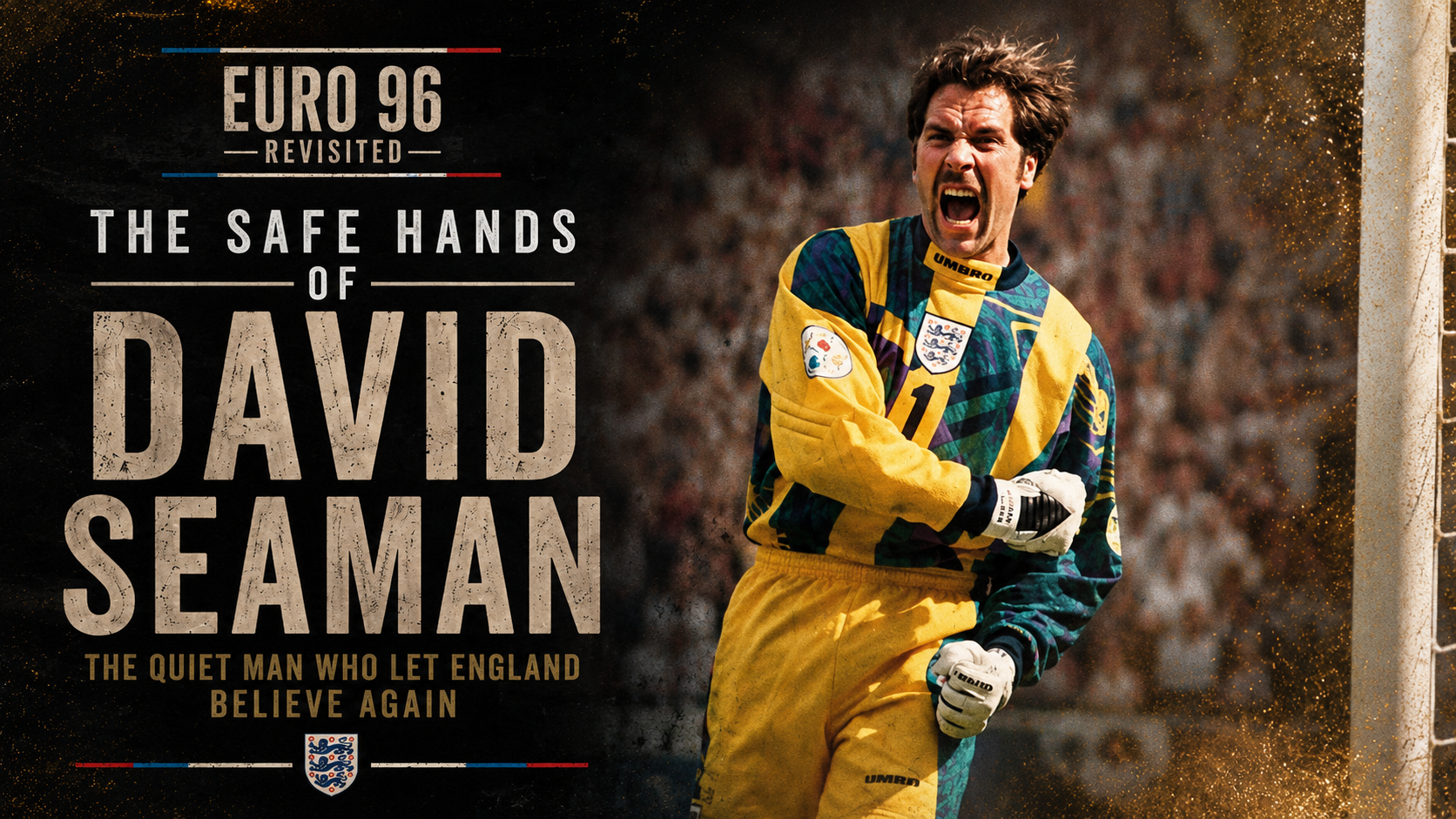
There are footballers remembered because they generated noise.
They scored spectacular goals, celebrated wildly, argued with opponents, screamed at teammates or provided the emotional soundtrack to entire tournaments. Football memory tends to favour the extroverts, the romantics and the wounded heroes. It remembers those who exposed themselves to us.
David Seaman’s contribution to Euro 96 was almost the opposite. His greatest gift was subtraction.
He removed anxiety.
England remembers Euro 96 as a summer of release. We remember the laughter. We remember Three Lions climbing the charts, Wembley rediscovering its voice and Paul Gascoigne volleying a bouncing ball over Colin Hendry before collapsing into the dentist’s chair celebration. We remember Alan Shearer’s goals, Stuart Pearce’s scream, Terry Venables’ tactical ingenuity and, ultimately, Gareth Southgate’s tears.
It is tempting, nearly thirty years later, to view the tournament as an uninterrupted surge of optimism, as though England simply arrived in June 1996 ready to embrace itself again.
The reality was considerably more fragile.
England entered its first major tournament on home soil since 1966 carrying thirty years of disappointment and embarrassment. The national side had not won a knockout match at a major tournament since reaching the semi-finals of the 1990 World Cup. The failure to qualify for the 1994 World Cup still felt raw. Venables himself was a divisive figure, admired by players for his tactical intelligence but viewed suspiciously in some quarters because of his off-field business dealings. Even before a ball had been kicked at Euro 96, there was a sense that England were one bad result away from another national inquest.
Then came Hong Kong.
The photographs of England players taking part in the now infamous dentist’s chair drinking game quickly found their way onto the front pages. The tabloids sensed blood. The squad were branded irresponsible and immature. Questions were asked about discipline, professionalism and leadership. The team’s preparations became a morality play. Venables was expected in some quarters to punish players publicly, restore order and reassure a sceptical public that England had not entrusted its greatest footballing occasion in a generation to a group of overgrown schoolboys.
Instead, Venables largely closed ranks.
He understood something important about tournament football. Once a squad reaches a major championship, technical preparation is often overtaken by psychology. Teams rarely win because they become dramatically fitter or tactically superior over three weeks. They win because they create an environment where pressure can be managed, external criticism neutralised and collective belief protected.
Venables transformed media hostility into a siege mentality. The players have spoken often about how tightly the group became knit during those weeks. But siege mentalities require strong walls. Defiance alone cannot sustain a team if the foundations beneath it feel unstable.
England in June 1996 trusted almost nobody.
They did not entirely trust their own history.
They did not trust penalty shoot-outs.
They did not trust the newspapers.
Many remained unsure whether they trusted Gascoigne’s self-control.
Some were unconvinced by Venables.
But almost everyone trusted David Seaman.
There was nothing particularly fashionable about David Seaman in 1996, which may have been part of his appeal. He lacked Gascoigne’s charisma, Pearce’s intensity or Sheringham’s edge. His appearance belonged to an earlier England, with the thick moustache and ponytail giving him the air of a man who might spend his weekends fishing rather than navigating the commercialised celebrity culture that increasingly surrounded elite footballers in the mid-1990s.
More importantly, Seaman appeared to inhabit an entirely different emotional climate.
Bob Wilson, who coached Seaman at Arsenal and understood him better than almost anyone, later said that only two goalkeepers he knew could “fill a room” simply by entering it: Pat Jennings and David Seaman. “They have an absolute calm about them.”
Calmness can be underrated in football because it is difficult to package into highlights. It does not sell shirts. It rarely becomes folklore. Yet trust operates as an institutional shock absorber. In moments of uncertainty, groups instinctively search for figures who appear immune to panic. They become reference points, allowing everyone else to function with greater freedom.
England’s most gifted player was Gascoigne.
Its most emotional player was Pearce.
Its most innovative figure was Venables.
Its most important psychological asset may have been the goalkeeper standing quietly behind them all.
Euro 96 is usually remembered as England falling in love with football again. In many ways, it was.
But before England could enjoy itself, before Wembley could sing with conviction and before an entire country dared to believe that something extraordinary might be possible, it first needed someone capable of removing its fear.
For three weeks in the summer of 1996, David Seaman became that man.
England’s Most Trusted Man
David Seaman was not supposed to become England’s goalkeeper.
By the standards of modern elite development, his pathway appeared almost archaic. Leeds United decided not to offer him professional terms as a teenager. He drifted into semi-professional football with Peterborough United while working in a plastics factory in Rotherham. Birmingham City offered him an opportunity, but even then he remained an unglamorous figure in a football culture that often valued athleticism and personality over patience and positional intelligence.
By the time Euro 96 arrived, however, Seaman had spent almost a decade proving that reliability could be a virtue in itself.
He had emerged as one of the country’s finest goalkeepers at Queens Park Rangers under Jim Smith before George Graham made him Arsenal’s first £1 million goalkeeper in 1990. At the time, the fee felt extravagant for a player whose game was almost deliberately understated. Seaman was not acrobatic in the mould of Bruce Grobbelaar. He lacked the imposing theatricality of Peter Schmeichel. Nor did he possess the manic edge that seemed almost a prerequisite for many elite goalkeepers of the era.
Instead, he appeared to simplify football.
Opponents crossed into his penalty area and found the ball calmly gathered into his chest. Through balls were extinguished by intelligent starting positions. Difficult saves often looked strangely straightforward because he had already moved himself into the correct place before the shot was struck. Supporters rarely left stadiums talking about David Seaman because the best version of David Seaman prevented situations from becoming memorable in the first place.
That quality had been built over years of quiet craft. At Leeds, he later recalled travelling to training with John Lukic and warming each other up because specialist goalkeeping coaching scarcely existed in the structured form that would later become normal. The position was still treated, in many British clubs, as something learned through exposure, repetition and resilience. Goalkeepers worked together, absorbed habits and survived mistakes.
Seaman survived better than most.
Wilson recognised this early. His comparison with Jennings was revealing.
Jennings represented an earlier generation of goalkeeping, one rooted in economy of movement and technical certainty rather than spectacle. Seaman belonged to that lineage. He was six feet four inches tall, broad shouldered and physically imposing, yet there was very little aggression in the way he carried himself. Even his communication with defenders was generally measured. While Schmeichel barked instructions and dominated his penalty area through force of personality, Seaman seemed to govern his through reassurance.
This distinction mattered.
England’s Euro 96 squad contained no shortage of combustible personalities. Gascoigne remained capable of brilliance and self-destruction in equal measure. Pearce played every match as though settling a personal score with football itself. Teddy Sheringham possessed an abrasive edge that teammates often admired and opponents rarely enjoyed. Tony Adams was rebuilding his own life after publicly confronting alcoholism. Venables was operating under the cloud of continuing financial scrutiny.
Seaman occupied a different emotional space.
He was, in many respects, reassuringly ordinary.
He spoke softly. He enjoyed fishing. He rarely sought headlines. He appeared immune to the mood swings that so often accompany international tournaments. If Euro 96 sometimes felt like an emotional carnival, Seaman resembled the man quietly checking that the safety barriers had been properly secured.
This is perhaps where discussions about trust become most interesting.
Football supporters do not simply trust talent. They trust predictability. They trust players who repeatedly demonstrate that stressful situations will not fundamentally alter their behaviour. Under pressure, Seaman remained Seaman. He did not seek to intimidate penalty takers. He did not manufacture confrontations. He did not perform confidence for television cameras.
He simply waited.
And over time, teammates, coaches and supporters came to understand that waiting alongside David Seaman was usually a sensible thing to do.
England arrived at Euro 96 searching for inspiration. They would eventually find it in Gascoigne, Pearce and Shearer.
But inspiration is often fleeting.
What tournament teams need, particularly those carrying decades of disappointment, is reassurance.
England wanted moments.
David Seaman offered certainty.
And in the volatile atmosphere of June 1996, certainty may have been the more valuable commodity.
A Goalkeeper Between Two Games
By the summer of 1996, David Seaman had become shorthand for security.
Supporters called him “Safe Hands”. Teammates trusted him instinctively. Opponents respected his command of the penalty area. Looking back now, it is easy to imagine Seaman as the final expression of a traditional English goalkeeper: tall, physically imposing, exceptional under crosses and utterly dependable.
The reality was considerably more complicated.
Seaman’s career happened to coincide with one of the most significant tactical revolutions football has experienced. The goalkeeper who walked onto the Wembley pitch against Scotland in June 1996 was not simply the custodian of an older style. He was someone who had spent four years painfully learning how to survive in a game that had suddenly decided to change the rules.
Football at the beginning of the 1990s often seemed exhausted by its own conservatism.
The 1990 World Cup produced only 2.21 goals per game, still the lowest average in tournament history. Defensive caution was frequently rewarded. Teams protected leads by retreating into compact shapes, breaking up rhythm and exploiting one loophole above all others. If pressure mounted, defenders simply rolled the ball back to their goalkeeper, who would calmly pick it up, hold it, walk several yards across his six-yard box and restart play when convenient.
The tactic was legal.
It was also increasingly unpopular.
By the time Denmark defeated Germany to win Euro 92, the back-pass had become emblematic of a sport drifting towards sterility. Goalkeepers collected deliberate passes, time ebbed away and spectators grew frustrated. FIFA intervened. From August 1992, goalkeepers could no longer handle deliberate back-passes from teammates.
The law appears obvious today.
At the time, it felt revolutionary.
For decades, goalkeepers had effectively trained as specialists whose feet existed largely to propel goal-kicks sixty yards upfield. Suddenly they were expected to become auxiliary outfield players. They had to receive under pressure, distribute accurately and think differently about their positioning.
Alan Hodgkinson, one of England’s most respected goalkeeping coaches, complained that the change was making “a mockery of my profession”. Others feared the rule would simply encourage aimless long balls and remove technical certainty from the position.
Seaman understood those anxieties because he lived through them.
He later admitted that the rule nearly gave him “a heart attack”. Years of instinctive behaviour had to be dismantled almost overnight. His natural inclination remained to gather the ball safely into his arms. On several occasions in the early months after the law changed, muscle memory took over and he found himself conceding indirect free-kicks inside his own penalty area after instinctively handling back-passes.
The irony was striking. England’s safest pair of hands spent the first years after 1992 trying to stop using them.
He was not alone.
Many goalkeepers from his generation struggled.
Some never truly adapted.
Seaman did.
That transformation owed much to Wilson.
Long before specialist goalkeeper coaches became commonplace, Wilson was treating the position as a discipline worthy of its own methodology. Technical details mattered, but Wilson’s greatest strength may have been psychological. He understood that confidence for goalkeepers is unusually fragile. Mistakes are public and disproportionately punished. Rebuilding belief requires more than repetition.
Seaman once described Wilson’s approach with obvious affection.
If Seaman produced an exceptional save early in a training exercise, Wilson would often end the drill immediately.
“You’ve done your set,” he would say.
The logic was deceptively simple.
Goalkeepers remember their last action. Wilson wanted Seaman walking away carrying the memory of excellence rather than dwelling on a mistake made twenty minutes later through fatigue.
It was an unconventional method.
It was also perfectly suited to Seaman’s temperament.
He was never a goalkeeper fuelled by adrenaline. He required rhythm, confidence and familiarity. Wilson understood that his greatest asset was not athleticism but composure. The challenge after 1992 was therefore not to reinvent Seaman entirely, but to preserve that composure while introducing skills his generation had barely practised.
By Euro 96, the process was largely complete.
Seaman still looked like a goalkeeper from another age. He preferred catching to punching. He commanded his six-yard box with old-fashioned authority. He rarely indulged in unnecessary theatrics.
Yet beneath the moustache, ponytail and reassuringly traditional appearance stood a footballer who had quietly undergone profound change.
He had learned to distribute differently.
To think differently.
To position himself differently.
To trust his feet.
In many ways, Seaman embodied the tournament itself.
Euro 96 often felt like the last great gathering of football’s old certainties. Matthias Sammer still swept behind defenders. Traditional centre-forwards remained influential. The golden goal promised sudden death drama. The game retained much of its analogue texture.
But underneath, the sport was shifting.
David Seaman understood that better than most.
England’s goalkeeper was not simply guarding the final years of an old footballing order.
He was standing at the point where two different versions of the game briefly met, carrying enough of the past to feel familiar, while adapting just enough to remain indispensable in the future.
The Save Before the Save
If David Seaman’s Euro 96 has become condensed into a single image, it is an unfairly narrow one.
People remember the elbow.
They remember Gary McAllister standing on the penalty spot. They remember Uri Geller hovering above Wembley in a helicopter with a crystal and George Cohen’s 1966 World Cup cap. They remember Paul Gascoigne flicking the ball over Colin Hendry moments later and recreating the dentist’s chair celebration in front of a delirious crowd.
Few remember the save that came first.
Few remember that Scotland had already come within inches of equalising.
Seaman’s tournament had actually begun with another underappreciated contribution. Against Switzerland, after Kubilay Türkyilmaz’s late penalty rescued a draw for the visitors, he spread himself brilliantly to deny Marco Grassi a winner. England’s summer had already flirted with disaster once.
Against Scotland, it flirted with it again.
England’s meeting with Scotland on 15 June was far more uncomfortable than memory often allows. The tournament’s emotional mythology has smoothed its rough edges, transforming it into a straightforward story of English catharsis. In reality, England spent much of the afternoon looking nervous, ponderous and burdened by expectation.
Scotland arrived at Wembley with considerably more than patriotic enthusiasm. Craig Brown had assembled an experienced and tactically intelligent side. McAllister and John Collins were technically accomplished midfielders capable of controlling possession. Colin Hendry organised the defence superbly. Gordon Durie offered clever movement across the front line. Scotland were not there to provide atmosphere for England’s rebirth. They genuinely believed they could derail it.
For forty-five minutes, they looked the more coherent team.
David Lacey, writing in The Guardian’s later Vault piece on the match, recalled England’s “somnambulistic tendencies”. The ball moved too slowly. Passing lacked conviction. Gascoigne drifted in and out of the contest. Scotland appeared happier in possession and more comfortable within the rhythm of the occasion. Wembley, so eager to celebrate, began to grow anxious.
Venables recognised the problem.
At half-time he acted decisively, withdrawing Pearce, repositioning Southgate on the left side of England’s defensive structure and introducing Jamie Redknapp to increase England’s tempo in midfield. The tactical adjustment liberated Gary Neville down the right flank, stretching Scotland’s defensive shape and creating spaces that had barely existed during the opening period.
The effect was immediate.
Eight minutes into the second half, Neville surged forward and delivered a superb cross that Shearer attacked with characteristic aggression, glancing his header beyond Andy Goram. Wembley exhaled. England led. The soundtrack of the tournament resumed.
Yet tournament football rarely permits comfort.
Scotland responded with urgency. Their passing quickened. England retreated instinctively. The match became increasingly stretched and frantic, the kind of contest where goalkeepers are often called upon to preserve not merely a scoreline but the emotional equilibrium of an entire stadium.
Then came the moment that has almost disappeared from collective memory.
Collins escaped into space on the left-hand side and delivered a teasing cross towards the far post. Durie timed his movement perfectly, rising above the defenders and directing a firm downward header towards goal. For a split second, Wembley seemed to freeze.
Seaman was moving the wrong way.
His weight had shifted slightly towards his near post as Collins shaped to cross. To recover, he had to replant his feet, spring back across his line and extend his right arm at full stretch. He managed not merely to touch the ball but to claw it away from danger.
It was a save of remarkable technical quality.
Goalkeepers often speak about the importance of economy. The greatest saves frequently appear unspectacular because they are built upon positioning, balance and early decision-making rather than desperate athleticism. Seaman’s intervention against Durie belonged firmly in that category. There was no dramatic camera angle. No sprawling leap worthy of a montage. No theatrical roar.
He simply prevented a goal that most people had already assumed was inevitable.
It was precisely the type of intervention that goalkeepers notice and everyone else forgets.
The irony is revealing.
David Seaman’s career was built upon these moments. He specialised in making the extraordinary appear routine. His excellence was often hidden precisely because his preparation and positioning eliminated the appearance of crisis. Schmeichel’s brilliance could feel explosive. Seaman’s often felt inevitable.
Only minutes later, Adams challenged Durie inside the penalty area and Italian referee Pierluigi Pairetto pointed immediately to the spot.
The save everyone remembers was about to arrive.
But England’s summer had already been rescued once.
Long before McAllister placed the ball twelve yards from goal, David Seaman had quietly ensured that Scotland never reached that penalty with the lead already restored.
It was the sort of intervention that tends to disappear from football memory.
For goalkeepers, however, it remains one of the finest moments of his tournament.
And perhaps one of the most revealing.
The Save Everyone Remembers
The strange thing about trust is that it is usually invisible until the moment it is tested.
For seventy-seven minutes against Scotland, David Seaman had largely been what he always was: competent, composed and quietly authoritative. He had organised his defenders, dealt with crosses, made one outstanding save and watched England oscillate between inspiration and apprehension.
Then Adams lunged.
Durie was clever enough to step across the Arsenal captain, inviting contact. Adams obliged. Pairetto pointed to the spot.
Wembley fell silent.
The transformation was almost physical. An afternoon that had briefly threatened to become celebratory suddenly felt suffocating once more. England led 1-0, but everyone inside the stadium understood what was at stake. Scotland had controlled long periods of the match. They had already demonstrated they could trouble England’s defence. An equaliser would alter the entire emotional trajectory of the tournament.
McAllister was precisely the player Scotland wanted standing twelve yards from goal.
He was their captain, their most accomplished footballer and perhaps the calmest individual on the pitch. He had won league titles with Leeds United, possessed immense experience and struck penalties with authority. Brown would later argue that Scotland had the momentum to go on and win the game had McAllister converted.
Then football briefly descended into absurdity.
High above Wembley, Geller sat inside a helicopter clutching a crystal and the cap worn by George Cohen during England’s 1966 World Cup triumph. Geller would later claim he concentrated intensely on the ball, shouting “Move!” as McAllister prepared his run-up.
Television replays appeared to show the ball shifting fractionally on the spot.
McAllister has since acknowledged noticing movement, although he stopped short of attributing his miss to paranormal intervention. Whether it genuinely affected him or merely became another eccentric footnote in English football folklore perhaps misses the point.
Seaman’s preparation contained no mysticism.
He was interested in body shape.
Penalty saves often reveal the personality of goalkeepers. Some seek confrontation. Some dance along the goal line. Others delay the taker by adjusting gloves or repositioning the ball. Seaman rarely indulged in theatre. He trusted his reading of opponents and his ability to remain patient.
This was especially notable because the prevailing culture of English goalkeeping encouraged anticipation. Goalkeepers were taught to commit decisively, to trust instinct and to attack situations aggressively. Seaman’s gift was his refusal to hurry.
He watched.
McAllister approached.
Seaman waited.
Only when the Scottish captain finally committed himself did England’s goalkeeper explode to his right.
The save itself was unconventional. Rather than a full palm, Seaman blocked the ball with his elbow, diverting it upwards and over the crossbar. It was not elegant. It did not need to be. The objective was survival.
He had achieved it.
What happened next has been replayed endlessly.
Exactly sixty-two seconds later, England broke forward. Teddy Sheringham combined with Darren Anderton. Gascoigne drifted into space, lifted the ball over Hendry and volleyed beyond Goram before collapsing onto the Wembley turf to recreate the dentist’s chair celebration that had so scandalised the tabloids only weeks earlier.
It remains one of the defining images of modern English football.
Yet there is an uncomfortable truth beneath the mythology.
Gascoigne’s goal was possible because Seaman had already absorbed the pressure.
England remembers genius because genius is easier to celebrate. It is immediate, emotional and highly visible. Competence is more difficult to romanticise. It tends to disappear beneath the moments it enables.
Even Shearer has joked that he wishes as many people remembered his opening goal against Scotland as they do the surrounding drama of McAllister’s penalty and Gascoigne’s volley.
Seaman might reasonably make a similar complaint.
Without his save, there is every chance Gascoigne’s goal never acquires its iconic status. Had Scotland equalised, England’s confidence may have evaporated entirely. Venables was considering substituting Gascoigne because of fatigue. The emotional momentum that swept England through the remainder of the group stage might never have materialised.
The summer England remembers was perhaps sixty seconds away from becoming another summer England preferred to forget.
David Seaman did not create the tournament’s most famous image.
He simply made sure it could happen.
And in doing so, he reinforced what teammates and supporters had increasingly come to believe.
When England looked uncertain, when Wembley grew anxious and when history appeared ready to repeat itself, there was at least one man on the pitch who seemed entirely untouched by fear.
The Goalkeeper Nobody Had to Worry About
David Seaman’s problem, at least from a historical perspective, is that he made elite goalkeeping look profoundly uninteresting.
Football is unusually generous to visible suffering. It remembers defenders throwing themselves into last-ditch tackles, midfielders playing through pain and forwards celebrating goals with unrestrained emotion. Goalkeepers, meanwhile, tend to enter mythology in one of two ways. They either produce spectacular acts of athleticism or commit catastrophic mistakes.
Seaman rarely did either.
He spent much of his career inhabiting the less glamorous territory between the two.
The best goalkeepers often speak about economy. Their objective is not simply to stop shots but to prevent situations from becoming emergencies in the first place. Positioning, anticipation and balance matter more than reflexes because correct decisions made two seconds earlier frequently remove the need for acrobatics later.
Seaman understood this instinctively.
Wilson certainly did.
Wilson was deeply suspicious of what he termed “camera saves”, interventions where goalkeepers appeared to make difficult stops largely because they had positioned themselves poorly beforehand. He valued stillness, patience and efficiency. Seaman became the perfect expression of that philosophy.
Years later, Seaman himself articulated a similar view.
“I look for goalkeepers who don’t make camera saves,” he explained. “Why are you trying to impress someone with an easy save?”
It is an illuminating comment because it reveals how differently goalkeepers often assess excellence compared to supporters.
Supporters remember Schmeichel launching himself through crowded penalty areas, arms spread wide, shouting instructions that seemed capable of shaking floodlights loose from their moorings. Schmeichel was magnificent, but his greatness possessed a visual drama that television adored.
Seaman’s brilliance was quieter.
He caught crosses cleanly when others punched.
He narrowed angles early.
He took half-steps that television cameras barely registered.
He remained on his feet fractionally longer than opponents expected.
He rarely seemed rushed.
And because he rarely seemed rushed, England rarely seemed rushed.
That matters.
International tournaments are exercises in emotional management. The margins separating success and failure are often painfully small. Teams look constantly for cues about how they should feel. One panicked clearance can infect an entire defence. One goalkeeper visibly berating his defenders can spread anxiety through an otherwise composed team.
Seaman projected the opposite.
He suggested control.
Not certainty that England would win.
Certainty that England would survive the next attack.
The distinction is important.
Gascoigne inspired people because he seemed capable of producing moments nobody else could imagine. Pearce inspired people because he appeared willing to suffer publicly on behalf of everyone watching. Shearer inspired confidence because goals followed him almost everywhere.
Seaman inspired trust because he seemed immune to emotional contagion.
Pressure reached him.
It simply did not appear to alter him.
Perhaps that is why his reputation has gradually become more difficult to sustain within modern football culture.
Contemporary football increasingly consumes goalkeeping through clips. We watch compilations of impossible saves. We admire sweeping recoveries, sprawling fingertip interventions and dramatic one-on-one duels. Goalkeepers have become performers as much as technicians.
Seaman belonged to a different tradition.
His finest moments often looked disappointingly straightforward.
The save from Durie’s header.
The stop from Miguel Ángel Nadal in the shoot-out against Spain.
Dozens of catches taken comfortably beneath swirling crosses.
Hundreds of angles quietly narrowed.
Thousands of decisions made correctly before anyone else recognised there was a decision to make.
The greatest compliment a goalkeeper can probably receive is boredom.
Supporters should almost forget he is there.
For much of the 1990s, England supporters did.
Not because David Seaman lacked quality.
Quite the opposite.
Because, whenever England needed him, he was usually exactly where he was supposed to be.
And there are few things in football more reassuring than discovering that the person carrying your deepest anxieties has no intention whatsoever of carrying them badly.
Spain and Football’s Changing Psychology
If Scotland tested David Seaman’s reliability, Spain tested his adaptability.
England’s quarter-final at Wembley was not remembered with the same affection as the victories over Scotland and the Netherlands. It lacked Gascoigne’s improvisation, Shearer’s swagger and Pearce’s catharsis. It was tense, attritional and often uncomfortable, a reminder that tournament football rarely conforms to romantic narratives for very long.
Spain were technically superior in several areas.
They circulated possession confidently, sought overloads in midfield and appeared considerably more at ease with some of the tactical developments that were beginning to reshape European football. Their players had grown up within an environment increasingly comfortable with nuance, deception and the manipulation of marginal advantages.
England, for all Venables’ tactical intelligence, still retained elements of an older football culture.
Few aspects illustrated this divide more clearly than penalties.
British football traditionally approached penalty taking as an exercise in conviction. The taker selected a corner, struck the ball firmly and accepted responsibility for the outcome. Shearer embodied the philosophy. Pearce did too. There was almost a moral dimension attached to it, an unspoken belief that the fairest penalty was the one struck honestly and decisively.
Continental football had begun moving in another direction.
The objective remained the same, but the process was changing. Players increasingly sought information from goalkeepers, using stuttering run-ups, delayed strikes and exaggerated body movements to encourage an early commitment before calmly placing the ball into the opposite corner.
The distinction appears unremarkable now.
In 1996, it still felt vaguely subversive.
During the shoot-out against Spain, Guillermo Amor offered perhaps the clearest example. Approaching the ball, he slowed noticeably, exaggerated his final stride and hesitated fractionally over his strike. Seaman instinctively twitched towards one side, realised he had been deceived and desperately attempted to reset himself. Amor simply rolled the ball into the opposite corner.
The reaction around him was revealing.
Adams complained that Amor had crossed some invisible line between intelligence and gamesmanship. In commentary, Ron Atkinson voiced his displeasure at penalties that “creep along the ground” after a check-step, sounding less like an analyst and more like a custodian of traditional British football values.
In truth, football was changing.
The penalty had become another psychological battleground.
Goalkeepers could no longer rely solely on reading hips and shoulders. They needed to understand rhythm, hesitation and manipulation. Patience itself was becoming a technical skill.
Seaman adapted.
That was perhaps his most underrated quality.
For a player so often portrayed as the embodiment of traditional English goalkeeping, he repeatedly demonstrated a willingness to evolve. He had survived the back-pass revolution. He had adjusted his distribution. He had refined his starting positions. Now, standing beneath the floodlights at Wembley, he was learning in real time about a new generation of penalty-taking techniques.
When Nadal walked forward for Spain’s fourth penalty, Seaman looked different.
There was less urgency.
Less anticipation.
He remained balanced for longer, resisting the temptation to commit himself prematurely. Nadal struck firmly enough, but Seaman had bought himself the additional fraction of a second he needed. Diving low to his right, he pushed the ball away.
Wembley erupted.
England were through.
The image that survives from the evening belongs, understandably, to Pearce, fists clenched, face contorted by six years of accumulated regret finally draining away. It was one of Euro 96’s most emotionally charged moments.
Yet once again, England’s celebration had been built upon Seaman’s restraint.
Pearce represented release.
Seaman represented control.
Euro 96 often feels, in retrospect, like England discovering how to enjoy football again. But enjoyment only became possible because there remained, at the back of the team, a goalkeeper willing to absorb uncertainty while the sport itself evolved around him.
He looked reassuringly old-fashioned.
Increasingly, he was anything but.
The One Burden He Could Not Carry
The difficulty with becoming a nation’s safety net is that eventually people expect you to catch everything.
By the time England walked out for their semi-final against Germany on 26 June 1996, David Seaman had already become one of the defining figures of the tournament. He had survived the opening draw with Switzerland, rescued England against Scotland and delivered another crucial intervention in the shoot-out victory over Spain. Increasingly, supporters had begun to assume that if England reached a difficult moment, Seaman would somehow find a solution.
Against Germany, however, football presented him with a problem that goalkeepers have confronted since the sport began.
Sometimes there is nothing to save.
England started brilliantly.
Shearer scored after only three minutes, rising to convert Neville’s cross and sending Wembley into delirium. It was his fifth goal of the tournament and further evidence that Venables had assembled a side capable of competing with Europe’s strongest nations.
Yet Germany possessed a quality England still lacked.
Emotional detachment.
Where England experienced tournament football as an existential event, Germany often approached it as a professional exercise. Conceding early did not alter their behaviour. Panic did not spread. Narratives did not intrude.
Sixteen minutes after Shearer’s opener, Stefan Kuntz equalised, bundling home after Andreas Möller’s initial effort had been blocked. Seaman reacted instinctively to the first shot, but the rebound fell kindly and Kuntz was close enough to force the ball over the line.
For perhaps the first time during Euro 96, England’s goalkeeper found himself unable to restore order immediately.
The match settled into a tense equilibrium.
England arguably played their finest football of the tournament. Anderton struck a post. Gascoigne famously slid inches short of making contact with Shearer’s low cross during extra time, a moment that has become one of English football’s enduring images of almost-glory. Germany threatened sporadically, but Seaman remained assured whenever called upon.
Eventually, the contest drifted towards penalties.
For England, penalty shoot-outs occupied a uniquely uncomfortable place in the national psyche. Italia 90 remained painfully fresh. Pearce and Chris Waddle had become symbols of collective trauma. The victory over Spain had felt liberating precisely because it suggested England might finally be escaping that history.
Germany never appeared burdened by such thoughts.
Thomas Hässler scored.
Shearer scored.
Thomas Strunz scored.
David Platt scored.
Mehmet Scholl scored.
Pearce scored.
Möller scored.
Gascoigne scored.
Thomas Helmer scored.
Sheringham scored.
Every penalty was struck with authority.
Then Southgate stepped forward.
Southgate’s miss has understandably occupied much of England’s collective memory. It became a shorthand for sporting heartbreak, then, decades later, an unlikely symbol of redemption when he returned as England manager and transformed the national team’s relationship with shoot-outs.
Less discussed is what the miss meant for Seaman.
For much of June 1996 England had behaved as though Seaman possessed the ability to insulate them from history itself. He had delayed disappointment repeatedly, postponed anxiety and bought his teammates enough time to produce moments of brilliance. Against Germany he encountered the simple truth facing every goalkeeper.
You can defer fate.
You cannot abolish it.
Möller approached the spot.
Seaman guessed correctly.
He moved to his left.
Möller’s strike was simply too precise, too powerful and too close to the corner.
The net rippled.
Germany celebrated.
England collapsed.
Seaman remained where he was for a moment, looking towards the goalmouth he had guarded so diligently throughout the tournament. There was no anger. No theatrical frustration. No visible self-pity.
Only acceptance.
Perhaps that was fitting.
Even institutional shock absorbers eventually reach their limit.
England had asked David Seaman to absorb thirty years of disappointment, weeks of tabloid hostility, the pressure of hosting a major tournament and the psychological burden of a nation desperate for validation. For much of Euro 96, he succeeded.
Against Germany, he encountered the simple reality that goalkeepers cannot save penalties that are struck perfectly.
There are burdens that even the safest pair of hands cannot carry indefinitely.
And perhaps that is why the image of Seaman standing helplessly as Möller’s penalty found the corner feels so poignant today.
For the first time all summer, England’s most trusted man had run out of ways to protect everyone else.
The Strange Disappearance of David Seaman
David Seaman occupies an unusual place in English football memory.
He is universally respected.
He is rarely celebrated.
Mention England’s greatest goalkeepers and supporters instinctively reach for certain names. Gordon Banks remains untouchable, forever preserved in black and white alongside his save from Pelé. Peter Shilton accumulated 125 caps and was England’s goalkeeper for more than a decade. More recently, debates have emerged around Jordan Pickford’s performances in successive tournaments and whether his contribution has been fully appreciated.
Seaman often sits somewhere in the background.
Acknowledged.
Admired.
Seldom discussed.
It is an odd fate for a player whose achievements compare favourably with almost anyone.
Seventy-five England caps.
Three league titles.
Four FA Cups.
A European trophy.
More than a decade as Arsenal’s undisputed number one.
Selection in UEFA’s Euro 96 Team of the Tournament.
Recognition as the competition’s outstanding player by sponsors Philips.
And yet, nearly thirty years later, his reputation feels strangely vulnerable.
Between 1990 and 2003, no English goalkeeper accumulated more trust from managers, teammates and supporters. That should have been enough to secure his place in the foreground of national memory. Instead, his legacy has had to fight against the cruelty of how football remembers goalkeepers.
Outfield players usually own moments.
Gascoigne owns the goal against Scotland.
Pearce owns the celebration against Spain.
Shearer owns the opening goal against Germany.
Southgate owns the missed penalty.
Goalkeepers often inherit something different.
They inherit mistakes.
Seaman’s career has gradually become condensed into a small collection of painful images. Nayim’s improbable lob from near the halfway line in the Cup Winners’ Cup final in 1995. Ronaldinho’s looping free-kick in Saitama during the 2002 World Cup. Artim Šakiri scoring directly from a corner for Macedonia in what proved to be Seaman’s final England appearance.
These moments exist.
They deserve acknowledgement.
But they also distort.
The problem is not simply recency bias. It is aesthetic bias.
Football tends to reward visible difficulty.
A full-stretch dive towards the top corner feels extraordinary because viewers instinctively understand how much athleticism is involved. A goalkeeper who appears to rescue his team repeatedly becomes easy to admire.
Seaman’s greatness often denied spectators that satisfaction.
He disliked camera saves. He preferred to narrow angles early, set himself quickly and make difficult interventions appear routine.
In practical terms, this frequently meant that shots travelled directly towards him.
Not because opponents lacked quality.
Because he had already moved himself into precisely the correct position.
It is the footballing equivalent of excellent defending. Nobody notices the centre-half who reads danger thirty seconds before everyone else. People remember the sliding tackle made desperately on the goal line.
Goalkeeping has become even more vulnerable to this problem in the digital age.
Modern football is increasingly consumed through clips, compilations and social media highlights. Spectacular moments thrive. Quiet competence struggles to survive.
David Seaman was almost designed to be underappreciated in such an environment.
He rarely shouted.
Rarely celebrated.
Rarely sought attention.
He simply occupied space intelligently, caught crosses cleanly and reassured teammates that the situation remained under control.
Schmeichel once described Seaman’s save from Paul Peschisolido in the 2003 FA Cup semi-final against Sheffield United as “the best save I’ve ever seen”. Seaman was thirty-nine years old at the time and playing his 1,000th professional match.
Even then, however, the narrative surrounding him was beginning to shift. The media had already decided he was ageing. His ponytail had become an object of ridicule. The same newspapers that had once treated him as a national treasure increasingly portrayed him as a relic.
Perhaps that tells us something larger about football itself.
The game remembers players who made us laugh.
Players who made us cry.
Players who disappointed us.
Players who astonished us.
It is less generous towards those who simply made us feel safe.
Yet safety was precisely what England required in June 1996.
Gascoigne supplied imagination.
Shearer supplied goals.
Pearce supplied catharsis.
Venables supplied ideas.
David Seaman supplied something arguably more important.
For three weeks, he convinced an anxious football nation that things would probably be all right.
And perhaps that is why he has become oddly difficult to remember.
Football remembers the players who made us feel joy, anger and heartbreak.
It is far less adept at remembering those who quietly removed fear.
The Quiet Man of a Loud Summer
Euro 96 has become one of those tournaments that exists simultaneously as history and mythology.
For those who lived through it, certain images remain permanently fixed. Pearce screaming into the Wembley night after scoring against Spain. Gascoigne floating above the turf against Scotland. Shearer wheeling away towards the crowd. Southgate standing alone after Germany had celebrated.
The soundtrack survives too.
Three Lions.
The chants.
The tabloid headlines.
The dentist’s chair.
The feeling that England, for perhaps the first time in a generation, had stumbled upon a version of itself that people genuinely wanted to support.
It was noisy.
Joyfully noisy.
Painfully noisy.
Relentlessly noisy.
David Seaman never really joined in.
He was not built for performance beyond the ninety minutes. He did not cultivate mythology around himself. He was not tortured enough to become a tragic figure, charismatic enough to become a cult hero, or flamboyant enough to dominate television retrospectives. Even his greatest saves often looked strangely ordinary because he worked so hard to ensure they appeared that way.
And perhaps that is the paradox at the heart of his place in English football history.
The qualities that made him indispensable in 1996 are precisely the qualities that make him difficult to celebrate today.
Reliability rarely produces folklore.
Competence rarely inspires documentaries.
Consistency struggles to compete with moments of genius or catastrophe.
Yet tournament football is often decided by players capable of imposing order on chaos. Teams require artists. They require goalscorers. They require coaches prepared to make bold decisions at half-time.
But they also need someone who can absorb uncertainty and quietly reassure everyone else that panic remains unnecessary.
That was Seaman’s role.
England arrived at Euro 96 carrying decades of disappointment, weeks of tabloid hostility and the burden of hosting a major tournament that many feared would expose old weaknesses once again. Venables helped turn that pressure inward, forging a squad that increasingly trusted one another. Gascoigne rediscovered his joy. Shearer rediscovered his goals. Pearce rediscovered his sense of belonging.
Seaman allowed them the freedom to do so.
He saved Durie’s header.
He saved McAllister’s penalty.
He saved Nadal’s penalty.
He adapted to a changing game.
He steadied a nervous defence.
He projected calm when almost everybody around him appeared vulnerable to anxiety.
Even against Germany, when Möller’s penalty finally defeated him, there was something fitting about Seaman’s reaction. No grand gesture. No visible anger. No attempt to turn defeat into theatre.
Simply acceptance.
An understanding that sometimes football asks more of goalkeepers than even the very best can provide.
Euro 96 remains one of England’s happiest football memories because it represented possibility. For a few weeks, supporters allowed themselves to believe that old patterns might finally be broken and that history was not always destined to repeat itself.
Much of that optimism was inspired by spectacular moments.
Some of it, however, rested upon something quieter.
A goalkeeper from Rotherham with a moustache, a ponytail and an almost stubborn refusal to look worried.
England spent much of the early 1990s distrusting football.
It distrusted tournaments.
It distrusted itself.
For three weeks in 1996, it trusted football enough to enjoy it again.
That trust did not begin with a song, a celebration or a volley.
It began with a goalkeeper who stood quietly on his line and convinced everyone around him that panic was unnecessary.
