


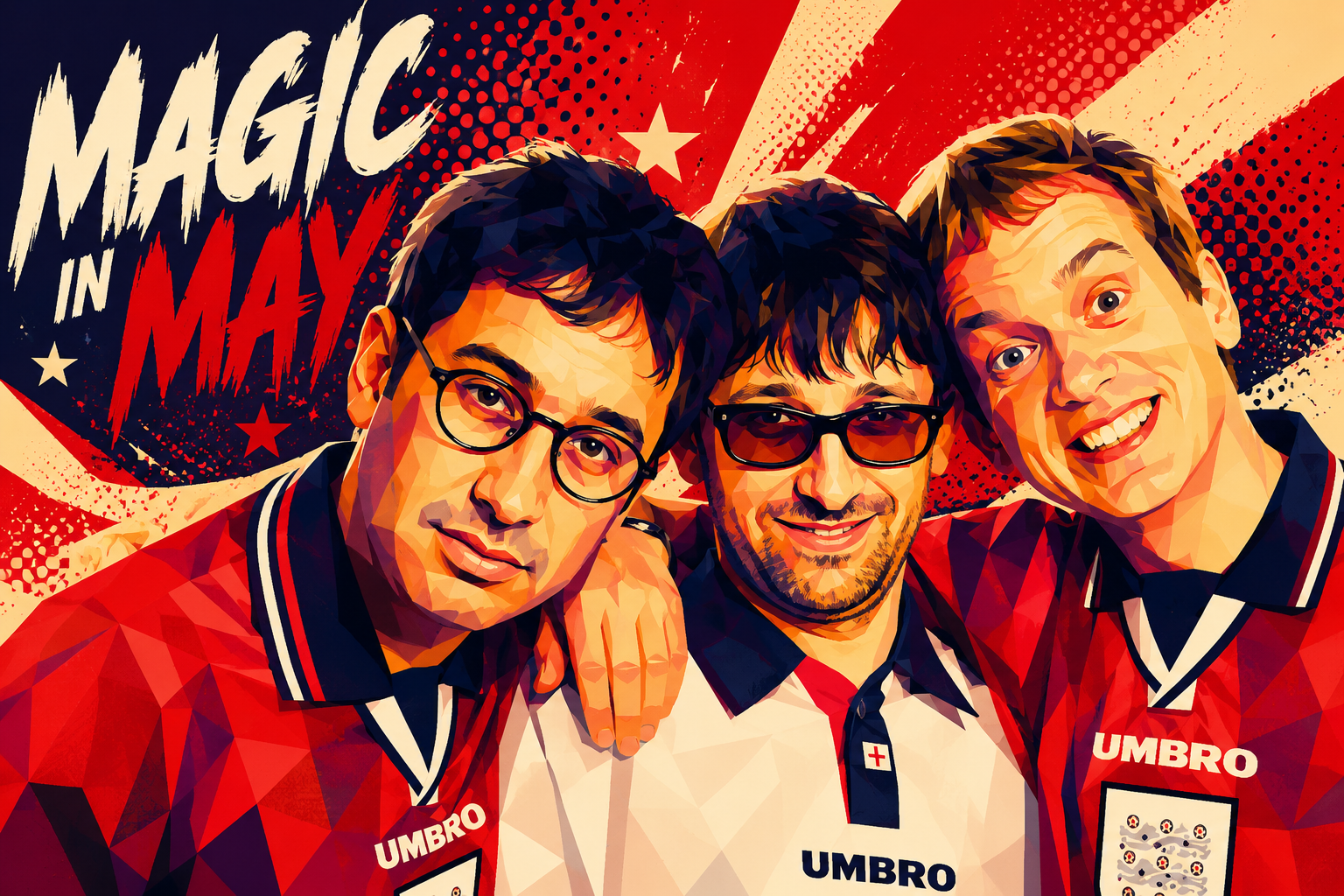
Three Lions was never really a song about England winning. It was a song about why England kept believing after losing had become part of the national inheritance. It was released 30 years ago today, 19th May 1996. And this is its story.
Key Takeaways
- Three Lions is widely misunderstood abroad as arrogance, when its real emotional engine is doubt, humour and self-protection.
- The song became immortal at Wembley in 1996 not because England won, but because supporters sang it after England lost.
- Gareth Southgate is the song’s human storyline: the penalty miss in 1996, the emotional revival in 2018, and the continuing argument between hope and hurt.
- Euro 2022 changed the song forever, with the Lionesses finally giving “football’s coming home” a victorious ending.
The Night Wembley Sang Through Defeat
The air above Wembley carried that strange, heavy warmth only English summer football can produce. Not heat exactly. Expectation. The kind that sits on your shoulders and tightens your chest.
On the evening of 26 June 1996, more than 75,000 people inside the old stadium existed in a state somewhere between belief and self-protection. England were facing Germany in the semi-final of the UEFA European Championship and, for the first time in a generation, the country had allowed itself to imagine something dangerous.
Not hope. Hope was manageable.
This was something closer to emotional exposure.
For three weeks, England had rediscovered itself in public. Terry Venables’ side played with speed and swagger. Paul Gascoigne looked reborn beneath the bleach-blond hair and tabloid chaos. Alan Shearer had become inevitable. Wembley, draped in St George’s flags and blaring brass bands, suddenly felt young again.
Then came the penalties.
By the time the shootout moved into sudden death, the stadium had shrunk into a single unbearable moment repeated over and over again. The floodlights burned white against the dark London sky. Some supporters could no longer watch. Others stood perfectly still, hands pressed against mouths, staring through fingers.
England scored five. Germany scored five. The noise after each kick was no longer celebration. It was relief.
Then Gareth Southgate began the walk from the halfway line.
He did not look like Gascoigne or Shearer or Steve McManaman. There was no theatre to him. No national mythology. He looked exactly what he was: a thoughtful, dependable defender carrying the exhausted weight of a country terrified of recognising the pattern unfolding in front of it.
Years later, Southgate would admit the song had become painful to him. Before England’s 2018 World Cup semi-final against Croatia, he said: “Football’s Coming Home is a song I couldn’t even listen to for 20 years.”
That pain began here.
Southgate struck the ball low to Andreas Köpke’s right. The shot lacked conviction almost from the moment it left his foot. Köpke saved it. Moments later, Andreas Möller smashed Germany’s winning penalty high into the net, chest out, fists clenched, swallowed by white shirts.
England were out.
Again.
The dream had not exploded dramatically. It had collapsed in the familiar, suffocating way England dreams usually collapse, slowly enough for everybody to feel the full weight of it.
And then something remarkable happened.
The old Wembley had seen anger before. It had seen blame, bitterness and drunken despair. English football in the 1970s and 1980s often turned defeat into accusation. But this felt different. The supporters inside the stadium did not immediately turn on Southgate. They did not howl abuse into the night.
Instead, from somewhere deep in the stands, a low murmur began to rise.
It’s coming home.
The words moved slowly across the stadium before gathering force, section by section, row by row. Within moments, tens of thousands of people were singing together through tears, exhaustion and disbelief.
They sang not because they believed England would win. England had already lost.
They sang because the song understood the feeling better than they did.
The Song Everyone Misheard
Outside England, Three Lions is often heard as a boast masquerading as a football song.
That misunderstanding has followed it for almost 30 years.
To many foreign supporters, particularly during major tournaments, the chorus sounds like the anthem of a nation unable to accept its diminished footballing status. During the 2018 FIFA World Cup in Russia, the phrase spread so aggressively across social media that it became impossible to separate from England’s run to the semi-finals. Croatian players admitted afterwards that they had used the perceived arrogance as motivation. Luka Modrić criticised sections of the English media and said the arrogance was “not so much related to the players” as to “people around them”.
From a distance, the interpretation makes sense.
The problem is that it completely misses the emotional language the song is actually speaking.
Three Lions is not a song about certainty. It is a song about preparing yourself for disappointment while secretly remaining hopeful anyway. Its central emotion is not arrogance. It is vulnerability wrapped in humour.
David Baddiel later described the song as being about “magical thinking”, a kind of hope over experience. Ian Broudie, who wrote the music, put it even more plainly when discussing its creation with The Guardian: “Most of being a football fan is disappointment.”
That is the key to the whole thing.
English football supporters do not move through tournaments with clean, unbroken confidence. They move through them with dread disguised as humour. Every generation inherits the failures of the previous one: penalty misses, red cards, tabloid implosions, tactical caution, nervous collapses and the lingering suspicion that England will find some new way to embarrass themselves just as belief begins to build.
Most official football songs try to erase that anxiety.
Three Lions leans directly into it.
That is why outsiders often misread it. They hear the hook without hearing the flinch underneath. They hear entitlement where England supporters hear self-protection. They hear a nation claiming the game belongs to them. England supporters hear a nation trying to talk itself into being hurt again.
Where Three Lions Came From
The story of Three Lions begins at a moment when both English football and English identity felt awkward, uncertain and slightly embarrassed by themselves.
By the mid-1990s, the national team had become emotionally difficult to believe in. England had failed to qualify for the 1994 World Cup after a grim, chaotic campaign under Graham Taylor. The English game itself was still trying to escape the shadow of the 1980s: hooliganism, stadium disasters, crumbling grounds and an international reputation that remained toxic across much of Europe.
Even the Premier League, only a few years old, still felt more commercial than glamorous. English football had money again, but not yet confidence.
At the same time, Britain was changing culturally. Britpop was dominating radio stations and magazine covers. Oasis, Blur, Pulp and their orbit had made Britishness fashionable again, at least for a younger generation exhausted by the grey cynicism of the early 1990s. Football, music and laddish humour suddenly occupied the same cultural space.
That convergence mattered.
When the Football Association began searching for an official song for Euro 96, they approached Ian Broudie, the Liverpool songwriter and frontman of The Lightning Seeds. Broudie understood the trap immediately. Most football songs collapsed under the weight of forced optimism and embarrassing player cameos. England footballers awkwardly chanting about victory had become a genre of national humiliation in itself.
Broudie refused to make another one.
Instead, he wanted the song to sound like actual supporters. Not what administrators imagined supporters sounded like. Real supporters. People carrying decades of disappointment into every tournament.
To write the lyrics, Broudie turned to David Baddiel and Frank Skinner, whose BBC programme Fantasy Football League had quietly changed football broadcasting. Before it, much of football television still treated supporters as tribal caricatures or tactical obsessives. Baddiel and Skinner treated fandom as something more recognisable: funny, insecure, obsessive, irrational and deeply emotional.
The chemistry was immediate.
Broudie later recalled sitting in Skinner’s flat with an acoustic guitar, looking not for a polished pop chorus but for something that could survive on terraces after three pints and a missed penalty. The melody was deliberately simple, almost circular, designed less like a conventional single than a chant already echoing around a stadium.
The FA, however, remained nervous. English football’s relationship with nationalism was still fragile. Euro 96 was the country’s first major tournament since the dark years of Heysel and hooligan bans, and officials were desperate to present a cleaner, safer image of the English supporter.
At one stage, Baddiel and Skinner included a line referencing Terry Butcher, bloodied and bandaged against Sweden in 1989. The FA worried it sounded too militaristic, too close to the imagery English football had spent years trying to escape. The lyric was softened into a Bobby Charlton reference.
The compromise revealed something important before the song had even been released. Three Lions was already fighting a quiet internal battle between official presentation and authentic football emotion.
That tension would become the reason it survived.
How a Single Became a Summer
When Three Lions was released in May 1996, it arrived into a country that did not yet trust its national team enough to fully embrace it.
The song reached No.1 on the Official Singles Chart, but chart success and emotional connection are not the same thing. England supporters still carried the stale emotional residue of the early 1990s. Failure to qualify for USA 94 lingered. Terry Venables remained under pressure. The tabloids treated the squad with suspicion bordering on hostility.
Then came Hong Kong.
Just weeks before Euro 96, several England players were photographed during a drunken night out on a pre-tournament trip to East Asia, most infamously participating in the so-called dentist’s chair drinking game. The backlash was immediate and vicious. English football had spent years trying to rehabilitate its image. Now the national team appeared immature and unserious on the eve of its biggest tournament in three decades.
The mood entering Euro 96 was not triumphant. It was anxious.
England’s opening match against Switzerland did little to change that. A tense 1-1 draw at Wembley produced more nerves than momentum. The crowd wanted release but remained emotionally cautious, almost afraid to commit fully in case the team collapsed beneath expectation once again.
Then came Scotland.
June 15, 1996 remains one of the defining afternoons in modern English football because it was the moment the tournament, the team and the song fused together permanently.
Wembley felt different long before kick-off. Louder. Hotter. More combustible. England versus Scotland carries a particular emotional charge, part football rivalry and part family argument stretched across centuries. The old stadium crackled with nervous aggression.
Alan Shearer gave England the lead with a thumping header early in the second half, but the match turned entirely on a sequence lasting barely more than a minute.
With England leading 1-0, Scotland were awarded a penalty. Gary McAllister stepped forward. Wembley tightened. English football supporters knew exactly how these moments usually ended.
David Seaman saved brilliantly.
Then, almost immediately, Paul Gascoigne drifted into space near the edge of the box. With one touch, he lifted the ball over Colin Hendry. As it dropped, he volleyed past Andy Goram with a finish that felt suspended in the summer air before detonating inside Wembley.
It was not just a brilliant goal.
It was liberation.
Gascoigne immediately dropped onto the turf while teammates recreated the dentist’s chair celebration. The gesture could have backfired. Instead, it transformed public perception almost instantly. England had stopped apologising for itself. The team suddenly felt charismatic, modern and emotionally connected to the country supporting it.
And crucially, Three Lions was there waiting for the moment.
After the final whistle, with England victorious and the stadium intoxicated by relief and possibility, the Wembley DJ played the song. The reaction was immediate. Supporters did not merely sing the chorus. They sang the whole thing back at the stadium speakers. The lyrics no longer sounded like a novelty single. They sounded autobiographical.
Days later, England dismantled the Netherlands 4-1 in perhaps the finest England performance of the modern era. Shearer and Teddy Sheringham scored twice each. Venables’ team attacked with a fluidity that felt startlingly un-English in its ease. Wembley crossed from optimism into something far more dangerous: belief.
By then, Three Lions no longer belonged to the charts, or the band, or even the tournament organisers.
It belonged to the crowd.
Why This Football Song Worked When Others Died
The enduring genius of Three Lions lies in the fact that it understands football supporters structurally, not just emotionally.
Most football songs fail because they are written from above. They sound like marketing campaigns trying to imitate fandom rather than expressions of fandom itself. They demand confidence from supporters who have spent decades learning caution. They mistake volume for authenticity.
Three Lions works because it behaves like a football crowd behaves.
If the song existed as a player, it would not be an aggressive centre-forward or chest-thumping captain. It would be a classic No.10, drifting constantly between melancholy and optimism, controlling emotional tempo rather than overwhelming it. Like the best playmakers, it always seems simpler than it actually is.
Broudie understood instinctively that football supporters do not sing with technical precision. They sing collectively. Melodies survive in stadiums only when they can be sustained by exhausted, emotional, frequently intoxicated crowds.
So he stripped the composition back.
The melody sits within a narrow vocal range, allowing almost anyone to sing it without strain. There are no complicated leaps or theatrical flourishes. The rhythm is repetitive without becoming dull. Everything about the structure encourages participation rather than performance.
Many official tournament songs are designed to be listened to.
Three Lions was designed to be inherited.
But the song’s real sophistication lies in the tension between its words and its music. The verses are loaded with pessimism and emotional fatigue. Baddiel and Skinner do not hide England’s history of failure. They pull it into the centre of the song.
Then comes the release.
When the chorus arrives, the harmony lifts into something brighter and more expansive. The emotional effect is immediate. Cynicism gives way to possibility. The shift feels less like triumph than temporary escape, the brief emotional window where supporters allow themselves to imagine that perhaps this time might finally be different.
That emotional movement is the entire England-supporting experience compressed into four minutes.
Even the famous refrain itself functions almost like a chant already embedded within football culture. The words pull crowds instinctively into repetition before silence can interrupt momentum. Once thousands begin singing it together inside a stadium, the song becomes incredibly difficult to stop.
That explains why it survived while countless other England songs disappeared almost immediately after tournaments ended.
But music alone does not explain its permanence.
The deeper reason Three Lions endured is because it gave English football supporters permission to feel emotionally honest in public. Before Euro 96, English football patriotism often moved awkwardly between embarrassment and aggression. Supporting England could feel performative, defensive or politically loaded.
Three Lions changed the emotional vocabulary.
The song allowed supporters to admit fear, disappointment and pessimism without surrendering hope.
That balance was revolutionary.
In fact, defeat may be the reason the song became immortal in the first place.
England Heard Vulnerability. The World Heard Arrogance
The central tension inside Three Lions has always been the battle between authenticity and interpretation.
Inside England, the song functions as self-aware emotional therapy. Outside England, it is often heard as arrogance. Few cultural artefacts in modern football have been so persistently misunderstood by the people singing them and the people listening to them at the same time.
That divide exists partly because English football culture has always had a complicated relationship with patriotism itself.
By the mid-1990s, overt nationalism in English football still carried uncomfortable associations. The scars of hooliganism remained fresh across Europe. English supporters had spent years being portrayed as violent, drunken and xenophobic, while football authorities worked desperately to soften the country’s image after the bans and shame that followed Heysel.
This was the atmosphere into which Three Lions arrived.
The FA wanted a tournament anthem that felt safe, marketable and celebratory. What they received instead was a song openly discussing national failure, anxiety and emotional fragility. The irony was subtle enough for English football supporters to recognise immediately, but not always obvious enough for outsiders to understand.
In England, supporters sang the refrain with varying levels of sincerity depending on results, alcohol intake and emotional self-preservation. Sometimes it was hopeful. Sometimes sarcastic. Sometimes deliberately exaggerated for comic effect. Often it was all three at once.
But irony rarely survives international travel.
By the time England reached the 2018 World Cup semi-finals, the phrase had escaped football culture entirely and mutated into global internet language. It appeared beneath videos, memes, political jokes, celebrity posts and increasingly absurd edits. England supporters weaponised self-awareness online, repeating the phrase partly because they believed and partly because they understood how ridiculous belief itself felt after decades of disappointment.
To England fans, the joke was that they knew how this story usually ended.
To everyone else, the joke often disappeared.
Germany had reached that conclusion much earlier. After defeating England in the Euro 96 semi-final, German supporters quickly adopted Three Lions themselves, gleefully singing it back at England fans. The symbolism was almost too perfect: England creates a song about hopeful suffering, Germany turns it into another instrument of English suffering.
And yet the song survived every reinterpretation thrown at it.
That resilience comes from the fact that Three Lions was never truly about winning tournaments in the first place. Had England won Euro 96, the song might have aged more quickly, trapped permanently inside one glorious summer. Instead, repeated failure kept renewing its emotional relevance.
The song continued to evolve because England’s relationship with failure kept evolving too.
Southgate, 2018 and the Internet Age of Hope
If Euro 96 gave Three Lions its soul, the decades that followed transformed it from a tournament anthem into inherited folklore.
The first major evolution arrived at the 1998 World Cup. The updated version sounded harder, brasher and more confrontational, reflecting the changing mood of English football culture in the late 1990s. Euro 96 had briefly convinced England supporters that perhaps the country really had rejoined football’s elite. The wounded self-awareness of the original began giving way to something more emotionally reckless.
For a while, it worked.
England travelled to France with expectation rather than hope. Then came Argentina. Michael Owen scored a breathtaking solo goal. David Beckham was sent off after flicking a boot towards Diego Simeone. England lost on penalties again.
The old emotional script returned almost immediately.
But Three Lions did not truly become immortal until Russia in 2018.
By then, the song belonged to an entirely different media ecosystem. Euro 96 had existed in the age of tabloids, pub conversations and television highlights. The 2018 World Cup unfolded inside the machinery of social media, meme culture, WhatsApp groups, fan parks and permanent online performance.
And somehow, Three Lions adapted perfectly.
As Southgate guided England towards the semi-finals, the phrase escaped football completely. It became a national reflex. It appeared in supermarket jokes, weather reports, office emails, group chats, pub videos and social feeds. The song returned to No.1, helping Baddiel, Skinner and The Lightning Seeds become the first artist line-up to take the same song to the top of the UK chart in four separate spells.
Crucially, the humour remained central to the phenomenon.
England supporters repeated the slogan partly because they believed and partly because they understood the absurdity of believing after decades of collapse. The phrase operated simultaneously as optimism and parody, sincerity and self-mockery. That ambiguity confused outsiders but made perfect emotional sense inside English football culture.
The deeper resonance came from Southgate himself.
No figure in modern English football was more intimately connected to the song’s original trauma. In 1996, he had been the player walking alone from the penalty spot while Wembley sang around him. Twenty-two years later, he returned as manager of a young England side that felt emotionally lighter than previous generations.
Southgate’s England did not swagger like the so-called Golden Generation. They looked human. Vulnerable. Comfortable laughing at themselves. The manager’s calmness altered the national mood. Players talked about pressure. Penalty shootouts were prepared for rather than treated as curses. England supporters who had spent years expecting embarrassment suddenly found themselves emotionally reconnecting with the team.
The waistcoat became a national obsession. A penalty shootout victory over Colombia triggered genuine disbelief. Crowds gathered in parks, pubs and fan zones not because England were dominating world football, but because supporting England suddenly felt enjoyable again.
And all the while, Three Lions played in the background like inherited emotional memory.
When Croatia beat England in Moscow, the pain almost reinforced the song’s truth again. Outsiders heard arrogance brought down. England heard the old story, updated for the internet age.
When the Lionesses Changed the Ending
Then, in 2022, the meaning of Three Lions shifted permanently.
For decades, the song had been tied emotionally to male failure, near misses and inherited disappointment. But during the UEFA Women’s European Championship, England’s women finally completed the mission the men never had.
When the Lionesses defeated Germany at Wembley to win Euro 2022, the old emotional script broke apart.
As the celebrations unfolded, Three Lions sounded around the stadium again. The players later burst into Sarina Wiegman’s press conference singing it, dancing around their manager, turning one of English football’s great songs of longing into a victory chant at last.
The irony was almost overwhelming.
A song built around recurring disappointment had survived long enough to witness the cycle being broken, not by the men whose failures had originally inspired it, but by the women who inherited the emotional burden and then changed its meaning.
And somehow the song still fit the moment perfectly.
Because by then, Three Lions no longer belonged to one team, one generation or even one result.
It belonged to the emotional history of English football itself.
Why Wembley 1996 Still Explains Everything
So we return to Wembley.
26 June 1996.
The old stadium glowing beneath floodlights. German players sprinting away in celebration. Gareth Southgate standing near the penalty area, hands on hips, trying to process the sudden emptiness that arrives after public failure.
And around him, remarkably, the crowd singing.
With distance, that moment reveals the true brilliance of Three Lions more clearly than any chart position ever could.
If the song had been written as a traditional football anthem, it would have died that night. Had Broudie delivered the kind of triumphalist march the FA initially wanted, defeat against Germany would have rendered it embarrassing almost instantly. It would have become another relic of misplaced confidence, replayed only ironically in documentaries about English failure.
Instead, the opposite happened.
England lost and the song somehow became stronger.
That is because Three Lions had already emotionally prepared supporters for disappointment before the tournament even began. It never truly promised victory. It never declared superiority. It acknowledged fear, fatalism and the exhausting familiarity of collapse. The song anticipated pain so accurately that defeat almost completed it rather than destroyed it.
In many ways, Three Lions succeeded because it removed the emotional shame from losing.
English football supporters in previous decades often responded to defeat with anger or blame. Newspapers searched for villains. Players were ridiculed publicly. Penalty misses became stains players carried for life. Yet when Southgate missed against Germany, the dominant emotional response inside Wembley was not fury. It was collective recognition.
Everybody understood the feeling.
The supporters singing behind the goal were not denying reality. They were processing it together.
The irony, of course, is that Southgate eventually became the living embodiment of the song’s deeper emotional arc.
In 1996, he represented failure, vulnerability and public disappointment. By 2018, he returned as the manager who rebuilt England’s relationship with itself. Calm, articulate and emotionally intelligent, Southgate transformed the national team from a source of embarrassment into something supporters could reconnect with emotionally, even without winning a tournament.
And through every stage of that transformation, Three Lions followed him.
The song became less about Euro 96 specifically and more about the enduring emotional contract between England supporters and hope itself. Every generation still inherits the same internal argument.
Protect yourself emotionally.
Dream anyway.
The Legacy of Three Lions
The legacy of Three Lions is not that it became popular.
Plenty of football songs become popular for a summer.
Its real legacy is that it permanently changed the emotional language of English football support.
Before 1996, official football anthems were usually stiff, overproduced and emotionally false. They tended to present football support as uncomplicated patriotism, all certainty and noise without vulnerability or humour. Supporters were expected to sing about inevitable victory even when experience suggested otherwise.
Three Lions shattered that formula.
For perhaps the first time, a major football anthem sounded emotionally truthful to the people actually singing it. It acknowledged fear without surrendering to cynicism. It allowed supporters to laugh at themselves without abandoning hope. Most importantly, it understood that football fandom is rarely rational. The song embraced obsession, inherited memory and emotional contradiction rather than trying to sanitise them.
That authenticity explains why it survived long after the tournament it was written for.
The football world changed dramatically across the next three decades. The Premier League became richer, more global and more corporate. Football culture fragmented across streaming services, algorithms and social media platforms. Modern tournament songs increasingly sounded like temporary marketing exercises, designed for playlists rather than terraces.
Yet Three Lions endured because supporters had already claimed ownership of it.
No focus group could have manufactured that relationship. The song survived because it escaped the machinery that created it. Once thousands of supporters began singing it organically inside stadiums and pubs, it ceased belonging entirely to Broudie, Baddiel or Skinner. It became collective property.
Children who were not alive during Euro 96 now sing the chorus instinctively before major tournaments. Many barely know the original context. They inherit the song almost the same way supporters inherit club chants: through repetition, memory and atmosphere rather than explanation.
That inheritance matters because Three Lions became about much more than football results.
It became shorthand for English optimism colliding repeatedly with English fatalism.
It became a way for supporters to express patriotism without drifting fully into aggression or triumphalism. In a country often uncomfortable with overt national displays, particularly after the violence and ugliness associated with sections of English football culture in previous decades, the song offered something softer and stranger: emotional patriotism built around vulnerability rather than dominance.
That nuance still confuses much of the outside world.
Internationally, the central phrase continues to be interpreted literally by many supporters and players. To them, it represents entitlement, a former football power assuming success belongs naturally to England. Inside English football culture, it usually carries layers of irony, anxiety and self-awareness that are difficult to translate.
The joke, even at moments of maximum belief, is often partially on England themselves.
And perhaps that is why the song still feels alive rather than nostalgic.
Most nostalgia freezes moments in the past. Three Lions remains emotionally renewable because England’s relationship with hope keeps renewing itself too. Every tournament produces a new generation trying to negotiate the same paradox the song captured in 1996: the knowledge that heartbreak is likely, paired with the stubborn refusal to stop imagining otherwise.
That emotional contradiction is not a weakness inside English football culture.
It may be the thing that keeps it human.
A Celebration of Continuing Anyway
Nearly 30 years after it was first released, Three Lions still returns every summer England begin to believe again.
It drifts out of pub speakers before kick-off. It rolls through fan parks after narrow victories. It appears half-jokingly on social media before becoming sincere somewhere around the quarter-finals. Older supporters sing it remembering Euro 96. Younger supporters sing it without fully realising they inherited the emotional script from another generation.
The song survives because it tells the truth about football support more honestly than most football culture ever dares to.
Supporting England has rarely been a story of domination. It has been a story of anticipation colliding repeatedly with disappointment, of hope surviving not because evidence supports it, but because football supporters cannot completely extinguish it inside themselves no matter how many times they try.
That is the real meaning of the song.
Not certainty.
Not entitlement.
Not even expectation.
Just the quiet, irrational decision to believe once more despite everything that came before.
And perhaps that is why Three Lions still echoes so powerfully after defeats as much as victories. It was never destroyed by failure because failure was built into its emotional architecture from the beginning. The song understood England long before England fully understood itself.
On that night at Wembley in 1996, with Gareth Southgate staring into the darkness after his missed penalty and tens of thousands of supporters singing through the pain around him, English football accidentally created its most honest self-portrait.
Not a celebration of winning.
A celebration of continuing anyway.
