

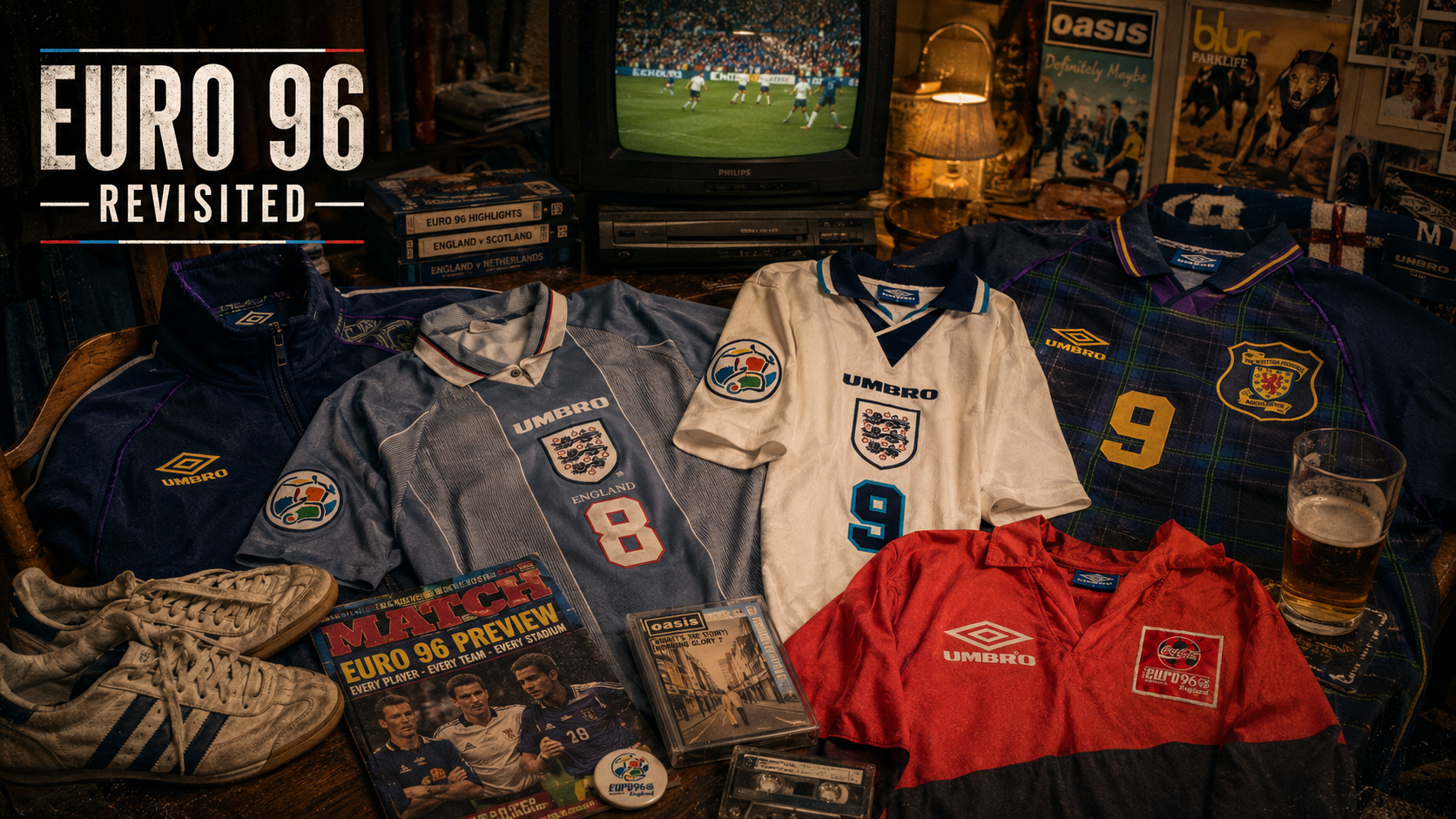
Euro 96 was the moment the football shirt stopped being just sportswear and became identity, fashion, memory and culture all at once.
Key Takeaways
- Umbro gave Euro 96 its most enduring visual language, from England’s white home shirt to the controversial grey away kit.
- The tournament arrived just as football shirts were moving beyond the stadium and into everyday British youth culture.
- Scotland’s tartan kit and Croatia’s Lotto checkerboard showed how visually distinct international football still was before template culture took over.
- Euro 96 kits still matter because they carry memory, atmosphere and emotion, not just design value.
The Summer Football Started Dressing Differently
Before Euro 96 became memory, it became texture.
White Umbro drill tops hanging off beer-garden chairs. Navy parkas zipped halfway against an English summer that never fully trusted the sun. Adidas Gazelles sticking to pub carpets soaked in lager by half-time. St George’s Crosses draped from upstairs windows beside hanging baskets and fading paintwork. The smell of cigarettes, fried onions, wet pavements and spilled Carlsberg. Football shirts worn nowhere near football grounds.
That was the shift.
By the summer of 1996, English football had started dressing differently, and in doing so, it had started presenting itself differently too.
The transformation was subtle at first. A decade earlier, football culture in England had still largely carried the visual residue of decline: concrete terraces, oversized police lines, decaying infrastructure, aggressive tribalism and the grim practicalism of 1980s sportswear. Shirts were functional objects. Cheap nylon. Heavy cotton. Something you wore to the match, then put away afterwards. Football itself still occupied a strange place in British public life, simultaneously loved and looked down upon. Popular, but not aspirational.
Euro 96 changed that balance.
Not alone, and not instantly, but decisively.
For one summer, football stopped looking industrial and started looking cultural.
The tournament arrived at precisely the right historical moment. Britpop had already blurred the lines between terrace culture, music culture and fashion culture. The Premier League had begun repackaging football as entertainment rather than civic endurance. Satellite television saturated the game in richer colour, cleaner graphics and cinematic framing. Lad magazines turned footballers into lifestyle figures. Music television made sportswear fashionable. The pub became both stadium and stage set.
And sitting quietly in the middle of all of it was Umbro.
Not loud in the way Nike would later become. Not futuristic in the way Adidas often presented itself. Umbro’s genius in the mid-1990s was subtler than that. The brand understood something before almost everyone else did: football shirts were becoming emotional objects.
Not just merchandise. Not simply team identifiers.
Identity.
The England home shirt from Euro 96 did not look revolutionary in isolation. White base. Navy trim. A touch of turquoise folded into the collar and sleeve detailing. Yet under the floodlights, on CRT televisions, and inside packed pubs, it carried a strange kind of warmth. The shirt looked modern without looking synthetic. Relaxed without looking careless. Patriotic without becoming militaristic. Even the fit mattered. The silhouette was boxier, looser, easier to wear away from football itself. It looked natural with jeans and trainers. Natural with a pint in hand. Natural on stage at a gig.
That mattered more than people realised at the time.
Because Euro 96 was arguably the first major international tournament where supporters wanted to dress like football culture even when football was not happening.
The game escaped the stadium aesthetically.
You could see it everywhere that summer. Teenagers wearing oversized training tops into town centres. Blokes pairing football shirts with denim jackets and desert boots. Umbro logos appearing in music magazines, nightclub queues, record shops and student bars. Liam Gallagher walking onstage at Maine Road in Umbro drill wear would later become one of the defining visual moments of the decade, but the conditions for that crossover already existed long before he zipped the top to his chin.
Football had become culturally wearable.
And once that happened, the meaning of the football shirt changed forever.
Euro 96 now survives partly because of goals, commentary lines and penalties. But it also survives because the tournament looked unforgettable. The kits. The colours. The oversized collars. The geometric patterns. The goalkeeper shirts that looked almost lawless in their design. Every team seemed visually distinct. Every broadcast frame carried texture and personality. Before template culture flattened football aesthetics into global uniformity, Euro 96 still allowed teams to look like places rather than marketing departments.
Umbro understood that instinctively.
Their kits were not minimalist. They were not sterile. They carried detail. Repeated diamond taping. Embroidered textures. Layered fabrics. Typography designed to breathe under stadium lights. The shirts felt authored rather than manufactured.
That distinction is important because Euro 96 was not merely the moment football became fashionable.
It was the moment football started understanding the power of its own image.
The Double Diamond Philosophy
Long before football shirts became luxury collaborations, archive pieces, or high-priced collectibles sold through carefully lit launch campaigns, Umbro understood something fundamental about the sport that many of its competitors still treated as secondary.
Football was visual theatre.
Not just ninety minutes of athletic performance, but colour, silhouette, movement, symbolism and identity. Shirts were not passive garments sitting underneath the action. They were part of the emotional architecture of the spectacle itself.
That understanding shaped everything Umbro produced in the mid-1990s.
Founded in 1924 by Harold and Wallace Humphreys, Umbro had always positioned itself differently from continental competitors. Adidas often projected precision and sporting authority. Nike, once it entered football aggressively later in the decade, would lean into rebellion, aggression and cinematic cool. Umbro’s identity sat somewhere else entirely. It felt closer to craftsmanship. Closer to tailoring. More intimate with the rhythms and rituals of British football culture.
Even the logo reflected that philosophy.
The “Double Diamond” was not simply a corporate mark stamped onto polyester. It became a repeating geometric language that ran through the company’s entire visual identity during the 1990s. Diamonds appeared woven into jacquard fabrics, repeated along sleeve taping, embedded inside tonal patterns, and layered subtly into collars and trim work. Umbro kits were designed to reward attention. The closer you looked, the richer they became.
This mattered because football itself was changing technologically.
The rise of satellite broadcasting transformed the visual relationship between supporter and match. Football was suddenly brighter, more saturated, more cinematic. Floodlights bounced differently off synthetic fabrics than they had off older cotton shirts. Close-up camera work captured texture and stitching in ways that would have been impossible only a few years earlier. Umbro recognised that shirts no longer needed merely to function physically on the pitch. They also needed to perform visually on television.
Their response was geometric modernism.
The influence of late-1980s Adidas aesthetics is impossible to ignore here. The angular dynamism of the Netherlands 1988 kit or Germany’s Italia 90 shirt had already established geometry as football’s new design language. Umbro absorbed those lessons but softened them into something distinctly British. Their patterns felt less rigidly engineered and more organically woven into the garment itself. Instead of overwhelming the eye, Umbro preferred layering and texture. Tone-on-tone repetition. Diamond shadowing. Embroidered rhythm rather than visual assault.
The effect under stadium lighting was remarkable.
An Umbro shirt from 1996 rarely looked flat. The fabric shifted as players moved. Shadows formed inside the weave. Crests emerged subtly through changing camera angles. Typography appeared deeper because of surrounding texture. On modern ultra-HD broadcasts, many contemporary shirts look hyper-clean but oddly lifeless, reduced to simplified blocks of colour designed for digital clarity. Umbro’s Euro 96-era shirts felt alive because they embraced imperfection, depth and movement.
Equally important was the fit.
The 1990s silhouette now appears oversized through modern eyes, but at the time it represented liberation from the tighter, restrictive uniforms of previous eras. Umbro shirts draped rather than clung. Sleeves sat lower. Collars felt substantial. Players looked comfortable inside them. Supporters could wear them naturally outside football spaces without feeling as though they were dressed for exercise.
That crossover was critical.
Umbro’s design team may not have explicitly set out to invent football fashion, but they instinctively understood the cultural moment they were entering. The rise of terrace casual culture, Britpop, rave aesthetics, and sportswear-as-streetwear created an environment where technical athletic clothing suddenly possessed social value far beyond the pitch. Umbro’s softer tailoring and tactile detailing made that transition possible. Their shirts looked believable in pubs, clubs, record shops and music venues because they carried enough design sophistication to escape pure functionality.
This was especially visible in the training wear.
The famous Umbro drill tops of the era now feel almost mythical in retrospect: thick cotton construction, stacked diamond embroidery, broad collars and rich colour blocking that balanced sportswear practicality with effortless cool. They did not look over-designed. They looked lived-in before they had even been worn. That authenticity became their power.
And authenticity was everything in the mid-1990s.
Football supporters could immediately detect when brands tried too hard to appear fashionable. Umbro rarely suffered from that problem because the company still felt rooted in football itself. At the launch of the Premier League in 1992, Umbro supplied kits to a remarkable number of clubs in the new division, giving the Double Diamond a level of visibility that would be hard to imagine in today’s more fragmented sponsorship world.
By the time Euro 96 arrived, Umbro had become something more significant than a manufacturer.
It had become the visual language of football’s cultural rebirth.
The Umbro Cup and the Prototype Summer
By the summer of 1995, England faced a strange problem.
The nation was preparing to host the biggest football tournament it had staged since 1966, yet the national team itself existed in a kind of competitive limbo. Because England automatically qualified for Euro 96 as hosts, Terry Venables’ side had no meaningful qualification campaign to sharpen its identity or sustain public momentum. There were friendlies, experimentation, flashes of promise, but little narrative coherence. The team needed opponents, stakes, atmosphere and visual presence.
Umbro saw opportunity where others saw inconvenience.
The result was the Umbro Cup.
Played in June 1995 and featuring England, Brazil, Sweden and Japan, the tournament has largely faded from mainstream football memory, overshadowed by the emotional force of Euro 96 itself. Yet in retrospect it feels enormously significant, almost like a prototype version of the following summer. Not simply tactically or atmospherically, but aesthetically.
The Umbro Cup was effectively a controlled branding laboratory.
Everything about it carried the fingerprints of a company beginning to understand football as immersive visual culture. The kits, presentation, typography, colour palettes, sponsorship integration and television imagery all pointed toward a more stylised future. Umbro was no longer merely dressing football. It was shaping how football looked, felt and remembered itself.
England’s shirts during the tournament acted as transitional objects between the older early-90s aesthetic and the fully realised Euro 96 identity. The home kit remained recognisably traditional, but subtle shifts were already visible. Repeating diamond motifs ran vertically through the fabric. Tonal detailing created movement across the shirt surface. The crest sat inside a more carefully balanced visual composition. Even the collars felt more deliberate, broader and softer, designed as much for visual framing as athletic utility.
Under summer floodlights, the shirts seemed textured rather than flat.
That distinction mattered enormously in the age of CRT broadcasting. Umbro understood that television softened and blended colours differently than direct daylight. Tonal jacquard patterns became richer on screen. Geometric detailing emerged gradually through movement and camera angle. Shirts almost shimmered into focus rather than simply existing as blocks of colour.
Brazil’s kits perhaps demonstrated this philosophy most clearly.
Umbro approached the Brazilian national identity with remarkable confidence. The famous yellow home shirt incorporated embossed detailing referencing the Brazilian federation crest, while the blue away shirt layered visual symbolism into the weave itself. Flags, lettering, geometric textures and tonal transitions combined without overwhelming the eye. The kits looked celebratory rather than clinical. They carried movement even while static.
That became one of Umbro’s defining strengths in the mid-1990s.
Most football shirts before this era had effectively functioned as uniforms. Umbro increasingly treated them as environments.
The Umbro Cup also revealed how aggressively the company had expanded its global reach. Though still fundamentally associated with British football culture, Umbro in the mid-90s possessed remarkable international influence. Inter Milan. Lazio. Napoli. Brazil. England. Scotland. Ireland. The brand occupied a unique space between local authenticity and global visibility. Unlike Nike, which often imposed a strong corporate identity onto teams, Umbro seemed more interested in adapting itself to national personality.
That sensitivity became crucial during Euro 96.
The tournament would later feel visually memorable partly because the teams still looked culturally distinct from one another. Umbro’s approach encouraged that individuality rather than flattening it into template uniformity. Scotland looked unmistakably Scottish. England looked unmistakably English. Ireland carried its own tonal identity. Even the typography felt bespoke.
The Umbro Cup previewed that entire philosophy one year earlier.
There is something else striking about the footage now, viewed three decades later.
The atmosphere feels transitional.
Not quite the decaying football culture of the 1980s anymore, but not yet the hyper-commercial modern spectacle that would dominate the 2000s either. The crowds wear football clothing casually but not self-consciously. Advertising hoardings still feel secondary to the football itself. The broadcasts retain warmth and grain. The kits appear oversized, expressive, human.
Football still looked touchable.
That sensation would become central to the mythology of Euro 96. But the emotional groundwork had already been laid during the Umbro Cup. In many ways, the summer of 1995 was the rehearsal dinner for football’s great mid-90s reinvention.
By the following year, the entire continent would be watching the finished product.
White, Grey, and the Colour of Emotion
Football kits are rarely remembered neutrally.
They absorb emotion too easily for that.
Victories stain them with immortality. Defeats trap them in melancholy. Certain shirts become inseparable from specific afternoons, specific commentaries, specific rooms full of shouting strangers. Over time, supporters stop remembering the garment itself and start remembering how the garment made the moment feel.
No tournament demonstrates that psychological process more clearly than Euro 96.
Umbro arrived at the competition with two England shirts that could not have aged more differently, yet together they now form one of the defining visual pairings in modern football culture. The white home shirt became the image of hope. The grey away shirt became the image of heartbreak.
Both became iconic for entirely different reasons.
The White Shirt
At first glance, England’s Euro 96 home kit seemed relatively conservative.
White base. Dark trim. Traditional symmetry. Nothing overtly radical. Yet the closer you looked, the more deliberate the shirt became. Umbro threaded subtle turquoise detailing through the collar and sleeve work, introducing a softer visual energy that separated the kit from earlier England designs. The colour choice mattered because turquoise felt contemporary in 1996. It belonged to the wider visual language of the decade: music television graphics, nightclub aesthetics, sportswear catalogues and the fading influence of rave culture.
The shirt looked modern without appearing futuristic.
That balance was difficult to achieve.
Many football kits of the era now appear trapped inside their decade, overwhelmed by excessive experimentation or garish colour combinations. England’s home shirt avoided that fate because Umbro understood restraint. The detailing enriched the shirt rather than dominating it. Tonal textures emerged under movement. The oversized collar framed faces naturally on television. Even the famous central crest placement subtly altered the emotional geometry of the design. The shirt felt open and optimistic.
And optimism was exactly what England needed.
The national team entered Euro 96 carrying decades of psychological baggage. “Thirty years of hurt” had already become national shorthand by the time the tournament began. Yet the visual identity of the team refused to lean into militarism or aggression. There was no attempt to present England as intimidating conquerors. Instead, the shirt looked approachable. Hopeful. Slightly vulnerable even.
That vulnerability became part of its power.
As England progressed through the tournament, the white shirt transformed into a collective emotional canvas. Gazza’s goal against Scotland. Shearer’s dominance against the Netherlands. The eruption of Wembley. The delirium of pubs and beer gardens and city centres. The shirt stopped being simply sportswear and became social fabric, something woven directly into the atmosphere of the summer itself.
It looked perfect under floodlights.
That detail sounds superficial until you revisit the footage. The whiteness of the shirt glowed softly on CRT broadcasts, while the turquoise accents prevented the image from appearing flat or sterile. Umbro had designed a shirt that television loved.
Three decades later, it remains one of the few England kits capable of triggering instant emotional recall across generations.
Not because it was revolutionary.
Because it felt emotionally correct.
The Grey Shirt
Then came the away kit.
Officially designated “Indigo Blue” by Umbro, the shirt was interpreted by almost everyone else as grey. Not silver. Not charcoal. Grey. Flat, muted, strangely lifeless at first glance. In a football culture still heavily conditioned toward bright away colours and traditional red alternatives, the reaction bordered on confusion.
Supporters mocked it openly.
Parents refused to buy it for their children. Pundits questioned whether players could even see each other properly wearing it. The timing could hardly have been worse. Only weeks earlier, Manchester United had abandoned their own grey Umbro away shirt at half-time during a chaotic defeat to Southampton after Alex Ferguson famously complained his players could not pick each other out on the pitch.
The idea of England arriving at a home European Championship wearing grey felt absurd to many people.
But Umbro’s thinking was more sophisticated than it initially appeared.
The away shirt was designed not merely as sportswear, but as lifestyle clothing. Something supporters could wear with denim, trainers and jackets away from football itself. The colour palette reflected broader mid-90s fashion trends where muted industrial tones had begun replacing the fluorescent excess of the late 1980s and early rave era. In modern language, Umbro were effectively trying to create a football-fashion crossover piece before football-fashion crossover culture truly existed.
The public laughed.
Then quietly bought it anyway.
As the tournament progressed, demand for the shirt surged. The shirt’s oddness became its attraction. It looked unlike anything else at the tournament. Oversized, slightly melancholy, strangely cool. It carried the emotional awkwardness of England itself.
And then Germany happened.
The semi-final at Wembley permanently altered the meaning of the shirt. From the moment Gareth Southgate’s penalty was saved, the grey kit ceased being a curious fashion experiment and became something far heavier emotionally. It absorbed disappointment permanently into its fabric.
That is the strange psychology of football nostalgia.
Supporters rarely treasure only the shirts associated with triumph. Often the most beloved kits are the ones connected to pain, because pain fixes memory more securely than success ever can. The grey Umbro shirt became armour for a generation raised on beautiful near-misses. A visual shorthand for hope collapsing gently into silence.
Its emotional legacy deepened over time.
Today, the shirt is treated almost reverentially within football culture. Rare originals sell for extraordinary prices. Designers reference it constantly. Younger supporters who never watched Euro 96 still recognise it instinctively. What was once mocked as colourless and uninspiring now feels impossibly sophisticated in retrospect.
Perhaps because it captured something true about England in 1996.
The white shirt represented who the country wanted to be.
The grey shirt represented who it feared it still was.
Scotland, Croatia, and the Last Tournament Before Templates
One of the reasons Euro 96 still feels visually alive is because every team appeared to arrive from a different footballing universe.
Modern international tournaments often blur together aesthetically. Manufacturers recycle silhouettes, collars, sleeve structures and panel construction across multiple nations, changing only colour palettes and crests. Contemporary kits are cleaner, sharper, more technically advanced, but also strangely interchangeable. Teams frequently look licensed rather than authored.
Euro 96 belonged to the final period before that homogenisation fully took hold.
The tournament still allowed national identity to exist visually.
Umbro played a central role in that distinction, particularly among the home nations, but the wider tournament benefited from a broader mid-1990s design culture where experimentation remained encouraged and individuality still mattered commercially. Brands had not yet fully surrendered to global streamlining. Football shirts still carried local personality.
Scotland’s kits perhaps demonstrated this best.
If England’s shirts reflected modernisation and crossover cool, Scotland’s visual identity leaned deliberately into heritage without becoming nostalgic or conservative. Umbro’s Scotland home shirt combined deep navy tones with a bespoke tartan pattern woven directly into the fabric, creating one of the most distinctive international kits of the decade. The tartan was not decorative wallpaper. It made the shirt feel tied to place, culture and belonging.
That decision carried cultural intelligence.
The shirt managed to feel proudly Scottish without collapsing into caricature. Purple detailing referenced the thistle subtly rather than theatrically. The geometric layering inside the weave gave the fabric movement under stadium lighting. Even the yellow numbering created warmth against the darker base tones. The shirt looked ceremonial and modern simultaneously.
It also looked unmistakably 1996.
That balance now feels difficult to recreate because contemporary football aesthetics often fear sincerity. Euro 96-era kits embraced symbolism openly. Scotland looked like Scotland. England looked like England. Ireland looked like Ireland. The shirts communicated place, culture and temperament before a ball had even been kicked.
Croatia’s arrival amplified that sensation further.
Although manufactured by Lotto rather than Umbro, Croatia’s checkerboard kit became one of the defining visual moments of the tournament precisely because it refused neutrality. The bold red-and-white pattern looked almost confrontational in its individuality. It announced Croatia’s first appearance at a major international tournament with total visual confidence.
The kit mattered beyond aesthetics.
Croatia in 1996 represented a newly independent footballing identity emerging from the violent fragmentation of Yugoslavia. The shirt therefore functioned not merely as sportswear, but as geopolitical symbolism. Every television frame carried emotional and historical weight far beyond football itself. Euro 96 was still close enough to the political fractures of early-1990s Europe that national kits retained genuine representational power.
That wider context helped the tournament feel visually richer.
Germany’s Adidas shirts balanced structure and restraint, using subtle flag detailing and geometric panel work that reflected the nation’s broader design culture. France’s kits combined elegance and theatricality through bold striping and oversized collars. The Netherlands glowed in saturated orange beneath floodlights. Even goalkeeper shirts seemed liberated from aesthetic restraint entirely. David Seaman looked dressed for a futuristic nightclub one evening and a packet of sweets the next. Peter Schmeichel’s Hummel designs bordered on psychedelic abstraction.
None of it felt accidental.
Euro 96 arrived during a uniquely experimental phase in football design history. Sportswear brands had started recognising football’s expanding commercial power but had not yet fully standardised production methods. Designers still possessed room for eccentricity, local references and visual storytelling. Shirts were allowed personality.
And personality matters enormously in memory formation.
Supporters often claim they miss the football of the 1990s, but frequently what they truly miss is visual distinctiveness. Modern tactical sophistication may be higher, athletic standards stronger, and broadcasting cleaner, yet many contemporary tournaments struggle to generate the same aesthetic permanence because the visual ecosystem feels too controlled.
Euro 96 still breathed visually.
The kits were oversized. The colours occasionally strange. The typography dramatic. The collars excessive. The silhouettes inconsistent. But all of that imperfection created texture. Human texture.
Umbro understood this instinctively.
Their shirts never aimed for minimalist timelessness in the modern sense. Instead, they pursued emotional recognisability. You could identify teams instantly from partial glimpses. A sleeve. A collar. A pattern beneath floodlights. The designs trusted memory rather than resisting it.
That trust now feels almost radical.
Because Euro 96 may have been the last major international tournament where football kits still looked like cultural artefacts before they became global products.
Typography Under Floodlights
The numbers mattered.
Not statistically. Visually.
One of the quiet revolutions of 1990s football aesthetics was the realisation that typography could shape memory almost as powerfully as goals themselves. Before the modern era of flattened branding systems and digitally optimised minimalism, shirt numbers still carried texture, personality and theatricality. They were designed not just to identify players, but to complete the visual identity of the shirt itself.
Euro 96 now feels inseparable from its typography.
Alan Shearer’s number 9. Gascoigne’s lettering beneath oversized shoulders. The sharp yellow numbering on Scotland’s navy tartan. Germany’s precise Adidas geometry. Croatia’s dramatic contrast against checkerboard red and white. Even before faces became recognisable on grainy CRT broadcasts, the numbers announced identity.
Umbro understood that typography was part of the spectacle.
Designers during the mid-1990s treated numbering as a fully integrated aesthetic component rather than an administrative afterthought. Tournament regulations were still relatively flexible compared to the rigid commercial standardisation that would later dominate football branding. That freedom allowed manufacturers to experiment with gradients, shadows, outlines, dimensional effects and proportion.
The result was typography designed for atmosphere.
Modern shirt fonts are usually engineered for digital clarity. They must remain readable across ultra-HD broadcasts, social media graphics, mobile clips, fantasy football apps and betting integrations. Simplicity dominates because simplicity scales cleanly across platforms.
Euro 96 existed in a different visual ecosystem.
Shirt numbers were built for floodlights, distance and analogue television. Designers anticipated how colours would bleed softly through CRT screens, how shadows would deepen beneath stadium lighting, and how movement would distort shapes across lower-resolution broadcasts. Subtle gradients and layered outlines gave numbers depth that modern fonts often lack entirely.
That depth created emotion.
A Shearer sprint looked different because the number itself carried physical presence. The typography moved with the player rather than sitting mechanically on top of the fabric. Numbers appeared embedded into the shirt’s identity instead of floating separately from it.
This mattered particularly in an era when television itself still possessed texture.
Modern broadcasts flatten visual information through extreme sharpness. Euro 96 broadcasts softened and blended images naturally. Scanlines, phosphor glow and lower resolution created accidental visual warmth. Umbro’s shirts worked beautifully inside that environment because the designs embraced layering rather than resisting it. Tonal detailing emerged slowly through camera movement. Typography breathed beneath floodlights. Shirts revealed themselves gradually.
Football still looked atmospheric rather than hyper-exposed.
There was also something psychologically important about the scale of 1990s kit typography.
The numbers were larger. Bolder. Slightly theatrical. They carried echoes of American sports aesthetics without fully surrendering to them. Player names arched dramatically across shoulders. Sleeve proportions exaggerated movement. Even substitutions felt visually significant because different silhouettes entered the screen.
That theatricality helped football become more televisual.
The Premier League era had already begun pushing football toward cinematic entertainment, and Euro 96 accelerated the process. Broadcasters framed players more aggressively. Close-ups lingered longer. Goal celebrations became emotional set pieces. Typography therefore evolved alongside television production itself. Kits needed to communicate instantly through rapidly expanding visual media.
Umbro’s detailing gave their shirts unusual screen intelligence.
Take England’s home shirt. The turquoise accents around the numbering softened the starkness of the white fabric under floodlights. Scotland’s yellow numbers against navy tartan created natural warmth on analogue broadcasts. Even the controversial grey England away shirt benefited from strong dark numbering that gave shape to an otherwise muted palette.
Nothing felt accidental.
This attention to detail partly explains why Euro 96 kits still reproduce so powerfully in memory. The designs were not merely seen. They were absorbed repeatedly through the rhythms of analogue television. Supporters watched the same highlights endlessly on VHS tapes, sports bulletins and late-night reruns. Typography became embedded into emotional recall.
People do not simply remember Gascoigne’s goal against Scotland.
They remember the way the number 8 moved as he swivelled.
That distinction matters.
Because Euro 96 belonged to the final era before football aesthetics became over-managed by corporate consistency. Designers still worked like craftspeople rather than brand technicians. Typography could still possess eccentricity. Shirts could still feel specific to a tournament rather than universally transferable across endless marketing environments.
Under modern 4K clarity, many contemporary football kits look perfect for five seconds and forgettable forever.
Under the softer floodlights of Euro 96, Umbro’s shirts looked human enough to last thirty years.
Liam Gallagher and Football Fashion Before Football Fashion
The photograph now feels inevitable.
Liam Gallagher standing onstage at Maine Road in April 1996 wearing an Umbro drill top, hands behind his back, chin tilted upward, staring into the middle distance like somebody simultaneously bored and invincible. The image has since become one of the defining visual documents of 1990s British culture, endlessly reposted, reprinted and mythologised.
At the time, though, it was genuinely disruptive.
Not because Gallagher wore football clothing. Terrace fashion had already existed for years. Casual culture had long blurred the boundaries between sportswear, designer labels and street identity. What made the Maine Road image culturally explosive was the complete absence of irony.
He wore Umbro like it belonged there.
Not as novelty. Not as postmodern commentary. Not as retro styling. Certainly not as celebrity branding strategy. Gallagher wore the drill top with the same seriousness previous generations reserved for leather jackets or tailored suits. It looked natural on him because football culture and youth culture had finally stopped pretending they occupied separate worlds.
That crossover changed everything.
Before the mid-1990s, football still carried residual social baggage within large sections of British cultural life. It remained associated with provincialism, violence and masculine crudeness. Music culture, particularly indie culture, often positioned itself as more sophisticated or intellectually elevated. Even supporters who loved both worlds frequently treated them as parallel identities rather than overlapping ones.
Britpop collapsed that distinction.
Suddenly football shirts appeared in music magazines. Indie musicians discussed formations and title races openly. Terrace chants bled into live gigs. Bands performed inside football stadiums not as detached global megastars, but as local tribal figures deeply connected to place and club identity.
And visually, Umbro sat right in the middle of the convergence.
The company’s training wear accidentally possessed perfect timing. The oversized drill tops, thick cotton construction, stacked diamond embroidery and broad collars aligned seamlessly with wider mid-90s youth aesthetics. Baggy silhouettes from rave culture. Sportswear comfort. Casual layering. Mod influences. Terrace masculinity softened slightly through music-scene vulnerability.
The clothes looked lived-in immediately.
That authenticity separated Umbro from more aggressively stylised competitors. Nike would later dominate football fashion through cinematic aspiration and urban cool. Umbro’s power came from familiarity. Their clothing looked like it belonged to actual football supporters because it did.
The Maine Road drill top itself became almost mythological after Gallagher wore it onstage. Supposedly acquired from Manchester City’s dressing rooms through unofficial means, the top represented something larger than simple merchandise. It symbolised the collapse of old cultural hierarchies. Football clothing no longer needed permission from fashion culture to become fashionable.
It simply became fashionable on its own terms.
That distinction shaped the next thirty years of menswear more than many people realise.
Today, football shirts appear routinely at Fashion Week shows, luxury collaborations and streetwear launches. Designers reference terrace culture constantly. Sportswear dominates mainstream casual fashion globally. But in 1996, none of this felt guaranteed. Football still existed slightly outside respectable cultural spaces. Gallagher dragging Umbro onto the biggest stages in Britain helped legitimise an aesthetic world millions already inhabited privately.
The important thing is that it never felt manufactured.
Britpop often gets retrospectively flattened into marketing shorthand now: Union Jacks, magazine covers, laddishness, “Cool Britannia.” But the reason football fashion crossed over so successfully during this era was because it emerged organically from shared social environments. Pubs. Clubs. Terraces. Student bars. Record shops. City centres. The same people listening to Oasis on Friday night were standing on terraces Saturday afternoon.
The clothing reflected that continuity naturally.
Umbro understood the mood intuitively. Their garments balanced performance practicality with enough visual confidence to survive outside football spaces. Drill tops looked credible with jeans. Training jackets worked inside pubs. Oversized shirts fitted seamlessly into the looser silhouettes dominating youth fashion generally.
Football had stopped being costume.
It had become style.
There is also something important about the masculinity of the moment.
The mid-1990s “New Lad” era now attracts understandable criticism for its laddishness, casual sexism and performative boorishness. Yet aesthetically, it also represented a transitional phase where young British men became more comfortable expressing identity through clothing without fully abandoning traditional masculine codes. Football fashion sat perfectly inside that tension.
Umbro clothing allowed emotional affiliation without overt vulnerability.
You could wear club identity publicly. National identity publicly. Sportswear publicly. Yet the look still carried toughness, humour and tribal credibility. The football shirt became one of the few garments capable of expressing belonging without embarrassment.
That emotional function remains powerful today.
People often describe Euro 96 nostalgically because they miss the atmosphere, the optimism, or the football itself. But part of what they truly miss is the feeling that football culture still belonged visibly to ordinary people. Before global luxury branding swallowed the game entirely. Before authenticity became market-tested.
An Umbro drill top in 1996 looked cool because it had not yet been officially declared cool.
That innocence cannot really be recreated now.
Which is precisely why the image of Liam Gallagher at Maine Road still carries such strange emotional weight thirty years later.
Why These Shirts Still Matter
The strange thing about football nostalgia is that it rarely behaves rationally.
Supporters do not simply miss winning.
If that were true, entire generations of England fans would feel almost nothing about Euro 96 at all. The tournament ended in defeat. The country did not lift the trophy. The defining emotional image remains Gareth Southgate walking away from the penalty spot in silence. Yet the shirts from that summer continue to hold extraordinary emotional gravity, not just for people who lived through the tournament, but increasingly for younger supporters who did not.
That persistence tells us something important.
Football shirts survive because they become containers for memory.
Psychologists describe something called the “reminiscence bump,” the tendency for human beings to retain unusually vivid emotional memories from adolescence and early adulthood. Experiences during those years attach themselves more deeply to identity formation. Music, films, clothing, friendships, summers, heartbreaks, routines. Everything feels heightened because the self itself is still being assembled.
For millions of people, Euro 96 landed directly inside that psychological window.
The shirts therefore became fused with much larger emotional landscapes. First pints. First pub tournaments. Teenagers skipping around living rooms after Gascoigne’s goal against Scotland. Parents allowing children to stay up late during summer holidays. The smell of cigarette smoke drifting through packed bars. Walking through city centres flooded with flags and noise and possibility.
The kits absorbed all of it.
That is why nostalgia for Euro 96 rarely feels entirely aesthetic, even when people insist it does. Nobody searches for an original Umbro shirt purely because of jacquard fabric patterns or geometric detailing. Those things matter, but only because they trigger emotional recall. The shirt acts like a visual access point into an older version of the self.
A vintage England shirt is not really fabric anymore.
It is atmosphere.
That emotional connection has only intensified in the modern era because contemporary football often feels psychologically exhausting. Endless content cycles. Transfer speculation every hour. Tactical discourse reduced to social-media warfare. Gambling integrations. Hyper-commercialisation. Performative outrage. Football consumed continuously rather than anticipated patiently.
Against that background, Euro 96-era kits represent something calmer and more human.
Not necessarily better football. Not necessarily purer culture. But slower emotional rhythms.
The shirts belong to the last period before football became permanently online.
That distinction matters enormously in the psychology of memory. Analogue experiences tend to anchor themselves differently because they required effort and scarcity. You waited to see highlights. Waited for magazines. Waited for tournament stickers. Waited for VHS recordings to rewind. The shirts therefore became part of physical life rather than disposable digital content.
Supporters wore them into pubs, onto streets, into parks, onto buses, through entire summers.
The garments aged alongside the memories themselves.
There is also something culturally revealing about which shirts survive nostalgically.
The Euro 96 grey away shirt is the clearest example. Initially mocked, now worshipped. Objectively strange, yet emotionally magnetic. It survives because it carries contradiction inside it. Hope and disappointment. Fashion and failure. Coolness and awkwardness. England itself compressed into polyester.
The shirt feels emotionally honest.
Modern football branding often struggles to create that honesty because everything arrives overly polished from the beginning. Euro 96 kits still carried imperfection. Slightly oversized fits. Odd colour choices. Experimental typography. Excessive collars. They looked like products designed by people rather than committees.
That humanity matters in retrospect.
The explosion of retro football culture over the past decade reflects this hunger clearly. Vintage football retailers now function almost like emotional archivists. Younger supporters search for shirts from eras they barely remember because the designs feel culturally richer than modern equivalents. Older supporters buy them because they represent fragments of lost emotional environments.
Not just football environments.
Life environments.
A 1996 Umbro shirt evokes pubs before smartphones. Television before fragmentation. Summers before permanent connectivity. Football before branding became self-aware. Even the flaws now feel comforting. The shirts crease strangely. Colours fade unevenly. Fabrics bobble with age. None of it reduces their emotional value. If anything, it deepens it.
Wear and tear become proof of life.
And perhaps that is why Euro 96 kits remain so enduringly powerful.
They remind people not merely of football as entertainment, but football as shared social memory. Something physically inhabited together rather than individually consumed through algorithms.
The shirts still matter because they preserve evidence of a world that modern football increasingly struggles to reproduce.
A world where identity still felt touchable.
The Last Beautifully Human Tournament
By modern standards, Euro 96 should probably feel outdated.
The football was often cautious. The pitches occasionally heavy. The broadcasts technically primitive compared to contemporary ultra-HD coverage. Some matches dragged. Some stadiums already looked old-fashioned even then. The tournament existed before social media, before tactical hyper-analysis, before football fully transformed into a permanent global content machine.
And yet almost everything about it still feels emotionally vivid.
That is the paradox at the heart of Euro 96.
The tournament survives so clearly not because it was perfect, but because it was human enough to leave fingerprints behind.
The kits carried imperfections. The broadcasts carried warmth. The shirts looked oversized and textured rather than clinically optimised. Fans wore football clothing awkwardly and naturally instead of strategically styling themselves for cameras. Music, sport, fashion and national identity overlapped messily without yet becoming fully monetised into lifestyle branding.
Football culture still possessed friction.
Umbro’s role inside that world now feels historically enormous.
The company arrived at precisely the right cultural moment with precisely the right aesthetic instincts. Their shirts balanced performance innovation with emotional recognisability. They looked modern without looking detached from football’s roots. They carried enough detail to become memorable and enough softness to become wearable. Most importantly, they understood that supporters did not merely want to watch football anymore.
They wanted to inhabit it.
That shift changed the visual future of the sport.
The football shirt stopped functioning purely as athletic equipment and became something emotionally and culturally loaded. Fashion object. Memory object. National object. Social object. By the end of Euro 96, football clothing no longer belonged solely to terraces or training grounds. It belonged to pubs, gigs, magazines, bedrooms, high streets and youth identity itself.
And no brand represented that crossover more completely than Umbro.
There is a temptation now to romanticise the entire era uncritically. To flatten the 1990s into endless nostalgia: Britpop optimism, pub gardens, VHS grain, oversized collars, “Football’s Coming Home.” Reality was obviously more complicated than that. The decade still carried violence, laddishness, exclusion, political tension and commercial acceleration that would eventually transform football into something far more corporate.
But even acknowledging those contradictions, Euro 96 still feels like a threshold moment.
The last major international tournament before football aesthetics became standardised globally.
The last tournament before template culture.
The last tournament before branding departments discovered how profitable nostalgia itself could become.
You can see the difference immediately when revisiting the imagery now.
Every team looked distinct. Every shirt carried cultural specificity. Goalkeeper kits bordered on absurdity. Typography possessed personality. Broadcasters experimented visually. Nothing felt entirely focus-grouped into submission yet. Football still trusted individuality enough to risk looking strange.
Modern football rarely allows itself that vulnerability.
Today’s kits are cleaner, sharper, more technologically advanced and more commercially efficient. Yet many disappear from collective memory almost instantly because they are designed primarily for scalability rather than emotional permanence. Euro 96 shirts survived because they embraced atmosphere instead of minimising it.
Umbro understood something that now feels almost lost.
People remember texture.
The soft geometric patterns woven into fabric. The strange grey-blue ambiguity of the away shirt. The thickness of a drill top collar. The oversized sleeves moving under floodlights. The yellow numbering against Scotland’s navy tartan. The glow of white polyester on CRT televisions.
Memory attaches itself to details.
Thirty years later, those details still carry emotional charge because they belong to a tournament that felt deeply inhabited rather than endlessly consumed. Euro 96 existed before football became frictionless. Before every moment was clipped, uploaded, debated, monetised and forgotten within hours.
The shirts therefore had time to breathe inside people’s lives.
And perhaps that is the real reason Umbro’s Euro 96 legacy endures so powerfully.
Not because the designs were flawless.
Because they looked and felt like they belonged to real people living through a real summer.
A football shirt hanging in a wardrobe after Euro 96 was never just a football shirt again.
It was proof you had been there when football briefly became culture, fashion, memory and hope all at once.
