


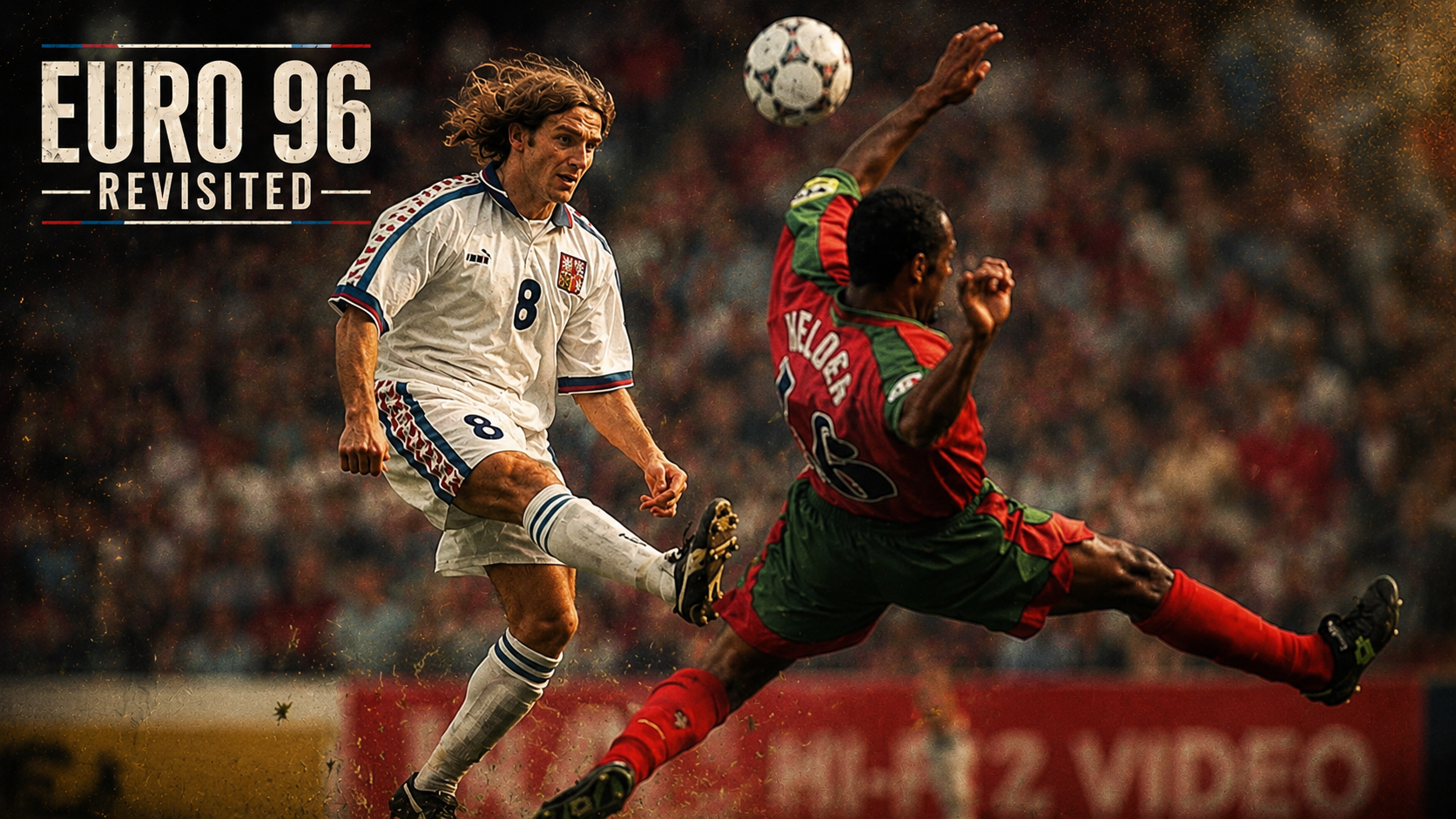
For a fraction of a second, nobody inside Villa Park seemed entirely sure what had happened.
Portugal and the Czech Republic had spent nearly an hour inside a quarter-final that felt tighter than the Birmingham air. The match had not flowed. It had clenched. Attacks ran into tackles. Passing moves collided with bodies. The game had the awkward quality of knockout football when one mistake can become permanent.
Portugal had arrived carrying expectation. The Czech Republic had arrived carrying possibility. Most assumed only one of those things would survive.
Then, in the 53rd minute, the ball found Karel Poborský.
Not near the touchline, where he usually operated. Not isolated against a full-back with grass ahead of him. Instead, he had drifted infield, collecting possession in an area that did not immediately appear dangerous. Several Portuguese shirts stood between him and goal. The move looked ordinary.
His first touch was not perfect. The ball escaped slightly from his control. For most players, that would have been the end of the attack.
Poborský accelerated instead.
A challenge arrived late. Another arrived awkwardly. The ball ricocheted kindly. Suddenly he was through. What had looked crowded a moment earlier now seemed strangely open. Fernando Couto stepped forward. Poborský surged past him. Hélder sprinted across in pursuit.
Now the stadium sensed something. Not a goal yet. Just danger.
The kind of danger that causes thousands of people to rise before they know why.
Poborský drove towards the penalty area. Vítor Baía advanced from his line. The angle narrowed. The obvious options disappeared. Most forwards in that situation would have struck through the ball. A low finish across the goalkeeper. A driven effort towards the far corner. Perhaps a conventional chip.
Poborský chose none of them.
As Hélder launched himself into a desperate slide, the Czech winger glanced up. It lasted barely an instant. Long enough to locate the goalkeeper. Long enough to see the space behind him. Long enough to imagine something nobody else inside Villa Park had imagined.
Then he slid his foot beneath the ball.
Not through it. Beneath it.
The ball climbed.
At first, it appeared to go too high. Then it kept rising. Baía stopped, turned and retreated. His movements contained none of the certainty usually associated with elite goalkeepers. They were the movements of a man trying to solve a problem that had appeared without warning.
Above him, the ball continued its strange ascent.
The remarkable thing about the goal, even now, is the way it seems to suspend time. Most great goals unfold quickly. The shot is struck. The net bulges. The celebration begins.
This one lingered.
Baía waited. Villa Park waited. Even now, when everybody knows the ending, there remains a split second where the mind wonders if gravity might yet intervene.
It never does.
The ball reached its highest point and began its descent. Baía was still scrambling. Hélder was still on the turf. Poborský was watching.
Then the ball dropped beyond the goalkeeper and into the net.
Only then did the stadium understand.
Only then did the noise arrive.
The celebration itself is almost secondary. The real memory is the image. The ball suspended against the Birmingham sky. The goalkeeper backpedalling beneath it. The feeling that something unusual had happened. Not simply a goal, but a goal belonging to a different category.
Years later, supporters would forget countless details from Euro 96. They would forget line-ups. They would forget substitutions. Many would struggle to remember the Czech Republic’s full route through the tournament.
Yet the image endured.
The scoop. The arc. The moment when a football seemed briefly unwilling to come back down.
The Goal That Hid The Footballer
The obvious explanation for why Karel Poborský’s goal survives is that it was beautiful.
That is true, as far as it goes. The finish was audacious. The technique was unusual. The timing was perfect. It arrived in a European Championship quarter-final and carried an unfancied Czech Republic side into the last four of a major tournament.
Football has always remembered moments like that.
But beauty alone does not explain why this goal remains so vivid.
Football history is full of magnificent goals that have slipped into the background. Every season produces volleys, dribbles and long-range strikes that briefly dominate conversation before disappearing into the archive. The sport creates far more great goals than it can possibly remember.
Some survive. Most do not.
The more interesting question is not why Poborský scored the goal. It is why, thirty years later, so many people can still picture it.
That question leads to the deeper story. Poborský’s lob was not only one of the great goals of Euro 96. It became one of the tournament’s defining images. In doing so, it created a strange bargain. The moment that made him famous also obscured much of the footballer who produced it.
For many supporters, Poborský remains frozen at Villa Park. Hair flying, white Czech shirt, right boot under the ball, Baía retreating helplessly towards his line.
That is a powerful form of immortality.
It is also a reduction.
Poborský was not a one-touch footballer. He was a creator, a crosser, a worker, a player of intelligence and width, a man who earned 118 international caps, played for Manchester United, Benfica and Lazio, helped shape one of the great Czech generations, and later produced four assists at Euro 2004.
Yet memory did not choose the full career.
Memory chose the picture.
Football Remembers Pictures First
Supporters often claim they remember tournaments.
Usually, they remember fragments.
They remember scenes, colours, sounds, goals, shirts, misses, celebrations and pauses. They remember the picture before they remember the table. They remember where they were before they remember who came on in the 72nd minute.
Euro 96 was unusually rich in those pictures.
Paul Gascoigne flicking the ball over Colin Hendry before volleying beyond Andy Goram at Wembley, the defining English image of the summer. Davor Šuker delicately lifting the ball over Peter Schmeichel at Hillsborough, a finish that turned Croatia’s arrival into art. Matthias Sammer stepping out of defence with the authority of an old-world libero in a game already moving towards something new. Oliver Bierhoff wheeling away after scoring the first golden goal in the history of a major international final.
The tournament survives less as a complete competition than as a gallery.
That has been part of this series from the start. Euro 96 was the last analogue tournament, a championship experienced through television schedules, newspaper reports, pub conversations and delayed highlights rather than second screens and instant clips. Its images had time to settle. They were not consumed and discarded in the space of a few seconds. They were discussed, replayed, argued over and reimagined.
Gascoigne’s goal became part of England’s emotional summer. Šuker’s became part of Croatia’s football birth as an independent nation. Portugal’s defeat became one chapter in the story of a gifted generation still learning what it might become, as explored in the rise of Portugal’s Golden Generation.
Poborský’s goal sits differently.
It is not anchored to a host nation’s dream. It did not win the final. It was not scored by the tournament’s eventual champions. It did not belong to one of Europe’s grand football powers. It exists almost independently of the match that produced it.
People remember the goal even when they forget the game.
That is rare.
Most famous football moments draw strength from the story around them. Geoff Hurst’s disputed goal matters because England won the World Cup. Marco van Basten’s volley matters because it helped crown the Netherlands in 1988. Zidane’s volley against Bayer Leverkusen matters because it delivered the European Cup to Real Madrid.
Poborský’s lob survives mostly on its own visual power.
The image carries itself.
Before The Image
Long before Poborský became a goal replayed across Europe for three decades, he belonged to a football world that no longer exists.
He was born in 1972 in Jindřichův Hradec, in what was then Czechoslovakia, and grew up away from the glamour of the football capitals that would later chase his signature. When he was a child, the country existed behind the Iron Curtain. Foreign football was watched through fragments, stories and delayed images. The commercial explosion that would turn the game into a global entertainment industry still lay years away.
The footballer who emerged from that environment carried little of the self-promotion that would later become common among elite players.
Even at the height of his fame, Poborský appeared uncomfortable with attention. Reflecting years later on the cultural shock of his move to England, he told The Guardian: “Growing up in Czechoslovakia under communism, nobody was allowed officially to learn English or German, or anything else. Everything felt upside down. My head was spinning.”
That sense of displacement is important. It reminds us that Poborský did not arrive at Euro 96 as a ready-made star built for the new football economy. He was a superb player from a country still creating its own post-Czechoslovak identity.
The Czech Republic itself was barely three years old. The peaceful dissolution of Czechoslovakia on 1 January 1993 had created two new states, but football identity does not simply arrive with a flag. It has to be built, tested and recognised.
The old Czechoslovakia had history. It had reached the 1962 World Cup final and won the 1976 European Championship. The new Czech Republic had possibility, talent and uncertainty.
Euro 96 offered a stage on which those things could become visible.
The squad assembled by Dušan Uhrin was talented but not glamorous. Outside Central Europe, relatively few supporters knew much about Pavel Nedvěd, Karel Poborský, Radek Bejbl or Vladimír Šmicer. Germany, Italy, Spain, England and Portugal attracted greater attention. The Czechs arrived as a curiosity rather than a threat.
Perhaps that helped.
There is a freedom that comes with low expectation. The Czech Republic began the tournament without entitlement. They were not carrying the burden of a nation convinced it had to win. They were not being chased by television narratives. They were learning, in real time, what kind of country and team they might be.
Poborský later remembered the mood simply. The players were “just happy to be there”. Some, by his recollection, had not even properly unpacked their suitcases because they expected their stay in England to be short.
That detail matters. It tells us what Euro 96 looked like from inside the Czech camp. Not a march towards destiny. Not a campaign of certainty. A chance. An opening. A summer to be lived before it disappeared.
Poborský embodied that spirit neatly.
At club level, he had already begun attracting attention. His move to Slavia Prague had transformed his career. In the 1995-96 season, he helped Slavia win the Czech title and reach the UEFA Cup semi-finals. Scouts were beginning to notice. Managers were beginning to ask questions. Yet even then he was not viewed as a future global celebrity.
He was seen as an excellent winger from an emerging football nation.
A useful player. A dangerous player. A talented player.
Not yet an iconic one.
If Euro 96 had never happened, Poborský would still probably have had a distinguished career. He was quick, intelligent and technically gifted. He crossed beautifully. He understood space. Teammates trusted him. Coaches valued him.
What he did not possess was myth.
That arrived suddenly.
Anfield Lit The Fuse
The story of Poborský’s Villa Park goal cannot be separated from what happened nine days earlier at Anfield.
The Czech Republic had lost 2-0 to Germany in their opening match. Their second Group C fixture, against Italy, looked like a dangerous assignment. Italy had reached the World Cup final two years earlier. Arrigo Sacchi’s side had beaten Russia in their opening game. The Czechs appeared close to an early exit.
Instead, Anfield gave them oxygen.
After only four minutes, Poborský cut back from the right and delivered a fine left-footed cross into the Italian penalty area. Nedvěd arrived and scored. Italy equalised through Enrico Chiesa, but Luigi Apolloni’s first-half dismissal changed the shape of the game. Radek Bejbl restored the Czech lead, and Uhrin’s side held on for a 2-1 victory.
It was a collective result, but it also served as an announcement. Poborský was not simply a runner on the right. He could see and deliver. He could alter the emotional temperature of a match with one action.
The Czechs then drew 3-3 with Russia, a wild match saved by Šmicer’s late equaliser. That result pushed them into the quarter-finals and deepened the sense that something unlikely was building.
Their reward was Portugal at Villa Park.
It was the least obvious glamour tie of the quarter-final round. England had Spain. Germany had Croatia. France had the Netherlands. Portugal against the Czech Republic felt quieter, but that was part of its power. It was a meeting between two possible futures.
Portugal represented the future people already expected. Rui Costa, Luís Figo, João Pinto, Fernando Couto and Vítor Baía belonged to a generation that had been praised for years. Their talent had a name before it had a senior international achievement. They were the Golden Generation, and everyone knew what was supposed to come next.
The Czech Republic represented a future still being discovered.
That contrast mattered.
Portugal looked more polished. The Czechs looked more willing to live inside disorder.
The Quarter-Final That Refused To Open Up
Portugal controlled much of the opening period at Villa Park. The ball belonged largely to them. Rui Costa and Figo gave the match a technical authority that the Czechs could not match over long spells. But dominance and comfort are not the same thing.
The Czech Republic were without Nedvěd through suspension, a serious loss to their energy and balance. Uhrin had to find another way through the match. His side stayed compact, accepted long passages without possession and waited for moments when Portugal’s control might leave space behind it.
This was not romantic football. It was practical tournament football.
Poborský later remembered the match as ugly, even “anti-football”. That was not false modesty. It was an honest description of the rhythm. Portugal had quality, but the Czech Republic dragged the game towards friction. Every passing sequence had to fight through bodies. Every attacking idea was made uncomfortable.
At half-time, Uhrin adjusted. Poborský was given freedom to move inside more often rather than remaining attached to the right flank. The logic was simple. If Portugal left spaces during transition, the Czech Republic needed one of their most dangerous players close enough to attack them.
It was not a tactical revolution.
It was a small alteration.
Football history is often shaped by those.
Eight minutes after the restart, Jiří Němec carried the ball forward. Poborský drifted centrally. The pass found him. The touch was loose. Paulo Sousa and Oceano were nearby. Fernando Couto stepped forward. Hélder covered. Baía advanced.
The move should have died at least twice.
It did not.
That was part of Poborský’s gift. He recognised disorder faster than most players. Some footballers thrive when a move unfolds exactly as rehearsed. Poborský had the instinct to see opportunity in a bad touch, a ricochet and a shrinking angle.
Years later, people would remember the finish. What is sometimes forgotten is the decision.
The safe choices were available. A driven shot. A low finish. A conventional chip.
Instead, he chose something stranger.
He slid his foot under the ball and lifted it high over Baía. The execution looked absurdly delicate for a moment created at such speed. The ball rose higher than expected. Poborský later admitted: “It went a bit higher than I wanted. I was afraid it would go over the bar.”
That detail matters. It keeps the goal human. It stops the moment becoming too polished, too inevitable. The player who produced one of the most composed finishes in European Championship history briefly feared he had overdone it.
Even genius can pass through uncertainty.
Portugal spent the rest of the match looking for an equaliser. The Czech Republic defended. Radoslav Látal was sent off late. Time slowed. When the final whistle arrived, the scoreboard recorded a 1-0 win and a place in the semi-finals.
At the time, that felt like the story.
It was not.
The result became a line in the record. The goal became permanent.
Why This One Stayed
The strange thing about Poborský’s goal is that it may have become more famous after Euro 96 than during it.
Not immediately, but gradually. Year after year. Montage after montage. Anniversary after anniversary. Every time the European Championship returned, the image returned with it.
That tells us something about the goal itself, but it tells us more about football memory.
Football does not preserve history fairly. It does not rank the labour of a career with the seriousness of an archive. It is drawn to images that can be replayed, described and recognised in an instant.
Poborský’s lob survives because it has the qualities memory loves.
It is visually clean. It has a clear protagonist and a clear victim. It contains surprise. It contains suspense. It looks unlike most other goals. It lasts long enough for the viewer to understand what might happen, but not long enough for certainty. It is both simple and impossible.
There is also the matter of originality.
Football had seen chips before. It had seen lobs before. It had seen delicate finishes over advancing goalkeepers. But Poborský’s finish was not quite any of those things. It was a scoop, almost vertical at first, less a strike than a piece of invention. The ball did not travel in the way footballs usually travel. It climbed, paused, then surrendered.
That is why the replay still works.
Even when you know the ending, the eye waits for proof.
UEFA’s own retrospective account still describes the goal as the moment that put the Czech Republic into the Euro 96 semi-finals. That is technically accurate, but it understates the memory. Plenty of goals decide knockout matches. Few detach themselves from the match and continue travelling for decades.
In a modern tournament, the clip would be online in seconds. It would be slowed down, memed, clipped from ten angles, pushed through social feeds, praised, argued over and replaced by the next piece of content. In 1996, the goal had room to breathe. Supporters discussed it before they could summon it on demand. They replayed it in conversation before they replayed it on a screen.
That gave the image depth.
It became not merely something people saw, but something they carried.
The Move That Changed The Meaning
Within days of Euro 96 ending, Poborský had become one of the tournament’s most sought-after players.
Sir Alex Ferguson moved quickly. Before the final, Poborský later recalled, Ferguson visited the Czech team’s hotel. “He asked me if I wanted to move to Manchester United and obviously I answered yes,” Poborský said. “As soon as he heard my answer, he left.”
The transfer was completed soon afterwards. From the outside, it looked like the natural next chapter.
The star of Euro 96 joining England’s biggest club.
Yet the reality was more complicated.
Poborský arrived at Old Trafford carrying the memory of Villa Park. Supporters expected the man from the highlights reel. The player whose first touch in their imagination was not a cross, a pass or a run, but a ball lifted over Vítor Baía. They expected magic to repeat itself.
Instead, they got the real player.
A professional. A creator. A wide footballer whose value often appeared at the end of someone else’s finish.
Over the course of his international career, Poborský scored only eight goals in 118 appearances. That statistic surprises people only if they have allowed the lob to define him. Goals were never the centre of his game. Service was. Width was. Decision-making was. “Which shows my game was based around supporting others,” he later reflected.
That made him useful.
It also made him vulnerable.
Because while Poborský was adapting to England, another story was unfolding beside him. David Beckham was becoming David Beckham.
The timing could hardly have been worse.
Both players occupied similar territory on the pitch. Both preferred the right side. Both delivered outstanding crosses. Both could alter the shape of an attack from wide areas. But Beckham was younger, homegrown and increasingly indispensable.
The comparison was not only tactical. It was cultural.
In another decade, the two might have coexisted more easily. In 1997, they were competing for the same position at the precise moment football was beginning to create global celebrities. Beckham became one. Poborský did not. One became a symbol of where the game was going. The other remained closer to the football world from which he had come.
That contrast feels central to Euro 96. The tournament stood between eras. So did Poborský’s Manchester United career.
He had arrived as a star of the last analogue summer, then found himself inside a club helping to build the next football age. Beckham’s rise was not simply a selection problem. It was a sign of the sport’s direction.
Poborský later spoke with clarity rather than bitterness about the situation. “I accepted that Beckham was number one and I was second in line,” he said.
There is no self-pity in that sentence. No melodrama. Just clarity.
He did not want to become a decorative squad member at a famous club. He wanted to play. Regularly. Meaningfully. Somewhere he mattered.
So he left.
That decision is often treated as evidence that his United move failed. The truth is more subtle. Poborský won a Premier League title. He played for Ferguson. He contributed. But he had arrived at a club where the available space closed almost as soon as he walked through the door.
There are moments when two careers briefly intersect and only one can occupy the future.
Old Trafford in 1997 was one of them.
The Career Football Forgot
The most important part of Poborský’s story is not that Manchester United did not quite work.
It is that everything after Manchester United did.
At Benfica, he began to look like himself again. Away from the Beckham comparison, people could see the footballer rather than the famous goal. He became admired for the qualities that had always defined him: width, timing, delivery, intelligence, willingness to carry the ball and the ability to serve forwards before serving himself.
At Lazio, he entered one of the most demanding leagues in Europe and produced another moment that deserves a much larger place in football memory. On 5 May 2002, Inter travelled to the Stadio Olimpico needing victory to win Serie A. Poborský scored twice in Lazio’s 4-2 win. Juventus took the title. Ronaldo cried on the bench. Italian football gained an image it has never quite released.
Yet outside Italy, even that intervention rarely follows his name.
The scoop does.
Back with the Czech Republic, Poborský remained central long after the world had filed him away as the man from Villa Park. By Euro 2004, he was no longer the emerging winger with the flowing hair. He was the veteran, the reference point, the survivor.
And he was superb.
That Czech team, featuring players such as Nedvěd, Tomáš Rosický, Jan Koller, Milan Baroš and Petr Čech, was one of the most admired sides of the tournament. Poborský provided four assists, a single-tournament European Championship record he shares with a small group of players. The Czech Republic reached another semi-final. Their football was bold, technical and widely admired.
For Poborský, it should have expanded the memory.
Instead, it became a footnote.
That is the central unfairness of his legacy. He spent the decade after Euro 96 proving he was not a one-moment player. Football watched, admired him in places, benefited from him, then returned to the image it already preferred.
Benfica faded. Lazio faded. Euro 2004 faded.
The ball above Baía remained.
The Image Won
There is a temptation to call this an injustice.
In some ways, it is.
A career of hundreds of professional matches should not be reduced to a few seconds. One hundred and eighteen international appearances should carry weight. A player who shaped two major Czech tournament runs, played in England, Portugal and Italy, and returned home with status and respect deserves a broader memory than one highlight.
But football does not work like that.
Supporters do not preserve history like archivists. They preserve it like storytellers. They keep the parts that can be passed on. The turn. The save. The miss. The celebration. The goal.
That is not always fair, but it is human.
Poborský’s lob has survived because it is easy to carry. You can describe it in a sentence. You can picture it before the footage begins. A Czech winger. Villa Park. Baía off his line. A scoop. A ball hanging in the sky.
A full career is harder to hold.
It has texture, contradiction, form, injury, adaptation, disappointment, recovery and labour. It does not fit neatly into a montage. It requires attention. It asks the viewer to care about what happens after the myth has been born.
Football is often poor at that.
It loves becoming aware of a player. It is less patient with understanding him.
Poborský’s career after Euro 96 was not a decline from one great moment. It was the proof of what the moment had only briefly revealed. The imagination in that finish was not a trick detached from the rest of his game. It came from the same football brain that made him such an effective creator. The same ability to see a possibility before others had recognised it. The same comfort with speed, angles and risk.
The lob did not misrepresent Poborský.
It compressed him.
That is both the beauty and the burden of it.
The Man After The Memory
In 2016, Karel Poborský nearly died.
A severe brain infection left him hospitalised, isolated and seriously ill. “If I arrived at the hospital one day later than I did, this interview would not happen,” he later said. “All of my face muscles were paralysed.”
That experience sits strangely beside the lightness of his most famous football moment. The man remembered for making the ball float was forced to confront something brutally physical. Illness. Fear. Survival. The body refusing to obey.
By then, Poborský had long since returned home. The hair that once flowed behind him at Villa Park had turned grey. The stadiums had become smaller. The noise had faded. The questions about the goal remained.
They probably always will.
There is no great tragedy in that. To be remembered at all is a rare football privilege. Thousands of excellent players disappear from public memory entirely. Poborský will not. His name will always unlock a picture.
Yet the better way to remember him is not to push the goal aside. It is to see the career through it.
The finish against Portugal was not random showmanship. It was the most visible expression of a footballer built on awareness. He saw Baía’s position. He saw the defenders’ momentum. He saw the space above the goalkeeper when most players would have seen only the body in front of them.
Vision is not only a quality of passers.
Sometimes it is a quality of finishers.
Sometimes it is the difference between a shot and a memory.
The Ball Came Down
Return to Villa Park now and the goal looks different.
Not because the footage has changed. Not because the outcome has changed. But because we know what followed.
We know that the goal would become part of the permanent visual archive of European football. We know it would appear in countdowns, montages and anniversary features. We know generations of supporters who never watched Euro 96 live would come to recognise it. We know it would become larger than the player, then risk making the player smaller than he was.
That afternoon in Birmingham, none of that existed.
There was only a quarter-final. Only a chance. Only an instinctive decision made in a fraction of a second.
Poborský did not lift the ball thinking about legacy. Footballers almost never do. They think about space, angles, defenders, goalkeepers and possibilities. What gives great sporting moments their power is precisely their lack of self-awareness. The people creating them rarely understand their significance at the time.
Gascoigne could not know that his goal against Scotland would become shorthand for England’s Euro 96. Šuker could not know that his chip over Schmeichel would become one of the defining images of Croatia’s arrival. Bierhoff could not know that his golden goal would forever symbolise both Germany’s victory and football’s brief experiment with sudden death.
Poborský could not know that one touch would follow him for the rest of his life.
Yet that is exactly what happened.
The goal escaped him.
It ceased to belong entirely to the footballer who scored it. It became something shared. A piece of collective memory. One of those rare football images that supporters borrow and carry with them.
That is why it still matters.
Not because it was the most important moment of Euro 96. Not because it won the tournament. Not because it transformed European football. But because it reveals something essential about the way the game is remembered.
Football rarely preserves what was biggest.
It preserves what felt unforgettable.
Karel Poborský spent the next decade proving he was more than one touch at Villa Park.
Football spent the next thirty years proving it preferred the touch.
That is how memory works.
The ball eventually came down.
The image never did.
