


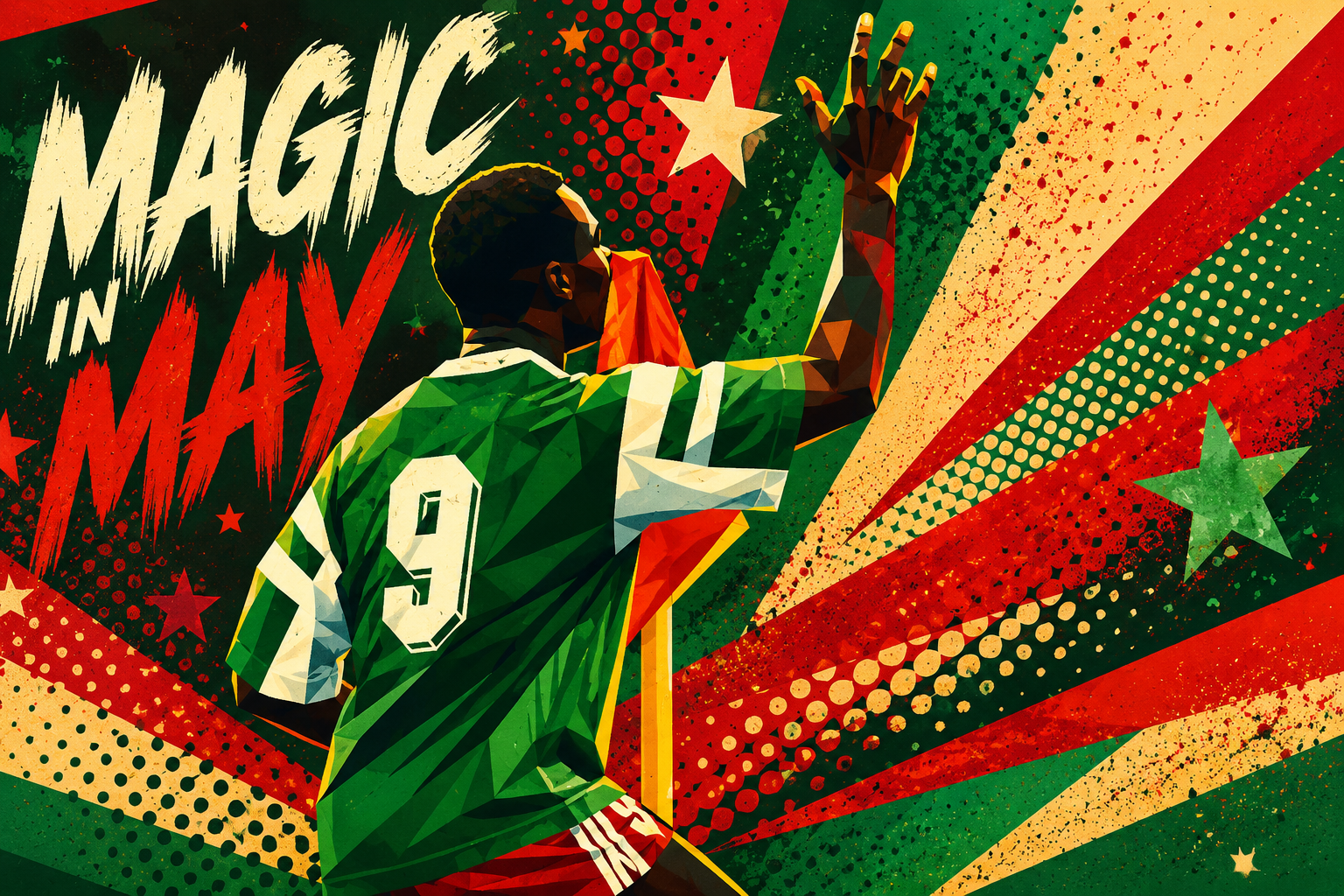
Roger Milla was not a World Cup novelty act, a dancing grandfather or a late-career miracle. He was a ruthless, intelligent forward whose joy made the world underestimate the calculation beneath it. Today is his birthday, which is why May 20th should be celebrated.
The Afternoon the Tournament Started Breathing Again
The air inside the Stadio San Paolo in Naples hung thick and motionless on the afternoon of 23 June 1990. Heat clung to the concrete bowls and refused to leave. Cigarette smoke drifted beneath the upper tiers. Restlessness spread through the crowd in slow waves. Italia ’90, billed as football’s grand Mediterranean celebration, had become something tighter, colder and more suspicious than anyone had imagined.
For 105 minutes, Cameroon and Colombia circled one another in a tense, airless Round of 16 tie that seemed determined not to blink first. The wider tournament had already begun collapsing into itself. Coaches retreated into caution. Defenders strangled matches at birth. Midfielders recycled possession without ambition. The 14th FIFA World Cup was slowly drowning beneath negative football, fear of mistakes and the looming terror of penalty shootouts. Even the noise inside the stadium carried fatigue.
Then Roger Milla arrived.
Not entered. Arrived.
At 38 years old, his legs should have belonged to another era. The accepted logic of elite football said he should already have disappeared quietly into memory, perhaps recalled occasionally as a respected African forward from the French league years. Instead, under the suffocating Neapolitan sky, he began moving through exhausted defenders with the serenity of a man who could still see possibilities nobody else recognised.
In the 106th minute, Milla received possession just inside the Colombian half. One touch. Turn. Acceleration.
Luis Carlos Perea lunged toward him and vanished behind the movement. Gildardo Gómez threw himself into a desperate sliding challenge that arrived half a second too late. Milla’s stride remained upright and strangely graceful, his balance never fully disturbed. As René Higuita rushed forward, Milla opened his body and guided a left-footed finish beyond him with almost casual certainty.
The release inside the stadium was volcanic. Cameroon’s bench exploded onto the touchline. Colombian defenders stood frozen in disbelief. Yet the goal itself was only the beginning.
Three minutes later came the moment that would outlive the tournament.
Higuita, football’s great anarchic goalkeeper, wandered far outside his penalty area to receive a loose clearance. The Colombian had built his reputation on rejecting the conventions of the position. He dribbled when others cleared. He baited pressure where others sought safety. The risk was part of the performance.
Milla knew it.
Rather than sprint wildly toward him, he stalked the space carefully, almost patiently. Higuita dropped his eyes for a fraction of a second as he attempted a drag-back turn. That was enough. Milla struck instantly, stripping the ball away with surgical precision before rolling it calmly into the empty net.
And then came the dance.
Not the clenched fists and chest-thumping masculinity football had become accustomed to. Not the joyless relief of men escaping elimination. Milla jogged toward the corner flag, placed one hand on his hip and raised the other toward the Neapolitan sky. Then his body began to sway gently to the rhythm of Makossa, the music of Cameroon’s coastal cities, broadcast suddenly and unapologetically to billions around the world.
His grin spread impossibly wide across his face.
In a World Cup suffocated by caution, Roger Milla did not merely score goals. He interrupted the emotional atmosphere of the tournament itself. He brought movement to a competition paralysed by fear. He made football feel playful again.
For a few extraordinary seconds in Naples, the oldest player at the World Cup looked like the youngest spirit left in it.
Why the Dancing Grandfather Story Gets Roger Milla Wrong
Because of those images in Naples, history has gradually flattened Roger Milla into something simpler than he truly was.
The collective memory of the wider football world tends to preserve him as a smiling elder statesman who briefly wandered into the spotlight during a romantic summer in Italy. He is remembered dancing by the corner flag, embarrassing René Higuita, grinning through the tournament with the looseness of a man untouched by pressure or consequence. In Western football culture especially, Milla became folklore before he was fully recognised as a footballer.
It is one of the most subtly misleading legacies in modern football history.
Long before Italia ’90 transformed him into a global symbol, Milla had already spent two decades terrorising defenders across Africa and France. He was not a novelty act fuelled by emotion and momentum. He was an elite centre-forward with a frighteningly complete understanding of space, timing and psychological control. By the time he arrived in Italy, he had won the African Footballer of the Year award twice, first in 1976 and again in 1990, separated by a staggering 14-year gap that remains almost impossible to comprehend in the modern game.
Britannica describes Milla as a forward renowned for “impeccable technique and grace under pressure”. That is closer to the truth than the popular caricature. Very few footballers in history have remained tactically relevant across such radically different eras of the sport.
Part of the problem lies in the way football historically consumed African players during the 1970s and 1980s. European audiences often celebrated African footballers aesthetically before they respected them intellectually. Flair was embraced. Improvisation was romanticised. Physicality was endlessly discussed. But sophistication, tactical intelligence and emotional discipline were far less frequently attached to African players in mainstream football discourse.
Milla became trapped inside that imbalance.
His joy was visible. His intelligence was quieter.
The dancing old man by the corner flag became easier to market than the ruthless forward who had spent years dismantling defensive structures in French football. The smile obscured the calculation. The charisma softened the reality that Milla was, at heart, a deeply predatory footballer. He did not survive into elite-level international football at 38 through nostalgia or spirit. He survived because his understanding of rhythm, pressure and defensive psychology was operating several seconds ahead of exhausted defenders.
Even his celebrations contributed to the misunderstanding. Because Milla played with visible happiness, many interpreted him as carefree. Yet there was absolutely nothing carefree about the precision with which he played the game. Beneath the looseness of his movement sat a cold tactical brain shaped by thousands of brutal professional battles in France and Africa.
He played with the freedom of a street footballer and the cruelty of a veteran striker.
That contradiction made him so difficult to categorise.
European football in the late twentieth century preferred neat definitions. South American players were artists. Germans were efficient. Italians were tactical. Africans were instinctive. Milla shattered those simplistic frameworks because he embodied several identities at once. He could overpower defenders physically, manipulate them psychologically and entertain crowds emotionally, often within the same passage of play.
Italia ’90 did not create Roger Milla.
It simply forced the rest of the world to confront a footballer Africa had already understood for years.
Railways, Dust and the Body That Would Not Age
To understand why Roger Milla remained so explosively alive deep into his thirties, it is necessary to look beyond football itself and into the unstable physical world that shaped him.
He was born Albert Roger Miller on 20 May 1952 in Yaoundé, though even his name arrived through accident and improvisation. A clerical error would eventually help turn Miller into Milla, a small administrative twist that somehow suited the unpredictability of the life that followed.
His father worked for the national railroad system, forcing the family into a restless existence that carried them across Cameroon during Milla’s childhood. Towns changed. Landscapes changed. Communities changed. Football remained the constant. Long before he became the smiling symbol of a nation, Milla was absorbing the rhythms, dialects and emotional textures of a country still shaping its own post-colonial identity.
That mattered later.
Cameroon’s national team was never merely a football team in 1990. It was a collision of regions, languages, classes and political tensions held together temporarily by collective belief. Milla understood that instinctively because he had grown up moving through the country rather than remaining fixed inside one corner of it.
His football education was equally fluid.
There were no elite academies waiting for him in the 1960s. No carefully measured training loads. No tactical classrooms. No pristine pitches. He learned football on uneven dirt surfaces in Douala and Yaoundé, often barefoot, improvising constantly against bad bounces, cramped spaces and physical chaos. Control became less about technical perfection and more about bodily adaptation.
That environment shaped the elasticity of his game.
Milla never moved like a mechanically coached European striker. His body operated with improvisational rhythm. He twisted out of contact naturally. He adjusted to awkward angles instinctively. Defenders often struggled to read him because his balance did not appear conventional. Even late in his career, his movements retained the reactive looseness of street football rather than the rigid patterns of academy development.
Yet the most important clue to his longevity may have come away from football entirely.
As a teenager, while playing for Eclair de Douala in Cameroon’s second division, Milla became the Cameroonian schools high jump champion. The significance of this is impossible to overstate when analysing the physical mechanics of his later football career.
The high jump demands explosive hip drive, extraordinary core stability and the ability to generate power while remaining relaxed through movement. Milla carried all of those qualities onto the football pitch. Even approaching 40, he retained unusual spring in his lower body and remarkable coordination through contact. Defenders frequently underestimated his strength because he did not carry the rigid posture of a traditional target man.
But there was another layer to it.
High jump is not simply about athleticism. It is about timing. About waiting fractions longer than instinct tells you to wait before exploding upward. That same delayed rhythm would later define Milla as a striker. He rarely rushed situations. He allowed defenders to commit themselves first. He paused when others panicked.
Many forwards rely on speed.
Milla relied on disruption.
The conditions of his upbringing also helped forge an emotional resilience that became central to his identity. African footballers of his generation travelled through unstable structures constantly. Facilities shifted. Contracts dissolved. National federations fractured. Security rarely existed. Adaptability became survival.
By the time Europe encountered Roger Milla, he had already spent years learning how to thrive inside uncertainty.
That may explain why pressure rarely appeared to consume him publicly. While defenders around him tightened emotionally under expectation, Milla often looked strangely relaxed, almost amused by the intensity of elite football. The famous smile was not naïveté. It was perspective.
He had grown up in environments where improvisation was normal.
A tense football match in Naples did not frighten him nearly as much as it frightened everybody else.
The French Years That Proved the World Was Late
Roger Milla’s rise to continental dominance did not happen through hype or projection. It happened because defenders across Africa kept failing to stop him.
At Léopard Douala in the early 1970s, he quickly evolved from gifted young forward into something far more intimidating: a complete attacking weapon capable of destroying teams in multiple ways. He could overpower centre-halves physically, drift away from markers into deeper areas, attack aerial balls with startling violence or manipulate defenders with sudden changes of rhythm. Opposition back lines often prepared for one version of Milla only to encounter another entirely.
The numbers alone were extraordinary. Eighty-nine goals in 116 appearances for Léopard. Three league titles. Then another ruthless stretch at Tonnerre Yaoundé, where he helped deliver the inaugural African Cup Winners’ Cup in 1975 while further cementing his reputation as the most devastating forward on the continent. By the age of 24, he had already become African Footballer of the Year.
Yet even at that stage, European football struggled to interpret players like him properly.
When Milla arrived in France in 1977 with Valenciennes, African footballers were still widely viewed through reductive scouting stereotypes. They were expected to be explosive rather than intelligent, athletic rather than tactically refined. French football admired flair from afar but often distrusted improvisation once matches became structurally rigid. African forwards were frequently judged as chaotic rather than sophisticated.
Milla unsettled those assumptions, though not instantly and not cleanly.
His early French years were uneven, disrupted by injuries and adaptation issues at Valenciennes and later at AS Monaco, where he won the Coupe de France in 1980. Yet inside dressing rooms and among defenders, his reputation began growing. Opponents discovered that Milla’s game was built on far more than physical attributes. He possessed an unusual ability to manipulate defensive timing.
He did not move continuously. He moved selectively.
French defenders of the late 1970s and early 1980s were accustomed to tracking strikers through recognisable patterns: near-post runs, aerial duels, shoulder battles, fixed positional references. Milla disrupted those references. He drifted into uncomfortable half-spaces. He slowed himself deliberately before accelerating again. He invited contact and then rolled away from it. Most importantly, he understood when defenders were mentally resetting during passages of play and attacked precisely at those moments.
He made defenders lose concentration before he made them lose duels.
At Bastia, he became something close to a cult figure. Corsica suited him. Bastia’s football culture carried an emotional intensity and edge that matched Milla’s own competitive personality. The island prized defiance, individuality and the refusal to behave politely before established powers. Milla responded by producing some of the finest football of his European career.
Supporters adored him because he played without fear but never without intelligence.
In the 1981 Coupe de France final against Saint-Étienne, Milla scored in a 2-1 victory that remains one of the defining moments of Bastia’s modern history. It was not simply the finish itself that lingered, but the authority with which he occupied the occasion. By then, defenders across France had learned an uncomfortable truth: tiring against Roger Milla was dangerous. He seemed to grow calmer as matches became more chaotic.
That quality followed him to Saint-Étienne in 1984.
Saint-Étienne were no longer the great European force they had been during the Michel Platini era. The club was fractured by scandal, financial instability and decline. Promotion back to Division 1 was not merely a football objective. It was an institutional necessity.
Milla became central to the rebuild.
There was an authority to his game by this stage that younger forwards could not replicate. He understood pressure instinctively. On the pitch, he blended physical aggression with strategic patience, often waiting for defenders to exhaust themselves emotionally before attacking decisively.
He scored 31 goals in 59 appearances for Saint-Étienne and helped drag them back into the top flight.
Then he repeated the feat at Montpellier.
That chapter revealed something deeper about Milla’s football identity. By the late 1980s, he was no longer simply surviving at elite level. He was adapting faster than the game expected ageing forwards to adapt. Younger strikers often mistook movement for influence. Milla had reached the stage where he could stand still and still make defenders uncomfortable.
His pace had softened slightly.
His understanding had sharpened dramatically.
There is also a structural reason why so much of this was missed outside Africa and France. Pre-globalised football did not distribute fame evenly. A brilliant African forward playing in Cameroon, Corsica, Saint-Étienne and Montpellier could spend years influencing games without becoming a weekly figure in the imagination of English, Italian or South American audiences. Television access was uneven. European media hierarchies were narrow. African excellence often travelled by reputation rather than by tape.
By the time Milla supposedly retired to Réunion in 1989, he had already built a career worthy of serious respect. Coaches trusted him. Defenders feared him. Teammates relied on him. Yet globally, he remained strangely underexposed outside specialist football circles.
Then came Italy.
And suddenly the world discovered a footballer France and Africa had already been studying for nearly twenty years.
The Tactical Genius of the Mini-Game
By the time Roger Milla arrived at Italia ’90, he was no longer operating according to the traditional logic of elite forwards.
Most ageing strikers decline in visible stages. First the acceleration fades. Then the sharpness inside the penalty area softens. Eventually the game becomes physically faster than their decision-making. Football history is littered with great forwards who spent their final years chasing movements their bodies could no longer execute.
Milla evolved instead.
Rather than fighting time directly, he redesigned the terms of engagement.
This was the true genius of his late-career reinvention and the reason the 1990 World Cup campaign remains tactically fascinating decades later. Milla and Cameroon created what might best be described as the “mini-game”: a condensed, high-impact version of elite centre-forward play built around intelligence, emotional timing and selective physical destruction.
He was not being preserved carefully because he was old.
He was being weaponised precisely because he was old.
While starting forwards exhausted themselves wrestling through ninety minutes of physical combat, Milla remained outside the emotional and tactical chaos, studying matches from the bench almost like an analyst. He watched defensive pairings lose concentration. He tracked which full-backs stopped communicating properly after an hour. He observed when centre-halves began defending space reactively rather than proactively.
Then he entered the game carrying fresh legs and accumulated information.
“I’d always been an intelligent player,” Milla later reflected. “So I knew if I got into shape I had a chance.”
That intelligence revealed itself in the way he manipulated rhythm.
Milla rarely sprinted continuously. He accelerated in bursts designed to destabilise defenders psychologically rather than overwhelm them physically. He slowed himself unexpectedly. Paused before receiving passes. Drifted away from central zones until defenders relaxed their body positions. Then suddenly he attacked the space they had unconsciously surrendered.
This made him extraordinarily difficult to mark late in matches.
Defenders prefer predictable physical reference points. They want to feel where strikers are standing, know which shoulder they favour and anticipate which direction pressure will arrive from. Milla dissolved those certainties. His movement patterns were irregular without becoming chaotic. He drifted into half-spaces like a second striker, then attacked aerial balls with the aggression of a traditional No.9. At times he looked almost languid between actions, conserving energy carefully. Then a single movement would rupture an entire defensive structure.
What made this even more dangerous was his understanding of emotional fatigue.
Tired defenders do not merely run slower. They think slower. Communication becomes fragmented. Aggression arrives half a second late. Recovery angles deteriorate. Milla sensed these tiny psychological declines instinctively. He treated football almost like controlled hunting, waiting patiently until concentration levels dropped before attacking decisively.
The first goal against Romania captured this perfectly.
The ball dropped awkwardly near the edge of the penalty area, precisely the kind of situation exhausted defenders hope will resolve itself naturally. Instead, Milla exploded through Ioan Andone with startling force, using his high-jump balance and core strength to bulldoze through contact before finishing calmly beyond Silviu Lung. The movement shocked Romania because it arrived after long stretches where Milla had appeared almost peripheral.
That was part of the trap.
He disguised danger brilliantly.
Even technically, his game became more refined with age. His first touch softened. His body positioning improved. He understood how to shield the ball without wasting movement. Younger forwards often play every phase at maximum emotional intensity. Milla selected his moments surgically. There was almost a veteran boxer’s understanding to the way he operated physically, conserving himself carefully before striking suddenly.
Crucially, though, he never became passive.
Many ageing forwards retreat deeper and deeper into the game until they effectively become auxiliary midfielders. Milla retained the mentality of a predator. He still wanted to hurt defenders. Still attacked moments with cruelty. Still carried the instinctive opportunism of an elite goalscorer.
That combination made him almost impossible to categorise tactically.
He was too physically forceful to be considered purely a technical second striker. Too intelligent spatially to function as a conventional target man. Too emotionally expressive to resemble Europe’s rigid tactical forwards of the era. Defenders could not settle into comfortable assumptions against him because his game constantly shifted shape.
What the world witnessed in Italy was not a sentimental farewell tour.
It was a master footballer adapting more creatively to ageing than almost anybody before him had managed.
The Presidential Recall and the Fragile Chaos Behind the Miracle
The miracle of Cameroon at Italia ’90 becomes even more extraordinary when viewed against the dysfunction that produced it.
By 1989, Roger Milla genuinely believed his elite career had ended. Exhausted by years of political tensions inside Cameroonian football and deeply hurt by what he perceived as indifference from the national federation following the death of his mother, he withdrew quietly from the centre of the game. He relocated to Réunion, the small French island in the Indian Ocean, where he played for JS Saint-Pierroise far from the noise and expectations of international football.
There was no grand farewell. No carefully staged final chapter.
Just distance.
To much of the football world, Milla had simply faded away.
Back in Cameroon, however, the national team was beginning to fracture under pressure. The Indomitable Lions entered the 1990 Africa Cup of Nations carrying enormous expectations and collapsed embarrassingly at the group stage, losing to both Senegal and The Gambia. Public anger spread rapidly. Supporters accused the squad of softness, indiscipline and lacking emotional leadership. Newspapers openly demanded drastic change before the World Cup in Italy.
One name surfaced constantly.
Roger Milla.
The campaign for his return grew so loud that it eventually reached the highest level of political power. Cameroon’s president, Paul Biya, became personally involved. According to accounts from the period, Biya pushed heavily for Milla’s inclusion in the World Cup squad, seeing him not merely as a footballer but as a symbolic national figure capable of emotionally stabilising the country.
Whether described as a formal presidential decree or overwhelming political intervention, the effect was the same.
Milla was coming back.
Not everybody welcomed it.
Inside the squad, resentment simmered. Several younger players viewed the recall of a 38-year-old forward from Réunion as an insult to their own status and years of work. Others feared the political pressure surrounding Milla would destabilise the dressing room entirely if results deteriorated. The situation also placed enormous strain on Cameroon’s head coach, Valery Nepomnyashchy.
Nepomnyashchy’s own presence at the World Cup already bordered on surreal. The Soviet coach had limited experience at elite senior level and spoke virtually no French, creating enormous communication barriers within a multilingual squad already carrying regional and political tensions. Team folklore later exaggerated parts of the chaos, including stories that his chauffeur helped translate tactical instructions and sometimes coloured the message in the process.
Like many great World Cup stories, the truth exists somewhere between dysfunction and mythology.
What is beyond dispute is that Cameroon arrived in Italy carrying instability rather than certainty. Joseph-Antoine Bell, Cameroon’s reserve goalkeeper in 1990 and one of the more authoritative voices in the squad, later said the group “was not like a professional team”.
Even Nepomnyashchy initially doubted whether Milla’s body could survive the demands of tournament football. The returning veteran was subjected to punishing physical work during training camps as the coaching staff attempted to determine whether sentiment had overtaken realism.
“My first aim was to get fit,” Milla later recalled. “The government wanted the coach to make me work very hard. But fortunately I was one of our best players in the friendlies, so I won him over.”
That line reveals something essential about Milla’s mentality.
He did not return expecting charity.
He returned expecting to prove himself again.
And underneath the smiling public image sat genuine pressure. If Cameroon collapsed in Italy, Milla would not have been remembered as a romantic hero. He would have been blamed as the ageing political favourite dragged back into the squad for sentimental reasons. His recall carried enormous reputational risk for everybody involved.
Cameroon were not entering the World Cup as carefree outsiders dancing toward destiny. They arrived carrying internal distrust, political interference, communication problems and global expectations so low that many European observers barely considered them tactically serious opponents.
Out of that fragile chaos emerged one of the greatest tournament runs football has ever seen.
And at the centre of it stood a 38-year-old striker who had already been discarded once by the game.
The Nights Cameroon Made the World Reconsider Africa
Cameroon did not merely participate in Italia ’90.
They detonated it.
Before the tournament began, African football still existed on the margins of global credibility. Talented individuals had emerged, certainly, but African national teams were largely discussed through the language of unpredictability and athleticism rather than tactical seriousness. European and South American powers expected Cameroon to provide colour, energy and occasional chaos. They did not expect them to alter the emotional architecture of the tournament itself.
Then came Milan.
On 8 June 1990, inside the San Siro, Cameroon opened their World Cup against the reigning champions, Argentina, led by Diego Maradona at the absolute height of his global aura.
The atmosphere before kick-off carried the certainty of hierarchy. Argentina were expected to begin their title defence with elegance and control. Cameroon were expected to survive respectfully for as long as possible.
Instead, they dragged the match somewhere profoundly uncomfortable.
Cameroon’s performance that evening is often remembered primarily for its physicality, particularly Benjamin Massing’s infamous assault on Claudio Caniggia that sent both boot and player spinning through the Milan air. But reducing the performance to violence alone misses the sophistication beneath it. Cameroon defended with remarkable collective discipline. Midfield spaces narrowed aggressively around Maradona. Passing lanes disappeared almost immediately after Argentina entered the final third. Every loose touch became emotionally expensive.
The world champions slowly suffocated.
Milla appeared only briefly late in the match, but his presence still altered the emotional texture of the contest. Argentina suddenly looked anxious whenever Cameroon transitioned forward. The possibility of humiliation crept visibly into their game.
Then came François Omam-Biyik’s towering header over Nery Pumpido in the 67th minute.
Even now, the image feels faintly impossible.
The defending champions beaten.
Africa celebrating.
Maradona stunned.
That victory cracked something open psychologically, not only inside the tournament but within global football culture itself.
Yet Roger Milla still remained largely a secondary figure in the wider narrative until Cameroon’s second group match against Romania in Bari.
That was the afternoon he seized the World Cup completely.
When Milla entered the game in the 58th minute, the match felt balanced and tense rather than historic. Romania possessed structure, physicality and technical quality through players like Gheorghe Hagi. Cameroon needed momentum.
Milla changed the speed of the match almost immediately.
Not necessarily through constant running, but through emotional acceleration. Every time he received possession, Romania’s defenders began retreating slightly faster. Midfielders stopped pressing quite so aggressively. The game tilted psychologically toward panic.
His first goal arrived through force and instinct. Attacking a bouncing ball near the edge of the penalty area, Milla powered through Ioan Andone with astonishing aggression for a supposedly ageing striker before guiding the finish beyond Silviu Lung.
The second carried even greater symbolic weight.
Receiving the ball near the right side of the box, Milla drove forward and smashed a finish high into the roof of the net. Then came the dance by the corner flag, joyful and loose and utterly unlike the carefully controlled emotional performances football usually offered the world.
Suddenly Roger Milla was not simply succeeding at the World Cup.
He was redefining its mood.
But the defining emotional chapter arrived in Naples against England.
Even now, the quarter-final feels strangely suspended between triumph and heartbreak depending on which side of the memory you inhabit. England entered the match carrying greater pedigree, deeper resources and a generation of elite players including Gary Lineker, Paul Gascoigne and Chris Waddle. Cameroon carried emotional momentum and Roger Milla.
For long stretches, England looked deeply uncomfortable with both.
David Platt gave England the lead shortly before half-time, and for a brief moment the expected hierarchy appeared ready to reassert itself. Then Nepomnyashchy released Milla into the game.
Everything changed instantly.
England’s defensive shape, relatively calm beforehand, began stretching awkwardly under his movement. Milla drifted into deeper pockets that English defenders did not want to follow. Midfield runners suddenly appeared uncertain about when to engage him physically. The game sped up around his touches.
Most importantly, England began looking frightened of transitions.
In the 61st minute, Milla rolled away from pressure inside the penalty area and drew a desperate challenge from Gascoigne. Emmanuel Kundé converted the penalty calmly.
Four minutes later came one of the most beautiful moments in African football history.
Milla received possession deep, slowed the game with a subtle drag-back and waited. That pause mattered. England’s defence committed itself emotionally for a fraction too early. Then Milla slipped a perfectly weighted pass into the path of Eugène Ekéké, who lifted the ball beyond Peter Shilton with exquisite composure.
“And Cameroon lead!” Barry Davies shouted on BBC commentary, disbelief flooding his voice.
For roughly twenty minutes, one of football’s oldest power structures genuinely appeared to be collapsing in front of the world.
Cameroon were not merely entertaining England.
They were outplaying them.
The emotional atmosphere inside Naples became surreal. English anxiety spread visibly through the match. Cameroon’s players attacked with the fearless momentum of a team beginning to believe history might genuinely bend in their direction.
Then came the tragedy.
Milla himself later admitted that Cameroon continued attacking because they wanted to entertain rather than simply survive. “We kept going forward because we wanted to entertain people,” he said. “We wanted to win spectacularly.”
It was beautiful.
And fatal.
England regained control through Gary Lineker’s ruthless calm from the penalty spot, first in normal time and then again in extra time after Cameroon’s defensive concentration finally cracked beneath exhaustion and pressure.
When the match ended 3-2, Cameroon’s players collapsed across the Naples turf in devastation. England looked less triumphant than relieved. That distinction told its own story. A supposed outsider had taken them to the edge of elimination, not through luck or chaos, but through football that was brave, clever and terrifyingly alive.
For Cameroon, the hurt was sharpened by what had been visible for those twenty minutes after Ekéké’s goal. They had not imagined history. They had stood inside it. A World Cup semi-final had been close enough to touch.
Yet something irreversible had happened.
For the first time in history, an African nation had reached the World Cup quarter-finals. More importantly, they had forced the football world to confront African football not as an entertaining sideshow, but as a genuine tactical and emotional force capable of reshaping the tournament itself.
At the centre of it all stood Roger Milla, smiling through exhaustion, still dancing against football’s old certainties.
The Higuita Goal Was Not Luck. It Was a Trap
The image has survived so long that it risks feeling simple now.
René Higuita too far from goal.
Roger Milla stealing possession.
An empty net.
A dance.
Football history has preserved the sequence almost as comedy, the reckless showman punished by the grinning veteran opportunist. Yet the closer the moment is examined, the less accidental it becomes.
Milla did not stumble into that goal.
He engineered it.
During his years in French football, Milla had shared a dressing room at Montpellier with Carlos Valderrama, Colombia’s magnificent midfield orchestrator and one of Higuita’s closest friends. Through Valderrama and through repeated exposure to Colombian football culture, Milla became deeply familiar with Higuita’s personality and methods.
He understood that Higuita did not merely play unconventionally.
He believed in risk emotionally.
That distinction mattered.
Most goalkeepers panic under pressure because they fundamentally fear losing possession. Higuita viewed danger differently. He trusted his feet almost as much as his hands and considered pressure an invitation rather than a warning. Milla knew this before the match even began.
“Through Valderrama I’d seen videos of Higuita dribbling the ball out of his area,” Milla later explained. “I knew if I was quick enough I might be able to take advantage of a mistake.”
Even that quote slightly understates the sophistication involved.
When Higuita moved toward the loose ball in the 109th minute, Milla did not charge recklessly. He approached carefully, controlling the distance between them. Too close and Higuita would simply clear the ball early. Too far away and the goalkeeper would complete the turn safely. Milla maintained precisely enough pressure to encourage the risk without eliminating the possibility of it.
Then he waited.
That is the crucial detail.
Elite forwards often speak about recognising moments when opponents stop thinking defensively and begin thinking performatively. Higuita, briefly, became consumed by the aesthetic challenge of escaping pressure elegantly rather than resolving the danger pragmatically.
Milla sensed the psychological transition instantly.
The moment Higuita dropped his eyes toward the ball to execute the drag-back, Milla accelerated. Not wildly. Efficiently. One touch to steal possession. One composed finish into the empty goal.
No panic.
No rush.
No wasted movement.
It was the action of a striker who had already visualised the sequence before it unfolded.
That is what made Roger Milla so devastating throughout Italia ’90. He processed football situations emotionally faster than exhausted opponents. While defenders and goalkeepers reacted to events, Milla anticipated the emotional mistakes likely to arrive before they happened.
The famous goal against Colombia was not simply a punishment of arrogance.
It was a study in football intelligence.
And perhaps that is why the dance afterwards felt so different from ordinary celebration. Milla was not celebrating survival or relief. He looked almost amused, as though the game had once again confirmed something he already understood about human behaviour under pressure.
Years later, the corner-flag dance still dominates memory.
But hidden beneath the joy was one of the coldest pieces of centre-forward play the World Cup has ever produced.
The Man Who Changed the Imagination of African Football
Roger Milla’s true legacy cannot be measured purely through goals, records or even World Cup runs.
What he altered was psychological.
Before Italia ’90, African football existed inside a narrow global imagination. European and South American powers acknowledged the athleticism of African players, occasionally admired the flair, and often romanticised the chaos. But genuine belief in African football as a tactical, emotionally resilient force remained limited. African teams were expected to entertain occasionally, unsettle opponents briefly and eventually disappear once the tournament reached its serious stages.
Cameroon shattered that ceiling.
And Roger Milla became the face of the rupture.
The importance of this cannot be separated from the historical context surrounding African football in previous decades. When Zaire collapsed at the 1974 World Cup amid the dictatorship and political terror of Mobutu Sese Seko’s regime, much of Europe consumed the humiliation as comedy. The enduring image became Mwepu Ilunga charging from a defensive wall to blast away a Brazilian free-kick before it had been taken, an act later understood through a more complex political and emotional context but widely mocked at the time as evidence of African football’s supposed tactical primitiveness.
That patronising framework lingered for years.
Milla and Cameroon attacked it directly.
What made the 1990 team so significant was not simply that they won matches. It was the manner in which they competed. They defended with structure. Transitioned intelligently. Managed emotional pressure. Adapted tactically from game to game. They combined physical aggression with technical quality and psychological fearlessness.
For many viewers outside Africa, this was treated as revelation.
For African football people, it was validation.
Milla stood at the centre of that validation because he embodied several contradictions simultaneously. He was joyful without being naïve. Expressive without sacrificing tactical discipline. Emotional without losing control. His football carried cultural identity openly onto the global stage without asking permission from Europe’s traditional powers.
That mattered enormously for the generation watching.
Samuel Eto’o has often spoken of Milla as a figure whose World Cup performances shaped the possibilities available to Cameroonian and African footballers. Similar stories emerged across the continent. For young players, Milla represented possibility expanding in real time.
Not possibility of participation.
Possibility of dominance.
His influence can be traced psychologically through later breakthroughs: Senegal reaching the World Cup quarter-finals in 2002, Ghana coming within a penalty kick of the semi-finals in 2010, Morocco finally taking Africa into the semi-finals in 2022, and the rise of figures such as George Weah, Jay-Jay Okocha, Didier Drogba and Eto’o himself as global football personalities rather than peripheral curiosities.
Milla did not create African football excellence.
That excellence already existed.
But he helped force the rest of the world to see it differently.
His impact also stretched beyond tactics and geopolitics into football culture itself. Modern goal celebrations now function as personal branding, emotional release and cultural performance simultaneously. In 1990, however, celebration culture remained comparatively restrained, especially on the World Cup stage. Milla’s Makossa dance by the corner flag felt radically alive because it carried something larger than individual ego.
It carried place.
He brought Cameroonian rhythm into the centre of football’s most global event and did so without apology or self-consciousness. Future generations of players from across Africa, South America and beyond increasingly treated celebration as an extension of identity rather than merely confirmation of scoring.
The commercial world understood it too. Twenty years later, Coca-Cola built a World Cup campaign around Milla’s dance, presenting it as one of the great triggers for modern celebration culture.
Then there is the longevity.
Football is obsessed with youth because youth reassures the sport about its future. Older footballers are usually treated as fading objects, discussed nostalgically even before they retire. Milla disrupted that emotional logic completely. At an age when most strikers had already disappeared into coaching staffs or testimonial matches, he became the most vibrant figure at the World Cup.
And he was not finished.
Four years later in the United States, Milla returned again for the 1994 FIFA World Cup and scored against Russia at 42 years and 39 days old, becoming the oldest goalscorer in World Cup history. The record still stands.
Even that feels symbolically appropriate.
Roger Milla spent his entire career stretching football beyond the limits it tried to impose upon him.
Age.
Geography.
Expectation.
Stereotype.
He kept outrunning all of them.
What remains misunderstood about Milla even now is that the joy was never separate from the seriousness.
The dancing was not decoration around the football.
It was part of the football itself.
The Eternal Dance
Football has always struggled with ageing.
The game worships youth because youth feels controllable. Young players can be projected onto the future, reshaped tactically and sold as possibility. Older players carry something less comfortable into elite sport. They remind football that time eventually wins. Legs slow. Recovery fades. The game moves on without sentiment.
Roger Milla refused to disappear that way.
That is why the images from Italy still feel strangely alive more than three decades later. Not simply because Cameroon reached the quarter-finals. Not simply because Higuita lost the ball. Not even because of the goals themselves.
It is the grin people remember.
The looseness.
The rhythm.
The sense that one man seemed untouched by the fear consuming everybody else.
Around him, Italia ’90 tightened into caution and exhaustion. Managers protected draws. Players protected careers. Entire matches collapsed beneath the weight of consequence. Yet each time Milla entered the tournament, football suddenly felt lighter again, as though he had temporarily rescued the sport from its own anxiety.
Perhaps that is why his story continues to resonate across generations.
Roger Milla did not represent nostalgia for a simpler football age. He represented resistance against football becoming emotionally joyless. Beneath the dancing sat immense tactical intelligence, competitive cruelty and professional resilience, but he never allowed elite football to strip away the spontaneity that first drew him to the game on dusty Cameroonian streets decades earlier.
That balance is extraordinarily rare.
Most players either surrender entirely to structure or disappear into self-indulgent freedom. Milla somehow carried both instincts simultaneously. He understood systems deeply while still playing as though football belonged to ordinary people rather than institutions.
And so the image endures.
Naples.
The corner flag.
One hand on the hip.
The other raised toward the sky.
A 38-year-old striker, discarded once already by the sport, swaying gently to the rhythm of Makossa while the world watched in disbelief.
For a few unforgettable weeks in 1990, the oldest player at the World Cup reminded football how young joy could still feel.
