


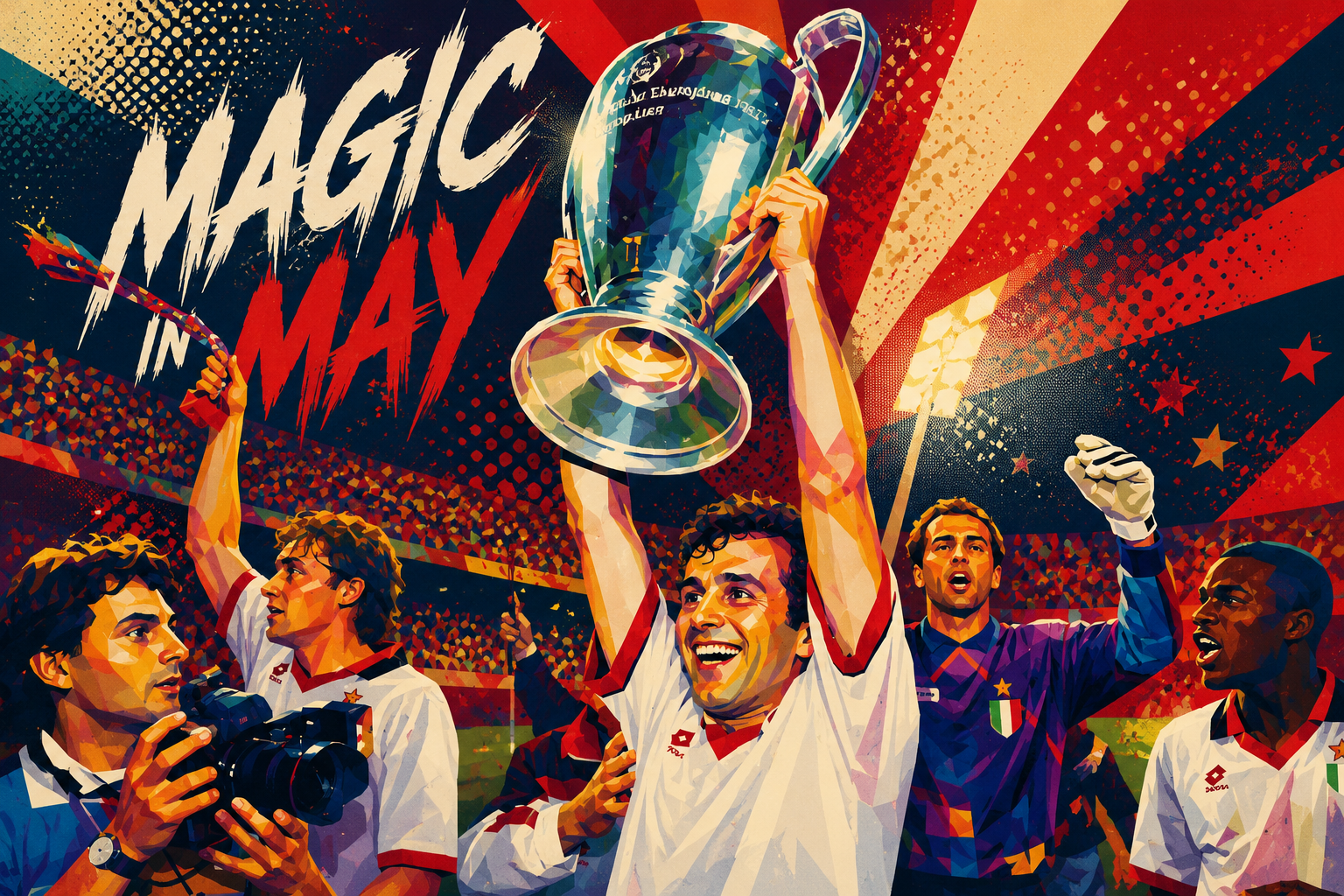
Dejan Savićević was the anarchist inside Fabio Capello’s machine: a player too gifted to ignore, too stubborn to tame, and brilliant enough to make Milan’s most disciplined side unforgettable.
The lob that broke Barcelona’s future
The heat in Athens that night clung to everything.
It sat above the Olympic Stadium in thick layers, trapping the cigarette smoke, the noise and the expectation beneath it. Barcelona arrived on 18 May 1994 carrying more than a team sheet. They carried certainty. Johan Cruyff’s Dream Team had won four straight league titles, conquered Europe at Wembley two years earlier and convinced much of the continent that football’s future belonged to them. Possession. Width. Courage. The ball as doctrine.
Even before the 1994 UEFA Champions League final against AC Milan, Cruyff could not resist the theatre of inevitability. Barcelona were not merely expected to win in Athens. They were expected to confirm history’s direction.
Milan, by contrast, arrived looking strangely vulnerable for a side that had just won Serie A. Franco Baresi and Alessandro Costacurta were suspended. Marco van Basten, the great spearhead of the previous era, was absent with the ankle injury that would soon end his career. Around Europe, the assumption hardened into consensus. Cruyff’s football would overwhelm Fabio Capello’s.
Then the match began.
Within 45 minutes, Barcelona looked disoriented. Milan pressed them high, ran through them in midfield and attacked with a speed Cruyff had not anticipated. Daniele Massaro scored twice. Marcel Desailly hunted Pep Guardiola across the pitch. Paolo Maldini, shifted centrally out of necessity, controlled space with frightening calm.
Still, at 2-0 down, Barcelona remained Barcelona. One goal could change the emotional temperature of the night. One sequence. One opening. One flash of Romário or Hristo Stoichkov brilliance.
Then Dejan Savićević saw the ball dropping out of the Athenian sky.
It fell awkwardly toward the right side of Barcelona’s penalty area early in the second half, hanging for a moment above Miguel Ángel Nadal. The defender waited for the bounce, trying to measure it. That hesitation was enough.
Savićević moved toward him with that strange, loose stride of his, never quite appearing to run properly, as though urgency was beneath him. Nadal tried to shield the ball. Savićević reached a left foot around him and nudged it away in one quick movement. The Barcelona defender swung wildly at air.
Suddenly the space opened.
Ahead of him stood Andoni Zubizarreta, edging off his line, narrowing the angle. Most players in that position would have driven toward goal. Others might have cut the ball back across the six-yard box.
Savićević barely seemed to think.
With the outside of his left foot, almost casually, he lifted the ball high into the warm Athens night. For a second the stadium fell into suspension. The ball climbed above Zubizarreta’s reach, began to dip and then dropped perfectly into the far corner.
Before it hit the net, Savićević was already turning away.
Arms raised. Face twisted into something between joy and defiance. Sprinting toward the advertising boards as the stadium erupted around him.
On the touchline, Capello barely moved. Hands in pockets. Expression guarded. Yet even he understood what had just happened. Not simply to the match, but to the mythology surrounding it.
Cruyff’s Dream Team had not merely been beaten. It had been humiliated by the one type of footballer modern elite systems increasingly struggled to trust.
The scoreline would finish 4-0. Milan’s performance would enter European football history. But the defining image of the night remained that impossible lob from the right edge of the penalty area, struck by a player who spent much of his career arguing with managers, ignoring tactical discipline and resisting the very structure Milan represented.
Years later, discussing the goal with UEFA, Savićević made it sound disarmingly simple. “If I had thought a lot I wouldn’t have scored,” he said.
That was the contradiction at the heart of him.
The most disciplined side in Europe had reached the summit because, for one night, it allowed its least controllable player to decide the future.
The outsider inside Capello’s machine
The story most often told about the 1994 European Cup final is comforting in its simplicity.
Capello’s Milan represented order, discipline and tactical control. Cruyff’s Barcelona represented expression, positional freedom and attacking idealism. Milan won 4-0 because organisation defeated romance. Structure crushed artistry.
It is a neat narrative. It is also incomplete.
Because the player who destroyed Barcelona that night was the one man in Milan’s side who never truly belonged inside Capello’s world.
Savićević was not supposed to be the symbol of tactical supremacy. He was the exception Capello spent two years trying to manage. At Milanello, where every movement was rehearsed and every defensive rotation drilled into muscle memory, the Montenegrin often looked like a man resisting the very idea of football as labour. He disliked repetitive training. He conserved energy openly during matches. He wandered from tactical instructions whenever instinct took him elsewhere.
Capello valued control above almost everything. Savićević played as though control itself was limiting.
Their relationship became one of the defining tensions of Milan’s era. Capello later described him as the player with whom he had the most arguments, while still acknowledging his exceptional talent. That tension was not incidental. It was the point.
Capello did not believe in indulgence. His Milan side won through collective sacrifice. The defensive line moved as one organism. Midfielders pressed in coordinated waves. Full-backs understood distances instinctively. Even great attacking players were expected to suffer for the system. Roberto Donadoni ran endlessly. Desailly absorbed collisions. Albertini supplied balance. Maldini read danger before danger fully existed.
Savićević existed differently.
Inside the dressing room, teammates understood the compromise being made. Milan often defended with ten functional outfield players and one unpredictable variable drifting between structure and improvisation. When possession turned over, others covered the spaces he abandoned. Desailly and Albertini absorbed extra defensive ground. Donadoni tucked narrower. Maldini stepped aggressively into danger early.
The machine compensated for the artist.
And yet Milan needed him.
Serie A in the early 1990s was the most tactically suffocating domestic league football had seen. Defensive lines stayed compact. Man-marking principles still lingered within broader zonal systems. Matches narrowed into attritional battles decided by moments rather than patterns. Milan themselves won the 1993-94 Serie A title scoring only 36 goals in 34 league matches.
In that environment, systems alone were not enough. Eventually every great defence encountered a moment structure could not solve. A pass had to split the line. A dribble had to destabilise the shape. Somebody had to see football differently.
That was Savićević’s function.
Capello never entirely trusted him because Savićević represented risk. But he also understood something that ideological managers often struggle to admit: elite football cannot survive on structure alone. Systems create control. Genius creates separation.
Silvio Berlusconi understood it too.
The Milan owner adored Savićević almost irrationally. Berlusconi collected footballers the way powerful men often collect symbols of beauty and status. He loved Van Basten’s elegance, Gullit’s charisma and Baresi’s authority. But Savićević fascinated him differently because he appeared capable of things no tactical board could design.
Before the 1994 final, Berlusconi reportedly challenged him to prove the genius he had spent two years defending. Whether told as dressing-room folklore or presidential theatre, the line has endured because it captures the reality of Savićević’s status at Milan. He was admired, feared, occasionally resented and frequently misunderstood.
To some journalists, he looked lazy.
To others, he looked liberated.
There were matches where he drifted through long periods barely touching the ball, conserving himself while the game churned around him. Then, without warning, he would receive possession between the lines, roll his body away from a defender and transform the entire geometry of the pitch in three touches.
Capello spent years trying to reduce the unpredictability without destroying the player himself. That balancing act became the hidden truth beneath Milan’s success.
Which is why the image of Athens remains so fascinating.
People remember Milan’s defensive discipline. They remember Cruyff’s humiliation. They remember Barcelona collapsing under pressure.
But the defining act of the final was still an act of individual rebellion.
Not a rehearsed movement. Not a tactical trigger. Not a pressing sequence.
A flick around Nadal. A glance at Zubizarreta. An outrageous lob from an impossible angle.
In the end, the most disciplined team in Europe conquered the continent because it allowed one footballing anarchist the freedom to ignore discipline altogether.
Concrete, chaos and the Yugoslav idea of football
Long before Italian football tried to organise him, Dejan Savićević learned the game in places where organisation barely existed.
He was born in Titograd in 1966, in what was then the Socialist Federal Republic of Yugoslavia, a state that no longer exists except in memory, argument and football nostalgia. The city would later reclaim its older name, Podgorica, after the collapse of Yugoslavia, but Savićević belonged unmistakably to that earlier world: a generation raised inside a country that produced footballers with unusual technical imagination and almost permanent tactical looseness.
In Western Europe, young players were increasingly shaped through systems, coaching structures and athletic discipline. In Yugoslavia, especially in the urban spaces where Savićević grew up, football still carried something closer to improvisation. Concrete courts. Small-sided games. Uneven surfaces. Older boys protecting territory through intimidation as much as skill.
Technique was not ornamental there. It was survival.
The hard surfaces mattered. On concrete, the ball moved faster and mistakes punished you immediately. Heavy touches invited violence. Slow reactions embarrassed you publicly. Young players learned how to manipulate space in fractions rather than metres. Body feints became instinctive because there was often no room to escape any other way.
Savićević developed accordingly.
Even later, at Milan, his dribbling retained traces of those environments. He rarely attacked defenders in straight lines. His movement came in angles and hesitations. Tiny shifts of weight. Small touches rolled just outside tackling distance. He seemed to pull defenders toward challenges they could never fully reach, then slipped through the gap left behind.
There was also something psychologically Balkan about the way he played. Yugoslav football culture valued audacity differently from much of Western Europe. The crowd did not merely appreciate efficiency. They admired humiliation. Nutmegs. Feints. Delayed passes. The potez mattered, the piece of invention that imposed superiority not just physically but emotionally.
The national side became known as the “Brazil of Europe” because Yugoslav football consistently produced technicians capable of improvisation under pressure. But the comparison only partially captured the culture. Brazilian football often celebrated joy. Yugoslav football carried edge. Pride. Defiance. Even its elegance could feel confrontational.
Savićević embodied that contradiction perfectly.
He emerged through the academy at Budućnost, making his senior debut as a teenager in the early 1980s. Those who watched him young spoke less about statistics than sensation. The feeling that the game accelerated unpredictably whenever he touched the ball. He was not physically imposing. He did not dominate matches through force. But defenders became uncomfortable around him because they could never fully anticipate the rhythm of his next action.
There were already signs of the tension that would define his career.
Coaches admired his talent but worried about his temperament. Savićević played according to instinct rather than instruction. He drifted through games before suddenly deciding them. He conserved energy without apology. Some interpreted that as arrogance. Others recognised something more complicated: a player who believed football should be solved through intelligence before effort.
That mentality would later create conflict in Italy, but inside Yugoslav football culture it still made sense.
The country’s greatest footballers often shared similar traits. Dragan Stojković played with theatrical swagger. Robert Prosinečki looked permanently unconcerned by pace or pressing. Even when Yugoslav football modernised tactically, its best players retained a resistance to mechanical football.
What distinguished Savićević even within that tradition was the peculiar mixture of laziness and sharpness in his game.
He could appear detached for minutes at a time, almost bored by the tempo around him. Then a passing lane would open and suddenly his entire body changed. The shoulders lifted. The stride lengthened. Defenders backed away instinctively because they sensed danger arriving before it fully materialised.
Years later, Capello would grow furious watching him conserve energy during matches. In Yugoslavia, though, nobody found it strange. Street football teaches players to choose moments carefully. Endless running means exhaustion. Exhaustion means vulnerability.
So Savićević learned another instinct early: save yourself for the decisive touch.
That principle never left him.
Not in Belgrade. Not in Milan. Not even in Athens, on the night he humiliated Barcelona with one swing of his left foot.
Red Star and the last shared Yugoslav dream
By the late 1980s, Yugoslav football had become one of the richest talent pools in Europe, but it also carried a permanent sense of instability. The country produced extraordinary footballers with alarming regularity, yet the best players rarely stayed together long enough to dominate the continent. Economic uncertainty pushed stars abroad early. Political fractures simmered beneath daily life. The national league glittered, but nervously.
Into that environment stepped Red Star Belgrade.
For ambitious footballers across Yugoslavia, Red Star represented scale. Noise. Expectation. The stadium itself seemed permanently charged, particularly on European nights, when the Marakana became one of the most hostile atmospheres on the continent. Supporters did not simply watch matches there. They consumed them emotionally.
Savićević arrived in Belgrade in 1988 and immediately looked different from the football around him.
There were technically gifted players everywhere in Yugoslavia, but Savićević played with unusual elasticity. He drifted between positions, operating somewhere between a second striker, creator and street football improviser. At times he appeared disconnected from matches entirely. Then suddenly he would receive possession between the lines, draw two defenders toward him and split them with one disguised touch.
What made him dangerous was not constant involvement. It was unpredictability.
European football at the time still relied heavily on defensive reference points. Defenders wanted fixed positions, identifiable patterns and repeatable movements. Savićević denied them all three. He floated away from centre-backs, abandoned traditional attacking zones and slowed sequences down until defenders lost patience. Then he accelerated through the opening they created themselves.
In Belgrade, that freedom was encouraged rather than restricted.
The side assembled around him became one of the most gifted collections of footballers Yugoslavia ever produced. Prosinečki brought impossible technical control. Darko Pančev supplied ruthless finishing. Vladimir Jugović added intelligence and balance. Across the squad there was a shared confidence bordering occasionally on arrogance, the sense of players who believed they could solve matches through superiority rather than caution.
Savićević became the emotional centre of it.
One European night against Bayern Munich in the semi-finals of the 1990-91 European Cup captured the strange electricity surrounding him. Red Star travelled to Germany carrying little of the institutional prestige associated with Milan, Real Madrid or Bayern themselves, yet they played without inferiority. Savićević drifted across the attacking line, refusing fixed reference points, dragging defenders away from structure and helping destabilise one of Europe’s most disciplined sides.
The second leg in Belgrade was chaos by the end, a match that seemed to convulse rather than finish. Red Star survived, Bayern fell, and the Marakana shook as though the noise itself had dragged the team into the final.
When Red Star reached the final against Olympique de Marseille in Bari, the tactical contrast felt almost ideological. Marseille possessed experience, physicality and status. Red Star carried technical freedom and collective rhythm.
The final itself was tense and cautious, eventually decided on penalties after 120 minutes without a goal. Savićević had been substituted before the shootout, furious at being withdrawn. Even in the biggest match of his career to that point, conflict followed him naturally.
Yet when Red Star won the European Cup, the image mattered beyond football.
A Yugoslav club stood on top of Europe just as Yugoslavia itself was beginning to collapse.
There is no clean way to write that sentence. Football did not cause what followed. It could not stop it either. But it did preserve one last impossible photograph: Serbian, Montenegrin, Croatian, Macedonian and Bosnian football lives briefly held together in red and white, before history pulled them apart.
Within months, war would begin tearing through the political and cultural fabric that had produced the team. Teammates who had represented a shared footballing identity suddenly belonged to nations drifting violently away from one another. The timing gave Red Star’s triumph an almost ghostly quality in retrospect, as though the team existed during the final brief moment before an entire sporting civilisation fractured.
Savićević emerged from that period transformed.
Not simply recognised. Feared.
In 1991, he finished joint second in the Ballon d’Or voting, behind Jean-Pierre Papin and level with Darko Pančev. Across Europe, major clubs saw the same thing: a footballer capable of disrupting defensive systems through instinct rather than athleticism.
Berlusconi became obsessed.
The Milan president viewed football partly as spectacle and partly as power projection. Milan already possessed extraordinary structure, but Berlusconi wanted artists too. He wanted players who could make stadiums gasp.
Savićević did exactly that.
So in 1992, Milan brought him to Italy.
On paper, it looked like the perfect move. The best tactical side in Europe acquiring one of the continent’s most gifted creators.
In reality, it was the beginning of a philosophical war.
Because Savićević had reached the summit of European football by trusting instinct above instruction.
And now he was walking into the most controlled environment in the sport.
The geometry of disorder
In Italy, they called him Il Genio.
Not because Savićević dominated football statistically. He did not score enough goals for that. He was never physically overwhelming. He did not control matches through relentless involvement in the modern sense either. There were entire stretches of games where he appeared half-detached from the rhythm around him, wandering through possession phases while teammates pressed and repositioned at full intensity.
Then the ball would arrive at his feet and everything changed shape.
What separated Savićević from most attacking players of his era was not simply technique. Serie A in the 1990s was filled with technically elite footballers. Roberto Baggio, Gianfranco Zola, Dennis Bergkamp and Zinedine Zidane all operated inside, or eventually entered, the same tactical ecosystem.
What made Savićević different was the way he unsettled defensive certainty.
Italian football then was built around control of space. Defensive structures stayed compact vertically and horizontally. Midfield units compressed central areas. Man-marking principles still lingered within broader zonal systems. Coaches obsessed over distances between players. Most attacks failed not because teams lacked talent, but because there was simply nowhere to move.
Savićević solved that problem by refusing to behave predictably enough to be organised against.
Nominally he operated as a second striker or free attacking midfielder, usually starting from the right side before drifting centrally. In practice, his positioning changed constantly. He moved toward the ball when defenders expected him to run away from it. He slowed transitions others would accelerate. He paused in pockets defenders assumed he would vacate.
That hesitation mattered.
Most attacking players telegraphed intention through body shape. Savićević concealed it until the final moment. He received possession half-open, shoulders loose, touching the ball softly across his body before suddenly changing angle with minimal backlift. Defenders struggled to read whether he intended to dribble, pass or shoot because often he seemed to decide late enough to make their first movement wrong.
That quality made him uniquely disruptive against rigid defensive systems.
One of his favourite movements involved drifting into the inside-right channel between full-back and centre-back, receiving the ball seemingly stationary before accelerating diagonally across the defender’s blind side. Crucially, he rarely relied on raw pace over distance. Instead he used timing and body manipulation. A tiny pause. A disguised touch. A subtle change of stride length. Defenders planted their weight half a second too early and immediately lost balance.
Watching him closely, there was always the sense that he treated football spatially rather than physically.
He did not overpower opponents. He rearranged them.
At Milan, this created both tactical brilliance and permanent frustration.
Capello’s system demanded collective intensity without possession. Wide midfielders tracked runners aggressively. The front players initiated pressing triggers. Defensive distances remained sacred. Savićević violated those principles constantly.
There were matches where Capello erupted on the touchline because Savićević had failed to recover defensively for the third or fourth time. Italian newspapers questioned his professionalism openly. Some coaches viewed him as a luxury football could no longer afford.
Yet Capello kept returning to him in major European matches for one simple reason: elite systems eventually require disorder.
Against organised opponents, Milan often dominated territory without finding decisive penetration. That was where Savićević became indispensable. He could destabilise defensive shapes without needing numerical superiority. One dribble forced rotations. One disguised pass pulled centre-backs out of line. One touch changed the attack.
The contradiction became especially visible in Europe.
Serie A’s weekly tactical suffocation often restricted him. European football, by comparison, occasionally gave him larger transitional spaces and less synchronised defensive structures. When those spaces appeared, Savićević could become devastating.
Capello understood this better than his public criticism sometimes suggested. Milan increasingly compensated for Savićević structurally rather than trying to eliminate his instincts altogether. When he drifted inward, Donadoni balanced the flank. When he preserved energy defensively, Desailly and Albertini covered additional ground behind him. Maldini stepped into danger early, preventing counters before they fully developed.
The system bent around the genius rather than fully disciplining him.
That compromise produced one of the defining paradoxes of 1990s football: the continent’s most controlled team relied heavily on a player who fundamentally distrusted control.
Savićević himself never apologised for the way he played. Discussing the Athens goal years later, his UEFA explanation was blunt: “If I had thought a lot I wouldn’t have scored.”
It sounded like instinct. It was also a philosophy.
Because Savićević believed football intelligence should reduce physical suffering, not increase it. He belonged spiritually to an older lineage of creators, the classic trequartisti who viewed movement as something to be rationed carefully rather than performed constantly.
Modern football increasingly moved away from that idea. Pressing intensified. Athletic demands rose. Coaches demanded universal participation without the ball.
Savićević resisted all of it.
Which was precisely why he remained unforgettable.
He played as though football should still contain mystery.
Capello, control and the problem of genius
Fabio Capello did not hate artists.
This is important to understand because history often reduces his relationship with Savićević into something simpler than it really was, as though Milan’s manager represented joyless pragmatism while the Montenegrin carried the soul of football itself.
Capello loved great players. He admired technical superiority. He understood talent immediately.
What he distrusted was instability.
Everything about Capello’s football worldview revolved around reliability. He believed elite teams won not through inspiration alone, but through collective obedience repeated under pressure week after week. Shape mattered. Distances mattered. Recovery runs mattered. Players who ignored tactical responsibilities weakened the entire structure.
Savićević ignored tactical responsibilities instinctively.
The conflict between them was inevitable almost from the moment he arrived in 1992.
At Milanello, training sessions operated with near-military precision. Capello controlled intensity obsessively. Pressing sequences were drilled repeatedly. Positional discipline was non-negotiable. Even world-class players found the environment exhausting.
Savićević hated much of it.
He disliked repetition. He conserved effort during drills. Some mornings he reportedly trained as though mildly irritated by the entire existence of structured football. Capello exploded regularly. Voices carried across the training ground. Teammates watched the arguments unfold almost routinely.
The timing of his arrival complicated matters further. Italian football still enforced the restrictive three-foreigner rule, meaning elite clubs constantly sacrificed major players from matchday squads. Milan’s foreign contingent included extraordinary names: Van Basten, Ruud Gullit, Frank Rijkaard, Papin and later Desailly.
Savićević was not automatically indispensable.
During his first season in Italy, he often found himself excluded entirely. At times Capello preferred the tactical certainty of Donadoni or the directness of Papin. Serie A matches became exercises in frustration. Savićević drifted in and out of the side, struggling to adapt to both the tactical suffocation of Italian football and the physical demands Capello imposed.
The tension occasionally spilled into open rebellion.
Italian newspapers portrayed him as temperamental and unprofessional. Certain pundits questioned whether Balkan flair players could truly survive in elite Italian systems.
Capello did not entirely disagree.
In many ways, Savićević represented the exact footballing archetype Capello mistrusted most: the gifted player who believed talent itself exempted him from labour.
And yet Capello could never quite let go of him.
Partly because Berlusconi intervened constantly.
The Milan president adored Savićević with almost irrational persistence. Berlusconi viewed him as football theatre, a reminder that even the most powerful systems still required imagination. When Capello wanted more functional balance, Berlusconi demanded more genius.
The manager and president argued repeatedly over selections.
Capello eventually reached an uncomfortable compromise. If Savićević would never fully submit to the system, then the system itself would have to absorb some degree of unpredictability. Milan adjusted structurally around him. Teammates covered spaces he ignored. Midfielders compensated for his defensive absence. Full-backs became more conservative when he drifted centrally.
But even then, the relationship never became easy.
Capello often looked personally offended by Savićević’s economy of movement. There were moments during matches when Milan defended desperately while Savićević jogged nearby conserving energy, waiting for transition opportunities rather than participating fully in recovery.
To Capello, football was collective responsibility.
To Savićević, football was selective intervention.
That philosophical divide never disappeared.
Yet over time, something close to mutual respect emerged between them precisely because neither man fully surrendered his principles. Capello never stopped demanding more discipline. Savićević never became obedient. The friction remained alive throughout their years together.
In retrospect, that tension may actually explain why Milan worked.
Purely disciplined sides can become predictable. Purely expressive sides often collapse structurally under pressure. Milan existed somewhere between those extremes. Capello built one of the most organised teams Europe had seen, then reluctantly inserted an unpredictable footballing anarchist into its centre.
The contradictions made the team stronger.
Years later, Capello still sounded half exasperated and half amazed when discussing him. There was one particular memory he returned to repeatedly: Savićević’s goal against Barcelona in Athens.
Capello spent his career trying to reduce uncertainty.
But in the end, even he needed one player who made uncertainty useful.
The missing world and the weight of absence
For all the brilliance attached to Savićević’s name, there remains something strangely incomplete about his career when viewed from a distance.
The honours are there. European Cup winner with Red Star. Champions League winner with Milan. Multiple Serie A titles. One of the defining attacking players of the 1990s.
And yet he still feels partially undocumented, as though football never captured the full version of him before history intervened.
Part of that comes from the era itself. Serie A in the early and mid-1990s consumed attacking players physically and psychologically. Matches became tactical trench warfare. Space disappeared almost instantly. Creative footballers survived through patience rather than freedom.
Milan’s domestic dominance under Capello reflected that environment perfectly.
The 1993-94 title-winning side conceded only 15 league goals all season. They controlled matches through defensive compression, territorial superiority and emotional suffocation. But aesthetically, they could often appear brutally functional. Milan scored just 36 goals in 34 league matches that campaign, an almost absurd total for champions by modern standards.
Savićević became both central and strangely invisible within that structure.
He did not produce spectacular league statistics. He scored no Serie A goals during the title-winning 1993-94 season. Critics used the numbers against him constantly, particularly in Italy where foreign stars were expected to dominate visibly.
But statistics failed to capture the subtler influence he exerted on matches.
He destabilised defensive lines before goals arrived. He slowed games into rhythms Milan preferred. He created hesitation inside otherwise organised systems. Some of Milan’s narrowest victories depended entirely on one disguised pass or one transition sequence beginning through him.
Capello understood the value even while publicly criticising him.
Occasionally, though, the restraints loosened and the older Savićević reappeared fully.
One of the clearest examples came away against Bari in January 1995, back in the same stadium where Red Star had conquered Europe four years earlier. Milan won 5-3. Savićević scored four times.
The performance felt almost rebellious.
There was a header. A finish with his right foot. Another with his left. Another strike arrived with the kind of clean violence that made Berlusconi’s fascination easier to understand. Capello’s Milan rarely permitted emotional chaos.
Savićević carried it naturally.
Yet even those moments now sit beneath the larger shadow hanging over his career: the destruction of Yugoslav football itself.
No generation suffered more from the collapse of the country than the players approaching their peak in the early 1990s. Yugoslavia had assembled an extraordinary collection of talent. Savićević. Stojković. Prosinečki. Davor Šuker. Siniša Mihajlović. Predrag Mijatović.
Technically, they could compete with anybody.
Politically, they never had the chance.
In 1992, as war spread across the Balkans, Yugoslavia was expelled from the European Championship before the tournament began. The players had already gathered for preparation when the news arrived. Denmark replaced them and went on to win the competition.
The cruelty of the timing remains difficult to process even now.
Savićević was entering his peak years. The national side possessed elite technical quality and significant tournament experience. Across Europe, there was genuine belief Yugoslavia could win a major international competition.
Instead, the team disappeared.
The ban continued through qualification for the 1994 World Cup in the United States, removing Savićević from the biggest international stage of his career. While figures like Roberto Baggio and Romário shaped global memory in America, Savićević remained absent entirely, trapped outside international football by events beyond sport.
That absence altered his legacy permanently.
Football history remembers tournament football differently from club football. International competitions create mythology because entire generations witness them simultaneously. Savićević never received that platform at his physical and creative peak.
Instead, his genius survives in fragments.
European nights. Serie A moments. Old VHS compilations. Stories told by defenders who faced him.
There is something strangely fitting about that.
Savićević always felt slightly out of sync with football’s broader direction. Too instinctive for rigid systems. Too irregular for statistical celebration. Too politically unfortunate to receive the global tournament stage his talent deserved.
Even his greatest years carried a sense of interruption.
Not failure.
Interruption.
The football world saw enough to recognise genius.
It just never saw the complete picture.
The night Cruyff lost control
By the time Milan walked out at the Olympic Stadium in Athens, Cruyff had already convinced much of Europe that football history belonged to him.
Barcelona were not viewed simply as the strongest side in Europe. They were treated as the intellectual future of the sport. Cruyff’s Dream Team appeared to offer something bigger than results: a blueprint. The ball would dominate. Systems would expand. Possession would suffocate opponents psychologically as much as tactically.
Cruyff believed it completely.
In the days before the final, he dismissed Milan’s approach openly. Barcelona attacked. Milan defended. One philosophy represented progress; the other represented caution. Even some Italian journalists quietly accepted the framing. Milan had won relentlessly under Capello, but they rarely inspired romance outside Italy. Barcelona did.
The imbalance in perception only deepened because Milan arrived wounded.
Baresi and Costacurta were suspended. Van Basten was absent entirely. Spanish newspapers described Milan as the weakest side of the Berlusconi era. Cruyff’s confidence became part of the weather around the match.
Capello noticed everything.
He did not need Milan to play beautiful football in Athens. He needed them to play angry, clear football.
They did.
Desailly surged into Guardiola’s space relentlessly. Donadoni drove at Barcelona’s left side. Massaro attacked the penalty area with aggressive directness. Most surprisingly of all, Savićević pressed with genuine intensity.
Cruyff had expected indifference from him defensively. Capello demanded involvement instead.
For perhaps the single most complete night of his career, Savićević accepted the bargain.
He tracked runners. Closed angles. Pressed Barcelona’s build-up aggressively. But crucially, Milan’s structure also created the exact transitional spaces where his instincts became fatal. Barcelona’s defensive line stretched wider than most Serie A sides would ever allow. The spaces between full-back and centre-back appeared briefly in transition.
That was enough.
When Savićević received the dropping ball near the right edge of the penalty area early in the second half, the match still retained theoretical uncertainty. Barcelona remained dangerous even at 2-0 down. One goal changes emotional gravity in finals.
Then Nadal hesitated.
Savićević reacted instantly, stealing the ball with that strange mixture of laziness and sharpness that defined him. It was not explosive acceleration that beat Nadal. It was timing. One delayed movement. One disguised touch. Suddenly Barcelona’s defensive shape fractured completely.
Then came the finish.
Even now, it looks slightly irrational.
The angle was tight. Zubizarreta stood positioned to narrow the shot. Crossing appeared safer. Driving toward goal appeared more logical. But Savićević did not really play according to conventional calculations. He recognised the goalkeeper’s momentum instantly and trusted the picture appearing in his head.
Outside of the left foot.
Minimal backlift.
Perfect height.
The ball climbed above Zubizarreta and began to dip.
For a split second, the entire stadium seemed suspended inside the trajectory.
Then the net moved.
What followed mattered almost as much as the goal itself.
Savićević turned away immediately, arms raised before confirmation arrived, as though certainty existed only for him. Barcelona players stood frozen. Cruyff remained motionless on the touchline. Capello barely celebrated outwardly, but the match ended emotionally in that instant.
Desailly’s fourth goal completed the humiliation. Barcelona were dismantled physically, tactically and psychologically. The Dream Team never fully recovered. Within two years, Cruyff himself would be gone.
But the reason Athens still resonates so powerfully is that the decisive image contradicted the wider narrative surrounding the final.
People remember Milan’s organisation correctly. They remember Capello’s tactical masterpiece correctly. They remember Barcelona being suffocated correctly.
Yet the defining act of the evening was still an act of pure improvisation.
No tactical structure in the world coaches a player to attempt that finish from that angle in a European Cup final.
Only a footballer operating entirely on instinct tries it.
That answer explained why Savićević and Capello never became simple.
Capello spent his career trying to reduce uncertainty. Savićević believed uncertainty was where football became beautiful.
And in Athens, for one perfect night, the anarchist won inside the system.
Football’s last great anarchist
Savićević belongs to a category of footballer modern football increasingly struggles to produce.
Not because players today lack technical quality. In many ways, elite footballers are more complete than ever before. They run harder, press smarter and process tactical information at extraordinary speed. Systems have evolved. Physical preparation has evolved. Positional structures have evolved.
What has gradually disappeared is tolerance for unpredictability without labour.
Savićević represented the opposite idea.
He belonged to a lineage of creators who believed football should first be interpreted, then solved. Players who slowed matches down emotionally before accelerating them technically. Footballers who viewed space as something to manipulate patiently rather than attack relentlessly.
You can trace fragments of him through later generations.
Dimitar Berbatov carried the same languid disdain for unnecessary movement. Juan Román Riquelme controlled rhythm through pauses rather than pressing. Mesut Özil often appeared detached from matches until suddenly splitting entire defensive structures with one pass.
All three, in different ways, encountered the same suspicion Savićević faced: does the genius justify the sacrifice required around him?
Modern football increasingly answers no.
Pressing systems demand universal participation. Managers trust repeatability more than inspiration. The margin for passengers has almost disappeared at elite level. Even attacking players now defend aggressively, sprint continuously and occupy highly choreographed positional structures.
Savićević would probably have driven modern coaches to exhaustion.
Yet that is precisely why he remains memorable.
Watching old footage of him now feels almost disorientating because the rhythms look unfamiliar. He walks through phases of games. He waits. He conserves himself openly. Then suddenly he receives possession and changes everything in seconds.
Modern football rarely permits that pacing anymore.
In Italy, his reputation always remained slightly divided. Some supporters adored him instinctively because they recognised rarity when they saw it. Others never fully forgave what they interpreted as inconsistency or laziness. Statistically, his numbers rarely matched the mythology surrounding him.
But football memory is not built entirely on numbers.
Certain players survive because they altered the feeling of a match whenever they touched the ball. Savićević belonged firmly in that category. Defenders remembered him. Teammates remembered him. Coaches remembered him, often with a mixture of admiration and exasperation.
Capello certainly did.
For all their clashes, the Milan manager repeatedly trusted Savićević in the biggest European matches because he understood something fundamental about elite football: eventually every system encounters situations structure alone cannot solve.
That is where players like Savićević become necessary.
The tragedy is that much of the football world never fully saw him at his peak. The collapse of Yugoslavia removed his prime international years from global view. There was no defining World Cup run. No major international tournament mythology attached to his name. Younger generations often encounter him now only through clips, statistics or stories passed down by older supporters.
And clips alone cannot fully explain him.
They show the dribbles, the feints and the lob against Barcelona, but they struggle to capture the strange emotional effect he had on matches. The feeling that conventional logic had temporarily stopped applying whenever he received the ball in dangerous areas.
At his best, Savićević made football feel unstable in the most thrilling way possible.
Comparisons with Lionel Messi, occasionally made by admirers of Yugoslav football, are tempting but imperfect. Savićević did not possess Messi’s sustained output or week-by-week inevitability. The more useful link is rhythm. Both players could manipulate defensive balance through body orientation, hesitation and changes of tempo rather than pure athletic domination.
Still, Savićević ultimately belongs to an older football species altogether.
He was one of the last elite attackers allowed to remain partially untamed.
Not fully disciplined.
Not fully optimised.
Not fully modern.
Just brilliant enough that the system bent around him anyway.
And perhaps that is why his career still lingers differently from many technically superior or statistically greater players.
Football has never stopped admiring genius.
It has simply become less willing to tolerate genius that refuses to behave.
The freedom to refuse
There is a temptation, when looking back at Savićević now, to frame him as the last romantic artist before football surrendered completely to systems and athletic optimisation.
That version of the story is attractive. It is also slightly unfair.
Because Savićević was not anti-discipline in the simplistic sense people sometimes imagine. He could work when he chose to. Athens proved that. Capello would never have trusted him in a Champions League final otherwise. Teammates at Milan understood he possessed elite football intelligence and extraordinary competitive pride beneath the apparent indifference.
What he resisted was submission.
Savićević never accepted the idea that football should become entirely mechanical. He distrusted over-coaching instinctively. Even at the peak of his career, inside the most organised side in Europe, he still behaved like somebody who believed the game fundamentally belonged to improvisers.
That belief followed him long after retirement.
When he later became president of the Montenegrin Football Association, critics questioned his unconventional approach to administration. Savićević responded in a way that sounded perfectly consistent with the player Capello spent years trying to manage. He had spent 20 years living by professional schedules, he explained, and had no desire to spend retirement stamping a time card.
The line sounded humorous on the surface, but it revealed something deeper too.
Savićević valued freedom almost irrationally.
Freedom inside systems.
Freedom inside football.
Freedom inside life itself.
That instinct made him difficult for coaches, frustrating for supporters and impossible for rigid tactical structures to fully contain. It also made him unforgettable.
The great irony of his career is that his defining moment arrived inside one of the most disciplined teams European football has ever produced. Capello’s Milan conquered the continent through organisation, defensive intelligence and collective sacrifice. Yet the image history preserved from Athens was not a pressing sequence or tactical adjustment.
It was one footballer seeing a possibility nobody else saw.
A glance at Zubizarreta.
A swing of the left foot.
The ball disappearing into the night sky above Athens.
Cruyff’s Barcelona believed football’s future belonged to perfect structure and collective certainty. In the end, the final was decided by a player who trusted instinct more than systems.
That tension still feels unresolved even now.
Modern football continues searching for ways to organise everything. Coaches control space more aggressively than ever. Data measures movement constantly. Players are taught structure from childhood. The game has become faster, cleaner and more efficient.
But occasionally, usually in the biggest moments, football still belongs to the people willing to ignore the script.
That was Savićević’s gift.
Not simply that he could produce genius.
But that he never entirely allowed football to tame it.
