

Red Star Belgrade did not simply win the 1991 European Cup. They became the final expression of a Yugoslav footballing world that was already falling apart.
Bari, 29 May 1991
The heat in Bari felt oppressive long before the match began. Even after sunset, the air around the Stadio San Nicola remained thick and unmoving, the kind of Mediterranean humidity that settles on the skin and refuses to lift. By the time the European Cup final drifted into extra time, the occasion itself seemed exhausted. The football had slowed to a crawl. Legs tightened. Passes shortened. Space disappeared.
This was not how Red Star Belgrade had conquered Europe.
For months, they had ripped through the continent playing football of startling speed and technical violence. They had overwhelmed opponents with transitions so sudden they barely seemed organised. Bayern Munich, Rangers and Dynamo Dresden had all discovered the same thing. Red Star did not merely counter-attack. They flooded forward in waves, stretching matches vertically until opponents lost all defensive shape.
Yet here, on the biggest night in the club’s history, they had retreated into themselves.
Across the touchline stood Olympique de Marseille, Bernard Tapie’s expensively assembled obsession. Jean-Pierre Papin. Chris Waddle. Abedi Pelé. Manuel Amoros. France’s great modern project. Marseille had expected chaos, movement and attacking risk from the Yugoslav champions. Instead, they encountered resistance, caution and silence.
The night before the final, sleep barely existed inside the Red Star camp. Some players drifted between rooms unable to settle. Others sat in the emotional quiet that comes before a match too large to discuss properly. News from home had become heavier by the week. Political tension across Yugoslavia was no longer background noise. It travelled with them, into hotels, training grounds, airports and team meals.
Players later spoke about the way political conversations became harder inside multi-ethnic dressing rooms as the country fractured. Nobody wanted to turn football into argument. Nobody wanted to test the limits of old friendships. Red Star’s players still trusted one another on the pitch, but away from it the future was becoming difficult to name.
For months, football had insulated them from reality.
Now reality sat outside the hotel doors waiting.
Before the final, Red Star manager Ljupko Petrović made a decision that felt almost sacrilegious given everything his team had become. He would not allow Marseille the open game they wanted. His instruction, later recalled in almost brutal simplicity, was to deny the match oxygen. When Red Star had the ball, they were not to invite danger. “When you get the ball, give it back to them,” went the line that came to define the final’s strange emotional temperature.
Siniša Mihajlović later remembered the match without romance. In an interview recalled by The Guardian, he called it “the most boring final match in European Cup history”, but added the crucial explanation: if Red Star had attacked, they probably would have lost.
He was probably right.
Petrović understood something his players did not fully grasp until much later. Marseille were used to big finals, big names and big emotional stages. Red Star had the better collective rhythm, but perhaps not the same institutional hardness. The safest way to win the European Cup was not to become themselves. It was to deny Marseille any version of the game they recognised.
And beneath the football itself sat something darker.
Yugoslavia was collapsing in real time.
Only weeks earlier, violence had escalated across Croatia. Nationalist rhetoric had consumed political life. Armed incidents were increasing. Stadiums had already become ideological battlegrounds. Many inside the Red Star dressing room understood, privately at least, that this might be the last moment they would ever stand together beneath the same flag.
Because this was never simply a Serbian team.
A Croatian orchestrated midfield possession. A Montenegrin drifted between defensive lines with impossible imagination. A Macedonian striker waited coldly inside the penalty area. A Bosnian-born defender swept behind them. Around them stood players who would soon belong to different nations, different passports, different versions of history.
For now, though, they remained one side.
The match staggered toward penalties. Marseille looked emotionally paralysed by the moment. Most striking of all was Dragan Stojković, once the brightest symbol of Red Star Belgrade, now wearing white after his transfer to France. When the shootout approached, he reportedly could not bring himself to take a penalty against his former club.
The responsibility fell elsewhere.
Robert Prosinečki began the walk first.
Blonde-haired, shoulders relaxed, socks loose around his ankles, the Croatian midfielder moved towards the penalty spot with a strange stillness around him. He was only 22 years old, but carried himself with the detached calm of somebody already exhausted by events larger than football. The stadium noise receded into something dull and distant.
Prosinečki placed the ball carefully.
Then he waited.
Pascal Olmeta bounced across his line, gesturing wildly, trying to break the silence. Prosinečki barely acknowledged him. He opened his body at the final moment and rolled the penalty low beyond the goalkeeper with surgical calm.
No celebration. No explosion. Just release.
It changed everything.
When Manuel Amoros saw his own penalty saved moments later by Stevan Stojanović, the psychological balance of the final collapsed completely. Red Star suddenly looked lighter. Marseille looked terrified.
One by one, the Yugoslav champions stepped forward and scored.
Dragiša Binić.
Miodrag Belodedici.
Siniša Mihajlović.
Finally, Darko Pančev.
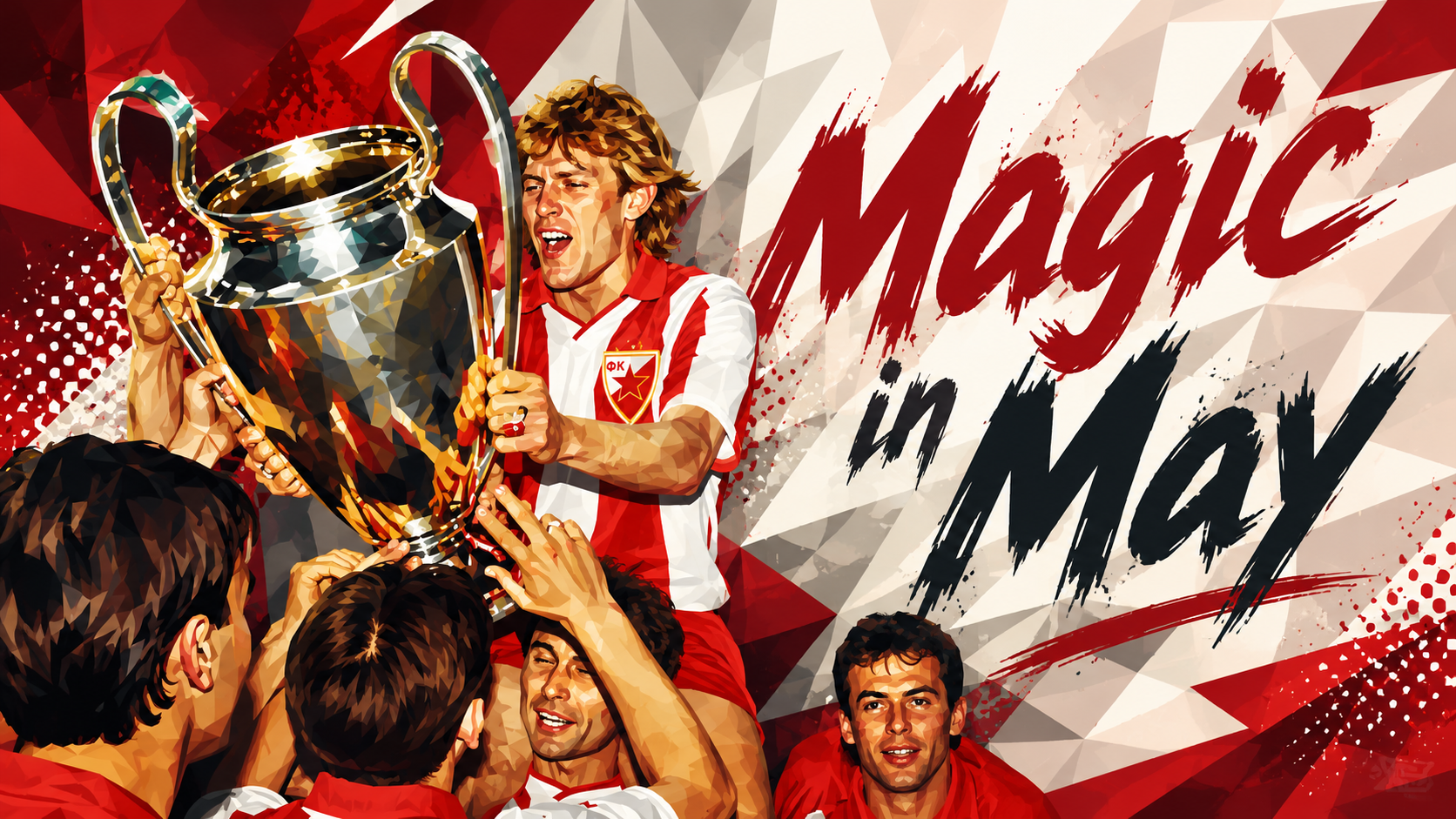
The Macedonian striker struck the winning penalty into the corner and immediately disappeared beneath a wave of red shirts as the Red Star bench emptied onto the pitch. Players collapsed into each other. Coaches sprinted into the darkness. Flags rose into the night sky above Bari.
Red Star Belgrade were champions of Europe.
And already, the country that had built them was beginning to disappear.
They Were Never Supposed to Win Europe
The simplest versions of football history rarely survive serious inspection.
In much of Western Europe, Red Star Belgrade’s triumph in 1991 has gradually been flattened into something convenient and romantic. An outsider story. A glorious anomaly from Eastern Europe before the Champions League era consumed everything. A talented but chaotic team emerging briefly from behind the Iron Curtain to steal one extraordinary night before vanishing back into history.
Even the final itself helped reinforce the misunderstanding.
The match against Marseille was grim, tense and deeply conservative. It lacked the emotional grandeur expected of European Cup finals. For many neutral observers, particularly outside Yugoslavia, Red Star became remembered less for how they reached Bari and more for how cautiously they behaved once they arrived there.
But that memory distorts the reality of what this team actually was.
Red Star Belgrade were not accidental champions.
They were not underdogs surviving on emotion.
And they were certainly not tactically naive idealists enjoying one unsustainable run.
In truth, they were probably the best side in Europe during the 1990-91 season.
What separated Red Star from many previous Eastern European champions was not simply technical quality, although they possessed that in abundance. It was the sophistication of the project itself. The club’s leadership understood earlier than most that European football was beginning to change irreversibly. Television money, commercial expansion and Western financial power were creating a future in which clubs from Yugoslavia, Romania, Hungary and Czechoslovakia would struggle to compete economically with Italy, Spain, Germany and England.
The window was closing.
So Red Star accelerated everything.
Under the guidance of club president Dragan Džajić and general director Vladimir Cvetković, the club initiated an aggressive long-term strategy during the late 1980s. The objective was brutally simple: gather the finest talent from across Yugoslavia before the richest clubs in Europe could take them away.
At the time, Yugoslavia remained one of the greatest football production lines in the world.
Its players emerged from radically different regional football cultures while sharing a common technical education. Croatian football emphasised composure and intelligence in possession. Serbian clubs often produced emotionally hardened competitors comfortable under pressure. Bosnia created improvisational street footballers. Montenegro contributed fearless attacking talent. Macedonia produced forwards with ruthless efficiency inside confined spaces.
Red Star assembled all of it.
Robert Prosinečki arrived from Dinamo Zagreb after Miroslav Blažević failed to recognise his generational potential. Dejan Savićević came from Budućnost Titograd carrying the unpredictability of a footballing street artist. Darko Pančev arrived from Vardar as Europe’s deadliest penalty-box finisher. Siniša Mihajlović brought aggression, technical precision and left-footed violence from Vojvodina. Vladimir Jugović supplied tactical intelligence and balance. Miodrag Belodedici, already a European Cup winner with Steaua Bucharest, arrived after defecting from Romania.
Individually, they were exceptional.
Collectively, they became something far more dangerous.
This was not a side built around one superstar. It was a deeply interconnected football machine in which every stylistic contrast strengthened the whole. Petrović understood exactly how to arrange them. Prosinečki and Savićević were given creative freedom, but never without structure around them. Jugović absorbed defensive responsibility. Belodedici controlled buildup from deep positions. Binić stretched the pitch vertically with relentless speed. Pančev conserved energy for the final action.
The result was a team capable of overwhelming opponents in phases most European sides still struggled to control: transitional moments immediately after regaining possession.
Red Star played with terrifying conviction.
When possession changed hands, they attacked before opponents could emotionally reorganise themselves. The speed was not reckless. It was choreographed. Prosinečki often initiated attacks with disguised passes that immediately shifted the direction of play. Savićević drifted unpredictably between midfield and forward lines. Pančev rarely touched the ball unnecessarily. Binić attacked empty space like a sprinter leaving starting blocks.
The football felt improvised to spectators because the execution was so fluid.
In reality, it was organised violence.
Graeme Souness discovered that brutally with Rangers. Bayern Munich discovered it too. So did Dynamo Dresden. Across Europe, opponents entered matches expecting technical elegance from a Yugoslav side and instead encountered relentless transitional pressure combined with extraordinary technical security.
By the spring of 1991, Red Star were not merely surviving Europe.
They were dictating it.
Which is why the final against Marseille remains such a fascinating contradiction. The most explosive attacking side in Europe reached the summit of the continental game by suppressing the very instincts that had carried them there.
But perhaps that contradiction reveals the team more clearly than anything else.
Red Star Belgrade were not romantics destroyed by reality.
They were intelligent enough to understand what reality required.
The Country That Built Them
To understand Red Star Belgrade in 1991, it is necessary to understand the country that made them possible.
Not simply Yugoslavia as a political state, but Yugoslavia as a footballing ecosystem.
For decades, the country occupied a strange and unusually fertile space within European football. It stood geographically and culturally between East and West, shaped by socialism yet more open than most Eastern Bloc nations, exposed to outside influences while fiercely protective of its own sporting identity. Yugoslav football developed without the rigid tactical conservatism that often dominated Soviet systems, but also without the full commercialisation beginning to transform the major Western leagues.
The result was a football culture obsessed with technique.
Children learned to survive in small spaces. Street football mattered. Improvisation mattered. Coaches prioritised touch, balance and intelligence before physical development. Across the federation, different republics produced different footballing personalities, yet all emerged from the same broad belief that the ball itself should remain central.
This was not accidental.
The Yugoslav game encouraged footballers to think.
Players were expected to solve situations creatively rather than merely execute instructions. Midfielders rotated naturally through multiple positions. Defenders stepped into possession confidently. Number tens were not luxuries hidden from responsibility. They were expected to carry emotional authority within matches.
Even the atmosphere surrounding football felt different.
Stadiums across the federation carried immense emotional intensity, but also a sophisticated understanding of the game itself. Supporters in Belgrade, Zagreb, Split and Sarajevo could be brutal, impatient and politically volatile, yet they also recognised technical brilliance instinctively. A disguised pass or sudden change of tempo could provoke the same eruption as a goal.
Within that environment, extraordinary players emerged continuously.
Safet Sušić. Dragan Stojković. Zlatko Vujović. Zvonimir Boban. Robert Prosinečki. Dejan Savićević.
The production line seemed endless.
Yet the most remarkable aspect of Yugoslav football was not simply the talent itself. It was the ease with which players from entirely different identities and backgrounds could combine inside the same dressing room.
That reality feels almost impossible to separate from later events now, but in footballing terms, the federation created an enormous shared talent pool. Clubs routinely scouted beyond republican borders. Ethnicity existed, of course, but inside elite football structures it had not yet become the absolute dividing line it would soon become politically.
And so Red Star’s European Cup-winning side became the ultimate expression of that shared system.
A Croatian playmaker controlled midfield rhythm.
A Montenegrin drifted unpredictably through attacking spaces.
A Macedonian striker finished chances with ruthless simplicity.
A Serbian defensive core held structure together.
A Romanian defector swept calmly behind them.
Around them stood players who would soon become symbols of entirely separate national football histories.
But in 1991, they still belonged to the same idea.
That idea had already begun to fracture politically by the late 1980s. Economic instability spread across the federation after the death of Josip Broz Tito in 1980. Nationalist rhetoric intensified. Political trust deteriorated. Different republics increasingly imagined different futures for themselves.
Football felt those tensions earlier than most institutions.
Supporter groups became tribal political identities as much as sporting communities. Chants changed. Symbols changed. Violence escalated. Stadiums gradually transformed into places where nationalism could be rehearsed publicly before it fully entered everyday life.
And yet, paradoxically, the football itself reached extraordinary levels precisely as the country began collapsing.
The Yugoslav national team that qualified for the 1990 World Cup in Italy was one of the most gifted squads in international football. Red Star Belgrade simultaneously assembled the finest club side in the federation’s history. The technical level remained astonishing even while the political structure beneath it weakened irreversibly.
Perhaps that is why the 1991 Red Star side still carries such emotional weight decades later.
They represented more than a club.
They became the final moment when the Yugoslav footballing idea still functioned completely.
For one last season, the system still held together long enough to produce perfection.
The Five-Year Plan
By the mid-1980s, Red Star Belgrade understood something many major clubs across Eastern Europe still refused to confront.
Time was running out.
European football was changing faster than the old socialist structures could adapt to it. Television money was beginning to distort competition. Italy’s giants were becoming financial superpowers. Spain’s elite clubs possessed global prestige Eastern European sides could not realistically match. Even before the Bosman ruling transformed the market entirely, the balance of power had already started drifting westward.
For clubs outside those financial centres, the future looked ominous.
Red Star’s response was not sentimental. It was strategic.
Rather than trying to preserve old structures, the club decided to exploit Yugoslavia’s greatest remaining advantage before the door closed completely: the extraordinary depth of footballing talent spread across the federation. If Western Europe would soon become impossible to compete with financially, then Red Star needed to move immediately and aggressively while elite Yugoslav players could still realistically be assembled inside one domestic project.
At the centre of the plan stood Dragan Džajić.
Even decades after retirement, Džajić remained one of the most respected figures in Yugoslav football history. Elegant, politically intelligent and deeply influential within Red Star, he understood both the emotional power of the club and the economic reality confronting it. Alongside general director Vladimir Cvetković, he helped build a project whose ambition extended far beyond domestic dominance.
The objective was explicit.
Win the European Cup before modern football economics made it impossible.
This was not a romantic long shot. It was a targeted institutional operation.
Recruitment became ruthless. Red Star searched systematically across Yugoslavia for players capable not only of technical excellence, but of surviving emotionally inside high-pressure European football. The club assembled personalities as carefully as footballers.
Robert Prosinečki arrived first.
Discarded carelessly by Dinamo Zagreb after Miroslav Blažević refused to trust him, the blonde-haired midfielder reached Belgrade carrying both resentment and extraordinary confidence. Red Star immediately recognised what Dinamo had missed. Prosinečki was not merely technically gifted. He saw passing angles before matches fully developed around him. Possession slowed when he wanted it to slow. Accelerated when he demanded speed. He could disguise intention until the final second.
At the 1987 FIFA World Youth Championship in Chile, he confirmed it publicly. Yugoslavia won the tournament. Prosinečki won the Golden Ball as the competition’s best player.
Soon others followed.
Dejan Savićević arrived from Budućnost Titograd carrying chaos in his game. Thin, unpredictable and impossible to fully systematise, he drifted across attacking positions with an improvisational freedom that unsettled defenders psychologically as much as tactically. When Savićević accelerated with the ball, matches briefly stopped obeying structure.
Darko Pančev brought something entirely different.
Nicknamed “The Cobra”, the Macedonian striker had little interest in decorative football. He conserved movement, rarely wasted touches and attacked penalty areas with ruthless economy. While others created instability around him, Pančev simply finished attacks. During the 1990-91 season, he became the deadliest striker in Europe.
Then came Siniša Mihajlović.
Left-footed, confrontational and technically exceptional, Mihajlović combined aggression with precision. His free-kicks carried genuine menace, but his broader tactical value mattered even more. He supplied balance to a side filled with creative personalities, often drifting deeper to stabilise defensive transitions.
Vladimir Jugović completed the midfield structure.
Disciplined, intelligent and positionally flexible, Jugović sacrificed visibility for functionality. He covered spaces others abandoned. Pressed aggressively. Rotated into defensive areas. Allowed Prosinečki and Savićević greater freedom without exposing the team structurally.
Behind them stood Miodrag Belodedici, perhaps the most unusual figure in the entire project.
Already a European Cup winner with Steaua Bucharest in 1986, Belodedici had defected from Nicolae Ceaușescu’s Romania and fled into Yugoslavia, risking enormous personal consequences. Elegant rather than physically imposing, he played as a sweeping libero with remarkable calmness under pressure. Red Star did not simply gain experience through Belodedici. They gained composure.
Then there was Dragiša Binić.
Fast almost to the point of absurdity, Binić stretched matches vertically in ways few European sides could defend. He once claimed he could run 100 metres in 10.5 seconds and openly challenged Carl Lewis to a race. Whether entirely true or not barely mattered. On the pitch, defenders behaved as though they believed it.
What made Red Star exceptional was not individual talent alone.
Many great sides possess gifted footballers.
What separated this team was the precision with which different qualities connected together. Prosinečki’s passing range became more dangerous because Binić attacked space relentlessly. Pančev scored heavily because Savićević destabilised defensive structures beforehand. Jugović’s discipline allowed creative players to take greater risks. Belodedici transformed defensive recovery into controlled buildup within seconds.
Everything linked.
And overseeing it all stood Ljupko Petrović.
Unlike some ideologically rigid coaches of the era, Petrović understood adaptation. He recognised that technical freedom only mattered when protected structurally. He did not attempt to suppress individuality. He organised around it. Red Star’s football looked spontaneous from the outside, but underneath sat carefully rehearsed balance.
By 1990, the project was complete.
Red Star Belgrade had assembled the strongest club side in Yugoslav football history.
The timing, however, could not have been more fragile.
How Red Star Actually Played
The mythology surrounding Red Star Belgrade often overwhelms the football itself.
War, nationalism, political collapse and the tragedy of Yugoslavia understandably dominate retrospective discussion. Yet there is a danger in allowing history to flatten what this side actually looked like on the pitch, because Red Star were not simply emotionally significant.
They were tactically magnificent.
And, crucially, they did not play like most Western audiences expected an Eastern European side to play in 1991.
There remained, particularly in Britain, a lingering assumption that Yugoslav football was essentially decorative. Technical, certainly. Creative. Entertaining. But ultimately too soft, too chaotic or too psychologically fragile to dominate elite European competition consistently.
Red Star destroyed that stereotype.
What made them so difficult to play against was not flair alone. It was the violence of their transitions. Matches against them often felt stable right until the moment they suddenly became uncontrollable.
Ljupko Petrović built the side around asymmetry and compression.
Without the ball, Red Star frequently narrowed the pitch aggressively, forcing opponents into crowded central areas before springing outward at terrifying speed once possession changed hands. The shape itself shifted constantly depending on the phase of play. At times it resembled a 4-4-2. At others, a narrow 4-5-1. In defensive moments, Jugović often dropped deeper, temporarily creating an additional layer in front of the defence.
The important detail was not the formation itself.
It was how quickly they accelerated after recovery.
Most European teams in that era still required stabilisation touches after regaining possession. Red Star did not. Their first instinct was verticality. Not hopeful long balls, but precise forward progression before opponents could emotionally reorganise themselves.
Opponents often described the same sensation afterwards.
The match would feel manageable.
Then suddenly it would not.
One turnover. One vertical pass. One sprint into open space.
And Red Star were already running at retreating defenders before the stadium itself had fully reacted.
The speed created panic. Not chaos in the reckless sense, but emotional destabilisation. Full-backs stopped pushing forward confidently because Binić waited permanently behind them. Midfielders hesitated before committing pressure because Prosinečki could bypass them instantly. Centre-backs dropped deeper and deeper protecting against Pančev’s movement, which only created more room for Savićević between lines.
Red Star did not simply beat opponents tactically.
They exhausted them psychologically.
Robert Prosinečki controlled much of this rhythm.
What made him extraordinary was not simply technical quality, although his technique bordered on absurd. It was his manipulation of tempo. He could receive possession under pressure and appear almost casual, shoulders loose, head constantly lifting, delaying defenders by half-seconds that felt insignificant until space suddenly opened elsewhere.
Then the pass arrived.
Not always spectacular. Often just devastatingly correct.
Prosinečki’s range altered the geometry of matches. He could bypass entire midfield lines with curved diagonal deliveries struck almost without backlift. Opposition pressing structures frequently collapsed because they could not predict where the next transition would emerge.
Alongside him, Dejan Savićević supplied instability.
Where Prosinečki organised, Savićević disrupted.
He drifted across attacking zones without obvious positional discipline, carrying the ball at defenders in ways that forced panic decisions. Defenders could not fully prepare for him because his body language concealed intention until the final moment. He slowed unexpectedly. Accelerated unexpectedly. Released passes from awkward angles. Sometimes he appeared to ignore structure entirely.
Petrović tolerated it because chaos was part of the design.
Darko Pančev completed attacks with ruthless simplicity. He was not interested in dominating possession or performing for spectators. Pančev behaved like a striker who considered every additional touch unnecessary labour. His movement inside penalty areas was economical, sharp and emotionally cold. By the end of the European campaign, he had become almost impossible to contain once transitions reached the final third.
Then came the structural balance.
Vladimir Jugović covered spaces others abandoned. Mihajlović protected the left side aggressively while still delivering exceptional dead-ball quality. Belodedici emerged from defence with extraordinary calmness, carrying possession through pressure before releasing attacks into midfield.
And on the right flank waited Dragiša Binić.
Binić was less a winger than a permanent emergency.
Petrović intentionally left him high up the pitch during defensive phases, gambling that his speed would immediately stretch opponents once possession turned over. The effect was psychologically exhausting. Full-backs knew that every attack carried danger behind them. Centre-backs were constantly dragged wider than they wanted. Midfielders hesitated before committing forward.
Once Red Star escaped pressure, they attacked open grass with terrifying speed.
Rangers discovered this brutally in the second round.
Graeme Souness arrived with a side physically dominant in Scotland and tactically confident in Europe. Walter Smith travelled to Belgrade beforehand to scout Red Star closely. His conclusion, later repeated in several accounts and cited by The Guardian, was blunt: “We’re fucked.”
The first leg at the Marakana finished 3-0.
Prosinečki scored a magnificent free-kick, but the wider story lay in how helpless Rangers looked once transitions began accelerating. Red Star bypassed pressure too quickly. Their movement between lines constantly distorted defensive shape. Rangers were not physically overwhelmed. They were mentally disoriented.
The same thing happened against Dynamo Dresden.
Red Star dismantled the East German champions across two legs with a level of technical superiority that bordered on humiliating. The second leg in Dresden was abandoned late on because of crowd trouble, with Red Star leading 2-1 on the night. UEFA later awarded a 3-0 result, completing a 6-0 aggregate victory.
Then came Bayern Munich.
Even by modern standards, Red Star’s first-leg performance in Munich remains astonishingly mature. After falling behind, they refused panic completely. Prosinečki controlled transitions calmly. Savićević drifted between defensive lines. Binić attacked space relentlessly. Pančev punished hesitation.
The equaliser encapsulated everything they were.
Prosinečki received deep inside his own half and immediately recognised Binić’s positioning before Bayern’s structure had reset itself. The pass curved diagonally across the pitch into open space. Binić accelerated beyond the defence and squared low for Pančev to finish.
It took seconds.
That was the essence of Red Star Belgrade.
Not sterile possession. Not chaotic improvisation.
Everything happened frighteningly quickly, but almost never carelessly.
The Country Begins to Crack
The deeper Red Star advanced into Europe, the more impossible it became to separate the football from the country surrounding it.
By 1990, Yugoslavia no longer felt stable even to those inside its most successful institutions. Economic decline had poisoned public life throughout the previous decade. Inflation spiralled. Political trust evaporated. Regional resentment hardened into nationalism. The language of unity that had once defined Tito’s Yugoslavia began disappearing from public discourse, replaced by competing versions of identity that increasingly viewed coexistence itself as temporary.
Football absorbed those tensions earlier than most parts of society.
In many ways, it amplified them.
Across the federation, supporter groups evolved into expressions of political belonging as much as sporting loyalty. Stadiums became places where anger could be performed collectively before it entered formal politics completely. Chants changed first. Flags followed. Then violence.
What had once been fierce sporting rivalries gradually transformed into rehearsals for something far darker.
Red Star existed directly inside the centre of this atmosphere.
The club’s ultras, the Delije, had become one of the most powerful supporter groups in Eastern Europe. Fiercely loyal, highly organised and increasingly nationalistic, they represented far more than football fandom by the beginning of the 1990s. Their symbolism shifted openly toward Serbian nationalism as Yugoslavia weakened politically. Historical references once suppressed under socialism returned aggressively into public life.
Inside the dressing room, however, reality remained more complicated.
This was still a multi-ethnic team.
Prosinečki was Croatian. Pančev Macedonian. Savićević Montenegrin. Belodedici Romanian. Others identified differently again. They trained together daily, travelled together and trusted one another professionally at the exact moment public life outside football increasingly demanded separation.
That contradiction sat quietly beneath everything Red Star achieved.
Some players later admitted they deliberately avoided political discussions inside camp because they feared where conversations might lead. Others insisted football temporarily protected them from wider events. But protection was becoming impossible. Every away match carried heavier atmosphere. Every newspaper headline deepened uncertainty. International call-ups increasingly felt politically loaded.
Even the Yugoslav national team, one of the finest in the world at the time, carried a strange emotional fragility beneath its talent. The squad reached the quarter-finals of the 1990 World Cup in Italy and pushed Diego Maradona’s Argentina to penalties, yet many players would later describe an underlying sense that the country itself no longer fully existed emotionally.
Red Star’s success briefly masked some of this.
Winning still provided a shared language.
European nights at the Marakana created moments where collective identity appeared intact. Tens of thousands stood together beneath floodlights willing the same team toward victory. For ninety minutes, football still offered the illusion of continuity.
But outside the stadium, politics accelerated relentlessly.
Slobodan Milošević consolidated power in Serbia through nationalist rhetoric and populist mobilisation. In Croatia, Franjo Tuđman’s Croatian Democratic Union increasingly framed independence as both political necessity and historical destiny. Media narratives hardened across republican lines. Public trust collapsed further.
And as the political centre weakened, football supporters became increasingly militarised in tone and behaviour.
Many of the chants echoing around stadiums during 1990 and 1991 no longer sounded connected to sport at all. Historical grievances returned publicly after decades of suppression. Symbols associated with wartime factions reappeared openly in terraces. Violence escalated between rival supporter groups whose identities increasingly mirrored the political fragmentation of the federation itself.
The players could feel it.
How could they not?
Every away trip carried new tension. Every newspaper carried another warning sign. Some footballers quietly began planning futures abroad earlier than expected because they no longer trusted what Yugoslavia might become.
And yet, paradoxically, the football itself kept improving.
That remains one of the strangest aspects of Red Star’s 1991 triumph. As the state around them deteriorated, the team reached extraordinary technical and psychological levels. Their understanding on the pitch deepened even while the society producing them fractured irreversibly.
Perhaps elite sport sometimes creates temporary order inside collapsing environments.
Or perhaps Red Star simply represented the final functioning version of Yugoslavia itself: different identities cooperating successfully because the collective objective still mattered more than the divisions waiting outside.
But the illusion was becoming harder to sustain.
Soon, football would stop merely reflecting the crisis.
It would become one of its central stages.
Maksimir: The Day Football Became War
On May 13, 1990, Dinamo Zagreb were scheduled to play Red Star Belgrade at the Maksimir Stadium.
The match never started.
In the years since, the day has acquired almost mythological status across the former Yugoslavia, repeatedly described as the moment football became inseparable from war. History is rarely as clean as that. Countries do not collapse because of one riot. Conflicts do not begin with one kick or one chant.
But inside Maksimir, something changed visibly.
The pretence disappeared.
Long before kick-off, the atmosphere around the stadium already felt dangerous. Red Star’s Delije had travelled in large numbers from Belgrade, many under the growing influence of Željko Ražnatović, better known as Arkan. Even then, Arkan carried a reputation somewhere between gangster, nationalist enforcer and emerging paramilitary figure. He understood the emotional force of football crowds instinctively. Stadiums offered young men, tribal identity and collective anger. The terraces became fertile recruiting ground.
Across the stands waited Dinamo Zagreb’s Bad Blue Boys, equally combustible, equally politicised and increasingly aligned with Croatian nationalism as Yugoslavia deteriorated.
The football itself barely mattered.
Almost immediately, violence erupted inside the stadium. Seats were ripped apart and thrown across sections. Metal barriers collapsed. Supporters surged toward one another. Police lines struggled to contain the disorder as nationalist chants echoed around the ground with startling intensity.
Many of the slogans no longer even attempted the language of sport.
The Delije sang openly about Serbian nationalism and historical grievance. Dinamo supporters responded with Croatian nationalist chants of their own. What had once existed beneath the surface of Yugoslav public life now exploded fully into the open beneath television cameras.
And then came the image that would define the day forever.
Dinamo captain Zvonimir Boban saw a police officer striking a Dinamo supporter amid the chaos. Boban sprinted across the pitch and launched himself feet-first into the officer with a flying kick that instantly became one of the most politically charged moments in football history.
To many Croatians, Boban became a symbol of resistance overnight.
To many Serbs, the incident confirmed that Yugoslav unity had collapsed irreparably.
The photograph travelled everywhere.
Years later, Boban would describe the riot not as his personal moment but as “a collective moment of the Croatian youth”, according to a 2025 Guardian interview. That distinction matters. The event did not start the Yugoslav wars, but it became one of their most powerful sporting images.
The tragedy was that footballers increasingly found themselves forced into symbolic roles they never truly asked to inhabit.
For Red Star’s players, the experience was psychologically disorientating.
They arrived in Zagreb as footballers representing a club. They left understanding they had become representatives of something much larger and far more dangerous. Many players later admitted the atmosphere felt less like a sporting event than a political rupture unfolding in real time.
And hanging over everything stood the terrifying reality of what would follow.
Arkan’s role inside Serbian nationalist circles intensified dramatically after Maksimir. Many members of the Delije would later join the paramilitary Tigers during the Yugoslav Wars. The imagery connecting football violence to military mobilisation became impossible to ignore in retrospect.
Inside the Red Star dressing room, however, daily life continued awkwardly forward.
Croats still trained alongside Serbs. Montenegrins alongside Macedonians. Players still celebrated goals together. Still travelled together. Still trusted one another on the pitch.
But the innocence had gone.
Football could no longer fully shield players from politics after Maksimir. The atmosphere inside Yugoslavia had changed too profoundly. Every conversation now carried undertones. Every crowd felt sharper. Every anthem sounded heavier.
And yet Red Star kept winning.
That remains one of the most unsettling aspects of their 1991 season. While Yugoslavia visibly fractured around them, the football side itself continued functioning with astonishing precision. The collective understanding on the pitch survived even as collective identity outside it collapsed.
Perhaps because football often delays reality rather than escapes it.
Or perhaps because the players understood, consciously or not, that their time together was already running out.
By the spring of 1991, Red Star Belgrade were no longer simply chasing the European Cup.
They were racing against history itself.
Bayern Munich: The Real Final
If Bari delivered the trophy, Munich and Belgrade delivered the truth of what Red Star Belgrade actually were.
The semi-final against Bayern Munich remains one of the great European Cup ties of the era, not simply because of its drama, but because it exposed the full force of Red Star’s football to the continent. Over 180 minutes, Bayern encountered a team faster, technically cleaner and psychologically calmer than they expected. A team that seemed to accelerate whenever pressure increased.
Years later, the final against Marseille would dominate memory because finals always do. But inside Yugoslavia, many players believed the real summit arrived earlier.
Bayern Munich were the true measuring stick.
They carried immense European authority even during a transitional period domestically. Experienced, physically imposing and emotionally hardened by decades of continental football, Bayern represented the old order of European power. Their football possessed structure and patience. Their players looked comfortable in high-pressure environments. They expected to control matches psychologically.
Red Star dismantled that certainty.
Inside the Olympiastadion, the German side initially appeared composed. Roland Wohlfarth gave Bayern the lead and, for a period, the match followed familiar rhythms. Bayern circulated possession confidently. Red Star defended narrowly. The crowd settled into expectation.
Then the game changed speed completely.
Red Star equalised just before half-time with a transition that encapsulated everything terrifying about them. Prosinečki received possession deep inside his own half and immediately lifted his head before Bayern’s midfield could recover shape. One diagonal pass sliced through the entire structure. Dragiša Binić exploded into space down the right flank, reaching the ball at full speed before drilling a low cross toward the penalty area.
Darko Pančev arrived exactly where he always seemed to arrive.
Goal.
The move lasted seconds.
That was what made Red Star so unsettling. Opponents often felt in control right until the moment they were suddenly overwhelmed. There was almost no visible buildup to the danger. Space appeared too quickly. Decisions arrived too late. Once transitions accelerated, panic spread through defensive lines immediately.
Early in the second half, Red Star struck again.
This time it was Dejan Savićević.
The Montenegrin drifted forward with that strange gliding movement that made him look simultaneously balanced and unstable. Released into space, he sprinted through Bayern’s defence and finished calmly beyond Raimond Aumann. Suddenly Red Star led 2-1 in Munich and, more importantly, looked entirely comfortable there.
The victory stunned much of Europe.
Not because Red Star had won away from home. Yugoslav sides had produced major European results before. But because of the authority with which they played. Bayern did not lose to emotion or atmosphere. They were tactically and technically outplayed for long stretches.
Yet the second leg in Belgrade would become something even greater.
On April 24, 1991, more than 80,000 people packed into the Marakana for the return fixture. The atmosphere carried a strange mixture of celebration and dread. Red Star stood ninety minutes from their first European Cup final. At the same time, Yugoslavia itself felt increasingly unstable with each passing week.
The stadium noise felt almost physical.
Flares burned across terraces. Smoke drifted through floodlights. Every Bayern touch drew whistles from all sides of the ground. The Marakana did not merely support Red Star. It consumed matches emotionally.
When Siniša Mihajlović hammered a vicious free-kick beyond Aumann midway through the first half, the stadium erupted into delirium. Red Star now led 3-1 on aggregate. The European Cup final suddenly looked within touching distance.
Then came panic.
Bayern, carrying all the institutional resilience associated with German football, refused collapse completely. Klaus Augenthaler and Manfred Bender scored within six second-half minutes, levelling the aggregate score at 3-3. The Marakana tightened with fear. Red Star’s players, so fluid and confident previously, suddenly looked trapped between protecting the result and continuing to attack.
For the first time in the campaign, uncertainty entered their football.
And then, in the 90th minute, chaos returned.
Prosinečki carried possession toward the edge of the Bayern area before releasing Jugović, who quickly shifted the ball left toward Mihajlović. Under pressure, Mihajlović drove a low cross dangerously into the penalty area searching for Pančev.
Bayern captain Klaus Augenthaler intercepted it.
But his attempted clearance sliced horribly upwards into the Belgrade night sky.
For a second, the entire stadium seemed suspended.
The ball looped backwards over Aumann, dropping slowly, cruelly, impossibly into the net.
Silence.
Then explosion.
Commentator Milojko Pantić’s voice cracked under the force of the moment as the Marakana disintegrated emotionally around him. Players sprinted in every direction. Supporters climbed barriers. Coaches collapsed into embraces. Bayern stood frozen inside the chaos.
Red Star Belgrade had reached the European Cup final.
Inside the dressing room afterwards, the atmosphere swung strangely between delirium and silence. Some players screamed celebrations into the corridors beneath the Marakana. Others simply sat staring at the floor trying to absorb what had happened. The Bayern tie had pushed Red Star to the psychological edge in a way few opponents managed all season.
There was celebration, certainly.
But also relief.
For perhaps the first time during the European run, the players fully understood how close they stood to immortality.
And how fragile everything around them had become.
Only weeks earlier, the Plitvice Lakes incident in Croatia had produced some of the first fatalities of the escalating conflict. Nationalist violence was intensifying rapidly. Political negotiations across the federation were failing openly. War no longer felt hypothetical.
Which is partly why the Bayern tie still carries such haunting emotional force.
For two matches, Europe saw the full expression of Yugoslav football before Yugoslavia disappeared.
Everything was there: the technical beauty, the tactical sophistication, the emotional volatility, the collective brilliance.
It felt less like the arrival of a new European dynasty than the final performance of one that history would never allow to exist.
Bari: Winning By Betraying Themselves
By the time Red Star Belgrade arrived in Bari for the European Cup final, exhaustion had settled over the squad in ways that extended far beyond football.
Physically, they had survived one of the most demanding campaigns in Europe. Emotionally, they had spent months carrying the pressure of representing a country visibly disintegrating around them. Politically, Yugoslavia no longer felt stable even day-to-day. Every player understood that events at home were accelerating toward something irreversible.
And waiting for them stood Marseille.
Bernard Tapie’s project represented everything modern European football was becoming. Wealthy, ambitious and unapologetically assembled for continental dominance, the French side carried star power Red Star could not match financially. Jean-Pierre Papin had just won the Ballon d’Or. Chris Waddle brought elite-level unpredictability from wide areas. Abedi Pelé supplied elegance and control between lines. Manuel Amoros and Basile Boli anchored an experienced defensive core hardened by repeated European campaigns.
On paper, Marseille looked like the future.
But Petrović recognised something important immediately.
Marseille expected Red Star to attack.
All season, the Yugoslav champions had overwhelmed opponents by accelerating matches into chaos. Their transitions terrified defenders. Their technical quality destabilised midfield structures. Opponents often lost emotional control trying to survive the speed of Red Star’s attacks.
Petrović decided to weaponise expectation itself.
In the days before the final, he made the most controversial tactical decision of Red Star’s entire European run. Rather than engage Marseille openly, he ordered his players to suffocate the game completely.
The instructions felt almost unnatural for a side built on movement and aggression. Slow the tempo. Protect shape. Minimise risk. Recycle possession if necessary. Deny Marseille transition opportunities entirely.
To some inside the squad, the plan felt deeply uncomfortable.
This was not the football that had destroyed Bayern Munich. Not the football that had dismantled Rangers. Not the football that made Red Star the most exhilarating side in Europe. Yet Petrović understood finals differently. He did not care how the match looked historically. He cared about survival.
And beneath the tactical conservatism sat another calculation entirely.
Yugoslav football had introduced a unique domestic rule during the late 1980s. League matches finishing level proceeded directly to penalty shootouts, with the winner receiving an additional point. Red Star therefore arrived in Bari possessing something Marseille lacked completely: repeated psychological exposure to penalties under competitive pressure.
Petrović trusted that advantage.
The final itself quickly became claustrophobic.
Marseille dominated possession territorially without ever truly controlling the match emotionally. Red Star defended narrowly and calmly, refusing space between lines. Prosinečki and Jugović closed central passing lanes. Mihajlović protected the left side aggressively. Pančev remained isolated for long periods, often touching the ball only briefly before possession turned over again.
The football deteriorated aesthetically with each passing minute.
Supporters expecting spectacle instead witnessed mutual caution hardening into paralysis. Players avoided mistakes rather than chased moments of inspiration. Even Marseille’s attacking stars appeared increasingly anxious as the match drifted deeper into uncertainty.
Boredom was part of Red Star’s strategy.
Petrović had successfully dragged Marseille away from the emotional terrain they preferred. The French side looked increasingly burdened by expectation. Red Star, by contrast, seemed strangely detached, almost resigned to enduring whatever the match became.
Then came extra time.
Bodies cramped. Passes shortened further. The stadium atmosphere flattened beneath tension. It no longer resembled a European Cup final so much as a collective psychological endurance test.
And hanging quietly over everything remained the knowledge that this team might never exist again.
Some players had already begun considering moves abroad. Political uncertainty at home deepened weekly. Rumours circulated constantly. The dressing room still functioned collectively, but reality waited outside.
When penalties finally arrived, Marseille looked emotionally broken by the occasion.
Most strikingly, Dragan Stojković refused involvement.
Once the brightest symbol of Red Star Belgrade before his move to France, Stojković reportedly could not bring himself to take a penalty against the club that had shaped him. The emotional contradiction proved overwhelming.
So Red Star stepped forward first.
Prosinečki walked calmly toward the penalty spot beneath the floodlights of the Stadio San Nicola. Blonde hair falling loose around his face, shoulders relaxed, he looked almost disconnected from the pressure surrounding him. Olmeta danced theatrically across his line attempting distraction. Prosinečki barely reacted.
He opened his body and rolled the penalty beyond the goalkeeper with complete control.
No wild celebration followed. Only calm.
Moments later, Stojanović saved from Amoros.
The final tilted instantly.
One by one, Red Star’s players advanced with growing certainty.
Binić scored.
Belodedici scored.
Mihajlović scored.
Finally came Pančev.
The Macedonian striker had spent much of the evening isolated and frustrated, but now the entire season rested on one strike. Pančev drove his penalty firmly into the corner before disappearing beneath a wave of teammates as the Red Star bench exploded onto the pitch.
Champions of Europe.
The players celebrated wildly beneath the Bari night sky, but the triumph already carried an unmistakable fragility. Around their necks hung medals representing the greatest achievement in club football. Yet many of the men embracing one another would soon belong to different countries, different histories and eventually different sides of a war.
Red Star Belgrade had conquered Europe by suppressing their own identity for one final evening.
And in doing so, perhaps they preserved the last moment when the Yugoslav football idea still functioned completely.
The Team That Never Got To Exist
The tragedy of Red Star Belgrade is not simply that they disappeared.
It is that they disappeared immediately.
Most great European champions are remembered through continuation. Dynasties deepen their authority over time. They defend trophies, evolve tactically and establish emotional permanence through repetition. Even teams that decline usually leave behind multiple seasons for history to examine fully.
Red Star never received that chance.
By the summer of 1991, the side that had just conquered Europe was already beginning to dissolve under forces no football institution could control.
War accelerated across Yugoslavia with terrifying speed.
Slovenia declared independence in June. Croatia followed shortly afterwards. Armed conflict intensified. Images of burning towns, barricades and military mobilisation replaced the uneasy political tension that had defined the previous year. The federation that had produced the finest football side in Europe effectively ceased functioning in real time.
Inside football, the consequences arrived almost immediately.
The dressing room that had briefly represented the highest expression of Yugoslav unity suddenly looked fragile and temporary. Players who had celebrated together in Bari were now returning to republics moving rapidly toward open conflict. National identities hardened around them whether they wanted that process or not.
As war spread across the region, maintaining the emotional closeness of the dressing room became increasingly impossible.
Some players remained in contact privately for years afterwards. Others drifted apart beneath the pressure of politics, geography and public identity. Former teammates who had once celebrated together in Bari now found themselves answering questions about nationalism, loyalty and war rather than football.
The shared Yugoslav identity that had once felt natural inside the dressing room suddenly became dangerous terrain publicly.
That remains one of the cruelest aspects of the story.
The players themselves did not collapse first.
The country collapsed around them.
And financially, Red Star had no realistic means of survival.
The club’s entire strategy had always depended on timing. Džajić and Cvetković understood that Yugoslav football stood near the end of its ability to retain elite talent domestically. The European Cup victory represented the peak before inevitable fragmentation. Once war and sanctions arrived, the collapse became unavoidable.
One by one, the team scattered across Europe.
Prosinečki joined Real Madrid, carrying enormous expectations alongside growing physical problems that would later haunt his career. Savićević eventually moved to AC Milan, where his brilliance would illuminate European football again under Fabio Capello. Pančev signed for Inter Milan. Mihajlović built a long Serie A career with Roma, Sampdoria, Lazio and Inter. Jugović followed a similarly elite European path through Italy and Spain.
The collective disappeared into individual careers.
That remains the emotional wound at the centre of Red Star’s story.
Europe never truly saw what this team might have become.
The 1991 side felt less like a finished project than the beginning of something potentially dominant. Most of the squad remained within their physical peak years. The tactical structure was sophisticated enough to evolve further. The players understood one another instinctively. Their football still carried room for growth.
Instead, history intervened.
United Nations Security Council Resolution 757, adopted on May 30, 1992, imposed sanctions on the Federal Republic of Yugoslavia and included measures preventing teams representing Yugoslavia from taking part in sporting events abroad. The Yugoslav national side, one of the favourites for Euro 92, was removed from the tournament only days before it began. Denmark entered as a late replacement and ultimately won the competition.
For many former Yugoslav players, that expulsion remains one of the deepest sporting scars of the era.
The national team contained extraordinary talent: Prosinečki, Boban, Savićević, Mihajlović, Šuker, Jugović, Pančev, Jarni.
In footballing terms, Yugoslavia stood on the verge of its golden age precisely as the country itself collapsed politically.
And Red Star represented the club-level version of the same tragedy.
The European Cup victory in Bari should have launched a dynasty.
Instead, it became a memorial.
Even the broader geography of European football changed permanently afterwards. Financial concentration accelerated westward throughout the 1990s. Italy, Spain, England and Germany increasingly monopolised elite competition. The Bosman ruling widened the imbalance further. Talented footballers from Eastern Europe no longer remained long enough to build domestic superclubs.
Red Star’s triumph now looks less like the start of something and more like the final moment before the modern era closed the door entirely.
That is partly why the team continues to haunt football history so powerfully.
They did not fail.
They disappeared before football could discover how good they might really become.
That kind of interruption often leaves behind a deeper emotional mark than decline ever could.
Because decline allows audiences to understand limits. It creates narrative closure. A team ages, weakens and eventually loses.
Red Star were denied even that.
Instead, they remain suspended permanently in memory at the exact point of their perfection.
Young enough to continue. Good enough to dominate. Gone before either could happen.
Legacy: The Last Great Eastern European Superteam
Football history often remembers winners without fully understanding what they represented.
Red Star Belgrade’s victory in 1991 tends to survive in fragments. The penalties in Bari. The smoke at the Marakana. Prosinečki’s blonde hair. Mihajlović’s left foot. Pančev’s winner. Political collapse surrounding the team. Isolated images drifting through nostalgia.
But the deeper significance of Red Star lies in what they revealed about European football at the precise moment the sport entered a new economic age.
They were the last great Eastern European superteam.
Not merely a successful side from Eastern Europe. A genuine continental superpower assembled outside the financial core of Western football.
And in many ways, they were the final warning before European football’s balance became almost impossible to reverse.
For decades, clubs from Yugoslavia, Romania, Hungary and the Soviet sphere had remained capable of producing elite football structures despite economic limitations. Technical education, tactical innovation and collective identity could still compensate for financial disadvantage. Steaua Bucharest won the European Cup in 1986. Red Star reached the summit five years later. Dynamo Kyiv, Partizan Belgrade and others regularly challenged Europe’s elite.
But by the early 1990s, the landscape was changing irreversibly.
Television revenue accelerated inequality. Italy’s Serie A became the gravitational centre of world football. Spain’s giants expanded commercially. English football, despite its temporary European isolation after Heysel, prepared for the Premier League era. Elite players increasingly moved westward younger and faster because financial disparity widened every season.
Red Star arrived at the exact final moment when a club from outside those centres could still realistically gather enough talent to dominate Europe collectively before being dismantled by economics.
That matters historically.
Because the 1991 side was not built cheaply or accidentally. It required an entire national football ecosystem functioning together. Regional scouting networks. Technical coaching traditions. Institutional patience. Shared identity. Domestic leagues strong enough to prepare players psychologically before European competition.
Once Yugoslavia collapsed politically and economically, that structure vanished almost overnight.
And football never truly replaced it.
The legacy of the side therefore exists on multiple levels simultaneously.
There is the tactical legacy.
Modern audiences watching Red Star closely are often surprised by how contemporary aspects of their football feel. Their aggressive transitions, compact pressing, positional flexibility and speed after regaining possession resemble many principles later celebrated in elite European coaching. They were not simply talented individuals improvising freely. They were structurally advanced.
There is the emotional legacy.
The 1991 team became the final functioning symbol of a shared Yugoslav sporting identity before war made that identity impossible. Croatian, Serbian, Montenegrin and Macedonian players won Europe together only months before the same region descended into violence and fragmentation. That contradiction gives the team an emotional weight extending far beyond football itself.
Then there is the individual legacy carried by the players afterwards.
Prosinečki became one of football’s enduring symbols of genius colliding with physical fragility. Savićević illuminated Milan with moments of staggering brilliance, most famously during the 1994 Champions League final against Barcelona. Mihajlović evolved into one of Serie A’s defining personalities both as player and manager. Jugović collected major trophies across Europe. Pančev’s career abroad never fully matched Bari, yet his place within the Red Star machine remained essential.
Individually, many succeeded.
Collectively, however, they became something almost mythical because they were never allowed ordinary continuation.
It is difficult to imagine a modern equivalent emerging now.
In contemporary football, a side with this much talent would almost certainly be dismantled before reaching maturity. Elite academies across Eastern Europe continue producing exceptional footballers, but the financial structure of the modern game pulls them westward too quickly for collective projects to stabilise organically.
A 22-year-old Prosinečki would leave earlier. A young Savićević would be purchased sooner. Pančev would likely disappear into a larger league before his peak. The system itself would never remain intact long enough to breathe.
That is partly why Red Star 1991 still feels so haunting historically.
They belonged to the final moment when a club outside football’s financial core could still gather extraordinary players together long enough to conquer Europe collectively before economics intervened.
And perhaps that is why Red Star Belgrade still feels strangely modern emotionally.
In contemporary football, superclubs are assembled through wealth concentration and global recruitment. Identity often becomes secondary to commercial scale. Red Star represented the opposite model. Their greatness emerged from a specific football culture reaching absolute maturity internally before being exported outward.
They belonged completely to the world that created them.
Which is why their disappearance felt so final.
Today, when Eastern European clubs occasionally threaten Europe’s elite, the ceiling always appears temporary. The best players leave too early. Financial disparity overwhelms sustainability. Domestic leagues cannot retain enough collective quality long enough to build true continental challengers.
Red Star 1991 now stands as the final example of what once remained possible.
A club outside football’s financial aristocracy gathering extraordinary players together long enough to become the best side in Europe.
Not through miracles. Not through sentiment. Not through chaos.
Through planning, intelligence, tactical sophistication and a football culture rich enough to create genius repeatedly.
And then, almost immediately afterwards, that world disappeared forever.
Closing Reflection
In the years after the European Cup final, fragments of the 1991 Red Star side continued drifting across football like pieces of a broken country.
Prosinečki smoking outside training grounds in Madrid while injuries slowly stole momentum from his body. Savićević turning defenders inside out in Italy beneath the floodlights of San Siro. Mihajlović hammering free-kicks through Roman skies. Jugović collecting medals across Europe. Pančev chasing another version of himself that never quite returned after Bari.
They remained visible everywhere individually.
But never together again.
That is the lasting sadness of Red Star Belgrade.
Not that they fell short. Not that they faded naturally. Not even that Yugoslavia collapsed around them.
It is that football never truly discovered the limits of what they might have become.
The team that won the European Cup in 1991 still feels unfinished somehow, suspended permanently between emergence and disappearance. Most great sides leave behind cycles of dominance, decline and renewal. Red Star left behind only possibility.
Sometimes football history preserves teams through repetition.
Others survive because they vanished too quickly.
Red Star belong firmly to the second category.
Today, reconstructed goalposts from the Stadio San Nicola stand in Belgrade as a monument to that night in Bari. Visitors photograph them. Younger supporters hear stories about the Marakana, about Bayern Munich, about Pančev’s penalty and Prosinečki’s calmness beneath impossible pressure. The images still feel almost surreal now. One final European Cup before the Champions League era. One final Yugoslav superteam before war and economics reshaped the continent completely.
And perhaps that is why the side continues to linger so powerfully in football memory.
For one brief season, everything aligned: the talent, the tactical intelligence, the emotional unity, the atmosphere, the timing.
A Croatian playmaker. A Serbian defensive core. A Montenegrin genius. A Macedonian striker. One dressing room. One shirt. One final shared objective before history tore the structure apart.
On the pitch in Bari, they celebrated together beneath a single flag.
Within months, that flag would no longer exist.
