


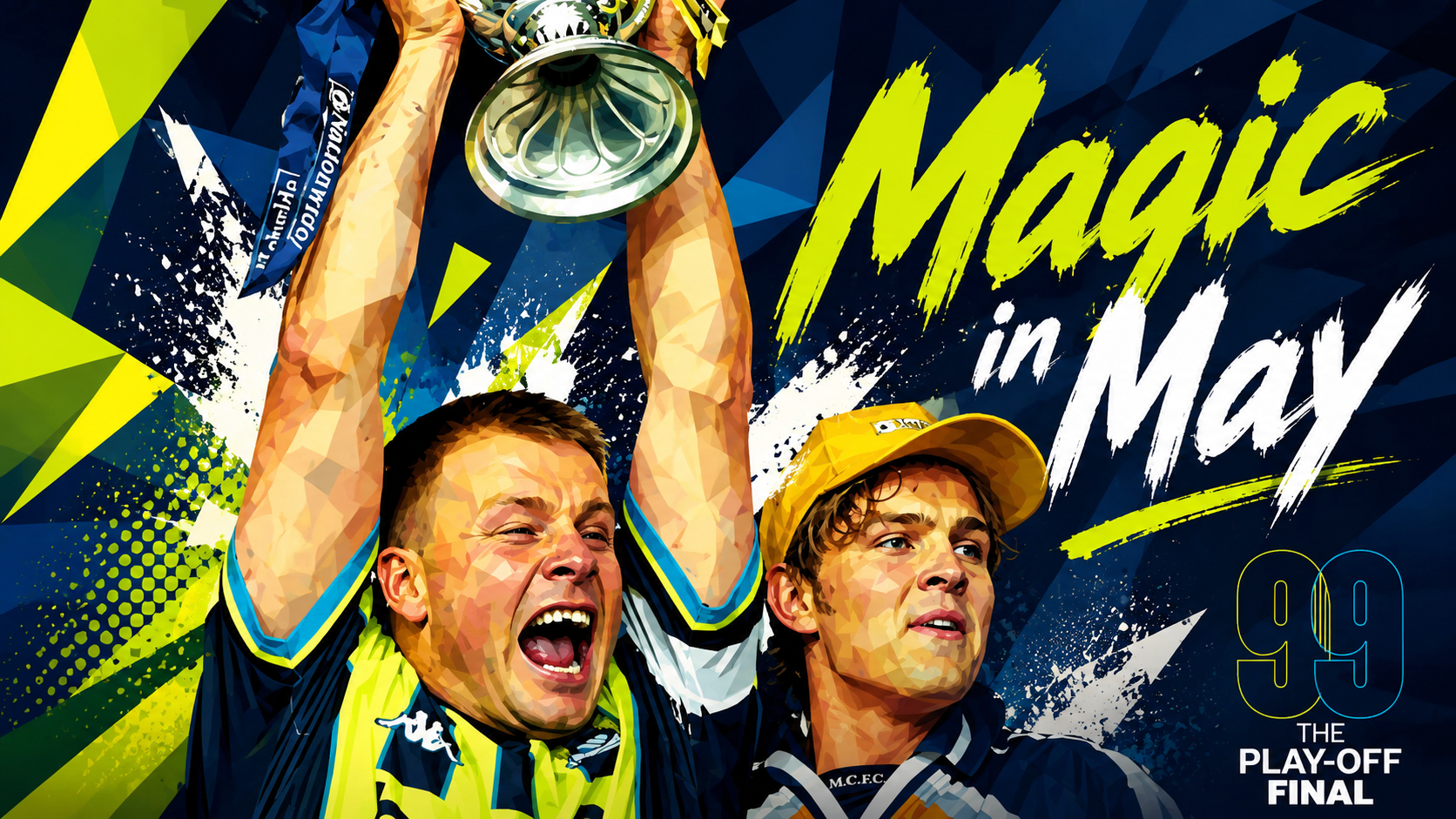
Before the billions, before Pep Guardiola’s perfection and before Manchester City became the defining English club of the modern era, there was Wembley, Gillingham, Paul Dickov, Andy Morrison and five minutes that stopped a broken institution from falling further into the void on May 30th, 1999.
94 Minutes
Paul Dickov never really sees the ball cleanly.
Years later, he would still describe the moment in fragments rather than sequence. Noise. Bodies. Panic. Instinct. Wembley collapsing inward on itself. The sensation that Manchester City’s entire recent history had suddenly narrowed into one violent swing of his left foot.
The clock had moved into the fifth minute of stoppage time.
Manchester City were losing 2-1 to Gillingham in the 1999 Football League Second Division play-off final at the old Wembley Stadium. Ninety seconds earlier, most of their supporters had accepted the inevitable. Some were already outside the stadium, drifting down Wembley Way in stunned silence, trying to beat the queues before the humiliation became complete.
Inside the ground, the emotional atmosphere had curdled into something darker than disappointment. Resignation. Manchester City had spent the previous three years teaching their supporters that catastrophe was not an interruption to normality. It was normality.
Now it was happening again.
Andy Morrison sat on the substitutes’ bench with his knee swollen beneath layers of strapping and painkillers. He had been forced off midway through the second half, physically incapable of continuing. Across from him, the Gillingham bench had started to believe promotion was theirs. The game was almost over. Everyone could feel it.
Then Gerard Wiekens launched one final ball into the Kentish chaos.
Shaun Goater challenged beneath it. Kevin Horlock helped keep the attack alive. The ball dropped into Dickov’s path. One touch. Shift. Strike.
The shot rose violently through bodies and into the roof of Vince Bartram’s net.
For a second, Wembley seemed unsure how to respond. The sound arrived in stages. First shock. Then disbelief. Then a roar so enormous it appeared to shake loose years of accumulated dread from the stadium’s concrete spine.
Dickov sprinted towards the touchline before collapsing onto his knees, fists clenched so tightly his forearms trembled. Behind the goal, City supporters were falling over seats, grabbing strangers, crying into scarves. Those who had begun leaving heard the explosion behind them and turned back towards the stadium, suddenly aware that something impossible had happened.
Morrison looked across at Gillingham again.
The certainty had disappeared.
Tony Pulis stood in his technical area with the look of a manager trying to restore order to a moment that had stopped obeying football logic. His players suddenly looked terrified. Not tactically concerned. Terrified. Football matches occasionally reach a point where momentum stops behaving rationally and begins behaving emotionally instead.
And Manchester City, the club that had spent years collapsing under pressure, had abruptly become the emotional centre of the entire stadium.
Dickov’s goal did not feel like an equaliser.
It felt like something refusing to die.
The Goal That Made the Modern Club Possible
Modern Manchester City presents itself as inevitable.
The immaculate football. The precision passing structures. The endless depth of elite talent. The trophies stacked one after another beneath the cold certainty of Pep Guardiola’s control. To younger supporters, especially those raised during the Abu Dhabi era, City can appear less like a football club than a permanent condition of modern English football. Powerful. Rich. Unavoidable.
But Manchester City were not built through inevitability.
They were built through survival.
That distinction matters because it changes the entire meaning of the modern club.
The popular shorthand reduces City’s rise to September 2008, when Sheikh Mansour purchased the club and transformed the financial architecture of English football overnight. Money became the origin story. Everything before it became prologue. Years to skim past quickly before arriving at Sergio Agüero, Vincent Kompany, David Silva, Kevin De Bruyne, Erling Haaland and the Guardiola machine.
Yet the real foundations of modern City were laid nine years earlier in a far less glamorous environment. Third-tier football. Mounting debt. Rotting confidence. Public embarrassment. A club losing credibility while their neighbours conquered Europe.
Had Dickov’s shot drifted six inches higher that May afternoon in 1999, there is every chance the modern institution never exists in its current form.
This is not romantic exaggeration. It is structural reality.
At the time of the play-off final, City were financially strained, competitively diminished and psychologically broken. They had cycled through managerial chaos. Their squad had become bloated and uneven. Maine Road, magnificent in memory but increasingly restrictive in reality, was becoming an ageing home at precisely the moment elite English football was accelerating commercially after the Premier League boom of the 1990s.
The club desperately needed promotion. Not only for revenue, but for legitimacy.
Without it, one of the most important developments in City’s modern history may never have materialised: the move to the City of Manchester Stadium, built for the 2002 Commonwealth Games and later adapted as the club’s new home.
David Bernstein, City’s chairman, understood the stakes more clearly than most. A measured, forensic figure by temperament, Bernstein recognised that football sentiment alone would not save Manchester City. The club needed scale. Infrastructure. Stability. Future-facing credibility.
Third-tier football threatened all of it.
Handing a state-of-the-art stadium project to a club trapped in the Second Division would have looked politically and commercially difficult. Without promotion, the council’s confidence in City as future tenants weakens. Without the stadium, City lose the asset that later made them a far more attractive investment proposition. Without that investment, the modern superclub never fully emerges.
The chain is uncomfortable because it strips away mythology and replaces it with consequence.
Dickov’s goal did not create the empire by itself. Football history is never that simple. But it kept the club alive long enough for the empire to become possible.
And perhaps that is why the moment still feels strangely emotional even now, despite everything City have achieved since.
Supporters instinctively understand what was truly hanging in the balance that afternoon.
Not merely promotion.
Existence.
For decades, City had lived with the uneasy sense that they were a large club vulnerable to behaving like a small one. The 1990s intensified that fear until it became almost existential. Relegation to the third tier was not just failure. It was humiliation on a national scale. Manchester United were becoming the dominant commercial force in world football while City drifted towards institutional irrelevance.
That contrast scarred the support.
Which is why the defining emotion of 1999 was never hope.
It was shame.
And shame changes the psychology of football supporters in ways success rarely understands.
Cityitis: The Club That Expected Disaster
Long before Manchester City became the most clinically efficient team in Europe, they became English football’s great warning about institutional collapse.
Not sudden collapse. Slow collapse. The kind that corrodes confidence year by year until failure starts feeling culturally embedded inside the club itself.
By the late 1990s, City supporters had developed a vocabulary for it. They called it “Cityitis”.
The phrase sounded half-joking, which made it more dangerous. Football supporters often turn trauma into humour because humour is easier to carry. But beneath the self-deprecation sat something very real: the belief that Manchester City possessed a unique psychological ability to destroy themselves whenever stability appeared within reach.
That atmosphere had not emerged from nowhere. It had been built through years of chaos.
When City were relegated from the Premier League in 1996 under Alan Ball, the assumption across English football was that they would recover quickly. Clubs of City’s scale were not supposed to linger outside the top division. They had history, support, infrastructure and commercial potential. Even diminished, they still felt too large for the Football League’s lower reaches.
Instead, the club unravelled.
Ball was dismissed. Steve Coppell arrived and resigned after just 33 days, citing the pressure of the job. Frank Clark followed, but stability remained elusive. Players came and went in waves. Expensive signings failed. Dressing-room standards deteriorated. Confidence disappeared.
Every attempted solution created fresh disorder.
By the spring of 1998, relegation to the third tier had become a genuine possibility. Yet even then, City managed to descend in a fashion uniquely tailored to intensify humiliation.
The defining image arrived at Loftus Road in April 1998.
Against Queens Park Rangers, with survival slipping away, Jamie Pollock attempted to deal with a routine ball near his own penalty area. Instead, City’s captain produced one of the most infamous own goals English football has ever seen, flicking the ball over his own goalkeeper after a piece of improvisation collapsed into farce.
The moment instantly escaped football and entered culture. Television blooper reels replayed it endlessly. Rival supporters weaponised it. National newspapers treated it as slapstick comedy.
For City fans, though, the goal carried a deeper psychological damage.
It confirmed something they had already begun suspecting: the club no longer merely lost matches.
It humiliated itself publicly.
Weeks later, City beat Stoke City 5-2 on the final day of the season, but survival depended on results elsewhere. Confirmation arrived that Portsmouth had done enough. City were relegated anyway.
That distinction matters because it captures the emotional difference between ordinary sporting failure and identity collapse.
Manchester City did not feel temporarily unsuccessful in 1998.
They felt absurd.
Meanwhile, across town, Manchester United were accelerating towards global dominance under Alex Ferguson. The contrast between the two clubs became grotesque. United had become modern football’s defining commercial and sporting force. City had become a cautionary tale.
By 1999, younger supporters were beginning to inherit fatalism before they had inherited success.
Away trips to places like York, Macclesfield and Colchester no longer felt like temporary detours. There were moments when they felt like the club’s natural level. That is what prolonged dysfunction does to football institutions. It shrinks imagination first. Then ambition. Then standards.
And still the humiliations kept arriving.
In December 1998, City lost 2-1 at home to Mansfield Town in the Auto Windscreens Shield in front of barely 3,000 supporters at Maine Road. Eleven days later came defeat at York City, leaving Joe Royle’s side sitting 12th in the table, closer to the relegation zone than automatic promotion.
Some supporters had stopped believing promotion was even realistic. Others feared something worse entirely: that Manchester City might settle permanently into mediocrity and slowly lose the cultural weight that once made them matter.
That fear sat underneath everything.
Football clubs rarely disappear overnight.
Usually they decay gradually, while everyone keeps insisting recovery is inevitable right up until the moment it no longer is.
And by the winter of 1998, Manchester City looked dangerously close to becoming one of English football’s great historical warnings rather than one of its future superpowers.
Joe Royle and the Removal of Illusion
Joe Royle did not arrive at Manchester City promising reinvention.
He arrived promising honesty.
That distinction became the foundation of the entire recovery.
For years, City had behaved like a club trapped between memory and reality. The institution still carried the self-image of a major force in English football, yet the daily standards inside the club no longer reflected it. Too many players had arrived expecting status without responsibility. Too many managers had attempted cosmetic repair while the deeper psychological damage spread underneath them.
Royle recognised almost immediately that the club’s biggest problem was not tactical.
It was emotional dishonesty.
City were still trying to feel like Manchester City while functioning like a collapsing Football League side.
Royle had no interest in protecting illusions.
A former Everton centre-forward who had grown up inside one of English football’s most emotionally demanding cultures, Royle understood wounded clubs instinctively. He understood crowds that turned anxious quickly. He understood the psychology of expectation curdling into self-destruction. Most importantly, he understood that lower-division football punished vanity more brutally than almost any other level of the English game.
Royle’s principle was blunt: City had to earn the right to play.
At Maine Road, that became almost ideological.
This was not a division where reputation mattered. Opponents did not care about City’s history, support or former status. They cared about pressing them physically, unsettling them psychologically and forcing them into panic. Every away ground became an exercise in confrontation. Tiny dressing rooms. Hostile terraces. Difficult pitches. Long throws. Early tackles. Chaos.
And for a while, City failed to cope with any of it.
The squad initially looked too soft for the environment. Technically decent in places, but emotionally fragile. Too many players expected games to unfold according to status. Too many still believed opponents would eventually submit to the size of the shirt.
The division did not work like that.
So Royle stripped the club back to essentials.
The tactical reset reflected the psychological one.
Forget elaborate possession football. Forget stylistic vanity. Forget trying to look superior. Royle built a side designed specifically for the conditions surrounding it. Direct when necessary. Aggressive always. Emotionally durable above everything else.
In many ways, the football became an act of institutional realism.
City stopped trying to perform like a fallen Premier League club and started behaving like a team capable of surviving the Second Division.
That shift sounds simple now. At the time, it was deeply uncomfortable.
Some supporters disliked the pragmatism initially. Maine Road had always carried romantic expectations about football. Even during decline, parts of the support still craved entertainers. Players like Ajax-bound Georgi Kinkladze had become cult figures precisely because they offered escape from the surrounding dysfunction. Kinkladze could drift past defenders and briefly make the club feel magical again.
But Royle understood something fundamental: magic without structure was partly what had helped create the collapse in the first place.
The decision to sell Kinkladze to Ajax in 1998 felt emotionally devastating to many supporters. He was one of the few genuinely elite talents still associated with the club. Yet the sale also symbolised a wider philosophical shift.
City could no longer afford sentimentality.
Financially or emotionally.
Bernstein supported Royle fully in that approach. Unlike the instability that had infected previous regimes, the relationship between chairman and manager became unusually aligned. Bernstein brought restraint, discipline and strategic planning. Royle brought emotional authority.
Together, they began removing the panic from the institution.
Not immediately. Not cleanly. But gradually.
One of Royle’s greatest strengths during that period was his refusal to escalate the hysteria surrounding the club. While supporters and media often framed every setback as existential catastrophe, Royle projected something calmer. Not optimism exactly. More stubborn practicality.
After defeats, he resisted melodrama.
After victories, he resisted sentimentality.
He understood that broken football clubs often sabotage themselves by swinging emotionally between extremes. City needed stability more than inspiration.
That steadiness became critical during the winter of 1998, when pressure intensified after the defeat at York City left promotion hopes seemingly collapsing. In previous years, panic might have triggered another managerial change or another cycle of short-term decisions.
Instead, Bernstein held his nerve.
Royle doubled down.
And slowly, the mood inside the dressing room began changing.
Not because City suddenly became technically brilliant.
Because they stopped pretending to be something they were not.
Andy Morrison: The Captain Holding Himself Together
Andy Morrison looked exactly like the kind of footballer Joe Royle believed the club needed.
Broad shoulders. Broken nose. Permanent scowl. A centre-half built less for elegance than confrontation. When Royle signed him from Huddersfield Town in November 1998, the reaction inside football was mixed between curiosity and alarm.
Morrison carried baggage everywhere he went.
He had already developed a reputation as one of the most intimidating defenders outside the Premier League. At previous clubs, teammates and opponents alike spoke about him with a mixture of admiration and caution. He fought constantly. Sometimes literally. Stories followed him through dressing rooms like rumours escaping ahead of a storm.
Manchester City had become physically and psychologically weak. Royle was recruiting somebody capable of hardening the environment immediately.
And Morrison did exactly that.
Training intensity changed almost overnight. Standards sharpened. Excuses disappeared. Younger players suddenly found themselves accountable not only to coaching staff but to a captain who treated every loose pass and every timid challenge like a personal insult.
But the harder Morrison drove himself publicly, the more chaotic his private life became.
This is where the story becomes more uncomfortable than football nostalgia usually allows.
Because Morrison was not simply battling pressure or poor form. He was battling severe alcoholism while trying to captain one of the biggest clubs outside the Premier League through institutional crisis.
At the height of his addiction, drinking binges regularly consumed stretches of time. Morrison later admitted there were periods where alcohol governed almost every aspect of his emotional life. Anger, insecurity, fear, self-loathing. Everything intensified once he left football environments and returned home.
And the deeper Manchester City sank into chaos, the more dangerous that cycle became.
In January 1999, during a break in fixtures, Morrison disappeared into one of the darkest spirals of his life. After days of heavy drinking, he eventually woke up inside a police cell in Inverness with virtually no memory of how he had arrived there.
The details almost sound fictional in retrospect. Scotland. A police cell. Manchester City’s captain mentally disintegrating while the club itself threatened to collapse around him.
Yet perhaps that was why Morrison resonated so deeply with supporters later.
He reflected the club’s condition back at itself.
Broken. Furious. Ashamed. Still fighting.
When Morrison returned to Maine Road after the Inverness episode, he expected destruction. Fine. Suspension. Public humiliation. Perhaps even dismissal. Football in the 1990s rarely dealt compassionately with vulnerability, particularly inside dressing-room cultures where weakness was often treated as contamination.
Instead, Royle surprised him completely.
Rather than screaming, Royle asked about him as a person. Morrison later said it was the first time he had felt spoken to like a human being rather than merely a footballer.
That matters because it reveals something central about Royle’s management during this period. He was not merely rebuilding a team. He was rebuilding damaged men inside a damaged institution.
Morrison stopped drinking shortly afterwards.
Not instantly cured. Not magically transformed. Recovery is never that clean. But the trajectory changed. The self-destruction that had threatened to consume him began loosening its grip.
And almost simultaneously, Manchester City’s season began changing too.
It is tempting to romanticise that correlation. Football writing often turns personal redemption into sporting destiny. The reality was more complicated than that.
But there was something symbolically powerful about City finally stabilising once their captain stopped destroying himself.
From February onwards, Morrison became the emotional centre of the dressing room. His relationship with supporters deepened because they recognised authenticity in him. He did not speak like a polished football celebrity. He sounded angry, vulnerable and occasionally combustible. In a period where the club felt detached from its own identity, that honesty mattered.
Teammates often described him less as a conventional captain and more as a force that altered the emotional temperature of entire matches.
That presence became especially important in the Second Division, where intimidation frequently shaped games before tactics even mattered. Morrison relished hostile environments. Tight grounds. Aggressive forwards. Aerial duels. He treated them like personal invitations.
Yet even while City surged towards the play-offs, Morrison’s body was beginning to collapse underneath him.
His knee had become a chronic problem. Swelling. Fluid build-up. Constant pain. By the end of the season, he was effectively managing damage rather than fitness. Before the play-off final at Wembley, his knee required heavy treatment just to get him onto the pitch.
He lasted until the 61st minute.
Then even Morrison could not fight his own body anymore.
As he limped from the pitch that afternoon, Manchester City lost more than a defender.
They lost the emotional axis around which the entire team had been rotating.
Direct, Ugly, Necessary
The great mistake struggling clubs often make is believing reputation alone should exempt them from reality.
Manchester City had spent years doing exactly that.
Too many players arrived expecting the division to bend around the badge. Too many managers tried imposing top-flight ideas onto Football League conditions that demanded something harsher and more practical. By the time Royle rebuilt the side during the second half of the 1998/99 season, one principle had become unavoidable:
Survival would require surrendering vanity.
So City built a team that matched the division instead.
Not beautifully. Not elegantly. But honestly.
The tactical framework was simple enough to look almost primitive through a modern lens. A rigid 4-4-2. Direct service into the forwards. Aggressive pressing in midfield. Wide delivery whenever possible. Territory over aesthetics. Duels over patterns.
But simplicity was precisely the point.
Royle understood the Second Division punished hesitation. Endless technical refinement meant little on heavy winter pitches against compact, physical opponents who viewed matches against City as season-defining occasions. Every away trip carried emotional hostility. Every ground became smaller. Tighter. More confrontational.
In those environments, football often reverted to psychology before quality.
City needed players capable of surviving emotionally first.
That was why the side worked.
Not because it was technically superior across the board. Because it finally reflected the conditions around it.
At the back, Morrison and Gerard Wiekens formed a partnership built on contrast. Morrison attacked danger violently. Wiekens absorbed it calmly. The Dutch defender became one of the smartest acquisitions of the era precisely because he brought balance to the chaos around him. While Morrison dominated physically, Wiekens read transitions early, covered space intelligently and distributed possession without panic.
Behind them stood Nicky Weaver.
At the beginning of the season, Weaver was effectively an afterthought. Young, inexperienced and not expected to become central so quickly, he seized his chance and became one of the defining figures of the campaign.
His clean-sheet record eventually became part of the season’s mythology.
That statistic alone understates his importance.
Weaver represented composure at a club addicted to emotional overreaction. While older players occasionally carried the weight of previous collapses into matches, Weaver played with the fearlessness of somebody not yet fully scarred by City’s dysfunction. His reflexes were outstanding, but it was his temperament Royle valued most. Calmness had become a tactical resource.
In midfield, City deliberately prioritised energy over artistry.
Michael Brown played football like a permanently irritated man trying to settle an argument. Aggressive in the tackle and endlessly confrontational, Brown brought edge to a team that had previously been too easy to disrupt physically. Beside him, Kevin Horlock offered left-footed balance and dead-ball quality, while Ian Bishop provided occasional moments of control and intelligence when matches threatened to descend entirely into chaos.
Then there was Terry Cooke.
Signed on loan from Manchester United, Cooke carried the unusual distinction of becoming a City favourite despite his United origins. Fast, fearless and relentlessly direct, he stretched games vertically in ways the squad desperately needed. His delivery from wide areas became central to Royle’s approach because City were not trying to dominate possession. They were trying to destabilise opponents emotionally and territorially.
Everything ultimately revolved around the front two.
Paul Dickov and Shaun Goater should not really have worked together on paper.
Dickov was small, furious and exhausting to play against. A forward who seemed to spend entire matches sprinting into defenders purely to aggravate them psychologically. He lacked physical presence but compensated through relentlessness.
Goater, meanwhile, moved with an awkwardness that initially made some supporters sceptical. His first touch could look clumsy. His running style seemed strangely uncoordinated. There were moments where he appeared technically incompatible with the rhythm of elite-level football altogether.
And then the ball would arrive inside the penalty area.
Suddenly everything simplified.
Goater possessed the rarest instinct in football: he understood where goals were about to happen before anyone else on the pitch did. Deflections, rebounds, second balls, loose touches, near-post flicks. He lived inside chaos instinctively. The chant “Feed The Goat And He Will Score” became popular partly because it captured something brutally accurate about his game. Complexity was unnecessary. Supply him and eventually he would punish somebody.
Together, Dickov and Goater reflected the broader identity of the team itself.
Functional rather than fashionable.
Emotionally relentless rather than technically pure.
And perhaps that was why supporters connected with them so deeply.
City fans in 1999 were not looking for performers anymore.
They were looking for footballers willing to fight the division on its own terms.
Wembley: The Collapse
By the time Manchester City arrived at Wembley on 30 May 1999, promotion already felt emotionally exhausting.
The play-off semi-final against Wigan Athletic had drained the club psychologically. The second leg at Maine Road had been tense, hostile and chaotic, culminating in Shaun Goater’s controversial winner, a goal Wigan players furiously insisted had involved a handball.
City did not apologise.
They had spent too long on the wrong side of football’s cruelty to feel guilty about finally benefiting from it.
Still, the semi-final reinforced something important about Royle’s side: they were emotionally surviving matches more than controlling them.
That distinction became critical at Wembley.
Tony Pulis arrived with a Gillingham team perfectly constructed to exploit City’s anxieties. Organised, disciplined and deeply unpleasant to play against, Gillingham approached the final like a siege operation. Pulis understood that City’s greatest vulnerability was not tactical sophistication.
It was emotional panic.
So Gillingham built the afternoon around frustration.
Their defensive shape stayed narrow and aggressive. Midfield runners collapsed into defensive areas quickly. Space disappeared almost immediately whenever City tried progressing centrally. Long balls became aerial battles. Second balls became collisions. Rhythm vanished.
The game unfolded exactly how Pulis wanted.
City’s early possession carried nervous energy rather than authority. Cooke struggled to isolate defenders consistently out wide. Dickov chased tirelessly but rarely found space. Goater spent long stretches wrestling physically rather than threatening goal.
As minutes disappeared, anxiety spread around Wembley.
This was the problem with carrying years of institutional trauma into high-pressure matches. Supporters did not experience tension normally anymore. Every misplaced pass felt predictive. Every failed attack triggered old memories. The crowd did not merely fear defeat.
They anticipated it.
When Morrison limped off in the 61st minute, the emotional balance shifted visibly.
His influence on the team extended far beyond defending. Morrison regulated the psychological temperature of matches. Without him, City looked smaller somehow. Less certain. Gillingham sensed it.
Then came the collapse.
In the 81st minute, Carl Asaba drifted into space and finished beyond Weaver after a sharp Gillingham move finally punctured City’s resistance. The Gillingham supporters exploded. Blue-and-white shirts crashed into one another in disbelief.
City looked stunned.
Five minutes later, Robert Taylor scored again.
The second goal felt less like concession and more like emotional detonation. Taylor slid the ball beyond Weaver with brutal calmness. On the touchline, Royle briefly lowered his head towards the turf as if trying physically to absorb the reality unfolding in front of him.
Around Wembley, City supporters began leaving.
Not dramatically. Quietly.
Thousands drifted towards the exits wearing the numb expressions familiar to anybody who had followed the club through the 1990s. The reaction was not rage. Rage requires surprise. This felt closer to exhausted recognition.
Of course this was happening.
Of course Manchester City would reach Wembley only to collapse in front of the entire country.
The wider context deepened the humiliation.
Four days earlier, Manchester United had completed the Treble by defeating Bayern Munich in the Champions League final at the Camp Nou. United were becoming the dominant force of the global game. Their players looked like international celebrities. Their manager appeared immortal.
Meanwhile, Manchester City were minutes away from spending a second consecutive season in the third tier after being outmanoeuvred by Gillingham.
For older supporters especially, the contrast felt unbearable.
Some could not watch the closing stages properly. Others stared blankly at the pitch without speaking. Fathers tried consoling children who had inherited City not as joy but as ritual disappointment.
That was the fear underneath everything.
Not losing a final.
Not missing promotion.
Permanent decline.
Football clubs of City’s size are not supposed to reach this point. Once they do, supporters begin wondering whether the institution itself has been fundamentally damaged beyond repair.
And at 2-0 down in the 89th minute, Manchester City looked like a club finally being swallowed by the weight of its own history.
The Resurrection
Kevin Horlock did not strike the ball like a man who believed he was saving anything.
He hit it like a footballer releasing frustration.
Ninety minutes had almost elapsed when the loose ball rolled towards him on the edge of the area. Bodies crowded the box. Legs blocked his sightline. Hope had already started leaking from the stadium in visible waves.
Horlock swung anyway.
The shot stayed low, skidding through traffic before slipping beyond Bartram and into the corner of the net.
For a moment, the reaction inside Wembley felt strangely restrained. City supporters celebrated, but with confusion wrapped around the noise. There was barely time left. The goal resembled consolation more than rescue.
Then the fourth official raised the electronic board.
Five additional minutes.
Suddenly the atmosphere changed.
People who had already started leaving froze in stairwells. Supporters outside the stadium heard the roar ripple outward and turned back. Tony Pulis sensed the emotional momentum shifting immediately.
That was the danger with defensive football in moments like these. Once panic enters the structure, the structure itself starts collapsing. Gillingham had spent more than eighty minutes controlling space, tempo and emotion expertly. Now they looked trapped by their own fear of losing everything.
City surged forward recklessly.
Not tactically. Emotionally.
Long balls. Second balls. Bodies thrown into challenges. The football itself almost stopped mattering. Wembley had entered that rare territory where matches become governed by collective psychology instead of systems.
Then Wiekens launched one final ball towards the penalty area. Goater challenged beneath it. Horlock helped it on. Suddenly it dropped into Dickov’s path.
Dickov barely had time to think.
One touch.
Left foot.
Violence.
The shot exploded upward into the roof of the net before Bartram could react fully.
Then came the noise.
Not celebration initially. Shock.
Wembley seemed to inhale all at once before detonating.
Dickov sprinted away screaming, arms outstretched, eyes almost wild with disbelief. Behind him, City supporters crashed over rows of seats in scenes that looked closer to emotional collapse than joy. Grown men cried openly. Strangers grabbed one another by the face. Some supporters would remember almost nothing for several seconds afterwards except sound.
On the bench, Morrison stood up so quickly he nearly lost balance on his damaged knee.
Across from him, Gillingham players looked physically shattered by what had happened. Their earlier confidence had vanished completely. Some stared at the turf. Others screamed furiously at teammates. Pulis paced the touchline with both hands on his head, trying desperately to restore order to a situation no longer behaving rationally.
Dickov later admitted the moment itself passed in a blur.
That makes sense.
Footballers are often asked to explain iconic moments as though they experienced them cinematically, frame by frame. Usually they do not. Adrenaline compresses memory. Emotion scrambles sequence.
But one detail remained painfully clear.
The goalkeeper beaten by Dickov’s shot was Bartram, one of his closest friends in football. Bartram had been best man at Dickov’s wedding. For one second at Wembley, friendship disappeared completely.
Dickov’s shot took a slight deflection off Darren Carr, lifting cruelly over Bartram’s reach. Tiny margins. Careers and histories bending around inches.
The emotional violence of the equaliser reached beyond the pitch because it ruptured something deeper around the club itself.
For years, Manchester City supporters had conditioned themselves against hope. Hope had become dangerous. Temporary optimism usually preceded humiliation. That defensive instinct had hardened throughout the 1990s until pessimism started functioning almost like self-protection.
Then, in less than five minutes, the entire emotional logic of the club inverted.
The supporters who had spent years expecting disaster suddenly watched disaster happen to somebody else instead.
And Wembley, which had spent most of the afternoon preparing for a funeral, now looked like a stadium trying desperately to process resurrection in real time.
We’re Not Really Here
Extra time barely registered emotionally.
After Dickov’s equaliser, the match no longer felt tethered fully to logic or tactics. Both teams looked physically present but psychologically elsewhere, as though the final twenty minutes were unfolding inside the aftershock of something neither side had fully processed yet.
Gillingham played like a side trying not to lose what they had already held in their hands.
Manchester City played like a team running entirely on adrenaline.
Every tackle carried exhaustion. Every clearance felt desperate. Cramp spread across the pitch. Players bent double during stoppages while Wembley crackled with nervous noise that rose and fell with every loose touch.
Then came penalties.
Even now, older City supporters speak about the shootout with exhausted disbelief rather than excitement. Penalty shootouts require emotional control. Manchester City in 1999 did not feel like a football club built for emotional control.
They felt like a club held together by exposed wiring.
Horlock walked forward first.
Physically shattered. Emotionally overloaded. He scored.
Then Weaver saved Gillingham’s first penalty from Paul Smith.
Then came Dickov.
The hero of normal time suddenly looked painfully vulnerable. Football has always enjoyed emotional cruelty, and there was something almost inevitable about the possibility of Dickov becoming both saviour and destroyer within the same afternoon.
His penalty struck one post.
Then the other.
Then bounced away.
For a second, Wembley froze again.
Dickov stood motionless, staring towards the goal in disbelief. Around the stadium, thousands of supporters felt old fears rushing back into their bodies. This was how City stories usually ended. One step from salvation before finding a fresh way to collapse.
But something fundamental had changed after the equaliser.
The panic had crossed the pitch.
Now it belonged to Gillingham.
Adrian Pennock missed. Terry Cooke scored for City. John Hodge scored for Gillingham. Richard Edghill scored for City.
Then Guy Butters stepped forward needing to keep Gillingham alive.
He hit the penalty down the middle.
Weaver blocked it with his legs.
What happened next became one of the defining images in modern Manchester City history.
Weaver did not celebrate normally. He exploded.
Arms flailing, tongue hanging from his mouth, the 20-year-old goalkeeper sprinted wildly across Wembley turf with the manic energy of somebody no longer fully in control of his own nervous system. Teammates chased after him in chaos while supporters behind the goal dissolved into hysteria.
For a few seconds, Weaver simply kept running.
Morrison later realised the young goalkeeper was about to be crushed beneath a pile of players and dragged him safely to the ground. Morrison then wrapped his body protectively around Weaver as teammates hurled themselves into the celebration. In Morrison’s telling, Weaver screamed at him to get off because he could not breathe.
The detail survived because it perfectly captured the emotional state of the club.
Relief masquerading as madness.
And perhaps that was why the celebrations felt so different from ordinary promotion scenes.
This was not triumph in its purest form.
It was release.
Supporters cried not because City had conquered English football, but because the club had temporarily escaped humiliation and decay. Players collapsed onto the turf looking less victorious than emotionally emptied. Royle shook hands calmly, almost quietly, as though he understood survival rather than glory had always been the true objective.
Then the singing started properly.
“We’re Not Really Here.”
The chant rolled around Wembley with strange force because the words carried emotional weight behind them. Outsiders often interpreted it as simple gallows humour, another example of City supporters mocking their own suffering. The truth was more layered than that.
The chant’s origin has long been discussed within City supporter culture, with accounts linking it to banned away followings, old terrace humour and the grief of supporters after the death of a fellow fan. Whatever its precise beginning, by the late 1990s it had become an anthem for a fanbase that increasingly felt detached from football’s mainstream narrative.
While other major clubs accumulated trophies and commercial status, City drifted into absurdity and irrelevance. The song became both joke and defence mechanism. A way of surviving embarrassment collectively.
At Wembley in 1999, though, the chant sounded different.
Not invisible.
Not absent.
Still alive.
The Club That Survived Long Enough to Become Powerful
The easiest mistake to make with the 1999 play-off final is treating it like the beginning of Manchester City’s rise.
It was not.
Promotion did not transform the club overnight. There was no immediate march towards dominance, no clean upward trajectory from Wembley to global superpower. The years that followed remained turbulent, contradictory and frequently unstable.
City achieved back-to-back promotions under Royle, reaching the Premier League in 2000. A year later, they were relegated again. Royle himself eventually lost his job. Financial concerns persisted. The squad still required major rebuilding. In purely football terms, the club remained volatile for much of the next decade.
But that is partly why the 1999 final matters so much historically.
Its significance was structural before it became sporting.
Bernstein understood this earlier than most. While supporters understandably experienced Wembley emotionally, Bernstein viewed survival through the colder lens of institutional viability. The chairman had spent years trying to stabilise a club that often seemed determined to sabotage itself. Debt reduction, wage control and long-term infrastructure planning mattered to him because he recognised something English football was beginning to reward aggressively by the late 1990s:
scale.
The Premier League era was changing what ambitious clubs needed to become.
Large modern stadiums mattered. Corporate facilities mattered. Commercial flexibility mattered. Emotional history alone no longer guaranteed relevance. Clubs unable to modernise risked slowly being left behind by football’s accelerating economics.
Maine Road remained beloved, but emotionally charged stadiums do not always function efficiently inside modern football systems. The ground was ageing. Revenue potential was limited. Matchday infrastructure increasingly lagged behind emerging standards elsewhere in the country.
The proposed move to the new City of Manchester Stadium therefore became central to the club’s future.
Without promotion in 1999, that future becomes far murkier.
Manchester City as a third-tier institution would have represented a deeply uncomfortable political and commercial proposition for the city council’s Commonwealth Games planning. Handing a newly built stadium to a club trapped in long-term decline would have carried obvious risks. Promotion restored credibility at precisely the moment City most desperately needed it.
Bernstein later helped steer the club towards the stadium move that became reality for the 2003/04 season. In hindsight, it became one of the most consequential administrative developments in the club’s modern history.
Because infrastructure changes investment possibilities.
When Sheikh Mansour’s Abu Dhabi United Group eventually purchased the club in 2008, they inherited more than a football team. They inherited a modern stadium, a huge urban footprint, significant supporter culture and enormous untapped commercial potential inside one of the world’s most watched leagues.
That combination mattered enormously.
Without it, Manchester City may still have attracted investors eventually. But they would not have represented the same scale of opportunity.
Which is why reducing City’s modern rise purely to money misses something essential about football institutions. Wealth accelerates trajectories. Usually it does not create them entirely from nothing.
The 1999 team helped ensure there was still a trajectory available to accelerate.
Culturally, the play-off final embedded itself even deeper.
Not because it was the club’s greatest achievement. It clearly was not. Guardiola’s side have since won Trebles, accumulated league titles and produced football of historic sophistication. Statistically, the 1999 promotion barely registers beside modern success.
Emotionally, though, it occupies different territory.
For many supporters, especially those who lived through the 1990s, Wembley became the emotional dividing line between old City and modern City. Before it came humiliation, drift and self-destruction. Afterwards came the possibility, however fragile initially, that the club might finally stop collapsing under the weight of itself.
That emotional memory still shapes the culture around the club now.
It explains why older supporters occasionally look faintly detached amid modern triumphs. Success did not erase the trauma of the 1990s entirely. It simply layered over it. Many fans who now watch Haaland score against Europe’s elite still remember Mansfield, York and Wembley because those experiences altered how they understood football permanently.
The suffering became part of the identity.
In some ways, modern Manchester City’s relationship with success remains psychologically different from clubs raised continuously at the top of the game. There is still an undercurrent of disbelief buried beneath the dominance. A memory of being ridiculous. A memory of being mocked. A memory of watching the club drift so close to irrelevance that survival itself briefly became the ambition.
That history matters because it gives context to the modern machine.
Without the shame of the late 1990s, the current perfection risks looking sterile.
Without the panic of Wembley, the trophies become easier but less meaningful.
And without Dickov’s goal, there is every chance the modern institution never receives the opportunity to become powerful enough to change English football forever.
Before the Perfection
Now, when Manchester City play football, everything appears choreographed.
The positioning. The rotations. The angles. Players drift into space before danger even develops, as though the game itself has already been solved several passes in advance. Under Guardiola, City became the embodiment of modern control, a side capable of suffocating elite opponents through precision alone.
Nothing about the current club resembles panic.
Which is partly why May 1999 still feels so important.
The modern institution was not born from control.
It was born from chaos.
Before the billions arrived. Before the trophies. Before the global supporter base and the immaculate football and the arguments about financial power, there was a broken football club in the third tier trying desperately not to disappear into its own humiliation.
There was Andy Morrison, barely able to walk.
There was Nicky Weaver sprinting wildly across Wembley with adrenaline pouring out of him.
There was Joe Royle stripping illusion away from a club that had spent years lying to itself.
And there was Paul Dickov, a five-foot-five striker with exhaustion in his legs, swinging at a loose ball because there was nothing else left to do.
That is the part of Manchester City’s story modern football sometimes struggles to understand.
The soul of the club was not built during the years of dominance.
It was built during the years when dominance felt impossible.
When supporters travelled to York and Macclesfield wondering how much lower things could fall. When Maine Road carried embarrassment as heavily as history. When “We’re Not Really Here” sounded less like terrace humour and more like an honest description of institutional drift.
The wealth changed Manchester City permanently.
But survival came first.
And perhaps that is why Dickov’s goal still resonates so deeply across generations of supporters who have since witnessed far greater achievements. Sergio Agüero’s title winner in 2012 altered the Premier League. Guardiola’s Treble winners conquered Europe. The modern side may ultimately become one of the defining football institutions of the century.
Yet none of it exists without the afternoon City refused to vanish.
At 2-0 down in the 89th minute, the club stood frighteningly close to becoming a historical warning about decline, mismanagement and wasted potential. Instead, somewhere inside five chaotic minutes at Wembley, the trajectory of English football bent in another direction entirely.
Manchester City rule the modern game now.
But their soul still belongs to the afternoon they almost ceased to matter.
