


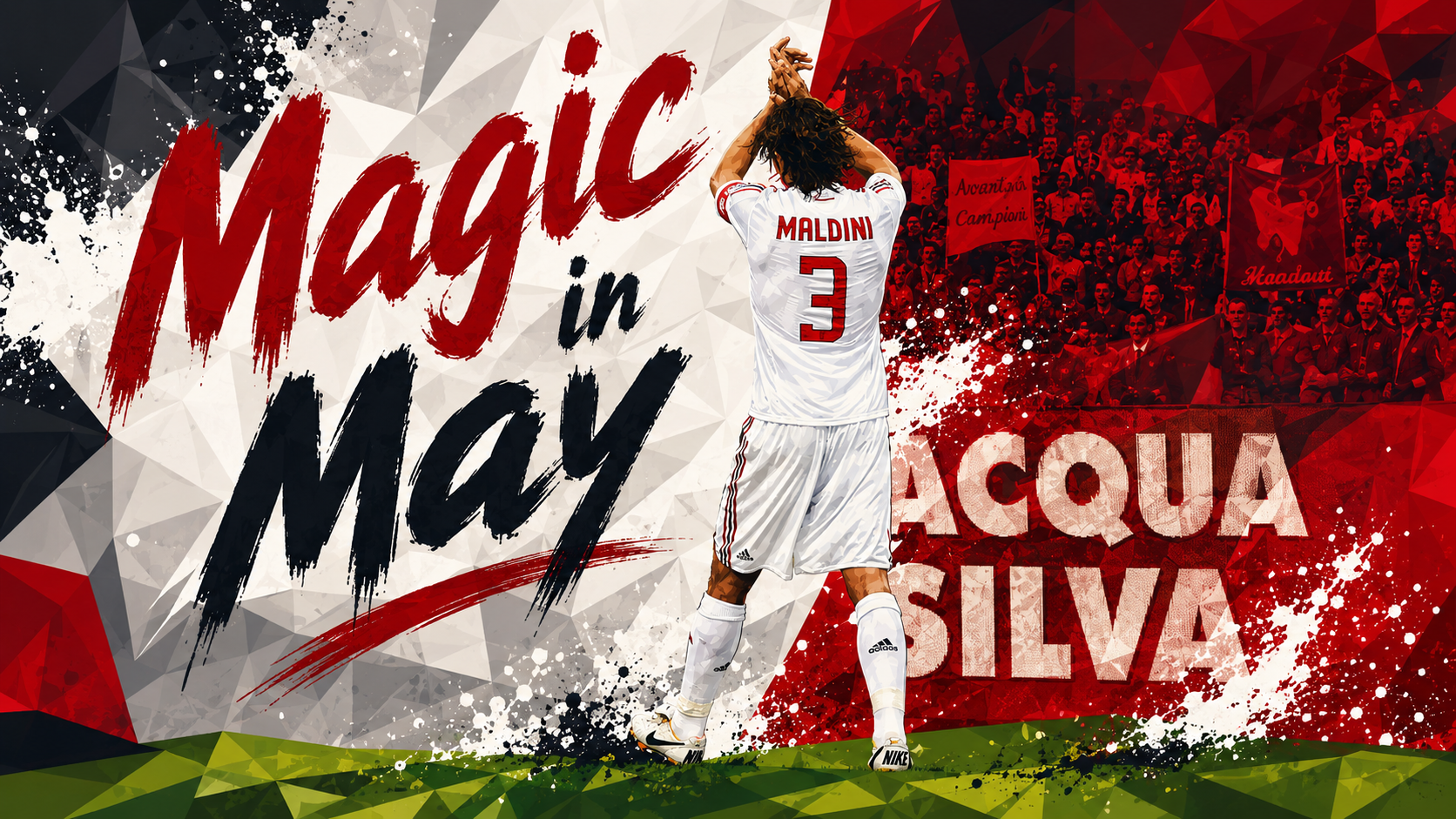
On 31 May 2009, Paolo Maldini played his final professional match away to Fiorentina. It was not a testimonial, not a parade, and not a soft goodbye. It was one last serious game from one of football’s last serious defenders.
Florence, 31 May 2009
The applause began before the match did.
Not the sudden eruption that follows a goal or a substitution, but something steadier and more deliberate. A long recognition. The kind footballers reserve for one another when reputation is no longer enough to explain what they are witnessing.
As AC Milan walked out at the Stadio Artemio Franchi on 31 May 2009, Fiorentina’s players formed a guard of honour for Paolo Maldini. The stadium rose with them. More than 41,000 people stood not because protocol demanded it, but because Italian football understood that one of its permanent figures was about to disappear from the landscape.
There were easier ways for Maldini to leave the game than this.
He could have walked away a year earlier, with his body still intact and his status untouched. He could have accepted a testimonial season built around nostalgia and applause. He could have drifted quietly into reduced appearances, protected from consequence by reputation.
Instead, his final night as a footballer arrived with Milan still needing something.
A draw would guarantee direct qualification for the Champions League group stage. A heavy defeat would allow Fiorentina to overtake Milan and push Carlo Ancelotti’s side towards the qualifying rounds. This was not a ceremonial fixture. It was not a staged farewell. It was a difficult away match against a side still chasing its own reward.
That detail matters because Maldini’s career should never be understood through sentiment alone.
He was 40 years old, approaching his 41st birthday, but Ancelotti still started him because Milan needed control. The night did not ask him to wave. It asked him to defend.
Milan won 2-0 through second-half goals from Kaká and Alexandre Pato. The result secured third place and direct entry into the following season’s Champions League. For Maldini, it was the 902nd and final official appearance of a Milan career that had begun as a 16-year-old in Udine in January 1985.
The neatness of that span is almost absurd. Twenty-four years and four months between first and last. From Udine to Florence. From Nils Liedholm to Carlo Ancelotti. From Serie A’s golden age to the beginning of Milan’s long uncertainty.
Yet nothing about the match felt like theatre.
Florence sat under late-spring heat. Fiorentina attacked with the energy of a side still climbing. Milan carried themselves differently. Older. Smarter. A team relying on rhythm and management rather than force.
At the centre of it all was Maldini, still organising, still adjusting, still playing like this was simply another serious evening.
He did not search for a farewell moment. There were no theatrical surges forward. No attempt to manufacture symbolism. His game remained almost stubbornly functional. He pointed. Closed angles. Shifted across danger early enough to make emergency defending unnecessary.
This had always been his particular gift.
Many great defenders dominate space physically. Maldini removed decisions from attackers before they fully recognised them. Opponents often arrived in the wrong place because he had altered the shape of the attack seconds earlier. By 2009, the speed had faded slightly, but the reading of the game had become almost unnervingly precise.
He seemed to know where attacks would end before they had properly begun.
Around him, Milan still possessed fragments of their old authority. Kaká drifted through midfield with that familiar long-striding elegance. Andrea Pirlo controlled tempo from deep. Clarence Seedorf moved inside to help compress central spaces. Pato stretched Fiorentina whenever Milan escaped pressure.
Yet the team also carried the unmistakable feeling of a cycle reaching its natural conclusion.
Late in the second half, with Milan two goals ahead and the result safe, Ancelotti turned towards his bench and called Maldini over.
The moment arrived quietly.
No grand pause. No staged emotional sequence. Just a substitution board rising into the Florence evening and one final walk towards the touchline.
Maldini removed the captain’s armband and handed it away. Teammates embraced him as he crossed the pitch. Fiorentina supporters stood again. So did the Milan fans. Ancelotti waited near the dugout, his own departure from Milan only hours away, and the two men shared a brief embrace that carried the weight of an era ending all at once.
Then Maldini disappeared from the pitch for the final time as a professional footballer.
Not in Milan.
Not at San Siro.
In Florence.
His Last Game Has Been Forgotten
For most people, Maldini’s career ends a week earlier.
It ends at San Siro against Roma, beneath the hostility of the Curva Sud, with banners hanging from the stands and a section of Milan’s support publicly turning on the greatest defender in the club’s history. That image has hardened into accepted memory because it fits modern football’s appetite for contradiction. Great player betrayed by his own supporters. Romance collapsing into bitterness. An icon denied the ending he deserved.
The story is dramatic, emotional and easy to package.
It is also incomplete.
Maldini’s actual final match came seven days later in Florence, and in many ways it revealed far more about him than the chaos at San Siro ever could. The Roma game exposed the fracture between Maldini and sections of Milan’s ultras. The Fiorentina match exposed something deeper and far more important: the reason that fracture existed in the first place.
Paolo Maldini never built his identity around being loved.
That sounds strange in an era where elite footballers are expected to perform emotional intimacy with supporters almost constantly. Modern football encourages accessibility, public vulnerability and endless symbolic gestures towards fan culture. Players kiss badges they may leave six months later. Every victory becomes a declaration of eternal devotion. Every defeat demands ritual apology.
Maldini belonged to a different football culture.
He believed in professionalism before performance. Standards before sentiment. Even at the height of his fame, there was always something slightly distant about him, as though he regarded the mythology around football with quiet suspicion. He represented Milan completely, but he refused to surrender himself to the theatre surrounding it.
That distinction defined the final years of his career.
His deteriorating relationship with the Curva Sud did not begin suddenly in 2009. It stretched back over years and came from a fundamental disagreement about authority. Maldini rejected the growing power ultras attempted to exert over players and club culture. He resisted the idea that loyalty to Milan required submission to organised supporter groups.
After the Roma match, when asked about those who had abused him, Maldini’s answer was cold and unforgettable: “I am proud to be nothing like them.” It was not the language of reconciliation. It was the language of a man who had drawn a line years earlier and saw no reason to redraw it for the sake of optics.
That is why Florence matters.
Nothing about his final appearance encouraged nostalgia. The match still mattered competitively. Milan still needed the result. Fiorentina were dangerous opponents with their own objective. Ancelotti selected Maldini because he believed he helped Milan control the evening, not because he deserved a ceremonial send-off.
Too often, ageing footballers become symbolic before they retire. Their presence remains culturally significant long after their usefulness begins to fade. Teams carry them out of reverence. Matches become tributes disguised as competition.
Maldini resisted that fate almost until the end.
At 40, with the miles of nearly a quarter-century behind him, he was still starting meaningful Serie A matches because he could still read danger faster than younger players could physically react to it. His authority came not from reputation alone, but from continued functionality.
That is why the Fiorentina match deserves to sit at the centre of his story.
Not because it was glamorous. Milan had experienced far grander nights during Maldini’s career.
Not because it was emotional. Football is full of emotional retirements.
Because it distilled him so precisely. One final high-pressure match. One final disciplined performance. One final evening where he approached football not as mythology, but as work requiring concentration, intelligence and control.
San Siro showed why Maldini could be divisive.
Florence showed why he was great.
The Last Working Night of Old Milan
By the spring of 2009, Milan no longer felt eternal.
The shirts were still famous. San Siro still carried the weight of European history. Opponents still looked at Milan through the lens of what the club had once been. But beneath the surface, something fundamental had shifted. The machine that had dominated Europe under Arrigo Sacchi, Fabio Capello and Carlo Ancelotti was beginning to slow beyond repair.
Maldini’s final game arrived at precisely the moment Milan’s old world started disappearing.
For nearly 25 years, his career had unfolded during one of the most powerful institutional eras football has known. He had entered the first team under Liedholm, become a symbol of Sacchi’s revolution, evolved under Capello’s control and survived long enough to captain Ancelotti’s elegant European side of the 2000s. Through all of it, Milan had operated as footballing aristocracy. Rich, stable, intelligent and feared.
The continuity itself felt unnatural.
Most elite clubs rebuild constantly, cycling through identities every few years. Milan, by contrast, seemed to sustain a single cultural line across generations. Franco Baresi handed authority to Maldini. Sacchi’s positional obsession flowed into Capello’s defensive control. Alessandro Nesta arrived almost as a spiritual successor rather than simply a new signing. Even the club’s aesthetics remained coherent. Milan sides were expected to defend beautifully, dominate intelligently and behave with composure under pressure.
Maldini became the living bridge connecting all of it.
There was even something strangely circular about the geography of his career. He had made his Milan debut away to Udinese on 20 January 1985, another northern Italian ground carrying none of San Siro’s mythology. Twenty-four years later, he left the game not in Milan, but again away from home, with the football itself still mattering.
That continuity was ending by May 2009.
Italian football itself had already begun losing ground internationally. The Premier League’s financial explosion had shifted power north. Spain possessed Lionel Messi and was about to receive Cristiano Ronaldo. Serie A, once the sport’s tactical and economic centre, suddenly looked older than the rest of Europe.
Milan reflected that decline more than any other giant.
Their squad still contained extraordinary footballers, but many belonged to an earlier cycle. Pirlo was 30. Seedorf was 33. Filippo Inzaghi was 35. Gianluca Zambrotta had returned from Barcelona with miles in his legs. Even Kaká, the one truly modern superstar in the side, felt halfway out of the door already. Within days of Maldini’s retirement, he would join Real Madrid in a transfer that symbolised the end of Milan’s ability to keep the world’s best players indefinitely.
Ancelotti was leaving too.
That mattered because his relationship with Maldini represented one of the defining partnerships of Milan’s modern history. They understood football similarly: structurally, calmly, without unnecessary emotional noise. Under Ancelotti, Milan became older but smarter, sacrificing intensity for rhythm and technical control. The team no longer suffocated opponents physically as Sacchi’s side had done, but it could still dominate matches intellectually.
Their final evening together in Florence carried the strange atmosphere of colleagues completing the last shift before the company changes hands.
There was no public grieving yet. Football rarely allows time for that in real time. But the signs were everywhere. Milan were still qualifying for the Champions League, still capable of beating strong sides, still functioning outwardly as a major power. Yet the inevitability had gone. The fear had gone too.
For two decades, European football often approached Milan with psychological inferiority before kick-off. By 2009, opponents increasingly believed age could overwhelm them physically. The aura remained visible, but vulnerable.
That context changes the emotional texture of Maldini’s final match entirely.
He was not leaving at the peak of a dynasty. Nor was he dragging himself through a broken final season inside a collapsing side. Instead, he departed during the uneasy in-between stage where great institutions recognise decline but have not fully accepted it yet.
That is partly why the performance in Florence mattered so much.
Milan still needed professionalism to survive. They could no longer rely on overwhelming superiority. Every weakness had to be managed carefully. Every transition mattered. Every positional mistake carried consequence. Maldini’s intelligence became even more valuable precisely because Milan were no longer dominant enough to control matches effortlessly.
Football often romanticises final games by isolating individuals from their surroundings, as though legends retire independently from history itself. Maldini’s last appearance only gains full meaning when viewed against the wider change happening around him.
His final match was not simply the end of a player.
It was the last competitive appearance of Milan’s old ruling class before modern football finally swept it away.
How Maldini Survived Time
Most defenders age visibly.
The decline usually arrives in stages. First the recovery pace disappears. Then the willingness to defend large spaces fades with it. Eventually, instinct gives way to caution and the game starts happening slightly too quickly around them. Elite forwards sense it before anyone else. The half-yard appears. The body turns slower. Duels that once looked inevitable suddenly become uncertain.
Maldini survived into his forties because his game had never depended on surviving chaos.
That was the fundamental difference.
Even during his athletic peak in the late 1980s and early 1990s, Maldini rarely defended in ways that looked desperate or reactive. He did not build his identity around spectacular last-ditch tackles or physical intimidation. He controlled situations earlier than that. By the time opponents thought they were attacking him directly, he had often already manipulated the conditions of the duel in his favour.
It is why so many clips of Maldini feel strangely modern despite belonging to another era. There is very little wasted movement in his defending. No theatrical aggression. No emotional lunging into challenges. He treated positioning almost mathematically, constantly adjusting body shape and spacing to influence what attackers could realistically do next.
The famous line often attributed to him, “If I have to make a tackle, then I have already made a mistake,” risks becoming worn through repetition, but it accurately reflects his understanding of defending. Maldini viewed tackles as emergency measures rather than expressions of dominance. The ideal defensive action was prevention.
That philosophy became more valuable as his body aged.
By 2009, Maldini no longer possessed the explosive acceleration that once allowed him to recover across enormous distances. In another type of defender, that physical decline might have ended an elite career years earlier. In Maldini, it simply forced further refinement.
He became even more economical.
Watch the Fiorentina match closely and the striking thing is how little he appears to exert himself physically compared with younger defenders around him. He conserved movement constantly. When Fiorentina attempted to break quickly through wide channels, Maldini rarely sprinted recklessly towards the ball. Instead, he adjusted angles early enough to slow the attack before acceleration became necessary.
He understood that most transitions are won or lost in the first two seconds of positioning, not the final tackle.
That understanding came from a football education unlike almost any defender before or since.
Under Sacchi, Maldini learned to defend space collectively inside one of the most demanding systems football had seen. Sacchi’s Milan operated with an aggressive high line that required defenders to move as a single organism. Mistakes in spacing were catastrophic because the entire structure depended on synchronisation. Maldini developed extraordinary spatial awareness inside that system, learning not just where to stand, but how his positioning affected everyone else around him.
Capello hardened those instincts further.
Where Sacchi’s Milan pressed aggressively, Capello’s became colder and more controlled. Maldini evolved from an attacking full-back into a defender capable of governing entire matches psychologically. By the mid-1990s, he was no longer merely winning individual duels. He was shaping the rhythm of games themselves. Opponents slowed down around Milan because Maldini and the defensive line removed obvious solutions before attacks could develop naturally.
Then came the final evolution under Ancelotti.
As Milan aged collectively during the 2000s, Maldini shifted increasingly towards centre-back, where anticipation mattered more than repeated recovery runs. Alongside Nesta, he formed perhaps the most aesthetically complete central defensive partnership of the modern era. Nesta defended through grace and timing. Maldini defended through command and foresight. Together, they made elite forwards appear trapped inside narrowing corridors of space.
And yet the remarkable part of Maldini’s final years was not simply that he remained tactically intelligent. Many older defenders stay intelligent.
It was that he remained trusted against serious opposition.
Ancelotti did not start him against Fiorentina out of sentimentality. Milan still had European qualification at stake. Cesare Prandelli’s Fiorentina were technically sharp, aggressive between the lines and dangerous in transition. Milan needed calm leadership in a difficult away environment and Ancelotti still believed Maldini gave him the best chance of controlling the game.
At 40, that is extraordinary.
Football history is full of great players whose reputations outlived their elite usefulness. Maldini avoided that almost entirely because his game aged intellectually before it aged physically. The decline came slower because so much of his dominance existed in decision-making rather than athletic superiority.
In Florence, during the final match of his career, he still looked like a footballer solving problems before everyone else had fully recognised them.
Florence as Examination
The danger with retirement matches is that memory softens them afterwards.
Everything becomes symbolic. Every touch becomes profound. The football itself disappears beneath the emotion. Players are remembered for waving to supporters rather than the level they actually performed at once the whistle blew.
Maldini’s final match resists that treatment because Fiorentina made sure it remained uncomfortable.
Prandelli’s side had spent the season establishing themselves as one of Serie A’s most technically ambitious teams. They were organised, aggressive between the lines and still carrying genuine incentive on the final day. Milan needed certainty to secure direct Champions League qualification, but Fiorentina wanted to expose them physically, particularly in wide areas where Milan’s ageing side could still be stretched.
The opening stages reflected that tension immediately.
Fiorentina moved the ball quickly through midfield, attempting to isolate Milan’s back line before the visitors could settle into defensive rhythm. Stevan Jovetić drifted intelligently into half-spaces, trying to drag defenders forward and create running lanes behind them. Alberto Gilardino, once a Milan striker himself, occupied central defenders aggressively and looked to pin the line deep enough for Fiorentina’s midfield runners to advance.
Prandelli’s side repeatedly looked for ways to overload Milan’s left defensive channel, using width and inward movement to create hesitation between Maldini and the defenders around him. Ten years earlier, Maldini might have closed those situations athletically. In Florence, he solved them through timing instead, delaying engagement long enough for Milan’s midfield line to recover compactness.
This was precisely the type of game that could have exposed a 40-year-old defender if his reading of space had deteriorated even slightly.
Instead, Maldini slowed everything down.
Not physically. Structurally.
One of the defining features of his performance that evening was how often he prevented Fiorentina transitions from developing proper momentum. Younger defenders often react to danger emotionally, sprinting towards the immediate threat and accidentally opening secondary spaces behind them. Maldini remained patient. He delayed first, narrowed angles second and only committed fully once the attack had become predictable.
Several times during the first half, Fiorentina attempted early passes towards the channels, hoping to force Milan’s defensive line into emergency recovery situations. Maldini repeatedly adjusted his positioning before the ball even travelled, subtly shifting his starting distance so he could cut off passing lanes without needing to engage in outright foot races.
To the crowd, it barely registered.
That was always the paradox of Maldini’s greatness. His best defensive work often looked uneventful precisely because he removed the drama before it properly arrived.
Alongside him, Milan defended with the collective intelligence of a veteran side that understood exactly what the evening required. Pirlo slowed the game whenever Fiorentina threatened to increase tempo. Seedorf drifted inside to help compress central spaces. Zambrotta gave the defensive line experience and balance. Milan’s out-of-possession shape often narrowed, reducing the space Gilardino could attack centrally.
Maldini constantly adjusted the line by half-steps rather than dramatic movements, subtly preventing Fiorentina from finding clean vertical passing lanes into the penalty area.
The match itself never became beautiful in the traditional sense. It was too tense for that. Milan were not dominating Florence through overwhelming superiority. They were managing the game. Regulating it carefully. Turning moments that could have become chaotic into slower, more controllable sequences.
That suited Maldini perfectly.
What stood out most was not authority in the old sense. He no longer dominated physically the way he had against elite forwards during the 1990s. Instead, he projected certainty. Teammates trusted his reading of danger instinctively, which allowed Milan’s entire defensive structure to remain calmer under pressure.
Footballers often speak about certain defenders making matches feel easier simply through positioning and communication. Maldini had become that type of presence completely by the end of his career. Even his movements carried reassurance. There was no panic in him.
When Milan eventually moved ahead through Kaká in the 55th minute, the emotional texture of the evening shifted slightly. Fiorentina had to chase more aggressively now, which theoretically should have increased the physical demands on Milan’s older defenders. Yet the opposite happened. The game began unfolding at the pace Maldini preferred. More space opened between Fiorentina’s attacking lines, making their combinations easier to anticipate. Milan could dictate where transitions happened instead of merely containing them.
By the time Pato added the second goal in the 76th minute, the result felt settled not because Milan had overwhelmed Fiorentina, but because Maldini and the defensive structure around him had gradually drained unpredictability from the match itself.
That was the real examination of his final night.
Not whether he could still produce heroic moments.
Whether he could still control serious football at the highest level.
The answer, even at 40, remained yes.
Milan’s Greatest Defender Never Fully Belonged to the Crowd
The strange thing about Maldini is that he spent his entire life representing Milan without ever becoming fully consumed by the performance of belonging.
Most one-club greats eventually merge into mythology. Their relationship with supporters becomes emotional shorthand. Loyalty becomes romanticised until the player no longer feels entirely human, only symbolic. Over time, nuance disappears beneath collective affection.
That never quite happened with Maldini.
He loved Milan too seriously for that.
The tension between Maldini and sections of the Curva Sud existed because the two sides understood loyalty differently. The ultras viewed loyalty emotionally, tribally and publicly. Maldini viewed it professionally. To him, representing Milan meant maintaining standards regardless of atmosphere, pressure or sentiment. He expected players, executives and supporters alike to behave in ways worthy of the institution itself.
That could make him appear cold.
Football culture often celebrates emotional spontaneity. Maldini rarely offered it publicly. He did not perform intimacy with supporters in the way many captains do. There were no carefully staged gestures designed to reinforce connection with the terraces. Even his interviews carried a certain restraint, as though he considered excessive emotional display slightly beneath the seriousness of the profession.
The ultras interpreted that distance as arrogance.
Maldini interpreted their behaviour as entitlement.
Over time, the fracture deepened into something ideological. During difficult periods in the late 1990s and 2000s, when Milan struggled domestically and supporter unrest intensified, Maldini became increasingly unwilling to indulge what he saw as destructive behaviour from sections of the fanbase. He resisted the expectation that players should submit themselves emotionally to organised supporter groups after poor results.
The hostility lingered for years.
By the time of the Roma match at San Siro in May 2009, the relationship had become permanently damaged. The banners displayed that afternoon were not impulsive anger. They were the culmination of a long-running argument about who truly represented Milan’s values.
Yet the bitterness of San Siro makes the warmth of Florence even more revealing.
Away from the political theatre of his own stadium, Maldini received something closer to pure footballing respect. Fiorentina supporters applauded him not because he belonged to them emotionally, but because they recognised excellence and longevity at a level that transcended rivalry. Opposing players embraced him because they understood the difficulty of sustaining elite standards for 25 years inside the most tactically demanding league in the world.
In Florence, Maldini was appreciated the way footballers often appreciate one another privately: through competence, sacrifice and endurance rather than sentiment.
That distinction matters because it cuts to the centre of who he was.
Maldini did not need universal affection to validate his relationship with Milan. He never tailored himself towards popularity. If anything, he seemed faintly uncomfortable with the idea that footballers should become emotional property of supporters entirely. His loyalty was directed towards the club itself: the shirt, the standards, the continuity of excellence stretching back through generations.
It is telling that one of the most emotional moments of his final match came not from interaction with the crowd, but from the embrace with Ancelotti on the touchline after his substitution.
That scene carried the intimacy Maldini usually reserved for football people rather than football theatre.
Ancelotti understood the discipline required to sustain a career like Maldini’s because he had lived inside the same institutional culture. Both men belonged to Milan’s great years not merely as employees, but as custodians of a certain idea about football: intelligent, controlled, technically refined and resistant to hysteria.
By 2009, that idea was already fading from the modern game.
Perhaps that is partly why Maldini could seem increasingly distant from contemporary football culture towards the end of his career. The sport was becoming louder, faster and more performative around him. Footballers were expected to become brands as much as professionals. Emotional accessibility became part of celebrity itself.
Maldini remained stubbornly old-fashioned.
Even his retirement reflected that instinct. There was no farewell tour. No attempt to centre himself emotionally in every moment. He played until he believed he could no longer meet the standards the role demanded, then stopped.
The crowd in Florence recognised the dignity in that immediately.
Not everybody needs to belong to the crowd completely in order to belong permanently to a club’s history.
Ancelotti, Kaká and the End of an Era
There are certain matches that feel older in hindsight than they did at the time.
Milan’s final game of the 2008-09 season was one of them.
On paper, it was simply a Champions League qualification decider played on the last weekend of Serie A. Important, certainly, but not historic in the immediate sense. No title at stake. No European final. No dramatic trophy lift waiting afterwards.
Yet almost every significant figure connected to Milan that evening represented something nearing its conclusion.
Maldini was retiring. Ancelotti was preparing to leave for Chelsea after eight years in charge. Kaká, still only 27 but already carrying the exhausted aura of a footballer who had spent too long trying to sustain a declining giant almost single-handedly, was moving towards Real Madrid. Even the wider structure surrounding the club was beginning to loosen.
The team in Florence looked less like a future and more like the final gathering of survivors from Milan’s last imperial phase.
That is partly why the atmosphere surrounding the match carried such strange emotional weight. Not openly mournful. Football rarely announces endings clearly enough for that. But there was a visible awareness that continuity itself was breaking.
Maldini embodied that continuity more than anyone else.
When he made his debut in 1985, Serie A represented the unquestioned summit of club football. Diego Maradona was at Napoli. Michel Platini was at Juventus. Zico had recently played for Udinese. European football’s tactical centre lived in Italy, and Milan would soon push those standards even higher under Sacchi. Maldini experienced every stage of that rise firsthand.
By the time he played his final match in Florence, the balance of power had shifted.
The Premier League possessed overwhelming financial momentum. Spain controlled the sport’s biggest stars. Italian stadiums looked increasingly dated beside modern European arenas. Serie A still produced sophisticated football, but no longer controlled the global imagination in the same way.
Milan mirrored that drift.
Under Silvio Berlusconi during the late 1980s and 1990s, the club had functioned almost like a footballing superpower. The best players in the world arrived there not merely for money, but because Milan represented prestige, innovation and competitive certainty simultaneously. They won European Cups while changing how elite football was played.
By 2009, they looked reactive instead of revolutionary.
Their recruitment had aged badly. Their core remained technically brilliant but physically vulnerable. Opponents increasingly believed they could outrun Milan even if they could not outthink them. The club still possessed history and glamour, but history itself had become part of the burden. Milan increasingly looked like a club trying to preserve an older idea of itself.
And yet there was still intelligence inside the side. Still culture. Still moments where the old superiority surfaced briefly.
That was what Ancelotti preserved better than most managers could have done.
He inherited Milan in 2001, after the intensity of Sacchi and the authoritarian control of Capello had already passed into history. Instead of trying to recreate those eras artificially, Ancelotti built a different type of Milan. Slower perhaps, but technically sublime. A side capable of controlling matches through rhythm and possession rather than relentless physical dominance.
Maldini became essential to that evolution.
As his athleticism declined naturally with age, Ancelotti adjusted the structure around him intelligently. Milan often defended deeper than Sacchi’s teams had done, reducing the distances Maldini needed to cover repeatedly. Pirlo’s control of possession also protected the defence indirectly by slowing games into patterns Milan’s veterans could govern comfortably.
The result was one of the most complete late-career evolutions football has seen.
Most defenders survive into old age by simplifying their game. Maldini seemed to deepen his understanding of football instead. By the final years under Ancelotti, he looked less like a player relying on physical attributes and more like a man directing movement around him through anticipation and memory.
That relationship between player and coach gave the final substitution in Florence its emotional force.
When Ancelotti embraced Maldini on the touchline late in the match, the moment carried more than simple farewell sentiment. It was recognition between two men who had protected Milan’s identity during a period when football itself was changing rapidly around them.
Both were leaving because football had started moving in different directions.
Ancelotti departed for England, where the financial centre of the sport now existed. Kaká would leave for Madrid, where modern football celebrity was becoming something larger and more commercial than Serie A could compete with consistently. Maldini retired altogether because there was no logical next stage beyond Milan.
After Florence, the old order scattered almost immediately.
Kaká left within days. Ancelotti followed. Milan remained famous, but the institutional certainty that had defined the club throughout Maldini’s life gradually disappeared. The following decade would bring instability, financial strain and repeated failed attempts to reconnect with former greatness.
That is why the image of Maldini walking off in Florence feels so significant now.
Not simply because a great player retired.
Because, without anybody fully realising it at the time, one of football’s great dynasties was walking off with him.
The Substitution
By the final minutes, the match had already begun drifting away from competition and towards memory.
Milan led 2-0. Fiorentina’s urgency had faded into acceptance. The heat that hung over Florence all evening seemed heavier now, slowing everything slightly as the game moved towards its conclusion. Around the stadium, people had started watching Maldini more closely than the ball itself.
Football crowds sense these moments instinctively.
Not the manufactured occasions modern sport often packages aggressively in advance, but the quieter moments when something genuinely final is approaching. The atmosphere changes texture. Noise gives way to attention.
Maldini kept playing exactly as he always had.
There was no visible search for sentiment from him. No wandering forward unnecessarily. No attempt to force himself into the emotional centre of the evening. Even in the closing minutes of the final match of his career, he remained focused on distances, positioning and defensive shape.
That restraint made the substitution feel even larger when it finally arrived.
Ancelotti turned towards the bench and called for the change. The fourth official raised the board. Maldini’s number appeared above the touchline for the final time in professional football.
For a moment, the stadium simply stood.
The applause spread slowly around the Artemio Franchi, beginning near the benches before moving upward through every section of the ground. Fiorentina supporters rose first. Then the Milan fans. Players from both sides started moving towards him as he crossed the pitch slowly under the floodlights.
It is striking watching the footage now how little theatricality exists in Maldini’s reaction.
No tears. No dramatic gestures towards the crowd. No attempt to hold the moment artificially in place.
He looked almost reflective instead. Calm. Slightly tired perhaps, but composed in the same way he had always appeared after difficult European nights or title-deciding matches. His expression carried recognition rather than performance. He understood the significance of the moment without needing to exaggerate it publicly.
One by one, teammates embraced him.
Pirlo. Seedorf. Inzaghi. Players who had shared dressing rooms, victories and defeats with him across different eras of Milan’s modern history. Opponents waited too. Fiorentina’s players understood they were participating in one of those rare moments where rivalry temporarily gives way to professional respect.
Then Maldini reached the touchline.
Ancelotti was waiting there, hands outstretched, and the embrace between the two men lasted slightly longer than the others. Not emotional in an openly demonstrative way. Neither man was built like that. But there was unmistakable understanding in it.
Together, they had experienced nearly every stage of Milan’s final great period.
Champions League triumphs. Istanbul. Athens. Serie A titles. Ageing squads rebuilt through intelligence rather than spending power. Years spent defending the standards of a club increasingly conscious of its own history. They had carried Milan through the final phase of its old dominance together, often through control and discipline rather than overwhelming superiority.
Now both were leaving simultaneously.
The symmetry of it felt almost too precise for fiction.
As Maldini finally walked towards the tunnel, the applause followed him. Forty thousand people standing for a defender. Not a goalscorer. Not a celebrity personality. A defender whose greatness had been built largely through prevention, concentration and technical control.
There was something deeply Italian about that scene. A recognition not merely of achievement, but of mastery as craft.
Perhaps that is why Florence mattered so much.
At San Siro a week earlier, Maldini’s farewell had become consumed by conflict, politics and the fractured relationship between modern football and supporter culture. In Florence, football stripped back to something simpler. Players, coaches and supporters acknowledged the difficulty of sustaining excellence over time.
No bitterness survived there.
Only respect.
Then Maldini disappeared, and professional football carried on without him for the first time since January 1985.
The Last Defender of Football’s Old Order
Maldini’s legacy is often reduced too quickly to numbers.
Seven Serie A titles. Five European Cups. More than 900 appearances for Milan. Twenty-five seasons at one club. Those achievements are extraordinary, but statistics alone struggle to explain why Maldini still feels culturally larger than many players with comparable honours.
What endured was not simply success.
It was the way he represented an entire understanding of football that now feels increasingly distant.
Maldini belonged to a generation shaped by continuity. Players stayed long enough at clubs to absorb institutional identity properly. Tactical systems evolved over years rather than months. Defenders developed through repetition, structure and positional intelligence rather than endless transition-heavy football. Careers unfolded slowly enough for authority to form naturally.
Modern football rarely produces figures like that anymore because the environment itself no longer allows it.
Elite players move earlier and more often. Coaches survive shorter periods. Teams are rebuilt constantly according to financial cycles, data trends and managerial preferences. Even the rhythm of football has accelerated. Matches are more transitional, more physically explosive and more emotionally performative than the game Maldini entered during the mid-1980s.
He survived all of those changes without fundamentally altering his identity.
That is exceptionally rare.
Many legendary defenders become frozen within one tactical era. Maldini adapted across several. He thrived in Sacchi’s aggressive pressing structure, Capello’s controlled dominance and Ancelotti’s slower possession-based football. He succeeded as an attacking full-back, a defensive left-back and eventually a centre-back whose game depended almost entirely on anticipation and positioning.
Few defenders in history have demonstrated that level of tactical elasticity over such a long period.
Yet his influence extends beyond systems and trophies.
Maldini changed how defending itself could be perceived aesthetically. Before him, defenders were often celebrated primarily for aggression, physical sacrifice and visible confrontation. Maldini introduced something calmer and more refined into elite defending. He made restraint look authoritative. Young defenders studying him discovered that control could be more intimidating than violence.
That may ultimately be his greatest influence on modern defending. He made anticipation aspirational.
Then there was the loyalty.
Not loyalty in the simplistic modern sense, where staying at one club automatically becomes moral virtue, but loyalty as continuity of standards. Maldini represented Milan across radically different eras without ever adjusting himself towards fashion or popularity. He carried the same seriousness into every period of his career, whether Milan were dominating Europe or slowly declining from it.
That consistency became almost institutional.
By the end, he no longer felt entirely separate from the club itself. Younger supporters inherited him as part of Milan’s architecture in the same way previous generations inherited San Siro, the red and black stripes or memories of European triumphs. Maldini ceased being merely a footballer and became part of the club’s internal idea of itself.
Which makes the contradictions surrounding his career especially fascinating.
Despite representing Milan more completely than almost anyone else, he never fully surrendered himself emotionally to the crowd. Despite being synonymous with elegance, he remained fiercely demanding and occasionally confrontational. Despite embodying loyalty, he resisted sentimentality constantly.
Those contradictions are partly why he still feels real.
Too many football greats become simplified over time into emotionally convenient symbols. Maldini resists simplification because his greatness depended on discipline as much as beauty. There was steel underneath the elegance. Distance underneath the loyalty. Pride underneath the professionalism.
Even his post-retirement path reinforced that complexity.
When he eventually returned to Milan in an executive role years later, he helped rebuild the club intelligently and restore competitive credibility. Yet even then, conflict followed. His eventual departure from the boardroom in 2023 reflected many of the same tensions that had shaped his relationship with modern football throughout his life: questions of standards, authority and institutional direction.
Maldini never adapted himself comfortably to football’s changing politics.
Perhaps that is why his final game in Florence now feels so symbolic in retrospect.
Not because it was glamorous or tragic.
Because it represented the last appearance of a football figure built according to older principles: continuity, tactical mastery, restraint and seriousness without performance.
The modern game still produces brilliant defenders.
But it no longer really produces Paolo Maldinis.
Leaving the Game Properly
In the years since Maldini retired, football has become louder.
The sport moves faster now, both physically and culturally. Players are exposed constantly. Every gesture is analysed. Every emotion becomes content. Careers are accelerated, consumed and recycled with increasing speed. Even greatness often feels temporary, pulled apart by transfer speculation, commercial obligation and the relentless demand for visibility.
Maldini’s final game in Florence feels distant from all of that.
Not because it belonged to some perfect lost age. Football in 2009 was already commercial, political and increasingly globalised. But there was still room then for a player to disappear quietly into the end of his career without turning retirement into spectacle.
That was the final thing Maldini controlled.
He did not leave football asking to be celebrated. He did not ask the match to stop for him emotionally. He simply continued doing the work at the level he believed Milan required until the moment he could no longer do it anymore.
There is something revealing in the fact that his final performance was defensive in every sense.
He protected space. Protected structure. Protected the result. Even the emotional tone of the evening felt carefully managed by him, whether consciously or not. Florence never descended into sentimentality because Maldini himself did not permit sentimentality to overwhelm the football.
That restraint gave the night its dignity.
The image that remains is not only the guard of honour, though that mattered. Nor the standing ovation as he walked off. Nor even the embrace with Ancelotti on the touchline.
It is the image of him still functioning properly.
Still reading attacks. Still adjusting defensive lines. Still solving football problems with the same composure he had shown for nearly 25 years. His final appearance did not feel like an ageing great surviving on memory. It felt like a serious footballer completing one final serious assignment.
Perhaps that is why the match continues to resonate once stripped away from the mythology surrounding his career.
Florence revealed the essence of Maldini more clearly than any montage of trophies or highlights ever could. Beneath the elegance, beneath the reputation, beneath the symbolism of one-club loyalty, there was ultimately a man who treated football as craft. Something to be studied, respected and executed properly every single time.
Even at the end.
Especially at the end.
When the final whistle blew at the Artemio Franchi on 31 May 2009, Paolo Maldini did not leave football in triumph or tragedy.
He left it the same way he had lived inside it for a quarter of a century.
Calmly. Intelligently. And with the job done properly one last time.
Further Reading
- AC Milan: Fiorentina 0-2 AC Milan, 31 May 2009
- ESPN: Fiorentina v AC Milan match report and statistics
- AC Milan: Paolo Maldini official legend profile
- UEFA: Retiring Maldini celebrates the beauty of Milan
- The Guardian: Maldini bows out at San Siro with jeers in his ears
- TNT Sports: Ultras sour Maldini bow
