


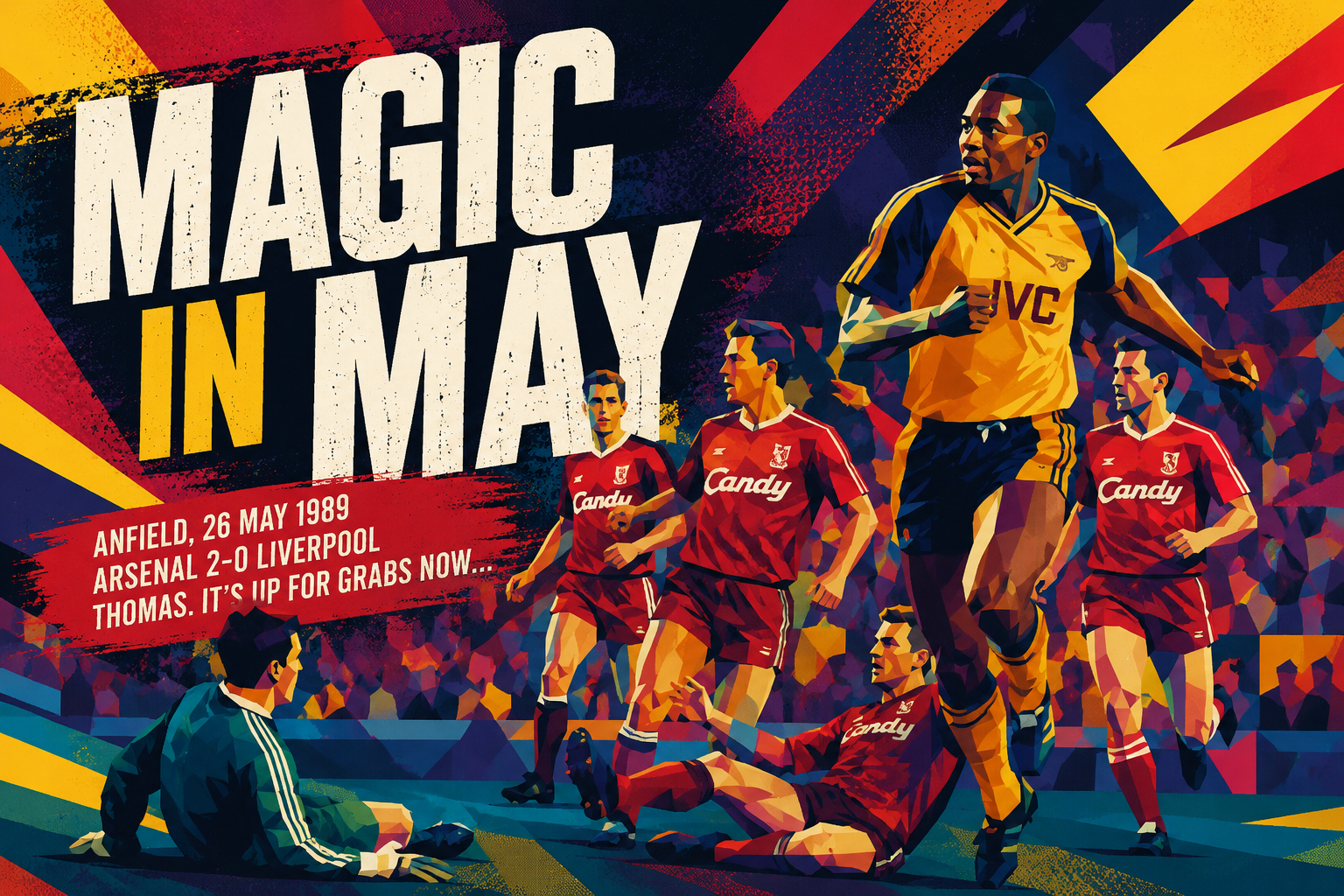
Arsenal’s 1989 title win at Liverpool is remembered for Brian Moore’s immortal line and Michael Thomas’s last-gasp finish. But the real story was not just the goal. It was the run that made it possible.
The Run
Steve McMahon held up one finger.
One minute.
Around him, Anfield was preparing itself for release. Liverpool were exhausted, emotionally hollowed out by the previous six weeks, but still standing. Arsenal led 1-0, which meant almost nothing. George Graham’s side had spent the evening chasing an almost impossible condition. To win the First Division title, they needed a second goal. Nobody had beaten Liverpool by two clear goals at Anfield in the league for more than three years.
Kevin Richardson collapsed with cramp near the halfway line. The delay felt significant, as though the match itself was struggling to continue. Players bent forward with hands on knees. Socks sagged around tired calves. The pitch was chewed up beneath the floodlights after a long English season. Inside the old stadium, the noise sharpened into whistles, screams and nervous encouragement.
Liverpool supporters could sense the finish line.
Then play resumed.
Liverpool had the ball where they wanted it, at the feet of John Barnes. Normally, this was how great sides killed games. Barnes was perhaps the finest footballer in England by 1989, capable of slowing matches to his own rhythm with a single movement. All Liverpool needed was composure. Carry the ball wide. Hold it near the corner flag. Drain the remaining seconds from the night.
Instead, Barnes drifted infield.
Richardson, who moments earlier could barely stand, stripped him of possession. The ball rolled loose toward John Lukic.
On Arsenal’s bench, assistant manager Theo Foley was screaming for urgency. Launch it. Get it forward. One last chance.
Lukic ignored him.
Instead, Arsenal’s goalkeeper rolled the ball calmly out to Lee Dixon on the right side. Dixon took a touch and looked up. Ahead of him, Alan Smith was backing into Steve Nicol, searching for space in a crowded central channel.
And then, almost unnoticed at first, Michael Thomas began to move.
Not toward the ball.
Beyond it.
The pass from Dixon hung in the Merseyside air longer than it should have. Smith stretched awkwardly under pressure, helping the ball over his shoulder into open grass. It was not elegant football anymore. Nobody out there had enough energy left for elegance.
But Thomas had already seen the space.
He burst through midfield with long, pounding strides, accelerating beyond every Liverpool shirt around him. Suddenly the whole shape of the pitch changed. Ray Houghton turned and chased. Nicol scrambled across. Bruce Grobbelaar rushed from his line. The stadium noise seemed to flatten into panic.
Thomas reached the ball just inside the area. His first touch was heavy. For a split second, the chance appeared gone. The ball ricocheted off Nicol and spun kindly back into Thomas’s path.
Now he was through.
Brian Moore’s voice rose from the commentary gantry.
“Thomas… it’s up for grabs now…”
Grobbelaar committed himself. Thomas waited. Just long enough.
Then, with the outside of his right foot, he lifted the ball over the goalkeeper and into the Liverpool net.
For a brief second, Anfield fell into something close to silence. Not complete silence. More the sound of tens of thousands of people simultaneously trying to understand what they had just watched.
Thomas hurled himself into a forward roll across the turf before disappearing beneath a pile of yellow shirts.
English football would spend the next three decades replaying the finish.
The real story was the run.
The Problem With Football Memory
Football has never been particularly fair with Michael Thomas.
Some players are granted entire careers in public memory. Others are reduced to moments. Thomas became a moment almost instantly. A commentary line. A forward roll. A grainy television image replayed endlessly whenever English football wants to explain drama to itself.
“Thomas… it’s up for grabs now.”
It is one of the most famous pieces of commentary in British sporting history, but it also trapped him. The goal at Anfield became so large, so culturally dominant, that it swallowed the footballer who scored it.
For many supporters under a certain age, Thomas exists almost entirely as a lucky figure who happened to arrive in the right place at precisely the right second. The replay encourages that interpretation. Nicol’s deflection appears generous. The finish looks instinctive rather than constructed. The chaos of the final minute overwhelms everything else.
But the goal only makes sense if you understand the player.
Michael Thomas was not a passenger in Graham’s Arsenal side. He was one of the most unusual midfielders English football had produced by the end of the 1980s. At a time when First Division midfields were still largely divided into functional categories, creators, battlers, wide runners, destroyers, Thomas blurred all of them.
He could tackle like a defensive midfielder and carry the ball like an attacker. He covered huge distances without appearing frantic. Most importantly, he understood vertical space before English football had properly developed the language to describe it.
Modern football discourse is full of phrases such as late runs, third-man movement and box-crashing midfielders. In 1989, English football was still far more rigid. Midfielders were expected to hold shape, protect territory and feed the forwards. Tactical systems valued discipline above fluidity.
Thomas disrupted that structure.
His defining quality was not flair in the traditional sense. He was not Glenn Hoddle spraying passes across the pitch or Chris Waddle drifting beyond defenders. Thomas’s modernity came from movement. He attacked open grass with aggression. He arrived where opponents did not expect him to arrive from.
That was what happened at Anfield.
The famous goal was not a random act of fate. It was the logical conclusion of Thomas’s football identity. In the 91st minute of the season, while most players were emotionally paralysed by exhaustion and pressure, Thomas still believed the space behind Liverpool’s defence could be reached.
So he ran.
The irony is that English football would eventually become filled with midfielders built around exactly those instincts. Patrick Vieira. Steven Gerrard. Frank Lampard. Yaya Touré. Players capable of dominating space physically while arriving decisively in attacking areas.
Thomas belonged slightly before the game was fully ready for him.
That does not mean he was perfect. Graham often questioned his concentration and temperament. His relaxed body language could look careless to old-school managers raised on visible intensity and constant aggression. Thomas sometimes appeared too casual for the era he inhabited.
But perhaps that was part of the misunderstanding.
He played at a tempo that looked strangely modern inside the chaos of late-1980s English football. While much of the First Division still relied on attrition, structure and directness, Thomas looked as though he had wandered in from a different tactical future.
History remembers the finish because football prefers simple images.
The more interesting truth is that Michael Thomas represented a different type of midfielder arriving just before English football itself began to change.
South London, Arsenal’s Youth Shift and the Graham Reset
Michael Thomas emerged from a part of London that produced footballers with hardness already built into them.
Born in Lambeth in 1967, he grew up in South London at a time when football still felt deeply local, tribal and physical. Talent alone rarely carried young players through. You survived youth football by coping with uneven pitches, older opponents and environments where technical mistakes were punished immediately. Thomas developed there first, long before the television cameras arrived.
By the time he captained England Schoolboys, the club already believed they possessed a serious athlete. Yet even then, Thomas did not fit neatly into established ideas about midfielders. He was tall, rangy and technically comfortable, but there was also a defensive edge to him. Coaches trusted him because he understood confrontation. He could tackle. He could recover possession. He could absorb physical contact without disappearing from matches.
That mattered enormously once Graham arrived at Arsenal in 1986.
Modern retellings often reduce Graham to a caricature: defensive, authoritarian, joyless. The reality was more complicated. Graham inherited a drifting football club. Arsenal had not won the league since 1971. Liverpool and Everton dominated English football. Highbury had become impatient and cynical, weighed down by nearly two decades of frustration.
Graham’s response was ruthless.
Senior players were discarded. Standards hardened almost overnight. Training became stricter, dressing-room discipline more rigid, excuses less tolerated. Arsenal stopped trying to imitate Liverpool stylistically and instead rebuilt themselves around control, organisation and psychological resilience.
Just as importantly, Graham trusted young players.
Tony Adams, David Rocastle, Niall Quinn, Martin Hayes and Thomas emerged into a club that suddenly believed youth could form the foundation of a title-winning side again. Arsenal became younger, more local and far more emotionally connected to their support.
Thomas initially entered Graham’s side as a right-back rather than a midfielder. That early positional education shaped him profoundly. He learned defensive spacing first. He learned when to hold position and when to engage physically. Unlike many naturally attacking midfielders, Thomas understood defensive structure because he had lived inside it.
Only later did Graham begin shifting him centrally.
Alongside the elegance of Rocastle and the calm intelligence of Paul Davis, Thomas brought something different to Arsenal’s midfield. He supplied force. Not merely aggression, but forward momentum. When Arsenal recovered possession, Thomas had the power to transform static defensive situations into attacks within seconds.
There was still rawness in his game. Graham occasionally became frustrated by what he viewed as Thomas’s relaxed attitude. The manager admired obsessive professionalism and visible intensity. Thomas often appeared almost too calm, even during matches played at ferocious pace.
But Graham also recognised something he could not easily coach into others.
Thomas could cover ground faster than almost any midfielder in England. More importantly, he did not simply run. He ran with purpose. His movement altered the shape of games.
By the late 1980s, Arsenal were no longer merely assembling promising young players.
They were constructing a side capable of confronting Liverpool directly.
And Michael Thomas sat at the centre of that transformation.
Arsenal Become Real Again
For most of the 1980s, Arsenal felt like a large club waiting for permission to matter again.
Liverpool and Everton dominated the decade. Tottenham played with greater flair. Manchester United possessed louder celebrity. Even when Arsenal threatened to improve, there remained a lingering suspicion that they lacked the authority, and perhaps the courage, to truly disrupt the established order of English football.
Graham despised that softness.
His Arsenal were built to remove comfort from matches entirely. Opponents were pressed into mistakes, dragged into physical contests and denied rhythm. Training sessions became brutally competitive. Defenders were drilled relentlessly. Midfielders were expected to work without complaint. Everything revolved around emotional control.
Thomas thrived inside that environment precisely because he brought something Graham’s system otherwise lacked naturally: acceleration.
By the beginning of the 1988/89 season, Arsenal no longer looked like hopeful outsiders. They looked dangerous. The opening weeks carried a new aggression about them, most clearly demonstrated in the 5-1 destruction of Wimbledon at Plough Lane in September 1988. Wimbledon were one of the most physically intimidating sides in the country, a team built to suffocate opponents psychologically before football even began.
Arsenal overwhelmed them.
Thomas was central to it. He surged through midfield repeatedly, refusing to allow the match to become static or territorial. Wimbledon wanted aerial chaos and second balls. Thomas kept driving Arsenal beyond that battle and into open space.
That became his role throughout the season.
Adams anchored the defensive line with increasing authority. Smith provided goals and relentless centre-forward occupation. Rocastle added grace and imagination. Thomas gave Arsenal thrust. When the game threatened to slow into attritional First Division football, he changed its speed.
The title race gradually became real.
By Christmas, Arsenal were top of the league. By February, they sat clear enough for the country to begin asking whether Liverpool’s dominance might finally be weakening. The numbers were startling, but the psychological shift mattered more. Arsenal no longer approached major matches hoping to survive them. They expected to compete physically and mentally with anyone.
Thomas embodied that transition.
There were matches during the winter months when Arsenal appeared almost impossible to counter because of the balance inside Graham’s midfield. Davis controlled tempo calmly from deeper positions while Thomas exploded beyond him into advanced areas. Opponents struggled to track the movement because English football still tended to defend zones rigidly rather than pass runners dynamically between midfield and defence.
Thomas attacked precisely those gaps.
And yet the season’s most important phase arrived when Arsenal began to wobble.
The pressure of leading the title race exposed the emotional fragility still lingering beneath the surface of Graham’s young side. A damaging defeat at home to Derby County shook confidence. Draws against Wimbledon and Coventry tightened the table again. Liverpool, carrying the emotional burden of Hillsborough but also the immense experience of serial champions, started closing relentlessly.
Old fears returned around Arsenal.
Could they actually finish it?
Could this young side withstand the psychological force of Liverpool chasing them down?
The answer increasingly depended on whether Arsenal could still impose themselves physically in difficult moments. Graham’s side were never at their best when patiently controlling matches through possession. They became dangerous when the game turned combative, open and emotionally unstable.
That was when Thomas mattered most.
He gave Arsenal momentum when momentum threatened to disappear entirely. Even during the spring collapse, when anxiety spread through the team, Thomas continued attacking games with unusual boldness. He kept carrying the ball through pressure. Kept making runs beyond the forwards. Kept dragging Arsenal up the pitch.
By the time the final fixture at Anfield arrived, Arsenal no longer looked like underdogs attempting a miracle.
They looked like a side that had spent an entire season preparing itself psychologically for one impossible night.
The Midfielder the First Division Wasn’t Built For
The easiest mistake when analysing Michael Thomas is to describe him using modern football language without understanding how unusual he looked in 1989.
Today, elite football is built around midfielders who can defend large spaces, break lines with carries, arrive late in the box and recover instantly when possession is lost. The modern game is full of athletes trained specifically for those demands.
The old First Division was not.
English football at the end of the 1980s still largely organised midfielders into recognisable categories. There were holding players who tackled and screened. Wide men who crossed early. Playmakers who slowed matches down. Hard-running battlers who covered territory and disrupted rhythm.
Thomas drifted awkwardly across all of them.
He had the physical profile of a defensive midfielder but the instincts of an attacker. He could dominate aerial duels and shoulder-to-shoulder battles, then suddenly glide through open grass with long, deceptively smooth strides. Most unusually of all, he attacked penalty areas from deep positions before English football had fully adapted to defending those movements.
Graham’s Arsenal were an intensely structured side. Their defensive organisation bordered on obsessive. The back line moved almost mechanically together, squeezing space with synchronised discipline that would later define the famous Arsenal defence of the early 1990s.
Thomas was one of the few players permitted to disrupt that structure.
Not recklessly. Graham would never have tolerated recklessness. But there was an unspoken understanding inside Arsenal’s system that Thomas could break shape because he possessed the athleticism to recover if attacks collapsed. He became the side’s vertical force. While others stabilised the game, Thomas accelerated it.
That acceleration often looked strangely effortless.
This was partly why Graham occasionally found him frustrating. Thomas carried himself with a relaxed physicality that older British managers sometimes mistrusted. He did not sprint around theatrically demanding the ball. He rarely appeared emotionally frantic. There were matches where he looked almost casual despite covering enormous distances.
But beneath that calm exterior was an exceptional athlete.
Thomas could devour space in seconds. Once he opened his stride, defenders struggled to adjust because his movement arrived from unfamiliar starting positions. He was not drifting forward slowly like a traditional midfielder joining attacks late. He exploded into advanced areas at full speed.
That was what made him so difficult to track.
Smith occupied centre-halves physically. Rocastle drifted elegantly between lines. Thomas attacked the spaces their movement created. By the time opponents recognised the danger, he was often already beyond them.
In many ways, he resembled a prototype for the Premier League midfielder that would later dominate English football.
Not quite Vieira, because Vieira controlled matches more authoritatively in possession. Not Gerrard either, whose passing range became central to Liverpool’s attack. Thomas perhaps sat somewhere between Bryan Robson and the generation that followed him, combining British physical intensity with a more fluid understanding of space and tempo.
There were flaws, naturally.
His concentration could drift. Injuries would later interrupt his momentum badly. Graham occasionally questioned whether Thomas truly maximised his talent. Some within the game believed his relaxed personality masked an inconsistent competitive edge.
Yet those criticisms also reflected the era itself.
English football still tended to admire visible struggle. Midfielders were expected to look exhausted, furious and permanently engaged in battle. Thomas often looked composed inside chaos. He played at his own rhythm.
And perhaps that is why the run at Anfield felt so unforgettable.
Most players in the 91st minute saw danger, exhaustion and pressure.
Thomas saw space.
George Graham Wanted Control. Thomas Played on Instinct
Graham built one of the most disciplined sides English football had seen in years.
That discipline was not optional.
Training at Arsenal under Graham was demanding, repetitive and fiercely structured. Shape mattered constantly. Players were expected to understand distances instinctively. Defensive positioning was treated almost like military drill work. Graham believed football matches were usually lost through carelessness rather than brilliance, so his teams were designed to remove uncertainty wherever possible.
Thomas represented uncertainty.
Not irresponsibility. Graham would never have tolerated that. But Thomas possessed instincts that pushed naturally against the limits of Arsenal’s system. He wanted to surge forward when others were holding shape. He trusted moments. He trusted space. He trusted attacks unfolding at speed rather than slowing games down into control.
That tension sat quietly beneath almost every phase of Arsenal’s rise.
Graham admired Thomas deeply as an athlete. Few midfielders in England could match his combination of stamina, pace and power. He could recover possession in one penalty area and arrive in the other within seconds. Arsenal needed that dynamism because Graham’s football, for all its organisation, often relied on explosive forward surges to create chances.
Yet Graham also distrusted aspects of Thomas’s personality.
The manager preferred footballers who radiated visible obsession with winning. Adams and Winterburn looked emotionally locked into every duel. Thomas often appeared detached from the violence of the contest around him. To Graham, that occasionally resembled complacency.
The contradiction was that Thomas often produced his best football precisely when games became emotionally unstable. Chaos suited him more than control did. Open grass suited him more than rigid positional football. The tighter Graham attempted to compress matches structurally, the more Thomas instinctively searched for moments to break them open.
Arsenal’s dressing-room culture only complicated matters further.
The famous “Tuesday Club” has since become football folklore, retold through stories of impossible drinking sessions and reckless tours abroad, but beneath the humour sat something revealing about English football in that era. Recovery culture barely existed by modern standards. Elite athletes drank heavily, trained hard and played through injuries that would now sideline players for weeks.
Thomas existed awkwardly inside that world.
Physically, he already resembled the next generation of Premier League midfielder: explosive, positionally fluid, capable of repeated high-intensity running. Culturally, he was still trapped inside the final years of old English football, where conditioning remained primitive and self-destruction was often mistaken for toughness.
In many ways, Arsenal themselves embodied that contradiction.
Graham’s side were simultaneously old and new. Their defensive structure and emotional hardness belonged to traditional English football. But their athleticism, collective compactness and speed on the break pointed toward something more modern emerging beneath the surface.
Thomas became the clearest symbol of that tension.
And perhaps that explains why his Arsenal career ended so abruptly.
In December 1991, only two and a half years after Anfield, Graham sanctioned Thomas’s sale to Liverpool. On paper, the decision made little sense. Thomas was still 24 years old. He had scored the most famous goal in Arsenal’s modern history. He remained one of the most physically gifted midfielders in the country.
But Graham valued certainty above sentiment.
Thomas could win Arsenal titles. He could also drift outside the manager’s emotional framework for how elite footballers were supposed to behave. There remained a lingering sense that Graham never entirely trusted him in the way he trusted Adams or Winterburn.
So the relationship stayed functional rather than deeply emotional.
Which created one of the strangest ironies of the era.
The player who delivered George Graham immortality ultimately became expendable to him.
Football Before and After
By the time Arsenal arrived at Anfield on May 26, 1989, the title race had stopped feeling like sport in its ordinary form.
English football was carrying too much weight.
Six weeks earlier, 97 Liverpool supporters had been fatally crushed at Hillsborough during the FA Cup semi-final against Nottingham Forest. The disaster froze the country. Football itself seemed briefly suspended between grief, anger and disbelief. Liverpool’s players returned to competition while representing a city shattered publicly and privately at the same time.
The final league fixture between Liverpool and Arsenal had originally been scheduled for April 23. It was rearranged for May 26, six days after Liverpool had beaten Everton in the FA Cup final. By then, Liverpool were chasing the Double. Arsenal needed to beat them by two clear goals to win the First Division title. A one-goal victory would leave Liverpool champions.
Nobody truly believed Arsenal would do it.
Liverpool had not lost by two goals at Anfield in the league for more than three years. They remained the defining institution of English football, a side so psychologically dominant that opponents often looked beaten before kick-off.
Graham understood that Arsenal could not survive emotionally if the match became open too early.
So he built the evening around control.
The tactical setup remains one of the boldest decisions of Graham’s managerial career. Arsenal effectively used a 5-4-1, with David O’Leary operating as a sweeper behind Adams and Steve Bould. Winterburn and Dixon stayed disciplined. Through midfield, Richardson and Thomas worked relentlessly to suffocate Liverpool centrally.
The plan was not to outplay Liverpool beautifully.
It was to make Liverpool uncomfortable.
For long stretches of the first half, Anfield became strangely tense. Barnes drifted searching for influence. Peter Beardsley, introduced after Ian Rush went off injured, dropped deep trying to connect attacks. John Aldridge found himself isolated repeatedly against Arsenal’s defensive line.
Arsenal were not spectacular.
They were emotionally unbreakable.
And beneath that stubbornness sat a quiet belief that one goal could destabilise the entire stadium.
It arrived eight minutes into the second half.
Arsenal won an indirect free-kick wide on the left. Winterburn curled the delivery into the area. Smith attacked it first, glancing a header beyond Grobbelaar and into the far corner.
Suddenly the atmosphere changed completely.
At 1-0, Liverpool still held the title. But now fear entered the stadium properly for the first time. Arsenal only needed one more. Liverpool’s certainty began to erode.
Watching the match back now, what stands out most is the exhaustion. Not tactical exhaustion. Human exhaustion. Players stumble rather than sprint. Hands rest on hips constantly. Legs tighten. Decision-making slows visibly. It feels like the entire First Division era dragging itself physically toward the finish line.
And still Arsenal kept pushing.
Thomas, especially, kept driving forward from midfield. In the 74th minute, he missed what should probably have been the title-winning chance, side-footing weakly at Grobbelaar after arriving unmarked near the penalty spot. Around him, Liverpool players looked almost relieved. It felt like the decisive moment had passed.
Perhaps that miss explains the final attack.
Most players protect themselves emotionally after failing in moments that large. They stop exposing themselves to another mistake. They retreat toward safety.
Thomas did not.
So when Barnes lost possession in stoppage time and Dixon lifted the ball forward toward Smith, Thomas was already accelerating through midfield before Liverpool’s defenders fully reacted. Smith improvised brilliantly, helping the ball into space. Nicol’s attempted intervention ricocheted kindly.
Then came the finish.
Moore’s commentary immortalised the moment instantly.
“Thomas… it’s up for grabs now…”
But what followed after the goal mattered too.
Liverpool supporters did not erupt in fury. Many simply stood still. Some applauded Arsenal as they collected the trophy. Grief had altered the emotional landscape around football that spring. The old tribal certainty of the English game felt softer somehow that night, exhausted by tragedy and drained by emotion.
For a few strange minutes, amid the churned mud under the floodlights, it felt less like one team defeating another than an entire era stumbling toward its conclusion.
Down on the pitch, Arsenal players wandered through celebration almost in disbelief. Graham, normally so emotionally guarded, briefly lost control of himself amid the chaos.
And at the centre of it all stood Michael Thomas.
Not simply the scorer of a famous goal.
The runner who kept moving when everyone else froze.
The Transfer That Never Quite Made Sense
For Liverpool supporters, Michael Thomas always carried an unusual emotional charge.
He was the player who had broken the club’s aura of inevitability at Anfield. The image remained unavoidable. Every replay of the 1989 title decider ended with Thomas lifting the ball beyond Grobbelaar while Liverpool defenders collapsed around him. In another era, that moment alone might have made a future transfer impossible.
Instead, Liverpool signed him two and a half years later.
By December 1991, English football was shifting again. Kenny Dalglish had unexpectedly resigned earlier that year. Graeme Souness arrived promising modernisation, harder professionalism and tactical renewal after Liverpool’s dominance had begun to fray at the edges. The old dynasty was weakening. Arsenal had just won another league title. Leeds United were emerging powerfully under Howard Wilkinson. The First Division no longer revolved entirely around Anfield.
Souness wanted athleticism in midfield.
Thomas still looked like one of the most gifted physical midfielders in the country. His ability to drive through space appeared perfectly suited to the faster, more aggressive style Souness envisioned rebuilding at Liverpool.
Yet the transfer never felt emotionally natural.
Thomas later told LFChistory: “I wanted to play abroad. I wanted to go to Italy or Spain but George Graham wouldn’t let me go. Liverpool consistently wanted me to come to the club.”
That admission matters. Thomas did not simply cross the old emotional line between Arsenal and Liverpool with boyish enthusiasm. He entered the move with hesitation, aware of what he represented to the people already inside Anfield.
He joined a club entering one of the strangest transitional periods in its modern history. The problem was not simply tactical. Liverpool themselves no longer fully knew what they were becoming.
The old Boot Room culture that had sustained decades of continuity was beginning to fracture under Souness. Established players were ageing. Training methods changed. The dressing-room atmosphere hardened. Success stopped feeling inevitable.
Thomas arrived carrying symbolic baggage as well.
At Arsenal, he had represented emergence. Youth. Athletic force. At Liverpool, he became part of an attempted reconstruction. Those are very different emotional environments for a footballer.
There were still important moments.
The finest arrived in the 1992 FA Cup final against Sunderland. Thomas opened the scoring at Wembley with a sharply taken finish, reminding observers how clean and technically secure he could be when fully confident. Liverpool won 2-0. Thomas collected another major trophy.
But his time at Anfield never settled fully into belonging.
Injuries disrupted his rhythm repeatedly. The explosive acceleration that had once defined his game became harder to sustain consistently. Liverpool’s midfield balance changed constantly during Souness’s rebuilding attempts, and Thomas often appeared caught between roles rather than fully trusted within one.
There were flashes of the old power, the old surge through space, but increasingly they arrived in fragments.
And perhaps the deeper issue was emotional rather than tactical.
At Arsenal, Thomas had become part of a cultural shift. The supporters saw themselves in that young side. Adams, Rocastle and Thomas represented Arsenal rebuilding itself through its own youth system and identity. The connection carried emotional permanence.
At Liverpool, Thomas remained slightly external to the club’s story.
Supporters respected him. Teammates valued him. But he never truly escaped the shadow of May 1989. Even while wearing red, he remained linked psychologically to the night he had wounded Liverpool most deeply.
That is the strange consequence of iconic football moments.
Sometimes they make players immortal.
Sometimes they trap them there forever.
The Goal That Closed One Era and Opened Another
The temptation with Anfield ’89 is to treat it as the moment modern football began.
That is too simple.
English football did not suddenly transform because Michael Thomas lifted a finish beyond Grobbelaar. The forces reshaping the game were already in motion long before that Friday night. Stadium reform following Hillsborough, the growing influence of television money, the commercial ambitions of major clubs and the approaching creation of the Premier League all sat on the horizon already.
But some matches become symbols large enough to absorb the meaning of their era.
Anfield ’89 became one of those matches.
The timing mattered enormously. English football in the late 1980s was exhausted by itself. The sport’s image had been battered by hooliganism, crumbling infrastructure and national tragedy. Following Heysel, English clubs remained banned from European competition. Hillsborough exposed catastrophic failures inside stadium safety and policing. Large sections of the political establishment still viewed football as a social problem rather than a national asset.
Then came this match.
Live on terrestrial television, under floodlights, with the championship decided in the final seconds, English football suddenly looked cinematic rather than broken. The drama felt almost impossibly complete from a broadcasting perspective. Narrative tension, identifiable heroes, emotional release, tactical jeopardy, and a final act that seemed too neat to be real.
Television executives did not need Anfield ’89 to invent commercial football. That argument would be lazy. But the match demonstrated how powerful domestic football could become when placed before a mass audience at exactly the right moment.
In that sense, Anfield ’89 became less a beginning than a transition point. The final great piece of First Division theatre before football accelerated into something richer, slicker and far more commercially dominant during the 1990s.
Culturally, the match also helped reshape how football fandom was written about and understood publicly.
Nick Hornby’s Fever Pitch would later use Arsenal’s title victory as part of a broader attempt to explain the emotional obsession of football support to readers outside traditional football culture. The book mattered because it helped reposition football spectatorship as something reflective and emotionally articulate rather than simply tribal or violent.
Thomas’s goal sat near the centre of that emotional reframing.
But the football legacy matters just as much.
Thomas remains oddly under-discussed when conversations turn toward the evolution of midfield play in England. Perhaps that is because his peak arrived just before the Premier League era created much larger global celebrity around similar players. Or perhaps the goal itself became too dominant, flattening everything else he achieved into one famous sprint.
Yet watching Thomas now, especially during the 1988/89 season, the outlines of the modern Premier League midfielder are unmistakable.
Not the deep controller. Not the luxury playmaker. The athlete who destroys distances.
Years later, English football would celebrate players such as Vieira, Gerrard and Lampard for those qualities: forward running, physical dominance, late penalty-box arrivals and technical control under pressure.
Thomas was not identical to any of them. But he existed in the evolutionary line leading toward them.
That is why the run against Liverpool still feels strangely current even now.
The movement itself belongs comfortably inside contemporary football. A midfielder recognising space instantly, attacking it at full speed and arriving beyond the defensive line before opponents can reorganise. Modern elite sides are built around those patterns.
In 1989, English football still largely viewed midfield through more static ideas.
Perhaps that is why Thomas remains slightly misunderstood historically.
He is remembered as a man attached to a moment rather than as a player who anticipated where parts of English football were already heading.
And maybe that is inevitable.
Football memory prefers iconic images to tactical evolution.
One is easier to replay than the other.
The Run Never Stops
The finish is what survives in public memory.
The clipped lift beyond Grobbelaar. Moore’s voice climbing into history. The forward roll across the Anfield turf. Every replay begins at the edge of the penalty area because football usually places meaning at the point where the ball crosses the line.
But the real significance of Michael Thomas exists further back up the pitch.
It exists in the decision to keep running.
By the 91st minute at Anfield, almost everybody else had stopped believing fully in movement. Liverpool were trying to survive. Arsenal were trying to force one final attack before time disappeared entirely. Legs had gone heavy. Minds had slowed. The entire season seemed physically exhausted.
Thomas still attacked the space.
That instinct tells you almost everything about both the player and the game English football was becoming. The old First Division had largely been built around territory, attrition and caution. Thomas belonged slightly ahead of it, a midfielder who viewed open grass as an invitation rather than a risk, who trusted momentum more than structure.
The famous goal did not happen because fortune suddenly chose him.
It happened because he moved before anyone else did.
And perhaps that is why the image still feels alive decades later. Not simply because Arsenal won the title in extraordinary circumstances, or because Liverpool finally looked vulnerable, or because television discovered the emotional power of live football under floodlights.
The moment endures because it captured English football at the precise point one age was beginning to disappear into another.
Careers are usually larger and messier than their most famous moments. Footballers rarely live inside history as neatly as supporters want them to. Michael Thomas won trophies, crossed rival lines, endured injuries and carried all the ordinary complications of a professional life.
But some goals become impossible to escape.
And on that exhausted night at Anfield, while everybody else was waiting for the season to end, Michael Thomas kept running.
