


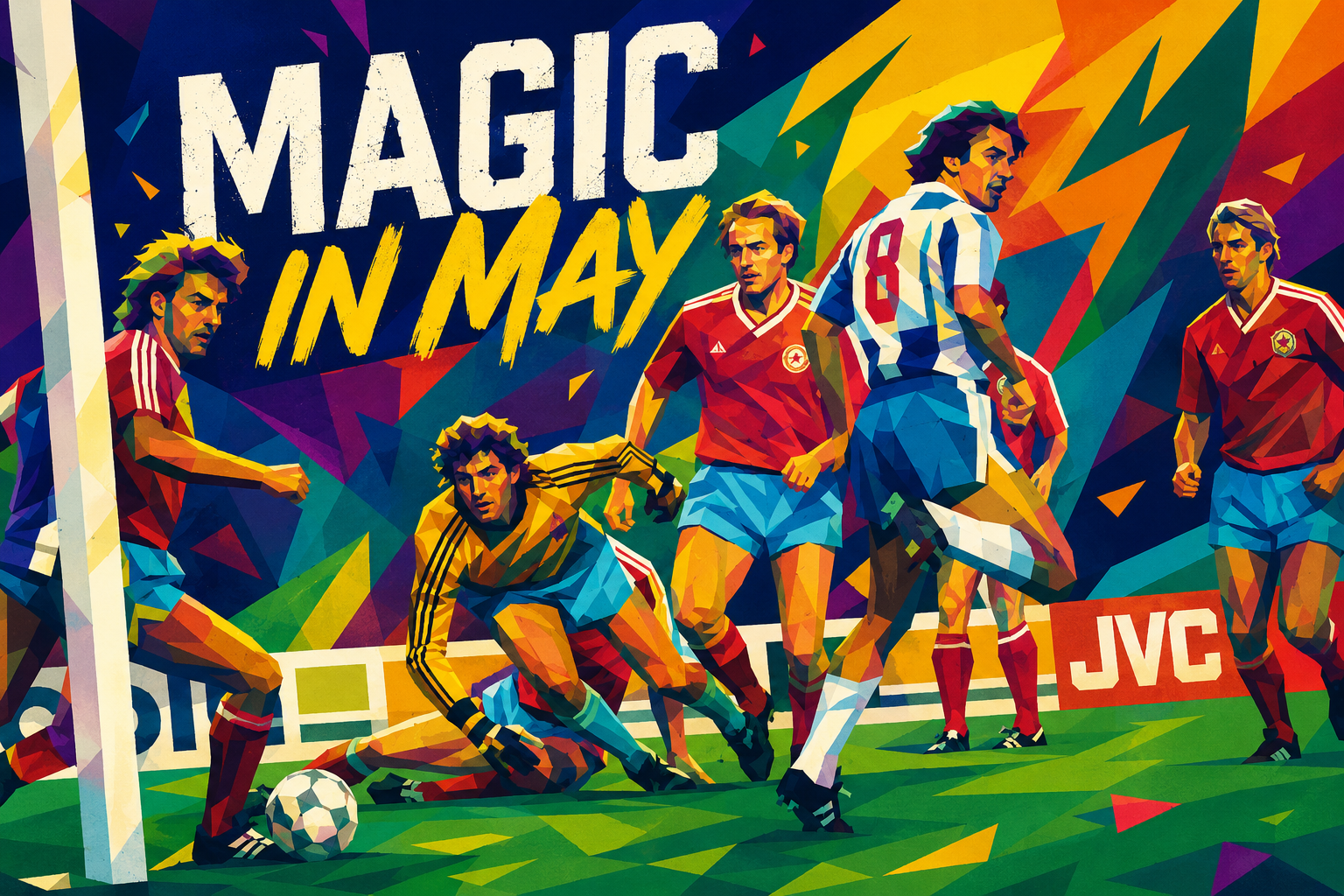
Before Rabah Madjer became a move, he was a footballer of rare intelligence, defiance and imagination. Vienna made him immortal. It also made him easier to misunderstand.
The Moment Vienna Stopped Making Sense
By the 77th minute in Vienna, the European Cup final had settled into the shape Bayern Munich wanted.
The West Germans led 1-0 through Ludwig Kögl’s first-half header. They controlled the tempo, controlled the spaces, controlled the emotional temperature of the night. FC Porto, missing the injured Fernando Gomes, had spent much of the match looking slightly overwhelmed by the occasion and slightly exhausted by Bayern’s structure. Every attack seemed to end with a blue shirt running into white shirts and coming back out without the ball.
Even Porto goalkeeper Józef Młynarczyk had admitted before the match that he was nervous. Rabah Madjer tried to calm him. According to Madjer, he told his team-mate that Porto had already beaten major sides to reach the final, insisted the game was “50-50”, then made a prediction.
Porto would win 2-1.
Inside the Praterstadion, it still felt improbable.
Bayern’s defenders were retreating calmly now, taking touches without panic. Jean-Marie Pfaff, one of the finest goalkeepers in Europe, barked instructions with the confidence of a man who believed the hardest work had already been done. Udo Lattek stood near the touchline watching events unfold almost exactly as he had planned them.
Then Juary accelerated into the right side of the penalty area.
The Brazilian had only been introduced at half-time, but his presence had changed the geometry of the game. Porto suddenly had another runner occupying Bayern’s back line. Another problem to track. Another body stretching the pitch horizontally. Bayern’s control had begun to loosen by degrees.
Juary reached the ball just before the byline and drove a pass across goal.
It was not clean.
The cross clipped a Bayern defender and changed pace completely. The deflection mattered. Without it, the move probably dies harmlessly in the six-yard box. Instead, the ball drifted awkwardly behind Madjer as he attacked the near post.
For a fraction of a second, the entire chance seemed to disappear.
Madjer had overrun it. Helmut Winklhofer was recovering toward the goal line. Pfaff was already spreading himself low across the angle. To control the ball would have required an extra touch. An extra touch would have closed the space completely.
Madjer understood this immediately.
Years later, speaking to UEFA, he explained it with almost startling simplicity. If he had tried to control the ball, he said, he would never have scored.
So he let it run between his legs.
Then, without turning, without fully seeing the goal, he flicked his right heel backwards toward the far corner.
At first there was confusion more than noise.
Pfaff twisted his head. Winklhofer stopped moving. The ball rolled slowly across the face of goal and inside the post.
For a brief moment, the stadium seemed unsure whether what it had seen was intentional.
Then Porto’s bench exploded.
Madjer sprinted away toward the corner flag with both arms spread wide, his face caught somewhere between joy and disbelief. Teammates crashed into him from every direction. Behind them, Bayern players stood still in silence, trying to process the fact that a European Cup final they had controlled for more than an hour had just been ruptured by one improvisational touch.
Three minutes later, Madjer destroyed them again.
Collecting the ball near the left touchline, he isolated Winklhofer, shifted his weight, opened his body, and curled a cross toward the far post. Juary arrived at speed and hammered the finish beyond Pfaff.
2-1.
Exactly as Madjer had predicted.
The backheel became immortal. It entered football’s vocabulary itself. In France, backheel finishes would eventually become known simply as une Madjer.
But the danger of iconic moments is that they flatten the people inside them.
The goal made Rabah Madjer unforgettable.
It also reduced him.
The Problem With One-Touch Immortality
The problem with football memory is that it prefers symbols to people.
George Best became the genius who drank. Garrincha became the broken dribbler. Marco van Basten became the volley in Munich. For Rabah Madjer, it became the backheel in Vienna. One touch. One replay. One frozen image repeated often enough that it slowly replaced the footballer himself.
That is the version history kept.
The improviser. The trickster. The man who produced an outrageous finish on the biggest stage and lived forever from the shock of it.
It is also an incomplete version of Rabah Madjer.
Because Madjer was not a novelty act who stumbled into immortality for one night in Austria. He was one of the most intelligent attacking footballers of the 1980s, a player whose game was built less on spectacle than interpretation. He read space early. He manipulated defenders before they realised they were being manipulated. He drifted between roles at a time when European football still expected forwards to remain in fixed lanes and fixed identities.
He could play as a central striker, a withdrawn forward, or a creator arriving from deeper areas. Some matches demanded goals from him. Others demanded rhythm, connection, disruption. Artur Jorge trusted him not simply because he could finish chances, but because he understood the emotional and tactical flow of elite matches.
That was what Bayern struggled with in Vienna.
Not flair.
Uncertainty.
Madjer did not behave like a conventional centre-forward. He drifted away from markers. He slowed movements unexpectedly. He occupied defenders mentally before he attacked them physically. Against rigid man-marking systems, especially those common across European football in the 1980s, that kind of ambiguity could become destabilising.
The backheel itself was part of that ambiguity.
People remember it as audacity. In truth, it was also practicality. The defender had recovered toward the line. The goalkeeper had closed the angle. The ball had run behind him after the deflection. The spectacular choice was simultaneously the most logical one available.
That duality defined Madjer’s football.
Improvisational, but rarely reckless. Creative, but fiercely competitive. Expressive, but rooted in efficiency.
There is another reason his story became simplified.
Football’s institutional memory did not know quite what to do with African greatness in the 1980s.
By the time Madjer reached his peak at Porto, he had already scored against West Germany at the World Cup, won a European Cup, won an Intercontinental Cup, and established himself as the creative reference point of one of Europe’s best sides. Yet the game’s most prestigious individual honour, the Ballon d’Or, remained closed to him because of geography rather than ability. Until 1995, only European-born players were eligible.
The absurdity of that restriction becomes clearer with time.
In 1987, Ruud Gullit won the Ballon d’Or. Madjer, despite deciding a European Cup final and helping Porto become world champions, was not even allowed onto the ballot. Football was willing to celebrate his moments without fully admitting him into its hierarchy.
That mattered.
Legacy is not built only through performances. It is built through archives, awards, documentaries, magazine covers, repeated discussion, and institutional reinforcement. European football canonised many great players of the era through trophies and memory-making machinery. Madjer, despite being admired, existed slightly outside that machinery.
As a result, he became strangely fragmented in football history.
In Algeria, he was a national figure tied to pride, resistance, and possibility. In Porto, he was one of the club’s transformational players. Across Africa, he became proof that an African footballer could lead a European champion technically, not merely physically.
But globally, he was too often compressed into a single clip.
The irony is brutal.
The goal that made him immortal also obscured the scale of the footballer who scored it.
Hussein Dey, Algeria and the Making of a Defiant Footballer
Rabah Madjer was born on 15 December 1958 in Hussein Dey, a working-class district east of central Algiers, only four years before Algeria secured independence from France after one of the bloodiest anti-colonial wars of the twentieth century.
That timing matters.
The Algeria Madjer grew up in was still constructing itself psychologically. Football occupied a central role in that process. Clubs were not merely sporting institutions. They carried political memory, neighbourhood identity, and ideas about what the country wanted to become after independence. Victories mattered differently there. So did visibility.
Madjer emerged from that environment.
He began playing locally before joining NA Hussein Dey, one of Algeria’s most respected clubs and a side deeply associated with technical football. The pitches were rarely perfect. Space was limited. Matches became exercises in improvisation and survival as much as structure. Young players learned quickly that if the ball escaped them, possession might not return for several minutes.
That shaped him.
European coaching systems in the 1970s often prioritised order first and technique second. Madjer developed in the opposite direction. Ball mastery came before systems. Awareness came before positioning charts. He learned to play while surrounded by chaos, pressure and constant physical confrontation. It produced footballers who relied heavily on instinct, but also on spatial intelligence.
Madjer was not especially imposing physically. Nor was he explosive in the traditional sense. What separated him early was fluidity. He moved differently from most forwards around him. Coaches noticed how naturally he manipulated angles and defenders. Older players noticed something else: he never seemed rushed in front of goal.
By his late teens, he was already carrying responsibility at NA Hussein Dey.
In 1978, the club reached the final of the African Cup Winners’ Cup. A year later, they won the Algerian Cup. Madjer was not yet the polished, internationally recognised figure Europe would come to know, but the core of the player already existed. He drifted between lines. He demanded the ball constantly. He attacked defenders psychologically as much as physically.
There was also a competitive hardness underneath the elegance.
World Soccer once described him as a player of finesse and technical ability, but also of combative nature. That combination feels important. Madjer was not simply a gifted aesthete. He carried himself like a footballer who believed he belonged at the highest level long before European football agreed.
That edge became important later.
Because by the late 1970s and early 1980s, African footballers entering European conversations were still largely discussed through limiting stereotypes. They were praised for athleticism, spontaneity, rawness. Rarely for tactical intelligence. Rarely for leadership. Rarely as the technical centrepiece of elite sides.
Madjer’s game was quietly rebelling against those assumptions before he had even left Algeria.
And there was another layer to his development that would remain visible throughout his career.
He played with freedom, but not indulgence.
Street football taught improvisation. Algerian football taught responsibility. If you tried something extravagant, it had to work. Tricks without purpose were quickly exposed. Madjer’s creativity therefore developed alongside practicality. Even at his most expressive, there was usually calculation beneath it.
Years later, that instinctive efficiency would produce one of the most famous goals in football history.
But the foundations of it were built long before Vienna, on rough surfaces in Hussein Dey, where touches had to be quick, spaces had to be imagined before they existed, and hesitation usually meant losing the ball.
Algeria, Gijón and the Shock That Changed the World Cup
For much of Europe, Rabah Madjer arrived fully formed in Gijón.
On 16 June 1982, at the 1982 World Cup, Algeria walked into their opening match against West Germany as little more than an afterthought. The reigning European champions possessed Karl-Heinz Rummenigge, Paul Breitner and a squad built from the hardest edges of elite European football. Algeria, appearing at their first World Cup, were expected to provide atmosphere and little else.
West Germany’s players barely disguised their confidence.
European football still viewed African and Arab sides through a patronising lens then, particularly tactically. They could entertain. They could run. They could surprise opponents briefly. But they were not expected to dismantle serious football nations structurally.
Madjer changed the emotional temperature of the tournament in one movement.
Early in the second half, Lakhdar Belloumi drove forward through midfield and released Madjer behind the German defence. He took the ball in stride and finished low beyond Harald Schumacher. Algeria led 1-0. The goal itself was calm, almost understated. But the effect was explosive.
West Germany equalised through Rummenigge after he entered from the bench. Most assumed order had been restored.
Instead, Algeria attacked again.
Belloumi scored the winner seven minutes later and the match finished 2-1, one of the greatest shocks in World Cup history. Across North Africa and the Arab world, the result travelled beyond football almost immediately. In Algeria especially, the victory carried emotional weight that exceeded sport. This was not simply a small nation beating a football giant. It was a recently independent country defeating one of Europe’s established powers on the world’s biggest stage.
Madjer became central to that symbolism.
Not because he shouted loudest or demanded attention, but because he looked entirely comfortable there. That mattered. He did not appear overawed by European authority. He looked like he belonged among it.
Yet the tournament would ultimately harden him more than it celebrated him.
Algeria defeated Chile 3-2 in their final group match and believed they had done enough to qualify. Instead, they became victims of one of the most notorious episodes in football history. Knowing exactly what result both teams required, West Germany and Austria played out a grimly cynical 1-0 match that eliminated Algeria on goal difference. Once Germany scored early, the contest effectively stopped. Players passed harmlessly across the pitch while the crowd whistled in disgust.
The game became known as the “Disgrace of Gijón”.
For Algeria, it felt like exclusion masquerading as tournament football.
The scandal later helped force a procedural change. FIFA moved to ensure final group matches were played simultaneously, a rule designed to prevent teams from managing outcomes with prior knowledge of other results. It was a belated correction, not justice.
The experience changed the trajectory of Madjer’s career anyway.
Europe had noticed him now.
In 1983, he moved to France with Racing Paris. The transfer itself did not carry the glamour later associated with African stars moving abroad. French football in the early 1980s could still be uneasy terrain for North African players, culturally and tactically. Madjer was admired technically, but there remained questions about discipline, consistency and positional structure, the familiar coded language often used against creative African footballers at the time.
He answered quickly.
At Racing Paris, then in Division 2, he scored heavily and immediately became the attacking reference point of the side. His football adapted faster than many expected. He could operate in tighter systems. He could absorb physical defending. He could play with his back to goal. More importantly, he improved teams rather than merely decorating them.
But France still felt transitional.
Madjer was developing faster than the clubs around him. He needed a team willing to build around intelligence and movement rather than merely accommodate flair. He needed a manager capable of understanding the strange elasticity in his game.
In 1985, FC Porto offered exactly that.
The move altered everything.
At Porto, Madjer would stop being a gifted outsider occasionally disrupting elite European football.
He would become one of its defining attackers.
The Attacking Brain of Porto’s European Revolution
At FC Porto, Rabah Madjer stopped playing on the edge of elite European football and began dictating matches inside it.
The timing mattered.
Portuguese football in the mid-1980s occupied an awkward position in the European hierarchy. Benfica carried historical prestige. Sporting produced talent. Porto, though growing rapidly under president Jorge Nuno Pinto da Costa, still existed slightly outside the continent’s aristocracy. The club had ambition, aggression and intelligence, but not yet universal recognition.
That made it the perfect environment for Madjer.
Under coach Artur Jorge, Porto were tactically flexible and psychologically confrontational. They did not approach European matches like respectful outsiders hoping to survive. They pressed emotionally against bigger clubs. They forced disorder into games. Madjer became central to that identity because he interpreted space differently from almost every forward around him.
Nominally, he was a striker.
In reality, he behaved more like a constantly shifting attacking reference point.
Sometimes he drifted deep into midfield to receive possession and turn. Sometimes he pulled into wider channels to isolate defenders. Sometimes he arrived late into the penalty area after disappearing from a centre-back’s field of vision entirely. Long before phrases like “false nine” entered mainstream tactical language, Madjer was already destabilising defensive systems through ambiguity.
That ambiguity mattered far more in the 1980s than it might today.
European football then remained heavily shaped by man-marking principles. Defenders preferred certainty. They wanted fixed positions, fixed responsibilities, visible threats. Madjer denied them that comfort. If a centre-back followed him into deeper areas, Porto’s wide attackers attacked the spaces behind. If defenders held their line, Madjer turned freely and accelerated at retreating back fours.
Paulo Futre, Porto’s explosive young winger, provided the perfect complement.
Where Futre attacked with speed and aggression, Madjer operated with rhythm and manipulation. The partnership worked because they distorted defensive attention differently. Opponents often became preoccupied with Futre’s direct running, which allowed Madjer to control the emotional flow of attacks underneath the surface.
What made Madjer truly elite, though, was not unpredictability alone.
It was decision-making.
Many expressive forwards produce chaos without control. Madjer rarely wasted movements. His first touch often functioned as a form of disguise, shaping defenders toward one solution before exposing another. He slowed defenders mentally before beating them physically. In tight spaces, especially around the edge of the penalty area, he played with the composure of a midfielder and the instincts of a centre-forward.
Portuguese defenders began speaking about him with a kind of reluctant admiration. He embarrassed opponents without seeming rushed. He could glide through matches quietly for twenty minutes and then suddenly decide them in seconds.
Artur Jorge understood that balance instinctively.
Rather than force Madjer into rigid positional discipline, he built structural freedom around him. Porto’s shape often looked conventional from distance, but the attacking movements underneath were fluid. Madjer’s roaming created rotational spaces for midfield runners and wide forwards. He was not simply finishing Porto’s attacks. He was organising them spatially.
The numbers reinforced the influence.
Porto won the league title in 1985-86 and again in 1987-88. More importantly, they no longer looked intimidated by Europe’s traditional giants. They played like a side expecting to belong.
Madjer’s style also carried something deeper culturally.
At a time when African footballers in Europe were still commonly reduced to athletic stereotypes, Madjer became the technical brain of an elite side. Porto did not rely on him for physical power or transitional running. They relied on him to interpret matches creatively under pressure.
That distinction matters historically.
Before players like Zinedine Zidane, Didier Drogba or Samuel Eto’o reshaped European perceptions of African footballers, Madjer was already challenging assumptions about what kinds of players African football could produce at the very highest level.
And he did it without conforming stylistically.
He was not mechanically efficient in the modern sense. He did not play football through rehearsed automatisms. His genius lived in interpretation. In moments. In improvisation guided by competitive logic rather than performance art.
That was why defenders struggled with him so deeply.
And that was why, when Porto reached the 1987 European Cup final against Bayern Munich, Artur Jorge trusted him to carry the emotional responsibility of the biggest night in the club’s history.
Genius, Institutions and the Career That Might Have Been
The closer Rabah Madjer moved toward the summit of European football, the more he seemed to collide with the limits of the era around him.
Some of those limits were physical.
Others were institutional.
Together, they shaped both the greatness and the incompleteness of his career.
The first tension sat quietly beneath almost everything Madjer achieved in Europe: he was operating inside a football culture that still did not fully trust African players with intellectual authority.
By the mid-1980s, African footballers were increasingly visible across European leagues, particularly in France and Portugal, but visibility was not the same as acceptance. The stereotypes remained stubborn. African players were praised for spontaneity, athleticism and instinct, while tactical intelligence and leadership continued to be coded as essentially European traits.
Madjer disrupted that framework.
At Porto, he was not a supporting piece or an exotic individual talent drifting around the edges of elite football. He was the attacking reference point of a side becoming European champions. Porto relied on his interpretation of games. Teammates trusted his decisions. Opponents altered defensive structures because of him.
Yet football’s institutional structures struggled to process players like Madjer properly.
The clearest example was the Ballon d’Or.
Modern audiences often forget that before 1995, the award was restricted exclusively to European-born players. It was not merely difficult for African players to win the Ballon d’Or. It was impossible. Eligibility itself was closed.
That meant Madjer’s peak years existed in a strange historical vacuum.
In 1987, he won the European Cup, scored and assisted in the final, won the Intercontinental Cup, and was named African Footballer of the Year by a huge margin. Porto became world champions. Individually and collectively, it was one of the finest seasons any attacking player in world football produced that year.
Officially, though, he did not exist within the Ballon d’Or conversation.
Madjer never fully hid his frustration about that exclusion. Years later, he openly stated he believed he should have won the award in 1987, 1988 and 1990. There was ego in that claim, certainly, but also logic. European football celebrated his moments while structurally preventing him from competing for its highest individual recognition.
It created a strange kind of partial immortality.
People remembered the goal.
The institutions did not fully preserve the footballer.
Then came the second conflict, the one that still hangs over his career like unfinished business.
Inter Milan.
In the summer of 1988, Madjer stood on the edge of entering the most demanding league in the world. Inter wanted him as part of Giovanni Trapattoni’s evolving side. Serie A then represented the absolute centre of elite club football. The league contained tactical sophistication, financial power and defensive quality unmatched anywhere else in Europe.
For a player like Madjer, success there would have altered his historical standing permanently.
The transfer advanced quickly. Madjer later recalled that Trapattoni personally travelled to meet him in Algiers. Contracts were prepared. Photographs were taken with the famous black-and-blue shirt. A three-year agreement had reportedly been translated into French for him to sign.
Then the medical examination changed everything.
Inter’s doctors discovered a muscle issue in his thigh. The club panicked over the risk. Suddenly the long-term contract disappeared. According to Madjer, Inter attempted to replace it with a shorter one-year deal written only in Italian. He refused.
And just like that, the move collapsed.
The emotional damage mattered as much as the sporting consequences.
This was not merely a failed transfer. It was the moment Madjer was supposed to step fully into football’s central stage. Serie A in the late 1980s was where reputations hardened into historical status. Instead, he returned to Porto carrying the strange psychological burden of having almost crossed into another level of visibility.
The injury itself became another quiet tension in his career.
Madjer’s game depended heavily on elasticity, timing and sharp directional movement. He was not the kind of footballer who could easily reinvent himself physically once small degradations appeared in the body. Even before the Inter collapse, there were periods where muscular problems interrupted momentum. The betrayal felt especially cruel because it arrived exactly when his football intelligence had reached maturity.
There is a haunting quality to it historically.
We saw Madjer conquer Portugal. We saw him conquer Europe. We saw him conquer the world with Porto in Tokyo.
But we never saw him tested weekly inside peak Serie A, against Arrigo Sacchi’s pressing structures, against Franco Baresi, Giuseppe Bergomi, Ciro Ferrara and the tactical brutality of late-1980s Italian football.
That absence leaves a permanent sense of interruption in his story.
Not failure.
Interruption.
Porto, Tokyo and Algeria’s Long Completion
The defining chapter of Rabah Madjer’s club career lasts only a few months on paper.
In reality, it altered the psychological map of European football.
When FC Porto began the 1986-87 European Cup campaign, they were not viewed as serious favourites outside Portugal. European football still revolved around familiar power centres. Italian clubs carried tactical prestige. Spanish clubs carried glamour. West German sides carried authority and physical certainty. Portuguese teams were respected, but rarely feared.
Porto changed that through accumulation rather than sudden explosion.
Their route to the final demanded adaptability. Against Brøndby, they faced aggressive pressing and direct transitional football. Against Dynamo Kyiv, they encountered one of the most tactically advanced sides in Europe under Valeriy Lobanovskyi, whose football resembled organised systems engineering more than traditional improvisational play.
Porto survived because they could alter emotional registers within matches.
And Madjer was central to that elasticity.
Against rigid defensive structures, he became a destabiliser between the lines. Against aggressive pressing, he offered release through ball retention and intelligent movement. He was not scoring constantly throughout the campaign, but he continuously reshaped matches spatially.
Inside the club, belief was growing.
Artur Jorge sensed it before many others. Porto’s president Jorge Nuno Pinto da Costa sensed it too. The squad itself began to develop the dangerous psychology common to breakthrough European champions: they stopped admiring opponents.
That mentality became crucial before the final in Vienna because Porto arrived damaged.
Fernando Gomes, the team captain and most reliable goalscorer, broke his leg shortly before the match and missed the biggest game in club history. His absence transformed the emotional atmosphere around the final. Porto had already been outsiders against Bayern. Without Gomes, many assumed they no longer possessed enough attacking weight to survive.
Even within the Porto dressing room, anxiety spread.
Goalkeeper Józef Młynarczyk later recalled admitting his fear directly to Madjer before kick-off. Madjer responded calmly. Porto had already beaten major clubs to reach this point, he reminded him. The final was “50-50”. Then he predicted the exact result.
2-1.
The match initially unfolded in Bayern’s favour.
Udo Lattek’s side controlled the opening stages through structure and physical authority. Bayern’s midfield compressed space aggressively, while their defensive unit denied Porto central access. Porto looked emotionally trapped by the occasion. Madjer himself struggled to influence the first half consistently because Bayern’s defensive shape denied him the pockets where he usually damaged teams.
When Ludwig Kögl scored midway through the first half, the game tilted toward inevitability.
Artur Jorge understood something had to change.
At half-time, he made the defining tactical decision of Porto’s modern history. Midfielder Quim was withdrawn and the Brazilian forward Juary introduced. Porto shifted shape and suddenly Bayern’s back line faced movement instead of containment. Juary stretched channels. Futre attacked wider spaces. Madjer gained room to drift underneath the defensive line rather than constantly receiving with pressure directly behind him.
The match opened psychologically before it opened tactically.
Then Madjer seized it completely.
The equaliser became immortal because of the finish, but the entire sequence matters. Madjer recognised the changing geometry of the moment instantly after Juary’s deflected cross altered path. The backheel was improvisation, but also processing speed under pressure. He solved the problem faster than everyone else around him.
Three minutes later came the second blow.
This goal often receives less attention historically, but in some ways it reveals more about Madjer than the backheel itself. Collecting possession on the left side, he isolated Winklhofer one-against-one, manipulated the defender’s balance with subtle body movement, then delivered a curling cross with perfect weight into the six-yard area. Juary attacked it and finished emphatically.
Suddenly Bayern were emotionally broken.
Porto won 2-1 and became European champions for the first time in their history.
Madjer was the defining figure of the final, but the year did not end there.
In December 1987, Porto travelled to Tokyo for the Intercontinental Cup against Peñarol. Played in freezing conditions and heavy snow, the match became another test of endurance and personality. Once again, Madjer decided it. Deep into extra time, he scored the winning goal in a 2-1 victory that crowned Porto world champions.
He was named man of the match.
That sequence matters enormously when judging his historical standing.
Madjer did not simply produce one iconic moment in Vienna and disappear into nostalgia. Within a single year, he became the decisive player in a European Cup final, the decisive player in an Intercontinental Cup final, African Footballer of the Year, and the attacking leader of the best club side outside Europe’s traditional elite.
The scale of that achievement still feels strangely under-discussed in wider football memory.
Partly because Porto were not viewed through the same romantic lens as Ajax, Milan or Liverpool. Partly because African footballers of that era were not archived with the same obsessive reverence as European stars. And partly because the backheel became too famous for its own good.
The image consumed the footballer behind it.
There was one more chapter still to come.
In 1990, Madjer helped Algeria win the Africa Cup of Nations on home soil. For Algeria, it was not merely a continental title. It was the completion of an emotional arc that had begun in Spain eight years earlier, when the nation had stunned West Germany but been denied progression by the disgrace in Gijón.
The 1990 side gave Algeria what 1982 had not: a trophy, a home celebration, a footballing memory that could not be taken away by another result elsewhere.
Madjer was older by then. Not quite the same electric figure of Vienna. But his authority remained. His presence linked Algeria’s defiant emergence in 1982 with its continental coronation in 1990.
That matters because Madjer’s story is not simply Porto’s story.
It is also Algeria’s.
The Logic Beneath the Backheel
The longer you study the goal in Vienna, the less it resembles improvisational chaos and the more it looks like advanced problem-solving under extreme pressure.
That is what makes it endure.
By the time Juary drives into the penalty area in the 77th minute, Porto are finally destabilising Bayern physically. The half-time tactical change has altered the rhythm of the match completely. Bayern’s defenders are retreating more often now. Spaces are appearing between units. Porto’s forwards are rotating positions instead of attacking predictably.
Then comes the deflection.
It is small, but decisive. The ball clips a Bayern defender and suddenly slows behind Madjer’s run. Most forwards in that moment attempt recovery first. They try to reset the body shape. Regain orientation. Create a cleaner angle.
Madjer understands immediately that there is no time for recovery.
Helmut Winklhofer is already moving toward the line. Jean-Marie Pfaff is collapsing the space from the front. The chance exists only for a fraction of a second and only through one movement.
So Madjer chooses instinct over convention.
Or rather, he chooses the only instinct that still makes logical sense.
Years later, he stripped the romance away himself.
“If I had controlled the ball, I would never have scored.”
That line matters because it reveals the true nature of the finish. Football history often treats the goal as spontaneous art detached from reason. In reality, it was the opposite. Madjer processed the situation faster than everyone else around him. The backheel was not a performance. It was a solution.
That is why the goal freezes people even now.
Not simply because it is beautiful, but because it feels impossible to fully anticipate while watching it unfold. Even today, viewers still react with delayed disbelief. There is always a split-second where the brain rejects what the body has seen.
Pfaff turns first.
Winklhofer stops moving second.
Then the stadium reacts.
Porto supporters would eventually vote it the most important and mythical goal in club history. In France, backheel finishes became known simply as une Madjer, football language permanently altered by one touch in Vienna.
But there is another detail that often disappears beneath the mythology.
Three minutes later, Madjer produced an equally devastating moment.
Receiving possession on the left flank, he slowed the situation deliberately. Winklhofer backed away, uncertain whether to engage or contain. Madjer shifted his body subtly, created half a yard, and curled a cross toward the back post with exquisite precision. Juary attacked it and volleyed beyond Pfaff.
2-1.
Game over.
The assist matters because it reveals the fuller footballer hidden beneath the famous replay. The backheel showed imagination. The cross showed control. Together they explain why Madjer dominated the final so completely once Porto escaped Bayern’s structural grip.
He did not merely produce a spectacular finish.
He psychologically dismantled the game.
And perhaps that is why the moment continues to resonate so deeply across generations. The goal itself is iconic, but the wider sequence carries something more powerful: a sense of hierarchy collapsing in real time.
Bayern entered Vienna expecting to confirm status. Porto entered trying to disrupt it. For decades, European football had largely treated clubs from Portugal as dangerous outsiders rather than central powers. African footballers, meanwhile, were still rarely imagined as the technical authors of elite European triumphs.
Then came those three minutes.
An Algerian forward from Hussein Dey, playing for a Portuguese side outside Europe’s traditional aristocracy, overturned the most powerful club in West Germany through improvisation, intelligence and nerve.
The backheel became immortal because it was visually unforgettable.
The deeper truth is that it also symbolised a changing football world, whether Europe fully understood that at the time or not.
Remembered Everywhere, Understood Less Completely
Rabah Madjer changed football history in ways that are obvious and ways that are strangely difficult to see.
The obvious part is easy.
He became the first African player to score in a European Cup final. He became one of the first African footballers to win the competition as a central attacking figure rather than a peripheral squad member. Later the same year, he helped Porto win the Intercontinental Cup, scoring the decisive goal against Peñarol in Tokyo. In 1990, he helped Algeria win their first Africa Cup of Nations title on home soil.
Those achievements alone secure historical significance.
But Madjer’s deeper influence sits elsewhere.
Before players like George Weah, Didier Drogba, Samuel Eto’o and Riyad Mahrez became global reference points, Madjer forced European football to confront a different image of the African player.
Not merely powerful. Not merely fast. Not merely entertaining.
Authoritative.
That distinction matters historically because European football in the 1980s still viewed African players through restrictive assumptions. Tactical intelligence, emotional leadership and creative control were rarely qualities attached to them publicly. Madjer quietly dismantled those assumptions by becoming the technical brain of an elite European side.
Porto trusted him to interpret games. To solve pressure. To decide finals.
That changed possibilities for the players who followed.
It also mattered profoundly in Algeria.
Madjer emerged during a period when Algerian football carried symbolic weight beyond sport itself. The generation of 1982 had already challenged European assumptions through performance, but the “Disgrace of Gijón” left emotional scars that lingered nationally for years. Madjer’s later success at Porto and Algeria’s 1990 AFCON triumph helped complete a different narrative: not merely participation or resistance, but victory.
For many Algerians, Madjer represented proof that technical brilliance from North Africa could dominate globally without imitation or apology.
And yet his legacy remains oddly fragmented.
Partly because he never played in one of Europe’s truly mythologised superclubs. Porto became European champions, but they still occupied a different emotional category within broader football memory than Milan, Real Madrid or Liverpool. Players attached to those clubs tend to be archived more aggressively by football culture itself.
Partly because African football visibility in the 1980s was shaped by uneven media infrastructure. European newspapers, television highlights, awards systems and magazine culture determined which careers were repeatedly explained and which were merely glimpsed. Madjer was not invisible. That would be too simple. He was visible in flashes, in decisive nights, in tournament memories. But the full career was not preserved with the same obsessive machinery that surrounded Europe’s favoured names.
And partly because his greatest moment became too famous.
The backheel solved one problem and created another. It guaranteed immortality, but narrowed the public understanding of the player. Younger supporters often know the finish before they know the career. Some do not even realise Madjer was Algerian. Others recognise the goal but not the context around it, not the World Cup in 1982, not the Intercontinental Cup in Tokyo, not the failed Inter move, not the tactical intelligence beneath the improvisation.
He became one of those footballers history partially compresses into shorthand.
A move. A clip. A moment.
The irony is that Madjer himself never played compressed football.
His game was expansive, interpretive and emotionally intelligent. He belonged to that rare category of forwards who seemed capable of altering the emotional direction of matches through small interventions rather than constant domination. Football today is richer in structure, data and tactical language, but there are still relatively few attackers who play with the same blend of calculation and spontaneity.
That is why his influence survives quietly inside modern football even when his name is not always spoken directly.
You can see traces of him in forwards who drift between positions rather than occupying fixed identities. In attackers who manipulate defenders psychologically before accelerating physically. In players who understand that improvisation works best when rooted in logic.
And perhaps that is the most honest way to view his place in football history.
Not as a forgotten genius. Not as an underrated martyr. Not as a player unfairly erased.
Rabah Madjer is remembered.
Just not always fully understood.
The Touch Survived. The Man Was Larger.
Football has a habit of reducing people to their most replayed moment.
Sometimes that reduction feels fair. Sometimes it feels cruel. With Rabah Madjer, it feels strangely both.
The backheel in Vienna gave him a form of immortality most footballers never approach. Few players leave the sport with their name embedded permanently inside its language. A Cruyff Turn. A Panenka. A Madjer. Long after careers disappear into statistics and fading footage, those names survive through repetition.
But immortality can flatten as much as it preserves.
Because the real Rabah Madjer was larger than the touch that made him famous.
He was the forward who helped drag Algeria onto the global stage in 1982 before football’s hierarchy closed ranks around them in Gijón. He was the attacking brain of a Porto side that stopped fearing Europe’s traditional powers. He was the African footballer proving, years before it became widely accepted, that technical authority and creative leadership did not belong exclusively to Europeans or South Americans.
And he was also something harder to define cleanly.
A footballer suspended slightly outside the systems that normally manufacture historical mythology.
Too early for modern global visibility. Too African for the old Ballon d’Or rules. Too associated with Porto to receive the endless archival treatment reserved for football’s aristocratic clubs. Too famous for one moment to be consistently studied beyond it.
That tension remains attached to him even now.
People remember the backheel because it looked impossible.
The fuller truth is that Rabah Madjer built an entire career around making difficult things appear natural. He played football with the calmness of somebody who trusted instinct completely, but there was always intelligence underneath the improvisation. Every feint, every drift between lines, every disguised touch carried purpose.
That was what defenders struggled to contain.
And perhaps that is why the image from Vienna still endures so vividly decades later. Not because it was reckless artistry, but because it represented a footballer solving a problem faster than everyone else on the pitch.
Pfaff diving. Winklhofer recovering. The ball drifting behind him. One touch left.
Madjer saw the solution before anybody else did.
Everybody remembers the touch.
Fewer remember the player who saw it first.
