


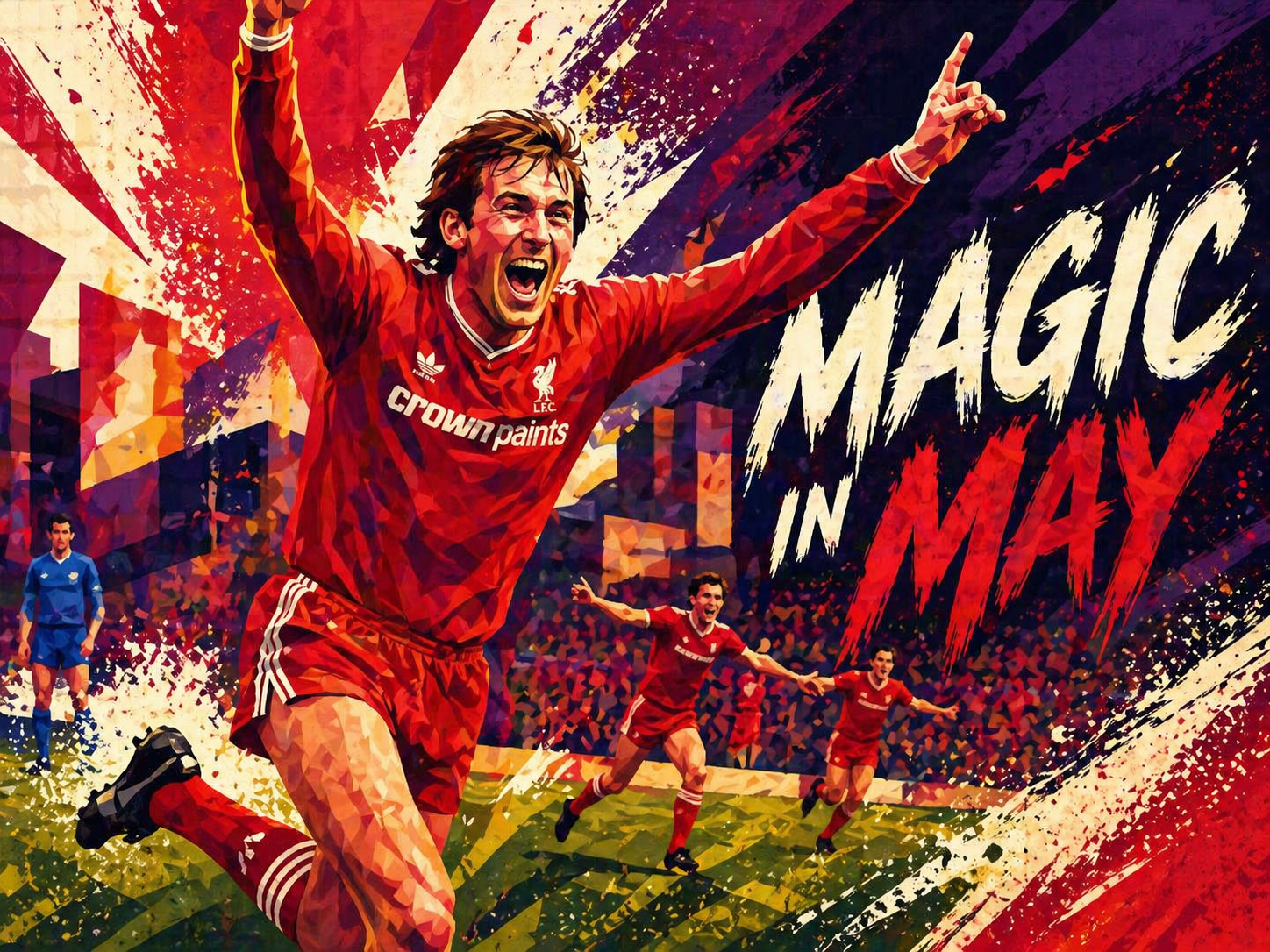
On May 3, 1986, Kenny Dalglish scored the goal that won Liverpool the First Division title at Chelsea. But the deeper story is how one player-manager carried authority from inside the team and held together one of English football’s rarest experiments.
Key Takeaways
- Kenny Dalglish scored the only goal as Liverpool beat Chelsea 1-0 at Stamford Bridge on May 3, 1986.
- The result secured Liverpool’s sixteenth First Division title.
- Dalglish had taken over as player-manager after Joe Fagan’s resignation in the aftermath of Heysel.
- Liverpool completed the Double seven days later by beating Everton 3-1 in the FA Cup final.
- The season remains one of the clearest examples of elite-level leadership from inside the team.
The Goal That Secured the Title — and Defined the Role
The air at Stamford Bridge on May 3, 1986 was heavy with the tension that only a title decider can produce. For Liverpool, this was not a routine fixture placed late in the calendar. It was the culmination of a season shaped by pressure, expectation, and a lingering sense that control still needed to be asserted. Chelsea stood in the way of a sixteenth First Division title. The margin for error had narrowed to almost nothing.
In the 23rd minute, the ball was moved out to Jim Beglin on the left. The full-back paused just long enough to lift a measured, looping pass into the penalty area, not struck with urgency, but with intention.
The moment slowed, not through drama, but through clarity.
Positioned between defenders, reading the flight early, was Kenny Dalglish. At 35, he was no longer simply the focal point of Liverpool’s attack. He was the manager, the organiser, and the central figure through whom the season had been shaped.
He controlled the ball with his chest, absorbing its pace in a single touch, setting it into his stride without breaking rhythm. Before the goalkeeper or the recovering defenders could reset, he struck through it, a clean, controlled volley driven beyond reach and into the net.
It was enough.
Liverpool led 1-0. The title was secured.
Dalglish turned away, arms raised, the release visible but measured, the moment understood rather than celebrated wildly. Around him, the significance travelled quickly. This was not simply a lead taken. It was a season resolved.
The details of the goal remain fixed in Liverpool history. LFCHistory records Dalglish scoring in the 23rd minute from Jim Beglin’s assist, while Liverpool’s own account describes him as the first player-manager to win the English championship, doing so by scoring the title-clinching goal himself.
Yet to view the goal only as the act that decided the match is to reduce it. Dalglish was not merely the player finishing the move. He was the manager who had guided the side through the demands of the campaign, who had balanced authority with participation, and who had chosen to remain inside the team rather than step away from it.
In that moment, those roles met.
The man who selected the side had delivered the title.
That is what endures from Stamford Bridge.
Not just that Liverpool won the league, but that, for one season, leadership existed inside the team itself, and held under pressure when it mattered most.
The Appointment That Followed Crisis — and the Authority That Had to Be Earned
There is a version of this story that has hardened into something close to folklore.
Dalglish replaces Joe Fagan, steps into a dominant side, and carries it forward with minimal disruption. A smooth handover. A continuation of certainty. A domestic Double that appears, in retrospect, almost preordained.
It is a neat narrative.
It is also incomplete.
Dalglish did not inherit Liverpool at the height of calm. He took over in the immediate aftermath of the Heysel Stadium disaster, an event that reshaped the club’s environment in ways that could not be separated from the season that followed. Thirty-nine people had died. English clubs were removed from European competition. Liverpool’s standing within the game, built over years of sustained success, became inseparable from the consequences of that night.
The structure of the club remained.
Its certainty did not.
Externally, the atmosphere around Liverpool was altered. The club existed within a wider context in which English football was being scrutinised, and the city itself was already under strain. Liverpool in the mid-1980s was marked by economic decline, political tension, and a growing sense of separation from the institutions that governed it. Football did not sit outside that reality. It absorbed it.
Dalglish stepped into that space as player-manager.
Internally, the shift was immediate and personal. He was no longer simply part of the dressing room. He was responsible for it. Selection, discipline, authority, decisions that affected players he had trained with, travelled with, and lived alongside for years now sat with him.
“Suddenly, you become the manager and you feel things clam up when you enter the room,” he later said.
That change was not theoretical. It altered behaviour. Conversations shortened. Relationships adjusted. Familiarity no longer carried the same weight.
There were tensions. Senior figures within the squad had their own expectations of how succession might unfold. Reports from the time, and later accounts, point to friction with players such as Phil Neal, who had both status and a legitimate claim to influence within the group. This was not open fracture, but it was not seamless alignment either.
Dalglish was required to assert authority in a space where authority had previously been shared.
That is a difficult position to occupy.
Because it demands change without disruption.
He could not dismantle what had made Liverpool effective. The system, the habits, the internal standards, all of that had to remain. But control had to be re-established in a way that was clear enough to function and subtle enough to be accepted.
This is where the player-manager role becomes more than a curiosity.
Dalglish did not step away from the team to impose authority from above. He chose to remain within it. He trained with the players. He played alongside them. He experienced the same physical demands, the same rhythms of the season, the same immediate pressures.
That decision narrowed the distance between instruction and execution.
It also increased the risk.
Authority is easier to maintain when it is separate. When it is visible from the touchline, reinforced by position and distance. Dalglish removed that separation. His authority had to be carried through behaviour, through consistency, through decisions that could not be deferred or softened.
Every selection mattered.
Every intervention mattered.
Every moment in which he acted as manager while remaining a player reinforced, or weakened, his position.
That is what makes the achievement of 1985-86 more complex than the simplified version allows.
This was not continuity.
It was control being rebuilt under pressure.
And it was done from inside the team itself.
The Foundations of a Football Mind — Why He Could Lead From Inside the Game
To understand why Dalglish could operate in that space, it is not enough to note that he was an outstanding player.
The distinction lies in how he understood the game.
Dalglish’s development in Glasgow, and more importantly under Jock Stein at Celtic, shaped a footballing intelligence that went beyond role or position. Stein’s teams were not built on individual expression alone. They were structured, disciplined, and tactically aware. Players were expected to understand how their movements affected the collective, how space could be created and controlled, how matches could be managed rather than simply played.
Dalglish absorbed that.
He did not arrive as a conventional forward. He became one through understanding rather than instinct. Early in his career he had played deeper, even beginning in goal at school level, before moving outfield and developing a broader reading of the game. That progression matters. It meant he saw football not as a sequence of actions, but as a connected system.
By the time he established himself at Celtic, and later moved to Liverpool, he was already operating with that awareness. He understood when to drop, when to hold position, when to accelerate the tempo and when to slow it. He recognised patterns as they developed, often before they were visible to others.
That is the foundation of his influence.
Because it meant that when he became player-manager, he was not learning to interpret the game from the outside. He had already been doing it from within.
This is the critical difference.
A player-manager can only function at the highest level if the player already carries a managerial understanding of the game. Without that, the demands of playing and directing become incompatible. With it, there is at least the possibility of alignment.
Dalglish operated within that possibility.
He did not need to step away from the pitch to see what was happening. He could feel it in real time. He could adjust his own positioning to correct issues, influence the rhythm of play, and reinforce decisions without waiting for the next break in the game.
This is not about instinct alone.
It is about structure being internalised to the point where it no longer needs to be imposed externally.
That is why his background matters in this context.
Not as biography, but as explanation.
Because the success of 1985-86 depends on it.
Replacing Keegan — and Redefining How Liverpool Attacked
When Dalglish arrived at Liverpool in the summer of 1977, he was not joining a side in transition. He was stepping into one at its peak.
Liverpool were European champions. Bob Paisley’s team had reached a level of consistency and control that few sides in English football had matched. But they had just lost their focal point. Kevin Keegan, the driving force of their attack, had departed for Hamburg.
Replacing Keegan was not simply a matter of goals.
It was a question of identity.
Keegan’s game was built on movement, intensity, and constant disruption of defensive lines. Dalglish did not attempt to replicate that. Instead, he altered the structure of Liverpool’s forward play.
He dropped deeper.
He connected phases.
He drew defenders out of position and created space for others rather than occupying it himself. The attack became less direct, more measured, more dependent on timing than momentum.
The change was immediate.
Dalglish scored on his league debut away at Middlesbrough, then again on his Anfield debut against Newcastle United. But the impact extended beyond those moments. Liverpool’s forward line began to function differently. It became more fluid, less predictable, and more difficult to contain.
This evolution reached a defining point in the 1978 European Cup final at Wembley against Club Brugge. In a tight, controlled match, Dalglish provided the decisive moment, lifting the ball over the advancing goalkeeper to secure a 1-0 victory.
The goal itself was precise.
The significance was broader.
Dalglish had not only replaced Keegan.
He had reshaped the role.
Over the following seasons, his understanding of space and timing became central to Liverpool’s attacking structure. His partnership with Ian Rush would later build on that, but the foundation was already in place. Dalglish did not need to dominate matches physically. He influenced them through positioning, awareness, and control of tempo.
That matters in the context of 1985-86.
Because when he became player-manager, he was not a forward trying to extend his influence.
He was a player who had already been shaping how Liverpool functioned.
The transition from player to player-manager did not introduce that influence.
It formalised it.
A Forward Who Controlled Space — and a Manager Who Refined It
What made Dalglish so difficult to contain was not pace or power.
It was awareness.
He operated in the spaces that unsettled defensive structures, moving between midfield and defence, drawing markers out of position, and opening lanes that did not exist a moment earlier. His game was built on timing rather than force. He did not arrive where the ball was. He arrived where it was going to be.
This is where his partnership with Ian Rush became so effective. Dalglish would drop into deeper areas, receive possession under pressure, and hold it just long enough to shift the shape of the opposition. As defenders followed him, space opened behind. Rush attacked that space with directness and clarity.
The movement was simple.
The effect was not.
It forced opponents to choose between stepping out and risking exposure, or holding their line and allowing Dalglish time to dictate play. Either decision carried consequences.
As a manager, Dalglish extended this logic.
In the 1985-86 season, Liverpool did not undergo radical tactical change. The framework remained familiar. What shifted was emphasis. Control of possession, management of tempo, and the use of space became more deliberate.
Jan Mølby played a central role in that adjustment. From deeper areas, he provided a level of composure that allowed Liverpool to dictate rhythm rather than react to it. His passing range slowed games when needed and accelerated them when opportunities appeared.
Alongside him, Steve McMahon added balance. His energy and defensive work allowed others to operate with greater freedom, ensuring that control was not lost when possession shifted.
These were not dramatic innovations.
They were controlled refinements.
Dalglish did not attempt to reshape Liverpool entirely. He understood that the existing structure was strong enough to compete. His task was to adjust it so that it could function under his authority, within the new demands of the season.
That approach reflects the same qualities that defined him as a player.
Awareness.
Timing.
Control.
He did not impose a new system.
He refined the one he had inherited, ensuring that it remained effective while aligning it with his own understanding of how the game should be managed.
And crucially, he did so while remaining inside it.
The manager was shaping the structure.
The player was living within it.
For one season, those roles did not conflict.
They reinforced each other.
From Teammate to Authority — Managing the Dressing Room Without Distance
The most delicate part of Dalglish’s first season was not tactical.
It was personal.
He had spent years as part of the dressing room at Liverpool, operating within a group that policed its own standards. Authority had existed, but it had been shared, reinforced by senior players and sustained through habit rather than imposed from above.
Now he was responsible for it.
That shift altered everything.
He was still training with the same players, still sharing the same space, but his role had changed. Decisions that had once been collective were now his. Selection, discipline, direction. Each choice carried weight, not only in football terms, but in how it would be received within the group.
“Suddenly, you become the manager and you feel things clam up when you enter the room,” he said.
The change was immediate and subtle.
Conversations became more guarded. Familiarity adjusted. Players who had been equals now looked to him differently, whether they intended to or not. The dressing room did not collapse, but nor did it remain unchanged.
Within that environment were strong personalities and established figures. Alan Hansen, Mark Lawrenson, Ronnie Whelan. Players accustomed to success, used to holding each other to account, and capable of influencing how the team functioned.
Dalglish could not override that structure.
He had to work through it.
That required restraint as much as authority. He did not arrive with a need to assert control visibly. Instead, he aligned his decisions with the standards already embedded within the squad. When changes were made, they were framed within that existing framework rather than against it.
But alignment does not remove tension.
There were moments where decisions affected players with whom Dalglish had long-standing relationships. Roles changed. Expectations shifted. According to accounts from the period, there was friction with figures such as Phil Neal, whose status within the squad and proximity to the role made the transition more complex.
This was not open conflict.
It was controlled tension.
And it required management.
Dalglish could not rely on distance to enforce authority. He was present in every training session, every match, every moment where standards were either upheld or allowed to slip. His authority had to be carried through behaviour, through consistency, through decisions that held under scrutiny from those closest to him.
That is the risk of leading from within.
There is no separation.
No buffer.
Every action is visible.
Every inconsistency is exposed.
For most of the season, Dalglish maintained that consistency.
The dressing room held.
And because it held, the structure of the team held with it.
That is what allowed the model to function.
Not just tactical understanding.
Not just individual quality.
But authority, sustained without distance, in the space where it is hardest to maintain.
The Collapse That Threatened the Season — and the Decision That Reclaimed It
For much of 1985-86, Liverpool were not in control of the title race.
That distinction matters.
Everton, under Howard Kendall, set the standard. They were the reigning champions, physically imposing, organised, and consistent. For long stretches of the campaign, they dictated the terms.
Liverpool were responding.
By late February, the pressure sharpened into something more tangible. On February 22, Everton came to Anfield and won 2-0. It was not simply a defeat. It reinforced the sense that Liverpool’s season was slipping away.
The gap widened.
Confidence wavered.
Inside the squad, there were doubts about whether the side had enough to recover. Alan Hansen would later describe it as the weakest Liverpool team he had been part of, a reflection not of talent alone, but of how the season felt at that point.
This is where the season pivots.
Dalglish did not respond with a structural overhaul.
He responded with presence.
Until that stage, his involvement as a player had been managed carefully. He had not been a constant in the starting eleven. Now, with the season at risk, he increased his role on the pitch.
Not as sentiment.
As intervention.
By placing himself back inside the team more consistently, he altered the balance. The distance between decision and execution narrowed. The tempo of games shifted. Possession was held more securely. Moments were managed rather than chased.
The effect was gradual, then decisive.
Liverpool did not suddenly become dominant.
They became controlled.
Results followed. Performances stabilised. The pressure that had built began to turn.
They won when they needed to win.
They held when they needed to hold.
The gap to Everton narrowed, then disappeared.
Momentum, which had belonged elsewhere, shifted.
This was not a surge built on spectacle.
It was built on control.
By the time Liverpool travelled to Stamford Bridge on May 3, the work had already been done. The structure had held through the most difficult period of the season. The authority Dalglish had been constructing, both as player and manager, had been tested and had not broken.
What remained was confirmation.
And when it came, it came from the same place the recovery had begun.
Inside the team.
Through the same figure who had chosen to lead it from within.
Seven Days Later at Wembley — Control Confirmed Under Greater Pressure
If Stamford Bridge resolved the league, Wembley tested whether the same balance could hold under a different kind of pressure.
Seven days after beating Chelsea, Liverpool faced Everton in the FA Cup final, the first time the competition had brought the city together on that stage. The league had been secured. The Double was now in reach. The opponent was the same side that had driven the title race and exposed Liverpool’s vulnerability at Anfield in February.
The conditions were different.
The margin for recovery was smaller.
Everton began with authority. They controlled the early phases, pressed higher, and disrupted Liverpool’s rhythm. The opening goal reflected that. Gary Lineker broke through and finished cleanly, placing Everton ahead and reinforcing the sense that the balance could tilt again.
At that point, the dynamic that had defined Liverpool’s run-in was tested under greater strain.
Dalglish, now operating primarily as manager on the touchline, had to restore clarity without the immediate influence of being inside the play. The response was not dramatic. It was controlled. Adjustments were made to regain composure, to stabilise possession, and to reduce the space Everton had been exploiting.
The second half shifted.
Ian Rush equalised, restoring balance. Craig Johnston forced Liverpool ahead, capitalising on sustained pressure. Rush added a second late in the match, confirming the outcome.
The scoreline, 3-1, suggests clarity.
The process was more demanding.
Liverpool had been forced to absorb pressure, respond, and reassert control against the strongest domestic opponent of the season. They did not overwhelm Everton. They managed them, just as they had in the final weeks of the league campaign.
That continuity matters.
Because it shows that Stamford Bridge was not an isolated moment. It was part of a sequence in which Liverpool’s structure held under different conditions, against the same opponent, across consecutive decisive matches.
Dalglish’s role, across both games, shifts in form but not in function.
At Stamford Bridge, he is inside the team, resolving the season through direct action.
At Wembley, he is outside it, restoring control through decision and adjustment.
The authority is the same.
The method adapts.
That is what confirms the achievement.
Not just that Liverpool won both competitions, but that the system Dalglish had constructed, one that balanced leadership and participation, could withstand pressure in different forms and still produce the same outcome.
The Double did not validate a moment.
It validated a model.
Back to Stamford Bridge — Why the Goal Carries More Than the Moment
Return to Stamford Bridge, and the goal shifts again in meaning.
On its own, it is a clean action. A pass from Jim Beglin, a controlled touch, a volley taken early enough to remove reaction. The technique is precise. The execution is decisive.
But it does not explain itself.
What gives it weight is everything that surrounds it.
Dalglish is not arriving in the box as a specialist finisher, detached from the structure of the team. He is arriving as the figure who has shaped that structure, who has managed the relationships within it, and who has carried the responsibility of maintaining it across the season.
The movement is simple.
The context is not.
He has spent the week preparing the side, selecting it, managing the balance between players who expect to start and those who do not, dealing with the external pressure that comes with a title race, and carrying the accumulated weight of a season played under scrutiny. When the ball is lifted into the area, he is not stepping into a moment separate from that responsibility.
He is bringing it with him.
That is what separates this goal from others that decide titles.
It is not only the final action.
It is the convergence of roles.
The same individual who has determined how Liverpool should play is now executing the decisive action within that system. There is no separation between instruction and outcome. No delay between decision and effect.
It happens in the same movement.
That alignment is rare.
In most cases, the manager defines the structure and the players deliver within it. The relationship is sequential. Here, it is simultaneous.
That is why the goal endures beyond the match itself.
Not because of its difficulty.
Not because of its timing.
But because it represents a point where responsibility and execution meet without distance.
For one season, that balance held.
At Stamford Bridge, it was resolved in a single touch and a single strike.
And in that moment, the model that had carried Liverpool through the campaign found its clearest expression.
What the Season Demonstrated — and Why the Conditions Mattered
What Liverpool achieved in 1985-86 was not simply a league title followed by a cup win.
It was a demonstration of how a team could function when authority was carried within it, rather than imposed from outside.
But that only works under specific conditions.
Liverpool’s structure had been built over years. Under Bob Paisley and Joe Fagan, the system had become internalised. Players understood their roles, but more importantly, they understood how those roles connected. Standards were not dependent on a single voice. They were reinforced across the group.
That matters.
Because it meant that when Dalglish stepped into the role, he was not building authority from nothing. He was aligning himself with something that already existed.
The dressing room could carry responsibility.
The team could manage itself within games.
Dalglish’s role was to ensure that alignment held.
This reduced the need for constant external intervention. Matches did not require continuous instruction from the touchline. Adjustments could be made within the game itself, by players who recognised what was required and acted on it.
That is what allowed the player-manager model to function at this level.
Not because the role itself is inherently effective, but because the environment supported it.
There was also a simplicity to the structure of the game at the time. Tactical systems were defined, but they were not layered with the complexity that would develop in later decades. Preparation was detailed, but not exhaustive. The number of variables a manager had to process was smaller.
That does not reduce the achievement.
It explains it.
Dalglish operated within a system that allowed clarity to be maintained. He could influence matches directly as a player while maintaining oversight as a manager because the demands, while high, were not fragmented across multiple layers of analysis and decision-making.
Everything remained connected.
That connection is the key.
Because it meant that when Liverpool needed to recover their season, the response could come from within the team itself. Dalglish could step back onto the pitch, adjust the rhythm, and reinforce the structure in real time.
There was no delay.
No translation between instruction and execution.
The system functioned as a whole.
That is what the season demonstrates.
Not just that a player-manager can succeed.
But that it requires a set of conditions that allow leadership, structure, and execution to operate within the same space without breaking.
Liverpool in 1985-86 had those conditions.
And for one season, they held.
Why the Model Did Not Survive — and Could Not Be Recreated
What makes the 1985-86 season stand apart is not only that it succeeded.
It is that it did not lead to repetition.
The player-manager at the highest level did not disappear immediately, but it became increasingly unworkable. The conditions that allowed Dalglish to operate inside the team began to shift.
The game expanded.
Tactical preparation became more detailed. Opponent analysis grew more specific. Training sessions became more structured, more segmented, more focused on micro-adjustments within systems rather than broad patterns of play. The number of decisions required from a manager increased, not only during matches but throughout the week.
That changed the nature of the role.
A manager was no longer simply responsible for selection and general direction. He became the central point in a network of information. Coaches, analysts, fitness staff, recruitment teams. Each layer added complexity. Each layer required attention.
Distance became necessary.
From the touchline, a manager could observe patterns, adjust positioning, communicate with staff, and respond to developments in real time with a broader view of the game. That perspective cannot be replicated from within play.
The player, by definition, is inside the moment.
The manager must be outside it.
Dalglish had operated in a space where those demands overlapped.
That space narrowed.
It is not only tactical.
The external environment changed as well. Media scrutiny intensified. The pressure surrounding elite clubs increased. Every decision, every selection, every result became subject to immediate and sustained analysis. The margin for error reduced, not only in results but in perception.
A player-manager would have to absorb both sets of pressures simultaneously.
That is not sustainable.
There is also the question of authority.
In a modern dressing room, with larger squads, higher financial stakes, and more diverse influences, authority is harder to maintain without clear separation. The manager’s position is defined not only by decisions but by distance. That distance allows clarity.
Dalglish removed that distance.
It worked because the environment allowed it to.
Once that environment changed, the model could not adapt.
That is why the achievement stands alone.
Not as a template that could be followed, but as a moment that marks the limit of what was possible under a specific set of conditions.
It is not that the role became less effective.
It is that the game moved beyond it.
And in doing so, it made what Dalglish achieved at Liverpool in 1985-86 something that belongs to its time, rather than something that can be recreated in another.
