


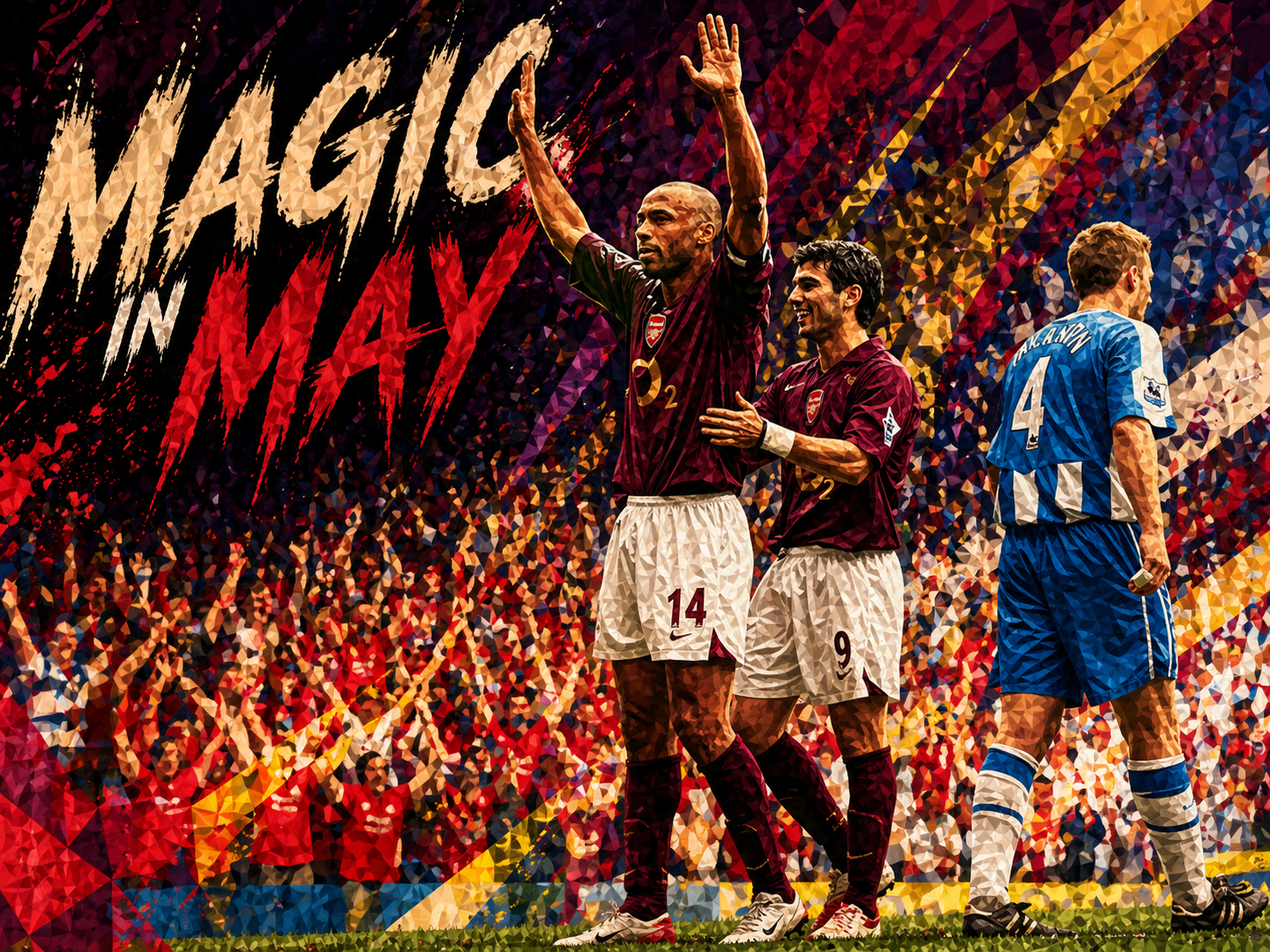
On 7 May 2006, Arsenal played their final match at Highbury. Thierry Henry scored a hat-trick, kissed the turf, and gave the old ground an ending that still feels almost too exact to be true.
Key Takeaways
- Arsenal’s final competitive match at Highbury ended in a 4-2 win over Wigan Athletic on 7 May 2006.
- Thierry Henry scored a hat-trick, including the final competitive goal at the stadium.
- The result secured Arsenal’s place in the following season’s Champions League after Tottenham lost at West Ham.
- Henry’s kiss of the Highbury turf was widely read as a farewell to Arsenal, but it was really a farewell to the ground that had made him complete.
- The match captured the central tension of Henry’s Arsenal career: loyalty, ambition, perfectionism, and the passing of an era.
The clock was moving towards the end, and Highbury knew.
Not in the sentimental way people later describe old stadiums, as if bricks carry memory by themselves. This was sharper than nostalgia. The place felt aware of its own disappearance. The redcurrant shirts, the ceremonial mood, the tight walls of the old ground, the strange pressure of a match that had to be won and mourned at the same time. Everything about 7 May 2006 seemed to resist ordinary football language.
This was not just Arsenal against Wigan Athletic. It was Arsenal against time.
The old ground had been home since 1913. It had carried Herbert Chapman’s modernism, Cliff Bastin’s goals, the Marble Halls, the North Bank, the famous East Stand, George Graham’s discipline, Arsène Wenger’s revolution, and the most beautiful football England had seen in the early years of the new century. But now it was hosting its final competitive act. After this, Arsenal would move to the Emirates, bigger and richer, but not the same. Highbury would become memory, property, garden, outline.
The afternoon refused to behave like a wake.
Arsenal needed to better Tottenham Hotspur’s result to finish fourth and qualify for the Champions League. Across London, Tottenham were at West Ham, their preparations disrupted by the illness that soon became part of Premier League folklore. At Highbury, Arsenal scored first through Robert Pirès, then let the script slip. Paul Scharner equalised. David Thompson put Wigan ahead. For a few awful minutes, the final day at Highbury threatened to become an embarrassment wrapped in ceremony.
Then Thierry Henry began to take ownership of the story.
First came the equaliser before half-time. Then the second. Then, late in the game, Freddie Ljungberg was brought down in the penalty area. Henry placed the ball on the spot. There was no great theatrical pause, no visible panic, no sense that the occasion had grown too large for him. He had always understood Highbury’s angles better than anyone. He ran up and scored.
Arsenal 4, Wigan 2.
A hat-trick. Fourth place secured. The final competitive goal at Highbury.
Then Henry turned away, dropped to his knees, bent forward, and kissed the grass.
That was the image. Not the penalty. Not the scoreline. Not even the Champions League qualification. The image was Henry, the most elegant footballer the stadium had ever known, pressing his lips to the turf as if thanking a living thing.
It looked like goodbye.
But it was not quite the goodbye most people thought it was.
It Was Never Just a Farewell
The simple reading was irresistible. Henry had been linked heavily with Barcelona. Arsenal had just staggered through a season of transition. Patrick Vieira had gone. The Invincibles were breaking apart. The new stadium was waiting. The club’s captain had scored the last goal at the old ground and kissed the pitch. Football does not often hand writers symbolism that clean.
So the conclusion came easily: Henry was saying goodbye to Arsenal.
Except he was not.
Less than two weeks later, after Arsenal lost the Champions League final to Barcelona in Paris, Henry signed a new contract. “I think with my heart and my heart told me to stay,” he said when confirming the decision. In another line that cut through the transfer noise, he said: “I am staying here, at the club that I love.” Those words matter because they complicate the photograph. The kiss was not a staged exit. It was not a player softening the blow before abandoning the club. It was something more specific, and more interesting.
Henry was saying goodbye to Highbury.
That distinction matters. Clubs present themselves as permanent, but footballers know how much place shapes performance. Highbury had not merely housed Henry’s greatness. It had helped produce it. The pitch was tight. The crowd was close. The walls seemed to lean inward. There was no vast bowl swallowing sound and space. Highbury compressed football. For some players, that would have felt restrictive. For Henry, it sharpened everything.
His game was built on angles, timing and sudden expansion. He would begin as a centre-forward, drift left, open the pitch from a narrow lane, and then finish into the far corner with a certainty that made the act look almost preordained. Highbury’s dimensions did not limit him. They framed him.
That is why the kiss endures. It was not only affection. It was recognition. Henry understood what was ending before everyone else had language for it.
Modern Arsenal would gain revenue, scale and possibility. But something would also be lost. The Emirates would be impressive. Highbury had been intimate. The Emirates would belong to the future. Highbury belonged to feeling.
Henry knew the difference.
The Concrete Before the Garden
To understand why that strip of North London grass mattered so much, it helps to go back to a place where grass was not part of the picture.
Thierry Daniel Henry was born in Les Ulis, a suburb south-west of Paris, in 1977. The story is often told with too much polish, as if it were a neat origin myth: tough suburb, gifted boy, escape through football. The truth is more useful when kept plain. Les Ulis gave Henry pressure. It gave him traffic. It gave him football in crowded spaces, on hard surfaces, against older boys, where technique was not decoration but protection.
He learned to move because he had to. He learned balance because the ground was unforgiving. He learned deception because space was scarce. Long before Wenger repositioned him, long before Highbury became his stage, Henry had already developed the habits of a player who did not need much room to create separation.
The other formative force was his father, Antoine, known as Toni. By Henry’s own telling, the standards at home were severe. A hat-trick did not bring unqualified praise. It brought the reminder that a fourth goal had been possible. A good performance was not a destination. It was evidence of what still needed to be improved.
That psychology never left him.
It explains the face that opponents and some supporters mistook for arrogance. The scowl. The sharp glance at a teammate who delayed a pass. The visible irritation when a move lost its shape. Henry could appear aloof, even disdainful, but much of that came from a more demanding source. He was not playing against the game alone. He was playing against an imagined perfect version of it.
That is the key to Henry. The beauty came from dissatisfaction.
The Reinvention That Nearly Failed
Henry’s greatness was not inevitable. That matters, because the later version was so complete that people often talk as if Arsenal simply received a finished masterpiece.
They did not.
At Monaco, under Arsène Wenger, Henry was a thrilling wide player. Quick, direct, gifted, but still raw. He won the World Cup with France in 1998, but even then he was not yet the footballer people now remember. He was a promise more than a fully formed force.
Then came Juventus.
The move to Italy in January 1999 should have been a finishing school. Instead, it became a warning. Henry was used wide, asked to perform duties that dulled his instinct, and placed inside a tactical culture that did not naturally suit his gifts at that age. Carlo Ancelotti later acknowledged that he had not seen Henry as the centre-forward he would become. That regret is understandable. In Turin, Henry looked constrained. At Arsenal, Wenger saw the player inside the position.
The transfer in August 1999 was not cheap, but it was brave. Arsenal had lost Nicolas Anelka to Real Madrid. They needed goals, but Wenger was not buying a conventional striker. He was buying a winger he believed he could rebuild.
The early weeks were awkward. Henry missed chances. He looked uncertain in the penalty area. English football was fast, physical and impatient. At Arsenal’s training ground, he was tested by Tony Adams, Martin Keown, Nigel Winterburn and the old defensive core. They did not give him a gentle education. They forced him to learn contact, timing and resilience.
Wenger’s genius was not merely seeing Henry’s pace. Everyone could see that. Wenger saw that Henry’s greatest weapon was not speed in open grass, but speed applied from unusual positions. He did not need Henry to become a penalty-box striker in the English tradition. He needed him to become something the league had not quite seen.
The first Arsenal goal came against Southampton in September 1999. It was not the whole answer, but it changed the emotional temperature. The anxiety lifted. The player began to trust the role. The crowd began to trust the player.
From there, the reinvention became one of the defining coaching achievements of the Premier League era.
The Striker Who Refused to Stay Still
Henry did not redefine the Premier League centre-forward by rejecting the role. He redefined it by expanding it.
On paper, he was Arsenal’s No.9. In reality, he was centre-forward, left-sided runner, creator, decoy and finisher. He could lead the line, but he did not want to live between two centre-backs. He wanted to move them. He wanted to drag one into space he did not understand. He wanted to isolate the right-back. He wanted to receive on the half-turn, accelerate diagonally and force the whole defensive line to make decisions it was not built to make.
The signature finish became part of English football’s visual memory. Henry starting left of centre. The defender backing off because stepping in meant death. The goalkeeper shading towards the near post, knowing what was coming and still unable to prevent it. Henry opening his body, using the inside of his right foot, and passing the ball into the far corner with a calm that felt almost insulting.
It was not just technique. It was geometry.
The brilliance of that Arsenal side was how many players understood his geometry. Dennis Bergkamp was the most important. Bergkamp did not need Henry to point. He saw the run before the run had been fully made. If Henry was movement, Bergkamp was anticipation. Their partnership had almost no waste. One thought in two bodies.
Robert Pirès added another layer. He and Henry shared the left side like conspirators. Ashley Cole overlapped. Pirès drifted inside. Henry moved wide or central depending on the defender’s panic. Arsenal’s left flank became less a channel than a series of traps.
This was the heart of the Invincibles. Not just athleticism. Not just flair. Spacing. Repetition. Trust.
The 2003-04 season remains Arsenal’s highest collective expression under Wenger, but one match from that campaign explains Henry’s value better than any table. On Good Friday in April 2004, Arsenal faced Liverpool at Highbury after a bruising week. They had been knocked out of the FA Cup by Manchester United and then beaten by Chelsea in the Champions League. The unbeaten league season was wobbling. Liverpool led 2-1 at half-time.
Then Henry took the game away from them.
His second goal was a run that looked like anger turned into balance. He gathered the ball, moved through midfield, left Dietmar Hamann and Jamie Carragher scrambling, and finished past Jerzy Dudek. He scored three that day. Arsenal won 4-2. The Invincibles survived.
That was Henry at his most important. Not merely brilliant when Arsenal flowed, but capable of restoring order when the whole season threatened to tilt.
The Tension Beneath the Elegance
Henry’s football was elegant, but his career was not frictionless.
The first tension was internal. Perfection drove him, but it also disturbed him. He seemed incapable of treating brilliance as enough. The misplaced pass, the wrong run, the delayed decision, the lost rhythm. These things stayed with him. That made him demanding in a way that could inspire and irritate. It also made him more human than the highlight reels suggest.
The second tension was tactical. Wenger gave Henry freedom, but that freedom depended on a finely tuned collective structure. Arsenal could carry his drifting because Bergkamp, Pirès, Vieira, Gilberto Silva, Cole and others understood the compensations. When that structure aged and changed, Henry’s burden grew. The more Arsenal lost around him, the more they needed him to be everything.
The third tension was European.
Domestically, Henry bent the Premier League around himself. In Europe, Arsenal’s story was more complicated. Wenger’s teams were admired across the continent, but they often fell short in the Champions League. Sometimes through tactical naivety, sometimes through bad luck, sometimes through the harshness of knockout football. Henry’s own European reputation became caught in that frustration. For all his brilliance, the question remained: could Arsenal’s most beautiful football survive the coldest nights?
That tension sharpened after Vieira left in 2005. Henry became captain. The symbolism was powerful, but the job was heavy. He was no longer simply the attacking genius at the edge of the structure. He had to carry the structure emotionally.
At the same time, Barcelona waited in the background. Not as rumour only, but as possibility. They offered the thing Arsenal could not guarantee: the Champions League, surrounded by a squad built for the final stage of European football.
Henry loved Arsenal. He also wanted the one club prize missing from his life.
That conflict gives the Highbury kiss its weight.
Prague, Paris and the Burden of Being Arsenal’s Answer
One of Henry’s most revealing Arsenal nights did not happen at Highbury. It happened in Prague.
In October 2005, Arsenal travelled to face Sparta Prague in the Champions League. Henry had been struggling with injury and was not expected to play a major role. Then José Antonio Reyes was forced off early. Henry came on and produced a finish of outrageous confidence, controlling and striking with the outside of his right foot. Later, he scored again.
That second goal took him beyond Ian Wright as Arsenal’s record goalscorer.
It was fitting that the record was broken away from home, almost inconveniently, in a match he had not been expected to shape. Henry’s Arsenal career often looked smooth in retrospect, but many of its defining moments came when circumstances were awkward. He thrived not because everything was arranged for him, but because he could bend inconvenience into theatre.
The 2005-06 Champions League campaign then became the strangest, toughest chapter of his Arsenal life.
This was not the Invincibles at full power. This was a side in transition. Injuries forced Wenger into defensive improvisation. Emmanuel Eboué, Philippe Senderos, Kolo Touré and Mathieu Flamini formed a back line that few would have imagined carrying Arsenal to Paris. Yet Arsenal became harder, more pragmatic, less open than in previous European years.
Henry, as captain, was the bridge between identities. He remained the artist, but now had to be the authority too.
At the Bernabéu against Real Madrid, he produced one of the great Arsenal European goals. He took possession near halfway, powered away, resisted challenges and finished past Iker Casillas. It was a goal of pace, strength and nerve. It was also a statement. On a pitch filled with names, Henry looked like the true galáctico.
Arsenal protected that lead, then advanced. They beat Juventus. They survived Villarreal, with Jens Lehmann saving Juan Román Riquelme’s late penalty in the semi-final. Somehow, improbably, Arsenal reached the Champions League final.
Paris should have been the perfect stage. Henry in his home country. Arsenal against Barcelona. The old Wenger project against the club so many believed Henry might join.
Instead, the final became a wound.
Lehmann was sent off after 18 minutes. Arsenal led through Sol Campbell, but playing with ten men against Barcelona eventually drained them. Samuel Eto’o equalised. Juliano Belletti scored the winner. Henry had chances and did not take them. After everything, Arsenal were one step short.
The disappointment was raw. Yet what happened afterwards complicates the easy story of Henry as a player seduced by bigger glamour. He stayed. He signed. He spoke of love, heart and responsibility.
That choice did not last forever. In 2007, he did leave for Barcelona. But in the immediate aftermath of Paris, when leaving would have been understandable, he remained.
That matters.
Highbury’s Last Day Was a Football Match, Not a Ceremony
The danger with the final Highbury match is to remember only the image and forget the contest.
It was not a parade. Wigan did not arrive as extras in Arsenal’s historical drama. Paul Jewell’s side had been one of the surprises of the season, newly promoted and already safe, direct, awkward and fearless enough to treat the occasion as a match rather than a museum opening.
That is why the day worked. Had Arsenal won 4-0 in comfort, the goodbye might have felt too polished. Instead, they had to suffer.
Pirès gave Arsenal the early lead, a fitting scorer in his own final Highbury appearance. Then Wigan punctured the mood. Scharner equalised. Thompson’s free-kick put Wigan 2-1 ahead. The crowd, dressed for farewell, suddenly had to confront something more immediate: failure.
Across London, Tottenham were losing at West Ham, but Arsenal could not rely on that alone. The old ground demanded one last act of rescue.
Henry supplied it.
The equaliser came through pressure and instinct. The second restored Arsenal’s control. The penalty completed the hat-trick and gave Highbury the ending it wanted, but not before the ground had earned it.
There is a difference between sentiment and drama. Sentiment asks for a soft landing. Drama requires danger. Highbury’s last day had danger.
That is why it still resonates.
The Defining Moment Revisited
So return to Henry on his knees.
By then, the kiss meant more than victory. It carried Les Ulis, Monaco, Turin, Wenger’s reinvention, Bergkamp’s passes, Pirès’ timing, the Invincibles, Prague, Madrid, Paris, and the tension of a player caught between gratitude and ambition.
It also carried Highbury itself.
Football grounds are often described through noise, but Highbury’s power was partly in its restraint. It had a kind of old-world confidence. The Art Deco stands did not need to shout. The pitch did not need vastness. The place trusted proportion. It suited a footballer whose most devastating quality was not chaos, but control at speed.
Henry’s kiss was not a grand romantic flourish. It was precise. Like his finishing. Like his movement. Like the relationship between player and ground.
He was thanking the turf because the turf had mattered.
It had witnessed the transformation from uncertain signing to Arsenal’s greatest goalscorer. It had framed the left-channel runs, the curled finishes, the glances across the defensive line. It had absorbed the roar after Manchester United, Liverpool, Chelsea, Tottenham, Inter Milan, Real Madrid and all the other nights when Arsenal under Wenger felt less like a team than an argument for how football should be played.
And it was going.
That is the part that still hurts Arsenal supporters. Highbury did not disappear because it failed. It disappeared because the club had outgrown it. That is a more complex grief. The move made sense. It was rational. It was necessary for the modern game Arsenal wanted to inhabit.
But football is not lived rationally.
Henry knew that too.
Legacy: What Henry Changed and What People Still Miss
Thierry Henry’s Arsenal legacy is usually introduced through numbers. That is understandable. He scored 226 goals for the club. He won Premier League titles, FA Cups, Golden Boots and individual awards. He became Arsenal’s record goalscorer. He gave the club some of its most replayed moments.
But numbers do not fully explain change.
Henry altered the Premier League’s idea of a striker. Before him, English football still leaned heavily on categories. Target man. Poacher. Second striker. Wide forward. No.10. Henry blurred those lines without becoming vague. He was not positionless. He was positionally intelligent. He knew where to begin, where to pull defenders, where to receive, when to accelerate, and when to become a finisher again.
That is why his influence runs through so many later forwards. Not because they copied him exactly. Few could. But because he expanded the job. A striker could start wide. A winger could become a central scorer. A forward could be both creator and executioner. Pace did not have to mean rawness. Elegance did not have to mean softness.
He also helped change the cultural feel of the Premier League. Wenger’s Arsenal were cosmopolitan, technical, fast and sophisticated at a time when English football was still negotiating its identity after the 1990s. Henry became the face of that shift. He made refinement look ruthless.
Yet he is still misunderstood in one important way.
People often remember the coolness and mistake it for ease.
Henry was not easy. Not as a personality, not as a teammate, not as an opponent, not even to himself. The gliding stride concealed work. The composed finish concealed obsession. The confidence concealed a constant internal argument with imperfection.
That is why the Highbury kiss matters more than another celebration would have. It allowed the public to see the feeling beneath the control. For once, Henry did not look untouchable. He looked grateful.
What Remains of Highbury
Highbury did not vanish completely. That almost makes the memory stranger.
The East and West Stand facades remain. The old pitch is now a communal garden. The place where Henry bent runs into art is marked by paths, trees and quiet residential order. The stadium became Highbury Square, a development that preserved parts of the structure while changing the purpose entirely.
There is something fitting about that. Highbury was always more elegant than loud. Even in afterlife, it did not become a car park or a blank space. It became somewhere people live.
Still, the football version exists only in memory now.
For Arsenal, the Emirates era brought different questions: debt, scale, commercial growth, distance from the pitch, years of adjustment, and eventually a new team trying to build its own emotional architecture. Clubs move forward because they must. Supporters look back because they cannot help it.
Henry sits at the centre of that divide.
He was the final great footballer of Highbury and the first symbolic burden of the Emirates. He belonged completely to the old ground, even when he briefly played in the new one. Some players define eras through trophies. Henry defined Arsenal’s Highbury ending through style, memory and one gesture of farewell.
That is why 7 May 2006 still feels unusually complete.
Arsenal needed a win. Henry scored three. Tottenham lost. Champions League football was secured. The last goal belonged to the right player. The celebration matched the moment. Football rarely arranges itself with such neatness.
But maybe Highbury earned that.
Closing Reflection
In the end, the kiss was not about one man leaving. It was about one place ending.
Thierry Henry eventually went to Barcelona. Arsenal eventually built new memories elsewhere. Highbury became homes and gardens, its old pitch traced rather than played on.
But some football images resist time because they contain more than they show.
Henry on his knees at Highbury is one of them.
It shows a player at the height of his power, but also at the edge of loss. It shows a club stepping into the future while grieving the place that had made its modern identity possible. It shows that football greatness is not only about talent, trophies or records. Sometimes it is about fit. A player, a manager, a team, a crowd, a ground, all meeting at the right moment.
Highbury gave Henry the perfect stage.
Henry gave Highbury the perfect last line.
