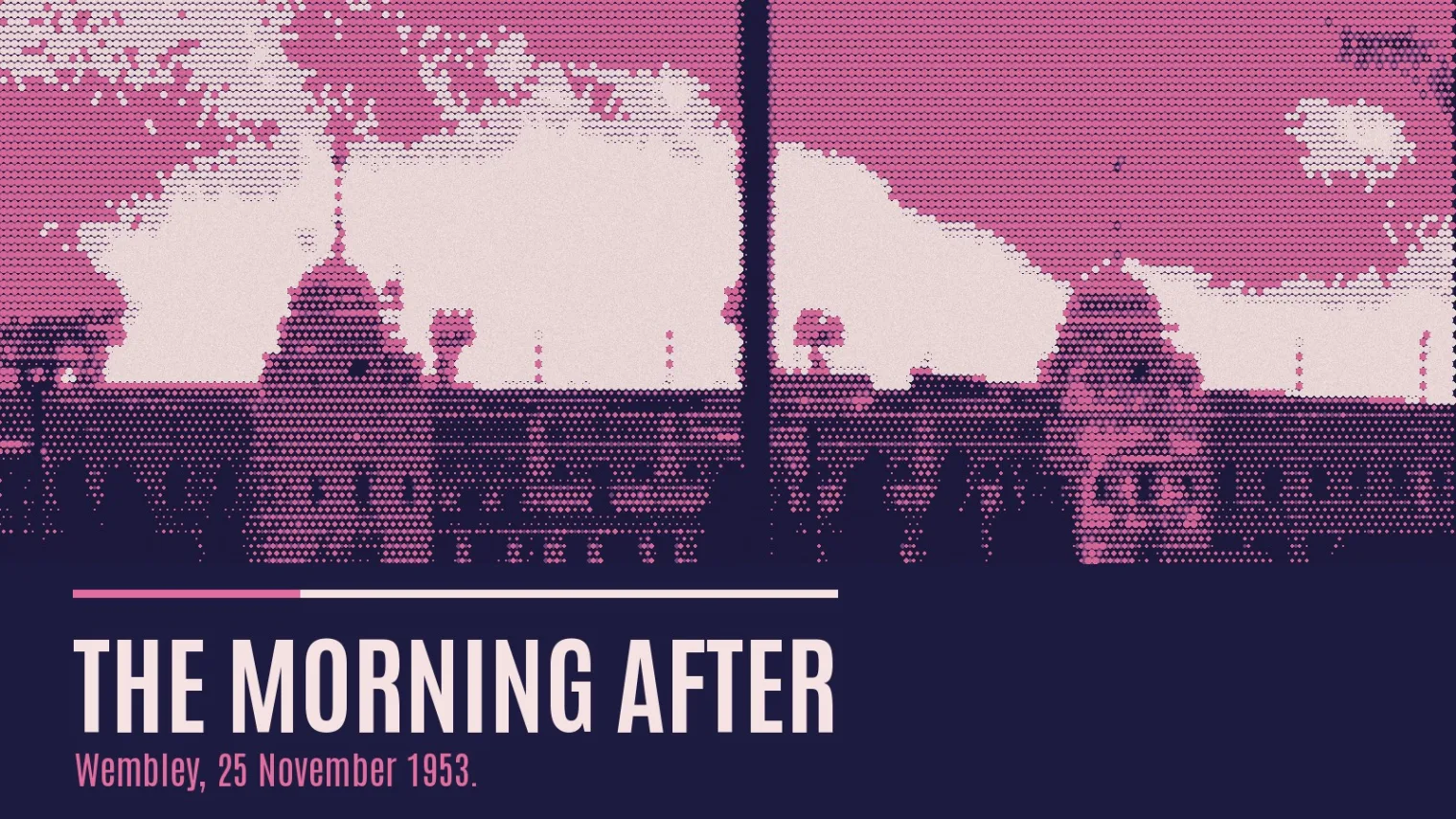
Seventy-three years ago today, on 25 November 1953, England lost 6-3 to Hungary at Wembley. The Hungarian side of that afternoon has already been told on this site, and told properly: from the team that taught the game how to think to Gusztáv Sebes and the Honvéd club that became a state. This is the other side of the same scoreline. The dressing room. The press box. And the morning after, when English football decided it had seen the future and then took thirteen years, and a different manager, to do much about it.
The year that was supposed to belong to Matthews
Jonathan Wilson, writing on the sixtieth anniversary, pointed out that the shock did not arrive from nowhere. Six months earlier, four of the men who would pull on England shirts at Wembley had been at the same ground in the FA Cup final. Stanley Matthews, at 38, finally had his medal. Blackpool had come back from 3-1 down to beat Bolton 4-3, and even the cynics in the press box, Wilson wrote, stood on desks to applaud. In the weeks that followed, Gordon Richards won the Derby and a British expedition climbed Everest. 1953 was supposed to be the year British sport remembered how to feel certain of itself.
Four of those Cup final players were back in November. Matthews, Ernie Taylor, Stan Mortensen and Harry Johnston all started for England. The teamsheet, as Pat Ward-Thomas printed it in the Guardian the next morning, still reads like a roll-call of the domestic establishment: Gil Merrick of Birmingham City in goal; Alf Ramsey of Tottenham and Bill Eckersley of Blackburn at full-back; Billy Wright of Wolves, Johnston, and Jimmy Dickinson of Portsmouth across the half-back line; Matthews, Taylor, Mortensen, Jackie Sewell of Sheffield Wednesday and George Robb of Tottenham in front of them. Tom Finney was missing. UEFA, looking back sixty years later, records that he was out injured. His verdict, delivered from the outside, would be the line that stuck: it had been “carthorses playing racehorses.”
England, as the old line goes, had never lost at home to a side from outside the British Isles. That is the careful version, and it is the one worth keeping. Brian Glanville later spelled out the caveat: the Republic of Ireland had already won 2-0 at Everton in 1949, though that Ireland side was made up entirely of English league players. The citadel at Wembley itself had not been as untouchable as the rhetoric suggested either. Two years earlier, Miguel Rugilo’s Argentina had arrived for a Festival of Britain showpiece and spent the afternoon making the old Empire Stadium feel suddenly penetrable. Eight years before that, Dynamo Moscow had toured Britain and left a riddle that English football chose to treat as politics. The warnings were on the record. They had not been taken as a lesson.
Wilson’s anniversary piece traces the same discomfort further back: Matthias Sindelar dropping deep for Austria in 1932, Vsevolod Bobrov doing much the same on that Dynamo tour, Switzerland’s Alfred Bickel in 1947, José Lacasia for Argentina in 1951. Deep-lying centre-forwards unsettled England. They always had. A month before Hungary arrived, they had even had a dress rehearsal they chose not to treat as one. In October 1953, England played a Rest of the World side at Wembley to mark the FA’s 90th anniversary. The visitors used a fluid front of Gunnar Nordahl, Bernard Vukas and László Kubala. England’s centre-half, Derek Ufton, could not live with it. “Deserted by his ‘prey’, he felt like a fish out of water,” the Austrian journalist Willy Meisl wrote. “One could see he felt acutely embarrassed, not to say lost. To follow Nordahl, or to let him roam? This stopper led a purposeless life for 90 minutes because a fanciful foreign centre-forward refused to play the game according to the British pattern.” A last-minute penalty, which Wilson calls dubious, earned England a 4-4 draw. The drawing of breath was mistaken for a lesson learned.
The complacency had a house style. Glanville remembered Frank Coles, of the Daily Telegraph, asking himself how the Hungarians would fare against an English club side fighting for points in midwinter, and answering that the English team would run through them. Glanville had already seen Hungary take Italy apart 3-0 at the opening of Rome’s Olympic Stadium that May, and had written a warning in a sports weekly about what was coming in November. It did not become the general view. The difference on 25 November was not that the problem was new. It was that the unsettlement finally happened at Wembley, on a misty afternoon, in the conditions English football still believed were its own.
In the press box
Ward-Thomas, filing for the next morning’s Guardian, did not wait for history to tell him what he had seen. “Hungary gave England a severe lesson in the arts of Association Football here this afternoon,” he wrote, “in probably the finest exhibition of attacking play that has been seen in an international match in Britain.” The 6-3, he thought, “did the visitors less than justice.” When the sixth goal went in, after less than an hour, “no one present would have been surprised had they scored ten.”
He put the crowd at 100,000. Later accounts have rounded it up; UEFA’s retrospective says 105,000. The man in the press box, writing to a deadline, had 100,000, and a sky that cooperated with the myth. “Gentle sunshine filtered through the greyness and filled the vast arena with golden light as the players came out,” he wrote. “Within a minute Hungary had scored.”
That opening goal is one of those moments later writers have remembered in slightly different ways. Glanville, more than half a century on, recalled a free-kick, a feint, and Harry Johnston drawn aside in the wall. Ward-Thomas, on the day, had it from a throw-in: József Bozsik, a short pass, and Nándor Hidegkuti shooting “instantaneously from an angle fifteen yards out” and leaving Merrick helpless. “This glorious goal was ominous indeed.” On the 73rd anniversary it seems fairer to stay with the man who was there with a notebook.
What Ward-Thomas saw, and kept returning to, was not a mystery of formations so much as a standard that would not hold. The English team was “competent by British standards except at inside forward,” but “this standard will not long be good enough for England to retain her position in the high places of the football world.” Only Matthews, among the England forwards, approached the Hungarians for “speed, ball control, and positional play.” The shooting, from any range, was “thrilling in its power and accuracy.” English forwards, “by comparison… simply did not start.” And then the sentence that, more than any tactical diagram, explains why the lesson was going to take so long to land: “England will never match this efficiency unless the progress of international teams becomes, as in Hungary, of more importance than the interminable league programme.”
The Hungarians, he wrote, “changed position at will, almost alarmingly sometimes, as when Hidegkuti was often seen in his own goal-mouth, but they rarely failed to find each other and most important did not have to hesitate in doing so.” Against that, “the English defence adopted its usual policy of retreat in depth,” a policy that had “foiled other European teams” and was now “confounded by speed, control, and unparalleled exactitude of positional play.” England, in other words, had brought the plan that usually worked. The plan was the problem.
He kept noticing the body as well as the brain. The Hungarians “always looked finer athletes with their poised, beautifully balanced movements.” They had “the immense advantage of playing together so often, superior fitness… and extraordinary understanding.” Even Finney, Ward-Thomas thought, would not have altered the destination: “Even the presence of Finney could not have changed the result.” It is a useful corrective, from the morning papers, to the later English habit of treating 6-3 as a puzzle that one missing winger might have solved.
Sewell equalised after fifteen minutes, Johnston having “moved far up the field in the grand manner of an attacking centre half of old” and found Mortensen, who found Sewell, who “just squeezed his shot home from a tight angle.” “Hopes briefly, falsely, rose again.” Hidegkuti scored again. Puskás scored twice before half an hour was gone. Mortensen, “trying desperately hard with little support,” forced a goal of his own before the interval. In the second half Bozsik drove in “a superb unstoppable shot” from twenty yards, Hidegkuti completed a hat-trick, and then, after what Ward-Thomas called “an unnecessary whipping of Robb’s legs from under him,” Ramsey converted from the spot: “his customary Wembley goal.” England had more of the ball for a stretch, Matthews made openings “in spite of rigorous attention from Lantos,” and still the forwards would not shoot quickly. Ward-Thomas had a phrase for that, too: “that accursed disease of making sure.”
The afternoon ended, he wrote, “with Ramsey several times gallant in defence, one great save from Merrick, and the Hungarians in absolute control.” “England’s proud record vanished in the twilight.”
The centre-half who stood off
The system that did this to England is the story of those earlier FBH pieces, and of the older two-part look at Hungary as nearly-men, continued here. Hidegkuti dropped off the front. Puskás and Sándor Kocsis ran off him. Bozsik arrived from deep. England’s WM, the shape Winterbottom had sent out, was built to mark a centre-forward who stayed where a centre-forward was supposed to stay. Once the number nine was no longer there, the whole chain had a question it had not been trained to answer.
Walter Winterbottom’s part in that afternoon is a piece of its own, and the short version is not the one that was convenient at the time. He had seen the problem coming. Glanville, who had watched Hungary take Italy apart 3-0 in Rome that May and had written a warning about what England would face in November, was not kind about what followed. A fortnight before Wembley, he noted, Sweden had held Hungary to 2-2 in Budapest under George Raynor, a Yorkshireman who “had shrewdly appreciated what England’s tactically naive Walter Winterbottom had disastrously not”: that Hidegkuti, in that deep position, “made the Hungarian wheels turn.” Raynor had him marked. Winterbottom, in Glanville’s account, “merely asked his designated centre-half, Harry Johnston, whether he wanted to man-mark Hidegkuti or stand off him, to which Johnston answered that he would stand off.” Nobody else was told to go with him. Hidegkuti scored three.
That is the dressing-room decision at the heart of the English afternoon. Not a failure to notice that Hungary were good. A failure, in the hour when it still might have been organised, to decide who was going to live with the man who would not stand still. Johnston was a Cup winner, a Blackpool man, a centre-half of the old sort. Standing off was the habit the domestic game had taught him. The habit lasted ninety minutes and was never going to be enough.
One moment from the first half has always been asked to stand for the rest. Puskás, just inside the area, dragged the ball back with the sole of his left foot. Wright, England’s captain, went with the tackle that was no longer there. Geoffrey Green, in The Times, wrote the line Glanville later called elegant: Wright “rushed past him like a fire engine going to the wrong fire.” UEFA’s later telling has “fireman” rather than “fire engine,” but the destination is the same. The captain of England had gone to the wrong emergency. It is the image English football has never quite been able to put down, because it is not really about one tackle.
The rest of the English testimony has the same stunned, almost grateful quality, as if the humiliation had at least been delivered by people who knew what they were doing. Matthews, quoted in UEFA’s retrospective, called it “an imaginative combination of exacting ball control, speed of movements and esoteric vision” that had been “as innovative as it was productive.” “Long before the final whistle,” he said, “the glory of our footballing past had been laid to rest.” Bobby Robson, who had been in the crowd, was blunter, and funnier, and somehow sadder: “We saw a style of play, a system of play that we had never seen before. None of these players meant anything to us. We didn’t know about Puskás. All these fantastic players, they were men from Mars as far as we were concerned.”
Puskás, before a ball had been kicked, had already taken his own reading of the English dressing room. Hanging about in the corridor in his kit, he saw Ernie Taylor, “who wasn’t very tall,” went back inside and told the others: “Listen, we’re going to be all right, they’ve got someone even smaller than me.” UEFA records that an England player, unnamed, had already referred to Puskás as “that little fat chap.” The Sunday Times, in the same retrospective, is quoted as saying that “hardly anybody was prepared to accept that England no longer ruled the world.” The scoreline would do the accepting for them.
The panic, and the bit that didn’t follow
“General panic ensued,” Glanville wrote. Watford, then in the Third Division, brought their players in for extra afternoon training. A book called Learn to Play the Hungarian Way did the rounds. There was, suddenly, an audience for the idea that English football might have something to learn. Wilson, in that sixtieth-anniversary essay, followed the ripples into the clubs. Peter Doherty, at Doncaster, noticed that Hungary’s numbering did not obey the old logic — the 2 marking the 11, the 5 marking the 9 — and had his own players wear random numbers, just to confuse somebody. At Manchester City, Don Revie dropped deep in the Hidegkuti manner, and in 1954-55 was footballer of the year. Something, at last, was being tried.
Something was also being evaded. Exactly six months later, as UEFA notes, Hungary beat England 7-1 in Budapest. It is the result English football tends to mention in a clause, as if the return fixture were a postscript rather than the proof. Winterbottom, Glanville thought, might at least have “devised a defensive strategy of damage limitation.” He did not, or could not. Clifford Webb, in the Daily Mail, called it “the mother and father of a good hiding.” “We were out-speeded, out-smarted and out-stayed,” he wrote. “I can only hope it will have a revitalising effect, and jolt our soccer chiefs into the realisation that control of the ball at speed is the secret of success nowadays.”
Up to a point, Wilson argued, it did. The myth of English superiority was harder to recite after a defeat at Wembley, “on a damp pitch on a misty November afternoon, in conditions most believed football was meant to be played in.” This had not been a defeat in Madrid in May, or in Belo Horizonte in July. It had happened at home, in the temple, in November. After that, “harking back to the way things had always been done as though the ancient tradition were some kind of immutable wisdom was no longer viable.” An environment was created in which people could experiment.
What did not happen, or did not happen quickly, was a revolution in the place that had been embarrassed. The league programme went on being interminable. The selection committee went on selecting. Winterbottom, as Glanville was careful to stress, “was not even allowed to pick his own teams but had to play second fiddle to a so-called selection committee made up of football club directors.” He also had the other job, as the FA’s director of coaching, which he would admit was the more important of the two. He survived 6-3, and he survived 7-1, and he stayed in the post for sixteen years. The culture around him could talk about learning from Hungary without having to change the way England actually chose, prepared or valued a team.
Hungary’s own story after Wembley is not this one. They went on being the side the rest of the world measured itself against until a final in Bern the following summer went the other way, and then history, as it tends to, scattered them. The English temptation has always been to treat 25 November as the day a foreign genius arrived and English football, chastened, grew up. It is a flattering way to lose. The less flattering version is that English football had a very loud conversation with itself, printed a few books, tried a few experiments at club level, and then carried on, in international terms, much as before.
Thirteen years, and a different manager
The man who would eventually be handed the means to change it was on the pitch. Alf Ramsey, Tottenham’s right-back, had been “several times gallant in defence” and had scored the penalty that made the score respectable. He is the hinge on which the English afterlife of 6-3 has always turned: the player who took the hiding, the manager who, thirteen years later, built a side that no longer needed the old wingers in the old places.
It is a clean story. It is probably too clean. Wilson was careful about this, and the care is the point. “To draw the conclusion, as many have, that Ramsey was directly influenced by the defeat is probably over-simplistic.” Ramsey’s “instinctive suspicion of anybody non-English was such he would probably never had admitted learning from a foreigner anyway,” and he seems “genuinely to have felt Hungary were fortunate,” blaming Merrick and noting that four of the goals had come from shots outside the box. Wilson adds that only three actually had. The more important education, in this reading, was closer to home: Arthur Rowe, Ramsey’s manager at Tottenham, and the push-and-run side that had won the league in 1951. Rowe had even lectured in Budapest before the war and found he shared ideas with the Hungarians. For Ramsey, Hungary may have looked less like a visitation from Mars and more like a sharper version of what he already knew from White Hart Lane.
That does not make Wembley irrelevant. It makes it a different kind of event: not a blueprint Ramsey folded up and took home, but the afternoon that made it impossible, for a while, to pretend the old certainties were enough. The shackles, Wilson wrote, “were broken and were only reapplied when, after 13 years of innovation, victory” in 1966 “established a new tradition.” The wingerless England that Ramsey took to that tournament can be seen, if you squint, as a logical evolution of the shape Hungary had used, “if not their style.” The man who built it had been the full-back watching it happen. He just would not have thanked you for saying so.
The other English inheritance is meaner, and more familiar. Merrick had a poor day, or was said to have had one, and the goalkeeper is always a convenient drawer in which to put a defeat you do not wish to think about too hard. Matthews, in the first volume of his autobiography, had already blamed Winterbottom’s pre-match talks for a different English shambles, insisting that “you just cannot tell star players how they must play.” The cult of the uncoachable winger and the cult of the blameless tradition are cousins. Both were in the dressing room at Wembley. Both were still there long after the Magyars had gone home.
Seventy-three years on, it is easy to watch the old film, wince at Wright sliding past the ball, and tell ourselves that this was the day England learned. Some of them did, in clubs, in arguments, in the slow, unglamorous work of coaching that Winterbottom had already been trying to make respectable. The national team learned more slowly. It learned, in the end, under a manager who had been on the pitch, who wanted the right to pick his own side, and who was not much minded to give Hungary the credit. The revolution English football talked about on 26 November 1953 was real enough in the papers. The one it eventually had arrived later, by a different door, and wearing an English suit.
The Magyars do not need another hymn from us today. They have had theirs, and they earned it. What the 73rd anniversary is for, if it is for anything, is the less comfortable English question Ward-Thomas filed before the twilight had even left the stadium. The standard that was good enough by British measures was no longer good enough. The league would still come first. The centre-half would still be tempted to stand off. And the fire engine, more often than we like to admit, would still be sent to the wrong fire.