


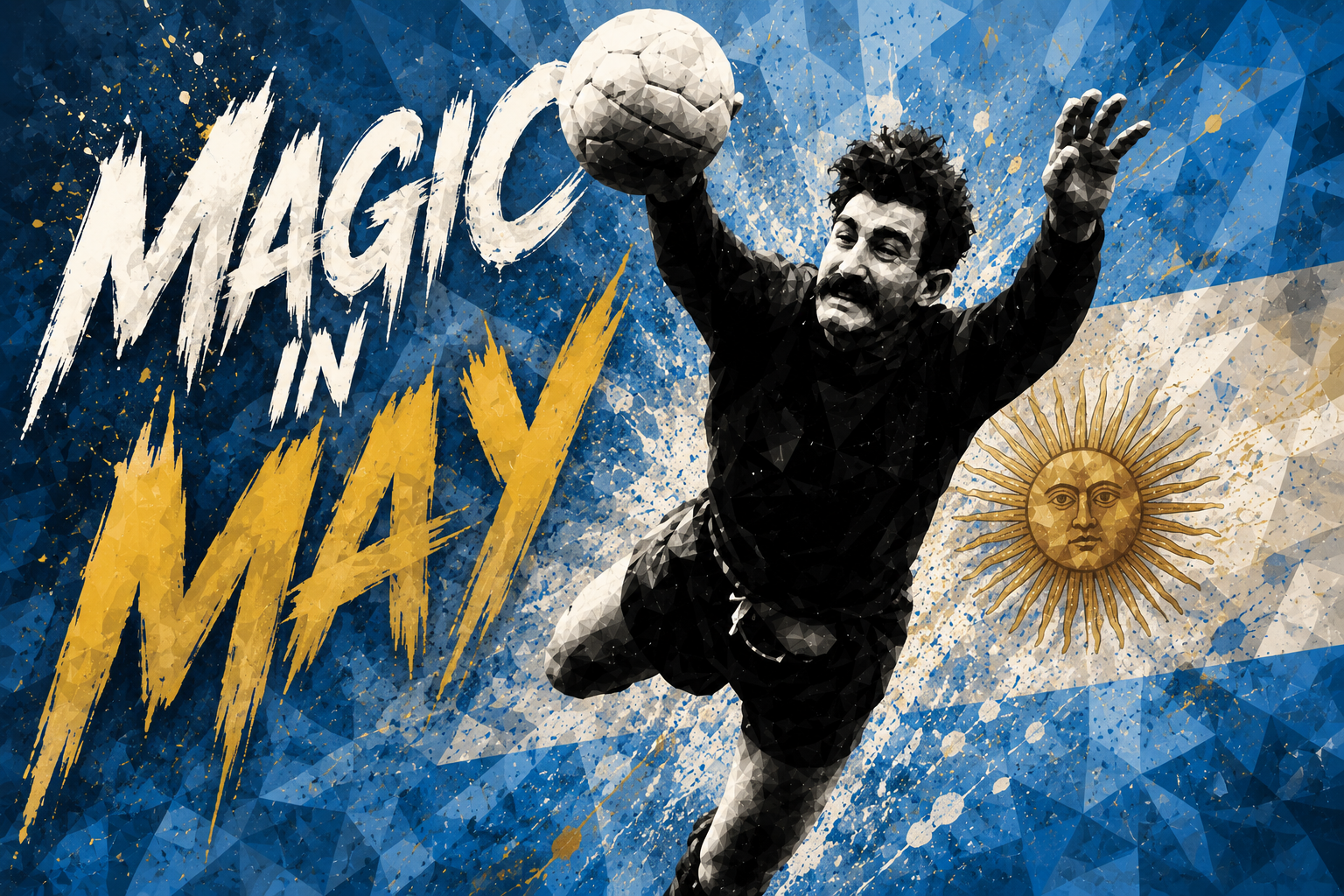
On 9 May 1951, England welcomed Argentina to Wembley for the first time. It was billed as a Festival of Britain showpiece. Instead, it became an early warning that the football world beyond Britain no longer intended to arrive as respectful guests.
The noise arrived first.
Not the full Wembley Roar, not yet. This was something lower and more anxious. A tightening sound rolling down from the stands of the old Empire Stadium as England prepared to take another corner late in the afternoon of 9 May 1951.
Inside Wembley, the atmosphere had shifted from ceremony to unease.
England were not supposed to be struggling like this.
For the first time, foreign opposition had been invited to Wembley. Not Scotland. Not Wales. Not Northern Ireland. A team from beyond the British Isles had finally been permitted entry into English football’s cathedral, and the assumption inside the ground was simple: England would demonstrate the natural order of the game.
Instead, with little more than ten minutes remaining, they were losing.
The Afternoon Wembley Stopped Feeling Untouchable
Tom Finney placed the ball near the corner flag. England had spent much of the second half forcing Argentina backwards. Stan Mortensen prowled along the six-yard box. Jackie Milburn hovered nearby, broad-shouldered and impatient. The pressure had become relentless. Crosses. Second balls. Scrambles. Bodies colliding in the heavy physical language of post-war English football.
And still Argentina resisted.
At the centre of the resistance stood Miguel Armando Rugilo.
The Vélez Sarsfield goalkeeper barely resembled the clean-cut image of the British footballer in the early 1950s. He wore a thick black moustache that gave him the appearance of a silent film actor rather than an international goalkeeper. Throughout the afternoon he had thrown himself into danger with theatrical defiance, diving at boots, punching through crowds, sprawling across the goalmouth as England attacked in waves.
At times, he seemed to be performing as much as playing.
English forwards complained. Spectators jeered. Then, gradually, something changed. The crowd began to recognise that beneath the theatre was something unmistakably serious. Rugilo was not mocking Wembley. He was surviving it.
Finney lifted the corner towards the near post. Harold Hassall helped the ball on. Mortensen stooped and headed England level in the 79th minute.
The old stadium exhaled.
Seven minutes later, Milburn scored the winner. England had escaped with a 2-1 victory.
Yet that was not what endured.
What endured was the sight of the defeated Argentine goalkeeper walking slowly from the Wembley pitch to applause from the English crowd that had spent the afternoon willing him to fail.
Back in Buenos Aires, broadcaster Luis Elías Sojit delivered the line that transformed Rugilo from beaten goalkeeper into permanent mythology.
El León de Wembley.
The Lion of Wembley.
A Defeat That Refused to Behave Like One
Miguel Armando Rugilo should not really exist in football history as he does.
He won no World Cup. He was never the undisputed best goalkeeper in the world. He did not build a long international career or dominate a generation. His Argentina career lasted only four official appearances.
Yet in Argentine football culture, Rugilo occupies a space that players with much grander careers never reached.
That contradiction is the point.
Modern football has become obsessed with permanence. Legacy is measured through medals, longevity, data, and statistical accumulation. A player who produced one transcendent afternoon in defeat would struggle to survive contemporary debate for more than a week.
But Rugilo emerged from a different sporting world, one where mythology could still overpower logic.
His performance at Wembley became immortal not because Argentina won, but because the match destabilised something larger than the scoreboard. Until that afternoon, English football still carried itself with the certainty of a civilisation convinced it remained the unquestioned centre of the game.
The Football Association had spent decades treating Wembley almost as a private imperial stage. Scotland were welcomed because Scotland belonged to the same footballing family. Continental and South American opposition were treated differently. Foreign teams played elsewhere, away from the symbolic heart of English football.
Argentina’s invitation in 1951 therefore mattered before a ball had even been kicked. England were not simply hosting another international fixture. They were opening the gates of the citadel.
And once the game began, something uncomfortable happened.
The English crowd saw a foreign side that looked technically refined, tactically intelligent, and psychologically unafraid. They saw England pushed into desperation on their own ground. They saw their forwards repeatedly frustrated by a goalkeeper who appeared to thrive amid the hostility of Wembley rather than shrink beneath it.
That matters historically because it arrived two years before Hungary’s 6-3 victory at Wembley, the match usually presented as the day English football finally realised the rest of the world had evolved beyond it.
But the warning signs had already appeared.
Rugilo’s Argentina did not dismantle England tactically in the same way Hungary later would. England still won. Yet psychologically, something shifted. The aura of absolute superiority cracked slightly for the first time against elite foreign opposition at Wembley.
Rugilo became the human face of that disruption.
Born Into Argentina’s Own Way of Playing
Miguel Armando Rugilo was born in January 1919, into a football culture already beginning to separate itself from its British roots.
By the time he emerged as a professional goalkeeper in the late 1930s and early 1940s, Argentina no longer viewed football merely as an imported game. It had become something distinctly national, shaped by the rhythms and realities of urban life in Buenos Aires.
That mattered enormously to the kind of player Rugilo became.
Argentine football developed in crowded spaces. Children learned the game in narrow streets, uneven dirt lots, and improvised neighbourhood pitches known as potreros. Technique became survival. Balance mattered. Improvisation mattered. The ball was treated less like an object to be moved quickly and more like something to be manipulated, protected, teased, and controlled.
From those environments emerged the philosophy Argentines proudly called La Nuestra. Our way.
British football traditionally valued structure, speed, crossing, and physical certainty. Argentine football increasingly celebrated deception, rhythm, and technical superiority. The dribbler became football’s central artist.
Goalkeepers existed slightly outside that romantic vision.
They were necessary figures rather than celebrated ones. Functional. Disposable, even. The heroes were forwards and creators. Men like José Manuel Moreno, Adolfo Pedernera, Ángel Labruna, and later Alfredo Di Stéfano embodied Argentina’s footballing self-image far more comfortably than any goalkeeper could.
Rugilo therefore stood apart almost immediately.
He was not elegant. He did not possess the polished aura associated with Argentine attacking football. Physically imposing and emotionally expressive, he played with visible aggression and instinct. There was little restraint about him.
At Vélez Sarsfield, he developed a reputation for fearlessness long before Wembley made him internationally famous. He attacked crosses violently. He challenged forwards physically. Most importantly, he understood that goalkeeping could be psychological warfare as much as technical execution.
His moustache became part of that identity.
In the clean-cut football culture of the 1940s, Rugilo’s thick black moustache made him visually distinctive before he even touched the ball. He later admitted he deliberately used it as part of his intimidation tactics, constantly stroking and twisting it during matches to project confidence and unsettle opponents.
“En el nerviosismo del juego tenía por costumbre acariciármelos, retorcerlos.”
In the nervousness of the game, he said, he had the habit of stroking and twisting it.
The performance element mattered because Rugilo understood something many goalkeepers of his era did not. Presence could alter matches. If a forward began doubting himself for even a second, the goalkeeper already held an advantage.
By the mid-1940s, Rugilo had become one of Argentina’s most recognisable domestic goalkeepers. In 1946, he entered local folklore by saving six consecutive penalties in league competition.
Yet despite his reputation, he remained strangely peripheral to the national team.
The Festival, Perón, and a Match Loaded With Meaning
The journey to Wembley began thousands of miles away from football itself.
In post-war Britain, the country was still exhausted. Food rationing continued into the early 1950s. Bomb sites remained visible across major cities. The government needed optimism, spectacle, and international symbolism capable of convincing the public that Britain was recovering materially and psychologically.
The Festival of Britain became part exhibition, part national therapy session. Architecture, science, culture, and sport were all mobilised to project resilience.
Football naturally became part of the programme.
Inviting Argentina to Wembley was therefore not merely a sporting decision. It was diplomatic theatre. Britain needed strong trade relationships with South America, particularly around food imports. Argentina, under President Juan Domingo Perón, saw enormous political value in demonstrating national strength abroad.
Perón understood football instinctively.
The Argentine national team could function as proof that the country no longer existed beneath European superiority. Victories against European nations carried symbolic importance far beyond sport. England especially represented something larger in the Argentine imagination: the birthplace of football, but also an old imperial power whose economic influence over Argentina had shaped decades of national resentment.
The Wembley invitation therefore arrived loaded with political undertones long before the players boarded the plane.
Yet Argentina travelled in complicated circumstances.
The great generation around Di Stéfano had already begun dispersing abroad following the domestic players’ strike. Several elite footballers were unavailable. The squad travelling to Europe remained talented, but it was not the strongest Argentina side possible.
That created opportunity for players like Rugilo.
At 32, he travelled not as an established icon but as a goalkeeper still attempting to secure lasting international recognition. The European tour represented a chance to alter how he was perceived both domestically and abroad.
The journey itself was brutal by modern standards.
Argentina departed Buenos Aires on 2 May and endured a punishing multi-stop flight. Air travel in 1951 lacked comfort entirely. Recovery science barely existed. Players arrived physically drained before they had even trained.
More importantly, many of them did not fully grasp Wembley’s mythology.
Rugilo later admitted this openly:
“Ignorábamos toda la leyenda tejida en torno al viejo Wembley.”
They were ignorant, he said, of the legend woven around old Wembley.
That ignorance may actually have helped them.
England, by contrast, carried the burden of expectation everywhere. Even in 1951, the national side still existed within an atmosphere of inherited superiority. Foreign opposition at Wembley were expected to admire the occasion as much as compete within it.
Argentina did not play that role.
When Two Football Languages Collided
The match quickly became a collision between tactical worlds.
Walter Winterbottom’s England still operated within the broad logic of the WM system Herbert Chapman had popularised decades earlier. The shape itself had evolved slightly by 1951, but the principles remained recognisably English: width from the wingers, quick service into the box, physical pressure around second balls, and direct attacks designed to overwhelm opponents territorially.
England’s forward line reflected those instincts perfectly.
Tom Finney supplied intelligence and precision from wide areas. Stan Mortensen attacked penalty-box spaces instinctively. Jackie Milburn brought power and aggression through the centre. The English approach was not always subtle, but at its best it became relentless through repetition. They forced opponents backwards until resistance eventually collapsed beneath sheer pressure.
Against many sides, Wembley itself completed the job psychologically.
Argentina defended differently from what England expected.
British observers struggled to describe the structure properly at the time. Some referred to a “funnel” system because Argentine players appeared to narrow central spaces aggressively when out of possession. The inside forwards tracked back deeper than English forwards normally would. Midfielders compressed passing lanes intelligently. England were repeatedly forced wide rather than allowed direct progression through the middle.
Today, much of it would look familiar.
In 1951, it looked foreign.
Argentina also introduced a different emotional rhythm into the match. English football traditionally prized tempo and momentum. Argentina were comfortable slowing the game, recycling possession, drawing fouls, and frustrating the crowd deliberately.
Then, after eighteen minutes, they struck.
Mario Boyé gave Argentina the lead. Wembley, expecting confirmation of England’s superiority, suddenly had to process the possibility of embarrassment.
From that point, the afternoon narrowed around Rugilo.
Rugilo’s Goalkeeping Was Part Courage, Part Theatre
Technically, Rugilo was not a modern sweeper-keeper or an elegant positional stylist in the contemporary sense. His brilliance came from command, reflexes, and emotional force.
He dominated space aggressively.
When crosses entered the penalty area, Rugilo attacked them rather than waiting passively on his line. He punched through traffic. He challenged forwards physically. He accepted collisions willingly if it meant disrupting England’s timing.
That bravery became critical because England increasingly abandoned patience as the match wore on.
The pressure became almost continuous during the second half. Finney and England’s wide players repeatedly delivered dangerous crosses. Mortensen attacked near-post spaces intelligently. Milburn’s physicality pinned defenders deeper and deeper.
Under modern refereeing standards, several challenges on Rugilo would probably have been punished more quickly.
In 1951, they were simply part of the job.
And still he resisted.
What separated his performance from ordinary heroic goalkeeping was not just the saves. It was the psychological control.
Rugilo rose from collisions slowly. He adjusted his moustache. He looked at England’s forwards. He delayed restarts. He made the crowd wait.
It was theatre, but calculated theatre.
He understood that Wembley was becoming emotionally unstable. The longer England failed to score, the more nervous the crowd became. Every exaggerated gesture deepened the tension further.
English supporters initially jeered the behaviour. Then many began laughing. Eventually, admiration replaced irritation almost entirely.
That transition mattered deeply.
Wembley crowds in that era respected courage above aesthetics. Rugilo was not merely preventing goals anymore. He was enduring punishment visibly and defiantly. English spectators recognised the authenticity of that resistance even while desperately wanting England to win.
Years later, Rugilo described the effect of his early saves simply:
“Me agrandé.”
I grew.
That phrase captures the entire performance.
The match enlarged him.
Every save increased his authority. Every collision strengthened his presence. Every frustrated English attack pushed him further towards myth.
By the final twenty minutes, the game no longer felt like England versus Argentina.
It felt like England versus Rugilo.
The Beautiful Idea Had Become Survival
The deeper the match went, the more isolated Rugilo became.
That isolation sits at the centre of the story.
Football is often described as collective expression, but goalkeeping remains profoundly solitary. A striker can disappear for eighty minutes and still become the hero with one touch. A midfielder can hide within the structure of a match. A defender can recover from mistakes through organisation around him.
A goalkeeper lives differently.
Every error becomes public immediately. Every moment of hesitation carries consequence. And when pressure arrives repeatedly, the goalkeeper absorbs the emotional weight of the entire occasion alone.
At Wembley, Rugilo eventually became separated not just from his defenders, but from Argentina’s original footballing identity altogether.
For the opening stages, Argentina had imposed elements of La Nuestra successfully. Their passing sequences frustrated England. Their movement disrupted the English midfield. Technically, they looked composed.
But English pressure at Wembley operated differently from anything most South American sides experienced regularly at the time.
The pitch narrowed emotionally as much as physically.
Cross after cross arrived. Second balls dropped dangerously. The crowd amplified every attack. England did not merely press tactically. They imposed cumulative psychological fatigue.
Argentina slowly retreated deeper.
And as they retreated, Rugilo inherited responsibility for preserving something larger than a result.
This is the critical tension within the match itself.
Argentina had arrived believing their technical approach could challenge England intellectually. Yet by the second half, survival increasingly depended not on collective Argentine superiority, but on the raw individual resistance of one goalkeeper enduring physical siege.
The beautiful idea had collapsed into desperate defence.
That contradiction gives the story much of its emotional force.
Rugilo was representing Argentine football’s pride while watching the match drift away from the style Argentina wanted to project to the world.
There was another quieter tension too.
Rugilo knew his place in Argentine football remained fragile.
He was already 32. He was not the long-term future of the national side. Guillermo Stábile had overlooked him repeatedly before this tour. One bad performance at Wembley could easily have returned him to obscurity.
So while England attacked physically, another battle unfolded internally.
Rugilo was fighting against disappearance.
That fear sharpens athletes in unusual ways.
The knowledge that opportunity may never come again often produces either paralysis or transcendence. Rugilo moved towards the latter. The pressure enlarged him emotionally rather than shrinking him.
But even transcendence has limits.
When the Wall Finally Broke
By the final ten minutes, Wembley no longer sounded confident.
It sounded desperate.
England had spent most of the second half attacking continuously, but the emotional texture of the match had changed with every Rugilo save. What began as expectation gradually became irritation, then anxiety, then something approaching disbelief.
How was this still 1-0?
The old Empire Stadium had witnessed pressure before, but there was something uniquely unsettling about watching England attack so relentlessly against foreign opposition at Wembley and still remain behind.
That psychological detail matters.
For decades, England’s relationship with Wembley had been built on inevitability. Visiting sides might compete briefly, but eventually the weight of the stadium, the crowd, and the physical intensity of the English game usually imposed themselves. The ground functioned almost as an extension of national identity.
Argentina disrupted that rhythm.
Not because they dominated England for ninety minutes. They did not. England controlled huge portions of the match territorially. But Argentina refused the emotional script Wembley expected.
Rugilo later admitted something deeply revealing about those closing stages:
“Nunca dudé de que ganábamos ese partido.”
I never doubted we would win that match.
That belief explains the devastation that followed.
When the equaliser finally arrived, it did not feel inevitable to him. It felt catastrophic.
Finney’s delivery curled towards danger. Mortensen reacted instinctively and headed England level in the 79th minute.
The emotional release inside the stadium was enormous.
Years of English certainty suddenly flooded back all at once. Wembley erupted not merely because England had scored, but because normality had finally been restored.
And psychologically, the goal changed everything immediately.
Argentina had spent over an hour surviving on concentration, adrenaline, and collective resistance. Once the equaliser arrived, the emotional structure holding the performance together weakened instantly.
In the 86th minute, England struck again.
Mortensen supplied the decisive touch in the build-up, and Jackie Milburn forced home the winner from close range.
2-1.
The comeback was complete.
And yet the enduring image of the afternoon was not Milburn celebrating the winner. It was Rugilo walking slowly away from the goalmouth afterwards, exhausted and defeated, while Wembley applauded him anyway.
That applause transformed the meaning of the match permanently.
England won the match.
But emotionally, culturally, and historically, the afternoon belonged to the defeated goalkeeper.
The Lion Returns to Buenos Aires
The strange thing about Rugilo’s career is that almost everything before Wembley now feels like prologue, and almost everything after it feels like aftermath.
That is both the glory and the cruelty of football mythology.
One afternoon can become so large that it consumes the rest of a life.
When Argentina returned home from Europe, the reaction bordered on surreal. Supporters greeted a side that had technically lost its biggest match, but the public did not experience Wembley as simple defeat.
They experienced it as revelation.
For decades, Argentine football had existed beneath the shadow of Europe intellectually, even while privately believing itself technically superior. The country possessed extraordinary players and a rich domestic culture, yet there remained limited opportunity to test those ideas directly against the self-appointed powers of the game.
At Wembley, Argentina had not looked inferior.
That mattered enormously.
And because football tends to compress complicated emotions into individual symbols, the public channelled much of that pride directly onto Rugilo.
He became the face of Argentine resistance abroad.
The nickname survived immediately.
El León de Wembley.
It sounded perfect in Spanish because it carried exactly the right emotional mixture of nobility, aggression, and survival. Rugilo had not conquered Wembley. He had fought inside it.
Yet the uncomfortable reality beneath the celebration was that football itself moves on quickly.
Stábile still did not fully trust him long term.
That remains one of the most revealing aspects of the story. Modern football culture assumes legendary performances permanently alter hierarchy. But in the 1950s, international careers could remain remarkably unstable, particularly in South America where political tension, travel difficulties, and inconsistent fixture calendars disrupted continuity constantly.
Rugilo’s performance made him famous.
It did not make him indispensable.
His Argentina career ended with only four official appearances.
His club career after Wembley drifted across Latin America in restless fashion. He played in Mexico with Club León, spent time in Chile with O’Higgins, and had a period in Brazil with Palmeiras before returning to Argentina.
None of those chapters attached themselves to public memory in the same way.
Because whenever people looked at Rugilo, they still saw Wembley.
The First Emotional Draft of England vs Argentina
The broader significance of England versus Argentina in 1951 is often overlooked because the truly explosive chapters came later.
But many of the emotional ingredients already existed.
England viewed themselves as football’s senior civilisation. Argentina viewed themselves as technically superior outsiders forced to earn respect from Europe.
That tension never disappeared.
It intensified through the bitterness of 1966, the political trauma surrounding the Falklands War, Maradona’s defining performance in 1986, and the Beckham-Simeone incident at France 98.
But psychologically, Wembley in 1951 mattered.
Argentina left convinced they could challenge England directly. England left aware that technical football outside Europe had evolved beyond many of their assumptions.
Rugilo became the emotional bridge between those worlds.
Not because he won.
Because he refused to collapse quietly.
Football rivalries are rarely born from results alone. They emerge from wounded pride, cultural friction, and the unsettling realisation that the outsider may not accept their assigned place in the hierarchy.
Long before the Hand of God, before the “animals” remark of 1966, before Beckham’s red card in Saint-Étienne, Rugilo gave England and Argentina a first emotional template.
England had won the match.
Argentina left with the myth.
Why the Lion Still Matters
Rugilo did not change football tactically in the way Hungary would two years later.
He did not redefine goalkeeping like Lev Yashin. He did not revolutionise distribution, positioning, or defensive structure. His career, viewed coldly through modern standards, appears oddly small for a player remembered so vividly.
But football history is not built only by revolutionaries.
It is also shaped by figures who alter psychology.
And psychologically, Rugilo mattered enormously.
He became one of the first South American footballers to leave a profound emotional mark on the English public itself. That distinction is important because British football culture in the early 1950s still carried traces of insularity. Continental and South American football existed at a distance for many supporters, discussed more through reputation than regular direct experience.
Wembley in 1951 narrowed that distance dramatically.
England supporters witnessed a foreign side capable of matching them technically and emotionally on their own ground. They witnessed a goalkeeper who treated Wembley not as sacred territory, but simply another battlefield to survive.
That image lingered.
So did the wider implication.
The rest of the football world no longer arrived merely to admire England.
It arrived believing it belonged there too.
Defeated on the Scoreboard, Immortal Everywhere Else
More than twenty years after Wembley, a journalist tracked Rugilo down in the western suburbs of Buenos Aires.
The scene could hardly have been less glamorous.
The man once applauded inside England’s national stadium was no longer part of elite football. There were no television studios waiting for him. No lucrative ambassadorial roles. No carefully managed nostalgia industry preserving former stars in permanent celebrity.
Rugilo was running a small sandwich business and helping operate a paper shop.
That quiet ending feels strangely appropriate for footballers of his generation.
Their greatest moments often survived more richly than their lives afterwards.
Yet even then, long after his playing career had faded into the background, Wembley still followed him everywhere.
People recognised him in the street.
Not constantly. Not with the suffocating intensity of modern fame. But enough.
And when they did, the conversation almost always returned to the same afternoon in May 1951.
Not Vélez.
Not Mexico.
Not Chile.
Not Brazil.
Wembley.
Always Wembley.
“Cuente cómo fue ese partido con Inglaterra.”
Tell us about that match against England.
There is something revealing in that.
Football history tends to pretend greatness is permanent and orderly, as though careers unfold logically towards trophies and universal recognition. In reality, the sport remembers people far more emotionally than rationally.
Some players dominate for decades and slowly fade from collective memory.
Others seize a single moment so completely that history refuses to let them disappear.
Rugilo belonged to the second category.
His story was never really about statistics or career longevity. It was about intrusion. About an outsider stepping into the symbolic heart of English football and refusing to behave like an inferior guest.
When people discuss the collapse of English football certainty, they usually begin with Hungary in 1953. That is understandable. The 6-3 defeat remains one of the most important tactical reckonings the sport has ever seen.
But footballing empires rarely collapse in one afternoon.
First comes discomfort.
First comes doubt.
First comes the unsettling suspicion that the outsiders may not fear you anymore.
Miguel Armando Rugilo helped create that feeling at Wembley in 1951.
England still won the match. The old order technically survived intact. Yet something about the atmosphere afterwards suggested the afternoon had carried consequences beyond the scoreboard.
The English crowd applauded the foreign goalkeeper because courage transcends rivalry. But they also applauded because they had seen enough quality and resistance to recognise that football’s centre of gravity might not belong exclusively to Britain forever.
Rugilo died in 1993 at the age of 74.
The old Wembley Stadium is gone now too. Its twin towers survive only in photographs and memory. Most of the people inside the ground that afternoon are gone as well.
But the image remains.
A moustached Argentine goalkeeper throwing himself through bodies beneath grey London skies while thousands alternated between frustration, admiration, and disbelief.
The Lion of Wembley.
Defeated on the scoreboard.
Immortal everywhere else.
