


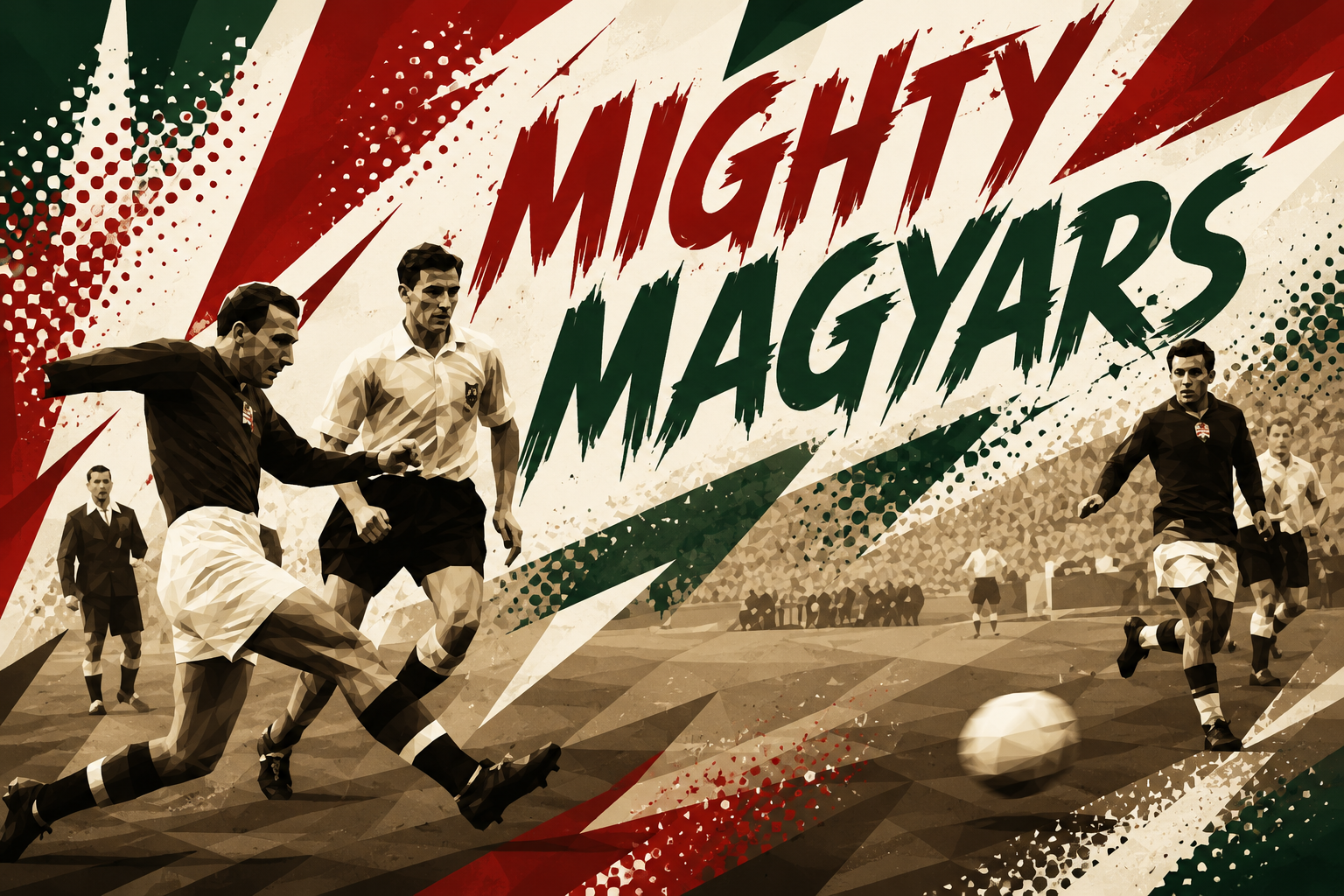
A footballing revolution born in Budapest, perfected at Wembley, broken in Bern and scattered by history.
When Wembley Saw the Future
England still believed football belonged to them.
Wembley carried that certainty in its concrete. In the weight of the twin towers. In the brass bands and dark overcoats. In the assumption, quietly repeated for decades, that the rest of the world might occasionally imitate the English game but could never truly surpass it.
On 25 November 1953, 105,000 people arrived expecting confirmation of that hierarchy.
Instead, they witnessed its collapse.
The Hungarian players emerged into the London cold wearing deep red shirts and expressions that betrayed neither nerves nor awe. They had travelled from behind the Iron Curtain carrying reputations that many in England still treated with suspicion. Olympic champions, certainly. Technically impressive, perhaps. But England had never lost at home to non-British opposition. Not once. The stadium announcers still spoke as though history itself would defend them.
Then the match started.
Within a minute, Nándor Hidegkuti drifted into space beyond England’s midfield line and drove the ball past Gil Merrick from distance. Wembley fell into an uneasy silence, the kind produced not by shock alone but by confusion. England did not yet understand what it was looking at.
Nothing seemed fixed.
Hungary’s forwards appeared in midfield. Midfielders surged beyond the attack. Defenders stepped into possession without panic. Angles opened and vanished before England could react. The familiar structure of the game, the reassuring geometry English football had trusted for generations, suddenly looked rigid and antique.
And then came the moment that outlived the match itself.
Midway through the first half, Ferenc Puskás collected the ball inside the penalty area with Billy Wright charging towards him. Wright was not merely England captain. He was English football in human form. Upright. Authoritative. Uncomplicated. A defender shaped by a system that valued order above improvisation.
Puskás waited.
At the last possible second, he dragged the ball backwards with the sole of his left boot.
Wright slid past him completely.
For a fraction of a second the great England captain seemed to disappear from the picture altogether, moving in the wrong direction while Puskás calmly created a new angle for the finish. The shot followed instantly. Hard. Low. Unstoppable.
Even decades later, the goal still feels modern.
Not because of the skill itself, but because of what it represented. England had spent half a century treating football as something essentially complete. Hungary arrived at Wembley playing as though the sport was still evolving.
By full-time, the scoreboard read England 3-6 Hungary. The margin barely captured the scale of the humiliation. Hungary had not simply beaten England. They had exposed them.
The old certainty drained from Wembley slowly.
Journalists searched for explanations. Some blamed fitness. Others blamed preparation. A few attempted to dismiss the result as a continental novelty that would never survive English intensity over time. But beneath the excuses sat a more uncomfortable truth.
England had not encountered a better version of their own football.
They had encountered the future.
And it had arrived from Budapest.
Hungary Did Not Fail. They Changed the Game
The Hungarian side of the early 1950s is often remembered through absence.
No World Cup trophy. No final coronation photograph. No neat ending that allows football history to package them alongside the great champions of Brazil, Italy or West Germany. Their story is usually told backwards, beginning with defeat in Bern in 1954 and ending with the melancholy of what might have been.
That framing has always been too small.
Hungary did not fail. Hungary altered the direction of football itself.
Long before the language of false nines, pressing triggers, positional play or fluid systems entered modern tactical discourse, the Aranycsapat were already dismantling the sport’s old certainties. They questioned fixed positions, stretched the geometry of the pitch and treated movement not as improvisation but as structure. What appeared chaotic to opponents was, in reality, meticulously organised intelligence.
This was not simply a gifted team enjoying a brief peak.
It was a footballing revolution.
The deeper irony is that many of the ideas now associated with later tactical empires were first assembled in post-war Hungary. Johan Cruyff’s Ajax, Rinus Michels’ Netherlands and even the positional frameworks visible in the teams of Pep Guardiola all carry traces of Budapest within them. The modern game did not emerge fully formed in Amsterdam or Barcelona. Some of its deepest roots belonged to a generation of Hungarian players raised amid war, political upheaval and ideological control.
That does not mean the Aranycsapat should be romanticised into untouchable saints. They were shaped by a Communist state eager to weaponise sporting success as propaganda. Gusztáv Sebes, the architect of the side, wielded extraordinary political authority over Hungarian football. The system demanded discipline as much as creativity. Players belonged not only to clubs but, increasingly, to the machinery of the state itself.
And yet that tension became part of the team’s genius.
The most fluid football in Europe emerged from one of the least fluid political environments on the continent. Hungary fused collective structure with individual freedom in ways the rest of the football world had not yet understood. England still separated defenders from attackers, labour from artistry, discipline from imagination. Hungary blurred all of it.
Centre-forwards dropped into midfield. Goalkeepers swept beyond their penalty areas. Full-backs attacked space before most teams even recognised it existed.
At Wembley in 1953, England believed they were hosting a foreign challenger.
In reality, they were confronting a sport that no longer resembled their own.
The Coffee Houses, Jimmy Hogan and the Thinking Game
The roots of Hungary’s football revolution were planted long before Puskás humiliated Wright at Wembley.
They emerged instead from cafés, street corners and crowded public spaces in Budapest where football was discussed with the seriousness other cities reserved for politics, philosophy or literature. While much of British football culture remained suspicious of tactical theorising, Central Europe increasingly treated the sport as something intellectual. Systems mattered. Angles mattered. Movement mattered.
Budapest became one of football’s great thinking cities.
The Danubian style that developed across Hungary and Austria during the interwar years prioritised technical fluency over physical confrontation. Short passing replaced hopeful clearances. Possession became a means of destabilising opponents rather than merely retaining the ball. Players rotated naturally through positions, not because they had been formally instructed to do so at first, but because the style itself demanded intelligence and adaptability.
Football was expected to flow.
At the centre of this evolution stood an unlikely figure from Lancashire.
Jimmy Hogan, an English coach largely ignored in his homeland, became one of the most influential tactical educators continental football had ever seen. Frustrated by what he viewed as the limitations of the English game, Hogan travelled across Europe preaching a different vision built around passing, technique and spatial awareness. In Hungary, unlike England, people listened.
His ideas took hold particularly at MTK Budapest, where his emphasis on combination football helped shape an entire culture. After the 1953 win at Wembley, Hungarian Football Federation president Sándor Barcs said: “Jimmy Hogan taught us everything we know about football.”
That line matters because it reframes the entire story.
The Mighty Magyars were not a miracle appearing from nowhere behind the Iron Curtain. They were the culmination of decades of tactical evolution, intellectual exchange and cultural openness within Central European football. Hungary did not reject English football entirely. In many ways, they absorbed its foundations more thoughtfully than England itself.
The Second World War interrupted that development brutally. Hungary emerged from the conflict battered physically and politically. Soviet influence tightened across the country as the Communist regime consolidated power, and football increasingly became tied to the image the new state wished to project abroad.
Yet football in Hungary was never simply propaganda.
The players who would define the Golden Era largely grew up together in working-class districts where football functioned as escape, identity and obsession all at once. Puskás and József Bozsik spent their childhoods in Kispest kicking rag balls through narrow streets and empty lots beside railway lines. They developed an instinctive understanding of each other before tactics boards or state structures entered the picture.
That intimacy later became visible in the national side. Hungary often appeared less like a collection of elite internationals and more like boys continuing conversations they had started years earlier.
And waiting in the middle of it all was Sebes.
Part coach. Part political operator. Part revolutionary.
He understood that Hungary possessed more than talented players. It possessed the conditions to build something entirely new.
Gusztáv Sebes and the Contradiction of Freedom
Gusztáv Sebes did not look like the future of football.
Heavyset, severe and permanently serious, he carried himself more like a government official than a sporting visionary. Which, in many ways, he was. Sebes served as Hungary’s Deputy Minister of Sport while managing the national team, a dual role that gave him a level of institutional control almost unimaginable in modern football.
He did not simply coach Hungary.
He helped engineer it.
Sebes understood earlier than almost anyone that international football could no longer rely on occasional training camps and loose collections of talented individuals. The game was becoming too sophisticated. Tactical relationships needed repetition. Movement needed instinct. Understanding needed to become automatic.
So while other nations still assembled national teams temporarily, Sebes effectively transformed Hungary into a permanent footballing project.
The Communist state made that possible.
In 1949, Hungarian football was reorganised along political lines. Clubs became attached to state institutions, industries or military structures. Kispest, the modest club where Puskás and Bozsik had emerged, was absorbed into the Hungarian Army and renamed Budapest Honvéd. Sebes then concentrated much of the national side’s core within it, using military structures to bring elite players together under one system.
Puskás, Sándor Kocsis, József Bozsik and Zoltán Czibor all eventually operated inside the same tactical ecosystem week after week.
Modern football would later call this continuity.
Sebes called it necessity.
He believed football should function collectively, almost mechanically, but without sacrificing invention. The Western obsession with individual stars held little interest for him. He wanted interchangeability. Adaptability. Positional intelligence. Players capable of solving problems dynamically rather than obeying fixed instructions.
Years later, these ideas would become associated with Total Football. In Hungary during the early 1950s, they were simply called football.
Sebes’ methods often bordered on obsessive. Training sessions rehearsed movement patterns repeatedly until players understood spaces instinctively. Warm-up matches were arranged against sides instructed to imitate upcoming opponents. Fitness work intensified beyond the standards of the era. Tactical preparation became exhaustive.
Hungary were not merely talented. They were prepared in ways international football had barely encountered before.
Crucially, Sebes also recognised that football’s traditional positional structure was becoming obsolete.
The old WM system separated players into neat categories. Defenders defended. Attackers attacked. Movement largely followed predictable lines. Sebes wanted to dissolve those borders. If opponents marked men individually, then movement itself could destroy the system. Drag defenders away from zones. Create numerical superiority elsewhere. Turn uncertainty into panic.
Hidegkuti became the key.
Nominally a centre-forward, Hidegkuti increasingly dropped into midfield spaces where opposing centre-halves felt deeply uncomfortable following him. If they stepped forward, Hungary attacked the space behind them through Puskás and Kocsis. If they held position, Hidegkuti dictated the game unchallenged between the lines.
It was not simply clever positioning. It was tactical sabotage directed at the entire defensive logic of the era.
How Hungary Made Opponents Doubt Themselves
What made Hungary frightening was not merely that they moved differently.
It was that they made opponents question what they were supposed to do.
Modern football audiences, raised on fluid systems and constant positional rotation, can underestimate just how destabilising the Aranycsapat appeared in the early 1950s. Most elite sides still operated within relatively fixed structures. Defenders held defensive zones. Centre-forwards stayed high. Wide players remained largely attached to touchlines.
The game possessed an inherited order that players rarely challenged.
Hungary treated those conventions as optional.
Sebes and MTK coach Márton Bukovi gradually reshaped the old WM structure into something looser, faster and more deceptive. On paper, the system often resembled a 4-2-4 before the formation officially existed. In practice, it behaved more like controlled positional chaos. The front line rotated continuously. Midfielders stepped forward aggressively. Defenders initiated attacks instead of merely surviving them.
Space became something Hungary manipulated deliberately rather than simply occupied.
The most radical element sat in the centre of the attack.
Hidegkuti did not behave like a striker because Sebes no longer believed the role should exist in its traditional form. Instead of pinning himself against opposition centre-halves, Hidegkuti retreated into midfield areas, collecting possession and drawing defenders into impossible decisions. English football, still heavily reliant on man-marking principles, simply lacked the tactical vocabulary to respond.
England had prepared for a striker.
Hungary sent them a problem instead.
That uncertainty infected entire matches. When centre-halves followed Hidegkuti deeper, Hungary attacked the newly exposed channels through Puskás and Kocsis. When defenders stayed compact, Hidegkuti gained time and space to orchestrate possession. Either choice carried consequences.
The brilliance of Puskás often obscures how tactically intelligent he was. He was not merely a scorer of spectacular goals. He understood space instinctively. Short, low-centred and deceptively explosive over small distances, Puskás thrived inside the confusion Hidegkuti created. Defenders expected a conventional inside-forward and instead encountered a player constantly arriving from unexpected angles with extraordinary precision off his left foot.
Then there was Kocsis.
If Puskás represented improvisation and imagination, Kocsis embodied punishment. His aerial dominance bordered on absurd. But reducing him to heading ability alone misses the sophistication of his movement. Kocsis attacked crosses late, often arriving after defenders had already adjusted their positioning. He understood timing in ways that felt almost mathematical.
At the 1954 World Cup, he scored eleven goals in five matches because Hungary’s system continuously created moments of imbalance around him.
Behind them, Bozsik controlled rhythm.
That role is easier to appreciate now than it was then. Before deep-lying playmakers became central to elite football, Bozsik operated as the team’s regulator, accelerating attacks or slowing possession depending on the flow of the match. He linked the entire structure together.
If Hidegkuti destabilised opponents psychologically, Bozsik ensured Hungary maintained control while doing it.
Even the goalkeeper changed.
Gyula Grosics, dressed permanently in black, operated far beyond the conservative limits expected of goalkeepers at the time. He swept behind the defensive line, recycled possession calmly and effectively became an extra outfield player decades before the role became fashionable again.
The result often resembled football from another era entirely.
England defender Syd Owen later described the experience of facing Hungary as “like playing people from outer space.” The line endures because it captures more than admiration. It captures disorientation. Hungary did not simply execute familiar ideas better than everyone else. They introduced concepts elite football had not yet properly encountered.
Wembley, 1953: The Public Unveiling
By the autumn of 1953, England still considered itself football’s measuring stick.
The defeats suffered at World Cups against the United States in 1950 and continental opposition in friendlies had caused irritation rather than transformation. English football remained protected by its own prestige. Tactical innovation elsewhere was often dismissed as novelty. The WM system still governed elite coaching. Physicality still carried moral authority.
The assumption lingered that, when properly focused, England would eventually reassert the natural order of the game.
Hungary arrived at Wembley carrying no interest in that mythology.
The British press framed the match respectfully but cautiously. Hungary were Olympic champions and unbeaten in more than three years, yet much of the coverage retained a faintly patronising tone. English football still viewed itself as football’s original language. Continental styles were accents at best.
Then the match started, and within seconds the entire atmosphere shifted.
Hidegkuti’s opening goal felt alarming not simply because England conceded, but because the move itself looked alien. The Hungarian centre-forward had appeared in a space no English centre-half expected him to occupy. Already, the geometry felt wrong.
England equalised through Jackie Sewell and briefly attempted to restore familiar momentum through direct attacks and physical pressure. But Hungary’s response exposed the limitations of England’s entire structure. The ball moved faster than England’s defenders. Positions dissolved and reformed continuously. Hungarian players appeared comfortable receiving possession under pressure in ways that English football still largely mistrusted.
And then Puskás produced the image that would outlive the century.
Receiving the ball inside the area, he shaped briefly as though to shoot first time. Wright committed himself instinctively, lunging forward to block. Puskás calmly dragged the ball backwards with the sole of his boot, leaving Wright sliding helplessly past him before rifling the finish beyond Merrick.
English football had rarely seen skill used that way.
The drag-back itself was not revolutionary. The context was. Wright had committed according to the logic English defending had taught for decades. Puskás punished the logic, not merely the defender. One movement exposed the difference between reactive football and anticipatory football.
Hungary already understood where the game was going before England realised it had started moving.
The Wembley crowd responded with something approaching stunned fascination. Even English supporters applauded certain Hungarian passages of play. That mattered. England did not merely lose often in this period. But this felt different because the superiority looked intellectual as much as technical.
At half-time, Hungary led 4-2.
The scoreline somehow flattered England.
Hungary finished with over thirty attempts on goal and repeatedly cut through England’s defensive structure with almost embarrassing ease. Bozsik controlled possession from deep positions. Hidegkuti completed his hat-trick. Kocsis attacked aerial spaces mercilessly. Grosics swept behind the defensive line like a player from another generation entirely.
By the final whistle, the 6-3 score had become less a result than a public unveiling.
Six months later, England travelled to Budapest hoping to restore dignity.
Instead, Hungary beat them 7-1 at the Népstadion.
Even now, it remains England’s heaviest defeat.
Bern, 1954: The Future Loses Control of the Present
By the time the World Cup began in Switzerland, Hungary no longer looked like contenders.
They looked inevitable.
The unbeaten run stretched beyond four years. The Olympic title had already been secured. England had been dismantled twice. Italy, Sweden, Uruguay and countless others had all been overwhelmed by the same relentless combination of tactical intelligence and technical superiority. Across Europe, journalists increasingly spoke about the Aranycsapat less as a national side and more as a footballing phenomenon.
The early matches only deepened that feeling.
Hungary opened the tournament by destroying South Korea 9-0, a performance so one-sided it resembled training-ground football at times. Then came West Germany in the group stage. Sebes rotated heavily, but Hungary still tore through the Germans 8-3 with frightening ease. Kocsis scored twice. Puskás controlled the match almost casually before suffering the challenge that would alter the trajectory of the tournament.
German defender Werner Liebrich crashed into Puskás’ ankle midway through the game.
The injury looked severe immediately.
Puskás limped from the pitch with what was later diagnosed as a hairline fracture. Hungary won comfortably anyway, but something fundamental shifted beneath the surface. The team’s emotional centre had been damaged. Sebes attempted calm publicly while privately recognising the scale of the problem. Hungary could survive without Puskás. They could not remain entirely themselves without him.
The tournament darkened from there.
The quarter-final against Brazil became known as the Battle of Berne, one of the most violent elite matches football had seen. Tackles flew with deliberate malice. Tempers collapsed repeatedly. Players fought on the pitch and reportedly continued inside the dressing-room corridors afterwards. Hungary won 4-2, but the match left bruises beyond the scoreboard.
This was no longer merely a beautiful football team captivating the world. It was a side fighting through exhaustion, pressure and increasingly hostile opposition.
Then came Uruguay.
That semi-final remains strangely under-discussed considering its quality and emotional intensity. Uruguay arrived as defending world champions and unbeaten in World Cup history. Hungary responded with perhaps the purest expression of their greatness. Even without a fully fit Puskás, they attacked with fearless fluidity, stretching and destabilising one of the strongest sides in the world.
The match drifted into extra time at 2-2 before Kocsis rose twice to score decisive headers, each one carrying the inevitability that had defined Hungary’s entire era.
The final against West Germany should have been coronation.
Instead, it became football’s most enduring paradox.
Heavy rain fell across the Wankdorf Stadium in Bern on 4 July 1954. Puskás, still injured, insisted on playing. Eight minutes into the match, Hungary led 2-0 through goals from Puskás and Czibor. The opening stages felt almost cruelly predictable. The Germans appeared overrun again, just as they had in the group stage.
Then everything changed.
Germany pulled a goal back quickly through Max Morlock before Helmut Rahn equalised minutes later. The rhythm shifted. The pitch deteriorated. Hungary’s passing became fractionally slower, their movement fractionally heavier. The Germans, wearing boots fitted with screw-in studs, appeared physically more stable as conditions worsened.
Still, Hungary remained the better side.
That is what history often forgets.
Kocsis struck the crossbar. Hidegkuti hit the post. Chances continued to emerge in waves. Even wounded, even exhausted, Hungary still played like the superior football team. But superiority in football has never guaranteed survival.
With six minutes remaining, Rahn drove the winning goal low beyond Grosics.
3-2.
The Miracle of Bern had arrived.
Yet the match never fully settled into history cleanly. Puskás believed he had equalised late on, only for the goal to be ruled out for offside. Television footage has never been definitive enough to close the argument. Then came darker suspicions around injections administered to West German players. Later studies and reports raised questions about possible stimulant use, though the claims remain disputed rather than conclusively proven.
Hungary had spent years proving football could be controlled through intelligence, preparation and structure.
In Bern, chaos answered back.
West Germany won the World Cup.
Hungary changed football.
History tends to remember the former more easily.
1956: The Team History Tore Apart
For a while, it seemed possible that Hungary might recover from Bern.
The defeat hurt deeply, but the team itself remained largely intact. Puskás was still only twenty-seven. Kocsis remained the most ruthless goalscorer in Europe. Sebes continued refining his ideas. Hungary were no longer invincible, but they still appeared capable of shaping the future of the game for years to come.
Then politics intervened more violently than football ever had.
On 23 October 1956, revolution erupted across Hungary. What began as student protests against Soviet control rapidly escalated into a nationwide uprising. Soviet tanks entered Budapest. Fighting spread through the streets. Civilians died in large numbers. The atmosphere of fear and ideological pressure that had sat beneath Hungarian football throughout the decade finally exploded into open conflict.
At that exact moment, Budapest Honvéd were abroad preparing for a European Cup tie against Athletic Bilbao.
The timing felt almost surreal.
The club that had effectively become the tactical heart of the Hungarian national team suddenly found itself stranded while its homeland descended into chaos. News filtered slowly into the squad hotel. Soviet intervention. Gunfire. Casualties. Confusion. Families unreachable. Players gathering around radios trying to understand whether they still had a country to return to.
The second leg against Athletic eventually took place at Heysel in Brussels after Bilbao refused to travel to Budapest. Honvéd lost the tie, but by then football itself felt secondary. The real question facing the players was existential.
Go home.
Or don’t.
For many of the Aranycsapat, the choice carried enormous personal risk either way. Returning meant re-entering a Soviet-controlled state where suspicion and surveillance would intensify after the revolution’s suppression. Remaining abroad meant exile, separation and accusations of betrayal from the regime they had once represented internationally.
Puskás chose exile.
So did Kocsis and Czibor.
In Hungary, they were condemned publicly as deserters and traitors. The state pursued disciplinary action. FIFA imposed bans on players who refused to return. Suddenly, the greatest football generation Hungary had ever produced became stateless.
What followed possessed the strange melancholy of a travelling theatre troupe after the collapse of an empire.
The displaced Honvéd players organised exhibition tours across Europe and South America partly to survive financially, partly because football remained the only stable thing left in their lives. Crowds still came to see them because the legend already existed. The Mighty Magyars had become footballing exiles carrying fragments of a vanished world.
Puskás’ story should probably have ended there.
Overweight, politically isolated and banned from competition for two years, he looked finished by his early thirties. Many clubs considered him damaged goods. But when Santiago Bernabéu brought him to Real Madrid in 1958, another transformation began.
Puskás rebuilt himself physically and evolved tactically once again, forming one of football’s great attacking partnerships alongside Alfredo Di Stéfano. He won three European Cups in Spain and scored four goals in Real Madrid’s 7-3 victory over Eintracht Frankfurt in the 1960 European Cup final at Hampden Park.
Even in exile, Hungarian football continued reshaping Europe’s elite game.
Kocsis and Czibor carried another part of the revolution into Barcelona. There, under the shadow of fellow Hungarian exile László Kubala, they helped strengthen a side increasingly influenced by Central European tactical thought.
The migration mattered historically because the collapse of the Aranycsapat did not destroy Hungarian football’s ideas.
It dispersed them across the continent.
The Legacy: Modern Football in Hungarian Clothing
Modern football is filled with Hungarian ideas disguised beneath other names.
That is the strangest part of the Aranycsapat story.
Ask most supporters where the modern game truly began and the answers usually drift toward the Netherlands of the 1970s, Cruyff’s Barcelona or Guardiola’s positional structures in the twenty-first century. Those teams undoubtedly refined football’s evolution. They accelerated it. Popularised it. Perfected parts of it.
But many of the principles themselves had already appeared in Budapest decades earlier.
The withdrawn centre-forward that terrified England in 1953 now exists in almost every elite tactical vocabulary. The positional rotations that once looked chaotic at Wembley are standard among top-level sides. Goalkeepers routinely operate as auxiliary defenders. Midfielders interchange fluidly with attackers. Teams manipulate overloads intentionally rather than accidentally. Pressing structures compress space aggressively across the pitch.
The language has changed.
The concepts have not.
That does not mean Hungary single-handedly invented modern football. Tactical evolution is never that neat. South American football shaped the game profoundly too. Austrian and Italian thinkers contributed enormously. Football develops through exchange rather than isolated genius.
But Hungary accelerated the future.
That distinction matters.
At a time when much of the football world still relied on inherited structures, the Aranycsapat demonstrated that space itself could be manipulated scientifically. They treated football less like a sequence of individual battles and more like a collective spatial problem. That intellectual leap changed everything.
Even their failures became historically influential.
The defeat in Bern forced tactical introspection across Europe. England’s humiliation at Wembley gradually exposed the complacency embedded within British football culture. Coaches elsewhere began studying movement more seriously. Systems became less rigid. Preparation became more analytical. In many ways, the modern coaching profession emerged partly from the shock Hungary inflicted upon established football powers.
Inside Hungary itself, however, the legacy feels more complicated.
The Golden Team became both inspiration and burden.
No subsequent Hungarian side has truly escaped comparison with the Aranycsapat. Their brilliance sits over the country’s football culture like memory and accusation at the same time. The Puskás Arena in Budapest stands not merely as a tribute to past greatness but as a reminder of how difficult it is to reproduce a generation that changed the sport’s direction.
Puskás himself eventually returned home after the collapse of Communism and was welcomed as a national icon. By then, time had softened the politics surrounding exile and revolution. The state that once labelled him a traitor now embraced him as a symbol of national identity.
That contradiction captures much about the Hungarian Golden Era itself.
The players were used politically, celebrated culturally and mourned historically all at once.
Perhaps the most misunderstood aspect of the Aranycsapat is this: they were not merely beautiful.
Too many retrospective accounts reduce them to romance, artistry and nostalgia. Those elements existed, certainly. But Hungary were also ruthless competitors operating inside one of the most sophisticated tactical systems football had yet seen. They did not dominate because they played prettily. They dominated because they solved football problems faster than everyone else.
And that may be why they still feel strangely contemporary.
Watch surviving footage carefully and certain passages no longer resemble ancient football. They resemble ideas still unfolding in the present tense. The movement looks familiar. The spacing looks familiar. The manipulation of defenders looks familiar.
Even now, more than seventy years later, parts of the Aranycsapat still appear ahead of the sport around them.
Very few teams in football history can say the same.
The Team That Taught Football How to Think
In the end, the greatest football team of the twentieth century may not have lifted the World Cup at all.
Brazil had Pelé. West Germany had resilience. Italy mastered tournament survival. But Hungary changed the game at a deeper level than any of them. They altered its rhythm, its geometry and its imagination. They transformed football from something largely structured around positions into something organised around movement and space.
And they did it before most of the world even understood what they were watching.
That is why the image of Puskás dragging the ball away from Billy Wright still matters so much.
Not simply because it embarrassed England’s captain.
Not because it became iconic.
But because, for a brief second inside Wembley Stadium, one footballing world moved past another. England represented the authority of tradition, certainty and hierarchy. Hungary represented possibility. Fluidity. Evolution. The idea that football was still unfinished.
The sport spent the following decades catching up.
The Aranycsapat never received the ending history usually reserves for immortals. There was no final trophy lift in Bern. No permanent dynasty. Political upheaval scattered the players across Europe before the project could fully mature. What remained instead were fragments carried into the future through coaches, systems and memory.
Yet perhaps that is fitting.
Hungary’s greatest achievement was never ownership of an era.
It was authorship of a new football language.
And every time a striker drops deep into midfield, every time defenders rotate calmly through possession, every time a goalkeeper steps beyond the penalty area to begin an attack, traces of the Mighty Magyars still flicker beneath the modern game.
Football remembers many champions.
It rarely remembers the teams that taught the sport how to think.
