


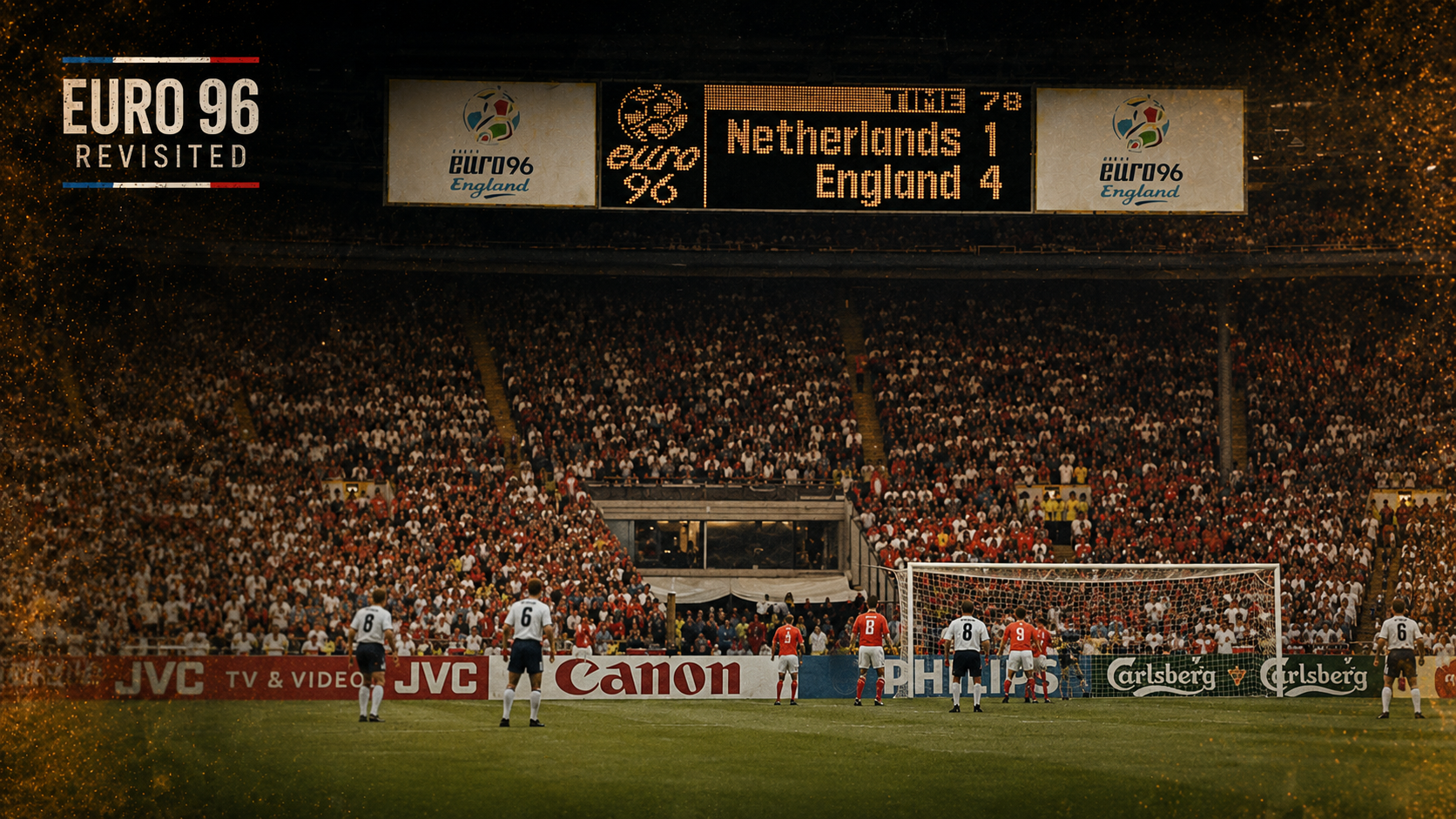
Kevin Keegan said something curious as England dismantled the Netherlands at Wembley on 18 June 1996.
English players, he suggested on ITV, simply needed to believe they were as technically good as their continental counterparts.
At the time, it sounded like an observation about confidence. Looking back, it feels more like an explanation for one of the strangest nights in modern English football history.
England supporters remember Euro 96 for many reasons. They remember Paul Gascoigne’s volley against Scotland, Stuart Pearce roaring into the Wembley sky, Gareth Southgate’s penalty, and a song that somehow managed to turn three decades of disappointment into a communal celebration. They remember a country enjoying itself. They remember football coming home.
Yet if there was a single evening during that summer when England seemed transformed into something almost unrecognisable, it was the night they beat the Netherlands 4-1.
Not because they won. England have beaten major football nations before and since. They thrashed Germany in Munich five years later. They reached a European Championship final in 2021. They have produced talented teams, technically gifted players and managers willing to borrow ideas from abroad.
What felt different about Wembley in June 1996 was the manner of the performance.
For perhaps half an hour, England appeared to become the team they had spent decades admiring from afar.
English football had long lived with an inferiority complex towards the Netherlands. Since the emergence of Total Football in the early 1970s, Dutch football had occupied a peculiar place in the English imagination. It was respected, envied and occasionally resented. It represented intelligence rather than industry, solutions rather than struggle. The Netherlands seemed capable of producing footballers who understood space instinctively, who could rotate positions without instruction and who looked entirely comfortable treating possession not as a means of survival but as a form of expression.
England, by contrast, were often characterised, both at home and abroad, as earnest but limited. Honest runners. Brave defenders. Dangerous from set pieces. A nation that worked hard but thought too little. Even when English clubs prospered in Europe during the late 1970s and early 1980s, there remained an underlying suspicion that the country’s football culture lagged behind the continent tactically.
By 1996, those feelings had not entirely disappeared.
The Netherlands arrived at Wembley carrying the prestige of a footballing lineage that stretched from Johan Cruyff and Rinus Michels through Marco van Basten and Ruud Gullit to a new Ajax generation that had conquered Europe only twelve months earlier. Patrick Kluivert was twenty years old. Clarence Seedorf was barely older. Dennis Bergkamp was entering his prime. Edwin van der Sar looked destined to guard the Dutch goal for the next decade.
England had Alan Shearer, Gascoigne rediscovering himself, Teddy Sheringham’s intelligence and Steve McManaman’s dribbling ability. They also carried something more familiar. The expectation that eventually, against sufficiently sophisticated opposition, they would revert to type.
What happened instead felt almost disorientating.
England did not merely defeat the Netherlands.
For a fleeting period, they played with a confidence, fluidity and technical freedom that supporters had traditionally associated with Dutch football itself.
And perhaps that is why the match still occupies such a powerful place in England’s sporting memory. It was not simply a great victory. It was a glimpse of an England side that seemed liberated from decades of inherited assumptions about what English football was supposed to look like.
The Football England Envied
English football has often defined itself through opposition. If the Scots were once regarded as the game’s early technicians and the Italians its great pragmatists, the Dutch became something altogether more alluring. They appeared to have solved football.
For a generation raised on grainy VHS tapes, late-night highlights programmes and occasional European Cup broadcasts, Dutch football represented a version of the sport that seemed simultaneously familiar and impossibly distant. It was attacking but organised, expressive but disciplined. Positions appeared negotiable. Defenders stepped into midfield. Midfielders drifted into forward positions. Space seemed to matter as much as strength.
The mythology, of course, began with Johan Cruyff and the Netherlands team that reached consecutive World Cup finals in 1974 and 1978. But mythology has a habit of becoming inheritance. By the late 1980s, Dutch football had acquired another golden generation. Marco van Basten’s volley in Munich at Euro 88 remains one of the defining images of the competition’s history, but the tournament itself mattered almost as much as the goal. Here was a Dutch side that appeared to marry aesthetics with efficiency. Ruud Gullit could dominate physically while possessing extraordinary technical ability. Frank Rijkaard could dictate tempo and destroy attacks. Ronald Koeman stepped out from defence and sprayed passes with the confidence of a midfielder.
English supporters watched with admiration tinged by resignation.
There was a sense that England occupied a different footballing universe. Domestic football was improving, but old assumptions remained stubbornly intact. English clubs were only beginning to emerge from the isolation imposed after Heysel. The newly formed Premier League had brought money and television audiences, but not necessarily a revolution in coaching. Discussions around England teams still revolved around commitment, work-rate and passion. Continental sides, meanwhile, seemed to operate according to a more sophisticated vocabulary.
It was not simply that Dutch players were technically gifted. English observers often perceived them as intellectually superior footballers. They appeared comfortable with ambiguity. They could adapt shape during games, exchange responsibilities and understand the movement of teammates instinctively. England’s best performances frequently felt like acts of collective determination. The Netherlands’ best performances resembled orchestral performances in which each player understood not only his own role, but everyone else’s as well.
That perception only intensified in the years immediately preceding Euro 96.
Ajax’s triumph in the 1995 Champions League looked less like a club achievement and more like a validation of an entire footballing philosophy. Louis van Gaal’s side combined youthful exuberance with tactical precision. Kluivert announced himself to Europe while still a teenager. Seedorf played with an authority beyond his years. Edgar Davids brought aggression and control. Michael Reiziger, Winston Bogarde and the De Boer brothers seemed to emerge from a production line dedicated to creating complete footballers.
England, meanwhile, had endured a difficult decade internationally. The tears of Turin in 1990 had been followed by failure to qualify for the 1994 World Cup. The domestic game was becoming wealthier, more polished and increasingly fashionable, as discussed elsewhere in Euro 96 Revisited, yet questions persisted about whether England could genuinely compete with the continent’s elite on equal terms.
There was an inferiority complex at work, even if few wished to admit it.
English supporters respected Germany because Germany usually won. They feared Italy because Italy usually found a way to survive. But the Netherlands occupied a different category altogether. The Dutch represented football as England wished it might one day become. Stylish without being frivolous. Tactical without being cynical. Comfortable in possession. Confident in identity.
That made the prospect of facing them at Wembley oddly unsettling.
England entered the final group match requiring victory to guarantee progress. The Netherlands needed only a draw. On paper, the Dutch possessed greater pedigree, greater technical depth and a recent history that suggested they belonged among Europe’s established aristocracy.
England had the crowd, momentum from victories over Scotland and Switzerland, and a growing sense that Terry Venables had assembled something coherent.
But coherence was not the same as transformation.
Very few people expected that within twenty-four hours, English newspapers, broadcasters and supporters would be discussing not merely a famous victory, but perhaps the closest England had come in modern times to looking like the football nation they had spent decades admiring.
The Team That Stopped Apologising
If Dutch football occupied such an elevated place in the English imagination, then the obvious question is why England looked so comfortable confronting it at Wembley.
The easy answer is Terry Venables.
The more interesting answer is belief.
Keegan’s observation that evening was almost throwaway in its delivery, but revealing in its implication. “We can play like the Dutch,” he said, “we’ve just got to believe a little bit more in ourselves.” It was a remarkable thing to hear from a man whose own playing career had largely coincided with an era in which English football tended to admire Europe from a respectful distance.
Venables understood this better than most. He had inherited a national team carrying the baggage of failed qualification for the 1994 World Cup, the ridicule surrounding the Hong Kong “Dentist’s Chair” episode and an increasingly familiar expectation that England would eventually discover their limitations against sufficiently sophisticated opposition.
Rather than attempting to shield his players from those anxieties, he appeared determined to dismantle them.
Before the Netherlands match, Venables conducted a lengthy tactical briefing that several players would later remember as among the most detailed they had experienced in international football. Gascoigne recalled the manager making it clear that this was likely to be one of the biggest matches of their lives. Tony Adams later spoke about the confidence Venables instilled by focusing less on Dutch strengths and more on Dutch vulnerabilities. The message was simple enough. The Netherlands possessed outstanding footballers, but they were not untouchable.
This is not the place to tell the full story of Venables, whose England project deserves its own treatment. But the relevance here is clear. Venables did not merely pick a team. He adjusted a mood. He convinced a group of English footballers that the opposition’s reputation was not a law of nature.
It was not necessarily revolutionary coaching. By modern standards, detailed video analysis and opponent-specific preparation are routine. In England during the mid-1990s, however, such work still carried a degree of novelty. English players were accustomed to being told to compete, battle and impose themselves physically. Venables instead appealed to something else.
Think.
Observe.
Trust your ability.
Do not assume the opposition possess answers you do not.
England’s starting eleven reflected that confidence. Shearer offered penalty-box ruthlessness, but Sheringham provided subtlety and imagination. Paul Ince screened the defence aggressively but intelligently. McManaman remained perhaps the most naturally continental footballer England had produced in years, carrying the ball over distance with an ease that looked more suited to Spain or Italy than the Premier League. Darren Anderton’s movement was understated but sophisticated. Gascoigne, meanwhile, was playing with the freedom of a footballer who finally appeared physically capable of matching his imagination.
More importantly, England no longer looked burdened by the old inferiority complex.
Supporting England has often involved watching talented players become slightly diminished by the shirt they wear. Passes become safer. Decisions become slower. Risk feels irresponsible. Teams retreat into caution because experience has taught them disappointment is rarely far away.
Against the Netherlands, England seemed to shed that habit.
This was not swagger in the modern sense. There was little of the manufactured bravado that has occasionally accompanied England teams since. The confidence at Wembley felt quieter and perhaps more authentic. It stemmed less from believing England were unquestionably superior and more from accepting they belonged at the same table.
There is a subtle but important distinction there.
For decades, England had approached elite continental opposition hoping to compete.
On 18 June 1996, they stepped onto the Wembley pitch expecting to.
Whether they could sustain that belief for ninety minutes remained uncertain. The Netherlands still possessed Bergkamp, Seedorf, Blind and Van der Sar. They remained one of Europe’s most gifted squads, whatever tensions simmered beneath the surface.
But England had already achieved something significant before a ball had been kicked.
For perhaps the first time in a generation, they had stopped apologising for being England.
Thirty Minutes of Total Confidence
Memory is an editor. It cuts awkward scenes, trims uncertainty and leaves only the moments that fit the story people wish to tell.
England 4 Netherlands 1 has undergone thirty years of editing.
The surviving version is glorious. England overwhelm one of Europe’s traditional powers from the opening whistle, Gascoigne dances through midfield, Sheringham and Shearer combine like old friends in a five-a-side game and Wembley spends an entire evening in a state of collective ecstasy. It is remembered as England’s most complete modern performance, the night football finally came home before anyone had quite dared believe it might.
The reality was slightly messier.
Which is precisely why it was so impressive.
England began brightly enough. In the 23rd minute, Venables’ plan produced its first reward. A corner was only partially cleared, Sheringham recycled possession intelligently and McManaman accelerated into space. McManaman had been England’s most effective carrier of the ball throughout the tournament, perhaps the player most naturally suited to stretching opponents in transition, and he immediately forced the Dutch defence backwards. Ince continued the move, twisting inside the penalty area with a neat Cruyff turn before Danny Blind lunged clumsily into the challenge.
Shearer placed the penalty firmly beyond Van der Sar.
Three matches.
Three goals.
England led.
Yet the scoreline disguised an increasingly uncomfortable truth.
The Netherlands were beginning to play.
Seedorf, only twenty years old but already carrying himself with remarkable authority, started to dictate the rhythm of possession. Bergkamp drifted intelligently between England’s central defenders, exposing moments of uncertainty. Winter arrived late into dangerous positions. Dutch corners accumulated. England struggled to retain possession for sustained periods.
At one stage Southgate’s mistimed header sent Bergkamp racing through on goal, only for David Seaman to react sharply and preserve England’s advantage. Winter should probably have equalised when he headed over from close range. By half-time, the Dutch had won eight corners.
Watching from the commentary box, Barry Davies sensed England’s discomfort.
“England really need half-time here.”
It was not an exaggeration.
England were ahead, but they were hardly cruising. Wembley remained anxious. Supporters knew too much history to relax. England teams had led major matches before. England teams had squandered promising positions before. The atmosphere retained an edge of anticipation rather than celebration.
And then something changed.
Perhaps it was tactical.
Perhaps psychological.
Perhaps football occasionally produces moments that defy neat explanation.
Within eleven extraordinary minutes, England played the finest football of the tournament and perhaps the most liberated football the national side had produced since 1966.
The second goal arrived in the 51st minute.
Gascoigne floated over a corner and Sheringham rose above Winter to guide his header home. It was a relatively simple goal, aided by confusion in Dutch marking responsibilities, but its impact was enormous. Wembley sensed vulnerability. England sensed possibility.
The third goal transformed the match into mythology.
Gascoigne collected possession deep inside his own half and surged forward, exchanging passes with McManaman before driving towards the penalty area. As defenders converged, he rolled the ball towards Sheringham.
Sheringham’s contribution was exquisite.
He shaped his body to shoot, inviting Johan de Kock to commit himself. Instead of striking at goal, Sheringham let the moment breathe. He would later explain that “only the pass felt right.” That instinct told the whole story. England were not rushing. They were not snatching. They were seeing the picture.
Shearer had anticipated everything.
He detached himself from the defensive line, arrived unnoticed and crashed his shot beyond Van der Sar, the ball kissing the inside of the post on its way in. StatsBomb’s later analysis graded the chance at 0.42 xG, a reminder that this was not a simple finish dressed up by memory. Shearer made it look simple because elite strikers often do.
Davies recognised beauty when he saw it.
“And you have to say it’s magnificent.”
It was.
Not because England had suddenly discovered Total Football. Not because they had become Ajax or the Netherlands of Cruyff and Michels. But because they played without inhibition.
Sheringham was dropping into pockets of space and dictating attacks. McManaman was carrying the ball thirty yards at a time. Gascoigne was improvising. Shearer was moving with complete certainty. Passes were attempted because players expected them to succeed. Movements were made because teammates anticipated them.
England looked liberated.
Five minutes later, they looked almost joyful.
Anderton’s shot deflected awkwardly, Van der Sar parried and Sheringham slid in to score England’s fourth.
Davies could barely contain himself.
“It’s four! Oh, it’s incredible now! Where’s it all gonna finish?”
On ITV, Martin Tyler captured the mood even more succinctly.
“It gets better and better and better.”
The final half-hour resembled something rarely associated with England at major tournaments.
Pleasure.
Gascoigne, who had spent the first half wearing a pair of Sheringham’s boots that were a size and a half too large before changing at the interval, seemed to play with increasing abandon. One-touch exchanges prompted rhythmic chants of “olé” from the crowd. Dutch players chased shadows. English players smiled.
Ince later offered a more practical explanation. England had stopped the Netherlands playing at their own pace. Once that happened, he suggested, the Dutch lacked a Plan B and England “swamped them”.
That word matters.
England did not merely hang on to a lead. They accelerated through the opponent’s doubt. They did what so many great European sides had done to them in the past. They recognised hesitation, pressed against it and turned a match into a statement before the opposition could recover their balance.
Sheringham later described the third goal as a product of an attacking shape that wanted to “interact, pass and move”. That sounds ordinary now. In the context of England at a major tournament in 1996, it felt almost radical.
Anderton later admitted he found himself humming along to Three Lions while standing on the pitch.
That detail feels revealing.
England supporters are accustomed to remembering courage, resilience and heartbreak. They remember teams hanging on. They remember penalties. They remember near misses.
At Wembley against the Netherlands, they remembered something different.
For perhaps thirty minutes, supporting England stopped feeling like an act of endurance.
It felt like fun.
The Dutch Were Human After All
If England’s brilliance has occasionally been exaggerated by memory, the opposite is true of the Netherlands. They have often been reduced to a punchline, a dysfunctional collection of gifted individuals who imploded under pressure and handed England an unforgettable evening.
That is too simplistic.
This was still a Dutch side containing Bergkamp, Seedorf, Winter, Blind, the De Boer brothers, Kluivert and Van der Sar. For much of the first half, they looked precisely like the team England supporters had feared beforehand. Bergkamp drifted intelligently into dangerous areas, Seedorf dictated possession with a composure unusual for a player barely out of his teens, and England spent long periods defending deeper than they would have preferred.
But elite football is rarely played in a vacuum. Teams do not arrive at tournaments as collections of attributes listed on a team sheet. They bring relationships, resentments, confidence, insecurities and accumulated disappointments. By June 1996, the Netherlands were carrying more noise than most.
The most visible fracture had emerged only days earlier.
After the disappointing draw against Switzerland, Davids launched a remarkable public attack on Hiddink, suggesting the manager should stop putting his head in certain players’ backsides, a clear accusation that Hiddink favoured established figures, particularly captain Blind, at the expense of younger members of the squad. Hiddink responded decisively, sending Davids home from the tournament.
It was probably a necessary decision.
It was also a revealing one.
Managers remove talented players from tournament squads when they believe discipline has become more important than ability. They do so knowing that even if order is restored publicly, trust can be much harder to recover privately.
This article does not need to tell the full story of Dutch fragmentation. That belongs elsewhere in the series. But it does matter that England encountered a side whose gifts were not matched by emotional unity.
Football matches often turn not on grand tactical concepts but on emotional resilience.
At 1-0, the Netherlands looked dangerous.
At 2-0, they looked uncertain.
At 3-0, they looked stunned.
By 4-0, they resembled a team desperate for the final whistle.
England deserve enormous credit for recognising weakness when it appeared. The third goal in particular was not the product of Dutch dysfunction but of English imagination, movement and execution. Sheringham’s pass was inspired. Shearer’s movement was intelligent. Gascoigne and McManaman drove the attack with confidence. Great teams punish vulnerability, and for a period England behaved like one.
Yet there remained an irony lurking beneath the celebrations.
For all England’s brilliance, the Netherlands still found a way to survive.
Kluivert’s goal twelve minutes from time slipped awkwardly through Seaman’s legs and altered the tournament’s arithmetic. In another context it would have been little more than a consolation. Instead, it proved decisive. The strike lifted the Dutch above Scotland on goals scored and sent Hiddink’s side into the quarter-finals.
Scotland had beaten Switzerland earlier that evening at Villa Park, a story explored in Villa Park, 1996: The Thirteen Minutes Scotland Believed. Their players spent the closing stages at Wembley willing England to score again, knowing one more goal would eliminate the Dutch and carry them into the knockout rounds. It never arrived.
One nation celebrated the finest evening it had experienced in decades.
Another stumbled onward, embarrassed but alive.
And perhaps that is the final reminder that even on nights which seem destined to become mythology, football remains stubbornly indifferent to narrative neatness. England produced the performance everyone remembers. The Netherlands endured the humiliation nobody expected.
Both were still playing four days later.
The Most Beautiful England Never Was
There is a reason England supporters still speak about the Netherlands game differently from almost every other victory of the modern era.
England have produced bigger results.
They won 5-1 in Munich. They beat Argentina in Sapporo. They reached the final of Euro 2020. They dismantled Ukraine in Rome and defeated the Netherlands again nearly three decades later in Dortmund. Younger supporters have witnessed England go deeper into tournaments with far greater consistency than any generation before them.
Yet mention Wembley on 18 June 1996 and there remains an almost involuntary warmth in the response.
People smile.
Commentators still recite Davies’ lines from memory. Supporters instinctively remember where they were sitting, who they watched the game with, what they drank afterwards, how the streets felt the following morning. The match has become one of those curious sporting landmarks that operates almost independently of what actually happened. It has drifted beyond football and settled somewhere closer to collective memory.
Part of that undoubtedly belongs to timing.
England in June 1996 was a country attempting to feel differently about itself. Britpop was reaching its commercial peak. Tony Blair’s New Labour project appeared youthful and optimistic. Football had spent the previous decade trying to emerge from the shadow of hooliganism, crumbling terraces and European exclusion. Euro 96 offered an opportunity to present a more modern, more confident version of Englishness to itself and to the wider continent.
That cultural turn runs through this whole project, from England’s attempt to rebrand itself as host nation to the way Britpop helped football become fashionable again.
But timing alone cannot explain why this particular match continues to resonate.
The answer may lie in emotion.
Supporting England has often involved managing anxiety. The national team carries a peculiar psychological burden. English supporters are experts in anticipation and disappointment. They scan matches for warning signs. A missed chance feels ominous. Conceding possession feels dangerous. Even periods of dominance are often accompanied by a nagging expectation that disaster is merely delayed.
Against the Netherlands, that collective tension gradually evaporated.
The first half still contained familiar fears. Bergkamp’s movement unsettled England. Seedorf imposed himself. Winter missed a chance that could easily have altered the entire trajectory of the evening.
Then Sheringham headed in the second goal.
And suddenly everything loosened.
The crowd relaxed.
The players relaxed.
England stopped appearing like a team carrying decades of accumulated disappointment.
They looked playful.
Sheringham grinned.
Gascoigne toyed with opponents.
McManaman dribbled because he could.
Shearer moved with the certainty of a striker convinced that every opportunity belonged to him, the same modern certainty explored in Alan Shearer at Euro 96: England’s First Modern Centre-Forward.
It is a lovely detail that Anderton remembered humming Three Lions because it captures something rarely associated with England at major tournaments.
Joy.
Not relief.
Not defiance.
Not resilience.
Joy.
For perhaps thirty minutes, England supporters were not watching their team survive. They were not admiring stoicism. They were not preparing emotionally for penalties.
They were simply watching footballers enjoy themselves.
And perhaps that is why the performance has become slightly untouchable in English sporting memory.
England did not simply beat a highly regarded Dutch side.
They briefly looked liberated from the habits and insecurities that had shaped generations of England teams.
They appeared comfortable possessing the ball.
Comfortable taking risks.
Comfortable entertaining themselves.
Comfortable being admired.
In retrospect, the performance feels less like a statement about England’s future and more like a fleeting glimpse of an alternative history.
An England that trusted its technical players sooner.
An England less preoccupied with proving its toughness.
An England more willing to embrace improvisation.
An England that viewed continental football not as something exotic or unattainable, but simply as another way to play.
That England never fully arrived.
But for half an hour at Wembley, it existed.
And for those fortunate enough to witness it, that was more than enough.
Chasing Wembley
The danger of writing about England 4 Netherlands 1 is assuming it was a promise.
Perhaps it was always better understood as an exception.
England did not suddenly become a different football nation on 18 June 1996. The country’s coaching structures did not transform overnight. The Premier League’s growing wealth did not immediately produce technically superior players. The old anxieties did not disappear. Four days later, England required penalties to overcome Spain. Eight days later, Southgate would walk slowly towards the spot against Germany carrying the same weight that previous generations had carried before him.
The old England was still there.
It simply stepped aside for half an hour.
And maybe that is why the match continues to occupy such a privileged position within England’s footballing memory. Supporters have spent much of the past three decades searching for that feeling again.
There have been moments that came close.
Michael Owen’s goal in Saint-Étienne against Argentina in 1998 suggested a new generation might play without fear. Wayne Rooney’s emergence at Euro 2004 hinted at a team capable of combining athleticism with imagination. Southgate’s England restored calm, professionalism and emotional intelligence to an environment that had often felt suffocating. They reached a World Cup semi-final, a European Championship final and another semi-final, achievements that dwarf much of what England produced between 1996 and 2016.
Yet supporters of a certain age still find themselves measuring England against Wembley.
Not against the result.
Not even against the tournament.
Against the sensation.
Against the collective disbelief that accompanied those final thirty minutes.
England supporters are not accustomed to watching their national team with complete abandon. There is usually calculation involved. How much time remains? Who is warming up? Will the opposition score next? What will happen if this goes to penalties? The emotional muscle memory of following England has been built around apprehension.
At Wembley against the Netherlands, that muscle memory failed.
People stopped worrying.
They stopped anticipating disappointment.
For a brief period, eighty thousand supporters and millions watching at home simply surrendered themselves to enjoyment. They sang before the final whistle. They celebrated passes. They cheered dummies. They responded to sequences of possession with chants usually reserved for southern Europe or South America. They behaved as though they belonged among football’s great romantics rather than its perennial pessimists.
The irony, of course, is that England did not become the Netherlands in June 1996.
They remained an English side shaped by English experiences, English expectations and English vulnerabilities.
But they did become something perhaps even more intoxicating.
They became an England team entirely comfortable with being England.
No inferiority complex.
No self-consciousness.
No apology.
Just footballers playing with confidence, intelligence and delight beneath a summer sky at Wembley.
England have won bigger matches.
England have reached greater heights.
England have produced more successful teams.
But England supporters still talk about Wembley against Holland because, for half an hour, they were allowed to forget what supporting England normally feels like.
