


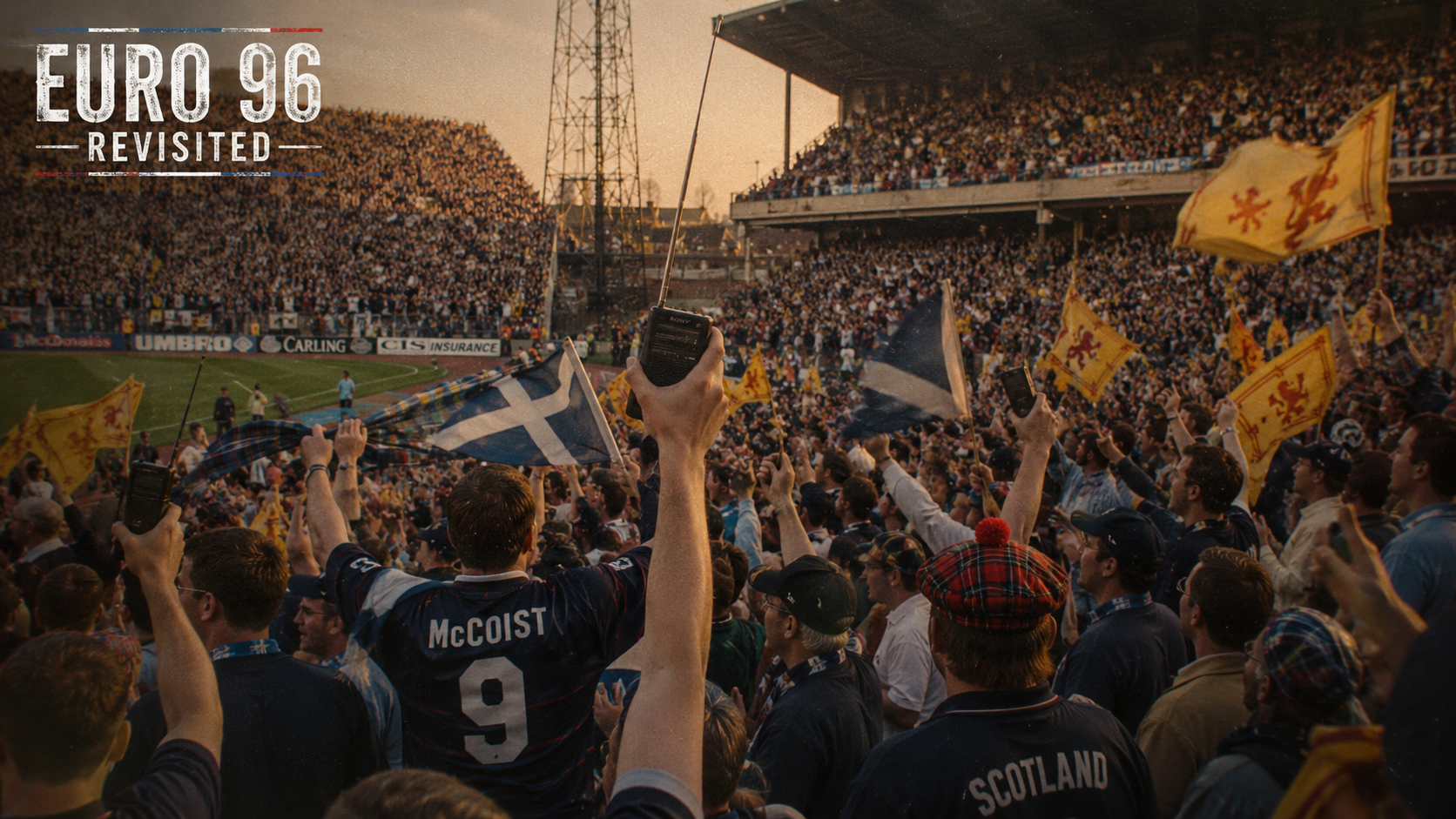
For one brief spell at Euro 96, Scotland were heading for the quarter-finals. Then Patrick Kluivert scored at Wembley, and a whole footballing world began to change.
The Thirteen Minutes
The noise arrived in fragments at first.
A shout from the upper tier. Arms suddenly raised behind the goal. A man in a dark Scotland top climbing onto his seat with a small transistor radio pressed against his ear. Inside the Holte End, thousands of Scottish supporters began turning away from the pitch and towards each other, searching faces for confirmation of something they did not quite trust yet.
England had scored again at Wembley.
By the summer of 1996, football supporters still carried information physically. News travelled through bodies before scoreboards. Rumours moved through crowds like weather fronts. Inside Villa Park on the evening of June 18, Scotland were playing Switzerland in Birmingham while, 120 miles south, England were dismantling the Netherlands in the match that would determine whether Craig Brown’s side survived Group A.
The arithmetic had seemed almost insulting beforehand. Scotland needed to beat Switzerland and rely on England defeating the Dutch heavily enough to overturn the gap. It felt too convoluted to be realistic. Too dependent on other people. Too vulnerable to humiliation.
And yet, suddenly, improbably, it was happening.
Ally McCoist had given Scotland the lead in the 36th minute with a finish that seemed to carry twenty years of frustration behind it, whipping a fierce strike beyond Marco Pascolo and into the top corner. McCoist sprinted towards the dugout with both fists clenched, disappearing beneath a collapsing pile of teammates and staff. For a player who had somehow reached the age of 33 without scoring at a major international tournament, the release was visible from the back rows of the stadium.
Even after the celebrations broke apart, he still seemed unable to stop smiling.
Still, Scotland required help.
Then came the goals from Wembley.
Alan Shearer. Teddy Sheringham. Another. Then another.
Inside Villa Park, the emotional temperature began to change in strange and disorientating ways. Scottish supporters found themselves celebrating English goals with embarrassed instinctiveness, cheering score updates they would ordinarily spend a lifetime resisting. Men who had spent decades despising England suddenly erupted when radios confirmed a fourth goal against the Dutch. Nobody quite knew how to process it properly.
For thirteen extraordinary minutes, Scotland were going through to the quarter-finals of Euro 96.
The Holte End became less a football stand than a single living organism. Cigarette smoke drifted slowly beneath the upper tier. Men leaned over crushed paper programmes trying to recalculate goal difference by hand. One supporter near the front held a small silver radio above his head so the people around him could hear the commentary from Wembley more clearly, the aerial bent sideways beneath the pressure of too many hands grabbing for updates.
Beer flew through the humid Birmingham air. Strangers grabbed each other by the shoulders. Some supporters laughed uncontrollably. Others simply stared at the pitch in disbelief, unwilling to trust mathematics until the final whistle physically arrived.
Down below, Craig Brown understood the danger immediately.
Scotland led Switzerland 1-0, but a single Dutch goal would destroy everything. Brown began urging his players forward with increasing desperation. Colin Hendry, the granite-faced Blackburn Rovers defender who had spent most of the tournament throwing himself in front of shots and headers, was pushed towards centre-forward in search of a second goal that might finally remove dependence on events elsewhere.
Scotland attacked with a kind of fearful urgency. Not reckless. Not wild. But aware that football history was beginning to shift beneath their feet.
What nobody inside Villa Park fully understood at that moment was that they were watching the last Scotland team that still felt structurally equal to Europe’s serious football nations. Not romantic outsiders. Not plucky underdogs. Genuine competitors.
Then, somewhere down in London, Patrick Kluivert redirected the entire emotional history of the evening with one low finish through David Seaman.
The goal itself was untidy. Almost forgettable in isolation. There was no dramatic soundtrack attached to it inside Villa Park. No collective gasp. Just the slow, creeping arrival of understanding.
The radios lowered first.
Then came the silence.
Not total silence. Scottish supporters are rarely fully silent. But the noise changed. The bounce disappeared from the Holte End. The delirium drained from the stadium in visible stages as supporters recalculated the table in real time.
England 4. Netherlands 1.
Scotland were level with the Dutch on points. Level on goal difference too.
But the Netherlands had scored three goals in the tournament.
Scotland had scored one.
And suddenly the entire campaign rested on that brutal, microscopic distinction.
For thirteen minutes, Scotland had belonged to the knockout stages of the European Championship. For thirteen minutes, the future still looked open.
Then football reduced everything to arithmetic.
This Was Not Glorious Failure
Scottish football has always possessed a dangerous relationship with defeat.
Not defeat itself. Most football nations lose eventually. Scotland’s particular instinct has been to reshape elimination into something emotionally survivable. The near miss becomes folklore. The heartbreak becomes personality. Failure softens into anecdote, humour, self-awareness, song.
Euro 96 has often been remembered that way. Paul Gascoigne’s goal. Gary McAllister’s penalty miss. Colin Hendry left sprawled on the Wembley turf. Patrick Kluivert scoring somewhere else. Scotland leaving bravely but inevitably.
It is a comforting version of events. It is also slightly dishonest.
Craig Brown’s Scotland were not a charmingly limited side surviving on adrenaline and national sentiment. They were one of the most tactically organised teams in the tournament. Across ten qualification matches for Euro 96, they conceded only three goals. They travelled to Moscow and kept Russia scoreless at the Luzhniki Stadium. They frustrated the Netherlands so completely at Villa Park that Guus Hiddink’s side spent large parts of the evening retreating into sterile possession with no rhythm or penetration.
At Wembley, Scotland were arguably the better side for the opening hour against England. The popular memory of that game now revolves around Gascoigne’s flick and volley, but before that moment England had spent long stretches anxious, flat and increasingly frustrated inside their own national stadium.
Scotland were not romantics. They were difficult.
That distinction matters.
By 1996, the old caricature of Scottish football still lingered south of the border. Blood-and-thunder players. Noise. Effort. Direct football. Brave losers wrapped in tartan sentimentality. Yet Brown’s side were far more sophisticated than that stereotype allowed. Their shape was disciplined. Their distances between units were excellent. Gary McAllister and John Collins controlled matches with intelligence rather than chaos. Scotland defended narrow, reduced space aggressively, and understood exactly how to turn games ugly for technically superior opponents.
The Netherlands expected freedom against them and found congestion instead.
England expected emotional disorder and found tactical clarity.
Even the structure of the squad reflected a football nation still producing serious players at elite level. Colin Hendry had captained Blackburn Rovers to the Premier League title the previous year. McAllister was one of the finest midfield passers in Britain. Collins would move to AS Monaco that summer and become one of the first significant British footballers to embrace continental football fully in the Bosman era. Andy Goram was operating at a level that many inside the Scottish game still consider the finest goalkeeping ever produced by the country.
This was not a minor football nation clinging to relevance.
It was the final Scotland side that still expected relevance naturally.
That historical context changes the emotional weight of Euro 96 completely.
When Scotland walked off Villa Park after beating Switzerland, they did not yet know they would disappear from major men’s international tournaments for more than two decades. Nobody inside the stadium understood they were witnessing the closing stages of an era. The long wait that followed, stretching from the 1998 World Cup until qualification for Euro 2020 under Steve Clarke, transformed the emotional identity of Scottish international football itself.
Expectation slowly became hope.
Hope slowly became longing.
Longing eventually became survival.
That is why Euro 96 still aches differently in Scotland compared to many other failed campaigns. The pain was not simply elimination. It was historical timing. Scotland were strong enough to compete seriously with elite nations just as the foundations beneath Scottish football were beginning to weaken permanently.
The Bosman ruling arrived only months before the tournament. The Premier League’s financial acceleration was beginning to distort British football irrevocably. Scottish clubs would soon struggle to retain elite talent. The old pipeline that had once sent world-class Scottish footballers into the top English sides began slowly drying up.
None of this was fully visible inside Villa Park in June 1996.
But it was already happening.
Which is why those thirteen minutes mattered so much.
Because for a brief period that evening, Scotland were not thinking like outsiders. They were not celebrating effort or noble resistance. They believed they belonged in the last eight of the European Championship because everything about their performances suggested they deserved to be there.
That belief would become harder to sustain as the years passed.
Craig Brown and the Last Old Scotland
Craig Brown never looked like the future of football management.
Even in 1996, amid the sharp tailoring and growing commercial sheen of the modern game, Brown appeared slightly removed from the industry accelerating around him. He spoke like a teacher because he had been one. Before becoming Scotland manager full-time, he balanced coaching with work as a schoolteacher, lecturer and eventually headmaster. He was thoughtful without seeming performative about it. Calm without looking detached. Players trusted him because he behaved like somebody interested in people before systems.
Before matches, Brown would often move quietly around hotel corridors checking on players individually rather than delivering grand speeches. Scotland did not feel managed under him so much as looked after.
That mattered enormously for Scotland.
International management in smaller football nations often drifts towards theatre. Chest-beating patriotism. Manufactured siege mentality. Emotional overload disguised as motivation. Brown resisted all of it. His Scotland teams reflected his personality instead: organised, measured, quietly resilient and emotionally stable under pressure.
Ally McCoist later described Brown as one of the best man-managers he worked under. Others spoke about his warmth, his memory for personal details, the handwritten notes he would leave for players in hotel rooms before matches. Brown could be funny too, although the humour arrived dry and sideways rather than loudly delivered. He understood that international football, particularly in Scotland, carried enough emotional tension already.
More importantly, Brown understood exactly what Scotland were becoming.
Or perhaps more accurately, what they were about to stop being.
Scottish football in the 1970s and 1980s had exported elite-level players almost as a matter of routine. Kenny Dalglish, Graeme Souness, Alan Hansen, Gordon Strachan, Denis Law, Joe Jordan. Scotland had long punched above its population size because the football culture beneath the national team remained structurally healthy. Scottish players populated top English sides naturally. European Cups were not alien concepts to Scottish footballers. Competing internationally did not feel improbable.
By the mid-1990s, however, subtle changes had begun gathering force beneath the surface of the game.
The Premier League had transformed English football economically almost overnight. Television money accelerated inequality. Stadiums modernised. Recruitment widened internationally. Wages accelerated beyond anything Scottish clubs could realistically sustain.
Then came Bosman.
When Jean-Marc Bosman won his case at the European Court of Justice in December 1995, only six months before Euro 96, football changed permanently. Clubs across Europe gained greater access to foreign players without transfer fees at the end of contracts. Borders inside football became softer. Recruitment became broader. Wealthier leagues grew stronger faster.
For Scotland, the implications were enormous.
The Scotland squad at Euro 96 still contained players shaped almost entirely by British football culture. Hendry at Blackburn. McAllister at Leeds. Durie at Rangers. McCall at Rangers. McKinlay at Blackburn. Calderwood at Tottenham. The dressing room remained recognisably local in rhythm, humour and football education.
Future Scotland squads would become more fragmented.
Not culturally weaker necessarily, but structurally different. Fewer Scottish footballers would establish themselves as automatic starters at elite English clubs. The country’s talent pool would narrow gradually. Qualification campaigns would become more emotionally desperate because tournament appearances themselves would grow rarer.
Brown’s Scotland existed precisely at that intersection between old British football and the rapidly globalising game emerging around it.
That is partly why the squad felt so coherent.
Most of the players still emerged from recognisably similar football educations. Hendry, McAllister, McCall, Durie, McKinlay, McCoist. They understood British football rhythms instinctively. The dressing room culture remained deeply local even while the sport itself was beginning to internationalise aggressively.
Brown’s genius was recognising that Scotland could no longer overpower elite nations individually, but could still unsettle them collectively.
He removed vanity from the side entirely.
There was very little improvisation about Scotland at Euro 96. Very little aesthetic indulgence. Every player understood distances, responsibilities and triggers. Brown built a side that compressed space intelligently and emotionally exhausted opponents. The shape mattered because Scotland no longer possessed the margin for tactical looseness.
In many ways, Brown was managing against history itself.
Not dramatically. Not consciously. But he understood that Scotland’s future would become harder. Qualification campaigns would become thinner. Talent pools smaller. Margins narrower. Wealth gaps wider.
And yet Brown never spoke publicly in apocalyptic terms. That was not his style. He carried himself with the emotional steadiness of somebody who believed panic rarely improved footballers.
Years later, after his death in 2023, tributes from former players returned repeatedly to the same qualities: dignity, decency, calmness, trust. Modern football often celebrates intensity in managers. Brown represented something quieter and increasingly rare: emotional proportion.
Which is why this Scotland team still feels strangely human when revisited now.
Not naïve. Not simple. Just uncorrupted by the hyper-performance culture that would later consume elite football almost entirely.
Inside Villa Park in June 1996, Craig Brown stood on the touchline in shirt sleeves and tie, watching radios reshape the emotional atmosphere around him, while somewhere beneath the noise an older version of Scottish football approached its ending.
The Team That Would Not Break
Long before Villa Park briefly dissolved into delirium, Scotland had already built themselves into something unusually stubborn.
The qualification campaign for Euro 96 was not glamorous enough to become mythology later. There were no defining soundtrack moments attached to it. No cinematic television montages. No national euphoria. Mostly it unfolded in cold stadiums, difficult away trips and narrow victories that revealed more about Craig Brown’s Scotland than any emotional speech ever could.
They became a team that refused to fracture.
That quality emerged slowly.
Scotland opened qualification in Helsinki in September 1994 with a controlled 2-0 victory over Finland. Duncan Shearer scored first, John Collins added another, and Brown’s side immediately established the emotional tone of the campaign. They did not chase spectacle. They managed matches. Even then, the football carried a kind of severe practicality that would define the side at Euro 96 itself.
A month later they demolished the Faroe Islands 5-1 at Hampden, Billy McKinlay scoring a hat-trick, but the campaign’s defining identity was never attacking fluency. It was resistance.
In Athens, Scotland lost narrowly to Greece but remained structurally intact. In Moscow, against a Russian side packed with technical quality and driven by the intimidating atmosphere of the Luzhniki Stadium, Brown’s players produced one of the most important results of the entire campaign: a grim, exhausting 0-0 draw that reinforced the idea that Scotland could survive hostile environments without emotional collapse.
Those matches mattered because Scottish football had often carried a psychological fragility beneath the noise and passion. Previous tournament sides sometimes arrived at major moments emotionally overloaded by national expectation or the mythology of the occasion itself. Brown gradually removed that volatility. His Scotland side played as though they expected discomfort. Difficult conditions did not surprise them. Tight matches did not alarm them.
They trusted repetition.
Training sessions under Brown were famously detailed without becoming oppressive. Shape work. Defensive distances. Set-piece routines. Players occasionally joked about the sheer volume of organisation involved, but many later admitted the clarity simplified matches psychologically. Scotland entered games understanding precisely what was expected of them.
That certainty became Scotland’s competitive advantage.
The defining victory of qualification arrived not in Glasgow or London, but in the North Atlantic wind of Toftir on June 7, 1995. One year before Euro 96 opened, Scotland travelled to the Faroe Islands knowing anything less than victory would destabilise the group completely. There was no romance to the occasion. The stadium was tiny. The conditions awkward. The pitch heavy beneath grey skies.
And yet those were precisely the sorts of evenings Brown’s Scotland learned to master.
Billy McKinlay scored first. John McGinlay added another before half-time. Scotland controlled the rest of the match with cold professionalism. No drama. No collapse. No emotional drift.
Looking back now, that evening feels strangely symbolic. While larger football nations often define themselves through spectacle, Scotland’s path to Euro 96 was built almost entirely on discipline and accumulation. Seven wins. Two draws. One defeat. Only three goals conceded across ten qualification matches. Nobody overwhelmed them physically. Very few opened them up tactically.
The campaign hardened the squad psychologically as much as technically.
By the time Scotland arrived in England for Euro 96, they carried none of the desperation often associated with smaller football nations. The players believed their structure worked because qualification had repeatedly proven it did. Hendry attacked crosses with absolute conviction because the defensive system protected him properly. McAllister slowed matches down because Scotland trusted shape over chaos. Goram played with unnerving calm because he understood the defensive screen in front of him intimately.
That confidence is important historically because later Scotland teams often arrived at tournaments or qualification campaigns carrying visible anxiety about belonging at elite level.
Brown’s side did not possess that inferiority yet.
They expected matches against major nations to be difficult, but not impossible. There is a meaningful distinction there. Against Russia, Greece, the Netherlands and even England, Scotland played like a side convinced organisation could neutralise reputation.
Often, they were right.
The campaign also strengthened something else that would become central to the emotional identity of Euro 96: trust between the players and supporters.
The Tartan Army had evolved dramatically by the mid-1990s. The chaos and aggression associated with elements of Scottish support during the 1970s had softened into something more self-aware and communal. Fans travelled with humour rather than menace. The relationship between crowd and team felt unusually forgiving compared to many international environments. Scotland supporters did not require domination from Brown’s side. They required honesty, effort and emotional commitment.
Brown’s players gave them all three.
Which is why Euro 96 still lingers so painfully in Scottish football memory. The tournament was not built around illusion. Scotland had earned their place there through tactical discipline, emotional maturity and defensive resilience. They arrived in England not hoping merely to survive, but genuinely believing they could compete with anyone in the group.
For a while, they did more than that.
Compression, Discipline, Survival
Scotland did not arrive at Euro 96 trying to entertain Europe.
They arrived trying to suffocate it.
That distinction sat at the centre of everything Craig Brown built. By the standards of mid-1990s international football, Scotland were not especially fashionable tactically. They did not press aggressively high up the pitch like Arrigo Sacchi’s Milan sides had done earlier in the decade. Nor did they possess the individual attacking talent to dominate matches through improvisation. Brown understood both realities clearly enough not to fight them.
Instead, Scotland compressed games.
Their system was less about defensive negativity than emotional control. Brown wanted matches played inside narrow corridors where opponents became frustrated, rushed and physically irritated. Wide players dropped quickly into the defensive line. Midfielders stayed compact. Hendry and Colin Calderwood attacked crosses early and aggressively before danger fully developed.
The shape demanded concentration rather than flair.
Against technically superior opponents, Scotland often defended with almost mathematical discipline. Distances between players rarely stretched beyond recovery. The midfield shifted laterally together. Forwards worked backwards constantly to prevent easy passing lanes into central areas. Everything about the system relied on collective trust. One player freelancing emotionally could destabilise the entire structure.
What made Scotland effective was that very few players broke shape unnecessarily.
At the heart of it all stood Gary McAllister.
Even in a tournament filled with glamorous names, McAllister remained one of the most intelligent midfielders in Europe. By 1996 he had already accumulated nearly a decade of elite-level football in England with Leicester City and Leeds United, but his real quality lay in tempo manipulation rather than spectacle. McAllister understood when matches needed slowing, when possession needed calming, and when Scotland required emotional oxygen after difficult passages of play.
He was not physically explosive. He did not dominate games athletically. But he controlled rhythm beautifully.
Alongside him, John Collins brought a more continental sharpness. Collins had always appeared slightly ahead of British football tactically, even before his move to AS Monaco immediately after Euro 96. Slim, intelligent and technically precise, he played with constant awareness of angles and spacing. While McAllister stabilised matches, Collins accelerated them subtly, breaking lines with passes or movement before opponents fully adjusted.
Together they gave Scotland something many outsiders never expected: technical credibility.
Then there was Andy Goram.
Scottish football has produced larger goalkeepers. More decorated goalkeepers too, arguably. Few, however, have inspired the same mixture of affection, unpredictability and awe. Goram did not look architecturally designed for modern elite goalkeeping. Standing under six feet tall, he lacked the imposing dimensions increasingly preferred by top clubs during the 1990s. Yet his reflexes compensated for everything else.
Tommy Burns once remarked that Goram “broke my heart” because of the sheer number of goals he prevented against Celtic while playing for Rangers.
At Euro 96, he became Scotland’s final protective layer. Against the Netherlands at Villa Park, Goram’s positioning frustrated Dennis Bergkamp repeatedly. He reacted sharply when required, stayed calm beneath aerial pressure and projected the strange confidence that eccentric goalkeepers sometimes carry into tournaments.
Goram’s personality mattered too.
Scottish football in the 1990s still allowed room for difficult, complicated characters. Goram represented Scotland in cricket as well as football. He carried tabloid controversy around his mental health after reports claiming he suffered from schizophrenia, prompting the Tartan Army to respond with the darkly affectionate chant: “There’s only two Andy Gorams.”
Modern football probably would not know how to contain somebody like him now.
And yet Brown trusted him completely.
That trust extended throughout the side. Colin Hendry attacked defending almost personally. Tosh McKinlay offered width from the left without losing positional discipline. Stuart McCall covered enormous distances intelligently. Gordon Durie stretched defensive lines selflessly even when matches offered him little glamour individually.
Scotland’s football identity at Euro 96 therefore became something subtly unusual: a deeply collective side operating in an increasingly individualistic football era.
That collective clarity frustrated elite opponents.
The Netherlands expected fluid superiority in Birmingham and instead found themselves dragged into a physically compressed contest where every forward movement became laborious. England expected emotional chaos from Scotland at Wembley and instead encountered a side controlling midfield spaces and dictating long stretches of the match territorially.
Scotland rarely looked overwhelmed because their structure prevented emotional panic from spreading through the team.
That may sound simple. It was not.
International football often becomes psychologically unstable very quickly. One goal changes emotional momentum. Crowds accelerate anxiety. Players abandon shape instinctively chasing moments. Brown’s Scotland resisted those impulses better than most.
Which is why the tournament still feels historically significant now.
Euro 96 was not the story of a limited side somehow surviving briefly through passion and noise. Scotland belonged tactically at that level. They understood themselves clearly enough to compete there.
In hindsight, that certainty feels almost luxurious.
A Country Beginning to Shrink
The strangest thing about Scotland at Euro 96 is that nobody involved believed they were living through the end of anything.
That awareness only arrived later.
At the time, Scotland still felt like a serious football nation operating within recognisable European standards. They qualified for tournaments regularly. Their players populated strong English sides naturally. Rangers had reached the final stages of the Champions League only three years earlier. Celtic still carried continental weight culturally, if not always financially. Scottish football retained enough confidence to view qualification not as a miracle, but as responsibility.
Euro 96 existed precisely on the edge of that disappearing world.
The warning signs were already there, although they remained subtle enough to ignore temporarily. English football’s financial explosion following the formation of the Premier League in 1992 had begun widening the economic gap between the two countries at frightening speed. Television money transformed England’s infrastructure almost overnight. Stadiums modernised. Foreign recruitment expanded. Wages accelerated beyond anything Scottish clubs could realistically sustain.
For decades, Scotland had compensated for economic limitations by producing elite football intelligence consistently. Scottish players traditionally travelled south and improved England’s strongest teams through personality, leadership and tactical understanding. Dalglish, Hansen, Souness and Strachan had not felt like exceptions. They felt like continuation.
But by 1996, the ecosystem feeding that pipeline was changing fundamentally.
The Bosman ruling accelerated everything.
When Bosman won his case at the European Court of Justice in December 1995, the immediate implications focused largely on player freedom and transfers. The deeper effect, particularly for countries like Scotland, was structural. Wealthier leagues could now recruit from across Europe more aggressively and more efficiently. The market widened overnight. Scottish players were no longer competing primarily against English, Irish or domestic rivals for elite-level opportunities. They were suddenly competing against the entire continent.
That shift mattered enormously.
The Scotland squad at Euro 96 still contained players shaped almost entirely by British football culture. Hendry at Blackburn. McAllister at Leeds. Durie at Rangers. McCall at Rangers. McKinlay at Blackburn. Calderwood at Tottenham. The dressing room remained recognisably local in rhythm, humour and football education.
Euro 96 now feels like the last Scotland tournament before qualification stopped feeling routine.
That does not mean the decline happened immediately. Scotland still reached the 1998 World Cup in France. Brown remained competitive. Individual players continued emerging. But the emotional atmosphere around the national side slowly changed after 1996.
Before Euro 96, Scotland entered tournaments expecting to compete seriously.
Afterwards, qualification itself increasingly became the emotional achievement.
That distinction altered everything.
It changed supporter psychology. Media coverage. Public expectation. Even the language around the national team became subtly more defensive over time. Heroic failure slowly replaced ambition as the safer emotional framework.
Perhaps that is why Euro 96 still occupies such a powerful place in Scottish memory. Not because Scotland won anything. They did not. Not because they produced the tournament’s defining moment. They did not. Gascoigne, Shearer and the England narrative eventually consumed most international attention.
But beneath the noise, Euro 96 captured the final appearance of a Scotland side untouched by inferiority.
They respected elite nations without fearing them.
Against the Netherlands, Scotland did not behave like tourists grateful for the occasion. Against England, they controlled long periods of the match without psychological panic. Against Switzerland, they played with urgency rather than resignation because progression felt genuinely attainable.
That confidence would become harder to recover in the years that followed.
The long absence from tournaments after 1998 reshaped an entire generation of Scottish football consciousness. Children who watched McCoist score at Villa Park grew into adults without seeing Scotland at another major men’s finals until Euro 2020. An entire emotional relationship with tournament football disappeared.
Which is why Villa Park now feels haunted in retrospect.
Not because Scotland failed there.
Because for thirteen brief minutes, before Kluivert scored at Wembley, Scottish football still existed in its older form. Competitive. Relevant. Expectant.
Then the modern game kept moving forward, and Scotland slowly drifted further behind it.
The Wall of Birmingham
The opening match against the Netherlands should have clarified Scotland’s limitations immediately.
Instead, it complicated them.
On paper, the Dutch possessed everything Scotland supposedly lacked. Technical superiority. Greater squad depth. More fashionable players. More tactical fluidity. Guus Hiddink’s side arrived in England carrying the lingering aura of Ajax’s recent Champions League triumph, with Edgar Davids, Clarence Seedorf, Patrick Kluivert and Dennis Bergkamp representing a football culture that appeared to belong to the future.
Scotland, by contrast, looked defiantly unfashionable.
Brown set his side up to deny space, protect central areas and turn the match into a physical argument. Before kick-off, much of the English coverage treated the match as an inevitable technical mismatch.
What followed at Villa Park instead was ninety minutes of irritation.
The Netherlands struggled from the beginning to find emotional rhythm against Scotland’s compactness. Every passing lane into Bergkamp arrived crowded. Davids and Seedorf repeatedly received possession facing sideways rather than forwards. Scotland defended narrow enough to deny central penetration while still retaining enough aggression to contest second balls physically.
Brown’s side did not simply defend deep.
They manipulated space.
That distinction mattered enormously. Scotland understood precisely where they wanted the game played and where they refused to allow it to develop. Dutch possession became slower and increasingly sterile because Scotland compressed the areas that mattered most. When the Netherlands tried widening the pitch, Scotland shuffled collectively. When they attempted quicker combinations centrally, Hendry and Calderwood attacked early.
The physical commitment of the performance carried psychological force too.
Hendry, in particular, defended as though every challenge required personal emotional investment. By 1996 he had already become one of Britain’s premier centre-backs after captaining Blackburn Rovers to the Premier League title the previous season. Against the Dutch, he played with furious concentration, throwing himself into aerial duels and recovery tackles with complete disregard for aesthetics.
Alongside him, Colin Calderwood brought calmness rather than noise. If Hendry supplied emotional aggression, Calderwood supplied positional discipline. Together they gave Scotland a defensive platform that rarely looked stretched despite the calibre of opposition.
Then there was Goram behind them.
The Dutch never fully settled because Goram projected something difficult for opponents to read properly. He lacked the rigid technical orthodoxy increasingly associated with elite goalkeeping, but compensated through instinct and reaction speed.
Scotland were fortunate once, certainly. Midway through the second half, John Collins handled the ball close to his own goal line under heavy pressure. In the VAR era, it would almost certainly have resulted in a penalty and probably a red card. In 1996, the officials missed it entirely. Scottish players carried on immediately while Dutch protests briefly consumed the stadium.
But reducing the performance to that moment alone misses the larger truth of the evening.
Scotland deserved the draw.
In fact, during parts of the second half they looked more emotionally composed than the Netherlands themselves. McAllister slowed possession intelligently whenever the match threatened becoming chaotic. Collins carried the ball forward with elegant calmness. Stuart McCall covered enormous distances closing spaces and disrupting transitions.
Most importantly, Scotland looked as though they belonged physically and tactically at this level.
That sounds obvious now. It did not feel obvious then.
International football in the 1990s still carried a rigid hierarchy around certain nations. Scotland were respected traditionally but rarely treated as serious tournament threats. The Netherlands, meanwhile, represented sophistication and continental modernity. Villa Park destabilised that assumption for ninety minutes.
The crowd sensed it too.
The Tartan Army had arrived in Birmingham carrying all the usual humour and noise, but beneath the songs there remained genuine anxiety about how Scotland would cope technically against elite continental opposition. By full-time, that nervousness had shifted into something more substantial.
Belief.
Not blind optimism. Scottish football rarely operates that way. But belief in the structure. Belief in Brown. Belief that this team might genuinely survive the group rather than simply participate in it respectfully.
After the final whistle, Brown remained typically restrained. The performance had been exactly what he had asked for: disciplined, brave, tactically clear.
Yet inside the dressing room the mood reportedly felt different.
The Dutch had not overwhelmed Scotland.
They had barely moved them.
Wembley Was Not the Real Tragedy
The danger with revisiting Scotland against England at Euro 96 is that memory has already edited the match too aggressively.
Everything now collapses towards a single sequence. McAllister’s penalty. Gascoigne’s goal. Dentist’s chair celebration. Tabloid immortality. The mythology arrives pre-packaged.
But the actual match felt far stranger than the highlight reel that survived it.
For almost an hour, Scotland looked calmer than England.
Wembley carried an emotional heaviness that afternoon which English players never fully escaped. The tournament had been marketed relentlessly as a national rebirth, yet expectation sat awkwardly on the hosts. England had drawn nervously with Switzerland in the opening game and the atmosphere inside Wembley before kick-off felt tense rather than triumphant.
Scotland sensed it immediately.
Brown’s side began with controlled aggression, pressing intelligently through midfield while refusing to allow Gascoigne space between the lines. McAllister and Collins circulated possession confidently. Stuart McCall drifted cleverly into pockets that disrupted England’s shape. Whenever England attempted building rhythm through Darren Anderton or Steve McManaman, Scotland narrowed the pitch quickly and dragged the match into uncomfortable areas.
By half-time, sections of Wembley were booing England.
That detail matters because history now falsely frames the match as inevitable English superiority interrupted briefly by Scottish resistance. In reality, Terry Venables spent much of the opening period watching Scotland dictate territory and tempo. England looked anxious. Scotland looked coherent.
Venables reacted decisively at the break.
Stuart Pearce was withdrawn and Jamie Redknapp entered midfield. England shifted shape subtly and increased the speed of circulation through wider areas, particularly down the right where Gary Neville began finding more space.
The adjustment changed the match.
In the 53rd minute Neville delivered an early cross into the penalty area and Alan Shearer powered between the Scottish centre-backs to score with a header that carried visible release behind it. Shearer did not celebrate with theatrical joy. He celebrated like a man exhaling pressure publicly.
Even then, Scotland did not unravel.
That remains one of the most revealing qualities of Brown’s side throughout the tournament. They absorbed setbacks without emotional collapse. Lesser international teams often fragment psychologically after conceding in major matches, especially inside hostile stadiums. Scotland instead became more assertive.
Durie stretched England deeper. Collins drove forward more aggressively. McAllister began finding wider passing angles as the game opened.
Then came the penalty.
Tony Adams fouled Gordon Durie after another intelligent Scottish attack split England centrally. Pierluigi Pairetto pointed immediately to the spot. For the first time all afternoon, Wembley genuinely fell silent.
McAllister placed the ball carefully.
What happened next has been replayed endlessly for thirty years, often stripped of the emotional reality surrounding it. The ball moved fractionally on the spot during McAllister’s run-up. Uri Geller later attempted claiming responsibility through absurd pseudo-telekinetic intervention from a television studio, one of several deeply 1990s footnotes attached to the tournament.
McAllister struck firmly towards Seaman’s left.
Seaman saved with his elbow.
And yet even now, that moment feels less emotionally painful in retrospect than what followed later at Villa Park against Switzerland. Perhaps because penalties exist within football’s accepted emotional violence. Somebody always misses eventually. Somebody always becomes temporary national symbolism.
What happened next, however, altered the tournament’s mythology permanently.
Barely a minute after the save, England counter-attacked through Darren Anderton before the ball arrived at Gascoigne near the edge of the Scottish penalty area. Colin Hendry stepped forward aggressively. Gascoigne lifted the ball over him with his left foot, spun through and volleyed beyond Goram with his right.
It was breathtaking.
Not because Scotland defended poorly. They did not. Hendry actually made the correct aggressive decision initially. Gascoigne simply produced a solution no defensive structure could fully anticipate.
Years later, Hendry would admit the goal haunted him. Yet there was something almost unfair about the way the moment consumed Scottish memory afterwards. Hendry had been magnificent throughout the tournament. McAllister too. Their reputations became disproportionately attached to one minute because football prefers symbolism to context.
The truth was more uncomfortable for England’s mythology.
For long stretches of the match, Scotland had matched them tactically and emotionally. Gascoigne’s goal did not expose inferiority. It interrupted parity.
That distinction matters because Scotland did not leave Wembley feeling humiliated. Hurt, certainly. Furious at the speed of the collapse from possible equaliser to probable defeat. But not diminished.
Inside the Scottish dressing room afterwards, the overwhelming emotion was frustration rather than despair. The players believed they had let a major opportunity slip against a vulnerable England side. Brown later described the match as one Scotland could have got something from.
He was right.
Which is partly why Wembley was not the real tragedy of Scotland at Euro 96.
The actual heartbreak arrived three days later in Birmingham, when Scotland briefly believed the tournament still belonged to them.
The Holte End
By the time Scotland arrived back in Birmingham for the final group match, the tournament had become strangely exhausting.
Not physically. Emotionally.
The defeat at Wembley lingered over everything without entirely killing belief. Scotland still had a route through the group, but it no longer belonged completely to them. Qualification required mathematics now. Cooperation from England. A heavy Dutch defeat. A level of scoreboard dependency that always feels psychologically dangerous in football because it forces supporters to split themselves between hope and calculation.
Even the journey to Villa Park carried tension.
Supporters later recalled coaches crawling through motorway traffic beneath heavy police presence, officers boarding buses to search for alcohol while nervous conversations drifted between football permutations and ordinary travel complaints. The atmosphere no longer carried the carefree novelty of tournament arrival. Scotland were close enough to qualification now for anxiety to become physical.
Inside Villa Park, however, something changed again.
The Holte End that evening became one of the great lost emotional landscapes of British football in the 1990s. Not because of violence or spectacle. Because of collective vulnerability. Before smartphones, before live table graphics permanently attached to broadcasts, supporters experienced information imperfectly. Nobody inside the stadium possessed complete certainty at any moment. News arrived through whispers, radios, stewards, half-heard announcements and crowd reactions rippling unevenly across the stand.
Football still felt local even while events elsewhere shaped it.
Scotland began urgently against Switzerland, but not recklessly. Brown understood the danger of emotional overcommitment. A draw would eliminate them immediately. Yet conceding early while chasing goals would destroy the structure that had carried them through qualification and into the tournament itself.
For long stretches, the match felt nervous rather than fluent.
Then McCoist scored.
The finish arrived in the 36th minute after Scotland worked possession across the edge of the Swiss penalty area. McCoist collected the ball outside the box, shifted slightly onto his right foot and whipped a vicious strike high beyond Marco Pascolo into the top corner. It remains one of the cleanest finishes of the tournament, although history rarely treats it that way because of everything happening elsewhere.
McCoist sprinted towards the bench almost disbelievingly.
Even after the celebrations broke apart, he still seemed unable to stop smiling.
There was relief inside the celebration as much as joy. Scotland’s most famous striker had waited his entire international career for a goal at major tournament finals. By 1996 he already carried immense emotional weight within Scottish football, but tournament football had repeatedly denied him moments like this.
At Villa Park, finally, one arrived.
Then the radios began changing the evening completely.
England scored first against the Netherlands at Wembley. Then again. Then again.
With every update, the emotional atmosphere inside the Holte End became more unstable. Scottish supporters found themselves trapped inside an almost absurd psychological contradiction: desperately celebrating English goals while trying not to think too deeply about what that meant emotionally.
One fan later described the experience as feeling guilty for cheering.
Another remembered strangers embracing after England’s fourth goal before immediately laughing at the surrealism of the moment.
For thirteen extraordinary minutes, Scotland were through to the quarter-finals of the European Championship.
And the remarkable thing was how naturally the belief arrived.
The Holte End did not celebrate like a crowd witnessing a miracle. They celebrated like people rediscovering something they had temporarily forgotten about themselves. Scotland belonged here. Scotland could compete here. Scotland could survive this group because their performances had earned survival.
Brown sensed the emotional shift instantly from the touchline.
As Wembley tilted further in Scotland’s favour, he began chasing security. Hendry moved forward increasingly often during attacks. Full-backs pushed higher. McAllister accelerated possession more aggressively instead of controlling tempo. Scotland were no longer simply trying to survive the evening. They were trying to reclaim ownership of it.
The crowd responded to every attack with mounting desperation.
Villa Park started to feel suspended between cities. Half the emotional energy inside the stadium no longer came from the football unfolding in Birmingham, but from events nobody could actually see unfolding at Wembley. Supporters leaned over radios. Stewards passed score updates through hospitality areas. Tiny pockets of noise erupted seconds before others understood why.
Then, somewhere down in London, Patrick Kluivert redirected the entire emotional history of the evening with one low finish through David Seaman.
That remains the cruel genius of football tournaments. Entire national moods can collapse through events occurring somewhere else entirely.
The Dutch goal itself was oddly flat in emotional texture. No dramatic soundtrack reached Villa Park immediately. No giant screen replayed the finish. Instead, understanding arrived gradually and unevenly. Radios lowered. Celebrations stopped halfway through. Faces tightened as supporters recalculated the table manually.
Scotland and the Netherlands would finish level on points.
Level on goal difference too.
But the Dutch had scored three goals in the tournament.
Scotland had scored one.
That was enough.
What followed after the final whistle carried a sadness unlike ordinary elimination. Scottish supporters applauded the players fiercely because the team had not failed in any recognisable emotional sense. They had competed properly. Defended brilliantly throughout the tournament. Matched England. Neutralised the Dutch. Beaten Switzerland.
And still they were leaving.
Years later, many Scotland supporters could still describe those thirteen minutes vividly. The radios. The noise. The impossible emotional alliance with England goals. The sensation that the country had briefly stepped back into elite football relevance before watching the door close again.
That is why Villa Park remains the emotional centre of Scotland at Euro 96.
Not because Scotland were humiliated there.
Because they believed there.
The Thirteen Minutes Revisited
With distance, the temptation is to reduce those thirteen minutes at Villa Park into sentimentality.
A beautiful near miss. A tragic sporting footnote. Scotland doing what Scotland always seemed to do in tournament football: arriving full of spirit before leaving with honourable disappointment.
But that interpretation misses the deeper significance of the moment entirely.
The reason those thirteen minutes still linger so powerfully in Scottish football memory is because they briefly restored something that later generations would struggle to recognise: expectation.
Not arrogance. Not entitlement. Expectation.
Scotland at Euro 96 did not carry themselves like outsiders grateful for inclusion. They approached matches believing organisation, intelligence and collective discipline could genuinely carry them beyond the group stage. Against the Netherlands they proved it tactically. Against England they proved it emotionally. Against Switzerland they proved it under pressure.
That is what made Villa Park so emotionally overwhelming when the permutations finally tilted in Scotland’s favour.
The belief felt natural.
Inside the Holte End, supporters were not reacting like lottery winners suddenly stumbling into impossible fortune. They were reacting like people realising the team in front of them genuinely deserved continuation. The campaign had earned legitimacy. Qualification would not have represented theft or chaos. Scotland were good enough to stay.
Nobody inside Villa Park understood they were watching the last Scotland side that still expected major tournaments to be part of ordinary football life.
That historical context matters because the years that followed gradually altered Scottish football psychology at every level.
As tournaments disappeared from reach, expectation slowly became nostalgia. New generations grew up experiencing major finals as television events involving other countries. Qualification campaigns became emotionally framed around survival rather than progression. The national team remained deeply loved, but the relationship with elite football shifted fundamentally.
By the time Scotland finally returned at Euro 2020, the emotional atmosphere surrounding qualification itself carried almost unbearable catharsis. Players cried publicly. Supporters spoke about closure more than ambition. The country celebrated reappearance.
In 1996, Scotland still expected participation.
That is why Villa Park now feels historically suspended between two eras of Scottish football consciousness. One still rooted in competitiveness and continuity. The other shaped increasingly by absence.
Even the players themselves seemed to recognise the difference later.
McAllister would eventually describe Euro 96 as one of the finest squads Scotland produced during his international career. Brown repeatedly argued that the team deserved more than four points and elimination. Hendry maintained enormous pride in the tournament despite the enduring visibility of Gascoigne’s goal against him.
None of them sounded like men clinging to glorious failure.
They sounded like footballers who believed they belonged at that level.
And objectively, they did.
Only Germany conceded fewer goals than Scotland during the group stage of Euro 96. The Dutch managed just one goal from open play across the tournament’s opening phase before Kluivert’s late finish at Wembley. England struggled badly against Scotland for long stretches despite carrying home advantage and the emotional momentum of the tournament.
This was not illusion dressed as patriotism.
Scotland were genuinely competitive.
Which makes Kluivert’s goal feel almost cruelly symbolic now. Not because of its quality. The finish itself was ordinary. But because of what it interrupted historically. For thirteen minutes, Scottish football still occupied its older emotional position within the European game. Competitive. Present. Relevant.
Then the margins shifted.
The modern football economy accelerated. Tournament absences mounted. The old confidence slowly faded from the national game. Scotland continued producing excellent footballers occasionally, but the assumption of belonging at elite level weakened year by year.
That is the real sadness inside Villa Park.
Not that Scotland failed.
That they briefly remembered who they used to be.
Before the Long Silence
When Scotland returned home from Euro 96, there was no sense of national embarrassment.
No backlash. No accusations of failure. No feeling that the team had disgraced itself. Members of Parliament tabled an Early Day Motion praising Craig Brown’s side for the “magnificent performance” they had produced during the tournament. Across Scotland, the mood settled somewhere between pride and quiet emotional exhaustion.
The country understood what it had watched.
Scotland had not survived Euro 96 through nostalgia, noise or patriotic theatre. They had competed properly. The players had carried themselves with tactical discipline and emotional maturity against elite opposition. Even in elimination there remained a collective understanding that the team had left England with dignity fully intact.
What nobody realised at the time was how difficult returning would become.
Brown’s side qualified again for the 1998 World Cup in France, and for a while the continuity disguised the structural changes beginning underneath Scottish football. But slowly, almost invisibly at first, the landscape hardened around them. The Premier League grew richer and more international. Scottish clubs struggled to compete financially. Fewer Scottish players established themselves naturally inside Europe’s elite sides.
The margins narrowed every year.
By the early 2000s, Scottish football no longer approached qualification campaigns with the same quiet expectation that existed in 1996. Hope remained. Passion certainly remained. But confidence weakened. The national team became increasingly trapped between memory and modernity, constantly measured against previous eras that had qualified more regularly and competed more naturally at major tournaments.
The playoff defeat to England in 1999 accelerated the emotional shift.
After that came years of drift. Near misses. Managerial changes. Campaigns that collapsed awkwardly somewhere between promise and resignation. An entire generation of Scottish supporters grew up without seeing the men’s national side appear at a major tournament finals.
That absence changed the emotional relationship between country and team.
In the decades after Euro 96, Scotland often became defined internationally through support rather than football itself. The Tartan Army evolved into perhaps the most admired travelling support in Europe, celebrated for humour, generosity and warmth rather than menace or tribal aggression. Supporters raised money for local charities abroad through the Tartan Army Sunshine Appeal. Scotland fans became symbols of joyful football culture even while the national side itself disappeared from elite competition.
There was something beautiful about that transformation.
And something slightly sad too.
Because the stronger the mythology around the supporters became, the weaker the football often felt underneath it. International audiences increasingly recognised Scotland through kilts, songs and self-deprecating humour rather than tournament performances. The country remained emotionally present in football culture while competitively absent from major finals.
Euro 96 now sits directly on the fault line before that separation fully emerged.
That is why the tournament continues haunting Scottish football memory differently from ordinary elimination campaigns. It was not simply heartbreak. It was transition. Scotland still possessed enough quality, structure and self-belief to operate naturally among strong European sides, but the conditions sustaining that competitiveness were already beginning to erode.
And yet Euro 96 endures precisely because Scotland never looked diminished there.
That remains important historically.
Too often, later narratives about Scottish football retroactively project inferiority backwards onto teams that did not actually feel inferior at the time. Brown’s Scotland were not psychologically grateful to participate. They expected to compete because qualification had taught them they could. Their tactical organisation was elite. Their defensive structure was among the best in the tournament. Their midfield intelligence matched stronger nations comfortably.
For thirteen minutes at Villa Park, Scotland were not a nation living through old stories or fearing future absences. They were simply where they believed they belonged: competing at a major tournament, expecting to stay. Then Patrick Kluivert scored at Wembley, the radios slowly lowered across the Holte End, and without anybody fully realising it, a long Scottish goodbye had already begun.
