


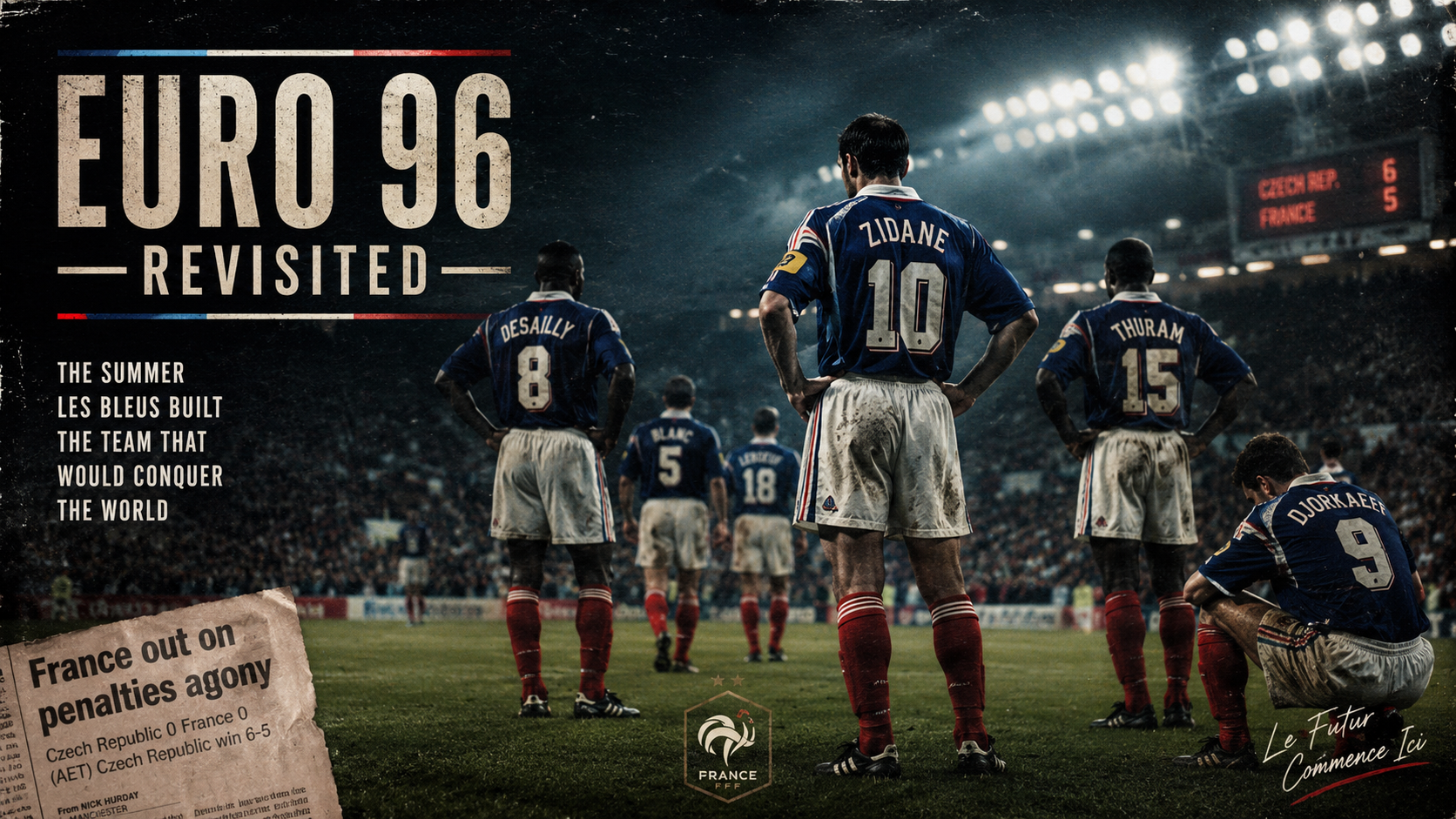
Reynald Pedros began the walk alone.
Pedros had been France’s sixth penalty taker in the Euro 96 semi-final. The match against the Czech Republic had lasted 120 minutes without a goal. It had been tense, cautious, airless. Then came penalties. Pedros struck low. Petr Kouba went the right way. The Czech Republic were through to the final.
France were out.
Officially, it was a semi-final defeat. In the eyes of much of the French media, it was something worse. Another major tournament had passed without a final appearance. Another generation appeared to have fallen short. Another summer had ended with questions about what French football was supposed to be.
The criticism arrived quickly.
France had reached the last four without losing a match in normal time, yet there was little warmth waiting at home. Their football was labelled cautious, defensive and negative. The team had scored only five goals in five matches. The manager, Aimé Jacquet, was accused of suffocating French football beneath layers of organisation and restraint.
To understand why that verdict was so harsh, it is necessary to remember what French football believed about itself.
This was a nation that had fallen in love with beauty. The France of Michel Platini had won the 1984 European Championship through imagination, rhythm and technical authority. Even in defeat, French teams were expected to play with a certain grace. Flair was not merely admired. It was part of the national footballing identity.
Jacquet’s team represented something different.
They took fewer risks. They defended relentlessly. They valued discipline over expression. To many observers, they looked less like heirs to Platini and more like a rejection of everything French football was supposed to be.
The mood inside Old Trafford reflected that uncertainty.
There were no obvious signs that a great team had been born. Zinedine Zidane, still two years away from global immortality, had endured a frustrating tournament. The attack lacked sparkle. The football rarely captured the imagination. France were leaving England without a trophy and without the affection of their own press.
Yet history often disguises its turning points.
Looking back now, the remarkable thing is not that France lost on penalties to the Czech Republic. The remarkable thing is how much of the future was already visible. The defensive foundations were in place. Didier Deschamps had become the embodiment of collective responsibility. Laurent Blanc and Marcel Desailly had formed one of the most reliable partnerships in international football. Lilian Thuram and Bixente Lizarazu were emerging as elite modern full-backs. Even Zidane, struggling through injury and exhaustion, was beginning to reveal what he might become.
Almost everything that would define France’s greatest era was already there.
The players could not see it.
The supporters could not see it.
Most journalists certainly could not see it.
On that June evening in Manchester, all anyone could see was another semi-final defeat.
What they were actually watching was the construction of a world champion.
Why Euro 96 Is Remembered Incorrectly
The images that survive in the public imagination are rarely the ones that tell the whole story.
When people think about French football in the 1990s, they do not usually picture Old Trafford. They do not picture Pedros walking back from the penalty spot. They do not picture Jacquet standing on the touchline, absorbing criticism from every direction.
They picture Paris.
They picture July 1998.
They picture Zidane rising above the Brazilian defence inside the Stade de France. They picture Deschamps lifting the World Cup. They picture a nation celebrating beneath blue, white and red flags. They picture the birth of a footballing superpower.
Success simplifies history.
Once France became world champions, everything that came before was recast as an inevitable march towards glory. The difficult decisions looked obvious. The controversies looked necessary. The tactical caution looked wise. Even the defeats acquired a sense of purpose.
Yet nothing felt inevitable in 1996.
France were not viewed as future world champions. Jacquet was not being praised for his vision. Zidane was not yet a global superstar. The squad itself remained divisive, caught between competing ideas about what the national team should represent and how it should play.
That is why Euro 96 occupies such a strange place in football history.
It is one of the most important tournaments France have ever played, yet it is rarely discussed in those terms.
It mattered because it revealed the shape of something that had not yet fully emerged.
For the first time since the collapse of the early 1990s, France looked like a serious tournament team. Not a collection of famous individuals. Not a group of gifted footballers sharing the same shirt. A team.
That distinction sounds simple. In reality, it was revolutionary.
French football had spent much of the previous decade wrestling with its own identity. The country’s greatest moments had been associated with artistry and invention. Technical excellence was expected. Elegance was celebrated. Individual brilliance was embraced.
Jacquet challenged those assumptions.
His France were harder to love. They defended first. They accepted ugly victories. They valued organisation over inspiration. To supporters raised on memories of Platini, Alain Giresse and Jean Tigana, this felt like a compromise. To Jacquet, it felt like reality.
The question that hovered over every decision he made was deceptively simple.
What exactly was France trying to become?
Were they trying to recreate a romantic past that no longer existed? Or were they trying to build a team capable of surviving the pressures of modern tournament football?
The answer was not obvious in 1996.
It only became obvious later.
The Ghost of Bulgaria
The ball should never have been crossed.
That remains the simplest way to explain one of the most consequential moments in French football history.
On 17 November 1993, France stood less than a minute away from qualification for the 1994 World Cup. A draw against Bulgaria at the Parc des Princes would be enough. The crowd knew it. The players knew it. The coaching staff knew it.
All France had to do was keep possession.
Instead, David Ginola received the ball high on the left side of the Bulgarian half and attempted something ambitious. Rather than running towards the corner flag or recycling possession, he delivered an early cross towards the penalty area. It sailed beyond everyone.
Within seconds, the match had turned.
Bulgaria broke forward at speed. The French defence retreated in panic. The ball found Emil Kostadinov, who drove into the right side of the penalty area before smashing a shot high beyond Bernard Lama and into the roof of the net.
France 1. Bulgaria 2.
The World Cup was gone.
The silence was more shocking than the goal itself. Thousands of supporters simply stood motionless. Players collapsed onto the pitch. Deschamps, usually so controlled, was overwhelmed. Others stared blankly into the distance, struggling to comprehend what had happened.
The defeat was not merely painful. It was humiliating.
France had now failed to qualify for consecutive World Cups. For a nation that regarded itself as one of Europe’s major football powers, the embarrassment was profound.
Yet the most damaging consequences arrived afterwards.
Rather than protecting his squad, manager Gérard Houllier publicly singled out Ginola. Houllier later insisted his words had been distorted, but the phrase that entered folklore was brutal. Ginola became, in the public telling, the man blamed for killing France’s World Cup dream.
Concentrating solely on Ginola, though, missed the larger truth.
France did not lose the World Cup in one minute.
France lost it over several years.
The squad contained exceptional footballers. Eric Cantona was emerging as one of the most influential players in England. Jean-Pierre Papin had won the Ballon d’Or only two years earlier. Ginola possessed extraordinary technical gifts. Laurent Blanc was one of Europe’s finest defenders. Deschamps was already demonstrating the leadership qualities that would later define his career.
Talent was not the problem.
The problem was that the pieces never quite fitted together.
France appeared trapped between competing ideas. Individual status often carried more weight than collective responsibility. The dressing room lacked cohesion. Tactical clarity was inconsistent. When pressure arrived, the group struggled to function as a single unit.
The Bulgaria defeat exposed that weakness with brutal clarity.
It forced uncomfortable questions.
Why did a team with so much talent repeatedly fail when it mattered most? Why did France appear emotionally fragile compared with rivals such as Germany and Italy? Why were gifted players unable to produce gifted teams?
In the months that followed, the focus remained on blame. Ginola was blamed. Houllier was blamed. Individual mistakes were dissected endlessly.
Few people recognised that the entire structure required rebuilding.
The memory of Kostadinov’s goal lingered over everything. It haunted selection meetings. It haunted qualification campaigns. It haunted major tournaments. Even three years later, when France faced Bulgaria again at Euro 96, the match carried an emotional weight that went far beyond the group table.
The ghost had travelled with them.
Aimé Jacquet Against France
If French football had conducted a nationwide search for the ideal figure to restore national pride in December 1993, Aimé Jacquet would have finished nowhere near the top of the list.
He lacked glamour. He lacked charisma. He lacked the aura that often follows successful international managers.
Most importantly, he lacked public support.
When the French Football Federation appointed him as Houllier’s successor, the decision was widely viewed as temporary. Jacquet was not presented as the architect of a new era. He was presented as a caretaker tasked with stabilising a damaged institution while French football searched for a more convincing answer.
Many supporters regarded him as part of the problem rather than part of the solution. He had served as Houllier’s assistant during the failed qualification campaign. Why, critics asked, should someone associated with failure be entrusted with rebuilding the national team?
French football in the 1990s was increasingly drawn towards celebrity. The sport was becoming louder, more commercial and more personality-driven. Jacquet seemed to belong to another age entirely.
He spoke carefully. He rarely sought attention. He appeared uncomfortable in the spotlight. Journalists searching for grand statements often left interviews frustrated.
There was nothing theatrical about him.
Yet beneath the reserved exterior sat a very different story.
Jacquet had been shaped by an environment far removed from the elite circles of Parisian football. Raised in Sail-sous-Couzan, a small commune in the Loire region, he grew up in a family where work was expected rather than celebrated. Before becoming a professional footballer, he worked in industry, spending time as a turner and miller in the steelworks of Saint-Chamond.
The experience left a lasting mark.
Football, in Jacquet’s eyes, was never primarily about self-expression. It was about responsibility.
Everyone had a task. Everyone contributed. Everyone sacrificed. The collective mattered more than the individual.
As a player with Saint-Étienne, he embodied those values. He was not remembered as an artist. He was remembered as a competitor. A midfielder willing to tackle, organise and cover for others.
The same philosophy followed him into management. At Bordeaux during the 1980s, Jacquet built one of the strongest teams in France, winning three league titles and regularly competing deep into European competition. Yet admiration was often reluctant. His teams were respected more than they were loved.
That distinction would define his national team career.
The France he inherited after Bulgaria was emotionally damaged and structurally confused. For years, the national side had attempted to build around individual brilliance. The assumption had been simple: if enough talented players occupied the same pitch, success would eventually follow.
Jacquet disagreed.
The evidence, after all, was sitting directly in front of him.
France had just missed a second World Cup in four years despite possessing players coveted across Europe.
Something deeper was wrong.
Jacquet believed the national team required a complete change in emphasis. Less celebrity. Less ego. Less obsession with individual talent. More discipline. More organisation. More accountability.
It was not an especially fashionable vision. Nor was it particularly French.
His first match in charge brought a notable 1-0 win against Italy in Naples in February 1994, a result that helped convince the federation to make his appointment permanent. Still, the doubts remained.
Every squad announcement was scrutinised. Every tactical decision questioned. Every cautious performance treated as evidence that he lacked ambition.
Jacquet listened. He remembered. And he carried on.
Because while much of French football remained focused on appearance, Jacquet was becoming increasingly focused on construction.
The team he wanted did not yet exist.
To build it, he would have to make a series of decisions that placed him in direct conflict with some of the biggest names in French football.
Why Cantona Had To Go
The easiest version of this story is also the least interesting.
It says Jacquet courageously dropped Cantona, Ginola and Papin, ignored public criticism, and was ultimately proven right when France won the World Cup.
History is rarely that tidy.
The truth is far more uncomfortable.
Even today, it remains impossible to answer one question with complete certainty.
Could France have won with Eric Cantona?
By the mid-1990s, Cantona was not merely France’s best-known footballer. He was one of the most influential players in Europe. At Manchester United, he had transformed the culture of an entire club. Teammates spoke about him with awe. Opponents feared him. Supporters adored him.
There was no obvious footballing reason to exclude him.
Cantona could create goals. He could score goals. He could dominate matches through personality alone. At a time when France often struggled for attacking inspiration, those qualities were valuable.
Yet Jacquet increasingly saw a different problem.
The national team had become dependent on star power. Too many decisions revolved around reputations. Too much attention centred on individuals. Too little focus was placed on the collective.
The lesson of Bulgaria lingered in the background.
France had possessed famous players then as well. It had not saved them.
Initially, Jacquet had no intention of abandoning Cantona. Quite the opposite. He made him captain and viewed him as a central figure in the rebuilding process.
Then football intervened.
On 25 January 1995, during a Premier League match against Crystal Palace, Cantona launched his infamous kung-fu kick at a supporter inside Selhurst Park.
The image travelled around the world within hours. The consequences were severe. Suspension. Public outrage. Months away from competitive football.
For Cantona, it was a crisis.
For Jacquet, it became a crossroads.
Without their captain, France were forced to evolve.
Instead of collapsing, the team began to grow. New partnerships emerged. New leaders developed. The collective became stronger. Players who had previously occupied supporting roles assumed greater responsibility. Deschamps became increasingly influential. Blanc established himself as a defensive leader. Younger players entered the squad without immediately deferring to a dominant superstar.
Most importantly, France started winning.
By the time Cantona returned to football, Jacquet faced a dilemma few managers would willingly choose.
The country’s most famous player was available again.
But the team no longer appeared to need him.
Public pressure was immense. Many journalists assumed Cantona’s return was inevitable. How could France seriously contemplate a major tournament without one of Europe’s outstanding footballers?
Jacquet disagreed.
Reintroducing Cantona would not simply mean adding a brilliant footballer. It would mean altering the balance of the entire project.
The same logic applied elsewhere.
Ginola remained one of the most gifted attacking players France had produced in a generation, but he represented a previous era and carried the baggage of 1993. Papin, Ballon d’Or winner and national icon, was struggling physically and increasingly belonged to a different football age.
In May 1996, The Independent reported what had become clear: Cantona, Ginola and Papin had been left out of France’s Euro 96 squad.
The reaction was fierce.
Critics accused Jacquet of cowardice. Others accused him of stubbornness. Some argued he was weakening France for ideological reasons.
Years later, it became tempting to portray the choice as obvious.
It was not.
There is a credible argument that Cantona’s genius might have elevated France. There is a credible argument that his creativity could have solved many of the attacking limitations that remained evident at Euro 96. There is a credible argument that one of the finest players of his generation should never have been left at home.
Jacquet understood all of those arguments.
He simply believed something else mattered more.
The manager was no longer building around talent. He was building around trust.
Every player needed to accept the same responsibilities. Every player needed to defend. Every player needed to sacrifice. Every player needed to belong to the collective before belonging to himself.
Cantona embodied exceptionalism. He was a player around whom teams naturally revolved.
Jacquet no longer wanted a team that revolved around anyone.
That decision altered the course of French football.
The superstar era ended.
The collective era began.
The Water Carrier
If Cantona represented everything French football had traditionally celebrated, Deschamps represented almost everything it had traditionally overlooked.
He was not especially elegant. He was not especially creative. He rarely produced moments that would be replayed for decades. Nobody bought a ticket to watch Didier Deschamps.
Yet Jacquet increasingly viewed him as the most important player in the national team.
French football had spent decades elevating artists. Raymond Kopa. Platini. Giresse. Players capable of transforming matches through imagination and technique.
Deschamps was something else.
He was an organiser. A problem solver. A footballer who understood space before style. His greatest strength was not what he did with the ball. It was what he prevented from happening without it.
The famous insult came from Cantona.
“Deschamps gets by because he always gives 100 per cent,” he said, “but he will never be anything more than a water carrier.”
The remark was intended as criticism. Instead, it became an accidental explanation of why Jacquet trusted him so completely.
Deschamps’ response was more revealing still.
“How many players can you find on street corners who have won two European Cups?” he asked. “Besides, every team needs its water carriers.”
It sounded like a defence of his own game. In reality, it was a defence of Jacquet’s entire project.
Every great tournament team requires players willing to perform invisible work. The glamorous moments belong to others. The foundations belong to them.
Deschamps understood positioning. He understood tempo. He understood responsibility. Most importantly, he understood that international football was different from club football.
Major tournaments are rarely won by the most entertaining team. They are often won by the team that makes the fewest mistakes.
By Euro 96, Deschamps had already developed into one of Europe’s most respected midfield leaders. His move to Juventus had exposed him to a culture obsessed with competitive detail. Winning was not treated as a by-product of good football. Winning was the purpose of football.
That mentality aligned perfectly with Jacquet’s vision.
Around Deschamps, a new spine emerged.
Blanc brought intelligence and calm. Desailly brought power and authority. Thuram offered athleticism and adaptability. Lizarazu added aggression and balance. Lama provided security behind them.
Individually, they were excellent players.
Collectively, they became something more significant.
They gave France an identity.
For years, the national side had searched for one. The teams that collapsed in previous qualifying campaigns possessed talent but lacked certainty. Under pressure, they often appeared vulnerable. Leads evaporated. Confidence disappeared. Panic spread.
Jacquet wanted the opposite.
He wanted a team that remained emotionally stable regardless of circumstance. A team that could absorb pressure. A team that could survive.
The defensive structure reflected those priorities.
Space between the lines disappeared. Transitions were managed carefully. Full-backs attacked selectively rather than recklessly. Midfielders protected central areas with relentless discipline.
Every player understood his role.
The objective was not to dominate possession.
The objective was to dominate risk.
England: The Laboratory
France arrived in England carrying more baggage than expectation.
The bookmakers did not regard them as clear favourites. The public remained unconvinced. Much of the domestic media viewed the tournament as an opportunity to expose the limitations of Jacquet’s project rather than confirm its success.
Three years after Bulgaria, trust had not yet been restored.
The opening match against Romania at St James’ Park offered the first glimpse of what Jacquet’s team had become.
It was not beautiful.
That was precisely the point.
St James’ Park was awash with colour and anticipation. French supporters had travelled north carrying equal measures of hope and caution. Three years after Bulgaria, nobody was entirely sure how this team would react when tournament pressure arrived.
Romania had been one of the sides that finished ahead of France during qualification. Gheorghe Hagi remained one of the most gifted footballers in Europe. Florin Răducioiu provided a constant threat.
France never allowed them to settle.
The game was tight, physical and controlled. Rather than chasing possession for its own sake, France focused on restricting space and waiting for opportunities to emerge. Midway through the first half, one finally did. Christophe Dugarry scored the only goal.
A 1-0 victory.
Three points.
Few headlines.
Exactly the kind of result Jacquet valued.
The second match, against Spain at Elland Road, presented a sterner challenge. Spanish football was beginning to emerge from its own period of reinvention. Technically gifted and increasingly confident, they represented a different type of examination.
France responded well. Early in the second half, Youri Djorkaeff opened the scoring. The advantage felt deserved. For long periods, France appeared in control.
Then came a familiar reminder of how fragile tournament football can be.
With five minutes remaining, José Luis Caminero equalised.
The match ended 1-1.
The reaction afterwards revealed the growing divide between perception and reality. Some observers focused on the missed opportunity. Jacquet saw evidence that his structure remained intact.
Then came Bulgaria.
Officially, it was merely the final group game.
Emotionally, it was something else.
Every French player understood the symbolism. Bulgaria were no longer just opponents. They were a memory.
The match itself was surprisingly comfortable. Blanc scored. Luboslav Penev’s own goal made it 2-0. Hristo Stoichkov pulled one back, but Patrice Loko scored late to complete a 3-1 victory.
France advanced to the quarter-finals.
More importantly, they had confronted the ghost that had haunted the entire project.
And survived.
The knockout stage brought the Netherlands.
For many neutrals, this represented a clash between two contrasting footballing philosophies. The Dutch possessed outstanding attacking talent. Dennis Bergkamp, Clarence Seedorf, Edgar Davids and Patrick Kluivert represented one of the most gifted collections of players in the tournament.
France reduced them to frustration.
What followed remains one of the defining performances of Jacquet’s reign. Not because it was spectacular. Because it was disciplined.
The Dutch struggled to create meaningful chances. Space disappeared whenever they approached the final third. The French back line remained composed. Deschamps controlled the rhythm. Every movement seemed coordinated.
The match finished 0-0.
Some critics saw confirmation of their worst fears about Jacquet’s football. Others saw something different.
They saw a team capable of surviving elite opposition.
When the penalty shootout arrived, France held their nerve. Seedorf missed. France went through.
By now, something unusual was happening.
France were not dazzling anyone. Yet they were becoming increasingly difficult to eliminate.
The defensive structure remained intact. The players trusted one another. The collective seemed stronger with every passing match.
And still, doubts persisted.
The attack lacked fluency. Zidane had yet to dominate a game. The football remained divisive.
Those questions followed France to Old Trafford.
By the time penalties arrived against the Czech Republic, exhaustion had settled over the stadium. Legs were heavy. Minds were heavier. France had spent three years learning how not to lose.
They were still learning how to win.
Zidane Before Zidane
One of the strange consequences of greatness is that it rewrites memory.
When modern audiences think about France in the late 1990s, they instinctively see everything through the lens of Zidane. The image is fixed. The shaved head. The elegance. The impossible control. The sense that every important match somehow bent towards him.
It is easy to forget how uncertain the picture looked in 1996.
The player who arrived in England was not yet the Zidane who would dominate a World Cup final. He was not yet the most influential footballer in the world. He was not yet the defining figure of a generation.
He was a gifted 24-year-old midfielder still searching for his final form.
The signs had been there.
Two years earlier, during his international debut against the Czech Republic, Zidane had announced himself spectacularly. Introduced as a substitute with France trailing 2-0, he scored twice to rescue a draw and immediately attracted comparisons with Platini.
French football, desperate for a new hero, began projecting extraordinary expectations onto his shoulders.
Jacquet refused to join the hysteria.
While journalists searched for the next saviour, the manager remained cautious. Zidane was selected, withdrawn, protected and occasionally criticised. Jacquet understood something many others did not.
Talent develops unevenly. The international game can overwhelm even exceptional footballers. The future cannot be rushed.
By the time Euro 96 arrived, Zidane was physically and mentally exhausted. His season with Bordeaux had stretched deep into European competition, culminating in the UEFA Cup final defeat against Bayern Munich. He had played an enormous number of matches. The demands placed upon him were increasing every month.
He was also compromised physically. Shortly before the tournament, Zidane was involved in a car accident. While he escaped major injury, the impact left him with a painful pelvic problem that affected his movement.
Throughout Euro 96, Zidane struggled.
The player who could slow matches to his own tempo often looked a fraction behind events. Opponents closed him down aggressively. Physical battles became uncomfortable. His influence drifted in and out of games.
Euro 96 may have been the only major tournament of Zidane’s career in which he looked merely gifted rather than inevitable. The future Ballon d’Or winner was visible in fragments, a turn here, a pass there, a moment of balance that seemed to ignore physics. But the force of nature that would dominate world football had not yet arrived.
That realisation would alter the course of his career.
In the summer of 1996, shortly after France’s elimination, Zidane joined Juventus.
The move is often remembered as a natural step upwards. In reality, it became a transformation.
Under Marcello Lippi, Zidane entered an environment obsessed with competitive excellence. Every detail mattered. Every weakness was targeted. Every limitation was addressed.
Most famously, he came under the supervision of fitness coach Giampiero Ventrone. Training sessions were notorious for their intensity. FourFourTwo later described Ventrone’s “bell of shame”, rung by players unable to finish the most brutal runs.
Zidane endured it all.
And changed.
The elegant but fragile playmaker gradually became something far more complete. His body grew stronger. His stamina improved. His ability to absorb contact increased dramatically. He learned how to dominate games physically as well as technically.
England did not reveal the finished Zidane.
It revealed the gap between what he was and what he could become.
In many ways, Euro 96 had provided the diagnosis.
Juventus supplied the cure.
France Beyond Football
The France that travelled to England in the summer of 1996 was not simply carrying footballing baggage.
It was carrying national baggage too.
The middle years of the decade were marked by uncertainty. Politicians spoke openly about social division. Economic anxiety lingered. Questions about immigration, identity and belonging increasingly dominated public debate.
Football could not escape those conversations.
In truth, it had become one of the places where they were most visible.
For decades, French football had benefited from demographic changes taking place across the country. The national team’s talent pool increasingly stretched beyond traditional footballing centres and into the suburbs surrounding major cities. Players emerged from communities shaped by migration from North Africa, West Africa, the Caribbean and elsewhere.
The national team began to reflect a broader version of France than many people had grown accustomed to seeing represented in public life.
Not everybody welcomed that change.
Among the loudest critics was Jean-Marie Le Pen, leader of the far-right Front National. Throughout the mid-1990s, Le Pen repeatedly questioned whether the national team genuinely represented France. He complained about the number of Black players and suggested that some members of the squad lacked sufficient attachment to the country they represented.
The comments generated controversy.
They also revealed something important.
The French national team was becoming a symbol.
Lilian Thuram emerged as one of the most thoughtful voices during this period. Born in Guadeloupe before moving to mainland France as a child, he spoke openly about identity, citizenship and belonging.
When Le Pen criticised the team, Thuram’s response was both simple and devastating.
“Clearly, he is unaware that there are Frenchmen who are black, Frenchmen who are white, Frenchmen who are brown.”
It was one of the early moments in which a future World Cup winner emerged not merely as a footballer, but as a public intellectual.
Those exchanges would later acquire enormous significance after the 1998 World Cup, when politicians and journalists embraced the phrase Black, Blanc, Beur as shorthand for a supposedly new, multicultural France.
Yet in 1996, none of that certainty existed.
The story was still being written.
Indeed, one of the most interesting aspects of the period is how incomplete the later mythology now appears. The popular narrative often portrays the French national team as a triumphant symbol of social integration. The reality was far more complicated.
Many of the economic and social problems confronting France remained unresolved. The suburbs that produced so much footballing talent still faced high unemployment, social exclusion and political neglect. Football could provide moments of unity, but it could not solve structural problems.
What the team offered was something more modest.
An example.
A group of men from different backgrounds working towards a shared objective.
In many ways, that idea mirrored what Jacquet was trying to achieve on the pitch.
Individual stories mattered, but they had to serve something larger. Talent mattered, but it had to fit within a structure. Personal ambition mattered, but never more than the team.
The parallels were impossible to ignore.
As France searched for a clearer understanding of itself, its football team was undergoing a similar process.
Jacquet Versus L’Équipe
Success does not always create belief.
Sometimes it creates suspicion.
By the time France returned from England, Jacquet had delivered much of what the federation had hoped for when it appointed him after Bulgaria. The national team had stabilised. Qualification had been secured. A European Championship semi-final had been reached. France had gone through the tournament without losing a match in normal play.
Objectively, the trajectory was positive.
Subjectively, the mood was anything but.
The problem was that many people hated the way France were getting there.
No criticism was more influential than that coming from L’Équipe.
For generations, the newspaper had occupied a unique position within French sport. Its opinions carried weight. Its praise could elevate careers. Its criticism could shape national conversations. Throughout Jacquet’s reign, L’Équipe increasingly positioned itself as the voice of opposition.
The football was the obvious target.
France were organised. France were disciplined. France were difficult to beat.
France were also, in the eyes of many critics, painfully conservative.
The language became increasingly hostile. Jacquet’s football was described as outdated, defensive and negative. At times, the word “paleolithic” was used to capture what critics saw as his refusal to embrace adventure.
The manager found himself trapped inside an impossible argument.
When France attacked and failed, critics questioned his judgement. When France defended and succeeded, critics questioned his ambition.
The deeper the team progressed into tournaments, the more intense the scrutiny became.
What made the conflict fascinating was that both sides were, in their own way, arguing about the future of French football.
The journalists feared France was abandoning its identity.
Jacquet feared France was clinging to an identity that no longer worked.
The battle intensified after Euro 96.
Every underwhelming performance became fresh ammunition. Every goalless draw reignited debate. Every experimental selection generated new headlines.
The pressure reached its peak in 1997, during the Tournoi de France. The tournament had been designed as a celebration, a dress rehearsal for the upcoming World Cup on home soil. Brazil arrived. Italy arrived. England arrived. France had an opportunity to showcase itself before the world.
Instead, the performances were solid rather than spectacular. Sections of the crowd booed. Calls for Jacquet’s resignation grew louder. Commentators questioned whether France could realistically challenge for a World Cup under such cautious leadership.
Less resilient personalities might have broken.
Less convinced managers might have changed course.
Jacquet did neither.
The more intense the pressure became, the more determined he seemed to protect the environment he had created.
Players noticed.
The criticism coming from outside gradually strengthened relationships inside. Journalists who intended to weaken the team often ended up reinforcing its unity.
The dressing room became tighter. Trust deepened. The collective identity Jacquet had spent years constructing grew stronger.
The irony was striking.
The media believed it was exposing weakness.
In reality, it was helping create resilience.
The Defeat Reconsidered
When France walked off the pitch at Old Trafford on 26 June 1996, the verdict seemed obvious.
They had failed.
That was certainly how many journalists saw it. France had not reached the final. They had scored only five goals across the tournament. They had produced few moments of genuine attacking brilliance. The caution that had defined Jacquet’s reign remained visible from first match to last.
On the surface, the evidence appeared overwhelming.
France were a decent team.
A difficult team.
Perhaps even a good team.
But not a great one.
Not yet.
The problem with that judgement is that it focused almost entirely on what France lacked while overlooking what France had become.
For three years, Jacquet had been trying to solve a specific problem.
Not how to make France more entertaining. Not how to make France more popular. Not even how to make France more talented.
France already possessed talent.
His challenge was something else entirely.
How do you build a team capable of surviving the emotional violence of tournament football?
The answer was beginning to emerge.
Look again at the evidence from England.
France did not lose a single match in normal time. France conceded only two goals in five games. France reached the semi-finals despite receiving little from the player who would later become the best footballer in the world. France eliminated the Netherlands. France confronted the trauma of Bulgaria.
France survived pressure.
France survived expectation.
France survived knockout football.
These were not minor achievements.
They represented skills that previous French teams had repeatedly lacked.
The gifted generation of the early 1990s might have contained more individual brilliance, but it had never demonstrated this level of emotional control. When adversity arrived, those teams often fractured. Momentum shifted. Panic spread.
Jacquet’s France responded differently.
They remained organised. They remained calm. They remained connected.
The France of 1993 would probably have lost to the Netherlands.
The France of 1996 eliminated them.
The France of 1998 would conquer the world.
The same story was unfolding.
Only the ending had changed.
The irony is that many of the qualities later celebrated during the 1998 World Cup were already visible in England.
The defensive authority. The tactical discipline. The leadership. The collective spirit. The trust.
It was all there.
What was missing was refinement.
Zidane had not yet completed his transformation. The attack still lacked consistency. The squad remained vulnerable to moments when creativity was required.
But foundations matter.
Every great team is built upon them.
The foundations of France’s future success were laid not in moments of triumph but in moments of frustration.
The quarter-final against the Netherlands. The endless tension against the Czech Republic. The defensive concentration required to survive ninety minutes, then one hundred and twenty, then penalties.
Those experiences mattered.
Not because they produced glory.
Because they produced belief.
The players began to understand something that had previously eluded French football.
They could compete with anyone.
Not occasionally. Not when conditions were perfect. Consistently.
That psychological shift may have been the most important development of all.
France Before France
The temptation, when writing about this team, is to skip directly to July 1998.
The image is irresistible.
Zidane rising above the Brazilian defence. The Stade de France shaking beneath the weight of celebration. Deschamps lifting the World Cup. Jacquet finally vindicated.
The photographs have become part of football history.
The problem is that those images can obscure the story that made them possible.
World Cups are often remembered as moments of arrival.
In reality, they are usually moments of confirmation.
The work has already been done. The habits have already been formed. The lessons have already been learned.
By the time France hosted the world in 1998, most of the difficult questions had already been answered.
The team knew how it wanted to play. The players understood their responsibilities. The dressing room hierarchy was established. The culture was secure.
England had not provided silverware.
It had provided certainty.
That is why Euro 96 deserves a far more significant place in the history of French football than it is usually given.
The tournament transformed the national team’s understanding of itself.
For decades, France had wrestled with a fundamental tension.
Should French football be judged by how beautifully it played?
Or by how effectively it won?
The country’s greatest footballing memories often leaned towards beauty. Jacquet never rejected that ambition. He simply believed it was incomplete.
Beauty without resilience had already failed.
Talent without structure had already failed.
The evidence sat in the ruins of Bulgaria.
What emerged during Euro 96 was not an abandonment of French football’s identity but a recalibration of it.
France did not stop valuing creativity.
They stopped relying on it.
That philosophy would shape the next quarter-century of French football.
The most obvious example arrived through Deschamps.
As a player, he became the embodiment of Jacquet’s values. Organisation. Discipline. Emotional control. Collective responsibility.
As a manager, he would later apply many of the same principles.
When Deschamps lifted the World Cup as France manager in Moscow in 2018, it felt less like the beginning of a new era than the continuation of an old one. The principles remained familiar. Collective responsibility. Defensive discipline. Emotional control. The fingerprints of Aimé Jacquet were still visible more than two decades later.
Even Zidane’s story follows the same pattern.
The myth remembers the genius. The reality required the struggle.
The physically compromised midfielder of Euro 96 became the dominant force of 1998 because he confronted his limitations and transformed himself. The tournament exposed weaknesses that would later become strengths.
Failure became education.
Defeat became preparation.
Perhaps that is why the semi-final against the Czech Republic deserves to be remembered differently.
Not because France were unlucky. Not because they deserved to win. Not because the penalties happened to fall the wrong way.
The match matters because it revealed what France had become.
A team capable of surviving pressure.
A team capable of controlling elite opponents.
A team capable of functioning as a genuine collective.
A team capable, ultimately, of becoming world champions.
None of that felt obvious at the time.
The newspapers focused on what was missing. The supporters focused on what had been lost. The players focused on the disappointment of elimination.
Only later did the wider picture emerge.
Only later did it become clear that England had served as a workshop rather than a destination.
Closing Reflection
History tends to remember winners.
It remembers the trophies, the celebrations and the photographs that follow.
French football is no different.
The story is usually told through the image of Zidane beneath the Paris sky in July 1998. It is told through the roar of the Stade de France, through two headed goals against Brazil, through a nation briefly convinced that football could explain itself.
But history is often untidy.
The most important moments rarely announce themselves as they happen.
Nobody left Old Trafford in June 1996 believing they had witnessed the making of a world champion. The players felt disappointment. The manager faced criticism. The newspapers found fault. The public remained uncertain.
All they could see was a semi-final defeat.
What they could not yet see was everything that had been built.
The discipline.
The resilience.
The leadership.
The trust.
The understanding that talent alone was never enough.
France left Old Trafford carrying disappointment.
It also carried something far more valuable.
An identity.
A structure.
A belief.
Two years later, the world would see the finished product.
The blueprint had already been drawn.
France arrived at Euro 96 searching for itself.
It left knowing exactly what it wanted to be.
