


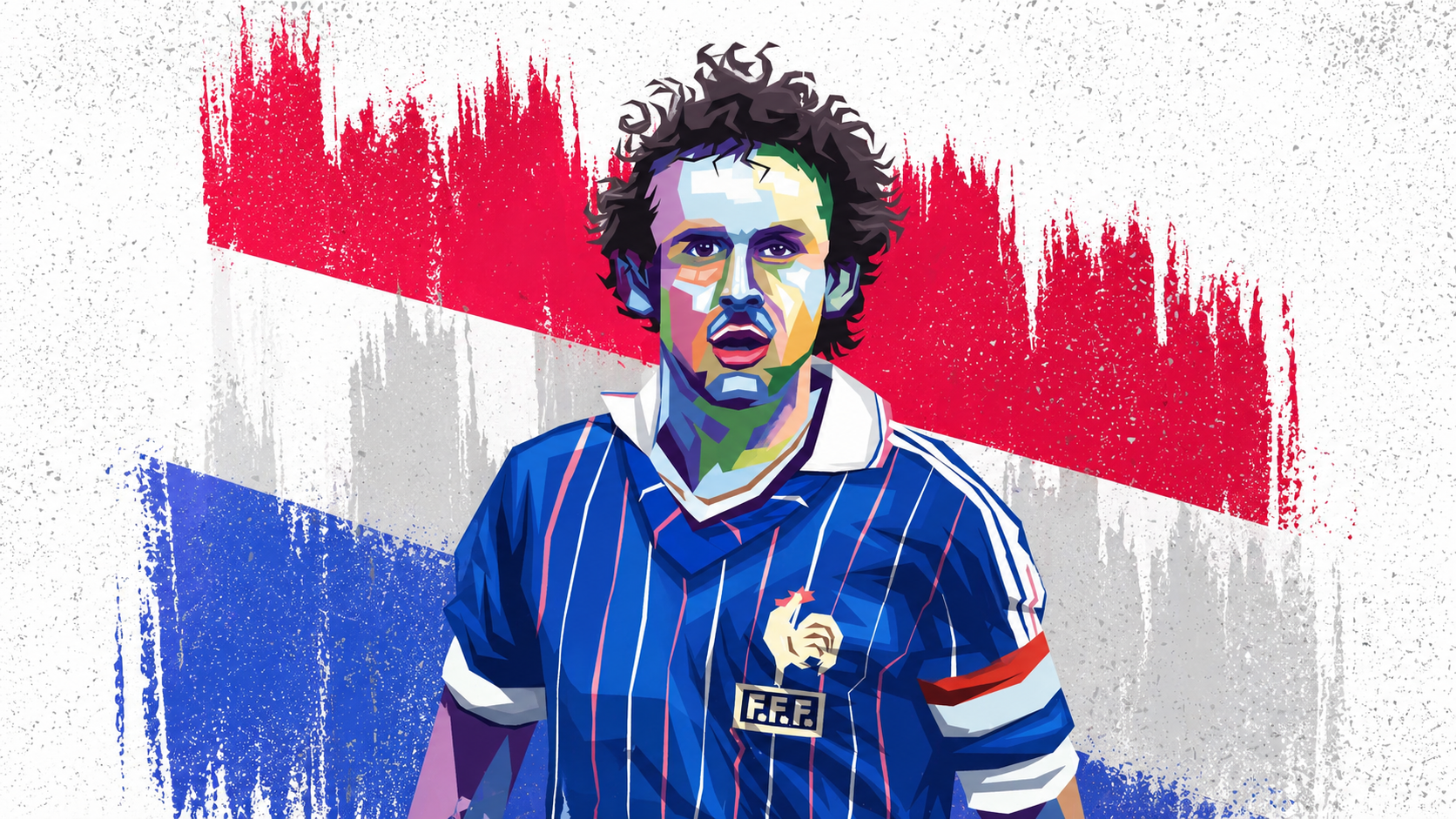
Turin, May 1985.
Michel Platini places the ball down and steps back. The stadium is full, but the atmosphere is wrong. It is loud without being alive, tense without being focused. Something has already happened here, something that has distorted the meaning of everything that follows.
He runs up and scores.
A clean penalty, struck low and certain, enough to win the European Cup for Juventus against Liverpool. He turns and celebrates, arms raised, face open with relief and pride, as any player would in that moment.
It should have been the defining image of his career.
Instead, it became something else.
Thirty-nine people had died before the match began in what is now known as the Heysel Stadium disaster. The goal stands, the medal counts, but the image has never sat easily. It remains one of the most uncomfortable intersections between football and reality.
And it tells you something important about Michel Platini.
His story is rarely as simple as it first appears.
The problem with how Platini is remembered
Platini is often described in the language of admiration. Elegant. Intelligent. Refined.
All of that is true. None of it is enough.
Because what made Platini different was not just how he played, but what he solved. He operated as a midfielder in a period that did not favour them, particularly not those who relied on thought rather than force. The 1980s were defined by defensive structure, by physical contests, by systems designed to compress space and suffocate time.
Platini did not resist that environment. He outthought it.
He scored goals at a rate that still looks unusual now, let alone then. He dictated matches without needing to dominate the ball in the modern sense. He did not overwhelm games physically. He anticipated them.
At Juventus and with France, teams were not simply built to include him. They were shaped around his understanding of the game.
That is a different level of influence.
Jœuf and the making of a different kind of player
He did not look like a future great.
Born in Jœuf, in the industrial northeast of France, Platini grew up in a football environment that valued understanding over athleticism. His father, Aldo, had played professionally and later coached. The game was discussed as much as it was played.
Platini absorbed it.
He was not quick in the conventional sense. Not especially strong. Not dominant in the air. Early in his career, there were even concerns about his physical condition.
But those limitations shaped him.
Where others relied on movement, Platini relied on timing. Where others reacted, he anticipated. He learned to arrive in spaces just before they mattered, rather than fighting for them once they were gone.
By the time he broke through at Nancy, he was already playing in moments that had not quite happened yet.
When inevitability replaced potential
There is a point in every great player’s career where promise becomes certainty.
For Platini, it arrived not through volume, but through control.
The 1978 Coupe de France final is often remembered for the free-kick. But the detail matters.
The ball is placed slightly left of centre. The wall is set. The goalkeeper takes half a step to his right, anticipating the obvious angle. Platini pauses, looks once, and strikes with the inside of his foot, not for power but for shape. The ball rises late, bending just enough to clear the wall before dropping sharply.
The goalkeeper moves, but too late.
It is not a spectacular free-kick in the modern sense. It is a calculated one.
That was the difference.
At Saint-Étienne, that same control began to define entire matches. The 1980–81 title was not built on dominance in the way great teams are often remembered. It was built on moments managed correctly, on games slowed down and then decided with precision.
Platini did not need to impose himself constantly.
He needed to be right when it mattered.
Italy: where thinking had to be faster than defending
Serie A in the early 1980s did not reward players like Platini.
It was a league built on defensive structure, on man-marking systems that followed players into uncomfortable areas, on limiting the influence of individuals. Space was reduced deliberately. Time on the ball was contested aggressively.
For a player who relied on both, it should have been suffocating.
Instead, Juventus made a choice.
Under Giovanni Trapattoni, the system adapted around Platini’s strengths rather than forcing him into its limitations. The midfield balance was deliberate. Players like Marco Tardelli absorbed the physical burden, covering ground, pressing, recovering possession. Zbigniew Boniek provided movement ahead of Platini, stretching defences, creating uncertainty.
This mattered.
Because Platini did not need space to begin with. He needed confusion.
When Juventus regained the ball, the first pass often moved quickly into central areas, not to hold possession but to accelerate decision-making. Platini would receive the ball facing forward more often than not, already scanning, already assessing where the move would end.
Defenders faced a problem.
Step out to close him, and space opened behind. Hold position, and he had time to pick the next action. Track runners, and he arrived late, unmarked.
There was no correct answer.
That is why his role looked unusual.
He was not building attacks. He was finishing them.
The 20 goals in the 1983–84 season make sense in that context. They are not the result of a midfielder overreaching his role. They are the natural outcome of a system designed to place him at the final point of decision.
Platini did not drift into the game.
He waited for it to reach him.
The goal that explains everything
There is a type of goal that appears again and again across his career.
The move develops wide. A cross is delivered and partially cleared. Defenders step out, reorganising, pushing the line forward. For a moment, the edge of the box is empty.
Platini is not there.
Then he is.
Arriving late, body already balanced, he strikes first time. The contact is clean, the decision immediate. No extra touch, no adjustment, no hesitation. The ball travels low and precise, past a goalkeeper who reacts a fraction too late.
It feels simple.
It is not.
It requires an understanding of timing that cannot be coached easily. Knowing not just where the space is, but when it will exist.
Platini did not chase those moments.
He trusted them.
Euro 1984: authority, not inspiration
Nine goals in five matches is the statistic. UEFA’s archive of Platini’s nine goals at Euro 1984 shows the deeper truth: this was not a hot streak. It was control expressed through finishing.
France’s structure in that tournament was clear. The midfield operated with balance, allowing Platini to occupy advanced central spaces without defensive overload. Alain Giresse and Jean Tigana provided movement and energy, ensuring that Platini did not have to compensate physically.
Again, the team adjusted.
The match against Belgium in the group stage is often remembered for the scoreline. Less remembered is how it unfolded. France did not overwhelm Belgium early. They managed the game, moved the ball patiently, and waited for openings to appear.
Platini scored a hat-trick, but each goal followed the same logic.
Position. Timing. Decision.
Against Yugoslavia, it was similar. The game opened, and Platini occupied the spaces that mattered most. Not constantly, not aggressively, but decisively.
By the time France reached the final against Spain, the pattern was set. Platini scored the opener in the final, taking his tournament tally to nine.
The free-kick that broke the deadlock is often discussed as a mistake by Luis Arconada. It is that. But it is also a reminder of Platini’s consistency from set-pieces. The strike is low, controlled, placed to test rather than to impress.
Again, it is calculated.
France won 2–0. Platini finished the tournament with nine goals.
More importantly, he finished it having dictated the rhythm of every match he played.
The missing piece: World Cups and what never quite happened
For all his control, all his success, there is a gap in Platini’s career.
The World Cup.
In 1982, France faced West Germany in one of the most chaotic semi-finals in football history. Leading 3–1 in extra time, they lost control of the match, eventually falling on penalties. Platini scored his kick, but the result lingered.
It was not a failure of performance.
It was a failure of completion.
In 1986, in Mexico, there was another opportunity.
The quarter-final against Brazil remains one of the defining matches of that tournament. Platini scored, arriving again at the right moment, finishing calmly. France advanced on penalties.
But the semi-final against West Germany brought the same ending as four years earlier.
Defeat.
By then, Platini was not fully fit. His influence remained, but it was reduced. The margins had shifted slightly, and at that level, that was enough.
He left international football without a World Cup.
It matters.
Not because it defines him, but because it complicates him.
The Ballon d’Or years
There is no need to inflate Platini’s peak. The record does that for him.
Three consecutive Ballon d’Or wins, in 1983, 1984 and 1985, still place him among the most dominant individual footballers of the modern European game.
What matters is the type of dominance.
He was not winning those awards because he was the most spectacular player in every match. He was winning them because he kept being decisive in the matches that shaped seasons.
Serie A title races. European finals. International tournaments.
Platini’s genius had a habit of appearing where the history was being written.
The tension: a player built for a different game
Platini’s brilliance came with a condition.
He needed a team that understood what he was not.
He would not press relentlessly. He would not cover wide spaces defensively. He would not function in systems that demanded constant physical output from every player.
In the 1980s, that could be managed.
In the modern game, it would be questioned immediately.
The honest answer is that Platini would not fit easily into today’s football.
He would either require a system built around him, as at Juventus, or he would be reduced by demands that misunderstood his strengths. There is no middle ground.
That is not a criticism.
It is a reflection of how much the game has changed.
Heysel, revisited
The goal remains.
So does the discomfort.
Platini celebrating in that moment, separated from the full reality of what had taken place, is one of those images that cannot be resolved neatly. Context explains it. It does not erase it.
And it should not.
Because part of understanding players fully is accepting that their careers do not exist in isolation from the world around them. Juventus won the 1985 European Cup, but as Britannica’s Juventus history notes, that victory was overshadowed by tragedy.
Platini’s playing legacy is immense. But it cannot be polished until it becomes uncomplicated.
The best football writing should not try to rescue its subjects from complexity.
It should make the complexity clearer.
What he changed
Before Platini, goals from midfield were a bonus.
After him, they became an expectation.
He did not redefine the role through physicality or volume, but through clarity. He showed that a midfielder could control a game and finish it, without needing to dominate every phase of play.
Players who followed inherited elements of that role, but the conditions shifted. The space reduced. The time disappeared. The demands increased.
What Platini represented became harder to sustain.
That is why his legacy feels different from most great players. It is not only about what he did. It is about what football has since lost.
What remains
There are players who dominate through force. Players who overwhelm through speed. Players who control through repetition.
Platini did something else.
He reduced football to its decisive moments and placed himself there first.
Not by running ahead of the game.
By understanding it before it unfolded.
And for a brief period in the 1980s, that made him something very few players have ever been.
Untouchable.
