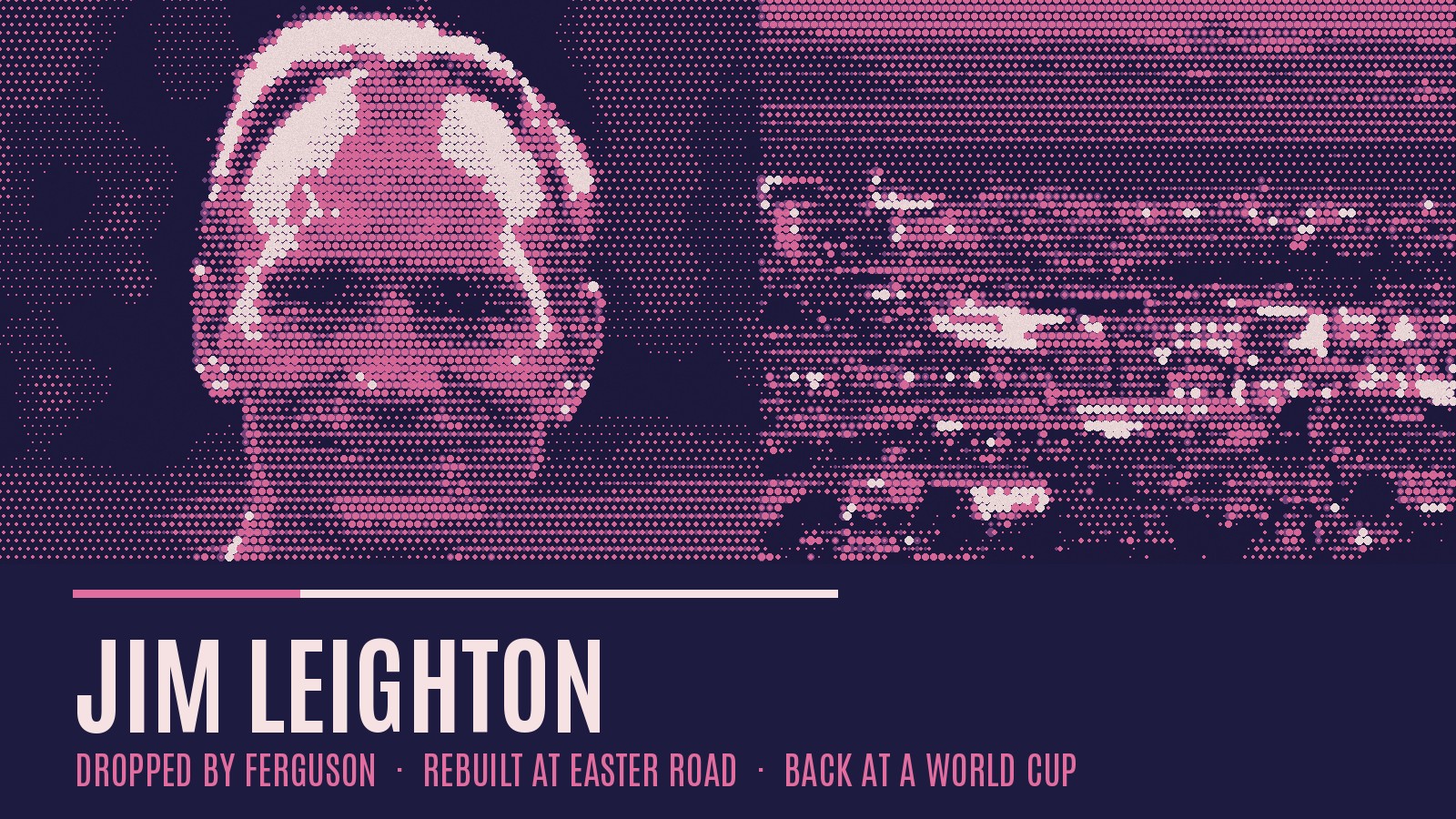
Forty years after Alex Ferguson took over at Manchester United, the goalkeeper who followed him from Aberdeen still won’t speak to him. Leighton’s second career, built on the worst night of his first, is the better story.
Thirty years ago this weekend, on Sunday 10 November 1996, a 38-year-old Hibernian goalkeeper stood in front of nearly 47,000 people at Ibrox and kept Sweden out for 82 minutes. John McGinlay scored early. After that it was mostly Kennet Andersson’s head, Jesper Blomqvist’s left foot and Jim Leighton. “On his previous two visits to Govan, with Hibernian, Scotland’s second-choice goalkeeper had been beaten 11 times,” Phil Shaw wrote in the Independent the next morning. “On this occasion, Leighton made a succession of brave and agile saves to belie his 38 years and leave the Swedes shaking their heads in frustration.” It was his 75th cap and his 37th clean sheet. He was the best player on the pitch. And Shaw, like everyone else writing about Leighton in those years, couldn’t leave out the other thing: here was a keeper “whose confidence was shredded after Alex Ferguson dropped him from Manchester United’s FA Cup replay side in 1990”.
Leighton’s own reaction to the best afternoon of his comeback? “I waited until Tuesday, then I changed my home phone number,” he told the Scotsman’s Alan Pattullo in 2012.
That’s Jim Leighton all over. He is a goalkeeper of 91 Scotland caps (in a country whose keepers, after Wembley 1975, spent decades living down a joke), four World Cup squads and a European trophy, and he spent much of his career wishing the cameras would point somewhere else. This week, as the 40th anniversary of Ferguson’s arrival at Old Trafford fills the papers, he’s the man from the first chapter that most of the retrospectives skip.
Two careers
Pattullo, who has interviewed him more than most, puts it simply. Leighton had two careers: “pre-12 May 1990 and post-12 May 1990”.
The first was spent almost entirely with Ferguson. Leighton came to Pittodrie from the juniors, having left school at 16 and worked for two years in the civil service. “I have always worked,” he said. He’d started badly at Hampden too: the first time he played at the stadium, for Eastercraig against Queen’s Park in the Scottish Amateur League, he broke the wrist of his writing hand the night before his English O Level.
Under Ferguson he won three league titles, four Scottish Cups, a League Cup, the European Cup Winners’ Cup in 1983 and the Super Cup after it. FBH has told the story of Gothenburg, and Leighton was in goal for it. Between 1982 and 1986, as Pattullo notes, he won every honour in Scottish football and a European one for good measure.
It was never a sentimental relationship, even then. Ten days after Gothenburg, Aberdeen beat Rangers in the 1983 Scottish Cup final, and Ferguson used his post-match TV interview to tear into his own team. “The boys could hardly put one leg in front of the other; Rangers were by far the better team on the day,” Leighton told BBC Scotland in 2018. “But, because the team were as good as they were, that got us through.” Ferguson, he said, “made a beeline for me”, told him he’d been Rangers’ best player and wouldn’t let the players open the champagne. “Nobody had any resentment towards Alex and Willie, but we all lost a lot of respect that day for him considering what we had achieved 10 days before that. He apologised to us the next morning, but the damage had been done for a lot of us.”
Still, when Ferguson needed a goalkeeper at Old Trafford, he went back for the one he knew. Leighton followed him south in the summer of 1988. Even the fee depends on who you ask: the Mirror has long given it as £750,000, United’s own record-keepers at mufcinfo as £450,000.
Wembley
Leighton was candid about what he was chasing at United. “It’s different now. They are expected to win the league,” he told Pattullo. “Back then it was 20 years since they last won it. Everyone wanted to be the first striker to win the title for Man United, the first centre-half, the first full-back. I wanted to be the first goalie. Unfortunately it never happened.”
What happened instead was 12 May 1990. United drew 3-3 with Crystal Palace in the FA Cup final after extra time, and Leighton was blamed for the first and third Palace goals. Steve Bruce remembered the irony: “We practised set-pieces all week because Sir Alex believed that if we defended them well we’d win. Palace scored from a set-piece after 17 minutes!” Ian Wright came off the bench, scored twice, and in extra time beat Leighton to put Palace 3-2 up. Mark Hughes rescued the replay with seven minutes left.
Ferguson’s account of the dressing room, in Managing My Life, is one of the most honest passages in the book. “In the dressing-room after the first game I noticed Jim Leighton with his head in his hands, completely shattered,” he wrote. “I went over and gave him a pat, but received no response. He looked to me like a beaten man. Jim knew he had given another poor performance and he felt helpless. I felt for him but a decision that was bound to hurt him further was forming in my mind. I thought if I sent him out in the replay and he made another bad mistake it would destroy him and cost us the Cup. Was Les Sealey a better goalkeeper than Jim? No, but he thought he was, and that can be important in a Cup Final. Prior to dinner on the eve of the replay, I broke the news to him and he took it very badly.”
Bryan Robson was in the room. “We went into a team meeting and the gaffer broke the news. It was horrible to see because Jim was really upset and a lot of the lads consoled him,” he told the Mail. “It was a massive decision, but that became the hallmark of the gaffer’s career. He wasn’t afraid of big decisions.”
Leighton’s version, as the Mail set it beside Ferguson’s, is the one that stays with you. “He took me aside to tell me that I was out of his Wembley line-up and that Les Sealey would be taking my place. I could not see straight and was rendered speechless.” Then came the walk to the stand on the night of the replay, 17 May. “United’s fans howled at me as I walked around the track to take my place in the stand. I wished I could make myself invisible for every pair of eyes in the ground, 80,000 of them, seemed to be trained on me.”
Sealey, on loan from Luton and roughed up by Mark Bright all evening, played well. Lee Martin scored. United won 1-0, and Ferguson had the first trophy of his Old Trafford career, the one generally credited with saving his job.
The medal
What happened next is the part everyone remembers about Leighton, and it says more about Sealey than about anyone. “Sealey came to my room that night,” Leighton wrote. “Basically, he wanted to convey some sort of apology. He also asked if I could do him a favour, but I knew what was coming, so I cut him short. ‘No,’ I told him. ‘I don’t want your medal.'”
He told Pattullo the same story more bluntly: “I said to him: ‘see if it was round the other way, you wouldn’t accept it, would you?’ He said ‘no’. I said: ‘well, I am not interested’.”
Having played in the first match, Leighton was entitled to a medal of his own. He sent that back too. “I had been fortunate enough to win quite a few medals up to that time and, unless I could walk up the stairs and wear the hat and the scarf and lift the cup, then I didn’t want anybody’s charity,” he told BBC Scotland. He told the club to return it to the FA.
The friendship with Sealey survived all of it. When Sealey died of a heart attack in August 2001, aged 43, Leighton helped carry his coffin. “That hit me hard, that one,” he said.
The friendship with Ferguson didn’t. It was “pretty frosty” over the previous six months, Leighton said, and “went to zero” a couple of weeks after the final. Managing My Life made it permanent. “To put it bluntly, I believe Jim was selfish,” Ferguson wrote. “As far as I am aware, not once did he hold his hands up and take any blame.” He also accused Leighton’s then wife of making a gesture at him after the replay (“That stung”), which Leighton has denied. The two men avoided each other at the 2008 match marking 25 years since Gothenburg. “We’ve never spoken since and never will do again,” Leighton said in 2018. He even described the WhatsApp group of the old Aberdeen squad and Archie Knox: “If he came on it, I would go off it, which is quite sad, but I am not alone.”
He is fair about it, in his way. “He was miles ahead of anybody in terms of knowledge of the game and tactics, but in terms of dealing with people, it wasn’t quite the same.”
Down and out
Ferguson picked him once more, at Halifax Town in the League Cup that September. Halifax were 92nd in the Football League at the time. Then he was nowhere: behind Sealey, behind the reserves, at one point (as he put it to George Graham) unable to “get a game for the Under-11s”.
The rescue came from Arsenal, for whom he never played. He spent several months on loan at Highbury at the end of 1990-91 as cover, and it was, he said, “the best club I have ever been at”. “At the end of the season, George Graham came to me and said: ‘We are going to Singapore for a week. As a thank-you for what you have done we’d like to take you away for a week’s holiday’. I said: ‘done you a favour? You have taken me away from United’… They won the league that year, and I was invited to go to every celebration. I never kicked a ball, never put on a strip, and never even did a warm-up. Yet they treated me like I had played in every game.”
There was no future there, because Arsenal had David Seaman, about to become the best of England’s goalkeepers of his generation. In 1992 Leighton went home, and things got worse. At Edinburgh airport, on his way to sign for Dundee, his agent told him Werder Bremen wanted him: their keeper had been injured the night before. He kept his word to Dundee. Werder won the Cup Winners’ Cup that season.
At Dens Park, the “broken promise after broken promise” began on day one. Leighton was unveiled alongside Simon Stainrod (“Two big names, one ego”). The manager who’d signed them both, Iain Munro, was sacked within a fortnight. Stainrod became player-manager and dropped Leighton for a young keeper called Paul Mathers, who became one of his closest friends. “It’s one thing being dropped by Manchester United, but, without being disrespectful to the club, or to Paul, it is a different thing to be dropped by Dundee,” he said. He feared he’d become associated with failure. There’s even a story of the Dundee reserves bus leaving without him.
Easter Road
When Hibs came in for him in 1993, he said, “there were no other options”. It turned out to be the best move of his life. “Those four years that I played at Hibs, they were the best I ever played in my life,” he told Pattullo. “I never played to that standard before and I never played to that standard afterwards. I love the club.”
He gives the credit to Alex Miller, the Hibs manager and Craig Brown’s assistant with Scotland, whom he rates as the second-best manager he ever played for. (You don’t need to ask who comes first.) “A lot of people thought I would not be able to recover from the knocks that had happened to me. Thankfully Alex gave me the platform to come back and do it again.” He’s indignant on Miller’s behalf about his reputation at Easter Road. “They always used to say he was a negative manager, but when I went there he signed Keith Wright, Darren Jackson, Pat McGinlay, Kevin McAllister, Michael O’Neill. Not one of them could tackle a fish supper. And yet everyone says Alex was negative.”
By February 1995 the Independent was reporting that Scotland were turning back to Leighton, “in superb form for Hibernian this season”, for a European Championship qualifier in Moscow. “Thankfully Jim’s in great form right now,” said Brown. Leighton was 36. He went on to collect more than 20 of his 91 caps as a Hibs player.
Even then the setbacks kept coming. In the final warm-up before Euro 96, against Colombia in Miami, Andy Goram took the shirt back, and Leighton watched all three games at the tournament, including Villa Park, from the bench. It stung him so much that he thought about retiring from international football that summer. Then Goram got a hip injury in the autumn, Brown needed a keeper for Sweden at Ibrox, and Leighton, freshly back from the first red card of his long career, kept the clean sheet that took Scotland top of their World Cup group.
Saint-Denis
On 10 June 1998, Scotland opened the World Cup against the holders, Brazil, at the Stade de France. Leighton, 39, had won the No 1 shirt back from Goram again. It was his fourth World Cup squad. And he says it was the biggest match of his career, bigger than Gothenburg.
“A lot of people in Aberdeen get disappointed and annoyed when I say the Scotland v Brazil game was the biggest match in my career,” he told Pattullo. “But I won’t go back on that. To go from Dundee reserves to playing v Ronaldo, Carlos and Cafu, and the route that I took, it was a lot more rewarding the second time around.”
That sentence is the whole argument of this piece. Gothenburg was the reward for being brilliant in a brilliant team under a brilliant manager. Saint-Denis was the reward for surviving that manager.
The last game
He went back to Aberdeen and played until he was 41. His last match was the 2000 Scottish Cup final against Rangers, and he’d told the press beforehand that he intended to be the last man off the pitch. Ninety seconds in, he went up for a 50-50 with Rod Wallace and came off on a stretcher with a broken face. Aberdeen’s manager, Ebbe Skovdahl, hadn’t named a substitute keeper; Leighton had told him he “might be making a mistake”. Robbie Winters went in goal and Aberdeen lost 4-0. “I have metal plates inserted that will always stay in,” he said. A few days later he was on a plane to Florida. He couldn’t play in his own testimonial.
The Scotsman reckoned that without the wilderness years of 1990 to 1994 he’d surely have passed Kenny Dalglish’s record of 102 caps. Maybe. What he got instead was 91 caps, four World Cups and the knowledge that the best football of his life came after the worst night of it.
Better than you remember
If you only know Jim Leighton from a grainy clip of Ian Wright scoring at Wembley, you’re remembering one evening out of a career that ran from the Gothenburg era to the millennium. Ferguson was right that Leighton was shattered that night, and probably right that Sealey was the better bet for one replay. He was wrong about the rest. The keeper who “looked to me like a beaten man” in May 1990 was, six years later, the man Scotland’s manager had to pick to keep out Sweden.
Leighton won’t be among those raising a glass to Sir Alex this week. He prefers golf at weekends now, and says he has “lost interest” in football. But somewhere there’s a phone number he changed in November 1996, because a 38-year-old Hibs keeper had just been the best player at Ibrox. Not bad for a beaten man.