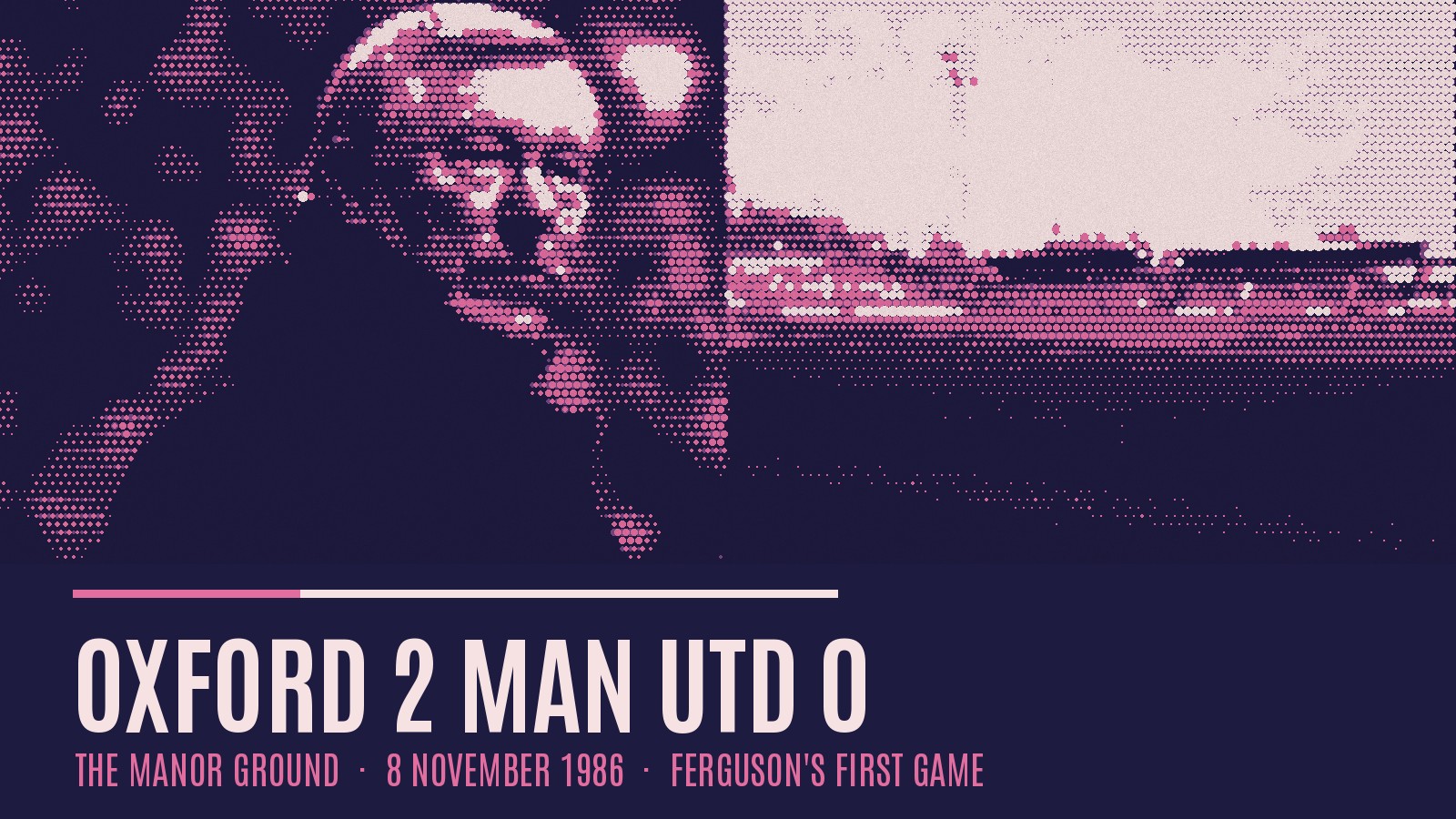
Forty years ago this week, Manchester United sacked Ron Atkinson, appointed a 44-year-old from Aberdeen and lost 2-0 at the Manor Ground. The defeat was ordinary. What Ferguson saw in it was not.
The biggest cheer at Pittodrie on Saturday 8 November 1986 didn’t come for a goal. Aberdeen drew 0-0 at home to St Mirren and, as the Herald’s Michael Grant later recalled, the loudest noise of the afternoon came at full-time, when the stadium announcer read out the scores and told the crowd that Manchester United had lost 2-0 at Oxford.
The supporters weren’t cheering Oxford. They were cheering against the man who had left them two days earlier. Alex Ferguson had given Aberdeen three league titles, four Scottish Cups, a League Cup and a night in Gothenburg when they beat Real Madrid. For eight years he had turned down Rangers, Arsenal, Tottenham and anyone else who came knocking, and then on a Thursday in November he had gone. His assistant, Archie Knox, the club’s co-manager and the man everyone assumed would succeed him, had said he was going too. Knox stayed to take charge of the St Mirren game, and when he walked out before kick-off the Main Stand stood up and booed him.
Four hundred miles south, at a cramped little ground off the London Road in Headington, Ferguson had just watched his new team lose to a club whose small, tight stadium was full and whose manager, Maurice Evans, was known as the most modest man in football. Everything about the afternoon was undramatic. Nobody at the Manor that day thought they’d seen the start of anything. Ferguson himself described it 25 years later, to the Guardian’s Daniel Taylor, in a single grumbled sentence: “Two-nil. I said to myself: ‘Oh, Christ almighty, I’ve picked a job here, all right.'”
Then he said something that tends to get cut from the anniversary pieces. “The fortunate thing,” he told reporters in 2011, “was I was able to get back to Aberdeen that night.”
So that’s the image to hold on to. On the evening of his first game as Manchester United manager, Alex Ferguson went home to the city that had cheered his defeat. His wife and sons were still there. His house was still there. United, for now, were a job he did during the week in a club hotel. Over the next few months he would take that club apart and begin to put it back together, but on 8 November 1986 he was a 44-year-old Scot with a new contract, a borrowed squad and an injury list as long as his arm, driving north in the dark.
This is the story of that week. Not the 27 years, the 38 trophies and the statue, but the six days between a League Cup replay on the south coast and a Saturday evening in Aberdeen, and what the people who were there remember about how it began.
Tuesday: Le Tissier at the Dell
The trigger was an 18-year-old from Guernsey. On Tuesday 4 November 1986, Southampton beat Manchester United 4-1 in a League Cup replay at the Dell, and Matt Le Tissier scored twice. The Independent’s Sam Wallace, reconstructing the week for the 20th anniversary in 2006, is clear that this was where “the story started in earnest”. United were in the bottom four of the First Division, with three wins from 13 league matches. The FA Cup they had won so thrillingly in 1985 felt a long way off. And the season before, they had opened with ten straight wins and still finished fourth. FBH has told the whole arc of the Atkinson years across 18 parts, and the ending is never in doubt once you’ve read the injury list.
That list is the part of the story that gets lost. United’s best players had come back from the World Cup in Mexico broken. Bryan Robson‘s shoulder was a recurring disaster. Norman Whiteside, Gordon Strachan, the goalkeeper Gary Bailey, the Danish right-back John Sivebaek and the left-back Arthur Albiston had all come home injured. Albiston had damaged an abductor muscle and kept playing, he told the Independent, because a desperate Atkinson asked him to. A squad that should have been challenging Liverpool and Everton was sending out reserves and the walking wounded every Saturday.
Martin Edwards, United’s chairman, had already decided who he wanted. “I made up my mind fairly quickly that he was the one,” he told FourFourTwo in 2024. “I’d met him when we were trying to buy Gordon Strachan in 1984, and was impressed with the way he went about his work.” One director, Mike Edelson, suggested Terry Venables. Edwards wasn’t interested.
Wednesday: bonfire night and a fake Scottish accent
The problem was getting to Ferguson without anyone at Aberdeen, or Atkinson, finding out. The solution Edwards described to BBC Sport is wonderfully low-tech. “I couldn’t ring up and say, ‘It’s Martin Edwards, the chairman of Manchester United, can I speak to Alex Ferguson?’,” he said. “So we decided to get Mike Edelson to put on a Scottish accent and pretend to be Gordon Strachan’s agent Alan Gordon, who knew Alex well. So he put on a Scottish accent and the secretary put him through and Mike told Alex, ‘It’s not Alan Gordon, Martin Edwards wants a word with you’.”
It worked. Edwards asked if Ferguson would meet them that evening, which was Wednesday 5 November, bonfire night. “We drove up to Scotland just to make sure everything would be OK before I made the official approach the next day to the chairman of Aberdeen,” Edwards said. “We needed to find out if Alex was prepared to come because the last thing we wanted to do was sack Ron and then find out we were managerless.”
Where exactly they met depends on who you believe. Edwards told FourFourTwo that “we travelled up by car, the whole of the board, and met at a motorway service station”. The Independent’s 2006 reconstruction, drawing on Ferguson’s own autobiography, says the deal was sealed in secret at the house of Ferguson’s sister-in-law in Glasgow. Both accounts may be true, and the meeting may have moved, but the detail that matters is the one they agree on. For years United’s official line was that they hadn’t approached Ferguson until after they’d sacked Atkinson. That wasn’t true. By the time Atkinson was called in on Thursday morning, his successor had already said yes.
Thursday: “I’ve just been sacked”
Norman Whiteside was injured and training on his own at the Cliff, United’s old training ground in Salford, when Atkinson’s car pulled in on the morning of Thursday 6 November. He told the Independent what happened next. “He said, ‘Big man, I want you in the office.’ I thought, ‘What have I done wrong?’ He looked very hurt. He told me to fetch the assistant manager, Mick Brown. ‘Tell Brown to get all the players together,’ he said. ‘I’ve just been sacked.'”
By the evening Edwards was in Aberdeen to finalise terms with the club’s board. The Herald’s report the next morning has Ferguson sounding both stunned and certain. “Everything has happened so quickly that I can hardly draw breath,” he said. “Manchester United is the only club I would have left Aberdeen to join. I recall Jock Stein once telling me that his biggest mistake was to turn down becoming manager of Manchester United, and I bore this in mind when I was offered the job today.”
Stein had died at Ninian Park in September 1985, on the night Scotland drew 1-1 with Wales to reach the World Cup play-off against Australia, and Ferguson, his assistant, had taken the team to Mexico. The ghost in that quote is real. Ferguson went on: “I will be in the dug-out for Manchester United in their game against Oxford United at Oxford on Saturday, and I must admit that I will also be thinking of how Aberdeen are faring against St Mirren at Pittodrie.” The Aberdeen vice-chairman, Ian Donald, called it “a shattering blow”. Ferguson had been put on the Aberdeen board only weeks earlier, Grant later wrote, precisely to stop his eyes straying to vacancies elsewhere.
Ron Atkinson, meanwhile, threw a party. Ferguson would never forgive the timing. In his 1999 autobiography Managing My Life he criticised his predecessor for holding a leaving do with the players 48 hours before an away match at Oxford. As the Independent’s Nick Townsend later put it, it was “more a case of a hangover than a takeover” when the new manager arrived.
Friday: the gym at the Cliff
Edwards brought Ferguson to the Cliff on Friday 7 November and introduced him to the squad in the gym. Whiteside remembered the opening line twenty years later, word for word: “I don’t care who you are, or what reputations you have – I’m the new manager of this club and I’m in charge.”
Peter Barnes, the winger, who would start the next day at Oxford, remembered the rest of it. “That first talk with us at the Cliff, he said: ‘Look, you’re playing for a great club and you need to keep yourselves fit so you can look after your family. This is a club that deserves all the success in the world’,” he told the Independent. “He said that he wanted the drinking mentality in the team to stop too. From the first day he arrived you knew that he was determined to succeed and he made it clear that you had to do things his way or not at all. He ruled with an iron fist and there was a lot of discipline introduced into training. The big stars like Bryan Robson, Frank Stapleton were told quite clearly that they had to do it his way.”
Sivebaek, the Dane who would go on to score Ferguson’s first goal, saw a different side of the same man. “I remember on his first day at United he was smiling and obviously very happy to be at the club,” he told BBC Sport in 2011. “He held a meeting and talked to every player. When we went out on to the training ground it quickly became evident that this was a man who had clear ideas and knew what he wanted. You could feel a change from the way things had been under Ron Atkinson from the first day he was there.”
It’s worth putting those two memories side by side, because they describe the two halves of the Ferguson method that would last a quarter of a century: the speech to the room, and the conversation with every individual in it. The fitness line in Barnes’s account matters too. A footballer’s body was his family’s income, and Ferguson framed fitness not as a rule but as a responsibility. It was a working-class Govan argument made to men on good wages, and he made it on day one.
Some of those men knew him already, and not from a dressing room. Whiteside had shared a flight home from Mexico that summer with the Scotland party, after Northern Ireland and Scotland had both gone out at the group stage. “We were in cattle class and Scotland were in first class so I chucked Frank McAvennie out of his seat and sat with the lads having a laugh – well, having a beer,” he told the Independent. “I looked over my right shoulder and Fergie was there with Archie Knox. I’m there having a few drinks on the flight, three months later he’s my boss!”
Saturday: the Manor Ground
Oxford United in November 1986 were not a soft touch. They had won the Milk Cup at Wembley the previous April, beating QPR 3-0, and were in their second season in the First Division. Their previous home league game had been a 2-1 win over Brian Clough’s Nottingham Forest, who were top of the table. They had John Aldridge, who would be at Liverpool within months, and Ray Houghton, who would follow him. They had Maurice Evans, a gentle man who had stepped up when Jim Smith left in 1985 and then led them to Wembley. Kick-off was at 3pm at a ground with sloping terraces and the feel of a club that had climbed into the top flight faster than its stadium could follow.
United’s team, picked by a manager who had met most of them the day before, was listed by the Oxford Mail as Chris Turner, Mike Duxbury, Arthur Albiston, Kevin Moran, Paul McGrath, Graeme Hogg, Clayton Blackmore, Remi Moses, Frank Stapleton, Peter Davenport and Peter Barnes, with Jesper Olsen coming off the bench. No Robson, no Strachan, no Whiteside. Of the eleven who started, only Blackmore would still be at the club when it won its first title under him, seven seasons later.
Ferguson didn’t want to be there. “The photographers didn’t help and it was one place I didn’t want to come for the first game,” he said afterwards, as reported in the Oxford Mail, and you can see why. The press box and the touchline were full of cameras that had come for him, not for the football, and the Manor was a small, tight place where an away dugout felt very exposed.
The match itself was simple. Aldridge scored a penalty after 15 minutes. Neil Slatter, the Welsh full-back, added a second with 11 minutes left. Oxford were the better side throughout, and the Oxford Mail’s John Ley wrote that “had Ferguson’s men played the way Evans’ players did and won 2-0, the new United boss would have been heralded as the new Old Trafford saviour.” The crowd was 13,545. The result moved Oxford up to tenth, ten points clear of United.
What Ferguson saw was a team that wasn’t fit and didn’t trust itself. Nick Townsend’s account in the Independent has him surprised at the fitness levels and at how jumpy his defence was, with one sentence of Ferguson’s that is almost funny: “We only relaxed when we were 2-0 down.”
The Oxford players remember a non-event. “We played ever so well, but to be fair, they weren’t at their best,” the midfielder Les Phillips told the Oxford Mail. “There were cameras everywhere. We just happened to be playing them, I don’t think we got much of a mention. But you’ve got to remember Man Utd weren’t a force then.”
The most revealing account comes from the Oxford right-back, Dave Langan, through a friend on the other side. Stapleton was, in Langan’s words, his best friend, and he told him what happened in the away dressing room. “He said that after the game Alex was very pleased, even though they had lost,” Langan said. “There was no hairdryer. He was quite calm and laid out his ideas and what he expected.”
That doesn’t fit the legend at all, which is exactly why it’s worth believing. The hairdryer would come later, and from Ferguson’s own account it was already being plugged in. But on the first afternoon, in a small concrete dressing room in Headington, with the photographers waiting outside and his old club’s fans about to cheer his defeat, he didn’t shout. He explained. He’d seen what he needed to see.
Saturday night: north
And then he went home. “The fortunate thing was I was able to get back to Aberdeen that night.” It’s worth thinking about what was waiting for him there. Pittodrie had cheered the score. Knox had been booed. Within weeks Rangers and Celtic fans would be taunting the Aberdeen crowd with “Where’s your Fergie gone?” to the tune of “Chirpy Chirpy Cheep Cheep”. The newspapers linked half of Scottish football with the job, Alex Smith, Jim McLean, Billy Bremner and Lou Macari among them, before Aberdeen appointed Ian Porterfield, a former Sheffield United manager who hadn’t lived in Scotland for 19 years and had applied on spec. Ferguson later admitted he was “amazed”.
Aberdeen’s decline after he left is part of this story too. Grant’s history of it is unsentimental: within four years of Gothenburg they were finishing outside the top three, and the managers who followed all suffered “the inevitably unfavourable comparisons with Ferguson”. The man who had broken the Old Firm couldn’t be replaced because what he’d done there was not a system anyone else could run. It was him. FBH’s piece on Gothenburg makes the same point about 1983.
The diagnosis
“I made it plain that I meant to put an end to United’s reputation of being as much a social club as a football club,” Ferguson wrote in Managing My Life. “To hell with soft-shoeing around such a major issue.” The chapter covering those first months is called “Drinking to Failure”. Atkinson’s 48-hour rule against drinking before a game, Ferguson called a “feeble prohibition”, and he replaced it with a simpler rule: no drinking while in training.
That’s the story as Ferguson told it. Atkinson told it differently, and has every right to be heard. “Under me Manchester United were a team that were supposed to have drunk themselves into oblivion, usually at the Four Seasons Hotel by the airport,” he wrote in his own autobiography in 2016. “That was a massive exaggeration. Alcohol was part of the temper of the times in English football and it was not confined to Manchester United. I once joined Liverpool on a post-season tour to Israel and I could not believe the amounts of booze that team put away; even those you wouldn’t suspect were big drinkers, like Hansen. Everton won two championships with Howard Kendall taking his team to Chinatown most Tuesday afternoons.”
Atkinson is right about the times. Liverpool and Everton drank and won. The difference is that by November 1986 United were drinking and losing, with a squad full of injuries that weren’t healing and a medical culture that sent Albiston out with a damaged abductor because the manager needed bodies. After Oxford, Albiston, who had played for Ferguson with Scotland, got the new regime in four words: “go and get it sorted.”
Whiteside, the player most often cast as the villain of the drinking story, is the most honest witness to it. “There was a hardcore of boys who would go out and socialise,” he told BBC Sport. “On a Sunday we would normally sit all day and drink Guinness, then at the end of the night we would have a curry fight and sing a few Irish songs. Sir Alex put down the law, saying he was the boss and was going to change things. If people saw you out in Manchester they’d tell the manager, but I used to go in to him in the morning, knock on his door and say ‘before anyone phones you, I was out last night boss’.”
The manager’s response was to find out where everybody lived. Whiteside’s favourite story is about a trip to “Costco or somewhere” and a garage full of wine. “I had about 100 bottles of wine and I was putting them in my wine rack,” he said. “I had got about 88 bottles in and he and Archie Knox drove past. If you went past my drive it came to a dead end, so they had to reverse quickly! He was going around seeing where his players lived.”
There was a softer side to the same obsession. Ferguson wanted the club to feel closer to its supporters, so he ordered the injured players, Whiteside among them, to eat in the restaurant at Old Trafford. The scheme was dropped after a few weeks, Whiteside said, because faced with a five-course menu every day he was “eating too much”.
Knox, the Cliff and the theatre of dreams
Knox stayed in Aberdeen for two weeks while the club looked for a new manager, then followed Ferguson south. The two of them lived together in what Knox called “various venues, none of them much good”, and Knox’s memories of those weeks are the funniest in any of the anniversary pieces. “One Sunday it was my turn to get the papers and he would cook the breakfast. So he was through cooking and all of a sudden there’s an almighty bang in the kitchen. I thought ‘Christ, he’s blown the bloody place up’. It was an old cooker with a grill at the top. He had set a box of matches on top and they had exploded.”
What Knox remembered most, though, was the phone calls while he was still at Pittodrie. “He called me on a regular basis and I think it was Alec who coined the phrase ‘Theatre of Dreams’,” Knox said. “I can remember him saying to me then: ‘You will absolutely love this place, it could be an absolute theatre of dreams this’. He just felt, given the rub of the green, he could resurrect what this club meant to people. It would be on the basis of what he had done at Aberdeen with the youth policy.”
Whether Ferguson really coined the phrase is another matter. It has other claimants, and Knox’s “I think” is doing a lot of work. But the memory tells you the scale of what he saw in a club sitting near the bottom of the table: not a team to be repaired, but a place to be restored. And it tells you where he planned to start. Whiteside noticed it within weeks. “If he was driving home and saw a five-a-side game in the park he would stop to watch,” he said. By the time Whiteside left in 1989, senior players were noticing a stream of schoolboys and their parents having dinner with the manager on the evening before games. That was the generation of Beckham, Scholes, Butt and the Nevilles, and the work on it started in the winter of 1986.
The first six weeks
The results came slowly, then all at once, then slowly again. United drew 0-0 at Norwich on 15 November. A week later, on 22 November, they beat QPR 1-0 at Old Trafford, and the goal came from the Dane who’d seen Ferguson smiling on his first morning. “I don’t remember too much about it except that it was a free-kick 20 yards out,” Sivebaek told the BBC. “It was a big goal because it gave Sir Alex his first win at Manchester United and it was also big for me because I didn’t score too many.” It ended 213 minutes without a goal under the new manager.
Then came Plough Lane. On 29 November United lost 1-0 at Wimbledon, Vinnie Jones scoring three minutes before half-time, in a dressing room that Barnes remembered as flooded, with salt in the half-time tea. “It was there I first saw him lose his temper,” Barnes told the Independent. “He went round all the players shouting at them and telling them ‘You can’t perform like that’. He said that we had to win games like that, he didn’t want players who were soft. Ron was a larger-than-life personality and the players had some leeway – he didn’t mind you having a drink. He was a bit sunnier than Alex, who you didn’t see crack a smile too often.”
If Oxford was where the diagnosis happened, Plough Lane was where the hairdryer was switched on. The Luton story, told by Gary Bailey, shows something cleverer. “The ball had landed between Colin Gibson and myself, and I had shouted ‘away!’ He couldn’t get there and they equalised,” Bailey remembered. “He is a very good reader of characters – he knew shouting at me was not going to help, so he just said to me at half-time, ‘What more could you have done?’ I said, ‘I shouted away!’ Then he turned and shouted at Gibbo saying, ‘That’s your ball, get the bloody thing away.’ I was a bit dumbstruck at first but I realised what they meant by the hairdryer. As I was walking out the door after the game Alex smiled at me. I thought, ‘Damn it, he wasn’t just shouting for the sake of shouting.’ He knew that shouting at Colin Gibson would have an effect on me. I thought, ‘Man, he’s a clever manager.'”
There were two 3-3 draws in December, at home to Tottenham and away at Villa, and a 2-0 home win over Leicester. Then, on Boxing Day 1986, seven weeks after Oxford, United went to Anfield and won 1-0. Whiteside scored with 12 minutes left. Liverpool were the champions and the standard. The next day United lost at home to Norwich, but the point had been made.
They finished 11th. It was not a revolution. The side he’d inherited was being dismantled even as it played.
On your way, son
The most chilling document in the Independent’s 2006 series is a table. Under the headline “On your way, son”, it lists the eleven men who started at Oxford, their ages, how many games each played for Ferguson and when and where he sold them.
Barnes, 29, played four games for him and was gone to Manchester City by January 1987. Stapleton, 30, played 20 and left for Ajax in June 1987. Albiston managed 20 appearances and went to West Brom in the summer of 1988, the same summer Moran left for Sporting Gijón and Hogg for Portsmouth. Turner went to Sheffield Wednesday in September 1988, Davenport to Middlesbrough that November. Moses retired injured in 1988. McGrath, 26 at Oxford, played 71 games for Ferguson and left for Aston Villa in July 1989. Duxbury lasted until 1990. Blackmore, the youngest at 22, made 177 appearances for him and was still there when the title finally came in 1993.
None of the players the Independent spoke to resented him for it. Albiston said: “I can’t fault him. He kept me involved. I was one of the guys who had been there the longest and he didn’t discard me.” Barnes said Ferguson had been honourable in his dealings with him. Whiteside, sold to Everton in 1989, tells the most surprising story of all. “We sat and talked about everything,” he said. “About my medical condition, about drink, about earning some decent money because I was on peanuts at Old Trafford… In 29 games at Everton I earned more than in all my [eight-year] career at United. He gave me an indication of what I should ask for. I was on 300 quid a week for the 1985 FA Cup final.” Then Ferguson rang Colin Harvey, the Everton manager, with Whiteside sitting in his office. “He said, ‘You can have Norman for £600,000 and an extra £150,000 if he plays 50 games.’ I only played 29 so United didn’t get their money.”
The McGrath sale was harder. When Managing My Life came out in 1999, the Irish Times noted that Ferguson admitted he couldn’t persuade McGrath to temper his drinking, and that the need to break up the “gifted but occasionally wayward” trio of McGrath, Robson and Whiteside was why he sold the two Irishmen. McGrath went for £450,000 and became a hero at Villa Park. Atkinson, who later managed him there, called him, “for what my opinion is worth, the best centre half the Premier League has seen”. Both men were probably right.
Why Oxford mattered
The temptation with Oxford 1986 is to treat it as a trivia question: name the team that beat Alex Ferguson in his first game at United. But the day matters for a better reason than that.
Ferguson arrived with no time to prepare and no illusions about what he’d find. In 48 hours he got a complete picture of the problem. He saw the injuries, because Robson, Strachan and Whiteside couldn’t play. He saw the fitness, because Oxford ran over them. He saw the nerves, because his defence only relaxed at 2-0 down. And he heard about the culture, because his first weekend in charge began with a farewell party for the man he’d replaced. If United had scraped a 1-1 draw at the Manor, it’s possible none of that would have been quite so clear.
What he did with the diagnosis was the unusual part. He didn’t panic-buy. He didn’t purge the squad that winter; he spent the next three years doing it. He started at the bottom, with schoolboys, scouts and five-a-sides in the park, because that was what had worked at Aberdeen. And he made the rules about the players as people (their bodies, their families, their houses, their wages) before he made them about tactics. “He had his system, his methods and his own ideas but he also listened before making decisions,” Sivebaek said. “He knew he couldn’t change the whole team straight away but he obviously knew things needed to change. He built it slowly.”
He built it so slowly that it nearly cost him his job. “We were beginning to get under pressure in 1990 because things hadn’t turned around,” Edwards admitted in 2011. “The pressure today might be even greater and I’d like to think we would be as patient but you never know.” FBH has written before about the transfer mistakes of those years. The patience that saved Ferguson in 1990 was bought, in part, by the honesty of 1986. Nobody at Old Trafford could say they hadn’t been told how long it would take.
There’s one last detail from that first season worth having. On 21 March 1987, United lost 1-0 at Hillsborough to a goal in the last minute from a 19-year-old Sheffield Wednesday striker called David Hirst. Ferguson remembered things like that. It wouldn’t be the last time Ferguson’s path crossed Hirst’s.
The drive home
Picture Ferguson on the evening of 8 November 1986, heading north. He’d lost his first game. He’d watched a team of men who’d been at a party two nights earlier get outrun by Oxford. His old club’s supporters had cheered his defeat. His family was still in Aberdeen and his new home was a hotel room. He’d tell the Guardian, a quarter of a century later, that his first thought had been “Oh, Christ almighty, I’ve picked a job here.”
But Langan’s friend Stapleton saw something else in that dressing room: a manager who was “very pleased, even though they had lost”. Ferguson wasn’t pleased with the result. He was pleased with what he’d learned. The Manor Ground gave him the truth about Manchester United in 90 minutes, and he spent the next six and a half years acting on it.
The cheer at Pittodrie was the last time anyone could fairly say that Alex Ferguson had picked the wrong job.