


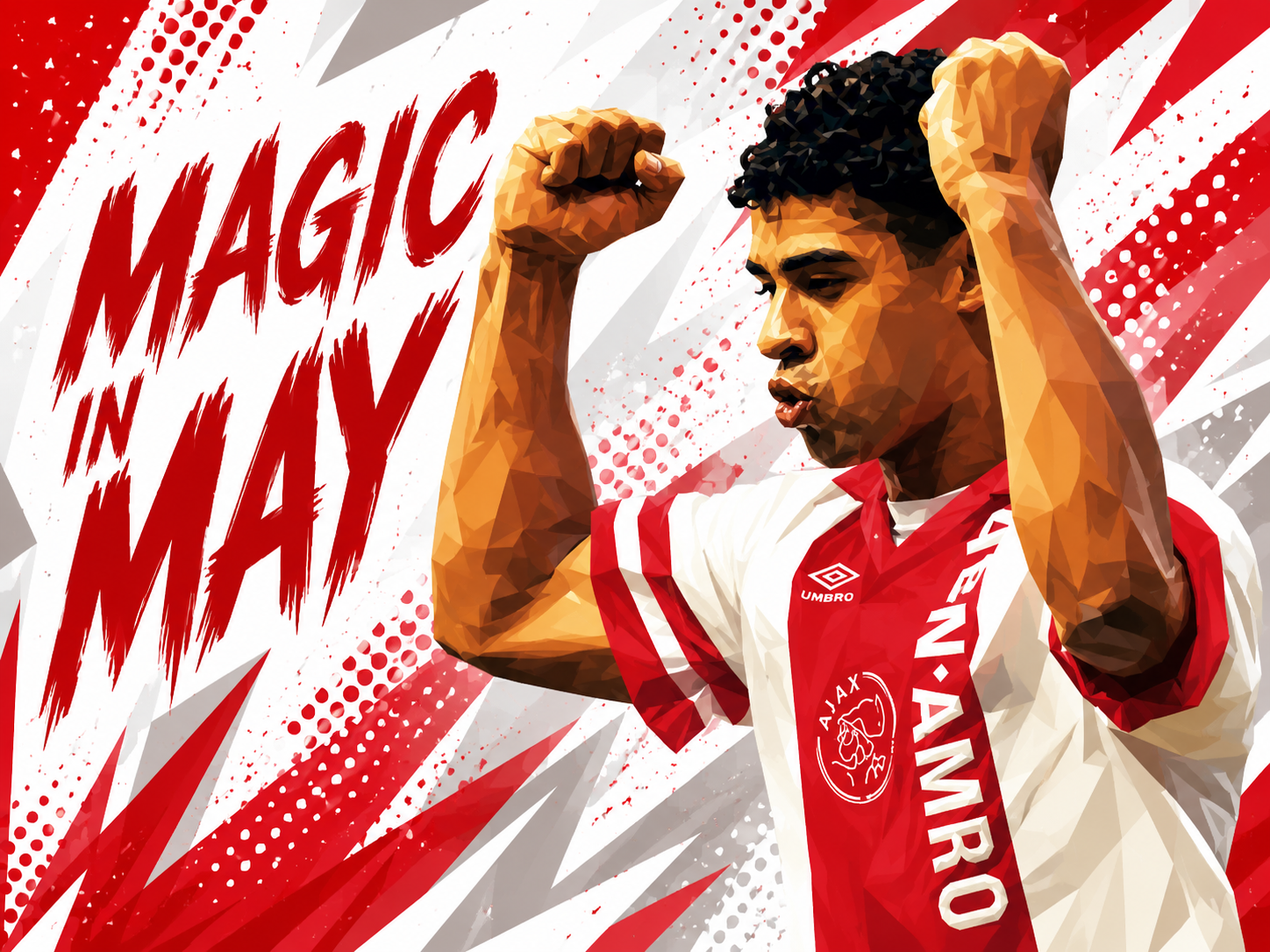
On 24 May 1995, Ajax beat AC Milan 1-0 in the Champions League final. But Vienna was more than a youthful upset. It was the night Frank Rijkaard and Louis van Gaal helped reveal the next tactical age of European football, just before the economics of the modern game made Ajax’s model almost impossible to protect.
The Pass Before the Goal
Patrick Kluivert did not celebrate immediately.
The ball had squeezed beyond Sebastiano Rossi and rolled into the corner, but for a split second the Ernst-Happel-Stadion seemed suspended between recognition and disbelief, as if Vienna itself needed time to understand what had just happened.
Franco Baresi turned first.
Then Paolo Maldini.
Then Alessandro Costacurta.
Three defenders who had spent the better part of a decade reducing European football to geometry and suffocation suddenly found themselves staring at a gap that had not existed a second earlier.
Frank Rijkaard had seen it before any of them.
The clock showed 85 minutes. The 1995 Champions League final had been played at the pace of a chess match disguised as a football match, full of compressed space, nervous touches and tactical caution. AC Milan, Fabio Capello’s reigning European champions, had spent most of the evening trying to slow Ajax into frustration. Ajax, meanwhile, had continued circulating the ball with a patience that bordered on defiance.
Out on the touchline, Louis van Gaal stalked his technical area in bursts of agitation and restraint. His team was young enough to look almost out of place in a final of this weight. Milan’s was among the most experienced European football had ever seen.
And yet, as the match drifted towards extra time, it was Milan who looked older.
Ajax moved the ball from left to right, then back again. Ronald de Boer stepped forward from deep, drawing Milan’s midfield towards the ball. The shape shifted with him. Briefly, almost invisibly, the line stretched.
The space appeared.
Rijkaard paused.
That was the detail people often missed about him. Even in the most chaotic moments, he played football as if he had access to a slower version of time. Around him were teenagers and rising stars moving at modern speed: Clarence Seedorf, Edgar Davids, Marc Overmars, Finidi George. But Rijkaard operated differently. He absorbed pressure rather than reacting to it.
Ahead of him, an 18-year-old substitute drifted between Baresi and Costacurta.
Patrick Kluivert.
Rijkaard disguised the pass beautifully. Not a sweeping Hollywood assist. Not a defence-splitting missile. Just a short diagonal ball slid quietly through the only vulnerable seam in Milan’s back line. The weight of it mattered as much as the vision. It arrived exactly where Kluivert needed it, inviting the first touch forward.
Kluivert held off Costacurta, adjusted under pressure and stabbed low towards Rossi.
1-0.
The stadium detonated.
Kluivert disappeared beneath a wave of navy and claret shirts. Van Gaal exploded on the touchline. The Ajax supporters behind the goal shook beneath the release of something that had been building all season, perhaps all decade.
Rijkaard turned away almost calmly.
There was no sprint across the pitch. No collapse to the turf. Just the expression of a man who understood the scale of what had happened before everyone else did.
This was not simply the winning goal in a European Cup final.
It was the final act of Frank Rijkaard’s playing career.
It was the moment Louis van Gaal’s Ajax announced a new footballing language to Europe.
And it was the night the future arrived disguised as a group of fearless young men from Amsterdam.
Ajax Did Not Shock Milan. They Replaced Them.
History often reduces great football matches into tidy myths.
The 1995 Champions League final is usually remembered as one of them.
Young Ajax upsetting mighty AC Milan. Fearless kids toppling Europe’s established kings. Patrick Kluivert announcing himself to the world before he was old enough to carry the burden that would soon follow him.
All of that is true.
None of it is sufficient.
Ajax did not arrive in Vienna as naïve outsiders surviving on adrenaline and romance. They arrived as the most tactically advanced side in Europe. By the time Kluivert scored, they had already beaten Milan twice earlier in the competition, winning 2-0 in Amsterdam and 2-0 again in Trieste, where Milan played their home match because of a stadium ban.
Those results were not accidents.
They were warnings.
What happened in Vienna was not a shock. It was a succession.
The deeper truth of that final is uncomfortable for football nostalgia because it forces a reassessment of how the modern game evolved. The accepted storyline tends to leap from Arrigo Sacchi’s Milan to Pep Guardiola’s Barcelona, as though football skipped directly from late-1980s pressing into the passing empires of the 21st century. But Van Gaal’s Ajax sits directly in the middle of that chain. In many ways, it is the missing bridge.
And standing at the centre of that bridge was Frank Rijkaard.
For years, Rijkaard had been misunderstood outside elite football circles. To casual observers, he was the powerful one in Milan’s Dutch trinity. Marco van Basten supplied the artistry. Ruud Gullit carried the charisma. Rijkaard did the hard work underneath them. He was remembered as the destroyer, the enforcer, the physically dominant midfielder who gave Sacchi’s side balance.
But that reading always said more about football’s historical blind spots than it did about Rijkaard himself.
Managers understood his real value.
Sacchi did. Van Gaal certainly did.
Rijkaard was not merely a defensive midfielder. He was a system stabiliser before football really had language for such players. He could defend transitions, dictate tempo, drop into the defensive line, resist pressure, break a press with one touch and reorganise the geometry of a match simply through positioning. He was a footballer who interpreted space faster than almost everyone around him.
Years later, Sergio Busquets would become celebrated for many of the same qualities. Rodri would be praised for controlling games. But Rijkaard was performing those functions in the late 1980s and early 1990s, often without recognition because football culture still preferred visible dominance over invisible control.
Van Gaal saw all of it.
That was why Rijkaard’s return to Ajax in 1993 mattered so much. On paper, it looked sentimental. A veteran returning home for one final chapter after conquering Europe with Milan. In reality, Van Gaal understood he was acquiring something much more valuable than experience.
He was acquiring the ideal interpreter for a radical footballing idea.
Van Gaal’s Ajax was not built on improvisation in the romantic Dutch sense. That is one of the great misconceptions about the team. People see the academy graduates, the technical brilliance and the fluid movement and assume freedom created the football.
The opposite was true.
Ajax became extraordinary because Van Gaal imposed structure with near-obsessive intensity.
Every passing lane mattered. Every rotation had purpose. Every positional exchange was rehearsed. Training sessions were relentless. Young players were corrected constantly. Movements were repeated until they became instinctive. Van Gaal believed collective organisation created individual freedom, not the other way around.
Where Johan Cruyff often viewed football as spontaneous interpretation, Van Gaal approached it almost like architecture.
Rijkaard became the perfect extension of those ideas on the pitch.
He had already lived through Sacchi’s revolution at Milan, where distances between units were compressed with military discipline and pressing became coordinated rather than reactive. Now, under Van Gaal, he adapted again, helping to build a side that used possession not merely to attack but to suffocate opponents psychologically.
That distinction mattered.
Most teams in the mid-1990s still viewed possession as a consequence of superiority. Ajax treated it as a weapon of control. Their passing was not decorative. It exhausted opponents mentally. Players moved constantly to create angles. The goalkeeper participated in build-up play. Midfielders rotated fluidly. Wide players stretched defensive blocks until central corridors opened.
Modern football supporters would recognise much of it instantly now.
At the time, it looked strange.
Even Milan struggled to process it fully.
Fabio Capello’s side represented the apex of another footballing era. Their defensive line functioned with astonishing collective intelligence. Baresi and Maldini understood space instinctively. Marcel Desailly provided devastating physical authority in midfield. Milan controlled territory through compactness, discipline and experience. They could slow games into submission.
But Ajax manipulated space differently.
Instead of merely controlling territory, they controlled reference points. Their movement constantly forced defenders into uncomfortable decisions: follow runners and leave gaps, or hold shape and concede possession. Jari Litmanen drifted between midfield and defence like a prototype modern false 10. Seedorf and Davids combined athletic aggression with technical precision. Overmars and Finidi stretched the pitch horizontally until opponents fractured.
And behind it all stood Rijkaard, calmly connecting every phase together.
The irony was extraordinary.
The man helping dismantle Milan in Vienna was also one of the players who had helped build Milan into Europe’s dominant power in the first place. Rijkaard understood the mechanics of Capello’s side intimately because he had once been essential to the ideological foundations beneath them.
That gave the final an almost strange emotional texture.
This was not rebellion against Milan.
It was evolution beyond them.
Frank Rijkaard: The Man Between Two Worlds
Long before Frank Rijkaard became the calm centre of Europe’s most sophisticated football team, he was another gifted kid playing in the streets of Amsterdam with Ruud Gullit.
The two boys grew up only a few miles apart, children of Surinamese families building lives in the Netherlands during a period of cultural change in Dutch society. Football in Amsterdam was not organised first. It was instinctive. Concrete cages, tight spaces and uneven surfaces forced players to solve problems quickly or lose the ball. Technique was survival before it became artistry.
Rijkaard learned early that football could be controlled without dominating attention.
Even as a teenager, he lacked the theatrical qualities Dutch football traditionally adored. Cruyff carried himself like a revolutionary intellectual. Gullit radiated charisma. Van Basten possessed elegance so obvious it almost demanded admiration. Rijkaard was quieter than all of them. Broader physically. More inward.
But inside Ajax’s academy, coaches quickly recognised something unusual.
He understood space naturally.
Not simply where to move, but why.
Rijkaard could play almost anywhere because he interpreted football structurally rather than positionally. He appeared comfortable in defence, midfield or deeper transitional roles because he viewed the pitch as one connected system. By the age of 17, Leo Beenhakker had already promoted him into Ajax’s first team. In his debut league appearance against Go Ahead Eagles in August 1980, he scored immediately.
Ajax did not produce timid footballers in that era. The academy educated players to believe they belonged at the centre of the game’s development. Yet even by those standards, Rijkaard’s rise felt unusually seamless. He could defend physically against experienced forwards while remaining technically composed enough to participate in Ajax’s possession-heavy structure.
What separated him from conventional defenders was not aggression.
It was calm.
He rarely looked rushed. Rarely looked emotionally accelerated by matches. While others chased games, Rijkaard often seemed to absorb them first, processing patterns before reacting. Teammates trusted him because he simplified situations around them. Pressure dissolved when the ball reached him.
By the mid-1980s, he had become one of the defining young players in Dutch football.
And then Johan Cruyff arrived.
The relationship should have worked beautifully. Cruyff admired intelligent footballers. Rijkaard embodied many of Ajax’s core principles. But personalities matter in elite sport as much as ideals, and the tension between them gradually became unavoidable.
Cruyff’s genius often came attached to confrontation. He challenged players publicly and privately, demanding psychological submission alongside tactical understanding. Some flourished under it. Others resisted.
Rijkaard resisted.
The breaking point arrived during the 1987-88 season. Accounts differ slightly on the exact trigger, but the underlying issue was clear: Rijkaard no longer believed Cruyff trusted him fully, while Cruyff viewed Rijkaard as increasingly difficult and emotionally distant. During a heated training-ground disagreement, Rijkaard walked away and effectively declared he would never play under Cruyff again.
For Ajax, it was seismic.
For Rijkaard, it briefly looked catastrophic.
He joined Sporting CP but never properly played there because of administrative complications, eventually spending time on loan at Real Zaragoza instead. Instead of ascending cleanly towards European superstardom, he found himself drifting through a strange footballing limbo, trapped between reputations.
Too talented to disappear. Too unsettled to stabilise.
In hindsight, that rupture changed everything.
Because while Cruyff and Rijkaard could not coexist comfortably, Arrigo Sacchi immediately understood what Rijkaard could become.
Sacchi was constructing something radically different at AC Milan. Italian football in the late 1980s still revolved heavily around man-marking traditions, territorial caution and individual defensive responsibility. Sacchi wanted compression, synchronised pressing and collective movement. His football required intelligence as much as physical endurance.
He already possessed Van Basten’s finishing and Gullit’s power. But he needed a player capable of connecting every phase together underneath them.
Milan signed Rijkaard in 1988.
The transformation was immediate.
Sacchi shifted him permanently into midfield, and suddenly European football saw the full scale of his game. Rijkaard defended aggressively when required, but his real brilliance emerged in transition moments. He could recover possession and instantly accelerate attacks with a vertical pass. He could drop between the centre-backs to stabilise build-up play. He could arrive late in the penalty area without disrupting the structure behind him.
Most importantly, he understood collective distances instinctively.
That mattered enormously in Sacchi’s Milan because the entire system depended on compression. Defenders pushed high. Midfielders squeezed space aggressively. The forwards initiated pressing triggers. One player misunderstanding positioning could collapse the entire structure.
Rijkaard almost never misunderstood it.
By the early 1990s, he had become almost untouchable as a footballer. Milan won back-to-back European Cups in 1989 and 1990. In the latter final against Benfica, it was Rijkaard himself who scored the winning goal after surging through midfield with devastating timing.
The irony now feels almost poetic.
The player once considered tactically difficult by Cruyff had become the essential organiser inside Europe’s greatest team.
But by 1993, something inside Milan was beginning to harden. Sacchi had gone. Capello maintained the winning machine, but the emotional and ideological atmosphere shifted slightly. Milan remained brilliant, perhaps even more efficient, but they became more pragmatic, more cautious, less exploratory.
Rijkaard sensed it.
And back in Amsterdam, Louis van Gaal was building something unfinished.
Louis van Gaal and the Obsession With Order
Louis van Gaal did not look like football’s future.
He looked, if anything, like the kind of man who might drain joy from it entirely.
Even in the early 1990s, before the public feuds, before the battles with players, journalists and executives across Europe, Van Gaal carried himself with uncompromising severity. He spoke with certainty because he genuinely believed uncertainty was weakness. Training sessions stopped constantly for correction. Positional mistakes were treated almost as moral failures.
And yet many of the defining ideas of the modern game flowed directly from him.
That contradiction sat at the heart of Ajax’s rise.
Van Gaal inherited one of the most romantic institutions in football and rebuilt it through discipline rather than romance. Ajax still spoke the language of Total Football, but Van Gaal translated it into something colder, sharper and more systematic. If Cruyff’s interpretation of football resembled jazz, Van Gaal’s resembled architecture.
Everything had shape. Everything had spacing. Everything had timing.
Even freedom itself had rules.
That was the first thing many young Ajax players discovered when they entered his orbit. Clarence Seedorf, Edgar Davids, Patrick Kluivert and the De Boer brothers possessed enormous talent, but Van Gaal was uninterested in talent detached from structure. He wanted players to understand not merely their own role, but the logic of the entire collective system around them.
Training became relentless repetition.
Passing patterns. Positional rotations. Defensive distances. Build-up structures.
Again and again until movement became instinctive.
Van Gaal believed elite football collapsed the moment players began improvising without reference points. Every player had to understand where the next passing angle would emerge before receiving the ball. Width had purpose. Possession had purpose. Even risk had designated moments.
It could be exhausting.
Some players adored him because the clarity improved them dramatically. Others found the intensity suffocating. Van Gaal demanded emotional submission alongside tactical discipline. There was little room for vanity or freelance interpretation inside his teams.
Yet strangely, the football rarely looked robotic.
That was the genius of it.
Ajax moved with fluidity precisely because the underlying structure was so stable. Players rotated constantly, but never randomly. When one moved inside, another compensated outside. When spaces opened, midfielders dropped. When pressure arrived centrally, the shape expanded naturally towards the flanks before collapsing back into the middle again.
The football breathed.
Van Gaal has often spoken about finals as different emotional events. Looking back on 1995, he told UEFA: “You never play at your best – the tension is too high.” That was not modesty. It was a revealing insight into how he saw elite football. The role of the coach was not to remove tension. It was to build a structure strong enough to survive it.
That belief separated him from many contemporaries.
Italian football in the early 1990s still largely revolved around containment and territorial control. English football remained more direct and transitional. Even many technically gifted European sides relied heavily on individual inspiration during difficult moments.
Van Gaal distrusted inspiration that could not be reproduced.
He wanted mechanisms.
This was where Frank Rijkaard became indispensable.
Van Gaal did not merely need a veteran presence inside his young dressing room. He needed a player capable of translating complex tactical concepts onto the pitch in real time. Rijkaard had already lived through Sacchi’s revolution at Milan. He understood compression, pressing triggers, spacing discipline and positional sacrifice instinctively.
More importantly, younger players trusted him.
That mattered enormously because Van Gaal’s methods could feel overwhelming without internal authority figures reinforcing them. Rijkaard stabilised the dressing room emotionally while simultaneously functioning as the tactical reference point around which the team rotated.
Danny Blind performed a similar role defensively, but Rijkaard became the ideological centre of the side.
Van Gaal recognised it immediately.
This was not sentimentality. He did not bring Rijkaard home because Ajax needed a returning hero for nostalgic reasons. He brought him back because Rijkaard’s football intelligence accelerated the entire tactical evolution of the team.
And the evolution was radical.
Ajax’s shape on paper often resembled a 3-4-3 diamond, but in practice it constantly shifted depending on possession, pressure and field position. Edwin van der Sar participated in build-up play almost like an auxiliary defender. Frank de Boer stepped aggressively into midfield zones with the ball. Jari Litmanen drifted between lines searching for overloads. Overmars and Finidi stretched opponents horizontally until central passing lanes appeared.
The entire structure depended on coordinated movement.
One player failing positionally could destabilise everything.
Van Gaal’s critics sometimes viewed this obsession with organisation as authoritarian excess. Cruyff certainly did at times. Their relationship became one of football’s great ideological cold wars, full of admiration poisoned by ego, philosophical differences and power struggles inside Ajax itself.
Cruyff believed players should discover solutions.
Van Gaal preferred to prepare them beforehand.
The irony, though, was that both men were chasing versions of the same dream: football controlled through intelligence rather than chaos.
Van Gaal simply trusted systems more than instinct.
By the 1994-95 season, the results became impossible to dismiss. Ajax did not merely win matches. They overwhelmed opponents psychologically. In the Eredivisie, they completed the league season unbeaten and scored 106 goals. In Europe, they dismantled Bayern Munich 5-2 in the semi-finals and defeated Milan twice before even reaching Vienna.
The team looked startlingly advanced.
Not because they played quickly all the time, but because they controlled rhythm collectively. Possession was no longer decorative dominance. It became defensive control. Ajax could starve opponents of momentum by denying them meaningful contact with the game itself.
And perhaps the most remarkable part was the age profile.
Van Gaal was constructing football’s next tactical age with players barely old enough to fully understand the scale of what they were doing.
Seedorf was 19. Davids was 22. Kluivert was still a teenager. Van der Sar was learning on the job in front of Europe.
Only Rijkaard and Blind stood as survivors from older football worlds.
That created an unusual emotional atmosphere around the squad. They carried youthful fearlessness because they had not yet accumulated football’s normal psychological scars. Milan’s players understood exactly how difficult European finals were supposed to feel.
Ajax had not learned caution yet.
Van Gaal encouraged that.
He protected his players from doubt by replacing uncertainty with tactical clarity. If every movement had been rehearsed, then fear lost some of its power. The players trusted the system because the system repeatedly solved problems for them.
Which was why Vienna mattered so much beyond the trophy itself.
This was not merely a gifted young side having one magical season.
This was a manager attempting to redesign elite football through organisation, spacing and collective intelligence.
The Team That Looked Like the Future
The most unsettling thing about Ajax in 1995 was not their age.
It was their familiarity.
Watch them now and the sensation is strange. The haircuts, kits and grainy broadcast footage belong unmistakably to another era, yet so many of their ideas feel entirely recognisable.
The goalkeeper splitting centre-backs during build-up. The holding midfielder dropping between defensive lines. The false 10 manipulating space between midfield and defence. The wide forwards pinning opponents horizontally to create central overloads. The aggressive counterpressing after losing possession.
So much of contemporary elite football already existed in fragments inside Van Gaal’s Ajax.
That is why the team still fascinates serious coaches and tacticians three decades later. They do not merely look like a brilliant side from the past. They look like a side from slightly ahead of its own time.
At the base of it all stood Van der Sar.
Goalkeepers in the mid-1990s were still adapting to the back-pass rule introduced only a few years earlier. Most remained fundamentally reactive players, uncomfortable under pressure and eager to clear danger quickly. Van der Sar changed the emotional rhythm of possession entirely. He did not treat the ball as an interruption to goalkeeping duties. He treated it as responsibility.
Tall, awkward-looking at times and deceptively calm, he operated almost like an auxiliary defender during Ajax’s build-up phases. When Milan’s forwards attempted to press high, Van der Sar simply became another passing option, allowing Ajax to bypass pressure through numerical superiority.
Today, Manuel Neuer and Ederson are celebrated for similar qualities. In 1995, the idea still looked radical.
Ahead of him, the defensive structure constantly shifted shape depending on the phase of play. Danny Blind acted as the libero, organising distances and sweeping danger with positional intelligence rather than pace. Frank de Boer carried one of the most underrated passing ranges in European football. He stepped forward from defence, breaking lines with vertical passes that transformed static possession into sudden progression.
Michael Reiziger completed the triangle athletically, covering space aggressively when Ajax lost the ball. Together, they created something unusual for the period: a defence that functioned as the first attacking platform rather than merely a protective barrier.
And then there was Rijkaard.
Van Gaal positioned him at the base of midfield, but the role cannot really be explained using the language football used at the time. Holding midfielder feels too restrictive. Deep-lying playmaker captures only part of it. Rijkaard became the balancing force that allowed every other moving part to operate aggressively without destabilising the structure underneath.
When Ajax built from deep, he dropped between defenders. When pressure arrived centrally, he offered release. When transitions threatened danger, he absorbed them early. When possession slowed, he accelerated it.
He controlled matches through interpretation rather than domination.
This was what made him such a profoundly advanced footballer. Rijkaard understood that elite midfield play was increasingly about organising space collectively rather than simply winning individual duels. His positioning constantly created cleaner passing angles for teammates. His calmness under pressure stabilised the entire structure emotionally.
The older he became, the simpler his football looked.
That simplicity was deceptive brilliance.
Further forward, Jari Litmanen may have been the player most visibly ahead of his era. Officially, he operated as an attacking midfielder. In reality, he functioned more like a prototype false 10, drifting constantly between midfield and attack in search of vulnerable spaces.
Litmanen did not dominate through physical explosiveness. He manipulated defensive reference points psychologically. Defenders struggled to decide whether to track him deeper or hold shape. Midfielders could not press him aggressively without exposing space behind them. His movement became particularly destructive because Ajax’s wider structure was so coordinated around him.
When Litmanen drifted left, Overmars attacked the vacated channel. When defenders stepped out towards him, Seedorf surged through midfield. When pressure collapsed centrally, Finidi stretched the pitch wide again.
Everything connected.
Seedorf himself was still only 19, yet already played with startling authority. Powerful physically, technically secure and emotionally fearless, he looked entirely comfortable dictating tempo against vastly more experienced opponents. Davids supplied a different energy beside him: aggressive, relentless and confrontational, but technically refined enough to thrive inside Van Gaal’s possession-heavy framework.
Together they formed a midfield unlike most European sides at the time.
They could fight physically if required. But they preferred to suffocate opponents technically.
Out wide, Overmars and Finidi created a different kind of fear.
Traditional wingers in the early 1990s often functioned as isolated dribblers waiting for transitions. Van Gaal weaponised width structurally instead. Overmars and Finidi stretched defensive lines until central passing corridors emerged elsewhere. Their pace mattered, but their positioning mattered more.
Overmars in particular terrified defenders because of how directly he attacked exposed space. Once Ajax manipulated an opponent’s shape successfully, he accelerated through the resulting gaps before defensive structures could recover.
Everything Ajax did carried interconnected purpose.
Which was why Kluivert’s role inside the squad felt so symbolic.
He was not even a guaranteed starter yet.
An 18-year-old academy forward waiting behind more established players, Kluivert represented the next wave already forming beneath the current one. Van Gaal trusted him because he trusted the system. Ajax’s academy did not simply produce talented footballers. It produced players already educated inside the tactical language of the first team.
That continuity mattered enormously.
Many clubs develop gifted individuals. Very few develop footballing ecosystems.
Ajax did.
And by 1995, the ecosystem itself had become the competitive advantage.
Milan: The Empire Facing Extinction
To understand the scale of what Ajax achieved in Vienna, it is necessary to understand exactly who AC Milan were in 1995.
Not simply a successful team. Not merely defending European champions.
They were the institutional standard of elite football.
For much of the late 1980s and early 1990s, Milan had felt less like a club than an argument nobody could defeat. Sacchi’s revolutionary pressing and zonal organisation had already altered the tactical direction of the sport, and Capello had inherited those foundations before hardening them into something colder and even more difficult to break down.
They won differently under Capello.
Sacchi’s Milan often overwhelmed opponents through intensity and territorial suffocation. Capello’s side retained the same structural discipline but became more pragmatic, more emotionally controlled, more willing to dominate matches through restraint rather than aggression.
It worked relentlessly.
Between 1991 and 1993, Milan went 58 Serie A matches unbeaten. In 1994, they dismantled Cruyff’s Barcelona Dream Team 4-0 in the Champions League final despite arriving with key absences and supposedly weakened attacking options. That performance in Athens felt almost cruel in its efficiency. Barcelona entered the match carrying romantic mythology. Milan destroyed them with spacing, pressing and ruthless transition football.
Europe watched in awe.
And at the centre of nearly all of it stood Baresi and Maldini.
By 1995, Baresi was 35 years old but remained one of the game’s supreme defensive minds. He did not defend through recovery pace anymore. He defended through anticipation. Entire attacking moves seemed to collapse because Baresi had already positioned himself correctly three seconds earlier.
Maldini, meanwhile, was reaching the height of his powers.
Elegant without softness, aggressive without recklessness, he represented the perfect balance between artistry and control that defined great Italian defending. Opponents rarely beat him physically. Even fewer beat him psychologically. Watching Maldini defend at his peak often felt like watching somebody solve problems before they fully formed.
Around them stood Costacurta, Desailly, Donadoni, Albertini and Simone. Experience everywhere. European Cup winners everywhere. Men who understood not just how to play finals, but how to survive them emotionally.
That emotional experience mattered.
Finals are rarely beautiful matches. They are tense, compressed and psychologically exhausting. Young teams often lose not because of tactical inferiority, but because anxiety slowly contaminates decision-making.
Milan understood this instinctively.
Ajax did not.
Or perhaps more accurately, Ajax had not yet learned fear.
That was part of what unsettled Milan so deeply throughout the 1994-95 Champions League campaign. Ajax played with technical certainty against them rather than reverence. They circulated possession confidently. Pressed aggressively. Refused to slow the match emotionally simply because of the shirt facing them.
Capello recognised the danger immediately.
His tactical plan in Vienna reflected enormous respect for Ajax’s structure. Milan defended cautiously, compressing central spaces and trying to deny Litmanen access between midfield and defence. Desailly was tasked with aggressively tracking the Finnish playmaker, often following him far beyond traditional positional zones in an attempt to disrupt Ajax’s rhythm before it developed fully.
For long stretches, it worked.
The final became suffocating rather than expansive. Clear chances were scarce. Ajax dominated possession, but Milan restricted dangerous central penetration effectively during the opening phases. Every movement felt monitored. Every passing lane seemed partially closed.
This was football played at the highest possible tactical level.
And yet there were subtle signs the balance was shifting.
Milan’s structure depended heavily on collective defensive synchronisation, but Ajax manipulated width and rotation differently from most opponents they faced. Litmanen’s movement dragged Desailly into uncomfortable areas. Overmars and Finidi stretched the back line horizontally. Seedorf and Davids kept recycling possession until Milan’s midfield gradually accumulated physical and mental fatigue.
The pressure was not explosive.
It was cumulative.
Ajax did not attack Milan in waves. They slowly expanded the match until Milan’s defensive references became fractionally less stable than usual. The spaces remained tiny by ordinary standards, but against teams built on defensive perfection, tiny spaces are enough.
Especially when Rijkaard is reading them.
There was another layer of irony underneath the final too.
Milan were not merely facing Ajax. They were facing part of themselves.
Rijkaard had been central to Sacchi’s great revolution years earlier. Van Gaal had studied many of Sacchi’s organisational ideas obsessively. Pressing, compactness, collective distances and positional discipline all existed within Ajax’s framework partly because Milan had proven such concepts could dominate Europe.
But football evolution is ruthless.
The ideas that establish empires eventually become the foundation for newer ones.
And by 1995, Ajax had pushed those concepts somewhere Milan could no longer fully follow. Capello’s side still controlled space brilliantly, but Ajax controlled movement within space more fluidly. Milan remained magnificent structurally, yet Ajax’s positional circulation forced them into slightly more reactive football than they preferred.
Even physically, the contrast felt symbolic.
Milan looked mature, hardened and scarred by elite competition. Ajax looked elastic and fearless.
The match increasingly resembled an empire trying to hold its borders against a younger force moving at unfamiliar speed.
Still, Milan remained dangerous because great defensive sides rarely need many opportunities. Their understanding of transitions, fouls, rhythm disruption and emotional management remained extraordinary. One mistake from Ajax could have changed everything instantly.
That tension gave the final its strange atmosphere.
This was not youthful chaos colliding with veteran control. It was two highly organised footballing ideologies testing which interpretation of the coming game would survive.
Capello trusted experience.
Van Gaal trusted structure.
Vienna
By kick-off in Vienna, the tension already felt strangely different from a normal European Cup final.
There was noise inside the Ernst-Happel-Stadion, of course. Colour. Anticipation. Nervous energy drifting through the stands. But beneath it sat something tighter and more cerebral. Players from both sides seemed to understand that one positional mistake could decide everything.
This was not a final expected to explode.
It was expected to suffocate.
Van Gaal knew Milan would attempt to slow Ajax emotionally as much as tactically. Capello’s side were masters of controlled discomfort. They understood how to reduce football matches into narrow psychological corridors where patience became harder to maintain with every passing minute.
And early on, that was exactly what happened.
Ajax monopolised possession, but Milan allowed it in carefully selected areas. Their defensive shape remained compact, disciplined and narrow through central zones. Desailly shadowed Litmanen aggressively, following him deeper into midfield than many holding players would normally travel. The objective was obvious: disconnect Ajax’s circulation before it reached dangerous central spaces.
For long stretches, Litmanen could barely turn.
Each time he drifted between lines, Desailly arrived behind him like a physical reminder that this was still Italian football’s era. The challenge levels rose steadily. Fouls interrupted rhythm. Passing angles disappeared quickly. Milan wanted Ajax thinking rather than flowing.
But Ajax refused to panic.
That composure became one of the defining characteristics of Van Gaal’s side. Younger teams often mistake patience for passivity in elite matches. Ajax understood the difference. They kept recycling possession calmly, switching the ball from flank to flank, stretching Milan’s defensive references a little wider with each passing sequence.
Van der Sar became increasingly important.
Whenever Milan’s forwards attempted to press higher, the Ajax goalkeeper calmly stepped into build-up play, creating overloads and bypassing pressure. It looked unusual at the time. Goalkeepers were still supposed to clear danger, not participate in positional construction. But Van der Sar’s comfort on the ball subtly destabilised Milan’s pressing structure because Ajax always seemed to possess one extra passing option.
Rijkaard orchestrated everything quietly beneath the movement around him.
He rarely accelerated play unnecessarily. That was the remarkable thing. He understood that Milan’s defensive organisation thrived against rushed attacks. Instead, Ajax circulated possession patiently until the shape stretched naturally. Rijkaard kept repositioning himself subtly, offering release angles, recycling pressure and ensuring Ajax never emotionally lost control of the match.
If Van Gaal’s tactical framework resembled architecture, Rijkaard was the load-bearing wall.
Milan still carried danger.
Albertini attempted several direct passes into channels behind Ajax’s defensive line. Donadoni drifted intelligently across the midfield searching for transitions. Simone remained dangerous whenever space opened unexpectedly around the penalty area. And always there was Maldini, calm and imposing on the left side of Milan’s defence, extinguishing danger before it properly emerged.
The first half ended almost exactly how Capello would have wanted.
Compressed. Uneasy. Controlled.
But football matches played at that tactical intensity carry a hidden physical cost. Every shift across the pitch drains energy fractionally. Every concentration-heavy defensive rotation taxes the mind. Milan’s structure remained outstanding after the break, but gradually the distances became just slightly harder to maintain.
Boban began covering less ground. The midfield recovered a second slower. The line stretched a little further than before.
Ajax sensed it.
Van Gaal certainly did.
One of the most revealing moments of the night arrived not through a goal, but through rage. Midway through the second half, Desailly launched into a dangerously high challenge on Litmanen near the edge of the penalty area. Van Gaal erupted. Furious that no penalty had been awarded, he performed an exaggerated karate-kick motion on the touchline to demonstrate the height of Desailly’s foot.
The image became part of the final’s folklore. Van Gaal later recalled that he was angry and performed the kick to make his point. It was theatre, frustration and tactical pressure escaping the body all at once.
In Vienna, it revealed how emotionally invested he was in proving Ajax belonged at this level.
He wanted validation.
Not simply victory. Validation.
As the match entered its final quarter, Van Gaal began changing the emotional rhythm deliberately.
First came Nwankwo Kanu for Seedorf.
Kanu’s long stride and unpredictable movement altered the game’s geometry. Milan’s defenders had spent an hour reading Ajax’s positional circulation patterns. Kanu introduced improvisational distortion into the structure. Suddenly the spaces looked different.
Then came the decisive substitution.
Kluivert replaced Litmanen.
At first glance, it appeared risky. Litmanen remained one of Ajax’s primary reference points between the lines despite Desailly’s marking. But Van Gaal recognised something important: Milan’s centre-backs were beginning to defend facing their own goal more frequently. Fatigue had subtly shifted the emotional balance of the match.
Kluivert could attack that.
The final phase became strangely hypnotic.
Ajax circulated possession while Milan retreated deeper into concentration. The game seemed suspended between exhaustion and inevitability. One mistake would decide it now.
Then came the sequence.
Ronald de Boer stepped aggressively out from deep, carrying the ball centrally and dragging Milan’s shape with him. The ball moved wide, then recycled back inside again. Ajax were not attacking quickly anymore. They were pulling at the edges of Milan’s organisation, waiting for a seam to appear.
Rijkaard received possession outside the penalty area.
For a fraction of a second, nobody pressed him properly.
That was all he needed.
Ahead of him, Kluivert drifted diagonally between Baresi and Costacurta. It was not explosive movement. It was intelligent movement. The kind that forces hesitation instead of panic.
Rijkaard saw it instantly.
The pass itself was almost modest. A short diagonal ball slipped quietly through the defensive line with disguised precision. No dramatic flourish. Just perfect timing and perfect understanding.
Kluivert controlled it under pressure, held off Costacurta and stabbed low beyond Rossi.
The ball rolled in.
1-0.
And suddenly the entire stadium changed shape emotionally.
Ajax players exploded towards Kluivert in disbelief and release. Van Gaal sprinted down the touchline, years of obsession and pressure pouring out all at once. Milan’s defenders stood momentarily frozen, not because they had been overwhelmed physically, but because they understood exactly what had happened.
Their defensive line had finally cracked.
Not through chaos. Not through individual brilliance alone.
Through structure. Patience. Movement.
And one final pass from Frank Rijkaard.
Rijkaard’s Final Pass
Frank Rijkaard never played professional football again after Vienna.
That detail alone gives the assist its strange emotional weight.
Football rarely offers endings this precise. Most great players leave gradually, diminished by age, injuries or irrelevance. Their final appearances arrive quietly in half-empty stadiums or meaningless league fixtures. Decline normally strips away narrative symmetry long before retirement arrives.
Rijkaard walked away at the exact moment his footballing intelligence reached its clearest expression.
Against Milan. In a Champions League final. Setting up the winning goal for an 18-year-old academy striker. In the final act of Van Gaal’s Ajax revolution.
It almost feels fictional in retrospect.
But what made the moment resonate so deeply was not simply the circumstance. It was how perfectly the assist distilled Rijkaard’s entire football identity into a single action.
The pass itself was understated.
That mattered.
Had Rijkaard bent a spectacular 40-yard through-ball into Kluivert’s path, the moment would probably be remembered differently. Spectacular assists tend to glorify execution. This pass glorified understanding.
Everything depended on recognition.
Rijkaard saw the movement before the gap fully opened. He understood Milan’s defensive line had become fractionally stretched by Ajax’s circulation. He recognised Kluivert’s positioning between Baresi and Costacurta. Most importantly, he understood the exact speed required on the pass itself.
Too firm and the angle disappears. Too soft and recovery arrives.
The ball travelled with quiet precision.
That was always Rijkaard’s genius. He reduced complexity until football looked almost simple around him. Spectators often missed the difficulty because the execution lacked theatre. But elite footballers understood. Coaches certainly did.
Van Gaal understood perhaps better than anyone.
By the mid-1990s, Rijkaard had already lived several footballing lives. He had emerged from Ajax’s academy during one era, become foundational to Sacchi’s Milan during another, and now returned home to help build something new entirely. Few players in modern football history have stood at the centre of so many tactical evolutions while remaining so strangely under-celebrated publicly.
Part of that came down to personality.
Rijkaard did not sell himself emotionally to audiences the way Gullit did. He did not possess Van Basten’s aesthetic purity or Cruyff’s ideological magnetism. He rarely explained football in grand philosophical terms. Even his brilliance often felt functional rather than performative.
But players trusted him instinctively.
He made difficult matches feel calmer. He made systems hold together. He made elite football look structurally manageable.
That influence became even more obvious during his final Ajax spell because of the age profile around him. Seedorf was still a teenager. Davids played with volcanic emotional energy. Kluivert remained fearless partly because youth often mistakes impossibility for normality. Even Van der Sar was still learning how to command elite European matches.
Rijkaard stabilised the emotional atmosphere around all of them.
Not loudly. Not theatrically. Simply through presence and interpretation.
It is easy now to frame Ajax 1995 entirely through Van Gaal’s tactical innovation, and rightly so to an extent. But revolutionary football teams still require interpreters inside the structure itself. Systems become fragile if nobody on the pitch understands how to emotionally regulate difficult moments.
Rijkaard regulated everything.
That was why the assist carried symbolic force beyond the goal.
The old master was literally passing the future forward.
Kluivert represented the next generation emerging from Ajax’s academy conveyor belt, a teenager already shaped by Van Gaal’s positional language and fearless enough to attack Europe’s greatest defence without hesitation. Rijkaard represented the accumulated tactical history underneath him: Michels, Cruyff, Sacchi, Milan, pressing football, positional development.
For one moment, the entire lineage connected.
There was another layer to it too.
Milan’s defenders knew Rijkaard intimately.
Baresi knew how he thought. Maldini understood his timing. Costacurta had trained alongside him for years.
And still he found the decisive pass against them.
That gave the moment an almost melancholy quality. Milan were being undone partly by a footballer who had helped define their own greatness. Rijkaard understood the strengths of Italian defensive football because he had lived inside its machinery. Perhaps that was why the assist felt so devastatingly calm. He recognised exactly where concentration would weaken after 85 minutes of collective strain.
The goal itself altered the emotional meaning of the final instantly.
Before Kluivert scored, Vienna felt tense and unresolved. Afterwards, it became historic. The image of Ajax’s young players collapsing onto one another in celebration transformed into a symbolic photograph of generational transition. Milan’s ageing empire stood still while the next version of elite football sprinted past them.
And at the centre of the image was Rijkaard.
Not celebrating wildly. Not demanding attention.
Just turning quietly away after solving the game.
That restraint somehow made the moment feel even larger.
Perhaps because it reflected something essential about him. Rijkaard never appeared particularly interested in dominating football culturally. He dominated it structurally instead. His influence lived inside systems, spacing, balance and control. He shaped matches from underneath them.
Even his retirement carried that same absence of noise.
No farewell tour. No prolonged goodbye.
He simply stopped.
Having won the Champions League in his final match, having delivered the decisive assist, having helped complete one of the most important tactical transitions in modern football, Rijkaard walked away at 32 years old and disappeared from the pitch entirely.
Years later, when he returned as a manager at Barcelona, many of the same qualities resurfaced. Calm positional football. Collective structure. Technical midfield control. He would help guide Barcelona to Champions League glory in 2006, before Guardiola carried parts of that lineage into an even more influential era.
But Vienna remains the purest expression of who Frank Rijkaard really was.
Not merely Milan’s enforcer. Not merely one-third of the Dutch trinity. Not merely a great holding midfielder.
He was the bridge between football worlds.
And on one night in Austria, with one disguised pass into the feet of Patrick Kluivert, he briefly connected all of them together.
Bosman and the Death of the Impossible
For a few weeks after Vienna, it genuinely felt as though Ajax might own the future.
That was the intoxicating part.
Not simply that they had beaten Milan, but how convincingly their entire model seemed positioned to dominate the next era of European football. They had the best academy in Europe. The youngest elite side on the continent. A revolutionary tactical framework. A manager utterly convinced of his own methods. Players who looked capable of ruling the Champions League for years.
It should have been the beginning of a dynasty.
Instead, it became the end of one.
That is what gives Ajax 1995 its haunting quality three decades later. The team now feels less like the first modern superclub and more like the final victory of an older football ecosystem that was already disappearing underneath them.
Because while Ajax were celebrating in Vienna, football’s economic foundations were shifting permanently elsewhere.
The Bosman ruling arrived in December 1995.
At first glance, the legislation looked entirely reasonable. Players out of contract could move clubs freely within the European Union. Restrictions on EU foreign players were relaxed dramatically. Labour freedom expanded. Football modernised legally.
But structurally, the ruling changed everything.
And nobody suffered the consequences more painfully than Ajax.
For decades, clubs outside Europe’s financial elite could remain competitive through continuity, academy development and tactical coherence. Ajax embodied that philosophy completely. They invested in youth education, collective identity and long-term progression rather than short-term transfer accumulation.
The system worked because talented players could realistically stay together long enough to mature collectively.
Bosman destroyed that balance.
Suddenly, Europe’s richest clubs could strip smaller leagues of elite talent far more aggressively and far more cheaply. Contract leverage shifted decisively towards players and major financial powers. The gap between developing talent and retaining it became almost impossible to bridge sustainably.
Ajax’s magnificent team was dismantled with brutal speed.
Clarence Seedorf left first. Then Edgar Davids. Then Michael Reiziger. Then Winston Bogarde. Then Kluivert.
Several ended up at Milan itself, creating one of football history’s strangest ironies: the old empire absorbing pieces of the team that had replaced it.
Marc Overmars joined Arsenal. Others scattered elsewhere across Europe.
Within only a few years, the side that looked capable of shaping an era no longer properly existed.
That is why the 1995 final carries emotional weight beyond tactics or nostalgia. It sits at the precise intersection between two football worlds. Ajax proved a club built primarily through academy intelligence and collective coaching could still conquer Europe. But they did so at the exact historical moment football became financially configured against such models surviving long term.
They won just before football stopped rewarding clubs built this way.
The tragedy is not simply that Ajax lost players. Great sides always evolve eventually. The tragedy is that the ecosystem supporting their existence became fundamentally unstable almost overnight. Modern football’s economic gravity increasingly pulled elite talent towards a concentrated group of superclubs capable of offering vastly superior wages, commercial exposure and long-term competitive certainty.
Ajax transformed from a destination into a developmental stage.
That shift altered European football culturally as much as financially.
By the late 1990s and early 2000s, the Champions League gradually became less a competition between distinct footballing identities and more a contest between concentrated economic powers. Wealth began compressing elite talent geographically. Tactical innovation still mattered enormously, but sustaining cycles became harder unless backed by immense financial infrastructure.
Ajax 1995 now feels almost impossibly organic by modern standards.
A locally developed spine. Teenagers trusted in elite European competition. A coherent academy philosophy extending directly into the first team. A tactical model refined patiently over time rather than purchased instantly through transfer markets.
Football still produces excellent young teams today, of course. But few are allowed to mature collectively for long enough to create the emotional continuity Ajax possessed. Modern recruitment cycles move too aggressively. Elite prospects are identified earlier, bought younger and redistributed faster.
The game became more global. Richer. More athletic. More commercially powerful.
But something subtle disappeared too.
Continuity.
That is partly why older football supporters still speak about Ajax 1995 with unusual reverence. They are not merely remembering a successful side. They are remembering one of the last occasions European football felt conquerable through philosophy and development alone.
The team reached another Champions League final in 1996, losing to Juventus on penalties, but the emotional certainty surrounding the project had already begun weakening. The forces of the new game were pulling everything apart.
Even Rijkaard’s retirement feels symbolic viewed through that lens.
He walked away before the fragmentation fully accelerated. Before transfer churn became constant. Before football’s elite ecosystem consolidated financially around the richest leagues and ownership structures. His final act belonged to a version of European football where tactical identity, academy development and collective continuity could still temporarily overpower economics.
Only temporarily, as it turned out.
Because the most painful truth about Ajax’s triumph in Vienna is this:
They built the future beautifully.
Then the future made it impossible for teams like them to survive unchanged ever again.
Why Modern Football Still Lives in Vienna
The easiest mistake to make with Ajax 1995 is to treat them like a beautiful historical curiosity.
A lost romantic team. A glorious anomaly. A brief interruption before football became modern.
The reality is almost the opposite.
Modern football still lives inside them.
Not entirely, of course. Tactical development never belongs to one team alone, and Van Gaal himself borrowed heavily from ideas developed by Rinus Michels, Cruyff and Sacchi before him. But what Ajax achieved in 1995 was to fuse those concepts into something startlingly coherent just as the sport accelerated towards a new age.
You can still see their fingerprints everywhere.
Watch Manchester City build attacks through their goalkeeper and central defenders under Guardiola and traces of Van Gaal’s Ajax emerge immediately. Observe how elite holding midfielders now control rhythm through positioning rather than constant tackling and Rijkaard’s influence becomes impossible to ignore. Watch modern attacking midfielders drift between lines manipulating defensive reference points and Litmanen suddenly looks decades ahead of his time.
Even the emotional logic of contemporary football owes something to that Ajax side.
Possession today is often discussed as an attacking principle, but the best teams use it defensively too. They suffocate matches through circulation. They deny opponents rhythm by monopolising the ball psychologically as much as physically. That concept sat at the heart of Ajax’s football in Vienna.
At the time, many people still interpreted it simply as technical confidence.
In reality, it was strategic control.
Van Gaal understood this instinctively. He believed structure reduced uncertainty, and uncertainty was what elite opponents fed upon. His Ajax side rarely looked emotionally chaotic because the players always possessed positional reference points. The football itself became a form of collective emotional regulation.
That idea now dominates elite coaching.
The irony is that Van Gaal himself never became universally adored in the way some of his tactical descendants did. His personality often obscured his influence. The confrontations, rigidity and public certainty alienated many people across his managerial career. At clubs like Manchester United and Bayern Munich, his methods sometimes appeared exhausting rather than visionary.
But influence is not measured by popularity.
And tactically, Van Gaal became one of the most important connective figures in modern football history.
Without Van Gaal, there is no Guardiola in quite the form football came to know him. Guardiola played under him at Barcelona and absorbed many of the positional ideas that later shaped one of the defining club sides of the 21st century. The line is not straight or simple, but it is unmistakable.
Rijkaard’s legacy is quieter but equally profound.
That is partly because football culture still struggles to fully celebrate players whose greatest qualities are organisational rather than spectacular. Holding midfielders traditionally receive praise for visible destruction or leadership. Rijkaard offered something more sophisticated. He organised games invisibly.
He made elite football structurally manageable for everyone around him.
Today, when analysts describe players controlling tempo, occupying zones or stabilising transitions, they are often describing functions Rijkaard performed naturally decades earlier. He helped redefine what a defensive midfielder could be before the role itself had fully evolved linguistically.
And yet he remains strangely under-discussed outside serious football circles.
Perhaps because his brilliance lacked vanity. Perhaps because his game looked too simple. Perhaps because he occupied the same era as louder personalities and more visually dramatic stars.
But coaches remember him differently.
So do teammates.
Sacchi trusted him with the structural heart of his Milan side. Van Gaal built an entire generational transition around him. Those are not accidental endorsements. Elite managers do not organise great teams around players they consider merely functional.
They organise them around interpreters.
Rijkaard interpreted football faster than most people around him.
And that is why the image from Vienna still resonates so strongly.
Kluivert scoring. Van Gaal exploding emotionally. Milan frozen momentarily in disbelief. Rijkaard already turning away calmly.
The scene now feels symbolic beyond the result itself.
The old order stood watching while the next version of football moved past them.
But perhaps the most important part of Ajax’s legacy is not tactical at all.
It is educational.
They proved elite football could still be built coherently from inside a club’s identity rather than assembled externally through pure financial force. Ajax’s academy was not simply producing talented players. It was producing footballers already fluent in the positional language of the first team. By the time Kluivert entered the Champions League final, he already understood the structural logic surrounding him instinctively.
That kind of continuity is incredibly rare now.
Modern football has become faster, wealthier and more global, but also more fragmented. Managers often inherit squads assembled by multiple recruitment departments, ownership visions and sporting directors. Tactical cohesion must frequently be accelerated artificially.
Ajax’s 1995 side felt unified because it genuinely grew together.
That may be the part modern football misses most.
Not innocence. Not simplicity.
Continuity.
And so the legacy of Vienna is larger than one goal or one trophy.
It is the story of a team that briefly saw the next tactical age more clearly than everyone else.
A manager obsessed with structure. A midfielder capable of organising entire matches through calm intelligence. A generation of academy players fearless enough to trust ideas before reputation.
For one night in Austria, all of it aligned perfectly.
And football has been trying to recreate parts of it ever since.
The Last Night Before Football Changed
Long after the celebrations ended in Vienna, the images remained strangely still.
Kluivert disappearing beneath a pile of Ajax shirts. Van Gaal sprinting down the touchline, years of obsession finally released. Baresi standing motionless near the edge of the penalty area. Maldini staring into the distance as if trying to understand where the game had shifted.
And Rijkaard, already walking away.
That image matters most now.
Not because Rijkaard wanted attention, but because he never really did. His entire career had been spent shaping football from underneath it, organising structures, calming pressure and quietly connecting generations together. Even his final act on a football pitch reflected that instinct. One disguised pass. One moment of recognition before anyone else saw the opening fully form.
Then silence.
In retrospect, Vienna feels almost impossibly symbolic.
The old European order stood on one side: Milan, Serie A, defensive mastery, accumulated experience, the institutional certainty of football’s established aristocracy.
On the other stood something younger, faster and intellectually different. Van Gaal’s Ajax were not rebels in the romantic sense. They were engineers. Their football carried the discipline of systems thinking merged with the technical courage of Amsterdam’s academy culture. They pressed collectively, circulated possession structurally and trusted positional intelligence more than individual hierarchy.
The coming game arrived wearing Umbro shirts and carrying academy scars.
And perhaps the strangest part of all is how briefly it lasted.
Within a few years, the team had fragmented. Bosman accelerated the redistribution of talent across Europe. Football’s economic centre of gravity shifted permanently towards financial superpowers capable of accumulating elite players at industrial scale. Ajax survived, adapted and continued producing talent, but the conditions that allowed a homegrown side like the 1995 champions to mature collectively at that level largely disappeared.
That is why the final carries melancholy alongside admiration.
It was not merely the birth of modern football.
It was also the last night before modern football fully consumed itself commercially.
Van Gaal would continue shaping the game elsewhere. Rijkaard would eventually return as a coach and help guide Barcelona towards another great tactical era. Seedorf, Davids, Kluivert and others would scatter across Europe carrying fragments of Ajax’s footballing education into different systems and leagues.
The ideas survived.
The ecosystem did not.
And maybe that is the real reason serious football people still speak about Ajax 1995 differently from most great teams. Not simply because they won beautifully, but because they represented one of the last moments when coaching, continuity, academy development and tactical intelligence briefly aligned strongly enough to overpower football’s coming economic reality.
They made the future visible before the future became unaffordable.
Thirty years later, elite football still chases many of the same principles Van Gaal and Rijkaard refined together in Amsterdam. Positional superiority. Collective pressing. Goalkeepers in build-up play. Midfielders organising transitions through spacing rather than violence. Structured possession used as emotional and defensive control.
The language has changed. The budgets have exploded. The athletes have evolved.
But the ideas remain recognisable.
Which is why Vienna still echoes.
Not just as a final. Not just as an upset. Not even just as Ajax’s last great European triumph.
But as the night one football world quietly ended while another began walking onto the pitch beside it.
