


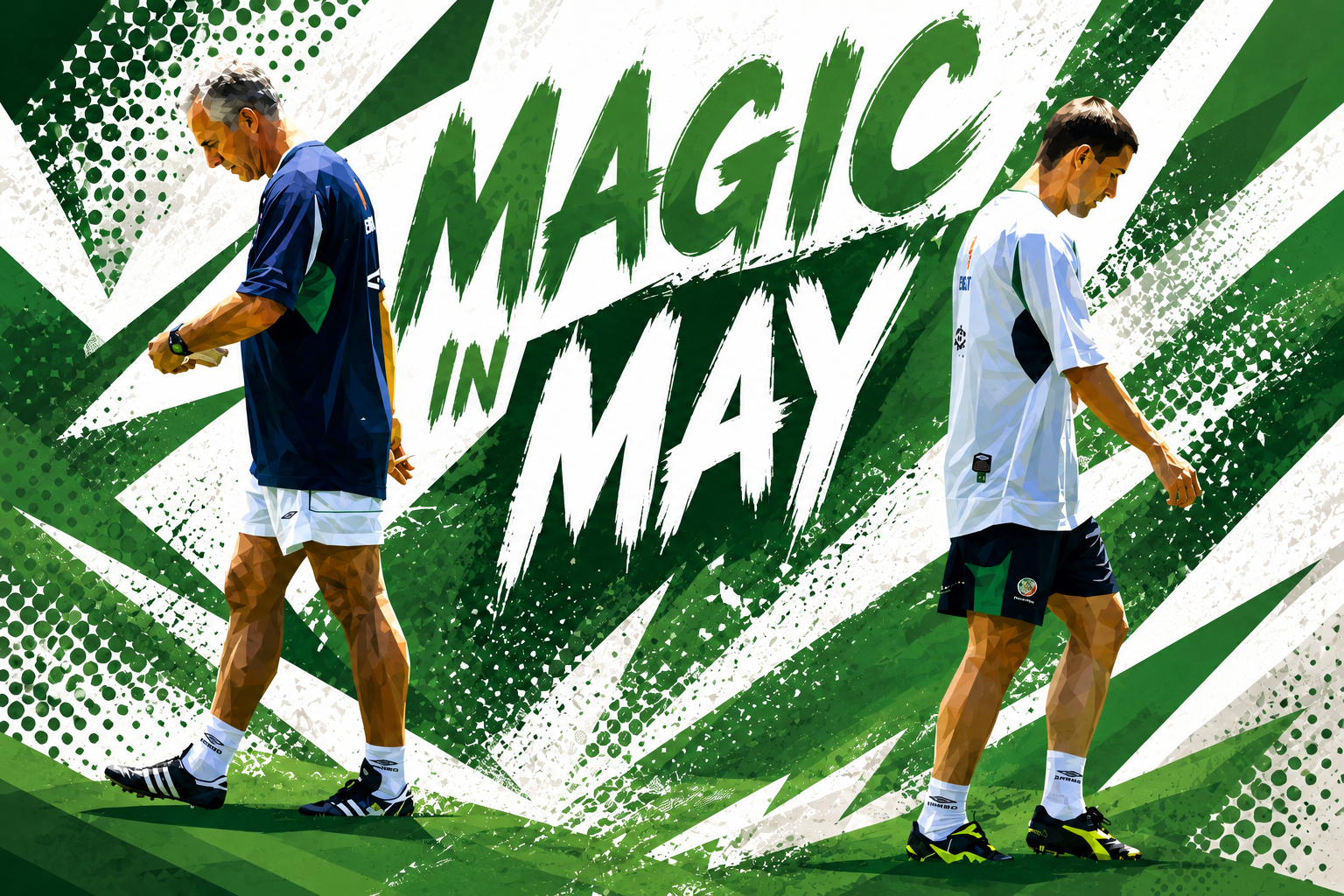
“You can stick your World Cup up your arse”
The room had already gone quiet before Roy Keane spoke.
Not ordinary quiet. Not the loose silence of tired footballers waiting for another meeting to end. This was tighter. Players shifting in their seats. Staff staring down. The kind of silence that tells you trouble has arrived before anybody has named it.
Outside the Hyatt Regency hotel, Saipan felt almost unreal. Palm trees. Pacific heat. Darkness pressed against the windows. Inside the Republic of Ireland camp on the evening of May 23, 2002, the air had gone thin.
The World Cup had not even started.
Mick McCarthy stood at the front of the room holding a copy of The Irish Times interview that had blown open the camp.
Roy Keane knew why.
The interview had set out his anger at Ireland’s preparation. The missing equipment. The chaotic travel. The training ground he regarded as dangerous. The feeling that Ireland had arrived at the biggest tournament in football carrying the habits of a provincial touring side.
For days, irritation had been building beneath the surface.
The flight to Saipan had exhausted players before proper training had even begun. Footballs and medical equipment had failed to arrive with the squad. Sessions had been improvised. Recovery routines had been disrupted. The training pitch itself looked wrong. Hard ground beneath tired legs at the end of a brutal European season.
Most players grumbled privately and got on with it.
Keane could not.
At Manchester United, every detail mattered. Every meal. Every recovery session. Every training surface. Under Sir Alex Ferguson, elite football had become an obsession with control. Margins decided everything. Preparation was not cosmetic. Preparation was survival.
Ireland, to Keane, still behaved as though spirit could compensate for structure.
McCarthy tried to steady the room. He asked Keane to explain the interview. At first, the exchange remained tense but controlled. Then came the line that changed everything.
McCarthy accused Keane of having let the country down before. Of exaggerating injuries. Of withdrawing when Ireland needed him.
Specifically, he referenced the play-off against Iran.
For a second, nobody moved.
Then Keane exploded.
Not theatrically. Not performatively. There was nothing rehearsed about it. This was years of resentment leaving the body at once. Anger, pride, exhaustion, distrust and humiliation, all thrown across the room.
“I don’t rate you as a manager,” Keane told him. “I don’t rate you as a person.”
The words landed hard.
Nobody interrupted him.
Senior players sat frozen. Niall Quinn. Steve Staunton. Men who had spent years in dressing rooms suddenly unsure whether to intervene or disappear into their seats. Some stared at the floor. Others looked at McCarthy. Nobody looked comfortable.
By then, the room had stopped functioning as a dressing room. This was no longer captain versus manager. No longer player versus authority. Something deeper had surfaced. Two visions of Irish football standing face to face with nowhere left to retreat.
McCarthy attempted to regain control, but the meeting had already escaped him.
“You can stick your World Cup up your arse,” Keane said finally.
And that was it.
No cinematic ending. Just silence.
The silence afterwards was what lingered.
Reserve goalkeeper Dean Kiely tried to break it with a joke about being able to do a job in midfield himself. Nobody laughed properly. Keane stood up and walked out of the room. No teammate followed him. No senior figure stopped him. The captain of Ireland disappeared down the corridor alone.
Within hours, McCarthy confirmed that Roy Keane had been sent home from the World Cup.
Ireland had not kicked a ball in the tournament yet, but the defining moment of their summer was already over.
Saipan was never really about Saipan
For more than two decades, the story has often been told as a choice between two easy conclusions.
Either Roy Keane was a selfish egotist who abandoned his country on the eve of a World Cup.
Or he was the only adult in the room, a ruthless professional trapped inside a broken football culture that mistook chaos for charm.
Both versions are incomplete.
The reason Saipan still matters is because neither side ever fully won the argument.
Keane was right about many of the standards. The later Genesis review of the FAI’s World Cup preparation criticised the association’s planning and structures, while contemporary reporting also described serious shortcomings in the FAI’s preparation and management systems.
But that does not automatically make Keane right about everything else.
Football teams are not management consultancies. They are fragile emotional ecosystems. Managers are not simply administrators of elite performance. They are custodians of trust, rhythm and collective belief. McCarthy understood that instinctively. Players would run through walls for him because he treated them like human beings first and footballers second.
That mattered.
What happened in Saipan was not simply a row about footballs, flights or training pitches. It was a collision between two entirely different understandings of what international football should be.
McCarthy belonged to an older Irish football culture. Imperfect, emotional, resilient, occasionally chaotic. The culture built by Jack Charlton’s teams had relied heavily on spirit, adaptability and collective sacrifice. Ireland were not expected to compete with Europe’s elite technically, so they competed psychologically instead. The mythology of those sides was built on camaraderie as much as coaching.
Keane came from somewhere else entirely.
By 2002, he was captain of Manchester United and one of the most demanding footballers in the world. His daily environment under Ferguson revolved around precision, accountability and relentless internal pressure. Mistakes were hunted down. Standards were non-negotiable. Sentiment carried no weight. Success belonged to the people willing to become consumed by detail.
Keane did not arrive in Saipan looking for atmosphere. He arrived believing Ireland could genuinely compete at the World Cup if they behaved like an elite nation.
The problem was that much of Irish football still viewed that mentality with suspicion.
To many supporters, there remained something uncomfortable about Keane’s intensity. Irish sporting identity had long celebrated resilience, wit and underdog spirit. Keane represented something colder. More exacting. Less forgiving. He did not romanticise struggle. He did not believe effort alone deserved admiration. He wanted Ireland to stop congratulating itself for merely belonging at major tournaments.
That made him both transformational and isolating.
By the early 2000s, the Republic of Ireland itself was changing rapidly. The old economic and cultural certainties were being tested by the force of the Celtic Tiger boom. A country historically shaped by emigration, modest ambition and suspicion of grand claims was suddenly becoming wealthier, sharper and more globally connected. The old Irish instinct to make do increasingly collided with newer expectations of professionalism and excellence.
Keane embodied that shift more aggressively than any Irish footballer before him.
He did not want Ireland to be plucky. He wanted them to be elite.
The tragedy of Saipan is that both sides could see part of the truth.
McCarthy understood dressing rooms better than Keane did. Keane understood elite performance better than McCarthy did.
And somewhere between those two realities, Ireland lost the greatest footballer the country had ever produced on the eve of its most important modern tournament.
Cork, fear and the making of Roy Keane
Roy Keane did not emerge from Irish football as a natural romantic.
There was no softness to the environment that shaped him. No sense of football as escapism or theatre. In Cork, particularly the working-class Cork that produced Keane, respect was conditional. You earned it or you went without it. Humiliation lingered. Weakness travelled fast.
Keane carried that mentality into everything.
Years later, he would joke that a superiority complex was the mark of a sound Corkman, but beneath the humour sat something real. Defensiveness. Pride. The constant need to prove that nobody was looking down on you. That you belonged wherever you walked into the room.
Even as a young player, Keane seemed permanently alert to disrespect.
His route into professional football was hardly smooth. English clubs initially dismissed him as too small. Trials came and went without contracts. There was no grand teenage coronation waiting for him across the water. When Nottingham Forest eventually signed him in 1990, Keane arrived in England not with entitlement, but with suspicion. He expected football to be ruthless because life had already taught him that it usually was.
Brian Clough quickly reinforced the lesson.
Clough remained one of English football’s great contradictions by that stage. Brilliant, charismatic and fading. The European Cup-winning visionary whose methods increasingly belonged to another age. For Keane, though, Clough’s Forest became an education in brutality as much as football.
One moment stayed with him forever.
During a match, Keane played a backpass to his goalkeeper. Afterwards, inside the dressing room, Clough walked over and punched him directly in the face.
Keane later recalled being too shocked to do anything except nod.
The incident mattered because Keane did nod.
Not out of weakness. Out of understanding.
Professional football, he realised almost immediately, was built on confrontation. Managers humiliated players. Players betrayed teammates. Clubs discarded people without emotion. Success depended on surviving psychologically as much as technically.
From that point onwards, Keane built armour around himself.
Distrust became instinctive. He developed an almost allergic reaction to laziness, excuses and self-promotion. In his mind, football was crowded with people looking for shortcuts. Bluffers. Passengers. Individuals protected by charisma rather than standards. The only reliable defence against failure was preparation so extreme that nobody could question your commitment.
That mentality eventually became both his greatest strength and his deepest flaw.
Keane’s intensity was never simply about winning trophies. It was about control. About removing vulnerability before vulnerability could expose him. Teammates often interpreted his anger as aggression directed outward, but much of it began internally. He demanded impossible standards from others because he demanded them from himself first.
And once he reached the elite level under Ferguson, those instincts hardened further.
Manchester United did not dilute Keane’s psychology. They industrialised it.
The club became the perfect environment for someone who viewed football as a daily examination of character. Weakness was punished there too, only more professionally. Ferguson could smell complacency before players recognised it in themselves. Standards became cultural. Winning stopped being emotional and became procedural.
Keane thrived inside that world because it validated everything he already believed.
Which meant that every return to the Republic of Ireland setup became harder to tolerate.
Not because he loved Ireland less than anyone else.
Because by the end, he expected more from it than almost anyone else did.
The player Ireland had never produced before
Keane arrived at Manchester United in the summer of 1993 carrying the burden of succession before he had properly unpacked his bags.
Bryan Robson was still there, still revered, still the emotional standard by which modern United midfielders were measured. Robson had represented everything English football traditionally admired: courage, running power, leadership through sacrifice. Replacing him was not simply tactical. It was symbolic.
Keane never looked intimidated by it.
That was the first sign he might become something rarer than merely excellent.
Under Ferguson, United were evolving into the dominant English side of the era, but they still lacked complete emotional control in major European matches. Domestically, they could overwhelm teams through tempo and talent. In Europe, games often became slower, more tactical and psychologically demanding. Ferguson needed a midfielder capable not just of competing physically, but of imposing emotional authority on elite matches.
Keane became that player.
Initially, his game contained more chaos than control. He surged into tackles, covered impossible distances and played with the aggression of someone trying to prove he belonged among established stars. But gradually, his football intelligence sharpened. His passing became quicker and cleaner. His positioning improved. He learned how to dictate the emotional rhythm of matches rather than simply reacting to them.
This was what separated Keane from being merely an elite competitor.
He controlled panic.
When games became unstable, teammates looked for him instinctively. Not because he was flamboyant. Not because he produced moments of aesthetic genius. But because he simplified pressure. He demanded the ball when others hid from it. He accelerated games when caution threatened to suffocate them. He slowed them when emotion risked overwhelming structure.
By the mid-1990s, he had become the axis around which Ferguson’s side rotated.
And then came Turin.
The second leg of the 1999 Champions League semi-final against Juventus remains the defining performance of Keane’s career because it exposed every essential truth about him within ninety minutes.
Manchester United arrived in Italy carrying enormous pressure. The tie sat delicately balanced after the draw at Old Trafford. Inside eleven minutes, United were 2-0 down. The Stadio delle Alpi felt ready to consume them. Zinedine Zidane drifted through midfield with that effortless authority unique to great players. Juventus looked calmer, smarter and more experienced.
Then Keane changed the emotional direction of the match almost single-handedly.
First came the header from David Beckham’s corner. Not elegant. Not cinematic. Just violent determination thrown at the game with total force. Then the rest followed. Tackles. Recoveries. Relentless pressing. Constant availability for possession. He dragged United upward psychologically before they fully recovered tactically.
Most importantly, he did it knowing he would miss the final through suspension.
That detail matters because it revealed something fundamental about Keane’s relationship with football. Lesser players would have drifted emotionally after the yellow card that ruled them out of Barcelona. Self-pity would have entered the performance. Some subconscious preservation instinct might have appeared.
Keane responded by becoming more influential.
Ferguson later described it as the most emphatic display of selflessness he had seen on a football field.
It was not simply a great midfield display. It was leadership expressed through football itself.
Every part of the performance reflected the psychological standards Keane demanded from the people around him. No surrender. No emotional collapse. No acceptance of context. Juventus leading 2-0 away from home was irrelevant because Keane refused to emotionally recognise defeat while the game remained alive.
United eventually won 3-2.
Long before Ole Gunnar Solskjaer’s goal against Bayern Munich in the final, Keane had already authored the emotional masterpiece of that European campaign.
Back in Ireland, the effect was profound.
The Republic had produced outstanding footballers before. Players admired across England and Europe. But Keane represented something different entirely. He was not surviving at the elite level. He was dominating it. Dictating it. Captaining the biggest club in England during one of its greatest eras.
For a country still emotionally attached to the underdog identity of Italia ’90, Keane’s rise challenged long-held assumptions about what Irish footballers could be.
He did not want admiration for competing bravely.
He expected to win.
Why Roy Keane was impossible to live with and impossible to replace
The easiest way to misunderstand Roy Keane is to reduce him to aggression.
The snarl. The tackles. The confrontations. The mythology of the hard man midfielder has followed him for so long that it occasionally obscures the far more important truth about his football.
Keane was one of the great controllers of emotional tempo in modern British football.
Everything about the best teams he played in flowed through that quality.
At his peak, Keane occupied matches psychologically before he occupied them tactically. Opposition midfields felt him before they escaped him. Teammates adjusted themselves according to his standards. Entire games subtly bent toward the emotional intensity he demanded.
That is much harder to replicate than technical brilliance.
Plenty of players can pass. Plenty can tackle. Plenty can run.
Very few can impose collective emotional order on twenty-one other footballers.
Keane did it constantly.
Under Ferguson, United often played with extraordinary attacking freedom. David Beckham’s crossing range. Ryan Giggs accelerating through space. Dwight Yorke and Andy Cole rotating fluidly across the forward line. Later, Paul Scholes operating between midfield and attack with almost mathematical intelligence.
What held the structure together was Keane.
Not because he sat deep like a modern holding midfielder. He was never simply a destroyer screening the defence. His influence came from interpretation. He understood when matches required calm and when they required confrontation. He sensed momentum shifts before they became visible.
Watch those United sides carefully and Keane is almost always the emotional first responder.
When opponents threatened to destabilise games physically, he increased intensity. When teammates retreated into caution, he demanded the ball more aggressively. When United became careless in possession, he shortened the rhythm and restored control.
He also protected the ambition of the side in less obvious ways. If Gary Neville advanced on the right, Keane sensed the space that might open behind him. If Scholes moved higher, Keane adjusted the balance. If United’s forwards lost the ball early, Keane often led the second wave of pressure that stopped counter-attacks before they became visible danger.
He was not elegant in the continental sense. There was nothing ornamental about his football. But his positional discipline and passing speed were elite. One-touch circulation. Sharp vertical balls through midfield. Constant movement into spaces where pressure could be absorbed and redistributed.
Most importantly, he never hid.
That sounds simple. It is not.
Elite football increasingly punishes psychological hesitation. Under pressure, even outstanding players subconsciously drift away from responsibility. Keane moved toward it instead. He wanted the game when matches became dangerous.
This was why Ferguson trusted him so completely.
Influence was the correct word.
Keane affected the emotional behaviour of everyone around him.
And nowhere was that clearer than with Ireland during qualification for the 2002 World Cup.
The defining performance came against the Netherlands at Lansdowne Road in September 2001.
Ireland were already overachieving in a brutal qualification group containing the Dutch and Portugal. The Dutch side contained extraordinary technical quality: Patrick Kluivert, Clarence Seedorf, Ruud van Nistelrooy, Edgar Davids. Early in the match, Gary Kelly was sent off. Ireland faced almost the entire game with ten men.
It should have collapsed.
Instead, Keane delivered one of the greatest international performances ever produced by an Irish footballer.
He covered impossible ground. Pressed relentlessly. Broke Dutch rhythm repeatedly. Demanded possession under pressure. Organised teammates constantly. Every phase of the game seemed to run through him. Ireland won 1-0, and by the final whistle the stadium understood it had witnessed something beyond ordinary leadership.
This was not motivation in the clichéd sense.
It was competitive will translated directly into football structure.
Keane’s teammates often spoke about the pressure of playing alongside him. Some found him exhausting. Others found him intimidating. Younger players occasionally looked terrified of disappointing him. But they also understood what his intensity provided.
Security.
Because if Keane accepted your standards, he trusted you completely.
That was the paradox at the centre of his career. The same qualities that made him almost impossible to live with also made him irreplaceable once removed.
Ireland discovered that fully only after Saipan.
Without Keane, the team became emotionally lighter. Freer. More unified publicly. But they also lost the one player capable of controlling elite matches from the centre of the pitch.
They lost the player who believed Ireland belonged at the highest table before Irish football fully believed it itself.
Mick McCarthy’s side of the story
The danger in writing about Saipan is that Roy Keane’s force of personality can flatten everybody around him into supporting characters.
Mick McCarthy deserves better than that.
History has gradually tilted toward Keane because many of his complaints about the FAI were ultimately validated. The infrastructure was inadequate. The preparation was flawed. The Genesis Report exposed serious weaknesses in planning and professionalism afterwards.
But that still does not make McCarthy foolish, weak or backwards.
In many ways, he represented the exact qualities Irish football had depended upon for decades.
McCarthy understood footballers emotionally. He understood dressing rooms culturally. He knew international football was different from club football because international managers do not control players every day. They inherit fragmented personalities from different clubs, tactical systems and national expectations, then attempt to build trust quickly enough for tournaments to function.
That requires emotional intelligence more than tactical perfection.
Players generally liked McCarthy because he removed tension rather than creating it. He was approachable, dryly funny and instinctively human in an environment increasingly becoming clinical and corporate. There remained something deeply old-school about him. Not in the sense of incompetence, but in the belief that footballers performed best when they felt emotionally relaxed.
For many Irish internationals, that atmosphere mattered enormously.
Ireland’s identity under both Jack Charlton and McCarthy had been built partly on emotional freedom. Team spirit was not marketing language inside those squads. It was tactical fuel. Ireland often lacked the technical depth of elite European nations, so collective trust became essential. Camaraderie mattered because it compensated for limitations elsewhere.
Keane increasingly viewed that culture as complacency.
McCarthy viewed it as survival.
That tension sat underneath almost every disagreement between them.
To Keane, laughter during inadequate preparation symbolised weakness. To McCarthy, maintaining perspective prevented pressure from swallowing players whole. Keane believed discomfort sharpened standards. McCarthy believed too much internal tension could fracture squads entirely.
Neither man was completely wrong.
And crucially, many players sided with McCarthy not because they lacked ambition, but because they recognised something difficult about Keane’s worldview: eventually, his intensity became exhausting to inhabit continuously.
Even inside the United dressing room, Keane could divide opinion. Younger players often admired him while simultaneously fearing him. Some teammates found his standards inspirational. Others found them oppressive. Ferguson managed that dynamic carefully because he understood Keane’s mentality could drive elite performance but also destabilise relationships if left unchecked.
International football provided fewer mechanisms for managing it.
McCarthy also carried his own authority into the situation. This is sometimes forgotten because Keane eventually became the larger football figure historically, but McCarthy was not some accidental placeholder. He had captained Ireland himself. Played at major tournaments. Led through difficult periods. He possessed enormous credibility within the squad.
And unlike Keane, McCarthy understood compromise instinctively.
That mattered during qualification for the 2002 World Cup. Ireland were not blessed with extraordinary individual talent across the pitch. They succeeded because the squad functioned collectively. Players trusted the environment. They fought for one another. McCarthy created emotional stability around a team that could easily have fractured under pressure.
Even after Saipan, that cohesion partly explains why Ireland performed so resiliently in Japan and South Korea.
There is another uncomfortable truth too.
Some players privately agreed with Keane’s criticisms of the FAI while still believing he had crossed a line publicly.
That contradiction sits at the centre of the entire episode.
The squad knew standards were imperfect. They knew preparation could be chaotic. But many also believed there were moments when collective responsibility had to override individual principle, even when the principle itself was correct.
McCarthy embodied that philosophy completely.
When he later explained the decision, his case was simple: he could not tolerate that level of abuse being thrown at him, and he believed he had acted for the benefit of the squad.
That was not a small thing.
McCarthy had to stand in front of the squad and calculate the cost of keeping his best player against the cost of losing his authority. In club football, a manager can sometimes absorb a difficult captain because tomorrow offers another training session, another meeting, another chance to repair the room. A World Cup camp gives you no such luxury. Once authority breaks there, it breaks in front of everyone.
McCarthy did not believe international football could survive permanent confrontation. Keane almost seemed unable to function without it.
And by the time the squad arrived in Saipan, those two worldviews had become impossible to reconcile.
The explosion started years earlier
By the time Roy Keane boarded the flight to Saipan in May 2002, the relationship between himself and the Republic of Ireland setup was already carrying years of accumulated resentment.
The World Cup camp did not create the fracture.
It merely exposed one that had been widening quietly for a decade.
One of the earliest warning signs arrived back in 1992 during a tournament in the United States. Keane was still young then, still raw enough to challenge authority without fully understanding the consequences. After turning up late for the team bus following a night out, he clashed with McCarthy, who was captain at the time.
The confrontation was relatively minor in isolation.
But Keane remembered it.
That mattered because Keane remembered everything.
Slights lingered with him long after most footballers had forgotten them. He carried arguments forward emotionally, storing grievances almost as motivational fuel. By his own later admission, the distrust between himself and McCarthy never fully disappeared after that American tour.
As Keane’s stature in football grew, his tolerance for what he viewed as mediocrity shrank proportionally.
Playing for Ireland increasingly became an exercise in psychological compromise.
At United, elite preparation had become routine. Recovery protocols. Nutrition planning. Tactical analysis. Precise training structures. Ferguson and his staff obsessed over marginal gains before the phrase itself became fashionable. Players arrived at matches conditioned to believe every detail mattered because, at the highest level, it usually did.
Then Keane would join Ireland camps and encounter something completely different.
Travel arrangements became recurring sources of irritation. Flights felt improvised. Hotels varied wildly in quality. Recovery standards often lagged behind the elite European clubs many players represented. Keane complained privately about players being served food he considered unsuitable before important qualifiers. Cheese sandwiches became symbolic of the wider problem, shorthand for an organisation still behaving as though professionalism was optional rather than foundational.
The hierarchy within the FAI irritated him too.
According to multiple accounts, Keane became furious at the perception that administrators often treated themselves with greater importance than the players representing the country. Stories circulated of officials flying first class while players travelled in business. Small details perhaps, but Keane viewed football entirely through small details.
To him, those details revealed mentality.
And mentality determined outcomes.
There was also the issue of his body.
By the early 2000s, Keane was carrying significant physical strain beneath the surface of his performances. Years of relentless football had begun to erode him. His hip problems increasingly required careful management. Painkillers, stretching routines and constant maintenance became part of daily life. At United, the medical and conditioning infrastructure around him reflected the needs of an elite athlete operating near physical exhaustion.
With Ireland, Keane often felt exposed.
Training on poor surfaces infuriated him partly because he genuinely feared injury. The image of him as permanently indestructible occasionally obscures how anxious he became about physical decline. His entire football identity depended upon intensity. If the body failed, the foundation beneath his game weakened too.
Meanwhile, much of the Irish squad adapted differently to imperfect conditions.
This is important.
Not because they lacked ambition. Many Irish internationals were hardened Premier League professionals themselves. But culturally, they possessed a greater tolerance for chaos. The old Irish football instinct remained powerful: stop complaining, get on with it, make the best of things.
Keane could not emotionally function that way anymore.
To him, accepting poor standards was participation in poor standards.
That mindset increasingly isolated him from teammates even before open conflict emerged. Some admired his refusal to compromise. Others found it relentless. There were moments when Keane appeared less interested in protecting dressing-room harmony than in forcing people to confront uncomfortable truths immediately.
International football rarely rewards that approach.
Unlike club football, there is little time for ideological wars. Tournaments demand emotional flexibility. Problems must often be parked temporarily for collective survival.
Keane struggled to do that.
As qualification for the 2002 World Cup progressed, the contradictions became sharper. On the pitch, he was magnificent. Ireland’s qualification campaign contained some of the finest football of his international career. Against elite opposition, he dragged performances upward through sheer force of personality and tactical intelligence.
Off the pitch, however, his frustration with the culture around the team deepened continuously.
By the time Ireland reached Saipan, the smallest spark was always going to ignite something much larger.
The explosion felt sudden to the outside world because the public only saw the final detonation.
Inside the camp, the pressure had been building for years.
The week Irish football split in two
The collapse began almost immediately.
Even before the Republic of Ireland squad reached Saipan, Keane sensed the familiar drift toward disorder that had come to define his relationship with the national setup. Dublin Airport was chaotic. Crowds pressed around players. Organisation felt improvised. Small delays accumulated into larger frustrations. Most squads absorb those moments and move on.
Keane catalogued them.
The flight itself only deepened the mood. Players endured the physical exhaustion of long-haul travel at the end of an already brutal club season. Bodies were stiff. Sleep patterns broken. Recovery routines disrupted. Some members of the Irish camp attempted to keep spirits high with jokes and conversation.
Keane retreated inward instead.
By the time the squad arrived on the Pacific island, irritation had already hardened into suspicion.
Then came the missing equipment.
The skips containing footballs, training gear and medical supplies had failed to arrive with the team. Sessions had to be improvised. Staff scrambled for solutions. What many players viewed as an inconvenience, Keane interpreted as proof that the FAI remained fundamentally incapable of operating at elite international level.
And then he saw the training ground.
The pitch has since become one of the defining images of Saipan because it symbolised everything Keane believed was wrong with Irish football administration. The squad had expected world-class preparation facilities ahead of the biggest tournament on earth. Instead, they found something resembling a neglected municipal surface. Hard ground. Uneven patches. Minimal grass. McCarthy himself later admitted it was poor.
Keane looked at it with disbelief.
He was thirty years old by then, carrying chronic hip problems after years of punishing football in England. At United, training loads, surfaces and recovery work were monitored obsessively. Ferguson understood that elite players nearing physical wear needed protection as much as motivation.
Saipan felt reckless by comparison.
The tension escalated further during a training-ground disagreement involving goalkeeping coach Packie Bonner and goalkeeper Alan Kelly. Keane wanted two goalkeepers available for a small-sided session. Bonner refused, arguing the keepers had already completed separate work and needed recovery.
To most squads, it was a minor football disagreement.
To Keane, it represented surrender to mediocrity.
The exchange grew heated enough for journalists nearby to sense genuine fracture developing within the camp. Players started taking sides quietly. Some sympathised with Keane’s demands. Others thought he was pushing the environment toward collapse over issues that should have remained internal.
The deeper problem was that nobody truly defused anything.
McCarthy attempted to calm the situation privately. Keane briefly informed management that he intended to leave the camp before reversing the decision after conversations with Ferguson and his adviser Michael Kennedy. For a few fragile hours, it appeared the crisis might still pass.
Then the interviews appeared.
Keane had spoken to journalists Tom Humphries and Paul Kimmage about the conditions in Saipan and the wider failures of preparation surrounding the squad. He described the operation as a farce. He criticised standards openly. He questioned whether the setup possessed genuine ambition.
Importantly, Keane believed he was forcing necessary truths into the open.
McCarthy saw public disloyalty.
That distinction destroyed whatever trust remained.
When The Irish Times published the interview, McCarthy understood immediately that his authority had been challenged in front of the entire country. International football managers survive partly through emotional control of dressing rooms. Once players sense that authority weakening publicly, tournaments can unravel quickly.
So McCarthy called the meeting.
In retrospect, it became the point of no return.
Not because disagreement itself was impossible to repair, but because the confrontation happened in front of the entire squad rather than privately behind closed doors. McCarthy needed to reassert authority publicly. Keane felt cornered publicly. Neither man possessed the temperament to retreat once challenged directly.
The room inside the Hyatt Regency became painfully tense almost immediately.
McCarthy held up the newspaper and demanded explanations. Keane defended his criticisms. Voices rose. Teammates stared downward. Staff members shifted uneasily against the walls.
Then McCarthy accused Keane of having let the country down before. Of exaggerating injuries. Of failing Ireland when commitment was required.
The reference to the play-off against Iran detonated everything.
Keane’s reaction felt less like anger than accumulated fury finally escaping containment. The famous insults came rapidly and viciously.
But the insults themselves were only part of it.
What truly stunned the room was the personal dismantling that followed. Keane attacked McCarthy’s credibility completely. As a player. As a manager. As a man. He mocked his authority. Mocked his standing.
The squad sat in silence as their captain verbally destroyed their manager in front of them.
And beneath the rage sat something sadder.
Exhaustion.
Years of frustration pouring out uncontrollably because neither side any longer possessed the emotional tools to stop the collapse.
When Keane finally told McCarthy to stick his World Cup up his arse, the room already understood the relationship was beyond repair.
The silence afterwards lingered longest.
Dean Kiely attempted a joke about being able to do a job in midfield, desperate to puncture the atmosphere before it swallowed everyone whole. The laugh never really came.
Keane walked out alone.
No teammate followed him immediately. No dramatic intervention arrived. The captain disappeared down the corridor while the rest of the squad remained seated in stunned disbelief.
Ferguson later said Keane had legitimate grounds to be angry about the facilities. But he also asked the only question that still matters: how far do you take a grievance?
Within hours, McCarthy confirmed publicly that Keane had been sent home from the World Cup.
Ireland had travelled to the Pacific hoping to prepare for the greatest tournament in football.
Instead, the country had stumbled into its own civil war.
Ireland without Roy
In the immediate aftermath of Saipan, the Republic of Ireland dressing room resembled a team trying to convince itself it had survived something necessary.
Publicly, the squad rallied around McCarthy.
Senior players stood beside him at press conferences. Unity became the message. Togetherness. Focus. The language of collective survival replaced the chaos of the previous days. There was little alternative. The World Cup was beginning and Ireland could not emotionally afford to remain trapped inside the argument.
Privately, the emotions were more complicated.
Some players felt relieved.
That truth remains uncomfortable in Ireland because it cuts against the mythology that everyone instantly recognised Keane’s departure as catastrophic. Footballers respected him enormously, but living alongside his intensity for weeks at a tournament had become draining. Several squad members later admitted the atmosphere relaxed after he left. Conversations became easier. Training lighter emotionally. The constant fear of confrontation disappeared.
McCarthy understood this shift instinctively and leaned into it.
The squad became less tense, less fractured internally. The emotional burden of managing Roy Keane had vanished overnight, even if the footballing burden remained impossible to replace.
And that burden became obvious almost immediately.
Ireland opened the tournament against Cameroon with a performance that looked emotionally resilient but structurally incomplete. Without Keane, midfield responsibility dispersed awkwardly across multiple players rather than concentrating through one dominant figure. Ireland still competed fiercely, still carried the familiar McCarthy-era resilience, but the game lacked control.
The draw felt respectable.
The second match changed everything emotionally.
Against Germany, Ireland spent long periods chasing shadows. Germany moved the ball calmly. Ireland defended deeply. Once Miroslav Klose scored, elimination loomed heavily over the tournament. Yet somehow the team kept surviving emotionally. McCarthy’s greatest strength as a manager surfaced fully during moments like this. Ireland never mentally abandoned matches under him.
Then, in stoppage time, Robbie Keane equalised.
The goal remains one of the defining moments in modern Irish football history because it seemed to vindicate the idea that collective spirit could transcend individual loss. Robbie Keane sprinted away screaming. Irish supporters erupted. McCarthy celebrated wildly on the touchline.
Meanwhile, thousands of miles away in Cheshire, Roy Keane watched on television.
That image haunted the tournament continuously.
Because every positive Irish result deepened the central contradiction of Saipan rather than resolving it.
Ireland were proving they could survive without him emotionally.
But football is rarely only emotional.
Against Saudi Arabia, Ireland finally won and reached the knockout stage. The celebrations carried genuine warmth. Players looked freer than they had in Saipan. McCarthy appeared vindicated publicly. The country slowly rallied behind the squad again.
Then came Spain.
The round-of-16 meeting with Spain remains one of the great unresolved what-if matches in Irish sporting history because the game unfolded almost perfectly for the Roy Keane debate to intensify permanently.
Spain were superior technically. More composed in possession. More fluid between the lines. Ireland spent large periods chasing the game. Yet they refused to collapse. A missed penalty from Ian Harte should have ended them emotionally. Instead, they kept pushing. Robbie Keane equalised late again from the penalty spot. Spain eventually went down to ten men during extra time.
And suddenly the impossible began whispering through the match.
Ireland could actually win this.
This was where Keane’s absence became almost physically visible. The game cried out for someone capable of controlling midfield once fatigue had taken the legs and fear had entered the pitch. Someone who could demand possession, slow Spain’s rhythm, win the second ball, organise the next press, and make a tired team believe the ball still belonged to them.
Ireland had courage.
What they no longer possessed was Roy Keane.
The penalty shootout defeat felt devastating partly because the pathway beyond Spain looked unusually open. South Korea awaited in the quarter-finals. A semi-final was imaginable. Not probable perhaps, but imaginable.
That possibility is what keeps Saipan alive culturally even now.
Because the tournament simultaneously strengthened both sides of the argument.
McCarthy proved Ireland could remain united without Keane.
Keane’s absence also reinforced how irreplaceable he remained against the very best opposition.
And perhaps that is the cruellest part of the entire story.
Ireland’s World Cup without Roy Keane became inspiring enough to survive him but never quite strong enough to stop needing him.
Roy Keane won the argument and lost the moment
In the years immediately after Saipan, Ireland tried desperately to force the story into a clean moral conclusion.
It never worked.
The country split into camps almost instantly. Team Roy and Team Mick became shorthand for something much larger than football opinion. Families argued. Radio phone-ins became national battlegrounds. Pubs divided themselves emotionally along generational and cultural lines.
For some, Keane had committed the ultimate betrayal. Ireland had waited eight years to return to the World Cup and their captain walked away days before the tournament began. No grievance, however legitimate, could justify abandoning teammates at the defining moment of their careers.
Others viewed him differently.
To them, Saipan represented the first time a major Irish sporting figure had refused to quietly tolerate institutional incompetence simply because patriotism demanded silence. Keane’s supporters believed he had exposed uncomfortable truths about Irish football culture that too many people preferred to ignore.
History gradually complicated the argument further.
The Genesis Report delivered a damaging assessment of the FAI’s preparation and organisational structure. Planning had been inadequate. Responsibilities unclear. Professional standards inconsistent. In practical terms, many of Keane’s complaints were effectively vindicated.
That mattered enormously because it shifted the public conversation over time.
Saipan stopped looking solely like the implosion of a difficult personality. Increasingly, it resembled a collision between elite modern professionalism and an institution struggling to modernise quickly enough around it.
Irish football changed because of that collision.
Preparation standards improved. Administrative structures evolved. Expectations rose. The old “sure it’ll be grand” mentality became harder to defend publicly in elite sport. Whether consciously or not, Keane forced Irish football to examine itself through harsher, more professional eyes.
But there remained a brutal personal cost.
Roy Keane never played at another major international tournament.
For all the medals, titles and iconic club performances that followed, the final World Cup of his career vanished in a hotel corridor in Saipan before a ball had been kicked. That absence leaves a strange incompleteness hanging over his international legacy even now.
Because Keane was not simply Ireland’s best player.
He was the first Irish footballer who genuinely belonged among the dominant figures of world football at the peak of his powers. Previous generations had produced outstanding players, but Keane captained one of the great modern club sides and controlled elite European matches from midfield. Ireland had never possessed a footballer quite like him.
And yet the defining image of his international career remains departure rather than performance.
That contradiction still shapes how people remember him.
There is another uncomfortable truth too.
Keane himself was not entirely built for compromise. The qualities that made him transformational also made him destructive. His refusal to lower standards inspired teammates and alienated them. His honesty could become cruelty. His intensity created elite performance while simultaneously exhausting the people around him.
In many ways, Saipan felt inevitable precisely because Keane was Roy Keane.
A more diplomatic personality might have survived the camp quietly and dealt with the fallout later. A more politically aware captain might have protected the dressing room publicly while fighting privately. Keane appeared psychologically incapable of operating that way once his trust collapsed.
That is what makes him such a compelling figure historically.
He did not merely demand excellence from Irish football. He demanded it absolutely, even when the timing became catastrophic.
This is the part of Saipan that still refuses to settle. Ireland did not simply lose a player. It lost the uncomfortable version of itself that Keane represented: ambitious, impatient, suspicious of sentiment, unwilling to accept the old consolations. But Keane also lost the Ireland that McCarthy protected: loyal, stubborn, communal, able to keep going when the room was broken. One man understood the standard. The other understood the group. At the only moment Ireland needed both, they destroyed each other.
Meanwhile, McCarthy’s own legacy evolved strangely too. Ireland’s performances at the 2002 World Cup restored some public affection toward him initially, but the emotional wounds of Saipan never fully healed around his reign. Attendances dipped afterwards. The atmosphere around the national team became fractured. Eventually, under growing pressure, McCarthy resigned later that year.
Both men, in different ways, became casualties of the same event.
And still the central question remains unresolved.
What if Keane had stayed?
What if McCarthy had handled the confrontation privately?
What if the FAI had prepared properly from the beginning?
What if Ireland had reached a semi-final with their greatest player controlling midfield?
The reason Saipan survives in Irish culture is because it exists permanently inside the space between justification and regret.
Roy Keane won the argument about standards.
But he lost the one stage his career still needed.
Triggs in Cheshire
On June 5, 2002, as Robbie Keane slid across the turf in Ibaraki after scoring against Germany, Ireland erupted.
Pubs shook. Car horns sounded through towns and cities. Grown men screamed at televisions. A country that had spent two weeks tearing itself apart suddenly rediscovered the emotional release only football can provide.
The Republic of Ireland were still alive at the World Cup.
Roy Keane watched it from home.
While his teammates prepared for matches against Germany and Spain, while Irish supporters painted faces and filled bars at impossible hours of the morning, the best footballer the country had ever produced walked his dog through the quieter rhythms of Cheshire life.
Triggs beside him.
The tournament continuing without him.
That image has endured because it captures something deeply sad about Keane beyond all the noise, arguments and mythology that followed Saipan.
He was right often enough to become vindicated historically.
The standards were poor. The preparation was flawed. Irish football did need to modernise. The Genesis Report proved much of that afterwards.
But football does not reward people simply for being correct.
Sometimes it rewards compromise. Timing. Silence. Emotional flexibility. The willingness to survive imperfect systems long enough to seize the moments that never come back.
Keane could never quite do that.
In his RTE interview after returning home, he insisted his conscience was clear. He also admitted the obvious human truth beneath all the defiance: the episode hurt him.
His greatness came from the same place as his self-destruction. The refusal to tolerate weakness. The inability to pretend standards were acceptable when he believed they were not. The conviction that elite sport demanded honesty even when honesty became combustible.
That mentality made him one of the defining midfielders of his generation.
It also cost him his final World Cup.
And perhaps that is why Saipan still feels unresolved all these years later. Not because Ireland ever fully chose between Roy Keane and Mick McCarthy, but because both men exposed truths the country was uncomfortable confronting at the same time.
McCarthy understood people.
Keane understood elite performance.
Irish football needed both.
Instead, on a humid night in the Pacific, it lost one of them before the tournament had even begun.
