


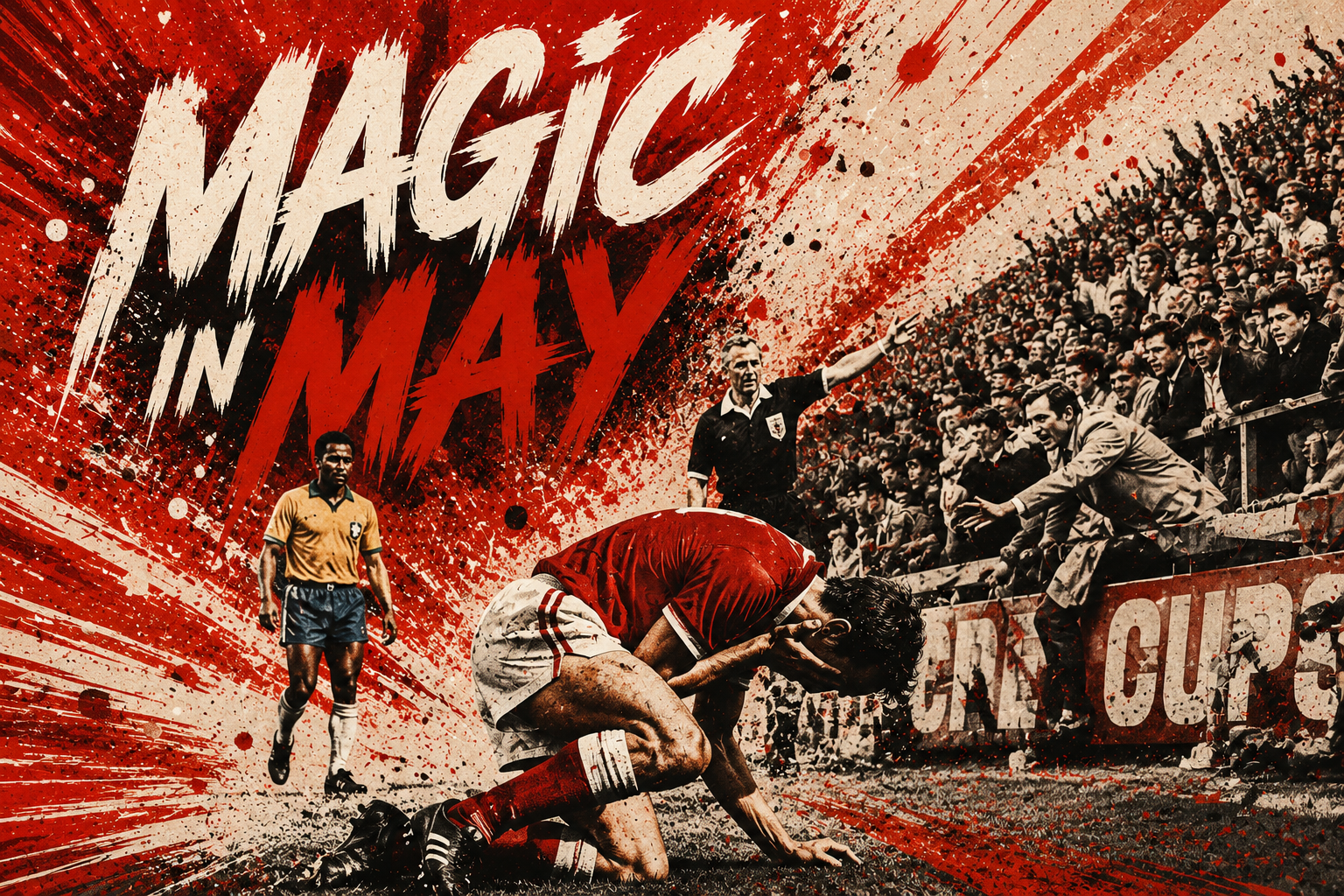
Gary Lineker is remembered as the polite face of English football. The truth is colder, sharper, and far more interesting: he was a ruthless specialist whose career ended just as the game began to move beyond players like him.
The missed Panenka that froze Lineker on 48
The old Wembley could still do silence better than any stadium in England.
On 17 May 1992, more than 53,000 people arrived expecting a ceremony disguised as a friendly. England against Brazil was almost secondary. The real occasion sat inside a simple number: 49. Gary Lineker, England captain, England’s centre-forward, England’s most reliable goalscorer for nearly a decade, needed one more goal to equal Sir Bobby Charlton’s national scoring record.
Everything about the afternoon felt pre-written. It was Lineker’s final appearance at Wembley before his planned departure to Japan and the beginning of the end of his England career. The crowd did not come merely to watch him play. They came to witness completion.
Ten minutes in, the script bent towards inevitability.
Lineker drifted across the Brazilian penalty area, then accelerated sharply between defenders. The movement itself was familiar. Small steps. Sudden burst. Defender reacting half a second too late. Bebeto, awkward and uncomfortable tracking the run, clipped him from behind. Scottish referee James McCluskey pointed to the spot immediately.
Wembley rose before the ball had even been placed down.
This was what Lineker did. Not the spectacular part. The ending. He had already scored four penalties for England, including the two against Cameroon that had rescued Bobby Robson’s side at the 1990 World Cup. His relationship with goals had always felt strangely practical. Others chased beauty. Lineker chased certainty.
Carlos Gallo waited on his line.
Lineker began his run-up.
Then, suddenly, he tried to become somebody else.
Instead of driving the penalty into the corner, he attempted a Panenka. The ball came off his boot badly, dragging low and flat through the middle of the goal rather than floating delicately over the goalkeeper. Gallo barely had to move. He simply stopped himself leaning left and gathered it.
For a second, Wembley seemed confused by what it had seen.
Lineker stood near the penalty spot. Gallo held the ball. Around them, the noise drained from the stadium.
It was not simply that he had missed. Strikers miss penalties. It was that the miss felt fundamentally wrong. Gary Lineker had built an entire career on refusing unnecessary risk inside the penalty area. He was football’s great simplifier. One touch when others took three. One movement instead of five. One finish before defenders understood the danger.
Yet here, with English football history waiting for him, he had abandoned the ruthless certainty that made him inevitable in the first place.
“I scuffed up some grass as I shot,” Lineker later said.
The explanation sounded mundane. The image did not.
He never scored for England again.
The polite public image never explained the footballer
The missed Panenka against Brazil survives because it fits awkwardly against the modern idea of Gary Lineker.
For more than three decades, English public life gradually transformed him from footballer into institution. First came the polished television presenter. Then the crisps adverts. Then the dry political commentary, the podcast empire, the silver-haired permanence of weekend football television. The image hardened into something comfortable: intelligent, polite, witty, essentially harmless.
But none of those versions explain the player.
The footballer Gary Lineker was not warm. He was not expressive. He was not interested in romance on the pitch. He played the game with a kind of emotional economy that could feel almost cold. While other great forwards imposed themselves physically or theatrically on matches, Lineker specialised in disappearance.
Defenders often spent entire games believing they had controlled him. Then they would look up and realise he had scored twice.
The Danish defender Kent Nielsen once described playing against him as closer to chess than football. That remains one of the better descriptions of Lineker’s game. Not artistry. Calculation.
He rarely dominated possession. Rarely dribbled through opponents. Rarely delivered the kind of goals replayed endlessly in montage culture. What made him devastating was harder to package visually: timing, angles, patience, and the ability to recognise danger before anyone else on the pitch fully saw it forming.
Watch Lineker carefully and one detail appears again and again.
He moved late.
Modern forwards often attack spaces early to stretch defensive lines. Lineker preferred hesitation. He lingered just outside the defender’s attention span, almost passive, before accelerating sharply across the blind side of a centre-half at precisely the moment a cross or second ball became vulnerable. He treated the penalty area less like territory and more like unfolding geometry.
That was why the Panenka felt so strange.
The attempt itself was not merely technically flawed. It violated the logic of Lineker as a footballer. This was a striker who built a world-class career by stripping risk out of scoring situations wherever possible. Even his finishing reflected restraint: side-foot finishes, first touches, near-post redirects, quick contacts before goalkeepers could reset themselves. He solved football problems rather than decorating them.
The popular memory of Lineker often centres on his decency. The real football truth was more uncomfortable for opponents than that. He was ruthless in a quieter way. He conserved energy because confrontation distracted from scoring. He avoided bookings not through saintliness alone, but because arguments with defenders wasted concentration.
Bobby Robson understood the trade-off better than most managers. “Gary was simply the best finisher I’ve ever seen,” Robson said, a line preserved in the National Football Museum’s Hall of Fame profile. That was the point. Lineker did not need to look involved all the time. He needed to be right when the ball arrived.
That simplicity became increasingly misunderstood as football evolved around him.
By the early 1990s, elite forwards were beginning to be judged differently. Coaches wanted pressing, hold-up play, tactical fluidity, defensive work, positional rotation. Lineker remained stubbornly specialised. He was perhaps the last great English striker whose entire existence could still revolve almost exclusively around scoring goals.
Which is why the penalty against Brazil carries such strange symbolic weight now.
For one moment, the coldest finisher of his generation stopped reducing the game to its essentials. He tried to make it beautiful instead. And in doing so, he exposed the tension that would follow the rest of his career: football was already changing into something that no longer fully understood players like him.
Leicester, cricket, and the making of a penalty-box brain
Long before Gary Lineker became obsessed with space inside penalty areas, he learned to think about angles somewhere entirely different.
Cricket came first.
Growing up in Leicester during the late 1960s and early 1970s, Lineker divided his sporting life between football pitches and cricket squares with little sense that one would eventually consume the other. At the City of Leicester Boys’ Grammar School, he developed into a talented batsman and captained the Leicestershire Schools side through his teenage years. For a period, he believed cricket might become his profession.
The influence of that game never really left him.
Batting, particularly at higher levels, is a sport built on anticipation rather than reaction. Players learn to read trajectory early, calculate space instinctively, and remain balanced while events accelerate around them. Much later, when defenders and managers tried explaining why Lineker always seemed to arrive first to loose balls inside crowded penalty areas, they were often describing instincts shaped years earlier with a cricket bat in his hands.
He idolised David Gower, the elegant England left-hander whose batting appeared effortless partly because it was so economical. There is an obvious football parallel there. Lineker’s game would eventually become defined by the same quality. Nothing wasted. No unnecessary movement. No dramatic physicality. Just timing.
Away from sport, life revolved around Leicester Market, where his father Barry ran a fruit and vegetable stall. The work was demanding and repetitive. Lineker and his younger brother Wayne helped out regularly, absorbing routines built around early mornings, reliability, and directness. Those who knew Lineker later in football often remarked on his professionalism and emotional steadiness. Much of that temperament existed long before the goals arrived.
There was little mythology around him as a teenager. No sense of a future national figure moving through the city. Physically, he developed late. He was slight, not especially imposing, and initially played in midfield rather than as an out-and-out striker. Even after joining Leicester City’s youth setup in 1976, he was not viewed as a certain star.
The school reports now read with accidental comedy. One teacher noted that he “concentrates too much on football” and doubted he would ever make a living from it. Yet there was a strange accuracy buried inside the criticism. Even then, Lineker’s focus on sport carried an almost narrow intensity. Friends and teammates would later describe a player whose mind constantly drifted back towards goals, movement, finishing, positioning. Not football in the broad sense. Scoring in the specific sense.
What mattered in Leicester was not the romantic idea of football, but repetition.
Lineker practised finishing endlessly. One-touch finishes. Quick turns. Rebounds. Small details. There was no fascination with tricks or spectacle because his game never developed around performance. Even as a teenager, he preferred efficiency to expression.
That partly explains why some elite managers later struggled with him.
Football culture increasingly celebrated forwards who could do everything: create, press, dribble, dominate possession, drift between positions. Lineker’s instincts moved in the opposite direction. He reduced the sport down to its simplest and most brutal question.
Where would the ball land next?
Few players in English football history answered that question better.
Everton, Mexico, and the moment Lineker became undeniable
By the middle of the 1980s, English football had started to understand that Gary Lineker was more than prolific.
The goals alone already demanded attention. He finished as Leicester City’s leading scorer year after year and shared the First Division Golden Boot in 1984-85 with 24 league goals. But prolific strikers existed throughout English football in that period. What separated Lineker was the growing sense that defenders never seemed fully prepared for how he scored.
He did not overwhelm opponents physically. Did not bully centre-halves. Did not dominate matches in the conventional sense. Entire games could drift past with Lineker barely touching the ball. Then a cross would arrive half-cleared, or a defensive line would hesitate for one second, and suddenly he was free inside the six-yard box.
Howard Kendall recognised immediately what Everton were buying when the club signed him for £800,000 in 1985.
Everton at that point were arguably the strongest side in England. Kendall had built a team with balance, aggression, width, and technical intelligence. Trevor Steven and Kevin Sheedy supplied crosses constantly from wide areas. Peter Reid controlled tempo underneath them. The side moved the ball quickly enough to expose transitional spaces before defences could reset themselves.
For a striker like Lineker, it was oxygen.
His first season at Goodison Park became the defining domestic campaign of his career. He scored 40 goals in 57 matches across all competitions, won the PFA Players’ Player of the Year and was named FWA Footballer of the Year. But the raw numbers still only told part of the story.
What Everton truly unlocked was his relationship with early delivery.
Lineker thrived when attacks developed before defenders established shape. He attacked unstable back lines brilliantly because his movement depended on uncertainty. Crosses whipped early into spaces between goalkeeper and centre-half suited him perfectly. He rarely waited statically in the middle of the box. Instead, he curved constantly across defenders, forcing them to turn their shoulders towards their own goal. Once that happened, he usually won the race.
There was very little glamour to it. Yet the effect was devastating. Lineker treated rebounds, flick-ons, ricochets, and loose touches as if they had predictable destinations. While defenders reacted, he anticipated.
Then came Mexico.
The 1986 World Cup transformed Lineker from elite English striker into global football figure, although even that tournament began awkwardly. England lost to Portugal, then drew with Morocco while Lineker struggled isolated inside a dysfunctional attack. Critics wondered if he could influence games without service.
Then Bobby Robson adjusted England’s shape and restored Peter Beardsley alongside him.
Suddenly the tournament changed.
Against Poland in Monterrey, Lineker scored a hat-trick that perfectly captured his strange efficiency. None of the goals belonged in World Cup highlight montages beside Diego Maradona slaloming through Belgium or Zico bending passes through defensive lines. They were predator’s goals. Sharp movements. Quick finishes. Relentless awareness of second balls and defensive panic.
The altitude suited him too.
While other forwards exhausted themselves chasing games in the Mexican heat, Lineker conserved energy obsessively. He rarely sprinted unnecessarily. Rarely pressed aimlessly. He waited. Watched. Calculated. Then exploded into space when the moment finally arrived.
The goals against Paraguay reinforced the pattern. One-touch finishing. Fast recognition. Minimal backlift. By the quarter-final against Argentina, England increasingly looked like a side built around his inevitability.
Even in defeat, Lineker remained the one English player who seemed capable of matching the emotional scale of the occasion. After Diego Maradona scored the “Hand of God” goal and then perhaps the greatest goal in World Cup history minutes later, it was Lineker who clawed England back into the match, drifting between defenders before stooping to head home Glenn Hoddle’s cross.
It is easy now to reduce Lineker’s Mexico to statistics. Six goals. Golden Boot winner. International breakthrough.
But the deeper significance sat elsewhere.
Mexico revealed that his game travelled.
English forwards of that era were often treated with suspicion abroad. Too physical. Too limited technically. Too dependent on domestic football’s pace and chaos. Yet Lineker’s qualities translated immediately against elite international defenders because anticipation survives every tactical system. Space exists in every country. Panic exists in every defence.
And Lineker understood both better than almost anyone alive.
Barcelona and the limits of a perfect specialist
The most revealing thing Johan Cruyff ever did with Gary Lineker was move him away from goal.
Not because it improved Barcelona. Often it did not. Not because Lineker suddenly became ineffective. He still scored important goals. But because the decision exposed, with unusual clarity, both the brilliance and the limits of his game.
Before Cruyff arrived in Catalonia in 1988, Lineker had largely existed inside systems that accepted a simple truth: if you delivered the ball into dangerous spaces often enough, he would eventually score. Terry Venables understood this instinctively during Lineker’s first two seasons at Barcelona. The team was built to accelerate attacks quickly, move opponents laterally, and create instability around the penalty area.
Within months of arriving from Everton for £2.8 million, Lineker had become one of the most recognisable foreign players in Spanish football.
His hat-trick against Real Madrid at the Camp Nou in January 1987 remains the defining performance of his club career. Yet even that game reveals something important about how he functioned.
None of the goals required domination of the match.
The first came from timing. The second from movement between defenders. The third from recognising space before Madrid reorganised themselves defensively. Again and again throughout his career, Lineker punished teams during moments of structural disorder. He did not create chaos. He detected it earlier than everyone else.
His movement inside the penalty area was extraordinarily disciplined.
Unlike forwards who constantly wrestled physically with centre-backs, Lineker preferred separation. He often began runs half a yard deeper than defenders expected, delaying movement until the final possible second before accelerating sharply across the front shoulder or blind side. Defenders hated this because it forced them into reactive turning movements facing their own goal.
That distinction mattered.
Many strikers attack space. Lineker specialised in attacking defensive hesitation.
Watch enough footage of him and recurring patterns emerge: the curved run towards the near post just as the crosser lifts his head, the brief pause before attacking rebounds, the dart between full-back and centre-half when defensive lines momentarily stretch, the first-time finish before goalkeepers can reset their feet.
He was particularly devastating against teams defending deeper because crowded penalty areas actually amplified his strengths. Tight spaces rewarded anticipation. Loose structure rewarded instinct. Defenders focused on the ball for one second and lost him entirely.
Yet the qualities that made Lineker elite also made him unusually specialised.
Cruyff saw this immediately.
Where Venables valued Lineker’s purity as a penalty-box striker, Cruyff viewed football far more holistically. In Cruyff’s system, forwards were not simply finishers. They were positional manipulators, pressing initiators, technical facilitators. The front line had to rotate fluidly, retain possession under pressure, and participate continuously in the collective rhythm of the side.
Lineker could finish at world-class level. But he was not naturally suited to positional fluidity.
He did not enjoy receiving with his back to goal. He was uncomfortable dropping repeatedly into midfield traffic. He rarely dictated tempo through possession. And while intelligent positionally, his intelligence operated vertically rather than expansively. He thought constantly about routes to goal, not about controlling entire matches.
Cruyff’s solution was ruthless.
Barcelona signed Julio Salinas and pushed Lineker wide on the right, effectively removing him from the spaces where he had built his entire football identity. Suddenly he was being asked to track full-backs, receive near touchlines, recycle possession, and contribute structurally to attacks rather than simply finish them.
The statistical decline was immediate. His league goals dropped sharply during the 1988-89 season. More revealing than the numbers, though, was how unnatural he looked. The game slowed around him. His movements became reactive rather than instinctive.
Lineker’s time in Spain remains one of the most fascinating English football exports of the pre-Premier League era. He succeeded abroad, learned the language, scored in a Clásico, won silverware, and remained admired in Catalonia. But Barcelona also proved something harder to romanticise.
He was not incomplete as a footballer.
He was extreme.
Graham Taylor, England, and the end of the poacher’s privilege
By the early 1990s, Gary Lineker had become both indispensable and inconvenient.
England still relied on his goals. The public still trusted him instinctively. But football itself was changing around him, and few managers embodied that shift more awkwardly than Graham Taylor.
Taylor inherited the England job after the emotional surge of Italia ’90, replacing Bobby Robson with a reputation built on structure, discipline, and directness. His best club sides at Watford and Aston Villa functioned through organisation and collective intensity rather than improvisation. He liked forwards who competed physically, pressed aggressively, occupied defenders constantly, and gave teams territorial control.
Lineker gave him almost none of that.
What he gave England instead was something more difficult to quantify and therefore harder to phase out: inevitability.
Taylor understood the contradiction immediately. Tactically, he wanted the national side to evolve beyond dependence on a specialist penalty-box striker entering his thirties. Politically, emotionally, and culturally, dropping Gary Lineker was close to impossible.
Especially while he remained within touching distance of Charlton’s scoring record.
That pursuit distorted everything around England during Taylor’s first two years in charge. Every match became partially about the number 49. Every missed chance became national conversation. Every team selection carried an extra layer of scrutiny because Lineker no longer represented merely a footballer. He represented continuity with England’s past and a comforting familiarity during a period when both the national team and English football itself felt unstable.
Taylor increasingly sounded trapped by it.
“It’s almost as if Gary is a national institution who cannot be touched,” Taylor told The Observer after the Brazil friendly, in a remark later revisited in accounts of his difficult relationship with Lineker. “You could argue that we played Brazil with 10 men, but you’re not allowed to.”
The comment landed with such force because it exposed the resentment underneath the diplomacy. Taylor did not simply worry that Lineker was declining physically. He worried that England had become tactically hostage to his reputation.
And there was evidence supporting him.
Lineker’s game depended heavily on sharpness over short distances, but by 1991 and 1992 the acceleration looked fractionally dulled. Not dramatically. Not enough for the public to fully accept it. But enough that certain spaces closed slightly faster around him. Enough that younger, more physically expansive forwards such as Alan Shearer began to look more suited to where elite football was heading.
Even Lineker seemed aware, privately at least, that time was narrowing around him.
In February 1992, he informed Taylor that he intended to retire from international football after the European Championship and move to Japan. The decision complicated everything further. Taylor wanted transition. The public wanted ceremony. Meanwhile England still needed results.
But beneath all of this sat a far more important reality that remained largely invisible publicly at the time.
In late 1991, Lineker’s infant son George was diagnosed with a rare form of leukaemia.
Suddenly football existed at a different emotional scale.
While newspapers obsessed over scoring records and tactical suitability, Lineker spent long periods inside Great Ormond Street Hospital watching his son undergo chemotherapy. Teammates later recalled how emotionally distant he sometimes seemed during England camps around that period, though few fully understood why. The sharpness of public debate around his performances now feels almost cruel in retrospect.
Lineker himself rarely dramatised the experience publicly. That restraint mattered. There was no attempt to reposition himself as tragic figure or misunderstood captain. But the context changes the emotional reading of his final England months entirely.
The goals record mattered enormously to everyone else.
To Lineker, football had started shrinking into perspective.
At the same time, the deeper football tension remained unresolved. Taylor was not entirely wrong about the tactical direction of the game. The specialised poacher was becoming harder to accommodate at elite level. Top teams increasingly demanded pressing, mobility, multifunctionality, defensive contribution. Strikers were expected to participate in entire attacking systems rather than wait for moments inside the box.
Lineker resisted that evolution almost by instinct.
Not publicly. Not rebelliously. But through the very nature of his game.
He continued conserving energy when others chased defenders. Continued drifting away from build-up play. Continued treating football as a sequence of scoring opportunities rather than ninety minutes of continuous involvement. At times it could make him appear detached from matches. Then suddenly he would score and the entire criticism collapsed again.
Bobby Robson had accepted that contradiction completely. Cruyff had tried to engineer around it. Taylor increasingly looked exhausted by it.
And hanging over all of it was the uncomfortable possibility that English football was slowly moving beyond the kind of striker Gary Lineker had spent his entire career becoming.
Italia ’90 and Japan: two very different forms of reinvention
Italia ’90 changed how England saw itself again.
That is difficult to fully reconstruct now because the tournament has hardened into nostalgia. The waistcoats. The tears. Nessun Dorma. Paul Gascoigne crying in Turin. But the emotional power of that World Cup came from timing as much as football.
English football in the late 1980s carried enormous damage.
The aftermath of Heysel still isolated English clubs from European competition. Hillsborough had exposed institutional neglect and forced a national reckoning with the treatment of supporters. Hooliganism remained attached to England’s international image abroad. The sport felt culturally diminished in ways now easy to forget in the Premier League era.
Then came Italy.
For a few weeks during the summer of 1990, England suddenly looked sophisticated, emotional, modern, vulnerable. And at the centre of almost all of it stood Lineker.
Not flamboyantly. Not theatrically. Characteristically, he influenced the tournament through moments rather than dominance.
Against the Republic of Ireland in the group stage, he looked isolated and frustrated as Bobby Robson’s side struggled creatively. Against the Netherlands, he barely touched the ball in dangerous areas. But once the knockout rounds began, the tournament increasingly bent towards his instincts.
The two penalties against Cameroon in the quarter-final remain among the most psychologically important goals scored by an England player in modern tournament history. Cameroon had destabilised England physically and emotionally. Roger Milla’s brilliance had turned the match chaotic. The atmosphere inside Naples felt febrile. Yet Lineker, who often appeared emotionally detached from games around him, treated both penalties with startling calm.
Especially the second.
Extra time. England facing elimination. National panic building. Lineker waited through the delay, placed the ball down, and finished low beyond Thomas N’Kono with minimal fuss. No spectacle. No grand release. Just execution.
That emotional restraint partly explains why teammates trusted him so deeply in pressure moments. Others around him became emotional. He became clearer.
The semi-final against West Germany completed the transformation of his public image from elite striker into national symbol.
When Andreas Brehme’s deflected free-kick gave the Germans the lead in Turin, England looked broken physically. But with ten minutes remaining, Lineker drifted into space near the edge of the area, exchanged passes with Paul Parker, rode one challenge, and whipped a finish low past Bodo Illgner. The goal itself was scrappier than memory sometimes allows. The significance was not.
England suddenly believed again.
The eventual defeat on penalties became national trauma partly because the team had reconnected emotionally with the public in ways English football had not managed for years. And Lineker, calmest amid the tension, became one of the defining faces of that reconnection.
Then came the line that would follow him forever.
“Football is a simple game,” he said afterwards. “Twenty-two men chase a ball for 90 minutes and at the end, the Germans always win.”
The quote survives because it sounds effortless. In reality, it perfectly captured Lineker’s intelligence as both footballer and communicator. Dry. Understated. Unsentimental. It reduced heartbreak into clarity.
That ability to simplify complicated emotional moments would eventually make him one of Britain’s most successful broadcasters. But it also reflected how he viewed football itself. Strip away the noise. Strip away performance. The game eventually reveals its truth.
His final major career chapter pushed him somewhere football had rarely seen an English superstar go before.
Japan.
When Lineker agreed to join Nagoya Grampus Eight in 1992, the move initially looked strange to much of the English game. Top English internationals did not leave Europe voluntarily in their early thirties. Especially not for an emerging league halfway across the world.
But the transfer was quietly pioneering.
The newly formed J.League wanted credibility, visibility, and internationally recognisable stars capable of accelerating football’s growth in Japan. Lineker arrived as one of the most famous English footballers in Asia outside Maradona-level global superstardom. Toyota marketed him relentlessly. His face appeared across campaigns, merchandise, advertising, and promotional material as Japanese football attempted to modernise itself commercially.
Lineker later wrote for the BBC that the day of his J.League debut with Nagoya Grampus Eight began with an earthquake and ended in a 5-0 defeat. “I didn’t get a kick,” he recalled.
It was funny in hindsight. At the time, the football reality was harder.
Lineker had adapted well culturally in Barcelona because football there still operated within elite European structures familiar to him. Japan felt entirely different. The language barrier remained difficult despite lessons beforehand. The football culture was still developing. Most cruelly, his body finally began failing him.
Toe injuries destroyed rhythm and mobility almost immediately.
For a player whose entire game depended on tiny explosive movements across short distances, even slight physical deterioration proved catastrophic. The half-yard advantage disappeared. The acceleration slowed. The timing remained mentally sharp, but the body could no longer fully obey it.
Over two injury-ravaged seasons, Lineker scored only four league goals before retiring in 1994.
There is sadness in that ending, although perhaps also strange symmetry.
The player who had spent an entire career surviving through precision eventually reached the point where precision alone was no longer enough.
Back to Wembley: why the Panenka still matters
So we return to Wembley.
England against Brazil. May 1992. One penalty. One goal required. One moment that somehow came to define the ending of Gary Lineker’s England career more completely than any of the 48 goals that preceded it.
The temptation is to treat the Panenka as vanity. A senior player chasing theatre. A famous striker trying to manufacture immortality rather than simply taking it.
But Lineker was rarely theatrical as a footballer.
That is what still makes the miss feel psychologically strange.
Throughout his career, Lineker stripped emotion out of finishing situations wherever possible. He reduced scoring to mechanics, timing, repetition, probability. Even his greatest goals carried very little aesthetic ego. He did not try to humiliate defenders or decorate moments unnecessarily. He finished quickly because quick finishing increased the chance of scoring.
Yet here, under the weight of Wembley expectation and the looming Charlton record, he suddenly abandoned his own footballing logic.
Why?
Perhaps because the record itself had distorted the moment beyond normality. Every England match by then revolved around the number 49. Every chance carried historical framing. The pressure was no longer simply to score, but to complete a narrative publicly and beautifully.
Perhaps Lineker felt that too.
Years later, Andrea Pirlo described the Panenka as less a technical act than a psychological one. “In that moment,” Pirlo wrote after scoring one against England at Euro 2012, “I felt that if I missed, it wouldn’t matter.” That freedom partly explains why the technique works. The player has detached emotionally from consequence.
Lineker looked like the opposite.
The strike lacked conviction almost immediately. Instead of floating cleanly over Carlos Gallo, the ball dragged awkwardly off his boot and travelled tamely through the middle of the goal. The execution felt hesitant, as though certainty had briefly deserted him halfway through the action itself.
Then came the silence.
Not anger initially. Confusion.
Because Wembley had just watched the most ruthlessly practical finisher England produced in the modern era attempt something entirely impractical.
The miss lingered over everything that followed.
Against Finland days later, Lineker struck the bar from close range. At Euro 92 in Sweden, England drifted through two sterile draws against Denmark and France while the atmosphere around the team tightened visibly. Graham Taylor looked increasingly tense. The media fixation on the scoring record became suffocating. England no longer looked like a side carrying a legendary goalscorer towards history. They looked like a team trapped by unfinished business.
Then came Stockholm.
England needed victory against Sweden to survive the group stage. Early on, Lineker helped create David Platt’s opening goal and briefly the old certainty seemed to return. But Sweden equalised, the game destabilised, and Taylor made the decision that came to define his England reign.
In the 62nd minute, the substitution board went up.
Number 10.
Lineker looked towards the touchline almost disbelievingly before slowly removing the captain’s armband. He handed it over without argument, but the emotional violence of the moment was obvious. England’s greatest tournament striker since Charlton was being removed from his final international match with the game level and the country still needing a goal.
Lawrie McMenemy later admitted the decision immediately felt dangerous, not merely tactically but symbolically. Taylor was not simply substituting a striker. He was publicly ending an era in real time.
Minutes later, Tomas Brolin curled Sweden ahead.
England were out.
Lineker remained stranded on 48 international goals forever.
What happened afterwards altered the emotional memory of the moment entirely. Had Taylor left him on the pitch and England still lost, Lineker might have absorbed much of the criticism himself. Instead, the substitution transformed him into something else: a football martyr removed before the ending had fully arrived.
“He probably did me a favour,” Lineker reflected years later. “If he’d left me on, I’d have been pilloried with the rest of them.”
It was a characteristically unsentimental assessment.
But there remains something quietly haunting about the final image of his England career. Not the missed penalty itself. Not even the substitution.
It is the sight of a striker who had spent his entire career making goals look inevitable suddenly confronting the possibility that inevitability had finally abandoned him.
Lineker’s real legacy: mastery of a role football erased
Gary Lineker did not revolutionise football.
That is important to say clearly because modern discussions around legacy often confuse greatness with reinvention. He did not alter tactical systems in the way Johan Cruyff did. He did not reshape physical standards like Cristiano Ronaldo or redefine creativity like Diego Maradona. Coaches did not spend decades trying to build entire philosophies around him.
What Lineker represented instead was something rarer in its own way: complete mastery of a role that football has gradually erased.
The pure poacher barely exists at elite level now.
Modern forwards are expected to press aggressively, rotate positionally, drop into midfield, contribute creatively, defend transitions, and participate continuously in possession structures. Even the game’s greatest goalscorers increasingly operate as hybrid footballers. Harry Kane became more influential once he evolved into a playmaker. Wayne Rooney drifted steadily away from being a penalty-box striker altogether. Even Alan Shearer, often grouped stylistically with Lineker, contributed physically and structurally to matches in ways Lineker rarely attempted.
Lineker remained narrower than all of them.
And that narrowness was precisely his greatness.
At his peak, almost every instinct he possessed pointed towards the same objective: scoring before defenders could react. Timing. Space. First contact. Rebounds. Transitional panic. Near-post movement. Tiny accelerations across defensive blind spots.
Nothing about his game was wasted on performance.
That partly explains why some younger audiences struggle to emotionally place him among England’s greatest forwards. Football culture increasingly values visible domination. Players who dribble past opponents, dictate games, produce highlight-reel moments, or overwhelm matches physically tend to leave clearer visual memories behind.
Lineker often looked strangely absent until the decisive action arrived.
But the numbers remain immense. According to the FA’s official England records, Lineker scored 48 goals in 80 appearances. FIFA lists him as England’s top World Cup goalscorer, with 10 goals across the 1986 and 1990 tournaments. His six in Mexico won the Golden Boot.
Crucially, his scoring efficiency survived across wildly different football cultures because anticipation survives everywhere.
That adaptability matters historically.
When Lineker joined Barcelona in 1986, English footballers abroad still carried suspicion. The stereotype painted them as tactically crude, culturally insular, and overly dependent on the pace of the English game. Yet Lineker integrated quickly in Spain, learned the language, handled the media intelligently, and succeeded inside one of Europe’s most demanding football environments.
He helped normalise the idea that elite English players could belong abroad long before the Premier League globalised English football culturally and financially.
There is also a tendency now to remember him primarily through the personality that emerged after retirement.
The broadcaster. The advertiser. The podcast entrepreneur. The political voice.
All real versions of Lineker. But incomplete ones.
The footballer underneath them was sharper-edged than the public memory sometimes allows. Teammates consistently described someone fiercely competitive, highly analytical, and occasionally stubborn. Bobby Robson trusted him because he simplified pressure situations. Graham Taylor struggled with him partly because he would not naturally bend his game towards broader tactical demands.
Even the famous disciplinary record, celebrated endlessly because he was never booked professionally, can be misunderstood slightly. It was not merely sportsmanship. It was efficiency. Lineker avoided pointless conflict because conflict distracted him from scoring goals. His professionalism often carried a kind of emotional detachment that suited elite finishing perfectly.
What ultimately makes him fascinating historically is that his career sits directly on the fault line between two football eras.
By the late 1980s, he was probably the best pure penalty-box striker in Europe. By the early 1990s, coaches increasingly wanted forwards to become something more complicated. Cruyff recognised the tension. Taylor wrestled with it. Football itself was moving away from specialists.
Lineker never truly changed with it.
That refusal now feels strangely admirable.
Modern football often rewards versatility above mastery. Lineker’s career stands as a reminder that there was once terrifying value in doing one thing better than almost anyone else alive.
The simplest scorer tried something complicated
In the end, Gary Lineker’s England career finished not with celebration, but with interruption.
That feels appropriate somehow.
Nothing about him as a player was ever truly theatrical. Even the goals that made him famous often arrived quietly. A movement unnoticed. A finish taken early. A rebound understood faster than everyone else inside the box. He spent most of his career reducing football to its cleanest possible form.
See space first.
Arrive first.
Finish first.
That was the entire craft.
Which is why the missed Panenka against Brazil still lingers so powerfully more than three decades later. Not because it denied him a record, although it did. Not because it looked foolish, although it did. But because, for one brief moment, Gary Lineker abandoned the certainty that had made him inevitable.
He tried something expressive.
Something decorative.
Something complicated.
And it failed.
The irony is almost too perfect. The purest penalty-box pragmatist English football produced reached the defining moment of his international career and suddenly behaved unlike himself. After years of solving football problems through restraint, he reached for style instead of certainty.
Then football moved on without waiting for him.
By the time Graham Taylor substituted him against Sweden at Euro 92, the game was already beginning to demand different kinds of forwards. More movement outside the box. More pressing. More structural involvement. The specialist scorer was slowly becoming an endangered species.
Lineker never fully adapted because, at his best, there was nothing to improve. He had already mastered the hardest part of football to a near-unmatched level.
Scoring goals.
Not spectacularly.
Not dramatically.
Simply better than almost everyone else around him.
And perhaps that is why the number 48 now feels strangely fitting. Incomplete, unfinished, slightly unresolved. Like the final years of the traditional poacher itself before elite football evolved into something more complex and less forgiving towards specialists.
Gary Lineker missed the record.
But he may also have been the last great English striker allowed to care almost exclusively about finding the net.
