


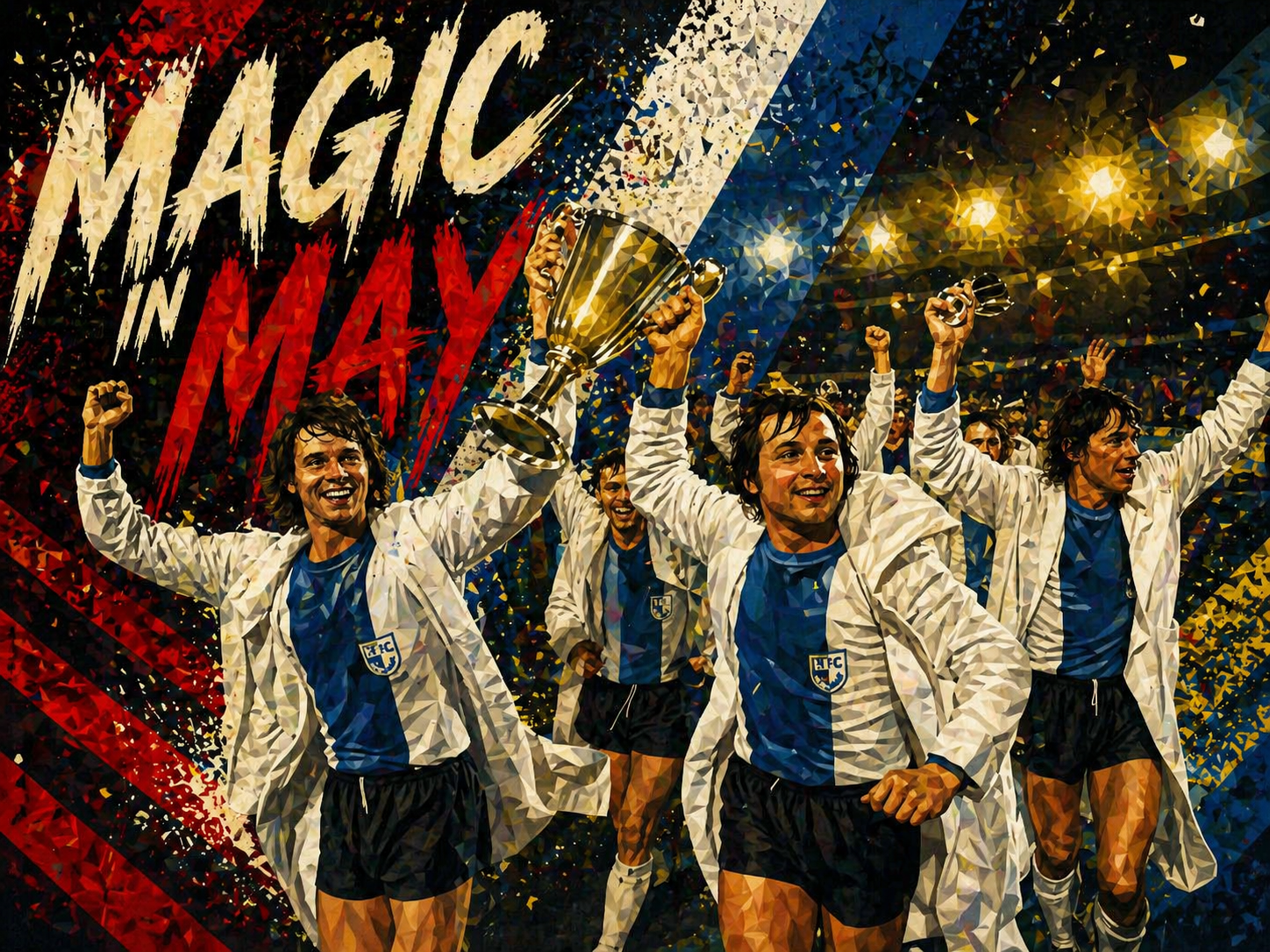
On 8 May 1974, 1. FC Magdeburg beat AC Milan in Rotterdam to become the only East German club ever to win a major European trophy. But the story was never just about a final. It was about a team of local players, a manager who refused to bend, and Jürgen Sparwasser, the gifted forward later trapped by the most famous goal of his life.
Key Takeaways
- 1. FC Magdeburg beat defending champions AC Milan 2-0 in the 1974 European Cup Winners’ Cup final.
- The match was played at De Kuip in Rotterdam on 8 May 1974 in front of only 4,641 spectators.
- Magdeburg remain the only East German club to win a major European trophy.
- Jürgen Sparwasser’s wider career has often been overshadowed by his World Cup goal against West Germany six weeks later.
- The victory was also the peak of Heinz Krügel’s expressive, locally built Magdeburg side.
A Final Played in the Wrong Weather
The rain seemed determined to erase the occasion before history could get hold of it.
Rotterdam was cold, wet and strangely empty on the evening of 8 May 1974. The European Cup Winners’ Cup final was supposed to carry ceremony. Instead, De Kuip looked half-abandoned. Only 4,641 spectators had come through the gates, a miserable attendance for a European final and a number that gave the match an almost private quality.
There was no great roar when the teams emerged. No continental theatre. No sense that football’s established order was about to be disturbed.
On one side stood AC Milan, defending champions of the competition, dressed in red and black and carrying the old authority of Italian football. Even in a season of uneven domestic form, Milan still had the weight of name, pedigree and European habit. Gianni Rivera remained the elegant brain of the side. Romeo Benetti brought force and edge. Karl-Heinz Schnellinger gave the defence experience and old-world calm.
On the other side stood 1. FC Magdeburg, a club from the German Democratic Republic with none of Milan’s glamour and none of their commercial muscle. They wore white shirts with a single blue stripe. They looked plain. They were local, almost stubbornly so. The team had been grown rather than bought, drawn from Magdeburg and its surrounding area, shaped by years of shared training, shared rhythms and shared restrictions.
Giovanni Trapattoni, still at the beginning of the managerial life that would later make him one of Europe’s great pragmatists, understood the danger of a final played on bad terms. The pitch was slick. The crowd was thin. The game had no natural warmth. Before kick-off, he is widely remembered as saying the first goal would decide everything.
He was right, though not in the way Milan wanted.
Late in the first half, Detlef Raugust drove a low ball into the Milan penalty area. It was not a moment that looked destined for immortality. It was a delivery into a difficult area, the sort of cross that asks defenders to be clean and decisive. Enrico Lanzi was neither. His touch sent the ball past Pierluigi Pizzaballa and into his own net.
Milan had conceded to confusion.
For a while, they still had the comfort of status. They were Milan. They had Rivera. They had time. They had the defensive habits of a football culture that had taught Europe how to close down matches, control risk and suffocate opponents.
But Magdeburg did not play like a side grateful to be there. They were not frantic. They were not overawed. They kept their distances, trusted their passing angles, and moved with the strange calm of a team that knew each other’s footsteps.
Then, in the 74th minute, came the goal that turned the upset into a verdict.
A sweeping diagonal pass found Wolfgang Seguin breaking into space on the right. The angle was narrow, almost unreasonable. From there, most players would have crossed, delayed, or looked for help. Seguin struck. The ball flew high into the net.
Magdeburg 2, Milan 0.
In the stands, some Milan supporters burned their own flags, the red and black fabric smoking into the wet Dutch air. On the pitch, the Magdeburg players celebrated in a manner that felt almost shy. They were soon wrapped in white hooded bathrobes supplied by the East German textile firm Malimo, a surreal image that has become part of the match’s afterlife. They looked like soaked prizefighters after an impossible bout.
Among them was Jürgen Sparwasser.
He had not scored in the final, but that misses the point. His movement, intelligence and sense of timing had helped make Magdeburg possible. He was one of the reasons Milan never quite found a shape that made sense.
Six weeks later, Sparwasser would score the goal that made him famous across the world. But Rotterdam was the night that explained him better.
The Story That Stole the Player
Sparwasser’s name is almost never allowed to stand alone.
It is usually attached to one date, one place, one political meaning: Hamburg, 22 June 1974. East Germany against West Germany in the World Cup. A long ball, one touch, a finish past Sepp Maier, and a result that the East German state seized as ideological proof.
The goal made Sparwasser globally recognisable. It also trapped him.
He later understood the scale of that trap with a kind of weary humour. “If one day my gravestone simply says ‘Hamburg 1974’, everybody will know who is lying underneath,” he said. It is a brilliant line, but also a sad one. It recognises how completely a single goal had swallowed the rest of his football life.
That goal against West Germany was extraordinary. It mattered. It remains one of the most politically charged moments in World Cup history. But it was not the best measure of Sparwasser as a footballer.
Hamburg made him a symbol. Rotterdam revealed him as a player.
That distinction matters because the Cold War version of Sparwasser is too narrow. It turns him into a state athlete, an obedient product of the GDR, a man whose value lay in what his goal could be made to represent. The footballer was more elusive than that. He was clever, expressive and instinctive. He was not a blunt instrument of a system. He was one of the rare East German attackers whose game seemed to resist the system’s preference for measurement, discipline and control.
His best football lived in the space between order and imagination.
That was the tension of his career.
He played for a state that wanted symbols, under a coach who wanted footballers to think for themselves. He became famous for a goal that suited propaganda, but his finest club achievement came from a team whose beauty lay in its local understanding and football intelligence.
To see Sparwasser properly, Hamburg must be moved to one side. Not ignored. Not diminished. Just placed where it belongs.
The deeper story begins in Magdeburg.
A Club Built by the State, Then Shaped Against It
East German football was never just football.
Sport in the GDR carried diplomatic purpose. It was used to present the small socialist state as disciplined, modern and superior to its western neighbour. Olympic medals were counted as proof. Athletes were developed inside a system that treated the body as a national resource.
Football was more difficult to control.
It was too fluid, too dependent on improvisation, too vulnerable to chance. A swimmer could be timed. A rower could be measured. A football match could still be lost because one player saw something nobody else had seen.
That made 1. FC Magdeburg unusual.
The club was formally founded in 1965 as part of the GDR’s effort to concentrate football talent into specialist centres. It was not the most politically favoured institution in the country. It did not carry the dark weight of BFC Dynamo, the Berlin club associated with the Ministry for State Security and the influence of Erich Mielke. Magdeburg’s strength was more provincial, more organic.
Its defining figure was Heinz Krügel.
Krügel was not a romantic outsider. He was a serious coach inside a controlled sporting system. But he had the one quality authoritarian structures often distrust most: independent judgement. He understood that football could not be reduced to stamina and obedience. His team needed structure, yes, but also licence. Players had to know when to leave their zone, when to rotate, when to interpret the next pass rather than follow the last instruction.
That mattered enormously for Sparwasser.
Born in Halberstadt in 1948, he came of age inside a divided Germany. He was not raised in footballing freedom. He developed within institutions, expectations and boundaries. Yet under Krügel, he found a form of expression. Magdeburg did not ask him to become a pure forward, nor a static playmaker. He became something between the two: a withdrawn attacker, a roaming connector, a player who could drop into midfield, appear between the lines, or arrive late in the penalty area.
His game was not built on domination of the ball. It was built on reading the next space.
That is why the player cannot be understood through the usual Cold War shorthand. Sparwasser was not especially useful as an emblem of uniformity. He was useful because he was different.
The Season Magdeburg Became Impossible to Ignore
Magdeburg’s rise was not a miracle in the sentimental sense. It was planned, drilled and earned.
They won the DDR-Oberliga in 1971-72 with a remarkably young side. That mattered because it showed Krügel had not simply assembled a competitive team. He had built a generation. Players grew together. They learned each other’s habits in league matches, training sessions and European ties. The familiarity became tactical capital.
By the 1973-74 season, Magdeburg were ready for Europe in a way few outside the GDR understood.
The Cup Winners’ Cup campaign tested them properly. NAC Breda were beaten in the first round, but the tie against Baník Ostrava exposed the stakes. Magdeburg lost the first leg 2-0 in Czechoslovakia, leaving themselves with a problem that required more than patience.
The return leg became one of the key nights of their season.
Wolfgang Abraham scored from the penalty spot to reduce the deficit. Martin Hoffmann, still a teenager, struck late to level the tie on aggregate. Then, in extra time, Sparwasser delivered the decisive blow.
That goal deserves a place in the story because it shows the part of him that Hamburg later obscured. Sparwasser was not merely a man who happened to score one famous goal in a politically enormous match. He had already shown the habit of appearing at the moment when structure alone was not enough.
The semi-final against Sporting CP confirmed it.
Sporting had danger, pedigree and a hostile home crowd in Lisbon. Héctor Yazalde was a serious forward. Marinho could damage teams from wide areas. Magdeburg needed a result at the Estádio José Alvalade, and Sparwasser gave them one, scoring in a 1-1 draw that shifted the tie towards the East Germans.
In the second leg, Magdeburg finished the job. Jürgen Pommerenke scored early. Sparwasser added another. Sporting’s late reply did not alter the direction of the tie.
By the time Milan arrived in Rotterdam, Magdeburg had not stumbled into the final. They had solved problems in different countries, against different styles, under different forms of pressure.
The empty seats at De Kuip suggested the football world had not noticed.
Milan noticed too late.
The Player Between the Lines
Sparwasser’s football was not spectacular in the modern highlight-reel sense. He did not exist as a sequence of tricks. His value was quieter and more sophisticated.
He created disorder by refusing to stay where defenders wanted him.
In Krügel’s side, he often operated as a nominal forward who did not behave like one. He could pull away from the centre-backs and drop towards midfield, which gave Magdeburg an extra passing option and forced defenders to make awkward choices. Follow him, and space opened behind. Hold the line, and he could receive, turn and connect play.
That sounds simple. It is not.
To play that role well requires timing, awareness and trust. If the player drops too early, he empties the attacking line. If he drops too late, he receives under pressure. If the wide players do not understand his movement, the whole pattern breaks.
Magdeburg understood him.
Raugust and Hoffmann could stretch the pitch. Pommerenke and Axel Tyll could feed the spaces that opened. Manfred Zapf, the sweeper and captain, gave the team defensive authority behind the ball. The side worked because its parts knew when to move in relation to one another.
This was why Milan struggled.
Italian defending in that period was associated with clarity of responsibility. Markers marked. Sweepers covered. Spaces were closed. But Magdeburg’s movement kept shifting the question. Who had Sparwasser? Who stepped out? Who passed him on? Who tracked the next runner?
The first goal, even as an own goal, came from precisely that kind of disruption. Milan did not concede because Magdeburg produced a perfect attacking pattern. They conceded because Magdeburg put the ball into a zone where hesitation became fatal.
The second goal was the cleaner expression of the same idea. The pitch was stretched, the defence was moved, and Seguin found the angle.
Sparwasser did not need his name on the scoresheet for the final to carry his fingerprints.
The Coach Who Would Not Bend
The tragedy of Magdeburg is that the system which helped create the team could not tolerate the independence that made it special.
Krügel’s authority came from football. That was both his strength and his danger. He protected his players. He trusted his ideas. He did not treat the game as a simple extension of party doctrine.
The most revealing story came after Magdeburg were drawn against Bayern Munich in the European Cup the following season. According to accounts of the episode, the Stasi had obtained covert recordings from Bayern’s dressing room and offered them to Krügel. He refused to use them.
As a football gesture, it was principled. As a political gesture, it was reckless.
In a free football culture, a European trophy might have made Krügel untouchable. In the GDR, it made him useful only while he remained controllable. By 1976, despite the greatest club achievement in East German football history, he was removed from his post. The official explanation was dressed in bureaucratic language. The real message was clear enough.
No coach, however successful, stood above the system.
For Sparwasser and his team-mates, Krügel’s fall changed the meaning of what they had built. Their greatest football had grown inside a protected space. Once that protection disappeared, the weight of the state returned.
Sparwasser, in particular, was already carrying more of that weight than most.
Hamburg, 1974: The Goal That Became a Cage
On 22 June 1974, East Germany played West Germany at the Volksparkstadion in Hamburg.
Even without the politics, the match would have mattered. West Germany were hosts, European champions, and one of the favourites to win the World Cup. Franz Beckenbauer, Gerd Müller, Paul Breitner and Sepp Maier formed the spine of a formidable side. Their manager, Helmut Schön, had been born in Dresden, adding another layer to an already loaded fixture.
But there was no way to remove the politics.
The GDR’s presence at the tournament was itself significant. A match against the Federal Republic carried the charge of recognition, rivalry and propaganda. The two German states met not just as teams, but as competing versions of post-war identity.
The game itself was tight, tense and awkward. West Germany had chances. East Germany defended with courage and discipline. Then, with 13 minutes left, came the moment that followed Sparwasser for the rest of his life.
Erich Hamann sent the ball forward. Sparwasser moved beyond the West German defence, controlled it, rode the pressure, and drove his shot high past Maier.
It was a magnificent goal.
It was also immediately taken from him.
The GDR state machine knew what it had. A 1-0 victory over West Germany could be used as a symbol of socialist achievement. Sparwasser became the face of the result, the man whose goal had apparently proved something larger than football.
He knew better.
The persistent story that he had been richly rewarded with a car, a house and money became part of the folklore. Sparwasser later rejected it. The reward was not luxury. It was attention, control and expectation.
His most famous goal did not liberate him. It narrowed him.
The irony, often missed, is that West Germany went on to win the World Cup. East Germany went out in the second group stage. In sporting terms, Hamburg was a famous victory but not a tournament-defining one. In political memory, it became enormous.
That imbalance is why Sparwasser’s career is so often misunderstood.
Rotterdam Revisited
Return, then, to De Kuip.
Return to the rain, the empty seats, the bathrobes, the strange quiet after the final whistle.
That night gives Sparwasser back to football.
It shows him not as a slogan, not as a Cold War ornament, but as a crucial part of a remarkable team. Magdeburg’s victory over Milan was not a propaganda set-piece. It was too odd, too wet, too sparsely attended, too resistant to pageantry. Its power lies precisely in its lack of theatre.
There was no vast crowd to confirm its importance. No grand European audience ready to mythologise it. It had to survive through the result itself.
And the result was extraordinary.
Magdeburg had beaten the holders. They had become the only East German club ever to win a major European trophy. They had done so with a team rooted in one city, under a coach whose ideas were better than the politics around him, with a forward whose intelligence was more subtle than the role history later assigned him.
There was, reportedly, no triumphant civic parade waiting for the players in the way one might expect. The World Cup was close, and the players were soon folded back into national duty. Even victory did not belong wholly to them.
That is the ache in the story.
The night they conquered Europe was also a reminder that they did not fully own their own triumph.
The Long Fall After the High Point
Magdeburg’s victory did not create a dynasty.
That is part of its fascination. Some European triumphs announce a new order. This one became a peak that could not be repeated.
The club remained strong in East German football for a time, winning further domestic honours, but the wider direction was set. Krügel was removed. The political centre of gravity shifted elsewhere. BFC Dynamo would come to dominate the Oberliga in circumstances that still carry deep suspicion and resentment.
Then came 1989.
The fall of the Berlin Wall transformed East German football more brutally than any tactical change could have done. The structures that had sustained clubs like Magdeburg vanished. The new market did not reward memory. Western clubs moved quickly for the best talent. Money, facilities and commercial opportunity flowed in one direction.
Magdeburg, like so many clubs from the former East, struggled to find a place in the unified German game. The club drifted far from the level it had once reached. Its European trophy became less a foundation than a relic.
That does not make the achievement smaller. It makes it stranger.
For one night, Magdeburg touched a height no East German club would ever match. Then history moved, and the ground beneath them disappeared.
Sparwasser’s Escape From the Symbol
Sparwasser eventually made the most decisive break of all.
In January 1988, while in Saarbrücken for a veterans’ tournament, he defected to West Germany with his family. For the GDR, it was more than an embarrassment. It was a symbolic wound. The man whose goal had been used to celebrate the system had walked away from it.
That act forces a reconsideration of everything that came before.
It is too easy to view athletes in authoritarian systems as either believers or rebels. Most lives are more complicated. Sparwasser played, succeeded, represented, endured and eventually left. His career was not a straight line of resistance. Nor was it proof of devotion.
It was the life of a footballer trying to keep hold of his own meaning in a state determined to assign one to him.
That is why Rotterdam matters so much.
There, his meaning was still footballing. He was part of a team that moved beautifully, solved problems and beat Milan. The politics were present, of course. They always were. But they had not yet consumed the picture.
Legacy Without Sentiment
Jürgen Sparwasser did not change football in the way Cruyff changed football, or Beckenbauer changed football, or Rivera changed football. It would be false to pretend otherwise.
His influence was narrower, but still important.
He changed what an East German attacker could look like. He showed that the GDR’s football culture, often dismissed as physical and obedient, could produce a player of timing, intelligence and imagination. He helped give Magdeburg a European identity that still matters because it remains unique.
He also exposes the danger of reducing players to moments.
Hamburg 1974 will always follow him. It should. The goal was too good, the setting too charged, the symbolism too strong. But the mistake is treating that goal as the whole story.
Sparwasser was not merely the man who scored against West Germany. He was the creative force in the greatest club side East Germany ever produced. He was a footballer whose best work came not in service of a state narrative, but in the shared language of a team that understood itself completely.
Magdeburg’s 2-0 win over Milan belongs in any serious account of European football history. Not as trivia. Not as a curiosity. As proof that football’s hierarchy has always been more fragile than it looks.
The game was played in front of almost nobody. That is part of its beauty. History sometimes announces itself to a packed stadium. Sometimes it happens in the rain, in front of 4,641 people, while the rest of Europe looks elsewhere.
Closing Reflection
The easiest version of Jürgen Sparwasser is the man in Hamburg, striking the ball past Maier and running into Cold War mythology.
The truer version is harder to hold.
He is in Rotterdam, moving between Milan’s lines, part of a team that had no business being so composed. He is in the rain, wearing white and blue, helping a city from the East defeat one of football’s great names. He is wrapped in a bathrobe after the final whistle, a European champion who still did not quite belong to himself.
That is the story worth remembering.
Not just the goal that made him famous.
The night that showed who he really was.
