


For more than six decades, Panini did not simply sell stickers. It taught football supporters how to organise the game emotionally.
The air in Florence on the afternoon of 15 January 1950 carried the kind of cold that settles into the bones. Inside the old Stadio Comunale, smoke drifted above the terraces, scarves were pulled tight against faces, and Italian football, still rebuilding itself after war and grief, searched desperately for beauty wherever it could find it.
Fiorentina and Juventus were locked in a tense, brittle Serie A contest that ultimately finished 0-0. Few inside the ground could have imagined they were witnessing one of the most important moments in football culture history. Not football history in the conventional sense. Not a title decider or a tactical revolution. Something stranger than that.
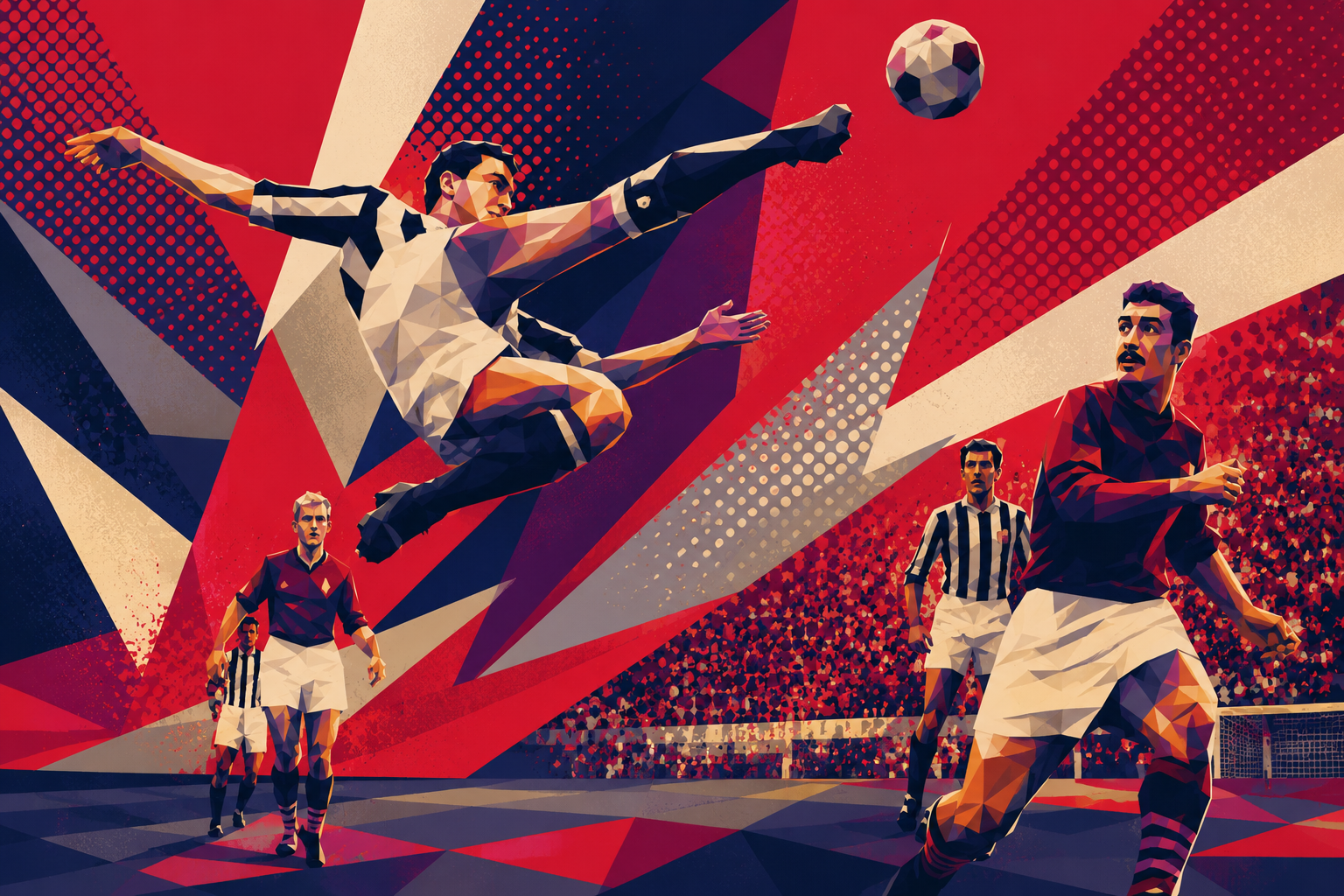
Around ten minutes from full time, Fiorentina launched a hopeful cross deep into the Juventus penalty area. The ball hung awkwardly beneath the grey Florentine sky. Carlo Parola, Juventus captain, retreated toward his own goal while tracking its flight over his shoulder.
Most defenders of the era would have headed clear. Others might simply have hacked the ball into the stands. Italian football in the early 1950s prized order above improvisation. Defenders were expected to erase danger, not create images.
Parola did something else.
He planted, twisted, and threw his body backward into the winter air. For a split second he appeared almost horizontal, suspended above the turf with impossible balance, before his right boot met the ball in a perfectly timed rovesciata. The clearance exploded away from danger.
It lasted perhaps a second.
Yet football has spent the next seventy-five years remembering it.
Behind the goal stood a freelance photographer named Corrado Banchi. From an unusually low position near the old steeplechase water-jump area, Banchi instinctively pressed the shutter.
The photograph he captured did not merely freeze a footballer in motion. It froze football’s idea of itself.
Parola’s body cut across the frame with geometric precision. One arm stretched outward for balance. His torso hovered above the earth. His striped shirt seemed suspended between violence and grace. Around him, blurred opponents and spectators dissolved into irrelevance. The image looked less like reportage than mythology.
Banchi sold the photograph. Parola returned to defending. The match disappeared into Serie A history.
But the image survived.
Fifteen years later, in a small industrial city hundreds of kilometres away, four brothers from Modena searching for an identity for their rapidly growing sticker business rediscovered Banchi’s photograph and immediately understood what they were looking at.
Not simply a bicycle kick.
Not even simply football.
They had found the perfect symbol for aspiration, movement, imagination and memory. The perfect symbol for what the game felt like to children.
Soon, Carlo Parola’s silhouette would appear on billions of packets across the world. In school playgrounds in Manchester, Naples, Buenos Aires, Lagos and Tokyo, children would tear open wax paper packets bearing the image of a footballer many of them had never heard of.
Long before most of them saw Pele. Before they watched Diego Maradona dribble through England. Before they knew who Lionel Messi was.
They knew the man in mid-air.
More Than Nostalgia: How Panini Changed Football Memory
It is tempting to reduce Panini to nostalgia.
That is how the company is usually discussed now. Through soft-focus memory. Through the language of childhood. Sticker books on bedroom floors. Bent corners. Swaps in school playgrounds. The panic of realising you already had six copies of a reserve goalkeeper from Belgium but still could not find the final shiny badge needed to complete the page.
All of that is true.
But it is also incomplete.
Panini did not merely sell stickers. Panini fundamentally altered how football was consumed, understood, organised, remembered and shared across the modern world. Long before social media, fantasy football, Ultimate Team packs, algorithmic recommendation systems or digital collectibles, Panini had already created a global behavioural economy built around anticipation, scarcity, tribal identity and social exchange.
The mechanics were astonishingly sophisticated for something that appeared so innocent.
Buy packet. Open packet. Assess value. Trade duplicates. Chase scarcity. Complete collection. Repeat.
Children understood market psychology before they understood economics. They learned negotiation before they learned algebra. Entire playground hierarchies emerged around access to rare shinies, club badges and superstar forwards. A holographic Liverpool badge in 1984 carried genuine social currency in British schools. So did a mint-condition Marco van Basten sticker in 1988 or a pristine Roberto Baggio from the Italia ’90 collection.
The language itself became universal.
Got. Need. Swap.
Three words capable of crossing class, geography and nationality.
And yet Panini’s influence extended far beyond childhood ritual. For millions of supporters before the arrival of satellite television, stickers were football education. They were geography lessons disguised as collectibles. A child in Birmingham could learn the names and faces of Peruvian internationals without ever seeing a Peruvian league match. A teenager in Sao Paulo could discover Scottish clubs through grainy headshots and strange badges printed on glossy paper.
Entire generations first encountered global football not through live broadcasts, but through numbered boxes inside sticker albums.
In that sense, Panini did something profoundly important.
It democratised football knowledge.
Today, supporters can instantly access tactical analysis, highlight compilations and scouting databases from every league on earth. In the 1970s and 1980s, most supporters possessed almost none of that access. Football existed largely through radio commentary, newspaper reports and imagination. Panini became the visual archive filling those gaps.
The albums also quietly shaped football memory itself.
If a player appeared prominently in a World Cup collection, they became part of the tournament’s mythology. If they were omitted, history often treated them differently. Entire generations remember tournaments partly through sticker layouts, badge designs and album covers. The visual identity of Mexico ’86 cannot be separated from Panini’s bright blocks of colour and crisp player portraits. Nor can the emotional texture of Italia ’90 be detached from packets opened during long summer afternoons while that tournament played endlessly on television screens.
This is why the story matters.
Because Panini was never really about stickers.
It was about football becoming personal.
And Carlo Parola’s bicycle kick, meanwhile, suffered a similar fate. The image became so globally recognisable that the footballer himself slowly disappeared beneath it. Over time, the silhouette escaped its origins entirely. Children recognised the logo without knowing the man. The bicycle kick became branding rather than biography.
Yet Parola himself was a fascinating footballer operating during one of the game’s most tactically transformative eras.
He was not merely an elegant defender caught in a beautiful photograph. He was one of the early interpreters of a changing Italian game, occupying the evolving centromediano metodista role within the rigid structures of post-war football. In an era dominated by defensive caution, Parola introduced timing, athleticism and imagination. His famous clearance was remarkable precisely because defenders were not expected to play that way.
The image endured because it captured football beginning to modernise itself.
That tension matters.
Panini ultimately became the same contradiction embodied by Parola’s photograph itself. Industrial yet emotional. Commercial yet deeply human. Mass-produced yet intensely personal.
A billion identical packets. A billion different memories.
From Survival to Stickers: The Modena Origins of Panini
The story of Panini did not begin with football romance. It began with survival.
In the aftermath of the Second World War, Italy remained scarred economically and psychologically. Factories had been destroyed, cities fractured, and millions of families were rebuilding ordinary life from near ruin. In Modena, a medium-sized city in the Emilia-Romagna region better known for balsamic vinegar and engineering than football culture, Olga Panini purchased a small newspaper kiosk on Corso Duomo in 1945.
It was not a grand entrepreneurial vision. It was simply work.
Her sons, Giuseppe, Benito, Umberto and Franco Cosimo, helped operate the stand. Newspapers, magazines and comics passed through their hands every day. The brothers learned distribution before they learned publishing. More importantly, they learned habit. They understood that people would spend money consistently on small, affordable rituals even during difficult times.
That understanding became the foundation of everything.
By the 1950s, the family had expanded into newspaper distribution through the Fratelli Panini agency. Giuseppe, the most commercially ambitious of the brothers, began noticing something curious buried inside the wider publishing market. Small football sticker collections, often cheaply printed and poorly organised, generated disproportionate enthusiasm among children despite being treated almost as throwaway products by publishers.
At the time, sticker collecting was fragmented and primitive. Some collections involved cutting images manually from magazines. Others required glue pots and awkward assembly. There was little consistency, little branding and almost no long-term vision behind the format.
Then came the accident that changed football culture.
In 1960, Giuseppe Panini encountered a large quantity of unsold football stickers produced by the Milanese publishing house Nannina. Most distributors saw dead stock. Giuseppe saw behaviour. He recognised that the appeal was not really the sticker itself. It was the uncertainty surrounding it.
The packet mattered more than the paper.
The brothers bought the remaining stock, cut the sheets apart and repackaged them into small sealed envelopes containing two stickers each. The concept was beautifully simple. You did not know what was inside until you opened it. Completion became addictive precisely because incompletion was guaranteed.
The first packets sold for ten lire, cheap enough for children to buy with pocket money or loose change. Demand exploded almost immediately.
Italy was entering the years of the so-called economic miracle, a period of rapid industrial growth and rising consumer culture. At the same time, football was becoming central to post-war Italian identity. Stadiums filled again. Newspaper circulation rose. Domestic clubs like Juventus, AC Milan and Inter increasingly represented modern Italian aspiration.
The Panini brothers understood instinctively that football fandom was changing from attendance into participation. Supporters no longer wanted merely to watch football. They wanted to organise it, catalogue it and possess it.
That distinction proved revolutionary.
Within a year, the brothers had reportedly sold millions of packets. Suddenly, the business was no longer a side venture attached to newspaper logistics. It was becoming an industrial operation in its own right.
Not every early idea worked. In one infamous experiment, the company attempted to branch into floral-themed stickers. The collection failed badly and briefly threatened the entire business. It was an important lesson. Panini’s success did not come from collectibility alone. It came from tribal identity. Football already possessed emotional infrastructure. Rivalries, loyalty, colour, mythology and belonging were built into the product before Panini even printed a sticker.
The company merely found a way to package that emotion.
In January 1961, Giuseppe officially founded Panini Editrice.
At first glance, the operation still looked modest. A regional Italian publishing company selling tiny pieces of paper to children. Nothing more.
But underneath, something much larger was beginning to form.
Because what the Panini brothers had really discovered was not a sticker business.
It was the commercial power of incompletion.
Every missing player created desire. Every duplicate created conversation. Every unfinished page demanded continuation.
Modern football consumption still operates on exactly the same psychological architecture today.
When the Season Became Something You Could Build
The moment Panini stopped being a clever regional business and became a football institution arrived with the release of the 1961-62 Calciatori collection.
The album itself was modest by modern standards. Forty pages. Hundreds of stickers. A cover featuring the elegant Swedish midfielder Nils Liedholm of AC Milan. Yet hidden inside was a completely new way of experiencing football.
For the first time, supporters could systematically build the season themselves.
Not read about it.
Not merely attend matches.
Build it.
Every sticker occupied a precise numerical place inside the album. Every squad became a puzzle demanding completion. The structure transformed collecting into pursuit. Children did not simply want stickers anymore. They wanted order. The missing spaces became obsessions.
The response stunned even the Panini brothers.
The first Calciatori collection reportedly sold around 15 million packets. By the following season, sales had nearly doubled. Demand surged across Italy with a speed that threatened to overwhelm the company’s entire infrastructure.
And this is where Panini’s rise becomes genuinely fascinating, because the company’s defining breakthrough was not artistic. It was industrial.
In the early years, sticker production remained astonishingly primitive. Workers manually mixed printed stickers inside large containers using improvised methods that reportedly included shovels and butter churns to randomise distribution before packaging. The results were inconsistent. Duplicate stickers flooded packets. Certain players appeared repeatedly while others barely surfaced.
For children, duplicates were frustrating.
For Panini, they were dangerous.
Because the entire business depended on maintaining belief in the system.
The company faced a tension that would define its future for decades. Collectors needed scarcity, but they also needed fairness. Too much repetition risked convincing buyers the process was manipulated.
Enter Umberto Panini.
If Giuseppe was the visionary salesman, Umberto was the engineer. After time spent working in industrial production environments in Venezuela, he returned to Modena with a solution that would change not only Panini, but the entire economics of sports collectibles.
The machine became known as the Fifimatic.
Named after fifi, Modenese dialect slang for stickers, the device automated the sorting and packaging process with remarkable precision. Instead of relying on chaotic manual mixing, the Fifimatic used a controlled distribution system designed to reduce duplication patterns while maintaining the illusion and excitement of randomness.
The distinction mattered.
The magic of Panini depended on uncertainty. But uncertainty had to feel honest.
The Fifimatic solved the scalability crisis. Suddenly Panini could produce millions of packets efficiently enough to expand far beyond northern Italy. The company industrialised anticipation itself.
At precisely the same moment, football was becoming more televisual, more international and more commercially interconnected.
The timing could not have been better.
During the 1960s, European football evolved into a truly continental spectacle through competitions like the European Cup. Real Madrid, led by Alfredo Di Stefano and Ferenc Puskas, had already shown how far football’s image could travel. Manchester United emerged from tragedy into myth after the Munich air disaster. Benfica carried the brilliance of Eusebio across Europe.
Panini understood before almost anyone else that football’s future would not remain purely local.
The albums evolved accordingly.
By the end of the decade, Panini collections were no longer simply documenting Italian football. They were beginning to map the emotional geography of the global game.
Then came Mexico 1970.
That tournament changed football aesthetically. Colour television spread the images of Pele’s Brazil around the world. Tactical systems loosened. The sport became brighter, faster and more cinematic. Panini recognised immediately that the World Cup could transform the company from a successful European publisher into something much larger.
The 1970 World Cup album became a cultural breakthrough.
For many children outside Italy, it was their first proper Panini experience. The collection carried players from every continent. Badges, kits and national colours suddenly became objects of fascination. The album felt less like merchandise and more like a passport into another world.
And critically, the timing aligned with childhood itself.
Summer holidays. Long afternoons. Television in the living room. Parents buying packets at kiosks and corner shops. Children organising swaps in parks and playgrounds.
Panini became embedded inside the emotional rhythm of football tournaments.
That was the true breakthrough.
Not merely manufacturing.
Not even distribution.
Association.
Panini successfully attached itself to how football felt.
The Best Panini Albums Football Has Ever Seen
By the late 1970s, Panini had ceased to be merely a publishing company. It had become part of football’s emotional infrastructure.
What made Panini special was not simply that people collected the stickers. It was the way the albums altered how supporters experienced the game itself.
Modern football culture is built on constant visual saturation. Every match is clipped, archived and endlessly replayed within seconds. But before satellite television and broadband access transformed the sport into permanent content, football remained strangely elusive. Many supporters knew legendary players only through still images, newspaper reports or fleeting televised highlights.
Panini filled those gaps.
For millions of children, the albums became football’s first global database.
A child in Sheffield could suddenly identify Socrates by beard alone. A teenager in Naples learned the face of Michel Platini before ever watching him properly. Young supporters in Argentina discovered obscure Scottish clubs through badge stickers and oddly cropped team photographs. Entire football worlds became tangible through paper rectangles no larger than a credit card.
The albums also imposed order onto football chaos.
Every player had a place. Every squad had structure. Every tournament could be completed.
That instinct sounds simple now, but it mattered enormously during an era when football itself often felt fragmented and inaccessible. Panini gave supporters the illusion that they could hold the entire sport inside their bedrooms.
And then there was the ritual itself.
The wax-paper packets made a distinct crackle when opened. The adhesive carried a smell so specific that generations can still recall it decades later. The stickers themselves possessed texture and weight. Some peeled cleanly. Others tore awkwardly. Children learned quickly how to place them carefully into the album without creasing corners or trapping air bubbles beneath the surface.
The imperfections became part of the experience.
No serious collector wanted a damaged shiny. No child wanted to ruin a badge sticker. And no feeling quite matched the moment of discovering the final missing player needed to complete a page.
That emotional architecture created its own social ecosystem.
The playground swap became one of the defining football rituals of the late twentieth century. Collections were not built privately. They were negotiated publicly.
“Got, got, got, need.”
The chant echoed through schoolyards across Britain, Italy, Brazil and beyond.
Duplicates were spread across concrete like trading floor assets. Children developed informal valuation systems. Ordinary squad players might exchange one-for-one. Club badges, star forwards and holographic shinies became elite currency.
The economics were surprisingly brutal.
A Liverpool shiny during the 1980s might cost four ordinary stickers. A rare Diego Maradona during Mexico ’86 season could distort entire swap markets. Some children hoarded stars deliberately. Others became specialists in negotiation, accumulating power through volume rather than prestige.
The system worked because Panini accidentally created something close to real capitalism.
Scarcity. Supply. Demand. Hoarding. Speculation. Status.
All learned before adulthood.
Yet what truly elevated Panini culturally was its ability to preserve football eras through visual identity.
The greatest albums became emotional time capsules.
Mexico 70: The First Global Passport
The Mexico 1970 collection carried the optimism of colour television football. Pele smiling from the pages felt less like a sticker and more like a global icon entering people’s homes for the first time.
The album’s power came from discovery. Flags, badges and players from across the world were brought into one organised space. For supporters with limited television access, this was not simply a souvenir of the tournament. It was a way to imagine the tournament before they could fully see it.
Argentina 78: Football Before It Learned to Pose
The Argentina 1978 album captured football during transition. Longer hair. Wider collars. Grainier photography. A sport slowly becoming more modern while still retaining traces of old working-class austerity.
There is something fascinating about those late-70s albums now. They feel caught between eras. The photography is imperfect. The designs are less polished than later editions. Yet that looseness gives them character. They look like football before it learned to pose for global commerce.
Mexico 86: Maradona, Myth and the Sticker as Proof
Mexico 1986 was myth-making.
The album arrived attached permanently to the image of Diego Maradona. To own the completed collection after his performances against England and West Germany felt like possessing evidence of something supernatural.
Panini did not create Maradona’s myth. But it gave millions of children a physical relationship with it. The sticker was proof. He had existed inside your album before he bent the tournament to his will.
Italia 90: The Panini Album That Became a Childhood Time Capsule
For many collectors, Italia ’90 remains the defining Panini experience.
Not necessarily the rarest. Not necessarily the most valuable.
The most emotionally complete.
Everything aligned.
The tournament itself possessed extraordinary atmosphere. Floodlit Italian stadiums glowed against dark summer skies. Opera mixed with football spectacle. Penalty shootouts, tears and national trauma unfolded almost nightly. The sport was becoming cinematic without yet becoming overproduced.
The Panini album mirrored that feeling.
The design was cleaner and sharper than previous editions. The colours felt richer. The player portraits carried a strange seriousness. Even the packet design itself became iconic.
And then there was timing.
Italia ’90 arrived just before football and childhood both changed permanently.
The Premier League did not yet exist. The internet did not yet dominate leisure. Mobile phones did not yet fragment attention.
Children still waited.
Waited for highlights. Waited for matches. Waited for parents to buy another packet at the newsagent.
That waiting created emotional intensity modern football rarely replicates anymore.
Collectors still speak about Italia ’90 with a kind of reverence because it became fused with memory itself. Not merely football memory. Personal memory.
Summer holidays. Long evenings. Family televisions. School ending. Heat. Possibility.
A completed Italia ’90 album feels less like merchandise than evidence that a particular version of childhood once existed.
Euro 96 and France 98: The Last Analogue Roar Before the Digital Age
By the late 1990s, Panini albums documented football entering hyper-commercial modernity. The sport looked richer, faster and more polished. Yet the sticker ritual somehow survived intact. Even as the internet emerged, children still gathered in playgrounds holding packets in their pockets.
Euro 96 carried the charge of football coming home. France 98 carried the sound of a world game expanding in confidence, colour and scale. These albums belonged to a generation standing at the edge of the digital age without quite knowing it.
That continuity became Panini’s real genius.
The company adapted visually without altering the emotional core of the experience.
And perhaps that is why the albums became impossible to replicate digitally.
Modern digital collectibles offer efficiency.
Panini offered vulnerability.
You could not instantly complete the collection. You needed other people. You needed luck. You needed patience.
Most importantly, you needed memory.
A completed Panini album was never simply an archive of footballers.
It was evidence of a summer.
The War Over Scarcity, Money and the Future of Football Collecting
Every institution that survives long enough eventually collides with the forces that created it.
For Panini, the central tension has always been strangely delicate: how do you mass-produce nostalgia without destroying the authenticity that makes people care in the first place?
The company’s entire business model depended on convincing collectors that chance still existed inside the packet.
That belief became increasingly difficult to maintain as Panini grew from a modest Modenese publisher into a multinational licensing giant.
And nowhere was the tension more visible than in the endless conspiracy theories surrounding scarcity.
For decades, children and adults alike have accused Panini of deliberately underprinting star players in order to force consumers into buying more packets. Every generation seems to have its own version of the myth. In England during the 1980s, it was impossible-to-find shinies. In Argentina, people swore Lionel Messi stickers appeared less frequently than ordinary squad players. During the 2018 World Cup collection, social media filled with theories about artificially rare stickers.
Panini has always denied it.
Senior figures at the company have long argued that all stickers are printed in equal quantities. The imbalance, they say, comes from human behaviour rather than corporate manipulation.
And in truth, that explanation reveals something far more interesting.
Collectors distort the market themselves.
A child who finds a Messi sticker rarely trades it. A second Messi might be hoarded. A third becomes leverage.
The superstar disappears from circulation because emotional attachment overrides rational exchange.
Panini’s genius was not creating artificial rarity. It was creating emotional value powerful enough to manufacture rarity organically.
That psychological insight sits at the centre of the company’s success.
But the tension surrounding scarcity was only one part of the story.
Another emerged through football itself.
World Cup albums required Panini’s editorial teams to predict squads months before tournaments began because global printing and distribution schedules allowed no flexibility. That forecasting process became a high-stakes gamble capable of embarrassing both the company and national-team managers simultaneously.
The omissions became legendary.
Salvatore Schillaci, the eventual top scorer of Italia ’90, was absent from the original album because he had barely featured internationally before the tournament. Ronaldo Nazario was omitted from the 1994 collection despite travelling to the tournament with Brazil. Javier Zanetti appeared in albums for tournaments he ultimately missed while being absent from one in which he starred.
These mistakes mattered because Panini albums carried authority beyond simple merchandise.
If a player appeared in the album, they felt officially part of the tournament. If they did not, their absence became oddly disorientating, almost as though football history itself had developed a printing error.
That tension between documentation and reality gave the albums a peculiar emotional fragility.
But the deepest conflict surrounding Panini was cultural rather than logistical.
The company grew powerful by remaining accessible.
Pocket-money pricing mattered. Corner-shop availability mattered. Ordinary children mattered.
Modern football increasingly moves in the opposite direction.
The contemporary game has become hyper-financialised, premium-driven and investment-oriented. Collectibles now exist inside a speculative economy dominated by grading systems, resale markets and investor culture. Increasingly, sports memorabilia is designed not for children completing albums on bedroom floors, but for adults storing assets in plastic cases.
That is the philosophical break.
Panini packets were made to be torn open immediately. Modern collectibles are increasingly made not to be touched at all.
And that brings us to the most significant rupture in Panini’s history.
After decades as FIFA’s defining sticker partner, Panini will lose its official World Cup role after the 2030 tournament. The licence is shifting to Fanatics through its Topps brand from 2031, marking the end of one of football’s most culturally significant commercial partnerships.
The split has triggered legal disputes, antitrust accusations and bitter public rhetoric across the wider collectibles industry. Yet beneath the corporate language sits something more emotional.
Collectors fear not simply change, but transformation of intent.
Fanatics represents a very different philosophy of sports collecting. More premium. More speculative. More investment-driven. The model leans heavily toward limited editions, expensive cards and digitally integrated assets aimed increasingly at adult consumers with disposable income.
Panini, despite becoming a major corporation itself, always retained traces of the newspaper kiosk in Modena. The packets still felt democratic. Children could still participate.
That distinction matters enormously.
Because football itself increasingly struggles with the same conflict.
Is the game still fundamentally communal?
Or has it become primarily transactional?
Panini’s potential disappearance from the World Cup landscape feels symbolic because the company represented one of the last surviving rituals untouched by modern football’s obsession with monetising exclusivity.
A packet of stickers still carried possibility. Still carried surprise. Still carried innocence.
Not perfectly. Not purely. But enough.
And perhaps that explains why the thought of losing Panini feels strangely personal to so many people who have not opened a packet in decades.
The company sold football as hope before football learned how to sell itself as luxury.
The Albums That Turned Panini Into Football Culture
The history of Panini is too large, too geographically scattered and too emotionally layered to tell chronologically from beginning to end. The more revealing approach is to trace the moments when the company stopped reflecting football culture and actively started shaping it.
Certain albums became more than collections.
They became historical artefacts.
Mexico 1970: When Football Became Global
If the early Calciatori albums established Panini inside Italy, the Mexico 1970 collection transformed the company internationally.
The timing was perfect.
Football itself was changing aesthetically. The tournament arrived during the expansion of colour television, allowing supporters around the world to experience the sport with a new visual intensity. Pele lifting the Jules Rimet Trophy in yellow became one of the defining images of twentieth-century sport.
Panini instinctively understood that football was no longer merely local identity. It was becoming global theatre.
The Mexico ’70 album reflected that shift. National flags, kits and squads were presented with an elegance and consistency that made the collection feel expansive rather than provincial. For many children outside Italy, this was the first time football from across the world had appeared inside a single organised framework.
The album effectively taught geography through obsession.
Children memorised countries they could not yet locate on maps. Badges became cultural entry points. Unknown players became familiar faces.
And because live international football remained relatively inaccessible in many countries, the album carried enormous imaginative power. The stickers often arrived before the football itself. By the time the tournament began, supporters already felt emotionally attached to teams they had barely seen play.
Panini was not documenting anticipation.
It was manufacturing it.
The British Playground Years: Got, Need, Swap
No market illustrates Panini’s emotional peak more clearly than Britain during the late 1970s and 1980s.
When the company launched its British football albums, something remarkable happened. The collections escaped the boundaries of hobby culture and entered everyday childhood life almost completely.
By the early 1980s, swapping stickers had become a ritual embedded into British playground identity.
Not a trend.
A ritual.
The details mattered enormously.
Children carried duplicates in jacket pockets or folded inside pencil cases. Some protected shinies with absurd levels of care. Others damaged stickers almost immediately through over-handling or poor trades made in moments of desperation. Entire friendships and arguments revolved around swap negotiations.
A Liverpool badge sticker could temporarily elevate social status.
Finding the final missing player before a classmate created genuine triumph.
Football during the 1980s still felt partially unreachable. Television coverage remained limited. Highlights were precious. Players carried mystique because supporters did not see them constantly.
Panini filled the silence between matches.
And crucially, the albums captured football during one of its last truly analogue eras.
The grainy photography. The muddy pitches. The oversized goalkeeping jerseys. The odd hairstyles. The strangely serious squad portraits.
Looking through those albums now feels like opening a social archive of working-class Britain as much as football history itself.
Italia ’90: Panini’s Emotional Zenith
For many collectors, the Italia ’90 album remains the defining Panini experience.
Everything aligned.
The tournament itself possessed extraordinary atmosphere. Floodlit Italian stadiums glowed against dark summer skies. Opera mixed with football spectacle. Penalty shootouts, tears and national trauma unfolded almost nightly. The sport was becoming cinematic without yet becoming overproduced.
The Panini album mirrored that feeling.
The design was cleaner and sharper than previous editions. The colours felt richer. The player portraits carried a strange seriousness. Even the packet design itself became iconic.
And then there was timing.
Italia ’90 arrived just before football and childhood both changed permanently.
The Premier League did not yet exist. The internet did not yet dominate leisure. Mobile phones did not yet fragment attention.
Children still waited.
Waited for highlights. Waited for matches. Waited for parents to buy another packet at the newsagent.
That waiting created emotional intensity modern football rarely replicates anymore.
Collectors still speak about Italia ’90 with reverence because it became fused with memory itself. Not merely football memory. Personal memory.
Summer holidays. Long evenings. Family televisions. School ending. Heat. Possibility.
A completed Italia ’90 album feels less like merchandise than evidence that a particular version of childhood once existed.
South America: Where Panini Became a Public Obsession
In parts of Europe, Panini gradually became diluted by competing brands, digital entertainment and changing childhood habits.
In South America, the obsession intensified.
During the 2014 and 2018 World Cup collections, major cities across Brazil, Argentina and Colombia hosted enormous public swap gatherings where thousands of collectors met specifically to exchange duplicates.
The scenes resembled financial markets mixed with football carnivals.
Tables overflowing with stickers. Collectors carrying folders organised by nation and rarity. Adults negotiating swaps with the seriousness of professional traders.
And that demographic shift matters.
Panini had evolved from children’s culture into intergenerational culture.
Parents who collected during Mexico ’86 or Italia ’90 were now completing albums alongside their own children. The company had successfully transformed nostalgia into continuity.
During the 2022 World Cup cycle in Argentina, sticker shortages became severe enough to become a genuine public issue. Inflation, supply problems and overwhelming demand drove prices upward. Public frustration grew so intense that officials became involved in discussions around supply and distribution.
Think about that for a moment.
A sticker album had become important enough to enter national political conversation.
Very few companies in sport possess that level of emotional penetration.
And perhaps that is because Panini never truly sold collectibles.
It sold participation.
The albums allowed supporters to feel connected to football history while it was still unfolding.
Parola Returns: Why the Bicycle Kick Still Matters
Return now to Florence.
To the cold air. To the blurred terraces. To Corrado Banchi crouched behind the goal with a camera he could not possibly have known was about to capture one of football’s immortal images.
And to Carlo Parola himself, suspended horizontally above the turf in that impossible instant between athletic instinct and visual mythology.
Because the remarkable thing about the photograph is not simply that it survived.
It is that it escaped football entirely.
By the mid-1960s, Panini had grown rapidly enough that the brothers understood they needed a recognisable corporate identity. Not just a business logo, but a symbol capable of communicating movement, aspiration and footballing romance across different countries and languages.
Giuseppe Panini remembered Banchi’s photograph immediately.
The image already contained everything the company wanted to become.
Elegance without arrogance. Athleticism without violence. Imagination without complexity.
Most importantly, the photograph captured football as children experience it: limitless and airborne.
Designer Walter Vaccari was tasked with transforming the image into a stylised logo suitable for mass reproduction. Certain details were deliberately altered. Parola’s original Juventus kit disappeared, replaced with neutral colours to avoid club tribalism overwhelming the wider identity. The figure became less a specific footballer and more an abstract footballing ideal.
That abstraction proved powerful.
Soon the silhouette appeared everywhere.
On packets. Albums. Advertising boards. Shop displays. World Cup collections.
Over time, the logo became so globally recognisable that millions encountered the image long before learning the name Carlo Parola. The footballer dissolved into the icon.
There is something oddly poignant about that.
Parola himself had been an intelligent and respected defender during one of Italian football’s formative tactical periods. He later managed clubs including Juventus and Fiorentina. Yet his true immortality arrived not through trophies or coaching success, but through involuntary repetition.
Billions of repetitions.
Every packet opened across decades carried his silhouette into another household somewhere in the world. Children in Lagos, Glasgow, Bogotá and Tokyo all interacted unknowingly with the same frozen moment from a Serie A match played in 1950.
That scale of reproduction transformed the photograph into something much larger than branding.
It became football memory itself.
And there is another layer to the image that feels increasingly significant now.
The bicycle kick represents risk.
Parola could easily have mistimed the clearance. A more conservative defender might have chosen safety over improvisation. Yet the image endures precisely because it captured football choosing creativity over caution.
Parola later described the move not as ornament, but as purpose. It disturbed the opponent, stole the ball from beneath him, and transformed danger into release. That is why the image is so powerful. It is beautiful, yes. But it is not decorative. It is football solving a problem beautifully.
In many ways, Panini embodied the same instinct.
The company succeeded because it understood that football supporters wanted more than information. They wanted imagination. They wanted participation. They wanted emotion organised into collectible form.
The packets offered possibility. The albums offered structure. The stickers offered identity.
And hovering above all of it was Parola.
Forever airborne. Forever unfinished. Forever moments away from landing.
That may ultimately explain why the image lasted while so many other football logos disappeared.
It does not feel corporate.
It feels human.
A single footballer, isolated against the sky, trying to reach something impossible.
What Panini Changed About Football Forever
What, ultimately, did Panini change?
The obvious answer is football memorabilia. The company helped create the modern sports collectibles industry and built one of the most recognisable licensing empires in global sport. That part is undeniable.
But the deeper answer is more interesting.
Panini changed how football remembers itself.
Before the modern broadcasting explosion, football was surprisingly difficult to see consistently. Domestic leagues were fragmented across national borders. International tournaments arrived briefly and disappeared again. Most supporters encountered foreign players through sparse newspaper photographs or short television highlights shown days after matches had taken place.
Panini created continuity where football previously existed in fragments.
The albums organised the sport into permanent visual memory. Players, squads, badges and tournaments became collectible archives rather than fleeting moments. Entire generations now recall football eras partly through sticker aesthetics. The typography of an album. The shape of the national-team boxes. The foil texture of club badges. The precise shade of a World Cup cover.
That influence reaches further than many people realise.
Modern football video games, fantasy sports and digital collectible systems all rely on the same psychological foundations Panini helped normalise decades earlier: collection, scarcity, completion, status, exchange and emotional attachment to acquisition.
Long before digital platforms turned football fandom into constant interactive engagement, Panini had already built a participatory ecosystem around the sport.
The company also democratised access to football identity.
That matters historically.
A child did not need expensive tickets or satellite television to participate in football culture. A few coins could buy entry into the same global tournament shared by millions of others. The albums flattened geography. They allowed children from vastly different economic backgrounds to engage with the same players and narratives.
That accessibility remains central to why people defend Panini so fiercely now.
Because the company represented one of the last football rituals still rooted primarily in ordinary participation rather than premium consumption.
And yet the legacy is not entirely romantic.
Panini also helped commercialise football fandom at industrial scale. The company understood earlier than most organisations that emotional attachment could become recurring consumer behaviour. In many ways, modern football merchandising owes an enormous debt to the Panini model.
There is tension in that.
The same company that created communal playground culture also helped lay foundations for the hyper-commercial sports economy that followed.
But perhaps the most revealing part of Panini’s legacy is the demographic transformation of its collectors.
The children never really stopped collecting.
Gianluigi Buffon once admitted that dressing rooms remained full of players quietly completing albums during major tournaments. Adults returned to the ritual not because they needed the stickers, but because the process itself triggered memory.
That distinction matters enormously.
People are not nostalgic simply for footballers.
They are nostalgic for anticipation.
For corner shops. For packets opened while walking home. For trades made at school. For the strange emotional weight carried by a missing shiny.
Panini survived the digital age longer than many predicted precisely because physical stickers offer something modern football increasingly struggles to provide: texture.
The packets crackle. The paper bends. The stickers smell distinct. The albums age visibly.
Digital collectibles can reproduce ownership.
They cannot reproduce wear.
And wear matters because football memory itself is imperfect. Old Panini albums often contain fingerprints, creases, damaged corners and poorly aligned stickers. Some pages remain unfinished forever. Others contain handwritten names or childish attempts at organisation.
Those flaws become emotional evidence.
A pristine album is impressive.
A worn album is personal.
That may be the most misunderstood aspect of Panini’s survival. Analysts often assume the company endured because older collectors simply refused to let go of nostalgia. In reality, the business survived because it continued offering something psychologically rare within modern sport: a physical relationship with memory.
Not streamed. Not updated. Not algorithmically personalised.
Held.
And now, as the company approaches the end of its long association with the FIFA World Cup, the emotional reaction surrounding that separation reveals just how deeply Panini embedded itself into football culture.
Supporters are not mourning a licensing agreement.
They are mourning a ritual.
Because for more than sixty years, opening a Panini packet was never simply about discovering which players were inside.
It was about believing, briefly, that football could still surprise you.
The Last Packet: Why Panini Still Feels Personal
At some point before the 2030 World Cup begins, somewhere in the world, a child will stand inside a corner shop holding a final Panini World Cup packet.
The ritual will look almost identical to the one performed generations earlier.
Thumb pressing carefully against wax paper. A slow tear across the top. A quick glance at the first sticker. Hope immediately reorganising itself around whatever is still missing.
Around them, football will look completely different from the game that existed when Carlo Parola launched himself into the Florentine sky in 1950.
Matches will be streamed instantly across continents. Players will exist permanently online. Artificial intelligence will dissect tactics in real time. Digital collectibles will trade globally in seconds. The modern game will continue accelerating toward frictionless consumption.
And yet the strange power of Panini always lived inside friction.
The waiting. The searching. The duplicates. The negotiation. The unfinished page.
Football became more memorable because completion was never guaranteed.
That is why the albums lasted.
Not because they resisted modernity entirely, but because they preserved something modern football increasingly struggles to protect: anticipation. The possibility that emotional value might still come from patience rather than immediacy.
For more than six decades, Panini transformed football from spectacle into participation. It allowed supporters to touch tournaments before they fully understood them. It gave children ownership over a sport otherwise controlled by broadcasters, clubs and institutions. It created a shared language spoken across schoolyards and continents alike.
Got. Need. Swap.
Simple words. But also a philosophy of fandom built around exchange rather than isolation.
And hovering silently above all of it remained Parola’s bicycle kick.
An image born accidentally. A defender choosing imagination over caution. A split-second clearance transformed into football’s most enduring commercial symbol.
Perhaps that is why the logo still resonates now.
Not because it represents business success.
Not even because it represents nostalgia.
But because it captures football at the precise moment before landing. Suspended briefly between possibility and reality.
A completed Panini album was never really complete anyway. New seasons arrived. New tournaments appeared. New stickers replaced old heroes. The gaps simply moved elsewhere.
Maybe that was always the point.
Football keeps changing. Childhood does not stay. The packets eventually stop appearing in your pockets.
But somewhere deep inside millions of supporters, there remains a stubborn instinct to check the next sticker anyway.
Just in case it is the one you have been waiting for all summer.
