


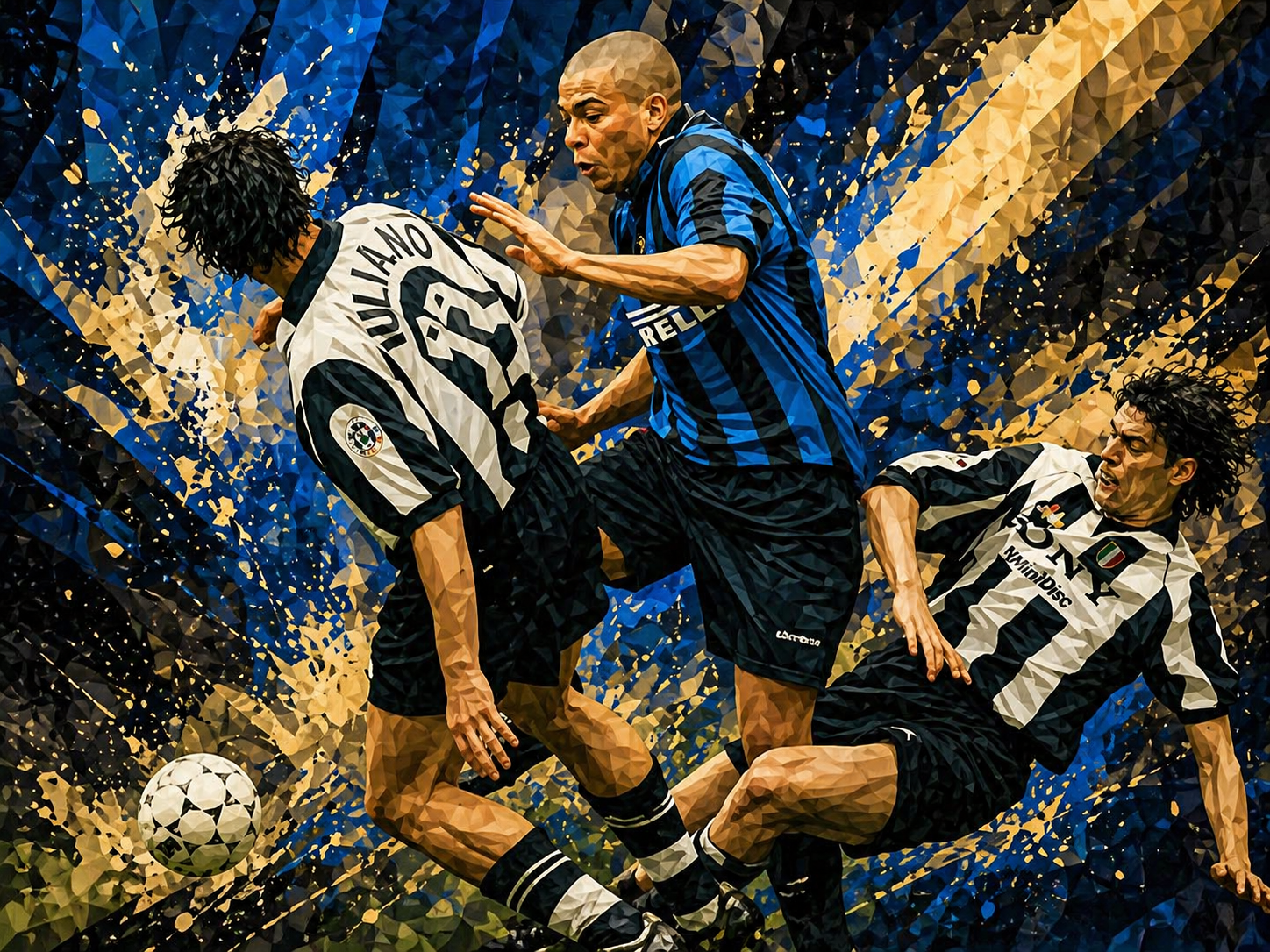
On April 26, 1998, Ronaldo Nazário collided with Mark Iuliano inside the Juventus penalty area. Referee Piero Ceccarini waved play on. Seconds later, Juventus were given a penalty at the other end. Italian football has been arguing about it ever since.
Key Takeaways
- Juventus beat Inter 1-0 on April 26, 1998, in a match that helped decide the 1997-98 Serie A title race.
- The defining moment came when Ronaldo went down under contact from Mark Iuliano and no penalty was awarded.
- Seconds later, Juventus were awarded a penalty, although Alessandro Del Piero failed to score.
- The incident became one of the great unresolved arguments of modern Italian football.
- Its power comes from the collision between what people saw, what was decided, and what Italian football later became forced to confront.
The Moment The Whistle Never Came
Ronaldo is already gone.
Not in the sense of distance, but in inevitability. The touch has taken him inside. The angle is open. The defender is no longer controlling the action, only reacting to it. For a fraction of a second, the moment belongs entirely to him.
Then Mark Iuliano steps across.
It is not a tackle in the old, clean sense of the word. There is no sweep of the boot, no attempt to nick the ball away, no visible contact with anything other than the man. It is a body placed into a path at the precise instant when that path has become dangerous.
Ronaldo cannot ride it. His stride is broken before the shot can come. He falls inside the Juventus penalty area, the ball rolling loose beyond him, the chance disappearing with it.
For a split second, the Stadio delle Alpi seems to understand what has happened before the referee has told it what to believe.
Penalty.
Except Piero Ceccarini does not give one.
He waves play on.
The noise does not simply rise. It changes shape. First confusion, then disbelief, then something harder and more lasting. Inter players turn towards the referee with the fury of men who feel the obvious has been missed in the one place where it could not be missed.
The game continues. The moment does not.
Within seconds, Juventus break to the other end and are awarded a penalty of their own. Alessandro Del Piero fails to convert it, but the damage is already done. The contrast is too sharp, too immediate, too perfect for outrage.
One appeal ignored. One penalty awarded. A title race caught between them.
That is why Juventus against Inter in 1998 has never settled into ordinary football history. It remains an argument, a wound, and a test of what people believe they saw.
Why This Was Never Just A Penalty Debate
The easy version says this was a missed decision.
That is true, but incomplete.
Football is full of missed decisions. Most of them fade. They become pub arguments, archive clips, lines in old match reports. This one did not. It survived because it landed in a league where excellence and suspicion lived side by side.
Serie A in the late 1990s was the strongest domestic competition in the world. Its depth was absurd. Ronaldo, Zinedine Zidane, Alessandro Del Piero, Gabriel Batistuta, Paolo Maldini, Roberto Baggio, Christian Vieri, Lilian Thuram, Juan Sebastián Verón, Hernán Crespo and countless others gave the league a concentration of talent that now feels almost unreal.
But quality did not produce trust.
Italian football was admired, feared and doubted. Decisions were rarely judged only as decisions. They were placed inside patterns, histories, suspicions and power structures. When Juventus benefited, the reaction was never neutral, because Juventus were not perceived as just another club.
They were the establishment force of that period. Controlled, expert, cold under pressure and fluent in the language of winning. Inter were rich and ambitious, but more volatile. They were still trying to break into a room Juventus seemed to own.
So when Ronaldo went down and the whistle did not come, it did not feel like a simple interpretation of contact.
It felt like a verdict.
The Title Race Had Narrowed To A Duel
By April 26, 1998, the Serie A title race had tightened into something close to a direct confrontation.
Juventus were top. Inter were close enough to make the meeting in Turin feel decisive, even if the mathematics had not yet closed around it. These were not two teams drifting towards the end of a long season. They were fighting for command of the league.
Juventus led 1-0 through Del Piero’s first-half goal. That detail matters. The Ronaldo incident did not happen in a level game or with Inter already comfortable. It happened with Inter chasing, but still close enough that one decision could change the shape of the afternoon.
A penalty would not have guaranteed Inter the title. It would not even have guaranteed them a point. But in that match, in that league, with that little space available, it would have changed everything that followed.
Serie A then was not a place of loose, open title deciders. It was tactical, compressed, fiercely managed. Matches between elite sides were often decided by one action because the teams were too good to offer many more.
Juventus were masters of that world. Marcello Lippi’s team could absorb pressure without looking hurried. They could defend a lead without retreating into panic. They understood rhythm, tactical fouling, tempo, emotional control.
Inter had Ronaldo.
That was both their plan and their threat.
Where Juventus trusted structure, Inter trusted rupture. They believed Ronaldo could turn a controlled match into something nobody could control.
Ronaldo Was The One Player Who Could Break The System
Ronaldo arrived in Italy in 1997 as a world-record player and the reigning Ballon d’Or winner. Inter had bought more than a striker. They had bought a force that challenged the basic assumptions of Italian defending.
At PSV Eindhoven and Barcelona, he had already shown the world what he was. In Spain, especially, he had played with a frightening freedom: receiving, turning, accelerating and finishing in ways that made elite defenders look late to every thought.
Italy was supposed to be different.
Serie A did not give forwards clean grass. It trapped them between centre-backs, screening midfielders and tactical systems designed to reduce risk. It was where attacking players went to be measured properly.
Ronaldo was measured and still looked beyond the scale.
His first Inter season was not just statistically brilliant. It was culturally shocking. He scored, created, frightened and distorted. Defenders who had spent careers mastering angles suddenly found the angles disappearing.
His role was nominally that of a centre-forward, but that barely explains him. He was not a penalty-box striker waiting for service. He was a striker who could become his own supply line. He dropped short, carried the ball, attacked the outside shoulder, drove through the centre, and turned half-openings into direct confrontations with goalkeepers.
What made him rare was not simply pace. Plenty of players were fast.
Ronaldo had acceleration with balance. Power with close control. The ability to change direction without losing command of the ball. At full speed, he could still think clearly enough to choose the finish.
That is why he was so hard to fit into ordinary tactical language. He was a No.9 who could behave like a No.10 for three seconds, then become a winger for two touches, then finish like a poacher.
His defining gift was not that he broke lines. It was that he made defenders choose before they were ready.
Iuliano’s collision with him belongs to that pattern. Ronaldo had reached the part of the move where defenders no longer had good choices.
The Collision That Became A National Argument
The ball comes early. Ronaldo reads it first.
He angles his run across Iuliano, not simply to reach the ball, but to take ownership of the space. It is a small movement, but the best forwards live off small movements. In one stride, he changes the defender’s problem.
Iuliano does not win the ball. He steps across the run. Ronaldo meets him at speed and goes down.
Ceccarini waves play on.
The Inter reaction is immediate and furious. Gianluca Pagliuca comes out from his goal. Players surround the referee. Luigi Simoni, Inter’s manager, is sent off amid the protests. The Guardian’s later account of the match noted that Simoni was dismissed after calling the referee “shameful”.
Then comes the sequence that sealed the controversy.
Juventus go up the other end. Taribo West challenges Del Piero. Ceccarini gives Juventus a penalty. Del Piero misses, with Pagliuca saving, but by then the incident has already escaped the match.
Had the Juventus penalty not followed so quickly, the Ronaldo decision would still have been controversial. But the timing gave it a dramatic cruelty. It made the afternoon feel less like a match and more like an accusation.
The final score was Juventus 1 Inter 0. Transfermarkt’s match record confirms Del Piero’s goal, his missed penalty and the date that made the fixture so central to the season: Juventus vs Inter, April 26, 1998.
The facts are plain. The meaning has never been.
Ceccarini, Iuliano And The Problem Of Interpretation
One reason the debate survives is that the principal figures never produced a version of events that satisfied everyone.
Iuliano has long rejected the idea that he deliberately fouled Ronaldo. In later comments reported by Football Italia, he argued that he was standing his ground and that Ronaldo ran into him.
Ceccarini, too, has defended the decision in later years. In one retrospective interview, he said VAR would not have turned it into a penalty, a view also reported by Football Italia.
That does not close the argument. It may even explain why it remains open.
Because the footage does not feel ambiguous to those who believe Ronaldo was fouled. It feels simple. A striker moves into the penalty area. A defender blocks his route. The ball is not played. The attack dies.
Yet football law, especially before VAR, always lived in that grey space between obstruction, collision, momentum and intent. Referees did not judge clips in silence from ten angles. They saw bodies, speed and consequence in real time.
That is the most generous reading of Ceccarini’s decision.
It is also the reading that has never convinced Inter supporters.
Ronaldo’s Own View Was Never Neutral
Ronaldo did not treat the incident as an ordinary disappointment.
Years later, when asked about that match, he still spoke of it with the same sense of injustice. In an interview covered by SBS Italian, he called what happened “a disgrace” and described it as part of “a different era for Italian football”.
That line matters because Ronaldo was not a natural conspiracy merchant. His public image, for most of his career, was not built around grievance. He was admired for joy, speed, goals and resilience, not bitterness.
So when that incident stayed with him, it told you something about the emotional force of the day.
For Inter, the sense was not merely that a penalty had been missed. It was that the defining point of their season had been removed from them.
That is a harder thing to forget.
The 1998 UEFA Cup Final Shows What Ronaldo Was At That Point
The Ronaldo who fell under Iuliano’s challenge was not a fading great or a player living off reputation. He was at the peak of his first footballing life.
Ten days after the Juventus match, Inter beat Lazio 3-0 in the UEFA Cup final at the Parc des Princes. UEFA’s own archive of the match, Lazio 0-3 Inter, records a night when Inter overwhelmed another Italian heavyweight on a European stage.
Ronaldo scored the third goal. It was pure him.
He ran onto a through ball, faced Luca Marchegiani, slowed the moment down, shifted the goalkeeper out of shape, rounded him and finished. There was no panic, no rush, no excess. Just control at the end of speed.
That goal is important to this story because it shows what Inter believed they had been denied in Turin. Give Ronaldo one clean lane, one honest confrontation, one defender beaten and the goalkeeper exposed, and the match could tilt.
Against Lazio, it did.
Against Juventus, Inter believed the lane had been closed illegally.
Genius Versus Structure
The core tension of Ronaldo’s Inter years was genius versus structure.
Serie A was built to slow football down. Ronaldo sped it up. Italian defending was designed to turn attacking play into a series of negotiations. Ronaldo made it sudden.
That is what made him so exhilarating and so difficult. He did not simply improve Inter. He changed the emotional temperature of their matches. Every time he received the ball, the crowd sensed possibility before the move had fully formed.
For a manager, that is both a gift and a complication.
Simoni’s Inter could look uneven, even blunt, when Ronaldo was removed from the equation. Their attacking structure was not always sophisticated enough to match Juventus over a season. But Ronaldo made tactical imperfections survivable because he could create his own solutions.
That is why the non-penalty felt so significant. It was not just a denied set-piece. It was a denial of the very thing that made Inter dangerous.
Ronaldo had escaped the system. The system, somehow, survived.
Juventus Were Worthy Champions, But That Does Not End The Argument
There is a temptation, especially from outside Italy, to flatten this story into moral simplicity.
Inter were robbed. Juventus were gifted the title.
That is too easy.
Juventus were a superb side. They had Zidane, Del Piero, Edgar Davids, Didier Deschamps, Filippo Inzaghi, Angelo Peruzzi, Ciro Ferrara and the competitive habits of a team that understood how to win across months. Their success was not an accident.
They also reached the Champions League final that season, losing to Real Madrid in Amsterdam. This was not a weak champion leaning entirely on one decision.
But acknowledging Juventus’ quality does not erase the Ronaldo incident.
That is the uncomfortable truth at the centre of the story. Juventus can have been worthy champions and the decision can still have been decisive. Those two things can coexist.
Football often struggles with that. It wants clean verdicts. Either a title was earned or it was tainted. Either a decision mattered or it did not. But real seasons are rarely so tidy.
The 1997-98 Scudetto was won by a great Juventus team.
It was also shaped by a moment that many Italians still cannot watch without anger.
Why The Incident Became Bigger After Calciopoli
The Ronaldo-Iuliano collision happened eight years before Calciopoli exploded across Italian football.
It would be wrong to treat one as proof of the other. The 1998 incident must be judged on its own facts, and there is no need to invent certainty where none exists.
But memory does not work like a legal document.
When Calciopoli later exposed improper relationships and influence around refereeing appointments, earlier controversies were inevitably re-examined. Supporters who had felt uneasy in the 1990s looked back and saw confirmation of instincts they had never been able to prove.
That is why the Ronaldo incident grew rather than faded.
It became part of a wider emotional archive: not evidence in a courtroom, but a symbol in the public imagination.
And symbols are powerful because they do not need every detail to be litigated each time. They condense feeling. They turn complex histories into one image.
For many, that image is Ronaldo on the turf, looking towards the referee, waiting for a whistle that never came.
The Defining Moment Revisited
Return to the collision and remove everything that came after.
No Calciopoli. No parliamentary arguments. No decades of replayed footage. No Inter grievance. No Juventus defensiveness.
Just the action.
Ronaldo moves into the box. Iuliano steps across. Contact comes. The ball is not played. The forward goes down. The attack ends.
That is why the moment remains so hard to settle. It looks simple.
When an incident is genuinely unclear, people eventually tire of arguing. When an incident looks obvious but is officially treated as something else, the argument hardens. Every replay becomes not a review, but a reopening.
The absence of VAR helped preserve the wound. There was no delay, no screen, no final explanation. The game just moved on, leaving everyone else behind.
Modern football is often criticised for over-analysis, but part of VAR’s appeal is its promise of closure. Even when people dislike the final decision, the process gives them something to argue against.
In Turin, there was no process.
There was only Ceccarini’s wave of the arm.
What Ronaldo Changed
Ronaldo’s legacy does not depend on this match. It is too large for that.
He changed the idea of the modern striker. Before the injuries, he was the clearest prototype of the forward who could do everything: run beyond, dribble through, create alone, finish early, finish late, score with power, score with calm.
His influence can be seen in later forwards who treated the centre-forward role not as a fixed position, but as a launch point. Thierry Henry, Kylian Mbappé, Karim Benzema in a different way, and countless others inherited parts of a language Ronaldo helped write.
What is often misunderstood is that his greatness was not just explosive.
It was intelligent.
The stepovers were not decoration. The changes of pace were not theatre. He used skill to move defenders’ weight, not to impress them. He understood that the best dribble is not always the longest one, but the one that forces a defender to make the wrong decision.
That is why the Iuliano moment matters within his career. It captures the problem he created for defenders. Once he had the angle, there was often no clean answer left.
What Italian Football Never Escaped
The lasting damage of Juventus versus Inter in 1998 was not that people disagreed about a penalty.
It was that the disagreement confirmed how fragile trust had become.
Italian football could still produce magnificent players, magnificent teams, magnificent nights. It could give the world Ronaldo in full flight, Zidane in control, Maldini in command, Del Piero bending games to his rhythm. But beneath the beauty sat a question that never fully went away.
Who was the game serving?
That is why the incident has outlived the scoreline. Juventus 1 Inter 0 is a result. Ronaldo and Iuliano is a question.
And questions last longer.
Closing Reflection
Not every controversy becomes history.
This one did because it contained more than contact. It contained a title race, a league’s reputation, a generational footballer, a dominant club, and a level of suspicion that had been waiting for an image strong enough to carry it.
Ronaldo did not miss. He did not hesitate. He did not fail the moment.
He reached the place great forwards spend their lives trying to reach: inside the box, ahead of the defender, with the game opening in front of him.
Then came the collision.
Then came silence where the whistle should have been.
And Italian football has been hearing that silence ever since.
