


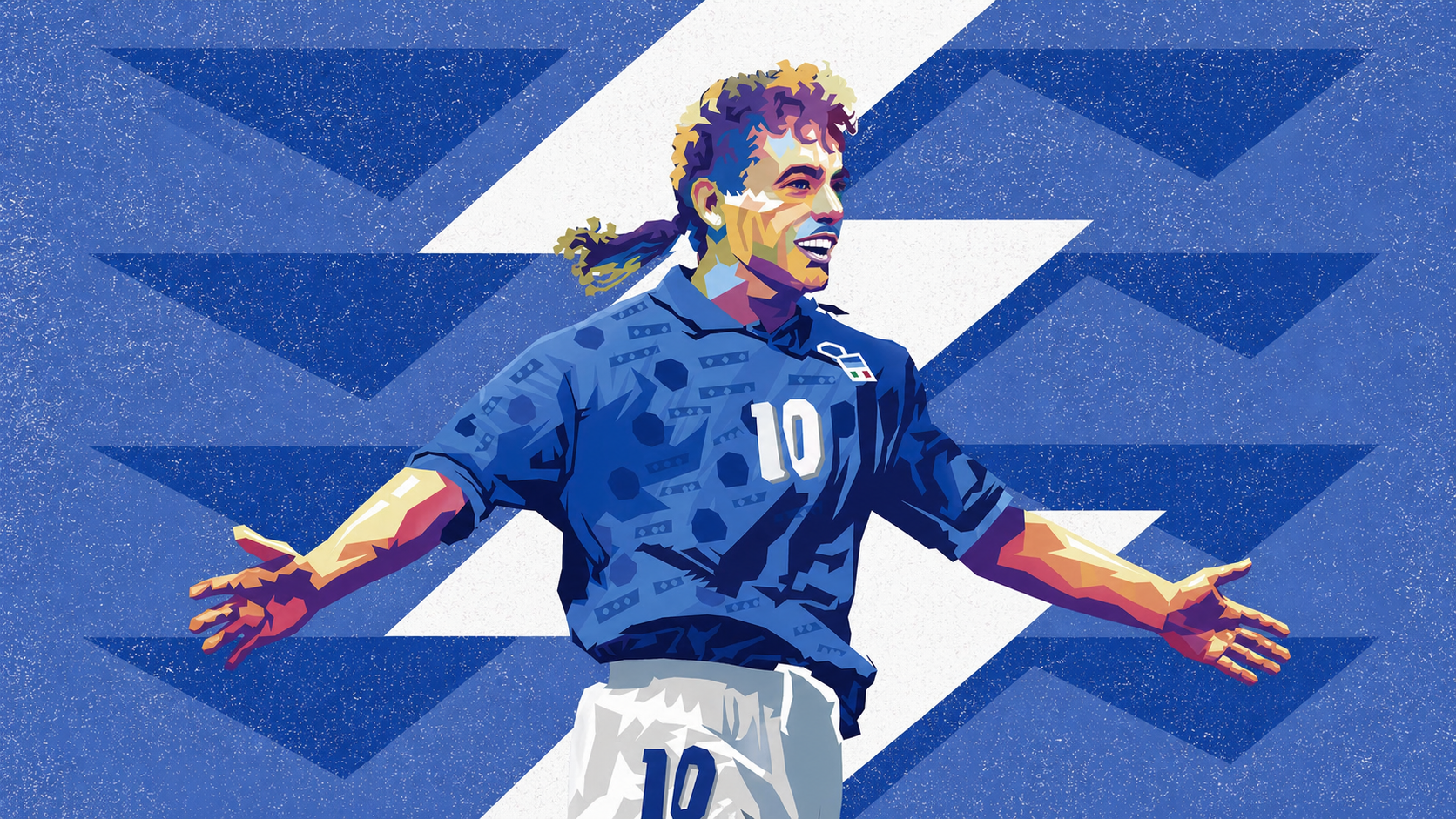
Pasadena, 1994: the image that refused to leave
Roberto Baggio walks back slowly, head down, alone with the noise.
The ball has gone over the bar. Brazil are world champions. Italy are beaten. The Rose Bowl has just witnessed one of the most famous moments in World Cup history, and the cruelty of it is immediate. Not because Baggio has failed more than anyone else, but because he is the one the image chooses.
Franco Baresi had already missed. Daniele Massaro had already missed. Italy were already standing at the edge of defeat. Yet memory is rarely fair. It does not distribute blame evenly. It fixes on the cleanest symbol, and in that moment, it found one: the finest Italian footballer of his generation, standing still after sending the final penalty high into the Californian afternoon.
The photograph did the rest.
It is one of football’s great visual traps. Baggio, motionless, ponytail hanging, the No.10 shirt suddenly carrying the full weight of a country’s heartbreak. The man who had dragged Italy through the knockout rounds was turned, in a second, into the player who missed.
That version of the story is familiar.
It is also too small.
Baggio later wrote about that moment with a clarity that still cuts. “Only those who have the courage to take a penalty miss them,” he said. “I failed that time. Period. And it affected me for years.”
That is the wound. But it is not the man.
To understand Roberto Baggio, you have to begin with Pasadena, then refuse to stay there.
More than the miss
Football loves simple endings. It wants a final image, a single mistake, a moment that explains everything. Baggio’s career resists that kind of treatment.
He was not a player of one tournament, one haircut, one free-kick game, or one penalty. He was a footballer of rare tenderness and precision, a No.10 who seemed to play the game from somewhere quieter than everyone around him. In the hardest defensive league in the world, with defenders who treated space like private property, he found ways to turn a half-yard into a story.
That was his gift.
He did not overwhelm matches physically. He did not dominate through volume. He did not look as if he was trying to bend the game to his will. He coaxed it. He saw little openings, small hesitations, the instant before a defender committed his weight, the angle before it appeared. Then he acted.
To watch Baggio at his best was to watch a footballer who made difficulty look private. He did not announce genius. He revealed it quietly, one touch at a time.
That is why the missed penalty, famous as it is, has always felt like a poor summary. It captures pain, yes. It captures consequence. But it misses the essential thing. Baggio’s career was not defined by failure. It was defined by his repeated refusal to be finished by it.
The mistake was not that Baggio missed. The mistake was believing that one kick could explain a career built on defying certainty.
Caldogno, Vicenza, and the first reconstruction
He was born in Caldogno, near Vicenza, in 1967, the sixth of eight children. Long before the Ballon d’Or, long before the blue of Italy or the black and white of Juventus, he was a small-town footballer whose talent arrived early and clearly.
Vicenza took him young. By his teenage years he was already moving beyond promise. He made his senior debut in Serie C and became central to the side that won promotion to Serie B in 1984-85. He was still a boy, but the pattern was already visible: touch, imagination, balance, finishing, and the strange calm that would later become part of his signature.
Then came the first rupture.
In 1985, before his move to Fiorentina had been completed, Baggio suffered a devastating knee injury. The damage was severe enough to threaten the career before it had properly begun. His right knee required major surgery, the kind that would have ended many players, never mind one still in his teens.
Fiorentina signed him anyway.
That decision matters because it tells you how highly he was regarded even before Serie A knew him. It also tells you something about the rest of the story. Baggio’s body would never be simple. Pain became part of the career. He would play through it, around it, against it. His genius did not come from a body in perfect condition. It came from a body that kept forcing him to find smarter ways to survive.
That is one of the reasons he never looked like other great players. There was always a hint of protection in his movement, as though he understood exactly what his body could and could not give. He was not explosive in the modern sense. He was measured. He carried the ball with care. He changed direction with economy. Every unnecessary movement seemed to have been edited out.
People remember the ponytail, but the right knee explains more.
Florence and the making of the Divine Ponytail
Fiorentina gave Baggio time, and Baggio gave Florence something close to devotion.
His early years there were interrupted by recovery and further injury, but when he finally began to settle, the relationship deepened quickly. Florence is not a city that treats beauty lightly. It understands form, proportion, gesture. Baggio fitted the place not because he was decorative, but because his football had a sense of composition.
He scored his first Serie A goal in May 1987, a free-kick against Napoli that helped Fiorentina stay up. That is how cults begin. Not with statistics, but with the timing of a moment.
From there, his reputation grew. In the late 1980s, Serie A was gathering the greatest concentration of football talent in the world. Diego Maradona was at Napoli. Milan had Marco van Basten, Ruud Gullit and Frank Rijkaard. Inter had German power. Defenders were elite, pitches were imperfect, and space was scarce.
Baggio rose inside that world.
He was not just another gifted Italian forward. He was a new kind of Italian fantasy player, a trequartista who could play between midfield and attack, create and finish, drift and decide. He had the vision of a playmaker, the instincts of a forward, and the set-piece threat of a specialist.
By 1989-90, he had become one of the defining players in the league. Fiorentina reached the UEFA Cup final, where they were beaten by Juventus. The symbolism would soon become unbearable.
The transfer that Florence could not forgive
In 1990, Baggio moved from Fiorentina to Juventus for a world-record fee.
It was not simply a transfer. It was a civic wound.
Florence saw Juventus as the powerful northern machine, the club that took what it wanted. Baggio was not just Fiorentina’s best player. He was the emotional centre of the team. He had been nursed through injury, adored through recovery, then watched as he became the footballer everyone had hoped he would be.
When the deal was agreed, the reaction was ferocious. The streets of Florence erupted in protest, a response that still feels extraordinary even by Italian football’s emotional standards.
Baggio had not wanted to be framed as a traitor. He later said he had been compelled to accept the move, but football supporters rarely make room for contractual complexity when heartbreak is involved.
Then came the return.
When Juventus played Fiorentina in April 1991, Baggio refused to take a penalty against his former club. When he was substituted, he picked up a Fiorentina scarf thrown from the stands. It was a small gesture, but in Italian football small gestures can carry the force of confession.
For Fiorentina supporters, it confirmed what they wanted to believe: that part of him still belonged to them. For Juventus supporters, it was harder to digest. Baggio was now their No.10, but emotionally, he remained complicated.
That was another pattern that would follow him. He was often loved most intensely by those who felt they had lost him.
Italia ’90: the first world-stage miracle
Before he had fully settled at Juventus, Baggio gave the world a glimpse of what Italy already knew.
At the 1990 World Cup, on home soil, he was not always used as heavily as hindsight thinks he should have been. Italy’s tournament became the summer of Totò Schillaci, but Baggio still produced one of its most beautiful moments.
Against Czechoslovakia, he began on the left, exchanged passes with Giuseppe Giannini, then moved through defenders with a softness that made the run feel almost frictionless. One feint opened the last gap. The finish was calm, low, certain.
FIFA still carries the goal as one of the defining clips from Italia ’90, and rightly so. It was not simply a great solo goal. It was the public arrival of a footballer who seemed to combine Italian intelligence with something more lyrical.
Italy finished third. Baggio left with a bronze medal and the sense that something larger was coming.
It was.
Juventus and the year he became the best player in the world
At Juventus, Baggio had to win over a different audience.
Fiorentina had loved him protectively. Juventus demanded. The shirt came with history, expectation, and a particular kind of cold assessment. It was not enough to be beautiful. He had to deliver.
He did.
The 1992-93 season was the fullest expression of Baggio at club level. He became Juventus captain, scored heavily, created constantly, and led the club to the UEFA Cup. In the final against Borussia Dortmund, he scored twice across the two legs as Juventus won 6-1 on aggregate. UEFA’s own retrospective notes how his exploits with Juventus earned him the Ballon d’Or in 1993.
That year, he was not just an Italian star. He was the best player in Europe, and arguably the world.
What made him so difficult to defend was the way he refused to be one thing. If defenders stood off, he could slide a pass through the line. If they stepped in, he could beat them. If a foul came near the box, the danger remained. If the ball fell loose around the area, he had the balance to adjust and the delicacy to finish.
He was a No.10, but not in the ornamental sense. He was the point at which the attack became dangerous.
Brian Laudrup once called him “the most skilful number ten in the modern game”, and that description still holds because it gets at the range of him. Baggio was not merely a goalscorer or creator. He was the archetype of the player who could do both without ever appearing to strain.
Everything looked light. Nothing was.
The 1994 World Cup: carrying Italy through heat and doubt
By the time Italy arrived in the United States for the 1994 World Cup, Baggio was the reigning Ballon d’Or winner and the natural centre of the team.
Then the tournament began badly.
Italy lost to the Republic of Ireland. They stumbled through the group. Arrigo Sacchi’s side looked tense, dry, oddly unsure of itself. Baggio, too, struggled to impose himself early. In the match against Norway, after Gianluca Pagliuca was sent off, Sacchi substituted him to bring on a goalkeeper. The image was jarring: Italy’s great creative hope sacrificed for survival.
Then came the knockout rounds, and the whole tournament changed.
Against Nigeria, Italy were minutes from elimination. Down to ten men, trailing 1-0, they needed something beyond structure. They needed Baggio.
The equaliser arrived in the 88th minute, and it felt less like rescue than recognition. Italy had spent the match searching for a clean solution. Baggio found one in the mess. The ball came across the area, the pressure was suffocating, and he opened his body just enough to guide the finish into the corner. No violence. No panic. Just a player seeing the only available answer before anyone else did.
Then he scored the winner from the penalty spot in extra time.
Against Spain, he scored the decisive goal in the quarter-final, rounding Andoni Zubizarreta and finishing from a narrowing angle with the calm of a man who saw the geometry before everyone else.
Against Bulgaria, he scored twice in the semi-final, both goals carrying that familiar Baggio signature: the first shaped beautifully into the corner, the second taken with quickness and precision.
By the final, he had done more than play well. He had hauled Italy there.
That is the part the penalty image often erases.
The penalty, properly remembered
The 1994 World Cup final was not a great match. Brazil and Italy were exhausted, tense, cautious. The Pasadena heat drained the game of rhythm. Baggio was carrying an injury after hurting his hamstring in the semi-final. He played anyway.
After 120 goalless minutes, the final went to penalties.
Baresi missed. Massaro missed. Brazil edged ahead. Then Baggio walked forward.
The ball rose.
Everything after that became mythology.
In his own account for The Guardian, Baggio did not hide from it. He wrote that he was the team’s penalty taker and had never run from responsibility. He called it the worst moment of his career and admitted it still lived with him.
That honesty matters. Baggio never tried to excuse the miss, but nor should the rest of us misunderstand it. He did not cost Italy the World Cup alone. Italy had already missed twice. Brazil still had a penalty to take if he had scored. The final was already leaning away from Italy.
But football does not always care about context.
It remembers the man standing alone.
After the fall: Milan, Bologna, Inter, Brescia
The years after 1994 are often treated as an epilogue. That is wrong.
Baggio was no longer always the same player, but he remained astonishingly productive in places where the story might easily have faded. He moved to AC Milan in 1995 and won Serie A, though the fit was never entirely natural. Milan were a machine of structure and hierarchy. Baggio was still Baggio, which meant genius, but also a need for space the system did not always grant.
At Bologna, in 1997-98, he found something freer again. His season there was a reminder, almost a rebuke, to anyone who thought he was finished. He scored 22 Serie A goals and played his way back towards the national conversation before the 1998 World Cup.
Inter followed, but that chapter was difficult. Marcello Lippi did not trust him fully, and Baggio’s relationship with the coach became one of the more famous personality clashes of late-1990s Serie A. Again, the old question returned: how much freedom does a genius require, and how much will a manager give?
Then came Brescia.
It should have been a quiet winding down. Instead, it became one of the most moving late-career acts in modern Italian football.
Under Carlo Mazzone, Baggio found a manager willing to build a team around what remained of him. Not the body of the young Fiorentina player, not the peak Juventus force, but the mind, the touch, the vision. Brescia became the place where the old master played with grace rather than nostalgia.
He reached 200 Serie A goals there. He returned from injury yet again. He remained capable of bending a match with one pass or one finish long after most players of his type had disappeared.
That late period is essential because it proves the point: Baggio was not a career built only on one golden peak. It was built on renewal.
The player: pain, patience and the Italian No.10
Technically, Baggio was almost complete.
He could dribble, pass, shoot, take free-kicks, play between lines, finish one-on-one, and make the final action under pressure. But a list of skills does not quite explain him.
His greatness lay in his timing.
He knew when to slow. He knew when to release. He knew how to tempt defenders into a decision, then punish the decision before it had fully been made. He was not quick in the way modern forwards are quick. His speed was in the disguise, the first touch, the early recognition of space.
That made him the purest Italian No.10 of his era.
Not a striker, though he scored like one. Not a midfielder, though he created like one. Not a luxury player, though some managers treated him that way. He lived between categories, and that was part of the problem. Systems like clarity. Baggio carried ambiguity.
Injuries shaped him too. Because he could not always rely on physical ease, he refined everything else. The body forced him towards intelligence. The knee took something, but it may also have sharpened the player who remained.
There is a temptation to talk about him as delicate. He was not. Any footballer who survives that many injuries, that many tactical battles, that much public pain, and still produces across two decades is not delicate. He was resilient in a way that looked quiet because his football looked quiet.
The Divine Ponytail and the question of belief
The nickname, Il Divin Codino, was never just about hair.
The ponytail made him instantly recognisable, but its meaning deepened because of the way he played and the life he chose around the game. Baggio’s Buddhist faith became part of his public identity, not as branding, but as a source of steadiness through the injury, pressure and disappointment that followed him.
That matters because Baggio’s career was full of suffering, and yet he rarely seemed consumed by bitterness. He carried sadness, certainly. The penalty never left him. The injuries never vanished from the story. But he kept returning, kept adapting, kept finding ways back to beauty.
There is something almost paradoxical in that. The Divine Ponytail was adored for grace, but his career was an argument with pain.
That is why he resonated so deeply. He was not flawless. He was wounded brilliance. He made people feel that beauty could survive damage.
Why Baggio still matters
Baggio’s influence is not difficult to trace.
Francesco Totti, Alessandro Del Piero and later generations of Italian creators all played in a world that Baggio helped define. He did not invent the trequartista, but he gave the role a modern emotional force. He made the No.10 feel at once sacred and fragile.
His career also reminds us that greatness does not always fit into clean institutional success. He played for Juventus, Milan and Inter, won major honours, and became the best player in the world. Yet somehow his story still feels unresolved. That is not because it lacked achievement. It is because his football promised something beyond achievement.
He made supporters want the impossible: the perfect pass, the perfect touch, the perfect redemption.
Football rarely grants that. It gave him Pasadena instead.
Career at a glance
- Born: 18 February 1967, Caldogno, Italy
- Clubs: Vicenza, Fiorentina, Juventus, AC Milan, Bologna, Inter Milan, Brescia
- Italy caps: 56
- Italy goals: 27
- Major individual honour: 1993 Ballon d’Or
- Major European honour: 1992-93 UEFA Cup with Juventus
- Serie A landmark: 200 career league goals
- World Cups: 1990, 1994, 1998
Back to the Rose Bowl
So we return to the penalty.
Not to excuse it. Not to pretend it did not matter. It did. Baggio said so himself, and no one felt it more than he did.
But the fairest reading of Roberto Baggio’s career is not that he missed when Italy needed him most. It is that Italy only reached the point of needing him most because he had carried them there.
That is the fuller truth.
The ball over the bar is part of the story. So is the free-kick that saved Fiorentina. So is the riot his transfer provoked. So is the goal against Czechoslovakia. So is the UEFA Cup. So is the Ballon d’Or. So are Nigeria, Spain and Bulgaria in 1994. So is Bologna. So is Brescia. So are the returns, the recoveries, the moments when the body should have ended the argument and the feet kept answering.
Some players leave behind records. Baggio left behind a feeling.
The sense that football, even at its most ruthless, could still be played with gentleness. That genius did not always have to arrive loudly. That pain could coexist with beauty. That a player could be broken, rebuilt, doubted, adored, and still remain unmistakably himself.
Pasadena gave football one image of Roberto Baggio.
His career gave us all the others.
