


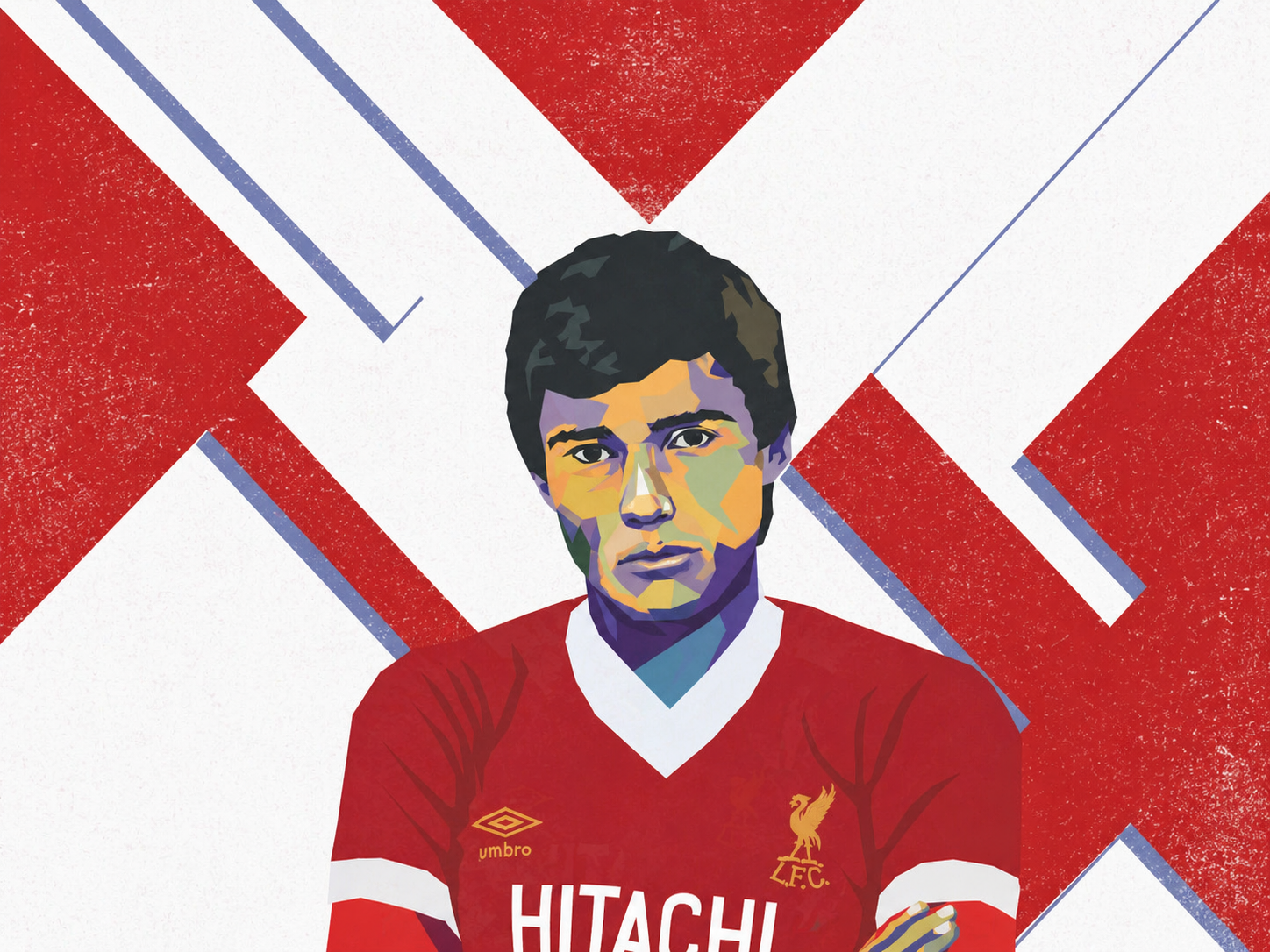
Alan Hansen is remembered by many for one sentence. That is the problem. The deeper story is of a defender who changed British football, a pundit who reshaped television analysis, and a man whose calm was never as effortless as it looked.
Cinematic Opening — The Sentence That Would Not Die
It is the afternoon of 19 August 1995, and inside BBC Television Centre the atmosphere carries that familiar, tightly coiled tension of live sport. The cameras are fixed. The studio lights are unforgiving. The nation is watching.
On the studio monitors, Aston Villa’s 3–1 win over Manchester United is still fresh. Villa Park has just offered the first great image of the new Premier League season: a youthful United side stretched, exposed, and beaten with a clarity that feels more significant than an opening-day setback.
It is not just a defeat. It looks like a miscalculation.
Throughout the summer, Sir Alex Ferguson has dismantled his own team. Paul Ince has gone. Mark Hughes has gone. Andrei Kanchelskis has gone. In their place, youth. Promise without proof.
Gary Neville. David Beckham. Paul Scholes. Nicky Butt.
Names that, at that moment, carry potential rather than authority.
In the studio, Des Lynam turns, as he so often does, towards certainty. Towards judgement.
Alan Hansen sits upright, composed in that unmistakable way. Immaculate suit. Still posture. Expression controlled to the point of severity. He does not rush. He does not soften what he is about to say.
He leans forward slightly, meets the camera, and delivers his verdict.
“You can’t win anything with kids.”
There is no flourish. No theatrical pause. Just clarity.
In that moment, it sounds less like opinion and more like fact. A conclusion drawn from experience rather than reaction.
Within nine months, Manchester United will win the league and FA Cup Double. The quote will be replayed endlessly. It will follow Hansen into every conversation, every retrospective, every summary of his career in broadcasting.
It will become shorthand for getting it wrong.
But like most football lines that survive too long as a soundbite, it tells only a fraction of the truth.
Reframe — What Hansen Actually Saw
The problem with football memory is not that it forgets. It is that it simplifies.
Over time, nuance is stripped away. Context disappears. What remains are fragments that are easy to repeat and even easier to weaponise. Alan Hansen’s line survives because it fits neatly into that pattern. Twelve words. Clean. Definitive. Wrong, supposedly.
But the reality is more uncomfortable than that.
Hansen was not reacting only to a single result at Villa Park. He was drawing on a decade spent inside one of the most demanding football environments the English game has ever produced. A place where talent was expected, but resilience was required. Where the difference between winning and falling short was rarely technical alone, but psychological.
His reference point was Bob Paisley, the manager who shaped his understanding of the game. Paisley’s view was simple and repeated often enough to become doctrine: experience matters when pressure arrives.
That belief was not theoretical. Hansen had lived it. He had seen young players arrive with ability and disappear under weight. He had also seen how teams were stabilised by older professionals who understood when to slow a game, when to take a risk, and when to remove one entirely.
So when he looked at that Manchester United side in August 1995, he was not dismissing the talent of David Beckham, Paul Scholes, or Gary Neville. He was questioning whether they could carry the weight of a season on their own.
That distinction matters.
Because the version of events that followed flattened everything into a simple contradiction: Hansen said they would fail, and they did not.
Yet that Manchester United team did not succeed because it was young. It succeeded because it was balanced.
Behind the emerging players sat Peter Schmeichel, already one of the most commanding goalkeepers in Europe. In front of him, Steve Bruce and Gary Pallister, hardened by title races. In midfield, Roy Keane, relentless and uncompromising. Above them all, Eric Cantona, whose influence extended far beyond goals.
The “kids” were not alone. They were protected.
Hansen understood that structure instinctively because it mirrored his own career. His elegance at Liverpool had never existed in isolation. It was supported by the aggression of Graeme Souness, the intelligence of Kenny Dalglish, and the ruthless standards imposed throughout the squad.
Strip that away, and even the most gifted player becomes vulnerable.
What Hansen delivered in that moment, then, was not ignorance. It was compression. A complex idea forced into a sentence too small to carry it.
Television rewards certainty. It does not reward qualification.
Years later, Hansen would laugh at the line and explain that he had meant something closer to “you can’t win everything with kids.” By then, it no longer mattered. The sentence had already outgrown him.
Origins — Composure Misread
Alan Hansen did not emerge from a system designed to produce footballers. He came from a place that rewarded instinct.
In Sauchie, a small village in Clackmannanshire, sport was not specialised. It was shared. He moved between disciplines without friction. Golf, where precision mattered. Squash, where space closed quickly. Volleyball, where timing was everything.
Each left its mark.
The way Hansen later carried the ball out of defence, head up and balanced, owed as much to those early influences as it did to formal coaching. He did not rush decisions because he did not see the game in a straight line. He saw angles. Distances. Time.
Football, at that stage, was not a calling. It was an option.
There was a brief attempt at something more conventional. A job with General Accident, the insurance firm that would later become part of Aviva. It lasted six weeks.
The routine suffocated him. Filing. Phones. Repetition. He would later recall deliberately quoting inflated premiums to avoid dealing with customers, a quiet act of resistance that said more about his temperament than any teenage ambition ever could.
He left, not out of certainty, but out of refusal.
Partick Thistle offered something different. A way out, but also a test.
Scottish football in the 1970s was unforgiving. Defenders were expected to defend in the most direct sense. Clear the ball. Win headers. Impose yourself physically. There was little patience for hesitation, and even less for interpretation.
Hansen did not fit that mould.
He held onto the ball longer than others thought safe. He stepped into midfield when he was expected to stay. He chose passes that required trust rather than force.
To some, it looked like indifference.
Bertie Auld, his manager at Thistle, was not immediately convinced. Hansen’s composure was misread as a lack of urgency. His calm as a lack of commitment.
It is a familiar pattern in football. Players who appear untroubled are often assumed to be disengaged. Effort is easier to recognise when it is visible.
Hansen’s effort was internal.
He was not avoiding the intensity of the game. He was controlling it. Slowing it down. Refusing to be dragged into situations he did not need to enter.
That distinction, subtle at first, would become the foundation of everything that followed.
What looked like ease was, even then, something constructed.
Rise — The Moment He Could Not Be Ignored
The shift from curiosity to certainty did not happen overnight. It was observed first, quietly, by a man whose job depended on seeing what others missed.
Geoff Twentyman did not scout in the modern sense. There were no data models, no video libraries, no curated highlight reels. He watched players repeatedly, in poor weather, on uneven pitches, looking for habits rather than moments.
When he first reported on Hansen at Partick Thistle, the assessment was cautious. There were doubts about pace. Questions about how he would cope against quicker forwards. Concerns that his composure might not survive under pressure.
But Twentyman kept watching.
Over time, the tone of his reports changed. The hesitation disappeared. In its place came something close to conviction.
Hansen was not slow. He was early.
He did not avoid duels. He removed the need for them.
By 1976, Twentyman was clear. This was not a player to monitor. This was a player to sign.
Liverpool, under Bob Paisley, acted decisively. In May 1977, they paid £100,000, a fee that reflected belief rather than certainty. Hansen arrived at Anfield not as a finished product, but as a projection.
It was not a forgiving environment.
Liverpool were European champions. Standards were not explained. They were enforced. The dressing room did not adapt to new players. New players adapted to it, or they disappeared.
Hansen understood that quickly. What he did not lose, despite the pressure, was the instinct that had defined him at Thistle. He did not abandon the ball. He did not rush decisions to prove urgency. He remained, outwardly at least, unchanged.
The real test came a year later.
On 10 May 1978, Liverpool faced Club Brugge in the European Cup Final at Wembley. Hansen, 22 years old, was selected ahead of Tommy Smith, a figure whose presence alone carried authority.
Inside the Wembley dressing room, Hansen felt it fully.
He would later describe himself as shaking. Not slightly unsettled, but overwhelmed by the scale of the occasion. The noise. The expectation. The awareness that one mistake could define him before his career had properly begun.
It is one thing to appear calm. It is another to manufacture it under that kind of pressure.
Ian Callaghan, Liverpool’s record appearance holder, recognised what was happening. He did not offer a speech. He offered reassurance, delivered quietly and without theatre.
“You won’t have a problem marking any striker in the world. You’ll breeze through it.”
It was not instruction. It was permission.
Liverpool won 1–0, thanks to Kenny Dalglish. The goal is remembered. The result is recorded. Hansen’s performance, by contrast, was defined by what did not happen.
No panic. No rash challenges. No visible disruption.
He played as though the occasion had no effect on him.
That was the illusion.
What mattered was not only that he performed well. It was that he performed on his own terms. He did not adjust his game to survive the final. He imposed it.
From that point, he was no longer a prospect within a strong squad. He was part of its structure.
Peak — Playing the Game Before It Happened
Alan Hansen’s peak is often described in aesthetic terms. Elegant. Composed. Effortless.
None of those words are wrong. All of them are incomplete.
What made Hansen exceptional was not how he looked, but how early he arrived at decisions. He did not react to the game. He anticipated it, often by a margin that removed the need for intervention altogether.
In an era where centre-halves were judged by tackles and clearances, Hansen reduced both. Not through avoidance, but through positioning. He placed himself where the problem would be before it developed into one.
This was not instinct alone. It was calculation.
Opposition forwards would make runs expecting to receive the ball under pressure. Instead, they found Hansen already there, body between man and ball, the danger resolved without confrontation. Interceptions replaced collisions. Control replaced recovery.
It changed the rhythm of Liverpool’s defending.
With Mark Lawrenson alongside him, the balance became precise. Lawrenson dealt with what was immediate. Hansen dealt with what was coming. One reacted. The other predicted.
The distinction mattered because it allowed Liverpool to defend without retreating.
When Hansen recovered the ball, the second phase began immediately. He did not clear under pressure unless forced. He stepped forward, head up, carrying the ball into midfield. This was not common behaviour for a centre-half in the early 1980s. It was, at times, considered reckless.
But it had a tactical effect that opponents struggled to solve.
Midfielders were forced into a decision. Step out and engage, leaving space behind them, or hold position and allow Hansen to advance unchallenged. That hesitation created openings that did not exist seconds earlier.
Into those openings, he passed.
Not long, hopeful clearances, but measured, progressive balls into Kenny Dalglish or Ian Rush. Attacks did not begin in midfield. They began with him.
In modern terms, he operated as a deep-lying playmaker from centre-back. At the time, there was no common British language to describe it that way. It was simply understood as different.
Graeme Souness once captured the visual contrast perfectly. Liverpool could be playing on what he called “a farmer’s field of a pitch”, with Lawrenson covered in mud, while Hansen would look as though he had “just stepped out of Marks and Spencer’s shop window”.
That was not vanity. It was evidence.
He rarely went to ground because he rarely needed to. His reading of the game allowed him to stay balanced, to stay in control of his movement, to stay available for the next action.
That detail, often overlooked, was central to his effectiveness. A defender on the ground is removed from the next phase. Hansen avoided that state almost entirely.
His physical profile was also misunderstood.
He did not impose himself through visible aggression, which led to assumptions about his pace and strength. In reality, he was quicker than he appeared, particularly over short distances. More importantly, he used that speed economically. He did not chase situations unnecessarily. He conserved movement for moments that required it.
That efficiency made him difficult to read. Opponents could not rely on provoking a reaction. He did not offer one easily.
The cumulative effect was control at a structural level. Liverpool did not simply defend well during that period. They dictated the terms on which defending happened.
Hansen was central to that shift.
He did not eliminate risk from the game. He reduced its frequency. He narrowed the number of moments where chaos could take hold.
And in doing so, he altered what was expected of a centre-half in British football.
The position no longer had to be defined by confrontation.
It could be defined by understanding.
Conflict — Control at a Cost
Great players are rarely defined by what they can do alone. They are shaped, often more sharply, by what resists them.
For Alan Hansen, that resistance came in two forms. One external. One internal. Both persistent.
The first was a tension that never fully made sense.
At Liverpool, he was the centre of one of the most dominant teams English football has seen. League titles. European Cups. Consistency at a level others could not match.
With Scotland, he was peripheral.
Twenty-six caps. It remains a number that feels incomplete, even decades later. Not because of what he might have become internationally, but because of what he already was at club level.
The reasons were never singular. Part of it was suspicion towards players based in England. Part of it was continuity, a preference for established partnerships built within Scottish football. And part of it, inevitably, was timing.
By the mid-1980s, Scotland had settled on a defensive core that did not include him.
When Alex Ferguson took charge for the 1986 World Cup following the death of Jock Stein, he turned to what he knew. Willie Miller and Alex McLeish, his Aberdeen pairing, were trusted. Hansen was not selected.
At that point, he was captaining Liverpool.
The contrast was stark. At club level, he represented control. At international level, he was treated as optional.
It is one of the quieter fractures in British football history. Not dramatic enough to dominate headlines, but significant enough to shape a career’s outline.
Hansen rarely pushed back publicly. That, in itself, was consistent with how he approached the game. He did not seek confrontation. He absorbed it.
The second tension was less visible, and far more difficult to manage.
On the pitch, Hansen appeared detached from pressure. He moved without urgency. He rarely rushed. Mistakes, when they came, did not alter his tempo.
It created an image of certainty.
The reality was different.
Throughout his career, he dealt with severe anxiety before matches. Not occasional nerves, but something more consuming. Sleep was affected. Routine became essential. Control extended beyond the pitch because it had to.
He would later describe making repeated trips to the bathroom before kick-off, his body reacting to the weight of expectation in a way that could not be hidden from himself, even if it was invisible to others.
“I wasn’t getting any sleep,” he admitted, worrying constantly about points and pressure.
The detail matters because it reframes everything that followed.
The composure that defined Hansen’s playing style was not a natural absence of stress. It was a response to it. A method of containing it. Every measured touch, every delayed pass, every refusal to rush was part of that process.
Teammates saw fragments of it.
Souness would later recall Hansen sitting cross-legged in the dressing room, reading the matchday programme from cover to cover, occasionally singing to himself. It looked like detachment. In truth, it was preparation.
A way of keeping the external world from accelerating beyond his control.
This is the paradox at the centre of his career.
The player who appeared least affected by the pace and pressure of the game was, in private, managing it constantly. The calm that defined him was not passive. It was constructed, maintained, and, at times, fragile.
It also explains something else.
Why he avoided unnecessary tackles. Why he refused to be drawn into chaotic exchanges. Why he insisted on dictating the tempo of his own involvement.
It was not just tactical intelligence.
It was self-preservation.
And it worked.
Not by removing pressure, but by reshaping how it was experienced.
Key Chapters — Leadership in the Game’s Darkest Moments
By the mid-1980s, Alan Hansen had moved beyond influence within Liverpool. He had become part of its leadership structure, first informally, then officially when he succeeded Graeme Souness as captain in 1985.
It was a role that demanded control, clarity, and, increasingly, resilience beyond the game itself.
On 29 May 1985, Liverpool faced Juventus in the European Cup Final at the Heysel Stadium in Brussels. What unfolded before kick-off has never been contained within the language of football.
A surge of movement in the stands. A collapsing wall. Thirty-nine people killed.
The players were drawn into it without preparation. There was no framework for how to respond, no precedent that offered guidance. Hansen and his teammates found themselves moving towards the stands, not as competitors, but as figures attempting to calm a situation already beyond control.
He would later recall the disorientation of it. Objects thrown. Confusion over what had actually happened. The realisation, gradually, that the structure of the stadium itself had contributed to the disaster.
The match went ahead.
That fact alone remains difficult to reconcile. Juventus won 1–0. The result, in any meaningful sense, was secondary.
What followed extended far beyond the night. English clubs were banned from European competition. Liverpool, as the club most closely associated with the tragedy, carried the weight of that decision. Internally, the responsibility shifted towards figures like Kenny Dalglish and Hansen.
The 1985–86 season that followed is often remembered for its success. League title. FA Cup. The Double.
But it was shaped as much by context as by performance.
Liverpool were operating within a landscape altered by exclusion. European competition removed. External scrutiny intensified. The need for internal stability increased.
Hansen’s role within that was not theatrical. He did not seek visibility. He maintained standards. Ensured continuity. Reinforced the structure that allowed the team to function despite what had preceded it.
If Heysel represented disorientation, Hillsborough represented something else entirely.
On 15 April 1989, Liverpool faced Nottingham Forest in an FA Cup semi-final at Hillsborough. Hansen had returned to the side after a prolonged absence through injury. The game began. It did not continue.
The crush in the Leppings Lane end developed quickly and catastrophically. Ninety-seven Liverpool supporters were unlawfully killed.
The aftermath extended into every part of the club.
For players, the separation between professional responsibility and personal connection disappeared. Funerals. Hospital visits. Conversations with families. The role shifted from competitor to participant in a shared grief.
Hansen later wrote about the emotional impact in simple terms. He cried. Repeatedly. Not as a public gesture, but as a response that could not be contained.
The season resumed. It had to.
Liverpool went on to win the FA Cup, beating Everton 3–2 in a final that carried a different weight to any that had preceded it. The images of celebration were present, but they existed alongside something more complex. Relief. Exhaustion. Absence.
For Hansen, these experiences did not sit outside his career. They became part of it.
Leadership, in that context, was not about instruction or visibility. It was about consistency. About ensuring that, even in circumstances that disrupted everything else, the internal standards of the club remained intact.
It required a different form of control.
Not over the game.
But over everything surrounding it.
The Defining Moment Revisited — What He Meant, and Why It Stuck
Return to August 1995.
Return to the studio. The lights. The monitors. The sense that something had shifted at Old Trafford, even if it had not yet fully revealed itself.
“You can’t win anything with kids.”
The sentence has survived because it is easy to understand and easy to challenge. It presents a clear position and, with the benefit of hindsight, a clear contradiction.
Manchester United did win. They won convincingly. They won in a way that suggested the future belonged to the players Hansen appeared to dismiss.
Phil Neville would later say the comment had a “devastating effect” on United’s younger players. That is part of its power. It was not a throwaway line to those inside the dressing room. It landed.
But the simplicity of the later reading hides the structure beneath it.
Hansen was not assessing potential. He was assessing durability.
He had spent his career inside a system where success was built on layers. Youth, certainly. But also experience. Leadership. Players who understood how to manage a game when momentum shifted, when pressure accumulated, when expectation became weight.
That understanding came directly from Bob Paisley, whose influence extended beyond tactics into something closer to philosophy. Paisley’s message was consistent: talent will win you matches, but experience will carry you through a season.
When Hansen looked at that United side, he saw imbalance. Too much responsibility placed on players who had not yet experienced the demands of a full title race. Too little emphasis, in that moment, on the structure required to support them.
What he did not say, or did not have the space to say, was that Manchester United already possessed that structure.
Behind the emerging players sat Peter Schmeichel, commanding and vocal. In defence, Bruce and Pallister, both seasoned by previous campaigns. In midfield, Keane, whose influence extended beyond technical contribution. And ahead of them, Cantona, around whom everything else could settle.
The youth were the visible change. The experience was the hidden constant.
Hansen understood that dynamic instinctively because it mirrored his own career at Liverpool. His composure, his ability to control games from defence, had never existed in isolation. It had been supported by the aggression of Souness, the intelligence of Dalglish, and a dressing room that enforced standards without compromise.
Remove that support, and the equation changes.
What Hansen delivered in 1995, then, was not a dismissal of youth. It was a warning about imbalance.
But television does not reward layered arguments. It compresses them.
In compressing Paisley’s philosophy into a single sentence, Hansen inverted its meaning. What he intended as a qualification became an absolute. What he understood as context became, in the public mind, a prediction.
He would later acknowledge the misstep, explaining that he had meant something closer to the opposite. That you cannot win everything with kids alone.
By that point, the quote had detached itself from him.
It had become part of the language of the game. A reference point. A shorthand. A reminder, often used without reflection, that certainty in football is always temporary.
And yet, within it, the original idea still holds.
Not as a rule.
But as a principle.
Legacy — What He Changed, and What Is Still Missed
Alan Hansen’s legacy is often approached through contrast.
The pundit who got it wrong. The defender who made it look easy. The player who seemed detached from the urgency of the game he controlled so completely.
Each version contains a fragment of truth. None of them are sufficient on their own.
What Hansen changed is clearer when viewed through what followed him.
The modern centre-half is expected to begin attacks, not simply end them. He is judged on positioning as much as physicality, on distribution as much as duels. The role has expanded, not in complexity, but in expectation.
Players such as Rio Ferdinand and John Stones operate within a framework that Hansen helped establish, even if indirectly. The idea that a defender can control the tempo of a game, step into midfield, and dictate possession is no longer unusual. It is required.
At Liverpool, Virgil van Dijk represents the clearest continuation. The composure, the positioning, the refusal to be drawn into unnecessary contact. Different era, different demands, but a recognisable philosophy.
Hansen did not invent the ball-playing defender. But he established it within a system that valued results above aesthetics. That distinction matters. It is easier to experiment when success is not expected. It is harder when it is demanded.
He proved that control and dominance were not opposites. They were linked.
In broadcasting, his impact was equally structural.
Before Hansen, football analysis on television tended towards observation rather than explanation. Events were described, but not always understood. Positioning was noted, but not interrogated. Mistakes were identified, but not broken down.
Hansen altered that balance.
Working on Match of the Day, he brought a sharper edge to analysis. Direct language. Clear judgement. An emphasis on responsibility within defensive structure. Terms such as “diabolical” or “shocking” were not used for effect, but to underline standards.
It shifted expectations. Viewers began to look at the game differently. Not just what happened, but why it happened.
That approach is now standard. It was not then.
And yet, even within that legacy, something remains misunderstood.
Hansen is often remembered for certainty. For authority. For an almost clinical detachment in both playing and analysis.
What is less visible, and less frequently acknowledged, is the cost of that presentation.
The control that defined his game was not effortless. It was maintained. The authority that defined his broadcasting was not comfortable. It was managed.
Even his departure from television in 2014 was shaped by that same underlying tension. The nerves did not diminish with experience. They increased. The performance remained consistent. The process behind it became harder to sustain.
This is the part of Hansen’s career that does not fit easily into summary.
He was not simply a player ahead of his time, or a pundit who reshaped analysis. He was someone who built a version of himself capable of operating at that level, and maintained it over decades.
That distinction is easy to overlook.
But it is central to understanding him properly.
Closing Reflection — The Shape of Control
On 25 May 2025, Alan Hansen returned to Anfield to present the Premier League trophy to Virgil van Dijk.
It was a quiet moment, but a significant one. A bridge between eras. The last Liverpool captain to lift the league title in front of supporters at Anfield standing alongside the current one.
As Hansen handed the trophy to Van Dijk, the symmetry was clear without needing to be overstated.
Different generations. Different contexts. A shared understanding of what the position demands.
Hansen’s career, taken in full, does not resolve into a single image.
Not the defender gliding across uneven pitches without a mark on his kit.
Not the analyst delivering a line that would outlive its meaning.
Not the captain navigating moments that extended far beyond the game.
It is something less visible than all of those.
A sustained attempt to impose order on environments that resist it. To slow situations that demand speed. To make decisions early enough that they appear simple when they are not.
That is what his football represented.
And it explains why it is so often misunderstood.
Because the easier something looks, the more likely it is to be reduced.
Alan Hansen made the game look controlled.
That was never the same as it being easy.
