


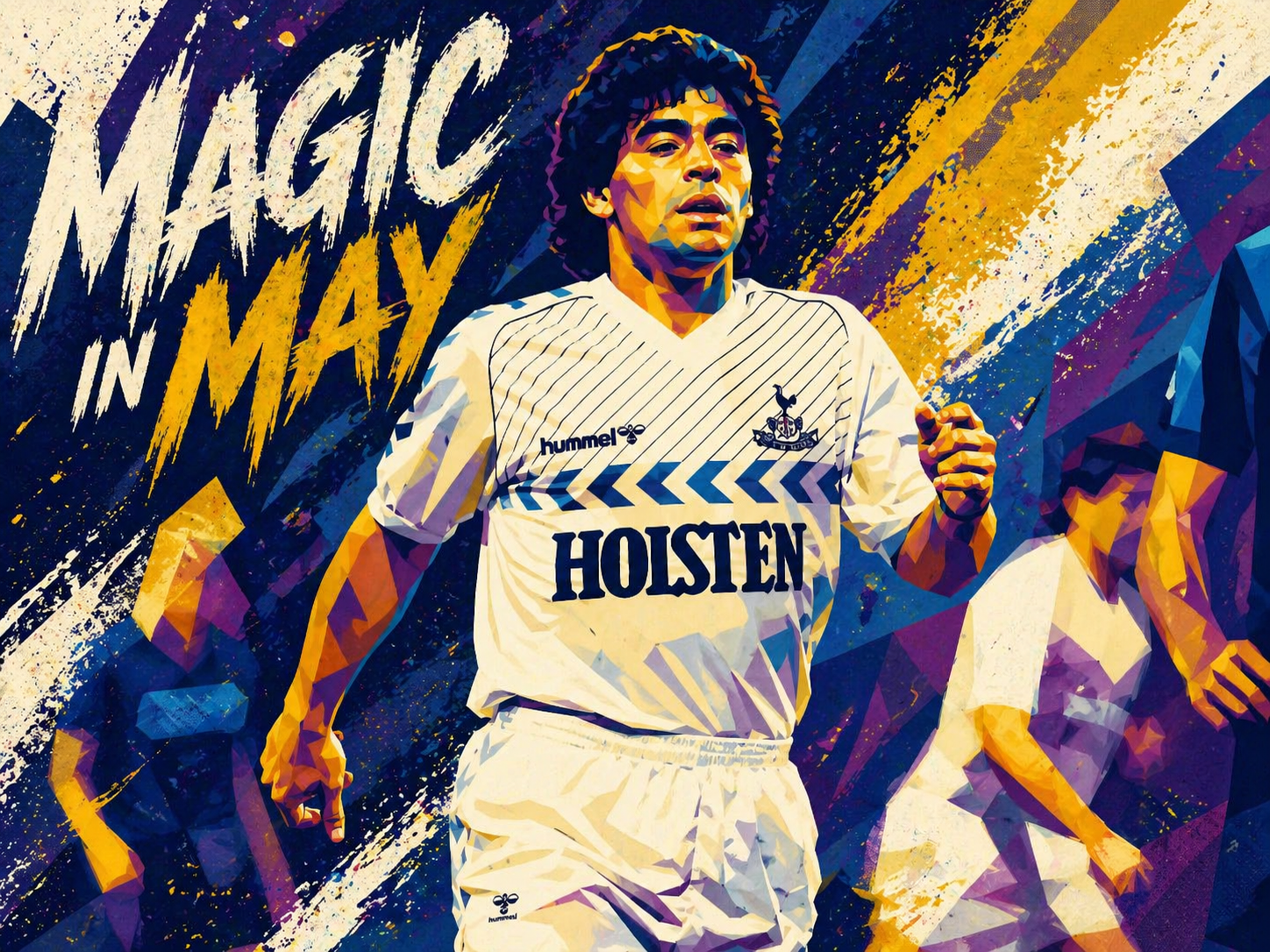
On May 1, 1986, Diego Maradona appeared for Tottenham Hotspur in Ossie Ardiles’ testimonial at White Hart Lane. Fifty-one days before the Hand of God, English football welcomed him not as a villain, but as a visiting genius in borrowed boots.
Key Takeaways
- Diego Maradona played for Tottenham Hotspur against Inter Milan in Ossie Ardiles’ testimonial on May 1, 1986.
- He arrived without boots after travelling from Oslo, having played for Argentina against Norway the previous night.
- Clive Allen lent him a pair of size six-and-a-half boots, while Glenn Hoddle gave up the number 10 shirt.
- The night complicates the usual English memory of Maradona as simply the villain of Mexico 1986.
- His appearance at White Hart Lane offered a rare glimpse of football’s future inside a game still shaped by old assumptions.
The Borrowed Boots of White Hart Lane
The air around the Tottenham High Road on the 1st of May, 1986, was thick with an electric, almost disorienting hum. It was a spring evening in North London, and the streets were completely gridlocked. English football, at this precise juncture in history, was isolated and fraying at the edges; domestic clubs had been banished from European competition following the Heysel disaster, stadiums were crumbling, and the game itself felt heavily anchored to a brutal, meat-and-potatoes physicality. Yet, inside the concrete belly of White Hart Lane, the atmosphere crackled with the kind of feverish anticipation normally reserved for a European Cup final. Over 30,000 supporters had crammed into a stadium that typically hosted 20,000 for a league fixture, overwhelming the turnstiles to the point where kick-off had to be delayed by fifteen minutes. They were not there for a trophy. They were there for a testimonial.
Deep inside the home dressing room, a crisis of equipment was quietly unfolding. Diego Armando Maradona, the undisputed greatest footballer on the planet, was standing without a pair of boots.
He had flown into London directly from Oslo, having played a gruelling pre-World Cup friendly for Argentina against Norway the night before. In the frantic dash across the continent to honour his great friend and compatriot, Osvaldo ‘Ossie’ Ardiles, Maradona had arrived with nothing. No shin pads, no training gear, and crucially, no footwear.
Ossie Ardiles, the man of the hour, turned to the Tottenham squad in a state of mild panic. “Who takes size six and a half?” he asked.
Clive Allen, Tottenham’s prolific striker, raised his hand. Allen had two pairs of boots in his locker: one battered pair that he had worn through the trenches of the entire First Division season, and a brand-new pair he was painstakingly trying to break in.
“Diego,” Allen told the stocky Argentine, “be my guest and take whatever pair you want!”
Maradona, a player whose entire genius relied on a microscopic, neurological connection between his skin and the leather of the ball, bypassed the new boots. He picked up Allen’s worn, seasoned pair, laced them up, and pulled on the famous white, Holsten-sponsored shirt of Tottenham Hotspur. Glenn Hoddle, the darling of the Spurs faithful, had willingly relinquished his iconic number 10 shirt for the evening, an ultimate gesture of deference to the visiting deity.
When Maradona and Ardiles finally emerged from the tunnel, walking out alongside Ardiles’ two young sons, the noise that greeted them was a visceral, thunderous roar. Here he was. The Golden Boy. Alone on a patch of grass in North London, wearing borrowed boots, completely unburdened by the crushing expectations of a nation. For the next ninety minutes, he would play with an expression of pure, unadulterated joy. It was a fleeting, impossibly romantic image. And it occurred exactly fifty-one days before he would break English hearts in the most infamous, divisive, and magical match in the history of the sport.
The Villain Who Was Loved
The collective British memory of Diego Maradona is almost exclusively defined by the events of June 22, 1986, at the Azteca Stadium in Mexico City. The prevailing narrative is etched in stone: he is the Artful Dodger, the ultimate pantomime villain who brazenly punched the ball beyond Peter Shilton and then had the audacity to claim divine intervention. For decades, the English discourse surrounding Maradona has been coloured by the bitter aftertaste of the “Hand of God” and the geopolitical shadow of the Falklands War. He is often framed as a man defined by his animosity toward the English establishment.
But this definitive profile requires us to forcefully challenge that narrow, jingoistic framing. The reality is far more complex, and significantly more poetic. The defining moment of his career against England is incomplete without the context of his appearance at White Hart Lane just weeks prior.
Maradona did not hate the English; he harboured a deep, profound respect for the soul of English football culture. The animosity was purely a construct of international rivalry and political fallout. In truth, the bond between North London and the Argentine diaspora was incredibly strong. When Ardiles and Ricardo Villa arrived at Tottenham in 1978, they brought Latin flair to a league defined by crunching tackles. Even during the height of the Falklands conflict in 1982, the Spurs supporters remained fiercely loyal to their South American imports. At Villa Park, during an FA Cup semi-final, the Tottenham faithful unfurled a banner that read: “You keep the Falklands, we’ll keep Ossie”.
It was this specific micro-climate of acceptance that allowed Maradona to feel safe stepping onto the pitch in London. He defied his own national team manager to be there. He was not a villain in England that night; he was an exotic artist welcomed as a hero. To reduce Maradona’s relationship with England to a single handball is to ignore the night he dazzled 30,000 Londoners in a white shirt, demonstrating that pure footballing genius can effortlessly transcend the borders of nationalism and war.
The Mud of Villa Fiorito
To understand why Maradona played with such desperation, and why he possessed a cunning that confounded structured European systems, one must look to the dirt of his origins. Diego Armando Maradona was born on October 30, 1960, in the Polyclinic Evita Hospital in Lanús, but he was forged in the grinding poverty of Villa Fiorito, a shantytown on the southern outskirts of Buenos Aires.
This was not a romanticized poverty; it was a desperate, daily survival. But from this environment emerged a psychological trait intrinsic to Argentine football: viveza criolla, the cunning of the criollos. It is the survival instinct of the streets translated onto the pitch, the ability to outsmart, to deceive, and to survive against larger, better-equipped adversaries.
His talent was evident so early that it defied logic. At the age of eight, playing for Estrella Roja and later the famed Los Cebollitas (The Little Onions) youth team of Argentinos Juniors, he possessed the physical build of a child but the spatial awareness of a veteran. His youth coach, Francisco Cornejo, was so stunned by Maradona’s ability during trials that he demanded to see the boy’s identification card, convinced he was a dwarf adult attempting a scam.
On October 20, 1976, ten days before his sixteenth birthday, Maradona made his professional debut for Argentinos Juniors. Within minutes of stepping onto the pitch, he received the ball and casually knocked it straight through the legs of Juan Domingo Cabrera. That nutmeg was not just a trick; it was a statement of intent. “That day I felt I had held the sky in my hands,” Maradona later reflected. Cabrera, speaking thirty years later, remembered the humiliation vividly: “He made the nutmeg and when I turned around, he was far away from me”. From the very beginning, his genius was rooted in making professional athletes look like spectators to his own private game.
The Burden of the Golden Boy
The trajectory of Maradona’s rise was not linear; it was a violent, upward thrust punctuated by severe emotional setbacks. The first defining heartbreak occurred in 1978. As Argentina prepared to host the FIFA World Cup, the 17-year-old Maradona was widely expected to be the crown jewel of César Luis Menotti’s squad. However, just days before the tournament began, Menotti cut him from the final roster, deeming him too young to carry the psychological weight of a home World Cup under the watchful eye of a military junta.
The rejection did not break him; it weaponized his talent. At the 1979 FIFA World Youth Championship in Japan, an 18-year-old Maradona unleashed his fury on the world stage. He led Argentina to the title, scoring six goals in six matches and winning the Golden Ball. Former FIFA President Sepp Blatter, watching from the stands, recalled the sheer disbelief of the spectators: “He left everyone open-mouthed every time he got on the ball”.
His domestic peak in Argentina arrived with his transfer to Boca Juniors in 1981. On April 10, in his first Superclásico against arch-rivals River Plate at La Bombonera, Maradona scored a goal that cemented his divinity in Buenos Aires. Dribbling past Alberto Tarantini and legendary goalkeeper Ubaldo Fillol, he rolled the ball into the net, sealing a 3-0 victory. It was a precursor to the global domination that would follow.
In 1982, he crossed the Atlantic, signing for Barcelona for a then-world-record fee of £5 million. His time in Catalonia was a chaotic blend of unparalleled brilliance and violent trauma. On June 26, 1983, he achieved something almost unthinkable: he became the first Barcelona player to be given a standing ovation by the Real Madrid fans at the Santiago Bernabéu. After rounding the goalkeeper, he paused just long enough for sliding Madrid defender Juan José to crash face-first into the goalpost, before casually slotting the ball home.
Yet, his rise in Europe was repeatedly interrupted by the brutal realities of 1980s defending. A vicious tackle by Athletic Bilbao’s Andoni Goikoetxea, the so-called “Butcher of Bilbao”, shattered Maradona’s ankle in 1983, threatening to end his career before it had truly begun. The simmering tension exploded during the 1984 Copa del Rey final in Madrid, where, after enduring 90 minutes of physical abuse and xenophobic taunts, Maradona sparked a mass brawl, headbutting and kneeing Bilbao players in front of King Juan Carlos. It was a visceral reminder that his artistry was perpetually at war with the violence of his era.
The Blueprint of a God
What made Diego Maradona the supreme footballer of the 20th century? To simply label him a “classic number 10” or an “attacking midfielder” is a severe dereliction of tactical analysis. Maradona was an advanced playmaker who fundamentally altered the geometry of the pitch.
At 5-foot-5, his physical stature was often mocked by early detractors, yet it was the very source of his invulnerability. He possessed a famously low centre of gravity, anchored by thighs like oak trunks, which allowed him to absorb violent, bone-rattling physical pressure from defenders without breaking stride. While players like Johan Cruyff glided across the turf, Maradona drove through it. Cruyff himself noted the singularity of Maradona’s dribbling, observing that the ball seemed quite literally attached to his boot.
He was fiercely, dominantly left-footed. In the modern, highly systematized era of football, extreme one-footedness is often considered a tactical limitation. For Maradona, it was a weapon. Defenders knew exactly what he wanted to do, shift the ball to his left instep, and yet they were utterly powerless to prevent it. He would frequently execute the rabona (a reverse-cross behind the standing leg) rather than use his weaker right foot, turning a perceived weakness into an act of breathtaking aesthetic beauty. He also popularized the roulette, spinning 360 degrees on the ball in tight spaces to escape the aggressive man-marking systems prevalent in Serie A.
But to view Maradona solely as an entertainer is to miss his tactical genius. He was a strategic mastermind. As former Napoli president Corrado Ferlaino aptly noted, he was “a coach on the pitch”. Maradona had an elite spatial awareness. He thrived in limited spaces, intentionally drawing two or three defenders into a melee before suddenly dashing out of the crowd or threading a blind pass to a suddenly unmarked teammate.
Beyond technique, his defining trait was his psychological dominance. He absorbed the emotional terror of the game so his teammates didn’t have to. Jorge Valdano, his international teammate, articulated this beautifully: “Maradona was a technical leader: a guy who resolved all difficulties that may come up on the pitch… we knew that if it was the case that we lost then Maradona would shoulder more of the burden, would be blamed more, than the rest of us. That was the kind of influence he exercised on the team”.
He was impossible to replicate because no other player possessed his precise cocktail of traits: the delicate touch of a ballerina, the brute strength of a middleweight boxer, the cunning of a street thief, and the tactical processing speed of a supercomputer.
The Genius Against the Machine
The dramatic arc of an elite sports narrative requires friction, and Diego Maradona’s entire existence was defined by a multi-front war. There was the constant tension between his god-given talent and his self-destructive body. There was the friction between his loyalty to his roots and the sprawling, suffocating demands of global superstardom. But the most compelling tension was the battle between Maradona’s freewheeling genius and the rigid, unyielding structures of football management and establishment rules.
This tension is perfectly encapsulated in the buildup to his appearance for Tottenham in May 1986. Argentina’s manager, Carlos Bilardo, was an obsessive tactician. Bilardo had built a heavily structured, pragmatic 3-5-2 system designed entirely around shielding Maradona and allowing him to operate freely in the final third. As the 1986 World Cup loomed, Bilardo demanded absolute focus from his squad.
When Maradona informed Bilardo that he was flying from their training base in Norway to London for a mere exhibition game, Bilardo was apoplectic. He strictly forbade it. The risk of injury, fatigue, and media distraction was too great. Maradona’s response was a masterclass in untouchable ego: “By the way, I’m going to London for Ossie… I’m Diego Maradona, I’m going”.
This was the core conflict of his career: he operated entirely outside the jurisdiction of mortal managers. Yet, this defiance bled into his personal life with tragic consequences. During his peak years at Napoli, his rejection of structure led him into the dark embrace of the Neapolitan underworld. The cocaine addiction that began in Barcelona spiralled out of control in Italy. He routinely missed training sessions, citing “stress,” racking up $70,000 in club fines. The narrative peddled by his detractors was that he was lazy, a man who coasted on natural ability while abusing his body with narcotics and alcohol.
Yet, this too is a misunderstanding. Asif Kapadia’s brilliant documentary Diego Maradona revealed that the Argentine employed a personal fitness coach, Fernando Signorini, long before such practices were standard. Maradona would endure agonizing, extreme physical conditioning regimens behind closed doors to sweat out the toxins of his partying, essentially rebuilding his body week after week. The tension was unceasing: he was destroying himself off the pitch, only to violently resurrect himself on it.
The Saint of Naples and the Sun of Mexico
To fully grasp the magnitude of the player who turned up at White Hart Lane, we must look at the empires he was building, and conquering, simultaneously.
When Maradona was unceremoniously sold by Barcelona in 1984 following the Copa del Rey brawl, he arrived at Napoli for a world-record fee of £6.9 million. The presentation at the Stadio San Paolo was attended by 75,000 disciples. Napoli was a working-class club in a city plagued by poverty, lack of sanitation, and the grip of the Camorra. Italian football was ruthlessly dominated by the wealthy, aristocratic northern clubs like Juventus and AC Milan. No team from the south of the Italian peninsula had ever won the Serie A title.
Maradona didn’t just join Napoli; he became their messiah. He weaponized the socio-economic resentment of the south, channelling the anger of Naples into his left boot. In the 1986-87 season, he dragged Napoli to their first-ever Serie A championship. The celebrations were apocalyptic. The city shut down for a week of rolling street parties, and mock funerals were held for Juventus, with coffins paraded through the streets. He had overthrown the establishment.
Simultaneously, he was preparing to conquer the world. The 1986 World Cup in Mexico remains the greatest individual domination of a team tournament in the history of sport. In the blistering heat and suffocating altitude, Maradona played every single minute. He scored five goals and provided five assists. He attempted a tournament-best 90 dribbles, three times more than any other player on earth, and was fouled a record 53 times.
But it was the quarter-final against England on June 22 that crystallized his duality. The match, played in the shadow of the Falklands War, was fraught with genuine hostility. In the 52nd minute, Steve Hodge sliced a clearance into the penalty area. Maradona, fourteen inches shorter than England goalkeeper Peter Shilton, leapt into the air and punched the ball into the net. As he wheeled away, he furiously urged his teammates to embrace him so the referee wouldn’t disallow it. “Shut the f*** up and keep on celebrating,” he barked at Jorge Valdano. He later coined it the “Hand of God,” a masterstroke of viveza criolla.
Four minutes later, the devil became an angel. Receiving the ball in his own half, he executed a pirouette that left Peter Beardsley and Peter Reid stranded. He then embarked on a 60-metre sprint, slaloming past Terry Butcher and Terry Fenwick, before dropping Shilton to the turf with a feint and sliding the ball into the empty net. It was voted the “Goal of the Century” by FIFA. In the span of 240 seconds, Maradona had perfectly articulated the two halves of his soul: the shameless street urchin and the untouchable sporting deity.
The Rap Battle of White Hart Lane
Let us return, with the full weight of this context, to the turf of White Hart Lane on the evening of May 1, 1986.
Tottenham Hotspur were facing Inter Milan in Ossie Ardiles’ testimonial. The crowd was buzzing, aware that they were witnessing a glitch in the matrix. The match itself was a 2-1 victory for Spurs, courtesy of goals from Mark Falco and Clive Allen, but the scoreline was entirely irrelevant. The real spectacle was the midfield alignment: Chris Waddle, Ossie Ardiles, Glenn Hoddle, and Diego Maradona.
For the English fans, raised on a diet of muddy pitches and route-one long balls, watching Maradona and Hoddle operate together was a revelation. Hoddle, deeply underappreciated by the pragmatic English FA for his artistic sensibilities, found a kindred spirit in the Argentine. Adam Powley, an author and fan in the crowd that night, described their interplay as “a rap battle… where one of them did something and the other one was just forced by honour to top it”.
Maradona, despite his exhaustion from the previous night’s game in Oslo, did not treat the match as a casual kickabout. He played the full ninety minutes. He pulled off bicycle kicks, slalomed through the notoriously rigid Italian defence of Inter Milan (marshalled by Liam Brady), and silenced the crowd with his first touch. On one occasion, a throw-in was hurled at him at shoulder height; without breaking a sweat, he killed the ball dead on his instep, an act of technical perfection that drew gasps from the terraces.
But the true emotional climax of the evening occurred away from the cameras, in the sanctuary of the Tottenham dressing room after the final whistle. Maradona, buzzing from the sheer pleasure of a game unburdened by pressure, sought out the Spurs players. Through Ardiles’ translation, Maradona walked up to Chris Waddle, shook his hand, and said, “Very good player, he should play in Italy”. Waddle, a world-class winger in his own right, was left utterly starstruck. “I thought, ‘Wow, Maradona just said I’m a good player,'” Waddle later recalled, openly admitting, “I’ve never seen a better footballer. Never”.
Then, Maradona turned his attention to Glenn Hoddle. He looked at Ardiles, genuinely bewildered by the English football landscape, and asked, “Where have you been hiding this guy Hoddle? He is world-class”.
In that single dressing room interaction, Maradona validated a generation of English flair players who had been marginalized by their own country’s tactical dogmatism. He recognised that Hoddle’s genius was being stifled by the “crunch tackling” ethos of the First Division.
The bitter irony, of course, is that just fifty-one days later, Hoddle and Waddle would be standing on the scorched grass of the Azteca Stadium, watching helplessly as the stocky little genius they had so warmly embraced in London danced through their defence to ruin their World Cup dreams. The 30,000 fans who had given Maradona a standing ovation at White Hart Lane would soon be screaming at their televisions, cursing his name. It is a cinematic twist of fate that perfectly encapsulates the chaotic, unpredictable poetry of football.
The Immortal Flaw
To evaluate Diego Maradona’s legacy honestly, we must strip away the heavy romanticism and confront the brutal truths of his existence. What did he actually change?
Firstly, he changed the laws of the sport itself. The modern game, with its stringent protections for attacking players, owes a massive debt of gratitude to the blood and bone Maradona left on the pitch. In the 1980s, defenders were virtually given a license to assault creative players. The tackles Maradona endured from the likes of Claudio Gentile and Andoni Goikoetxea would result in immediate, lengthy bans in today’s Premier League. His suffering forced FIFA to implement stricter disciplinary measures. As Guillem Balagué noted, modern icons like Lionel Messi owe Maradona a great deal, because the tactical brutality Maradona survived would never be tolerated today.
Secondly, he influenced an entire lineage of deep-lying playmakers and free-kick specialists. His unique technique of striking a dead ball, raising his knee at a high angle to generate vicious dip and curl, was directly studied and emulated by Gianfranco Zola (his understudy at Napoli) and later Andrea Pirlo and Lionel Messi.
What is most misunderstood about Maradona is the assumption that his genius was effortless. The myth is that he was a lazy, cocaine-addled savant who simply rolled out of bed and dominated world football. This is demonstrably false. Napoli manager Ottavio Bianchi debunked this myth, stating: “They all speak of the fact that he did not train, but it was not true because Diego was the last person to leave the pitch, it was necessary to send him away because otherwise he would stay for hours to invent free kicks”. His manager for the national team, Menotti, echoed this sentiment, insisting that Maradona’s brilliance was “a product of his hard work”. He was a deeply flawed human being, yes, but his dedication to mastering the mechanics of a football was absolute.
The Heaviest Shirt
On November 25, 2020, Diego Maradona’s heart finally gave out in his sleep at his home in Buenos Aires. He was 60 years old. The autopsy revealed a body ravaged by decades of excess: liver and kidney damage, and a heart that weighed almost twice that of a normal human.
The tributes flowed from every corner of the globe. In Naples, the stadium was immediately renamed in his honour. In Argentina, the nation ground to a halt, plunging into three days of national mourning. But among the avalanche of grief, the words of his old friend, Ossie Ardiles, rang with a specific, piercing melancholy.
“Our conversations always finished in the same way,” Ardiles reflected. “It was very beautiful to be Maradona, but it was not easy to be Maradona… Inside the pitch, he was the happiest person in the world”.
In 2017, Maradona had returned to North London one final time. Standing on the pristine turf of the new Wembley Stadium, he watched Mauricio Pochettino’s Tottenham dismantle Liverpool. He met Harry Kane in the dressing room, offering the English striker a piece of hyper-specific tactical advice: “When you shoot, look one way with your eyes, but shoot the other”. Kane, soaking in the wisdom of a god, went out and scored two goals.
It was a beautiful full-circle moment, but the definitive image of Diego Maradona in England will forever remain that spring evening in 1986.
Before the chaos of Mexico. Before the Hand of God. Before the mafia, the failed drug tests, the bloated decline, and the tragic, premature death.
Just a 25-year-old kid from the mud of Villa Fiorito, standing in the tunnel at White Hart Lane. He is wearing a white shirt that doesn’t belong to him, and a pair of size six-and-a-half boots borrowed from Clive Allen. The roar of the London crowd is spilling down the concrete steps. The whistle is about to blow. And for the next ninety minutes, with a ball at his feet, Diego Armando Maradona is entirely free.
