


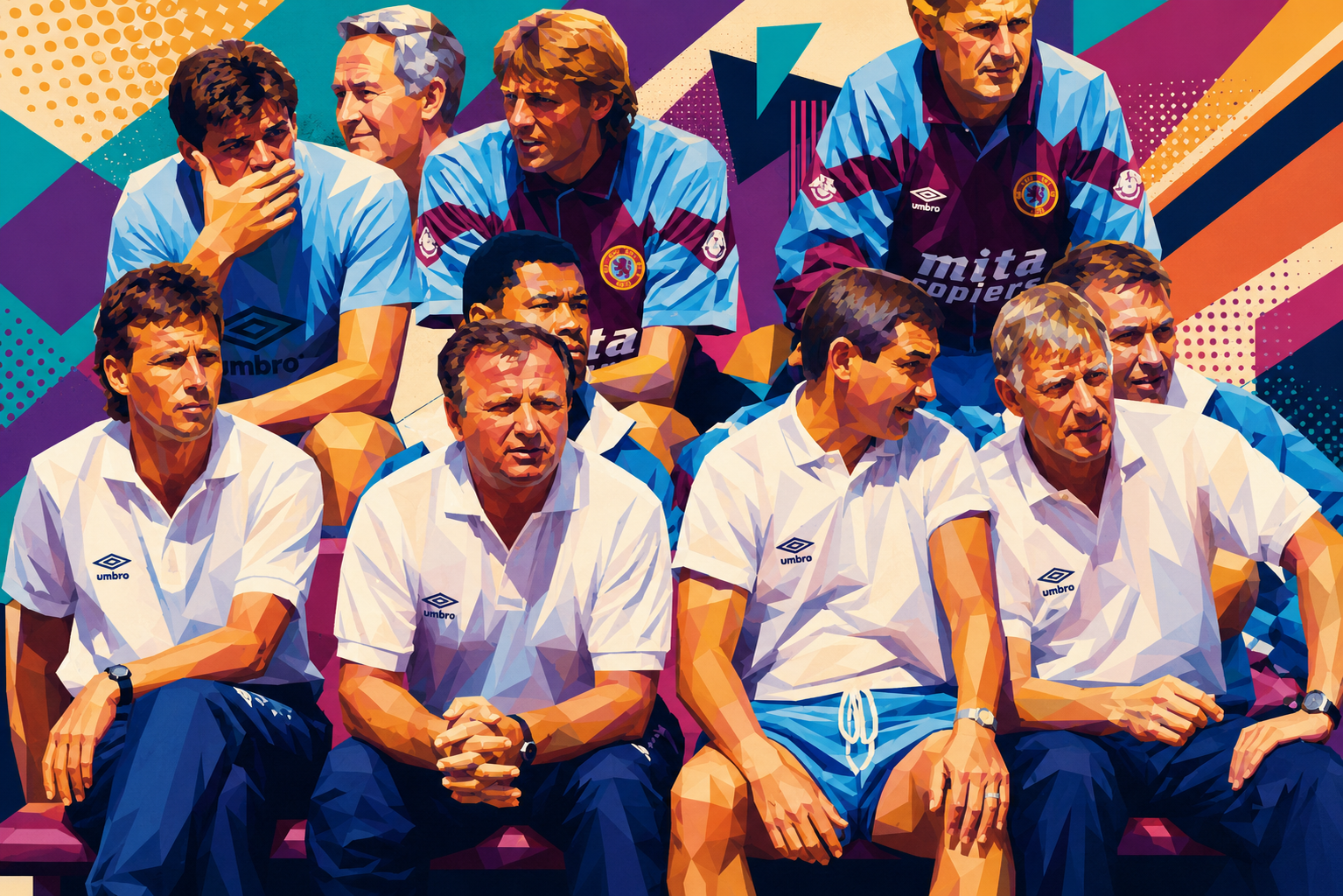
Jozef Venglos lasted one season at Aston Villa, but his brief spell at Villa Park exposed English football’s fear of the future before the Premier League had even begun.
The room did not laugh at first.
That is the detail that matters.
When Doug Ellis stood before the assembled press in July 1990 and unveiled Aston Villa’s new manager, the reaction was not outrage, curiosity or excitement. It was silence. Long enough to become awkward. Long enough for Ellis, never a man especially comfortable with dead air, to break it himself.
“Does anybody know who this is?”
According to those in the room, almost nobody did.
English football had spent the summer staring at itself. Italia ’90 had reignited old myths about courage, spirit and the unique emotional force of the English game. Graham Taylor had left Aston Villa after guiding them to a second-place finish in the First Division, bound for the England job as the respectable heir to Bobby Robson. Villa supporters expected continuity. Another English manager. Another familiar football voice.
Instead, standing awkwardly beside Ellis at Villa Park was a softly spoken 54-year-old Czechoslovakian with a doctorate in physical education, a background in psychology, and a résumé that most of the room had not bothered to read.
Dr Jozef Venglos had just led Czechoslovakia to the quarter-finals of the World Cup. He had coached at European Championships. He had lectured for FIFA and UEFA. He had spent years studying the physiology and psychology of elite performance at a time when much of English football still treated preparation as something that happened naturally between Friday afternoon and kick-off on Saturday.
None of that seemed to matter.
To much of the British press, he looked less like the future of football than an administrative error.
#JozefVenglos July 1990 – Czech national coach Jozef Venglos is appointed as the new manager of @AVFCOfficial Nobody knew quite what to make of him ; including his baffled squad pic.twitter.com/oTHzL37ZLy
— FootballRetroPlus (@robertmdaws) November 16, 2020
The English game in 1990 still viewed foreign coaching with suspicion bordering on hostility. This was a football culture built on instinct, routine and inherited wisdom. Managers were expected to project authority through force of personality. They shouted. They drank with players. They talked about desire and commitment and hard work. Venglos arrived speaking instead about recovery, tactical flexibility and the relationship between mental fatigue and physical output.
Even his manner felt wrong.
There was no performative charisma. No tub-thumping confidence. No theatrical self-belief. He spoke calmly, academically, often searching for the precise phrase rather than the dramatic one. Reporters compared him to a schoolteacher. Some rival managers privately mocked him. One of the most respected coaching educators in Europe had entered a football culture that still distrusted the very idea of football education.
And yet Aston Villa had not appointed a fool or a novelty act.
They had appointed a man who believed English football was underdeveloped.
That was the real provocation.
Not failure, but friction
The easiest version of the Jozef Venglos story is also the least interesting.
First foreign manager in English top-flight history. One season at Aston Villa. Seventeenth place. Gone within a year.
English football moved on. Arsène Wenger arrived six years later and changed everything properly.
That is the simplified version. The tidy version. The version history tends to prefer because it creates clean heroes and clear failures.
But Venglos does not fit neatly into either category.
He was not a visionary genius destroyed by ignorant players and xenophobic journalists. Aston Villa genuinely regressed under him. A side that had finished runners-up under Graham Taylor won only one league match during the final months of 1990. The rhythm disappeared. Confidence drained from the team. Results became impossible to defend. By the end of the season Villa sat just above the relegation places, closer to collapse than continental qualification.
Nor, however, was Venglos a deluded academic hopelessly unsuited to English football.
That interpretation has aged even worse.
Modern football is now built almost entirely on ideas that English football once treated with suspicion during Venglos’s year at Villa Park. Nutritional planning. Recovery science. Tactical periodisation. Psychological management. Controlled training loads. Structured warm-downs. Positionally fluid football. Detailed opposition analysis. All of it now forms part of the standard operating procedure at elite clubs.
In 1990, much of it was still viewed as faintly ridiculous.
The real story of Venglos at Aston Villa is therefore not about success or failure in isolation. It is about friction. About what happens when an advanced football ideology collides with a culture psychologically unprepared to absorb it.
English football at the time did not merely distrust foreign coaches. It distrusted abstraction. It distrusted intellectualism. It distrusted the idea that football could be studied scientifically without somehow losing its soul in the process.
Venglos represented all of those things at once.
He was a doctor in an environment that valued instinct over theory. A tactician in a culture that still romanticised chaos. A manager who spoke quietly in a game addicted to noise.
England in 1990: the closed room
To understand why Jozef Venglos felt so strange to English football, it is necessary to understand how strange English football had become to the rest of Europe.
By 1990, the First Division existed inside its own sealed ecosystem. The Heysel disaster and the subsequent ban on English clubs from European competition had done more than remove teams from continental tournaments. It had isolated an entire football culture during one of the most tactically transformative periods in the modern history of the sport.
While continental Europe continued to move toward pressing, spatial awareness, positional flexibility and specialised conditioning, England largely remained emotionally and tactically committed to older certainties.
The English game still celebrated intensity above subtlety. Managers spoke about character, desire and commitment with almost theological reverence. Tactical sophistication was often viewed with suspicion, occasionally even as weakness. Training remained physically punishing rather than strategically precise. Recovery science barely existed in mainstream discussion. Nutrition was an afterthought. Drinking culture remained deeply embedded inside dressing rooms.
The stereotype of “blood and thunder” football persisted because, to a significant degree, it was true.
This was not a league devoid of intelligence or quality. English football in 1990 contained outstanding players and excellent managers. But structurally and culturally, it lagged behind much of Europe in how the game was being analysed, prepared for and understood.
Aston Villa themselves represented one of the strongest examples of the old English model functioning successfully.
Under Graham Taylor, Villa had finished runners-up in the 1989-90 First Division season, behind only Liverpool. Taylor’s side was organised, aggressive, emotionally resilient and physically relentless. They played with speed and directness. David Platt surged from midfield. Tony Daley stretched teams with raw pace. The football was not primitive, as some later caricatures suggested, but it was unmistakably English in its rhythm and priorities.
Taylor understood the ecosystem perfectly because he belonged to it.
When he departed for the England job after the World Cup in Italy, Villa chairman Doug Ellis faced a choice that reflected a broader crossroads emerging within English football itself. He could appoint another domestic traditionalist and preserve continuity, or he could attempt something more radical.
Ellis chose radicalism.
In retrospect, it remains one of the boldest appointments English football made before the Premier League era.
Who Venglos really was
Part of the problem Jozef Venglos faced at Aston Villa was that English football mistook unfamiliarity for insignificance.
Because the British press did not know him, many assumed he had emerged from nowhere. In reality, Villa had appointed one of the most respected coaching educators in European football.
By the summer of 1990, Venglos possessed a depth of international experience that few English managers could rival. He had coached national teams, lectured for FIFA and UEFA, worked across multiple continents and helped shape tactical conversations far beyond Czechoslovakia. Within European coaching circles, he was viewed less as a provincial manager than as a football intellectual.
The irony was that his authority became harder, not easier, to communicate in England precisely because of the way he carried it.
There was no swagger to Venglos. No performative certainty. No cultivated mystique. He did not resemble the archetypal British football manager of the period, all force of personality and dressing-room intimidation. He looked more like a university lecturer accidentally dropped into professional sport.
In some ways, that was not entirely inaccurate.
Born in Ružomberok in 1936, Venglos had originally been a technically gifted midfielder for Slovan Bratislava before illness abruptly altered the trajectory of his life. Hepatitis forced him away from playing in his early thirties, an interruption that redirected his energy toward studying the game rather than merely participating in it.
That distinction became central to everything he later represented.
Where many managers of his generation built authority through accumulated dressing-room experience, Venglos approached football analytically. He completed a doctorate in physical education and specialised in psychology at a time when the emotional and cognitive dimensions of performance remained largely unexplored within British football culture.
To Venglos, football was not simply about effort and momentum. It was an interconnected system of physiology, psychology, tactical structure and human behaviour.
Before arriving at Aston Villa, Venglos had already accumulated achievements that should have commanded enormous respect. As assistant coach, he played a major role in Czechoslovakia’s victory at Euro 1976, the tournament forever remembered for Antonín Panenka’s audacious chipped penalty against West Germany. Later, as head coach, he guided Czechoslovakia to third place at Euro 1980 and then to the quarter-finals of the 1990 World Cup in Italy, where they eventually lost to West Germany after a Lothar Matthäus penalty.
That 1990 World Cup run mattered.
Czechoslovakia played with tactical fluidity and technical confidence. Venglos encouraged positional interchange and intelligent movement rather than rigid structure. His football was not defensive Eastern Bloc orthodoxy. It was adaptive, technical and strategically modern.
Yet in England, those credentials barely registered.
Bodymoor Heath: the first battle was not tactical
The first revolution Jozef Venglos attempted at Aston Villa did not happen on the pitch.
It happened in the canteen.
Long before English football fully understood pressing structures, positional rotations or tactical periodisation, Venglos recognised something more basic: the professional footballer in England was not living like a high-performance athlete.
At Bodymoor Heath, the changes arrived immediately and without compromise.
Steak and chips disappeared from pre-match routines. Heavy meals gave way to pasta, vegetables and lean proteins. Alcohol consumption came under scrutiny. Warm-ups became more structured. Warm-downs became mandatory. Training sessions shortened in duration but increased in technical intensity. Recovery itself became part of preparation.
To modern footballers, almost all of this sounds unremarkable. In 1990, it felt deeply unnatural.
Tony Daley would later recall the abruptness of the transition with genuine disbelief.
“I remember eating steak and chips the night before the game when I first started playing. That went out of the window overnight.”
The quote matters because it captures more than nutritional change. It captures cultural disruption.
English football in the late 1980s still operated within habits that had barely evolved from previous decades. Many players drank heavily during the season. Midweek sessions at the pub remained normalised. Senior professionals guarded dressing-room traditions aggressively because those traditions reinforced hierarchy, bonding and identity.
Football preparation was often based less on sports science than inherited ritual.
Venglos challenged that entire ecosystem.
His background in physical education and psychology led him toward a more holistic understanding of performance. He believed fatigue accumulated invisibly through poor recovery, alcohol intake and improper nutrition. He viewed the footballer not simply as a competitor for ninety minutes on Saturday afternoon, but as a physiological system requiring constant management.
Peter Withe, who later joined Venglos’s staff during the season, understood why the transition proved so difficult.
“In all sports, players like to have things the same way,” Withe later reflected. “What Graham did was the British way and the players were comfortable with that. So when this new philosophy was introduced around training, diet and drinking, some players resented it. They shut it out.”
That phrase is important.
They shut it out.
Not because the players were foolish or lazy, but because Venglos’s methods threatened routines that had underpinned their entire careers. Footballers who had played hundreds of First Division matches without being told how to eat or recover suddenly found themselves monitored by a softly spoken academic insisting their bodies could be optimised scientifically.
For older professionals especially, the implication felt almost insulting.
The tactical problem: he inherited a Graham Taylor squad
If the cultural resistance at Bodymoor Heath defined the atmosphere of Jozef Venglos’s reign, the tactical contradictions inside Aston Villa’s squad ultimately defined its limits.
Venglos had not inherited a blank canvas.
He had inherited a team specifically constructed for Graham Taylor’s football.
That distinction mattered enormously.
Taylor’s Aston Villa had been one of the most effective sides in England because they understood precisely what they were. Direct without being simplistic. Aggressive without losing shape. Physically relentless. Their football relied on verticality, transitions and emotional momentum. They attacked space quickly, crossed early and played at a tempo that suffocated opponents psychologically as much as tactically.
David Platt embodied the system perfectly. He surged forward from midfield with devastating timing, arriving late into the penalty area before opponents could react. Tony Daley stretched defensive lines through sheer acceleration. Defenders played forward quickly rather than circulating possession unnecessarily. Villa’s intensity became their identity.
Under Taylor, there was clarity.
Under Venglos, clarity became more complicated.
The new manager did not reject intensity entirely. Contrary to some caricatures, he was not attempting to transform Aston Villa into a delicate continental side uninterested in physical football. What he wanted instead was control. More intelligent possession. Greater tactical flexibility. Structured movement between units. Players capable of adapting positions rather than remaining trapped inside rigid roles.
He believed English football moved too quickly too often without understanding why.
That philosophy immediately created tension with the construction of the squad itself.
Tony Cascarino, signed shortly before Taylor’s departure for a substantial fee, became symbolic of the broader mismatch. Cascarino was a traditional British-Irish centre-forward of the era, dominant aerially, physically confrontational and most effective when attacks developed rapidly around him. Venglos, however, preferred football played through combinations and movement along the ground. The relationship between manager and striker was not hostile, but stylistically they often seemed to exist inside different tactical languages.
Villa therefore drifted into an awkward hybrid.
At times, Venglos attempted to implement slower, more controlled possession sequences. Defenders were encouraged to build more patiently from deeper areas. Midfielders rotated positions more fluidly. The team sought technical rhythm rather than pure vertical force.
But under pressure, old instincts returned quickly.
English football in 1990 punished hesitation brutally. Opponents pressed aggressively, pitches deteriorated through winter and crowds demanded urgency. When confidence wavered, Villa frequently reverted to the direct football the squad knew instinctively. Long balls appeared earlier. Defensive clearances became hurried. Tactical discipline fragmented.
The result was not a coherent transition between styles, but a team often caught between identities.
Aston Villa 2-0 Inter Milan: the future appears for one night
For one night in October 1990, Jozef Venglos stopped looking like a foreign curiosity and started looking like the future.
Villa Park had not staged a European night of this magnitude for years. English clubs were only beginning to re-emerge from continental exile following the Heysel ban, and the atmosphere carried something heavier than ordinary anticipation. This was not simply Aston Villa against Inter Milan. It was English football reintroducing itself to Europe, uncertain whether it still belonged among the elite.
The opposition made the occasion feel even larger.
Inter arrived carrying the aura of continental power. Their squad contained three freshly crowned World Cup winners from West Germany’s triumph in Italy that summer: Lothar Matthäus, Jürgen Klinsmann and Andreas Brehme. Around them stood hardened Serie A internationals forged inside the most tactically sophisticated league in world football. Italian football in 1990 represented the sport’s intellectual frontier. English football, by contrast, remained treated internationally with a mixture of nostalgia and suspicion.
And yet under the floodlights at Villa Park, something unexpected happened.
Aston Villa looked more comfortable in the modern game than Inter Milan did.
The tactical setup revealed Venglos at his sharpest. Villa operated in a fluid defensive structure that shifted between a back five and a back three depending on possession phases. Paul McGrath marshalled the defensive line with extraordinary calm, stepping intelligently into spaces rather than simply retreating toward goal. David Platt moved with freedom through midfield channels, arriving late into dangerous areas in a manner that repeatedly unsettled Inter’s markers. Tony Daley stretched the game vertically, forcing Inter deeper than they wanted to defend.
Most importantly, Villa did not play with fear.
That alone felt unusual for an English side facing Italian opposition at the time.
Instead of relying solely on intensity and direct pressure, Villa circulated possession confidently and disrupted Inter’s shape through movement between lines. The football was not sterile or over-elaborate. It retained English aggression. But now that aggression was connected to tactical purpose.
For perhaps the clearest ninety minutes of Venglos’s reign, the old English game and the coming continental future briefly coexisted.
Kent Nielsen opened the scoring after 15 minutes, sending Villa Park into delirium. Then came David Platt’s goal midway through the second half, arriving with symbolic force as much as technical quality. Platt, the player most naturally suited to Venglos’s ideas, became the face of Villa’s greatest European performance under the Czechoslovakian coach.
Inter looked stunned.
Not physically overwhelmed. Tactically unsettled.
The 2-0 victory resonated far beyond the result itself. It was the first meeting between English and Italian club sides since Heysel. The symbolism mattered enormously. Italian football represented sophistication, control and modernity. English football still carried the image of emotional chaos and brute force. Yet here was Aston Villa, managed by a softly spoken Czechoslovakian academic, outplaying one of Europe’s giants through tactical organisation and technical confidence.
The San Siro and the long winter
The problem with glimpsing the future too early is that eventually you still have to return to the present.
For Aston Villa, the return was brutal.
Two weeks after defeating Inter Milan beneath the floodlights at Villa Park, Venglos and his players arrived at the San Siro carrying not just a 2-0 advantage, but the weight of expectation that perhaps something genuinely transformative was beginning to emerge. English football had spent days celebrating the result as a symbolic continental reawakening. Venglos’s methods, briefly, no longer looked eccentric. They looked vindicated.
Then Inter Milan reminded Aston Villa what elite European football actually demanded over two legs.
The Italians won 3-0.
The collapse itself was not shameful. Inter were among the strongest sides in Europe, filled with international experience, tactical discipline and technical authority. Yet the nature of Villa’s defeat exposed many of the structural weaknesses that had simmered beneath the surface all season.
At Villa Park, emotion and momentum had accelerated the experiment. At the San Siro, under sustained tactical pressure, the uncertainties returned.
Villa struggled to maintain possession cleanly enough to control transitions. Defensive shape became reactive rather than proactive. The team’s hybrid identity reappeared. In moments they attempted Venglos’s controlled football. In others they retreated instinctively into hurried clearances and direct balls played under pressure.
The tension between the old game and the new one became impossible to hide.
Inter sensed it immediately.
By the final whistle, Villa’s exhilarating European possibility had narrowed back into familiar English doubt.
What followed domestically proved even more damaging.
The psychological impact of the San Siro defeat lingered across the squad. Villa won only one league match during the remainder of the 1990 calendar year. Momentum evaporated completely. Injuries, inconsistency and tactical uncertainty combined to drag the club steadily toward the bottom half of the table.
Results transformed the atmosphere around Venglos almost overnight.
In football, innovation is tolerated only while it appears connected to winning. Once performances deteriorate, every unfamiliar idea becomes easier to attack. The warm-downs became evidence of over-complication. The nutritional changes became symbols of cultural disconnect. The quieter management style became interpreted as weakness.
The media, already sceptical of the appointment from the beginning, hardened visibly.
Headlines increasingly contrasted Venglos with Graham Taylor, whose emotionally charged style suddenly acquired a nostalgic glow in retrospect. Villa had finished second under Taylor. Under Venglos they were drifting alarmingly close to relegation. The comparison became impossible to escape.
By early 1991, Villa had also exited both domestic cup competitions. What had briefly looked like the beginning of a modernising project now resembled institutional instability. Supporters became restless. Journalists sensed vulnerability. Rival managers quietly questioned whether foreign coaching methods could truly function inside the English game.
Villa eventually finished 17th. For a club that had finished runners-up twelve months earlier, the decline felt catastrophic. Officially, Doug Ellis reportedly wanted Venglos to remain. But by then the relationship between manager, environment and expectation had become too fractured to repair.
After only one season, he left Aston Villa.
English football largely treated the episode as confirmation that the experiment had failed.
History would eventually reach a very different conclusion.
28 years ago today David Platt scored a hat-trick for #AVFC vs Spurs.
He notched 24 that season, despite Villa plummeting to 17th under Dr Jozef Venglos.pic.twitter.com/p7UvEC7XND
— A Funny Old Game (@sid_lambert) March 16, 2019
The dressing room and the press resistance
The easiest way to tell the Jozef Venglos story is to turn him into a lonely genius surrounded by fools.
It is also the least truthful.
Because the resistance Venglos encountered at Aston Villa did not emerge purely from ignorance or xenophobia, even if elements of both undeniably existed. The deeper issue was that he arrived attempting to accelerate cultural change faster than the environment could psychologically absorb it.
Football dressing rooms are conservative places by nature.
Not politically conservative necessarily, but structurally conservative. Habits become survival mechanisms. Rituals create trust. Senior players establish behavioural norms that younger professionals inherit automatically. Anything threatening those routines risks being interpreted not merely as tactical adjustment, but as cultural invasion.
Venglos walked directly into that tension.
At Aston Villa, many of the senior players had built successful careers within the rhythms of the traditional English game. Graham Taylor’s methods were familiar, emotionally intuitive and validated by results. Training was demanding but culturally understood. Social habits existed largely without interference. Authority operated visibly and directly.
Then arrived a softly spoken doctor from Czechoslovakia asking players to reconsider almost every aspect of professional life simultaneously.
Food changed. Recovery changed. Tactical language changed. Preparation changed. Even the emotional atmosphere around training shifted.
For some players, it was simply too much too quickly.
Tony Daley’s reflections years later remain revealing precisely because they avoid caricature. He did not describe open rebellion or dressing-room chaos. Instead, he described uncertainty. Scepticism. Resistance rooted less in hostility than disbelief.
“I’m not saying there was a drinking culture,” Daley explained carefully, “but the boys would go out for a midweek drink pretty regularly. Other players at other clubs did exactly the same. The guys who had played 400 matches saw little reason why they should suddenly change their habits.”
That sentence matters because it captures the psychological heart of the conflict.
From the players’ perspective, their existing professionalism had already produced successful careers. Many had international caps. Many had survived years in one of Europe’s toughest leagues. Why should they suddenly trust methods imported by a foreign manager whose authority inside English football remained entirely theoretical?
Venglos also struggled against a subtler problem: his personality did not naturally align with English football’s traditional image of leadership.
He was cerebral rather than theatrical. Reflective rather than explosive. He rarely projected dominance through confrontation. In another environment, those qualities may have appeared sophisticated and modern. Inside English football in 1990, they could easily be mistaken for softness.
Peter Withe later recognised this dynamic clearly.
“What Graham did was the British way and the players were comfortable with that,” he explained. “So when this new philosophy was introduced around training, diet and drinking, some players resented it. They shut it out.”
Again, the wording is important.
Not mutiny. Not sabotage. Rejection.
The British press amplified those tensions constantly.
English football journalism at the start of the 1990s remained deeply parochial. Foreign managers were not viewed as potential tactical innovators. They were viewed as curiosities. Venglos’s doctorate became a source of amusement rather than authority. His calm demeanour was interpreted as detachment. His Dictaphone recordings during scouting trips became objects of ridicule among rival managers and journalists alike.
Ralph Ellis, covering the Midlands at the time, later remembered the confusion surrounding Venglos’s arrival vividly.
“We were there for the new manager’s arrival but had no idea who it was,” he recalled. “Doug’s memorable introduction was: ‘Does anybody know who this is?’ There was widespread silence.”
That silence followed Venglos throughout much of his season.
Venglos and Wenger: the six-year gap that changed everything
By the time Arsène Wenger arrived at Arsenal in 1996 carrying broccoli, nutritional plans and continental training methods, English football had somehow convinced itself it had never seen anything quite like him before.
That is the strangest part of the Jozef Venglos story.
Because six years earlier, Aston Villa had already lived through many of the same arguments.
The contrast between how English football reacted to Venglos and how it later embraced Wenger reveals less about the men themselves than about the speed with which the game around them changed.
When Venglos arrived at Villa Park in 1990, English football still existed psychologically inside the old First Division era. The Premier League had not yet been created. Foreign players remained relatively rare. Sports science sat at the margins of the game. Clubs were still emerging from post-Heysel isolation. Much of the football establishment continued viewing continental influence with suspicion.
By the time Wenger appeared in north London, the environment looked very different.
The Premier League’s commercial explosion had accelerated professionalisation rapidly. Television money had transformed infrastructure. Foreign players were arriving regularly. European football was no longer distant or abstract to English audiences. Clubs had become more internationally connected both tactically and financially.
Most importantly, English football had already started losing confidence in its own superiority.
That shift mattered enormously.
Venglos had arrived attempting to modernise a culture still convinced it did not need modernising. Wenger entered a league increasingly aware that Europe possessed ideas worth importing.
The parallels between the two managers remain striking.
Like Venglos, Wenger immediately challenged dietary norms. Heavy pre-match meals disappeared. Alcohol intake became tightly controlled. Training moved toward shorter, more scientifically structured sessions. Recovery and flexibility work became central components of preparation. Footballers were treated increasingly as elite-performance athletes rather than naturally gifted competitors who simply played regularly.
The similarities extended tactically as well.
Both managers valued technical football, positional intelligence and controlled possession. Both distrusted purely reactive, emotionally driven football. Both believed preparation should extend beyond the training pitch into every aspect of a player’s physical and psychological life.
Yet the public response could hardly have been more different.
Wenger was eventually celebrated as a visionary. Venglos had often been treated as an eccentric.
Timing explains much of that difference, but not all of it.
Wenger also benefited from immediate success. Arsenal won the Premier League and FA Cup Double in his first full season. Winning creates legitimacy faster than any philosophical argument ever can. Once results aligned with Wenger’s methods, resistance collapsed quickly. Players bought in because trophies followed.
Venglos never received that protection.
Celtic and the long validation
English football largely filed Jozef Venglos away as an interesting anomaly.
One difficult season. One failed experiment. One foreign manager who arrived too early, struggled to adapt and quietly disappeared.
But Venglos himself did not disappear.
Nor did the respect he commanded across much of world football.
After leaving Aston Villa, he continued operating inside the international coaching circles where his reputation had always remained stronger than it ever was in England. He worked extensively with FIFA and UEFA technical groups, lectured on coaching development and contributed to the broader evolution of football methodology at a time when the sport was becoming increasingly globalised and scientifically driven.
Within those environments, Venglos was not viewed as a curiosity.
He was viewed as a teacher.
That distinction followed him throughout the remainder of his career.
When he arrived at Celtic in 1998, the reaction in parts of the Scottish press carried familiar undertones. “Dr Who?” became a recurring line again. There remained suspicion around the quiet academic with the continental ideas and the soft delivery. British football, despite the growing internationalisation of the Premier League era, still retained elements of the same cultural defensiveness Venglos had encountered years earlier at Aston Villa.
But Celtic also provided something Villa never fully gave him: enough time for aspects of his football intelligence to become visible.
His greatest act at Parkhead came not through systems or lectures, but recruitment.
Venglos identified Ľubomír Moravčík, a 33-year-old Slovak playmaker whom large sections of the Scottish media dismissed almost immediately after his signing. Critics questioned his age, his mobility and even whether Celtic had signed the wrong player entirely. Yet Moravčík became one of the most technically gifted and beloved midfielders of the modern Celtic era, capable of manipulating matches through intelligence and control rather than physical dominance.
The signing revealed something important about Venglos.
Even when football around him misunderstood his methods, he consistently recognised where the game itself was evolving. He valued technical quality, spatial intelligence and tactical adaptability long before those attributes became fashionable recruitment priorities across British football.
Celtic also produced one of the defining results of his later career.
In November 1998, Venglos guided Celtic to a 5-1 victory over Rangers at Parkhead, one of the most emotionally charged Old Firm matches of the modern era. For a manager often stereotyped as overly academic or detached from football’s emotional demands, the result carried symbolic force. His teams could compete technically, tactically and psychologically in football’s fiercest environments.
Yet even at Celtic, the contradictions persisted.
Supporters admired aspects of his football intelligence while still questioning whether his personality fully aligned with the emotional intensity British football expected from its managers. Venglos remained himself. Calm. Thoughtful. Analytical. He never attempted to reinvent his public image into something more culturally familiar.
The silence revisited
When Doug Ellis asked the room if anybody knew who Jozef Venglos was, the silence sounded like ignorance.
Looking back now, it sounds more like resistance.
That press conference at Villa Park has survived in English football memory partly because it feels faintly comic in retrospect. The unknown foreign coach. The baffled journalists. The awkward unveiling. It fits neatly into the mythology of a game that still likes to romanticise its old provincial certainties.
But the silence carried something deeper than unfamiliarity.
It revealed how insulated English football had become by 1990.
Venglos was not an obscure figure internationally. He had coached at major tournaments, worked across multiple continents and established himself as one of Europe’s most respected football educators. Yet none of that translated automatically into credibility inside England because the English game still largely measured legitimacy through domestic recognition.
If English football did not know you, it struggled to believe you mattered.
That cultural instinct shaped everything that followed at Aston Villa.
The dressing-room scepticism. The media ridicule. The fascination with his doctorate and Dictaphone. The suspicion toward his methods. Even the way his calmness was interpreted as weakness rather than control. Venglos spent much of his single season in England fighting not only for results, but for the basic right to be taken seriously inside a football culture deeply attached to its own traditions.
And yet the years since have transformed the meaning of that original silence completely.
Because modern English football now resembles Venglos’s worldview far more than the culture that rejected him.
The first modern manager English football encountered
Jozef Venglos did not transform Aston Villa.
That is important to say plainly.
He did not build a dynasty, win major trophies in England or leave behind a tactical blueprint copied immediately across the First Division. His single season at Villa Park ended in disappointment, tension and exhaustion. The league position deteriorated badly. The dressing room never fully embraced the methods. The project collapsed before it could stabilise.
Measured purely through results, the experiment failed.
But football history is not shaped only by successful teams. Sometimes it is shaped by people who arrive carrying ideas that initially feel uncomfortable, impractical or culturally threatening before eventually becoming impossible to avoid.
That is where Venglos belongs.
His true legacy lies not in what Aston Villa became under him, but in what English football eventually became after him.
Today, virtually every elite club in the Premier League operates through principles Venglos attempted to introduce in 1990. Nutritional planning. Recovery science. Tactical flexibility. Data-driven preparation. Sports psychology. Controlled training loads. Positionally intelligent football. International coaching structures. All of it now forms part of football’s accepted professional reality.
At Aston Villa, much of it still felt alien.
That does not make Venglos uniquely prophetic in every respect. Football was already evolving internationally before he arrived in Birmingham. Venglos was part of that wider movement rather than its sole architect.
What made him historically important was where he attempted to introduce those ideas.
England in 1990 remained culturally attached to older football myths. Effort mattered more than efficiency. Authority was expected to sound loud. Preparation remained relatively primitive compared to much of continental Europe. The footballer was still treated partly as a rugged competitor rather than a meticulously managed elite-performance athlete.
Venglos challenged all of that simultaneously.
And in doing so, he exposed how emotionally resistant English football initially was to its own modernisation.
That is why describing him merely as “the first foreign manager” feels inadequate now.
Technically, the label is correct. Historically, it undersells him completely.
Venglos was really the first modern manager English football encountered.
Not modern in the superficial sense of nationality or novelty, but modern in methodology. He understood football as an interdisciplinary performance system years before the Premier League industrialised those ideas commercially. He believed physical preparation, psychology and tactical structure could not be separated from one another. He viewed marginal gains not as luxuries, but as competitive necessities.
English football eventually embraced that worldview completely.
It just did so without him.
Closing reflection: the future arrived anyway
Years later, English football became obsessed with the very things Jozef Venglos tried to teach it.
Recovery. Nutrition. Tactical structure. Sports psychology. Marginal gains. Positional intelligence. The scientific management of elite athletes. By the turn of the century, clubs that ignored those ideas looked outdated. By the modern Premier League era, they became unavoidable.
In 1990, they made Aston Villa’s manager look strange.
That is what gives the Venglos story its lasting power. Not because he was perfect, and not because Aston Villa failed to understand a hidden genius, but because his single season at Villa Park captured English football at the precise moment before it realised it needed to change.
He arrived from a different football world carrying methods shaped by international experience, academic study and tactical evolution. English football responded with suspicion, humour and resistance. Some of that resistance came from fear of foreign influence. Some came from the emotional conservatism of dressing-room culture. Some came from simple disbelief that football needed to become more complicated than it already was.
And some of it came because Venglos himself could not quite bridge the emotional gap between his ideas and the environment he had entered.
That tension is what makes the story human rather than mythical.
He was neither fraud nor martyr. Neither failure nor misunderstood saviour. He was a serious football thinker attempting to accelerate change inside a sport that still measured authority through instinct and noise.
For one extraordinary night against Inter Milan, the future flickered into view beneath the Villa Park floodlights. The movement looked sharper. The ideas looked coherent. The game looked as though it might finally be catching up with the man on the touchline.
Then reality returned. Results deteriorated. Resistance hardened. The project collapsed under the weight of timing, culture and expectation.
But football kept moving in his direction anyway.
And that is why the silence inside that Villa Park press room still echoes now.
Not because English football did not know who Jozef Venglos was.
Because it did not yet recognise what it was becoming.
