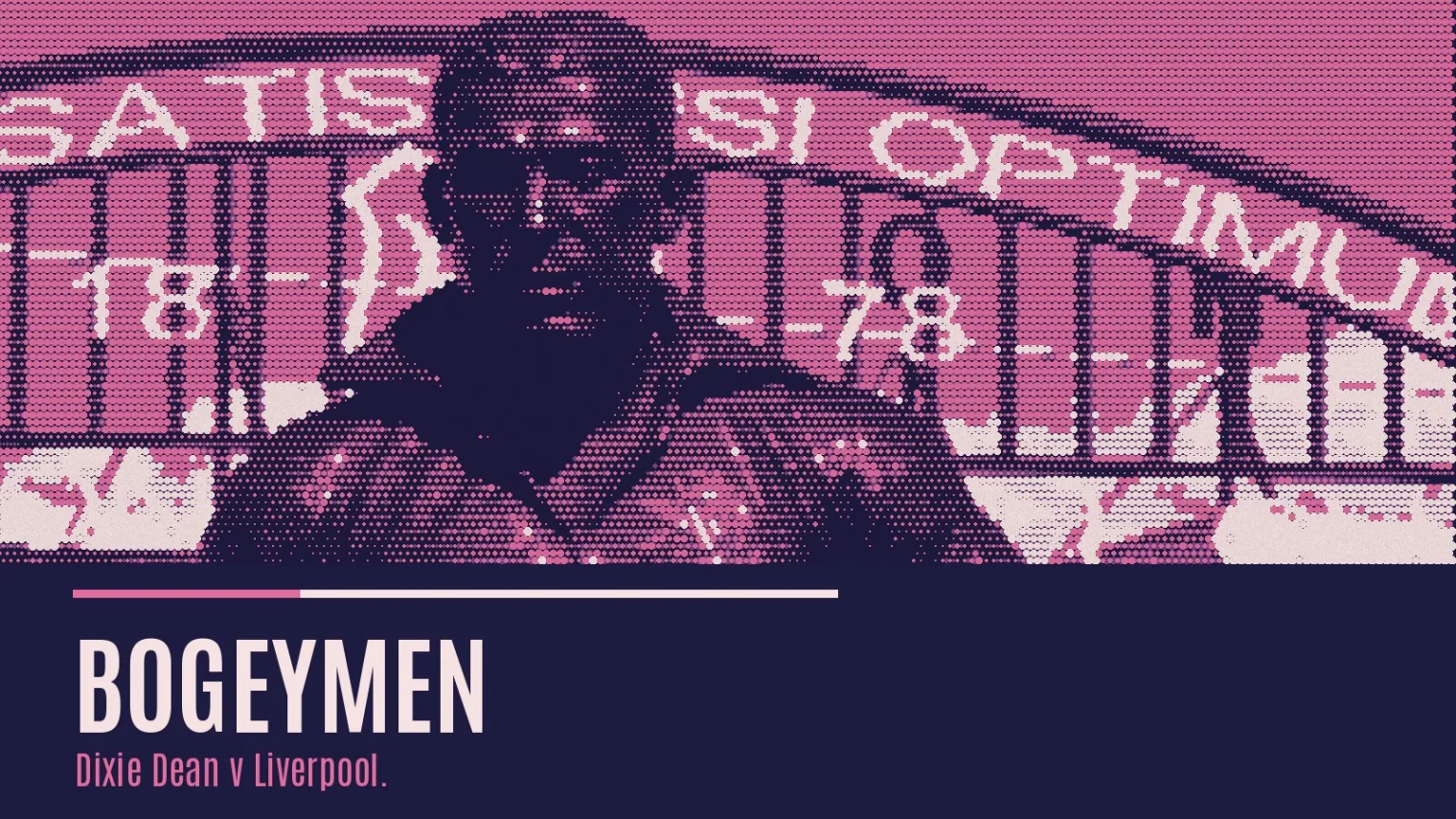
Every club has one. The first Bogeymen piece took Ian Rush and Everton, and tested a number everyone already knew. The second took Rod Wallace and Spurs, and asked whether “wherever he went” would survive the record. This one goes back to the mountain Rush had to climb: Dixie Dean against Liverpool, written from the other side of the park.
The job is the same. Open on a match, then see what the record will bear.
Dean’s Day
On the afternoon of 19 September 1931, at Anfield, it did not look, beforehand, like a day that would need inventing. Everton Results has the league positions: Everton tenth, Liverpool fifth, a First Division derby on the opening stretch of the season, a crowd the same page puts at 53,220. The local papers, filing that evening and the next morning, rounded it to 55,000. William Ralph Dean, Everton’s captain, walked out as the most famous centre-forward in the country and, if you believed the talk in the week, a man who might not have been picked.
“Bee,” in the Liverpool Post and Mercury, later transcribed by LFChistory, put the mood without mercy. “Dean had not scored a point throughout the season. He had offered some to his comrades, but there the register stood. It had even been mooted that the captain of the side might be dropped.” Ankle trouble had kept him out while a teammate, White, “got a hat-trick performance at Portsmouth.” Critics had “seen him play for nought at home games.” The selectors, Bee wrote, “wisely denied the thought of sinking the pilot.” Then the match started, and the argument ended.
Dean scored after a minute. Wright equalised in the third, from a position Bee thought looked offside. Dean scored again after fifteen minutes, and again after twenty-one. Everton Results and LFChistory agree on those times: 1′, 15′, 21′. Everton led 3–1 at half-time and 3–1 at the end. The Evening Express, by “Ijay”, called it “Dean’s Day” and itemised the hat-trick as “a goal with each foot and one with his head.” It was, the same report said, “his second in the Derby series.” Bee, less interested in left foot or right, was interested in the placement. Dean “headed a goal from the despised Critchley’s centre with little space at which to aim, and he scored a further goal with that accuracy of placing that makes him put a ball to inches of the upright.” “Little room is needed by this bulky man.” “This was Dean’s game.”
It was also, both papers thought, a record. Bee wrote that Dean had “passed the long-standing record of the ‘Derby’ games wherein Sandy Young stood attention at ten. Dean has eleven – with power to add to his number.” The Evening Express had Young on nine, and Dean eclipsing him. A later compilation of the fixture, on Everton Results, has put Young on eleven in all matches and nine in the league. The contemporary writers did not agree with each other, and they do not quite agree with that later book. What they agreed on, that afternoon, was the feeling: the man who had not scored all season had just done this, at Anfield, in twenty-one minutes, and the derby now had a new name attached to it.
Everton, a year earlier, had not been in a position to attach anything to it. They had finished bottom of the First Division in 1929–30 and spent 1930–31 in the Second, which the Football Club History Database records as a championship season, 28 wins, 121 goals, first of twenty-two, and a straight return to the top flight. RSSSF’s list of English leading scorers has Dean top of Division Two that year, with 39. There was no Merseyside derby in 1930–31, because the clubs were no longer in the same division. The first one back, Dean treated as if the year away had been an insult.
It was not a one-afternoon revival. Everton, back in the First Division, went on to win it in 1931–32, 26 wins, 116 goals, first of twenty-two, a fourth championship. Dean’s September hat-trick was the opening of that season’s account against Liverpool, not a farewell flourish. Bee, watching him that day, thought the two years since the relegation had hidden something. “He showed craft, speed, and safety first; measures on Saturday that made one wonder where he had hidden his reserves for the last two years.” Scott, in the Liverpool goal, “made a series of wonderful saves,” Ijay wrote, “and many thousands in the 55,000 crowd still aver that he is the world’s greatest goalkeeper.” It was not enough. Done and Jackson, Ijay thought, had no working arrangement, and “could not give Bradshaw any help in holding off Dean.” The bogeyman, on that evidence, was already a structural problem. You could have the best goalkeeper on the ground and still spend the first half-hour trying to work out who was supposed to be standing with him.
Nineteen, tested
So what is 19? Ahead of the 200th Merseyside derby, in December 2004, the Liverpool Echo set Dean’s mark at 19, “18 League and one FA Cup,” the record Rush broke. LFChistory, counting from the other dugout, gives him 17 appearances and 19 goals, and then, unusually helpfully, lists every one of them with a minute. The individual Everton Results match pages, added together, produce the same 19 and the same split: 18 in the league, one in the FA Cup. Those three sources agree. The work of this piece is to walk the 19 back to the afternoons, and to see whether anything in the pile is doing the sort of padding that, in Rush’s case, the Super Cup was doing.
The list starts, as these things often do, with a blank. On 26 September 1925, at Anfield, Dean played and did not score. Liverpool won 5–1. Forshaw scored a hat-trick, and Everton’s only goal was Kennedy’s, late, in the 84th minute. Dean had only just arrived from Tranmere Rovers. Everton’s own account of the signing puts the fee at £3,000, in 1925. The Evening Express, six years later, was still calling him “the ex-Tranmere player,” as if the journey across the water had never quite worn off. The first derby was not the beginning of the dread. It was a 5–1.
The first goal came the following February. On 6 February 1926, at Goodison, the sides drew 3–3, in front of 45,793. Irvine scored in the first minute, Chedgzoy just before half-time, and Dean, in the 60th minute, made it 3–2 before Forshaw equalised again. One goal, in a draw, in his second derby. The feeling had not started yet. It starts when the second one arrives, and the third, and you realise the first was not a one-off.
What happened next belongs in the career, not in a derby table, but it sits between those two goals and the first hat-trick, and it is why the 1928 afternoon still feels slightly unbelievable. Everton’s own history, drawing on Thomas Keates’ club jubilee book, records a motorcycle accident in the summer of 1926 in which Dean’s skull and jaw were fractured. “Doctors were afraid he could not live for many hours,” Keates wrote. “When recovery was assured the medical pronouncement was ‘This man will never be able to play football again.'” He did, of course. The same club page quotes a contemporary report on what made him different in the air: “Ordinary players butt the ball with the crown of their heads. Dean artistically glides it downwards with the side of his head.” Ijay, five years later, would still be counting the headed one among the three at Anfield. The accident is not a derby fact. It is the reason the man who scored the 17th-minute goal in February 1928 was not supposed, by one medical account, to be there at all.
The 1927–28 season is a story FBH has already told, and this piece is not going to tell it again. What belongs here is the derby inside it. On 15 October 1927, at Goodison, in front of 65,729, Everton and Liverpool drew 1–1, Troup scoring for Everton, and Dean did not get on the scoresheet. The return, on 25 February 1928 at Anfield, was different. Everton Results has a 3–3, a crowd of 55,361, and Dean scoring at 17, 40 and 60 minutes. Hopkin, Bromilow and Hodgson got Liverpool’s three. Everton began and ended the day top of the league. The club’s own history of that season treats those three as goals 41, 42 and 43 of the 60. The hat-trick, in other words, was both a derby afternoon and a staging post on a different record. For our purposes it is simpler: by full time Dean had four derby goals, three of them on the same day, all of them at Anfield, and the second half of the fixture had just acquired a habit.
A year later, on 29 September 1928, Troup scored the only goal of a 1–0 at Goodison and Dean, again, was on the pitch and not on the list. The blanks matter. A bogeyman is not a man who scores in every meeting. He is a man who scores often enough, and in the meetings you remember, that the blanks do not comfort you.
The 1929–30 season, the one that ended in relegation, gave him four more, and they are worth taking slowly, because they are the last of the first run, and because they show the record building even as the team fell apart. On 7 September 1929, at Anfield, Everton won 3–0, Dean scoring at 16 and 41 minutes, Martin the third, in front of 44,891. It was a complete away performance in a season that would otherwise have almost nothing complete about it. Four months later, on 4 January 1930, at Goodison, with Everton already twenty-first in a league of twenty-two, they drew 3–3, and Dean scored twice in three minutes, at 50 and 53, with a Liverpool goal between them, in front of 52,600. A side going down can still have a centre-forward who will not let a derby lie. By the time the sides went their separate ways for a year, he had eight derby goals. Then came the Second Division, the 39, the promotion, and the afternoon Bee and Ijay could not stop writing about. The hat-trick at Anfield on 19 September 1931 took him to eleven, all of them in the league.
Two hat-tricks, then, both at Anfield, three years and a division apart. The first, in February 1928, came in a 3–3, with Everton top of the league, in the middle of the sixty-goal season. The second, in September 1931, came in a 3–1 win, after a year in which the fixture had not existed, and after a week in which dropping the captain had been a serious conversation. The 19 is a career total. The memory, if you were in the crowd those two days, is of the same man doing the same thing in the same ground, once as a champion in waiting, once as a man who had just come back from the Second Division and had something to prove. Ijay was right to call the second “his second in the Derby series.” The series, by then, had a shape.
Fifteen seconds, and the only cup goal
The twelfth was the FA Cup one, and it did not even win the tie. On 9 January 1932, in the third round at Goodison, Everton Results records a 1–2 defeat, in front of 57,090, and puts Dean’s goal at 15 seconds. LFChistory, less precise, files it in the first minute. Gunson equalised, Hodgson won it. Elisha Scott was in the Liverpool goal, as he had been for so many of these afternoons, and for once the early puncture was not decisive. Three weeks later, in the league at the same ground, Everton won 2–1 without Dean scoring: White and Critchley got the goals, and Everton began and ended the day top of the First Division. They would be champions again that spring, their fourth title, as the same historical record shows. Dean’s contribution to the derby that season, after the September hat-trick, was a cup goal that lasted only until the rest of the afternoon caught up with it.
The remaining seven league goals are a shorter list, and they are not all victories. On 1 October 1932, at Goodison, Everton won 3–1, Critchley scoring first in the second half, Dean twice in a minute, at 73 and 74, after Gunson had given Liverpool the lead. On 11 February 1933, at Anfield, in an eleven-goal afternoon, Liverpool won 7–4. Barton scored a hat-trick for the home side. Dean scored twice, the first of them timed at five minutes by Everton Results and at eight by LFChistory, the second agreed at 75. A bogeyman can have a day like that and still leave you 7–4 down. The dread is not that he wins every time. It is that, even in a ruin, he has his share. That season, incidentally, Everton also won the FA Cup, their second, in 1932–33, a fact that belongs in the club’s year and not in this list. The derby that winter was not a cup afternoon. It was a 7–4, and Dean’s two did not prevent it.
On 15 September 1934, at Goodison, he had the whole share. Everton won 1–0, and the goal was Dean’s, in the 89th minute, in front of 43,001. That is the classic bogeyman finish: a tight game, a late one, the usual man. Goodison had waited until the 89th minute and still got the goal it had come for. The following March, on the 20th at Anfield, Liverpool won 2–1 on a Wednesday afternoon, a crowd down at 31,965, and Dean’s goal was a penalty, timed at 18 minutes by Everton Results and 17 by LFChistory. Hodgson had already scored one from the spot. It was Dean’s eighteenth derby goal, and only the second that season. The last of the blanks in his list had not yet arrived.
It arrived on 7 September 1935, at Anfield, and it was a hiding. Liverpool won 6–0. Howe scored four, Hodgson two. Dean, who went into the game as captain, “retired injured, broken toe,” in the 75th minute, according to the same page. He did not score. A year later, on 19 September 1936, back at Goodison, Everton won 2–0 in front of 55,835, Stevenson at 64 minutes, Dean at 73. That was the nineteenth, and the last. He was still captain. Stevenson had made the first; Dean, nine minutes later, made sure. His final derby appearance was on 23 January 1937, at Anfield, a 3–2 defeat in which Stevenson scored both of Everton’s goals and Dean, still captain, did not add a twentieth.
The number that stands
So the myth, tested, looks like this. Dixie Dean scored 19 goals against Liverpool, in 17 appearances, between September 1925 and January 1937. Eighteen were in the league. One was in the FA Cup, after fifteen seconds, in a tie Everton still lost. Two of the afternoons were hat-tricks, both at Anfield, the first in a 3–3 in February 1928, the second in a 3–1 in September 1931. LFChistory’s list and Everton Results’ match pages, laid against each other, produce the same 19. The appearance count is the same 17: Dean is in the Everton eleven on every one of the seventeen match pages Everton Results holds for the fixture in those years. The Echo’s 2004 split is the same split. There is no Super Cup sitting underneath the total, and no later goal in another shirt. The only arguments worth having are small ones: a minute here or there, a crowd of 53,220 or 55,000, and what Sandy Young had actually scored when the local papers tried, in 1931, to tell you Dean had just gone past him.
Even if you were minded to be awkward, there is not much to prise away. Take the FA Cup goal out, and he still has 18, all in the league. The league half of the record never needed a cup footer to look complete. Rush, as the first piece in this series set out, has 13 in the league and 25 in all, five of them in a competition almost nobody wanted. Dean’s 19 is the cleaner mountain. It is also, once you put the appearances next to it, the steeper one. Seventeen games, 19 goals. The Echo gave Rush 37 Liverpool derby appearances for his 25. The rate is not the thing the 25 is famous for, and it is not why Dean’s 19 lasted more than fifty years. But it is why, if you were an Everton supporter between the wars, or a Liverpool one, you could be forgiven for thinking the next derby would have him in it.
What the number cannot tell you is the week in which the captain might have been dropped, or a first derby that finished 5–1 to the other lot, or a year in the Second Division when the fixture simply went away, or a man leaving Anfield in 1935 with a broken toe and a 6–0 in his ears. The bogeyman, in the end, is not a total. It is the particular dread of a particular player, on a particular afternoon, in a particular shirt. Liverpool had that, for years, and they had it most vividly on the days when he did it at their place, with his head and with both feet, while the papers tried to keep up.
He died at Goodison, the club says, “minutes after the final whistle of a derby match,” in March 1980. The Echo, on a later anniversary, dated it to 1 March, after a lunch, and quoted his daughter Barbara: “We say he stage-managed the whole thing. Knowing him he would have to go out in style.” It is a closing the fixture can hold, and it is not a ninth goal. The 19 was already finished in 1936. The statue outside the Grand Old Lady is for the whole career, and for the 60. This series is only for the part of him that Liverpool could not shake.
If Rush’s 25 was yours, or if Dean’s 19 wasn’t, the next pairing is Alan Shearer against Leeds. After that the list runs on, through Le Tissier, Ferdinand and the rest. If you have a bogeyman of your own, the one the numbers may or may not support, tell us. A lead is not a fact. We will check it before we write it.