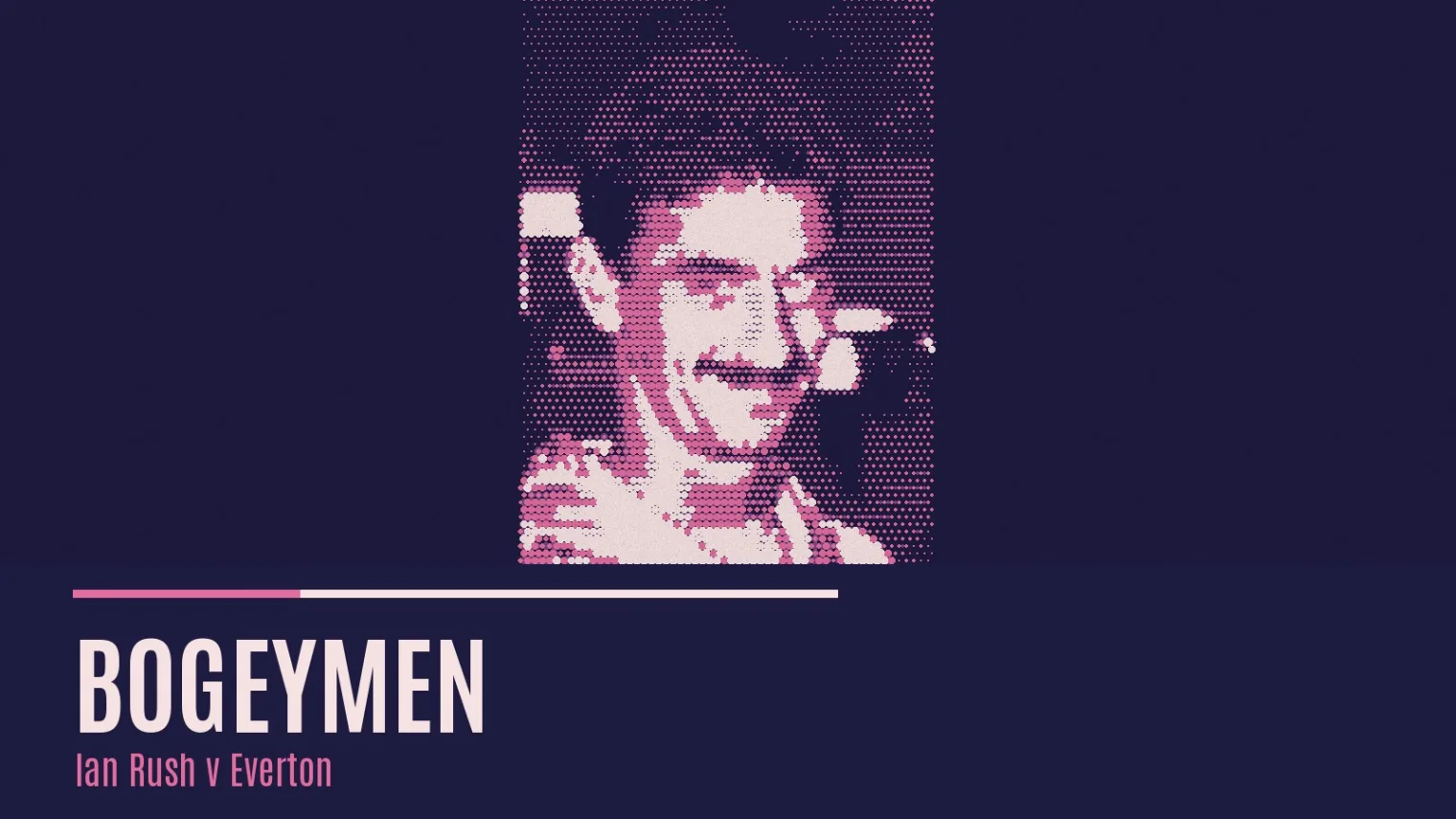
Every club has one. The player who seemed to save their best, or at least their goals, for your team. FBH is starting a weekly series about those players. The first is the most famous pairing of all.
On the afternoon of 6 November 1982, at Goodison Park, it did not look like Liverpool’s day. Ian Rush and Sammy Lee hit the woodwork. Kenny Dalglish had a header ruled out for offside. Then Glenn Keeley, on his derby debut, hauled Dalglish down as the Scot ran through and was sent off, and the afternoon turned. By half-time Rush had scored the only goal. In the second half he scored three more. Mark Lawrenson got the other. Everton, Howard Kendall’s Everton, still finding their way, were beaten 5–0.
Rush, looking back, was not surprised to have preferred the derbies at Goodison. “It wasn’t just because, being the home side, Everton were bound to come out and leave me a bit more room. It was also the fans. Although we’d only have maybe ten of fifteen thousand of ours at Goodison compared with maybe forty thousand at Anfield, they somehow seemed to make more noise.” He had also been helped, he said, by an offside trap “not doing it very well. I always fancy my chance against teams who play offside, and when you look at the video of that game it seems as though one full-back or the other is always playing me on.”
Bob Paisley had put the idea in his head beforehand. “I remember Bob Paisley saying to me: ‘Do you know that no-one has scored a hat-trick in a Merseyside derby for about 40-50 years?'” Rush told the Liverpool Echo in 2013. “Looking at it now he was putting it in my mind that there was a chance for me to do it. He knew with my pace and them playing a high line that there was a chance.” The first goal came from Alan Hansen. “I saw Neville Southall coming out and thinking I would put it through his legs. It was a fantastic feeling.” The Echo’s 2004 account of the afternoon has Hansen starting the first two, Lawrenson sliding in the third, Rush completing his hat-trick off a post from a Dalglish assist, and Sammy Lee sending him through for the fourth. That fourth, the Echo noted, equalled the derby hauls of Fred Howe and Alex “Sandy” Young.
Rush was 21, a little over a year on from a row with Paisley that had almost stopped the career before it started, and a boyhood Evertonian. At the end of the afternoon his friend and Wales teammate Kevin Ratcliffe, who had watched from the sidelines, drove him home, match ball and all, and took more stick from the Everton supporters than Rush did. “They said ‘What are you doing taking him home?'”
The Kop still sings about it. The four goals became the coda to Poor Scouser Tommy. They were also, though nobody in the ground that day was counting this far ahead, four of 25. Twenty-five is the number everyone knows. The job of this piece is to test it.
A boyhood Blue
It did not help, as the Echo has repeatedly pointed out, that Rush had been an Evertonian as a boy. He came to Liverpool from Chester City for £300,000, and at first he could not buy a goal. Paisley, in the Echo’s 2013 account, was disappointed not just with the lack of goals but with the lack of desire. “All you ever want to do is lay the ball off,” the manager told him. “You are afraid to take responsibility.” Rush said he thought the Liverpool way was about keeping the ball. Paisley was unmoved. “You are frightened to think for yourself. As a centre forward, your main job in the team is to score goals. But you haven’t scored a single goal for us yet. That’s why you’re not playing.”
Rush walked out of the office. On the pitch he did what he had been told. He failed to score in seven First Division appearances in his first season, then scored 17 from 32 in 1981–82. The four at Goodison helped him to 24 from 34 in 1982–83, and 32 from 41 followed the season after. Paisley later told John Keith that Dalglish had “made all the difference to Ian in his early days”, placing the ball “into the space where Ian was heading”. Together, Paisley said, they were “the most lethal pairing I have ever seen.”
The first of the 25, the Echo recorded in 2004, was uncharacteristic: bundled in off his chest at Anfield on 7 November 1981. The most talked-about statistic that afternoon, the Echo said, was not Rush at all, but Eamonn O’Keefe’s sending-off for a high tackle on Ronnie Whelan, only the third dismissal of the century in a Mersey derby. A year later came the four, and nobody was talking about anything else. After that the goals against Everton were no longer a surprise, which is the beginning of a bogeyman: not the freak afternoon, but the feeling that it will happen again.
Rush loved the fixture. “The derby games mean so much,” he said. “There’s nothing better than to get a hat-trick or score four goals in one of them.” By the time he left Anfield he had 346 goals for Liverpool, the club record, in a career the Echo counts at 666 league and cup games. No opponent, it added, had suffered more at his hands than Everton.
Twenty-five, tested
So what is 25? In December 2004, ahead of the 200th Merseyside derby, the Echo set the record out in full. Rush, it said, held Liverpool’s record for derby appearances, with 37, and had struck 25 times “in five different competitions”: 13 in the league, five in the FA Cup, one in the League Cup, one in the Charity Shield, and five in the Screen Sport Super Cup. Dixie Dean’s mark, which had stood for more than 50 years, was 19, “18 League and one FA Cup”. Rush’s last Liverpool derby goal, the Echo added, came at Anfield in March 1994.
Those are the numbers to work with, and they need a few footnotes. One other figure from the same Echo piece belongs alongside them. The player with the most derby appearances is not a Liverpool man at all, but Neville Southall, who took his first derby bow in March 1982 and left 15 years and 41 matches later. The fixture’s two great statistical figures, the Echo noted, were Welshmen: the goalkeeper who stood in the way, and the striker who, more often than anyone, went past him.
The first is the Super Cup. After Heysel, English clubs were banned from Europe. The Football League invented a consolation tournament for the six sides that would have qualified, delayed it, dragged it into the following season, and then scrapped it. Liverpool and Everton, who had already met in the 1986 FA Cup final and the Charity Shield, met again in the two-legged final in September 1986. At Anfield on the 16th, RSSSF’s records have Rush scoring twice in a 3–1 win; Steve McMahon got the other, Kevin Sheedy the Everton goal. At Goodison on the 30th, Rush scored a hat-trick and Steve Nicol the other in a 4–1 win, 7–2 on aggregate. The Echo, looking back in 2019, called it “the forgotten Merseyside derby”, a trophy almost nobody wanted. The start had been delayed by a row over television rights. The group games drew thin crowds — 17,000 for Liverpool against Southampton, the lowest Tottenham crowd for 39 years for one of theirs — and the final had to wait a year, until after the 1986 FA Cup final and the Charity Shield, because of fixture congestion and the World Cup in Mexico. By then it was, the Echo noted, the fourth trophy the two clubs had contested in a single stretch of months. Alan Hansen lifted a cup almost nobody remembers. Five of Rush’s 25 arrived in those two midweek games. They are official, they are on the list, and they are the part of the record a careful reader is entitled to set to one side.
Take those five away and he has 20: still one more than Dean.
The Charity Shield and League Cup goals are not mysteries either. On 16 August 1986, at Wembley, the sides drew 1–1 in the Charity Shield in front of 88,231, Everton Results’ record of the afternoon. Adrian Heath put Everton ahead late on; Rush equalised later still, from a Kenny Dalglish pass, according to LFChistory. The two sources agree on the scorers and disagree, by a minute, on when each goal went in. The League Cup goal came the following January: a late winner at Goodison in the Littlewoods Cup quarter-final on 21 January 1987, set up, LFChistory says, by Paul Walsh, in front of 53,323. A Wembley curtain-raiser is not a Super Cup afterthought, and it is not a league match either. Both are named, dated, and on the list.
Take away the Charity Shield as well, and you are left with 19 — 13 in the league, five in the FA Cup, one in the League Cup — level with Dean’s 19, though Dean’s were almost all in the league. The Super Cup padded the record. It did not create it. Even a strict count, confined to the league and the two domestic cups, leaves Rush at least level, and in the FA Cup clearly ahead. The bogeyman survives the audit. What changes, depending on where you draw the line, is the margin, not the identity. That is the test this series is for: not to debunk a feeling, but to see what the feeling is sitting on.
The second footnote is a 26th goal, which the 25 usually ignores, for a good reason and a slightly sentimental one. On 4 January 1998, in an FA Cup third-round tie at Goodison, Rush came off the Newcastle bench, for Faustino Asprilla, and scored the only goal of the game. Newcastle’s own match report called it his “26th goal against the old enemy.” Everton Results, which counts every goal scored against the club in all competitions, puts Rush top of that list as well, with 26, for Liverpool and Newcastle, between 1981 and 1998: 13 in the league, six in the FA Cup, one in the League Cup, one in the Charity Shield, five in the Super Cup. The extra one is the FA Cup goal in a black and white shirt. It is a goal against Everton. It is not, in any useful sense, a Merseyside derby goal. The 25 remains the right number for the fixture. The 26th tells you something else: that the feeling survived the red shirt.
The third footnote is smaller, and should be left as a loose thread rather than forced into a neat figure. The 2004 Echo gives Rush 37 Liverpool derby appearances. A published line-by-line list that independently confirms every match is not among the sources used here, so this piece treats 37 as the best published figure rather than a count retallied for this article. The goals are the record.
In 2015, asked by CNN for his own Merseyside derby tally, Rush guessed “either 24 or 28.” It was 25. Even he did not carry the number around in his pocket. The myth is not that a statistician somewhere has a spreadsheet. It is that Everton supporters, for 15 years, felt him coming.
The first equaliser that won the Cup
If the 1982 four-goal afternoon is the story the Kop sings, the 1986 FA Cup final is the one Rush has described as a childhood dream. “My dream as a kid was to score the winning goal in the FA Cup final,” he told the Echo in 2020. “Playing for Liverpool I’d won the league, the European Cup, the League Cup… I’d won everything but the FA Cup.” The build-up, in those days, started on television at nine in the morning and was still going after five. Camera crews came to the hotels to watch the players eat breakfast. When he was a boy, Rush said, he would go out at five o’clock “and pretend I was the player who’d just scored the winning goal to win the Cup.”
The final was on 10 May 1986, a week after Kenny Dalglish, as player-manager, had scored the goal at Chelsea that won Liverpool the league, ahead of Kendall’s Everton. It was the first all-Merseyside FA Cup final. Everton were without Southall, who had injured an ankle playing for Wales. “He was the best goalkeeper in the world for about five or six years at that time,” Rush said. “If he was English everybody would have been raving about him — and that could have been the difference.” Gary Lineker, double Footballer of the Year, scored in the 28th minute. Early in the second half Everton pushed for a second. Twelve minutes after the break Rush equalised.
The equaliser carried a weight that had nothing to do with the scoreline. At that point, the Echo noted, Liverpool had not lost any of the previous 120 matches in which Rush had scored. “Fans have told me as soon as I equalised in that game they knew Liverpool were going to win because of the record I had,” Rush said. “I can’t say I felt that way at the time but looking back I can see what they mean, I think it was Gary Lineker who said it was the first equaliser that won the Cup!” He did not let himself rest. “Because we were playing Everton, I knew we couldn’t afford to rest at all.” Craig Johnston put Liverpool in front. Rush scored the third with about six minutes to go. Liverpool had the Double, a rare thing then, “only Tottenham and Arsenal having achieved it in living memory.”
Two of the five FA Cup goals in the 25 had arrived in a single afternoon at Wembley, against the team he had grown up supporting, in the match he had pretended to win in the street. The Super Cup legs, that September, would add five more that almost nobody remembers. The ones that stay are these.
A different Wembley
Three years later they were back, and nothing about the occasion was the same. Five weeks before the 1989 FA Cup final, Liverpool had gone to Hillsborough for a semi-final against Nottingham Forest, and the disaster that followed hung over the city and the match. Everton had reached the final on the same afternoon, at Villa Park. Rush, who had missed much of his first season back after a year at Juventus through hepatitis and chicken pox, started on the bench. He came on after 72 minutes, for John Aldridge, who had scored in the fourth minute.
“When I came off the substitutes bench for Aldo, my main thought was to help Liverpool win the game,” he said. “We were 1-0 up so my job was to work hard for the team so we could win this 1-0.” Stuart McCall equalised late, and extra time came on a roasting afternoon. Rush, fresher than most, scored early in the first period. McCall equalised again. Then John Barnes “put a great ball in for me to head the winner.”
CNN’s quiz, years later, treated those two goals as the moment he overtook Dean. That is the conventional dating, and it fits the arithmetic: a brace in an FA Cup final would take a man already close to 19 clearly past it. I have not seen a contemporary 1989 cutting that writes the new record into the match report, so this piece does not pretend to have watched the scoreboard tick over in real time. What is not in doubt is the destination. By the time Rush had finished, Dean was second.
Rush has always talked about that final as a victory for the supporters, and for the people who had gone to the semi-final and not come home. “It was an occasion for the whole city of Liverpool,” he said, “and one of things which stands out is the whole ground singing ‘Merseyside’.” Everton, he added, had been “fantastic about the whole situation.” The bogeyman story is about goals and inevitability. This particular afternoon was about something the fixture, for once, was big enough to hold.
The four FA Cup final goals — two in 1986, two in 1989 — are the ones the 2004 Echo meant when it wrote of “four famously coming in FA Cup finals.” They are four of the five FA Cup strikes in the Liverpool 25. The fifth is a matter for a line-by-line list I have not seen published in one place, so it is left as the remaining one rather than guessed at.
A last one in red, and one more in black and white
The last of the 25, at Anfield on 13 March 1994, was not a match-winner, however neatly that would sit. Everton, through Dave Watson, went ahead after 20 minutes. Thirty-one seconds later, from a long Julian Dicks pass, Rush volleyed past Southall. Robbie Fowler, 18, a boyhood Blue playing his first derby, scored the winner just before half-time. The 150th Merseyside derby, Guy Hodgson wrote in the Independent the next morning, was played on an FA Cup quarter-final weekend, a sign of how far both clubs had slipped from their mid-80s habit of going to Wembley. Fowler “plunged the dagger.” Rush, by then the Liverpool captain, had equalised so quickly that Hodgson wondered whether Everton’s celebrations from the first goal were still going on. It was a quieter ending than 1982, or Wembley, and it was still him.
Four years later he came back. The circumstances were almost a parody of the old ones: an FA Cup third-round tie, a rain-swept Goodison and a crowd of 20,885, Rush 36 and short of goals, on as a substitute after 52 minutes for Faustino Asprilla. The move had Liverpool stamped on it even though the shirts were Newcastle’s. Keith Gillespie volleyed across the six-yard box from the right, the ball stuck in a puddle, John Barnes lofted it towards the back post, and Rush, just ahead of Claus Thomsen, forced it in at the Gwladys Street end. Newcastle’s report timed the goal at 67 minutes on the scoresheet and, a sentence later, at 68; the Irish Times, the next day, said the 67th minute. It improved, the same Newcastle report said, on an FA Cup record of 42 goals. Howard Kendall was in the Everton dugout again. Kenny Dalglish was in the other. The Irish Times put it as mildly as anyone could: the great goalscoring days were “almost certainly in the past”, and still “for the umpteenth time in his career he was in the right place at the right time.” “Give him a scent of blue shirts,” the Newcastle report said, “and he is a different man.” It was not a derby. It felt like one, which is the point of a bogeyman. The number on the spreadsheet stayed at 25. The people in the Gwladys Street knew what they had seen.
The number that stands
So the myth, tested, looks like this. Ian Rush scored 25 goals against Everton in a Liverpool shirt, in five competitions, across 15 years. Thirteen were in the league. Five were in the FA Cup, four of them in finals. One was in the League Cup, one in the Charity Shield, and five in a Super Cup that almost nobody wanted and almost nobody remembers. A 26th, for Newcastle, sits just outside the fixture and just inside the feeling. Appearances, on the Echo’s 2004 count, come to 37. Dixie Dean’s 19 is still the other mountain on the skyline, and a later Bogeymen piece will have to climb it from the other side. Even without the Super Cup, Rush is ahead, or at worst, depending on what you count, level. The record is not a trick of a forgotten tournament.
What the number cannot tell you is the lift home with Ratcliffe, or the offside trap that wouldn’t sit still, or a boy at five o’clock pretending he had just won the Cup, or a ground singing “Merseyside” when the fixture had more to carry than a scoreline. The bogeyman, in the end, is not a total. It is the particular dread of a particular player, on a particular afternoon, in a particular shirt. Everton had that, for years, and then they had it once more, in the rain, when he was supposed to be finished.
If Rush wasn’t yours, who was? The next one in this series is Rod Wallace against Tottenham, the player who, Spurs supporters of the 90s will tell you, scored against them wherever he went. After that the list runs on, through Dean, Shearer, Le Tissier and the rest. If you have a bogeyman of your own, the one the numbers may or may not support, tell us. A lead is not a fact. We will check it before we write it.