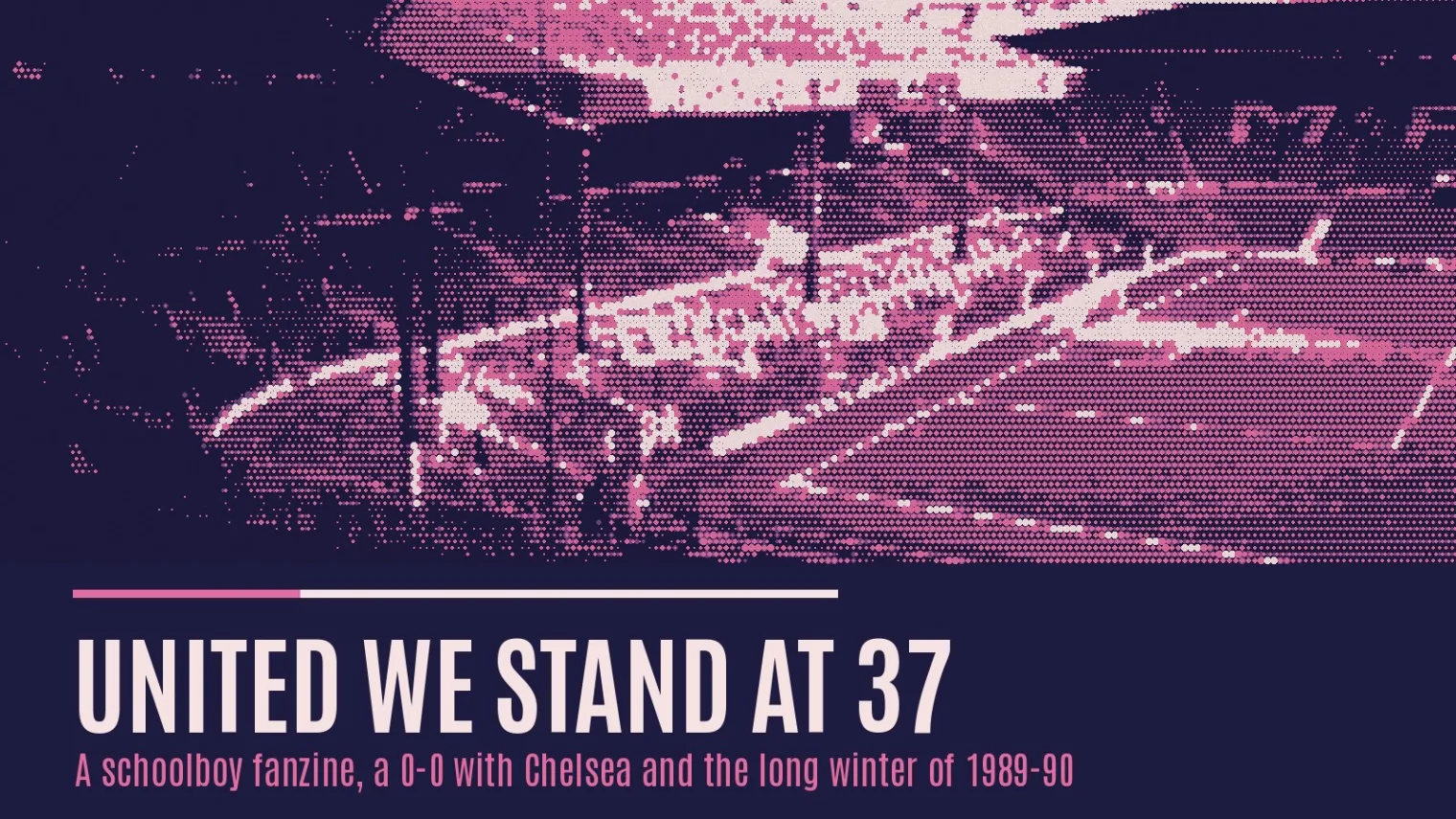
On the afternoon of Saturday 25 November 1989 two Manchester United supporters went to Old Trafford with something to show the world, and only one of them got it out. Pete Molyneux, a season-ticket holder in J Stand, had a carrier bag at his feet with an old sky-blue bedsheet in it, painted in black with a verdict on Alex Ferguson. He had brought it to the Nottingham Forest game a fortnight earlier, but there was a minute’s silence and it didn’t seem right. Against Chelsea, he later told the Manchester Evening News, “I had it in a plastic bag at my feet and didn’t pull it out… because there was another minute’s silence.”
Outside, a 15-year-old called Andy Mitten was selling the first issue of a fanzine called United We Stand. He had paid for the photocopying with £20 borrowed from his mum. “We put some words down,” he remembered decades later, in a conversation with Private White V.C., and the result was “terrible content-wise looking back”. The banner stayed in the bag until the following month. The fanzine went on sale that day, and there has been an issue every month of the football season since.
Thirty-seven years on, Mitten marked the anniversary on X with a line that reads like a weather report from a bad winter: United were tenth that afternoon, they drew 0-0, and they did not win another league game until 10 February 1990 at Millwall, by which time they were 17th. Every part of that checks out. The more interesting question is why a schoolboy’s photocopied magazine, launched into the bleakest stretch of Ferguson’s time at Old Trafford, is still being sold on match days when most of the fanzine boom it belonged to has long since gone to the recycling. The answer has less to do with the anger that started it than with what happened once the anger had to share a page with a team that, eventually, started winning.
A point against the leaders, and then nothing
It is worth saying first that 25 November 1989 was not, on paper, a disaster. United had won their two previous league games, 1-0 at home to Forest and 3-1 at Luton, and Chelsea arrived among the leaders and left level on 27 points with Arsenal and Aston Villa at the top. Bobby Campbell’s side had Dave Beasant in goal, Graham Roberts as captain and Kerry Dixon up front; Ferguson picked Jim Leighton, Steve Bruce and Gary Pallister, Bryan Robson, Paul Ince and Brian McClair, with Mark Hughes and Danny Wallace in attack. Wallace went off three minutes after half-time and Russell Beardsmore came on. Mick Duxbury replaced Lee Martin with 21 minutes left. MUFCInfo’s record of the game lists the crowd as 46,975; 11v11 and the Chelsea history site Stamford-Bridge.com both have 47,106. Nobody scored.
Mitten, writing for GQ in October 2021, remembered the optimism of the morning more than the football: “I remember being excited at the prospect of United moving up to sixth with a win.” Instead, the table that evening had United tenth, on 21 points from 14 games, in a four-way tie with Derby, Spurs and Everton separated only by goal difference.
What followed was the sort of run that makes a manager’s previous good results look like a clerical error. Mitten, in the same GQ piece, compressed it into eleven letters: “DLLLDLDDLLD”. In full it went like this. A 1-0 defeat at Highbury. A 2-1 home defeat by Crystal Palace, a side who had lost 9-0 at Anfield earlier in the season. A 1-0 home defeat by Spurs. A goalless draw at Anfield two days before Christmas, a 3-0 defeat at Villa Park on Boxing Day, 2-2 at Plough Lane, 0-0 at home to QPR on New Year’s Day. Then 2-1 at home to Derby, 2-0 at Carrow Road, and 1-1 in the derby against City on 3 February. The season’s results show eleven league games without a win, starting with the afternoon the fanzine went on sale.
The slide in the table was steady rather than sudden, which in some ways made it worse. United were 15th at the turn of the year. By the evening of 9 February 1990 they were 17th, a point above Millwall, with only Luton and Charlton below those two. The next day at the Den, Darren Morgan put Millwall ahead before Wallace equalised with 25 minutes left and Hughes won it six minutes from time. The record of that game has the crowd at 15,491. It was hardly a turning point in the league; United finished the season 13th, level on 48 points with City and Palace and separated from both only by goal difference.
The FA Cup is where the story everybody knows lives. Mark Robins scored the only goal at the City Ground on 7 January, during the worst of the run, and Lee Martin’s goal in the replayed final against Palace on Thursday 17 May won the trophy that is usually credited with keeping Ferguson in work. How Ferguson’s time at the club began is a story for another day on this site, and whether one Cup run really saved him is an argument that will outlive us all. What matters for the fanzine is that its first six months were spent covering a team that could not win a league match, with a manager a large part of the crowd had stopped believing in.
“I’m not scum”
None of which is why Mitten started it. Asked over the years what drove a schoolboy to borrow money for a photocopier, he has given remarkably consistent answers, and almost none of them are about Ferguson.
“I was quite an angry fan, because I felt that the government considered all football fans to be hooligans,” he told Huck magazine in March 2020. “I just felt that decisions were being made on behalf of fans without any fan consultation. It came after the Bradford City fire, it came after Hillsborough. I delivered newspapers then and I was spending good money watching games in terrible conditions.” In the same interview he put it more simply: “I suppose it was that feeling of fans being some sort of underclass that inspired me to start the fanzine.”
Speaking to Stretty News two months later, he went back to a particular away day. “I remember going to Forest away when I was 14 and it cost twice my weekly wage to stand on a terrace and their facilities and view were crap.” The government, he said, “looked down on football fans, they felt they were all scum and I thought ‘I’m not scum’ so we started United We Stand.” To Private White V.C. the complaint was the same, just with sharper edges: “I was 15 and felt the British government were taking the piss out of football fans. They thought we were all hooligans with no brains and wanted to bring in ID cards on our behalf after Hillsborough.”
The ID cards were not a teenager’s exaggeration. Rogan Taylor, one of the founders of the Football Supporters’ Association, has described in his history of the FSA’s early years how the arrests of England fans at Euro 88 led Margaret Thatcher to announce that every supporter would have to carry a computer-read card to get into a match, and how by spring 1989 the legislation “had jumped all its hurdles and was about to become law in time for the following season.” When Saturday Comes, looking back in June 1997, summed up what that would have meant in practice: “No more casual fans; no more birthday trips for kids without filling in forms in triplicate.”
Then came 15 April 1989. Taylor, who was at Hillsborough, describes the disaster as “a version of our worst fears about the imposition of the ID Card scheme”: thousands of fans, a crush outside, police making a decision in seconds. By the time Mitten was selling his first issue, Lord Justice Taylor’s interim report had blamed police failure, his final report was two months away, and the membership scheme was still government policy, waiting on the judge.
That is the context in which a 15-year-old decided that fans needed to be heard. Whatever the thinking behind the name, in late 1989 “United We Stand” read less like a slogan about a club than one about the people on its terraces.
Canaries in the coalmine
Mitten was late to the party, if not by much. When Saturday Comes had started in March 1986, launched by Mike Ticher and Andy Lyons as, in the Independent’s words on its 30th birthday, “the voice of the ordinary supporter, one who enjoyed football as part of a wider life; did not engage in violence, but still cared about it passionately.” The first issue “was hand-stapled, photocopied, contained handwritten notations and cost 20p.” Bradford’s City Gent was older still; its editor Mike Harrison told Huck it had been going round the away coaches since 1984. At Old Trafford, Red News had started in 1987 and Red Issue in February 1989, according to the Manchester Evening News and the Guardian. Leeds’ The Square Ball appeared the same year as United We Stand, as the BBC noted in 2017. By the time Mitten arrived, there was a market, a vocabulary and a postbag.
Tom Davies, who edited Leyton Orientear in the 1990s, wrote the best short account of what all this felt like, in WSC in April 2011. “By the end of the 1980s almost every English and Scottish football league club boasted one fanzine, and around half boasted more than one.” The early jokes about pies and haircuts “seemed ground-breaking, cutting edge even” because “mainstream football writing was stultifyingly one-paced and unquestioning.” The politics came with them: “an angry movement – directed at everything from bland matchday programmes, unaccountable chairmen, the creeping over-commercialisation of the game (yes, even then)… poor stadium facilities, callous policing and a government whose hostility to football manifested itself in the ID card proposals”. His description of the fanzines themselves is still the one to beat: “the hastily stapled and clumsily Xeroxed canaries in football’s coalmine.”
Mitten’s own description of his early issues is less romantic. He told Huck the quality was “terrible” at first. Even so, after three issues the fanzine had sold around 1,000 copies, and he told Private White V.C. that “within a year we were selling thousands.” Kevin Whitcher of Arsenal’s The Gooner gave Huck the more generous reading of what the whole movement achieved: “I think there was a huge change in the way football supporters were viewed after the Hillsborough Disaster. The intelligence of fanzine writing around that time played a part in that. People realised that people who went to football matches were not thugs.”
It is tempting to read that as fanzine people congratulating themselves, but the official record bears some of it out. In November 1989, the month United We Stand launched, the Sir Norman Chester Centre for Football Research surveyed members of the Football Supporters’ Association on the questions raised by Hillsborough, and Lord Justice Taylor quoted the results in his final report two months later. The same report is unusually blunt about the experience Mitten had been complaining about since Forest away. Fans “eat their hamburgers or chips standing outside in all weathers,” Taylor wrote. “There is a prevailing stench of stewed onions.” More to the point: “The football supporters’ organisations complain that supporters have not hitherto been much consulted about this or about anything else affecting their well-being and enjoyment.” And in the section on leadership, “until recently, very few clubs consulted to any significant extent with the supporters or their organisations.”
That is an appeal court judge, in a Command Paper, agreeing with a 15-year-old. When the Home Secretary, David Waddington, presented the report to the Commons on 29 January 1990, he announced that the government had “decided not to proceed with the establishment of a football membership authority”. Roy Hattersley, replying for Labour, put it more bluntly: “the identity card scheme is dead as a result of the report.” United were still twelve days from their next league win.
The banner and the photocopier
Here is the tension at the heart of the fanzine’s first winter, and in a sense of its whole life. United We Stand was born to argue with the government and the game about how fans were treated. It immediately found itself covering a club where the most pressing question in the stands was whether the manager should keep his job.
Molyneux finally got his banner out on 9 December, during the defeat by Palace. “People saw it and the applause began – it caused quite a commotion and seemed to polarise people,” he told the MEN in 2013. “The police came over and there was a tug of war with some lads behind me from Grey Mare Lane and Miles Platting. They got the banner in the end.” The message, cleaned up for a family newspaper, read: “3 YEARS OF EXCUSES AND IT’S STILL ****… TA RA FERGIE”. The “ta ra”, he explained, came from Bet Lynch.
The banner is the image everyone remembers from that winter, and it is the opposite of a fanzine in almost every way. It lasted a few minutes before the police took it. It said one thing, and it said it to the whole ground at once. A fanzine says lots of things, some of them wrong, to people who have chosen to pay for it, and then it has to come back next month and say something else. A banner can’t be wrong for long because it doesn’t last long. A monthly magazine is on the record, and the people who bought it remember.
Mitten has been honest about what that means. The BBC’s 2017 piece on surviving fanzines recalled the United We Stand cover from the 1991-92 run-in that announced “Champions at Last”, shortly before United lost three in a row and Leeds won the title. “I’d had 4,000 copies printed and I was stood outside Old Trafford making an absolute fool out of myself,” he said. “I was getting loads of abuse because of it, and quite rightly so.” Molyneux, for his part, ended up delighted to be made a fool of by Ferguson. “Thankfully they took no notice of me,” he told the MEN. The difference is that the banner man could say that once, from a distance. A fanzine editor has to keep turning up outside the ground, holding the evidence.
This is the quality that the winter of 1989-90 built into United We Stand from the start. It could not be a cheerleader, because there was nothing to cheer; the eleven-game run saw to that. It also couldn’t be a running Fergie Out campaign, because the anger that founded it was aimed elsewhere, at Westminster, at ticket prices, at the terraces. And a magazine with a long memory had to be careful about what it would be held to. In his GQ column in 2021, written as Ole Gunnar Solskjaer’s job came under pressure, he used that first winter as evidence for patience rather than revenge: “Fergie was in a mess but he got out of it, eventually.”
Staying independent
The obvious risk for a fanzine attached to a club that becomes the biggest in the country is that it gets absorbed. By the time Mitten was at university, the absorption was offered to him in person. “Two years into that United offered me a job for their official magazine but I didn’t want to stop my studies so I didn’t,” he told Stretty News. “It was pretty flattering as it was the editor’s job as a young lad but I always felt I wanted to keep my independence as it adds to your integrity and you can ask difficult questions.”
Independence also meant the selling, which never stopped being physical. Writing for FourFourTwo in August 2010, Mitten described himself in those early years as “a 15-year-old selling a little fanzine”, looked after on the streets around Old Trafford by older Mancunians. He also wrote about selling at Chelsea every season by the Britannia Gate on the Fulham Road, where the home lads would wind him up about how he’d never have got away with it at the Bridge in the 70s, until one of them advised him he wasn’t a kid any more and should “stand closer to the turnstiles and away from the gate”. He listened. “There were other grounds we simply could not sell at: Leeds, City and Liverpool.”
That is the part of fanzine history that gets left out of the nostalgia: it was retail, done in the cold, by people who could get a slap for it. Mitten started it with a group of mates while he was still at school, Huck reported. Twenty-three years in, Mitten was still devoting “about five days a month” to the magazine, according to his diary for the Football Writers’ Association in June 2012. By then it was on issue 217 and had “about 40 people” contributing: “writers, sellers, sources, distributors and designers”. They included the Telegraph’s Jim White and the former pro and United fan James Scowcroft, and “some high-flying talents who’d rather hide their identity. I doubt their employers realise they also work for a mere fanzine…”
“A mere fanzine” is a nice touch from a man who was by then writing for FourFourTwo, the National and others. It is also the clue to how the magazine survived. The fanzine became where its editor learned his trade rather than where he stayed, and the trade then fed back into it. Huck noted in 2020 that United We Stand had by then “featured interviews with the Manchester United hierarchy, managers and players”. For a magazine founded on the complaint that nobody was consulting fans, getting the people who run the club to answer fans’ questions is the logical end point. It is also a long way from photocopies and anger.
Two ways to finish
The contrast with Red Issue is instructive, because the two magazines started within a year of each other, sold outside the same ground for a quarter of a century and came to opposite conclusions about the same football.
Red Issue was the funnier, nastier and more feared of the two. It was, in the Manchester Evening News’s account of its closure, a “valuable mouthpiece for United fans in the late 80s” which “played a pivotal role in the defeat of Rupert Murdoch’s attempted takeover via his BSkyB company during the 1998-99 season” and later campaigned against the Glazers. It also ran covers that got it into serious trouble, which the MEN’s news desk listed when it announced the end. Its final issue, number 295, was sold at the Southampton game in January 2015, and it was not money that killed it. “RI isn’t under any financial pressure & sales-wise remains a viable entity,” the fanzine said. Instead, the editorial said: “The game we’ve been clinging onto is gone. Football now is happy-clappy families, half-and-half scarves, tourists and selfie sticks; there’s no point trying to fight that.” Then: “The B******t Industry’s become overbearing, and we can’t stand the stench any longer.”
There is something admirable about a fanzine that decides it has said all it has to say. There is also a revealing line in the same final editorial: “A United employee told us on Warwick Road recently, ‘Everyone in the club offices reads Red Issue. It’s like the antidote to working there’.” The club’s staff reading you as a guilty pleasure is a sort of victory, and a sort of defeat. Red Issue chose to stop rather than become part of the furniture.
United We Stand chose to become the furniture, in the sense of being reliably there, and to keep the independence in the content rather than in the pose. The magazine’s own description now talks about being “proudly independent and funded by sales”, of being produced 11 times a season and having passed 300 issues, and of being named British Fanzine of the Year in 2012 and 2019. That is not the language of 1989. It is closer to a trade publication, which is what the most durable fanzines quietly became.
Whether that counts as winning or selling out depends on what you think the boom was for. Davies, in that 2011 WSC piece, was candid about the movement’s limits: “Very few of the first, or any, wave of fanzines still exist now.” Desktop publishing had made the boom possible, he argued, and the web had taken away the perceived need “to knock out 40 pages of A5 every month or two.” But he also insisted that “when it came to the fundamentals, we were right about a lot of this stuff”, and the fundamentals (consultation, ticket prices, the treatment of the people who pay) were exactly what Taylor had written into a government report in January 1990. Whitcher’s view to Huck was gentler and bleaker: “As the readership gets older, as they gradually shuffle off this mortal coil, [fanzines] are not going to last forever.” The Moral Victory at Dulwich and a later generation of print fanzines, the Football Pink among them, suggest the form keeps finding new people to staple it. But the ones from the first wave still going are mostly the ones that learned to be magazines.
A 0-0, and every month since
Football history likes to measure that winter in what it led to: the Cup, Cantona, the all-seater grounds and the money that followed. On those terms the fanzine is a footnote. Mitten’s own anniversary post measures it differently, by what didn’t happen. United didn’t win, and the magazine kept coming out anyway.
Something of the founding winter is still in United We Stand because of that. A magazine that launched in tenth place and spent its first eleven league games waiting for a win was never going to believe the club’s good times were permanent, and it hasn’t had to; the years since Ferguson retired have given it plenty to write about. A magazine that began because a 15-year-old felt fans were treated like an underclass was always going to care about the queue at the turnstile more than the view from the directors’ box, even when it started getting invited into the box. And a magazine sold by hand outside the ground was always going to know its readers personally, including when they were giving the editor loads of abuse for “Champions at Last”.
Pete Molyneux kept his bedsheet in a carrier bag on 25 November 1989 because of a minute’s silence, and it came out a fortnight later and was gone again within minutes. Andy Mitten’s £20 of photocopying went out through the same streets that afternoon, and the magazine never really went back in the bag. Thirty-seven years and more than 300 issues later, the most durable thing that started at Old Trafford on the day of a 0-0 with Chelsea was not a team, a manager or a protest. It was a teenager with a stack of paper who wanted to be asked, and who decided not to wait.