The National Stadium at Cardiff Arms Park was a curious place to go looking for a football country. It sat on the Taff, all concrete cantilevers and rugby ghosts, and for years the Football Association of Wales had treated it as someone else’s house. Then Terry Yorath’s side started filling it, and on the evening of 17 November 1993 it was full again, a midweek sell-out, with Romania in town and a place at the World Cup at the end of the night if Wales could win.
It is remembered, if it is remembered at all outside Wales, as the night Paul Bodin hit the bar. That is not untrue, and it is not the whole of it. Gheorghe Hagi scored, Dean Saunders equalised, Bodin did hit the bar, and Florin Răducioiu won the match late on. Wales lost 1–2. Romania went to the United States. Yorath, after five years in the job, would not be offered a new contract. And after the final whistle a marine distress rocket was fired across the pitch, and John Hill, a 67-year-old retired postman from Merthyr Tydfil who had gone to the game with his son, was killed. The result would have been a scar on its own. What followed it turned the evening into something Welsh football has never been able to treat as only a football story.
A side that had started to believe
Yorath had been in charge for five years, long enough to have taken Wales through one failed qualifying campaign and to the brink of another. The Independent, writing the morning after the Romania game, called it his 100th match with the national team: 59 caps as a player, his 41st as manager. The side he put out was, on paper, as close as Wales had come to a team of genuine international weight since the one that reached the quarter-finals in Sweden in 1958. Neville Southall of Everton was in goal. The back line had Paul Bodin of Swindon, Andy Melville, Kit Symons, Eric Young and David Phillips. Barry Horne, the captain, was alongside Gary Speed and a 19-year-old Ryan Giggs. Up front were Dean Saunders, then of Aston Villa, and Ian Rush. Mark Hughes, who would ordinarily have been in among them, was suspended.
They had not arrived at this night in a straight line. The campaign had opened, on 20 May 1992, with a humiliation in Bucharest. Romania led 5–0 at half-time and won 5–1, Hagi scoring twice, Ioan Lupescu twice, Gavril Balint once, Rush grabbing a consolation after the interval. Horne, who played every minute of the ten ties, later told BBC Sport it was “just 45 minutes that you wouldn’t believe.” Wales had the best goalkeeper in the world, he said, and the shots were still going in.
What followed was the opposite of a collapse. At the Arms Park they began to look like a side that knew how to use the place. They beat the Faroe Islands 6–0, Rush scoring a hat-trick. They won in Cyprus. On 31 March 1993 they beat Belgium 2–0 in Cardiff, Giggs getting his first goal for his country and Rush a second that, Welsh Football Online records, took him past Ivor Allchurch’s scoring record, which had stood for 29 years. There were draws with the Representation of Czechs and Slovaks, home and away, after Czechoslovakia had split at the turn of the year and finished the group as a single team. There was a 2–0 home win over Cyprus in October that kept the arithmetic alive.
The Arms Park itself had already done some of Yorath’s persuading. In June 1991, in a European Championship qualifier, Wales had beaten the reigning world champions, Germany, 1–0 there, Rush scoring, Southall making the saves that made the result possible. That BBC Sport archive still calls it a historic evening. Three months later, in a friendly, Saunders scored the only goal as they beat Brazil 1–0 at the same ground, the only time Wales have ever beaten them. Neither of those results belonged to this World Cup group, and it would be cheating to pretend they did. They belonged to the feeling around the team: that the national rugby stadium, once they had the sense to play there, had become a place where Yorath’s Wales could live with anyone.
Romania, even so, were not just anyone. Anghel Iordănescu had taken over in the summer after a 5–2 defeat by the RCS in Košice had cost Cornel Dinu his job. The side he brought to Cardiff had Hagi, then of Brescia in Serie B, which still sounds like a clerical error when you say it out loud. It also had Gheorghe Popescu of PSV, Dan Petrescu of Genoa, Ilie Dumitrescu of Steaua Bucharest, the libero Miodrag Belodedici, and Răducioiu, who was on Milan’s books and, as Phil Shaw noted at the time, surplus to their requirements. Two days before the match Yorath told Shaw he had watched the Romanians on video and did not imagine the compliment had been returned. “I don’t think they’ll make any special plans for our qualities because they’ve got an arrogance about them that would say they don’t need to,” he said.
Two points for a win
The group was still running on two points for a win, which made the last night tighter than a modern table would have been. Going into the final fixtures, Welsh Football Online’s record of the group has Belgium top on 14 points, Romania on 13, the RCS and Wales both on 12. Two teams would go through. Belgium, at home to the RCS, needed a point to be sure. Romania, at the Arms Park, needed only a draw. Wales had to win. An RCS victory in Brussels would have left the two results to be sorted on goal difference, which is a longer piece of arithmetic than anyone in the Arms Park was in the mood to do. In the event it never came into play.
Dumitrescu, looking back for BBC Sport in 2013, was blunt about Romania’s task. “We only needed a draw to qualify but from the start we tried to keep the ball and not give Wales too many chances.” Horne remembered Yorath’s assistant, Peter Shreeves, sending them out with a last instruction: go and look at the player you are up against, and ask yourself if they are good enough to stop you going to the World Cup finals. “Those were his last words before we ran out,” Horne said, “and I remember thinking to myself ‘no, they are not’.”
By kick-off even the rest of Britain was being asked to watch. England were playing San Marino in a dead rubber, and the BBC, as Chris Bevan later reported, abandoned that coverage to switch to Cardiff as Bodin placed the ball on the spot. Viewing figures, the BBC said, rose from 2.2 million to 12.9 million after the switch, and 34,000 people phoned in five minutes to complain. It is one of those period details that would be funnier if the night had ended as a football match. Barry Davies was on the commentary. Clips of him from that broadcast still circulate, more than thirty years on, whenever the anniversary comes round.
Hagi, and a goal Southall never forgot
Romania were the better side early, and not only in the way visiting teams sometimes keep the ball to quiet a crowd. Petrescu struck the woodwork in the 11th minute. In the 32nd, Hagi scored. Shaw, in the next morning’s Independent, described a speculative low shot from 25 yards that owed less to venom than to Southall’s misjudged dive over the ball, “as bad a blunder as the veteran keeper can have made in 71 internationals.” Yorath, twenty years later, was still cross with himself for not having said the obvious thing in the dressing room. “Before the game I meant to tell the players that once Hagi drifts over to the right, he likes to come in on his left and hit a shot,” he told BBC Sport. “But really, Nev should have done better. It went through him.”
Southall has never hidden from it. “I am sick and tired of people blaming Paul Bodin for the defeat because they are totally wrong,” he said on a BBC Radio Wales programme for the same anniversary. “I should have saved that first goal. If I could have come off then, I would have done.” It is the sort of sentence a goalkeeper can spend the rest of his career meaning, and still watch the public walk past it on the way to the penalty.
Wales had their moments before the interval. Shaw saw Eric Young, who was always a threat at set pieces, force Florin Prunea to touch a goal-bound header over, and Andy Melville direct a similar effort wide. Early in the second half Romania missed again, Ovidiu Sabău chipping just over, Hagi volleying wastefully wide after inventing the chance for himself. Then, on the hour, the ground came back to life. Giggs delivered a free-kick, Young and Speed helped it on in a crowded area, and Saunders stabbed the ball in from point-blank range. It was 1–1. The night, suddenly, was there to be taken.
Jeremy Goss had already come on for Symons, in the 53rd minute. Almost immediately after the equaliser, Speed went down under a challenge from Petrescu. Kurt Röthlisberger, the Swiss referee, pointed to the spot. Dumitrescu thought Romania were finished. “Because of the way the match had gone, with us missing some very good chances, I was thinking our opportunity had passed and now this was their big chance to go the World Cup.”
Up steps Paul Bodin
Bodin was the taker, and not by accident. He had scored all three of his previous penalties for Wales. Five months earlier he had taken one at Wembley, in the play-off final, with Swindon 3–3 against Leicester in the 84th minute and promotion to the Premier League depending on it. He scored that one too. “There was probably more pressure on me at Wembley,” he told BBC Sport in 2013. “Again, I felt confident. That time, I scored.”
Horne, watching him walk up from left-back, was less sure about the picture in front of him. “I remember turning to see Paul walk up the pitch from his left-back position and thinking he looked white as a sheet,” he said. Bodin has always insisted he felt able to take it. “I wouldn’t have stepped up if I didn’t think I could score.”
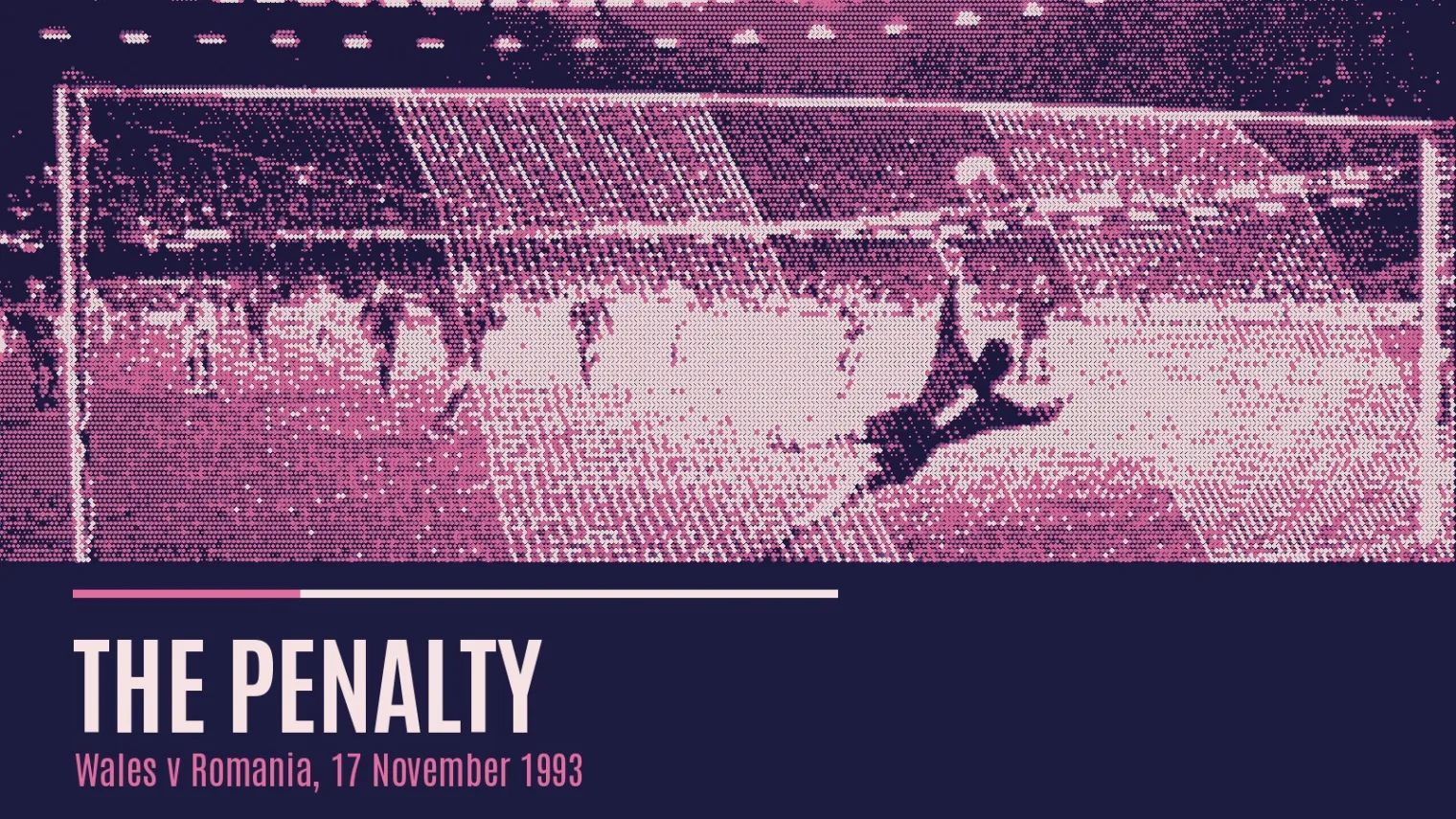
There was a delay while the Romanians argued with Röthlisberger. Prunea, in that pause, picked the ball up and kissed it. Bodin saw him do it. “Where he kissed it, I wiped it into the ground,” he said. “I don’t know why, it was just by instinct. But that is not an excuse. I kept my mind and I kept my focus, and I just hit it as hard as I could. That was how I took penalties, by drilling them rather than placing them.” In a 2007 interview with The Observer he was more precise about the target. He had decided on the top left-hand corner, “as powerfully as I could.” He watched it all the way. “It looked good until it seemed to change trajectory at the last second. It crashed against the bar. Just two inches lower and we would have been winning.”
The Arms Park had oval crossbars, not round ones. Bodin has returned to that detail more than once, not as an alibi, more as a piece of physics he cannot leave alone. “I had hit it on the apex, so it came right back out,” he told the BBC. “So if it had been half an inch lower it might have hit underneath the bar, and bounced down and maybe in.” The ball flew back out over his head. Shaw, the next morning, wrote that a familiar fatalism swept over the stands.
It is worth being careful, here, about what the miss did and did not decide. There were still the best part of half an hour left. Rush and Saunders both brought saves from Prunea. Răducioiu, at the other end, blazed over from a simple chance after another Hagi run. The game, as Bevan wrote, was wide open. Bodin was withdrawn, for Malcolm Allen, around the 70th minute. He has had to live with the idea that the night turned on him. The night was still alive when he left the pitch.
The winner came with seven minutes to go, in the 83rd minute by the timings in RSSSF’s 1994 qualifying records and the 11v11 match file. Dumitrescu, who had the ball from Popescu, took it forward and slipped it in low from the left. Răducioiu met it from about ten yards, and the shot went between Southall’s legs. Shaw remembered “an eerie silence.” Dumitrescu remembered a different noise entirely, the one in his own head. “When he beat Southall, I thought ‘we are going to the World Cup’.”
Belgium, in Brussels, had drawn 0–0 with the RCS. The news, when it arrived, made the arithmetic cruel in a very simple way. A Wales win, any Wales win, would have been enough. Romania had got the win they did not strictly need, and topped Group Four on 15 points, level with Belgium, ahead on goal difference. The RCS finished third on 13. Wales, with five wins, two draws and three defeats, had 12 points and 19 goals, and they were out.
After the whistle
Seconds after the final whistle, a marine distress rocket was fired from the opposite side of the stadium. It travelled across the pitch and struck John Hill in the chest.
Hill was 67, a retired postman from Merthyr Tydfil, a grandfather, at the game with his son, also called John. The son, speaking publicly for the first time on the twentieth anniversary, told BBC Wales that he heard a huge rushing noise and thought, for a moment, that an aeroplane was about to hit the stadium. He looked round and saw nothing. Then his father fell forwards. He did not, at first, put the two things together. He thought it might have been a heart attack, or a fall, and tried to lift him, and found he could not do it on his own.
It is not a sequence that improves with more detail, and it does not need it. A man had gone to watch Wales play football and, as Bodin later put it, “would not be going home.” Players already leaving the pitch saw the rocket pass over them. “It wasn’t just a normal rocket that you see in your back garden, it was a huge flare,” Bodin said, remembering it from the bench. John Hardy, commentating for the BBC, has said that the sound of it, coming from behind the commentary position, is the thing that still sends a chill through him when he hears the old tape. In the dressing rooms it took a little time for the word to arrive. There were no phones in pockets then. Mark Evans, who was with the FAW, has described the radio channel suddenly being cleared, and then the police advice that someone had been killed.
Two men from Wrexham, Andrew McAllister and Kerry Still, were charged with murder in the days after the game. The following May, at Cardiff Crown Court, they admitted manslaughter. On 26 May 1994, Mr Justice Schiemann jailed each of them for three years, telling the court that it was important to punish “mindless and crass stupidity” at public events. The prosecution, at the start of the hearing, had called the firing of a marine distress rocket, horizontally, into a crowded stand, the “ultimate act of football hooliganism”. John Hill’s son, twenty years on, said he had chosen not to hold angry feelings against the two men. “I didn’t see that that would help me – it wouldn’t help my family and it would be a negative energy.” He also said his mother, who died in 2005, never recovered from the way her husband had been killed.
Yorath, the next day, was already trying to set the football to one side, as far as anyone in his position could. “My players gave it their best shot, and we could have won the game with the penalty,” he told The Independent. “I don’t think Romania would have come back from that, but technically they will always be better with the ball at their feet.” Shaw noted that the death had overshadowed the end of the Welsh dream, and that Yorath, of all people, was perhaps better able than most to keep a result in perspective. The football talk, in that interview, was about passing, about a Premier League he called Thatcherite, about getting back to basics. Behind it sat a much simpler fact. A spectator had been killed at his match.
The contract that was not renewed
In the immediate aftermath, some of the reporting suggested Yorath’s contract was about to expire on the spot. The more careful version, which emerged as the Football Association of Wales actually dealt with it, is this. The contract ran to 31 December 1993. Had Wales qualified, Shaw had already written, it would have run on through the following summer. They had not qualified, and the association spent December deciding whether he was worth keeping.
On 17 December, Trevor Haylett reported a day of messy talks. The FAW’s chief executive, Alun Evans, had said at lunchtime that Yorath’s terms for staying on were unacceptable. Yorath, who was on £45,000 a year and had asked for a rise of £15,000, said he had expected a counter-offer, not a door closing. The association had offered him a new two-year deal on the same salary, with a £30,000 bonus if Wales reached Euro 96. Yorath wanted that money paid up front, which would have taken him to £60,000, still, as he pointed out, a long way short of what international managers were earning elsewhere. “I asked for nearly a third of my wages again on top of what they were before, but I did so with the idea of them coming back to me with another offer,” he said. “I am prepared to compromise if they do the same. I want to carry on in the job because we have a fantastic team spirit within the squad, but it really depends if they want me to be the manager.”
On Christmas Eve he was told the contract would not be renewed, and was invited to reapply for his own job. “Whether calculated or not,” he said later, “this was a humiliation beyond reason.” In early February, after the association had courted Terry Venables and Bobby Robson and then appointed John Toshack on a part-time basis, with the former manager Mike Smith alongside him, Yorath broke his silence. He spoke of his “sadness and humiliation.” He said he had been left waiting, and had turned down other work, while being told he was still in the running. The first he knew he was finished, Haylett wrote, was when Toshack telephoned to say he had been given the job. “More than anything I would like to stand for election and help run Welsh football,” Yorath said. “I now intend to get on with my life and know I can look the FAW in the eye and say I have earned my wages, done my job and that my removal was neither linked to events on the pitch nor was wanted by the majority of the Welsh footballing public.”
Whether you believe the last part depends on how much good faith you are willing to grant a football association that had just asked a popular manager to reapply for his post over a five-figure rise, and then gone shopping for a more famous name. What is not in dispute is the sequence. The contract expired at the end of December. It was not renewed. Yorath was gone before the next campaign had begun, and the team he had built had to start again under someone else.
What we chose to remember
Bodin went back to Swindon. He has said he did not sleep that night, or the night after, and that the first thing waiting for him in training was a bit of stick from his team-mates. John Gorman, his manager, took him aside and told him he would still be taking the penalties. That Saturday, against Ipswich, Swindon were awarded one. He scored it. “It was my duty as a professional not to let what happened for Wales affect what happened for my club,” he told the BBC. “I do not want to sound like my miss for Wales did not matter, because it did. It was the lowest moment of my career. But I just had to get on with things.”
He has never really been allowed to put it down. The most painful line in that 2013 interview is not about the bar, or the kiss on the ball, or the oval crossbar. It is this: “The most disappointing thing for me is that, unlike some players who miss a vital penalty, I never got the opportunity to put things right.” Wales did not come that close again in his time, or in Rush’s, or in Southall’s, or in Giggs’s. Horne’s way of dealing with the night was to try to put it in a box and never think about it. “I still do, of course, but I try not to because it is so heartbreaking.”
Romania, the following summer, had the tournament Wales had been reaching for. They were one of the sides people actually wanted to watch, with Hagi at the centre of it, and they went as far as the quarter-finals, where they went out on penalties to Sweden. Belodedici was among those who missed. Dumitrescu, who scored in that shoot-out, later said he knew how it felt when a vital penalty got away. It is a neat symmetry if you want one. It does not give Bodin his night back, and it is not the point of remembering Cardiff.
The point, or part of it, is that a penalty can attach itself to a player until it becomes the thing he is for, and still be the wrong thing to hang a match on. Southall said so at the time, in his own way, and has gone on saying so. Yorath’s Wales were beaten by a better footballing side on the night, by their own mistakes, and by the fine margins that qualifying has always specialised in. They were also a serious team, built over years, playing in a stadium they had made their own, one win away from a journey this country had not taken since 1958. The miss is part of that story. It is not a substitute for it.
And then there is John Hill, who was not part of the sporting argument at all. Anniversaries like this one are hungry for a single image, and the image they are usually given is a football hitting a crossbar. It is easier to handle than a rocket crossing a pitch. It is also a way of looking past the person who did not get home. If 17 November 1993 is going to be replayed every year, it ought to be replayed in the right order: a Welsh team that believed, a Romanian side good enough to live with that belief, a penalty that stayed out, a late goal, and, after the whistle, a death that put every one of those things in its place.